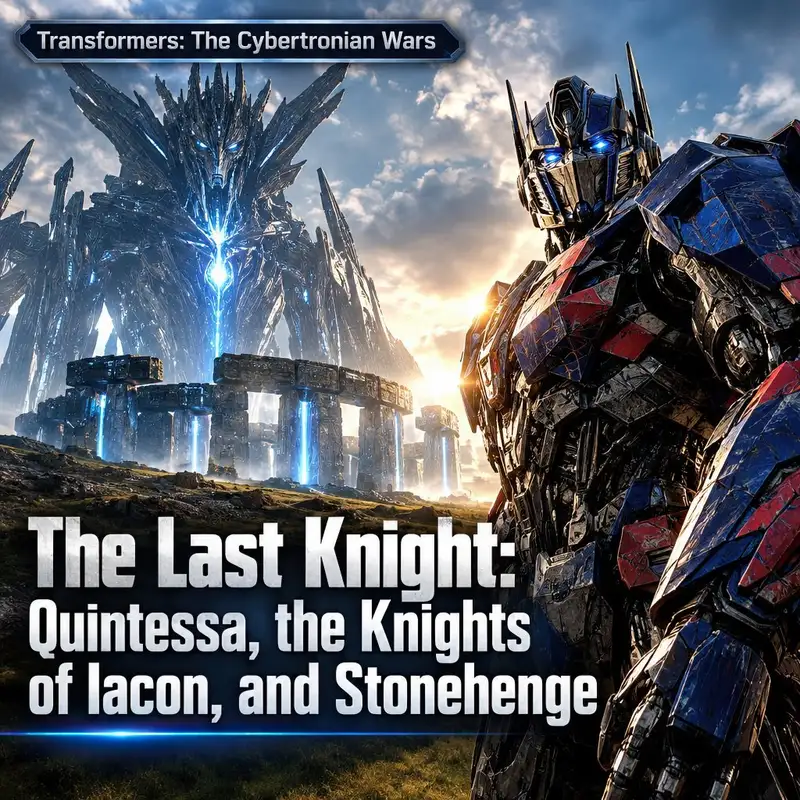
The Last Knight: Quintessa, the Knights of Iacon, and Stonehenge
In the year 484, Arthur’s force is losing ground to the Saxons. The field is mud, confusion, and collapsing confidence. Merlin has no reserve army to commit and no conventional weapon that can reverse the battle. His reputation as a wizard is, by his own admission, largely a performance. What he does possess is access to a hidden force that has been waiting beyond the edge of human understanding: twelve Cybertronian knights concealed on Earth.
The knights answer Merlin’s appeal with a capability no army of the period could match. They combine into a three-headed mechanical dragon, Dragonstorm, and strike the Saxon force from above. To the humans on that battlefield, it can only look like legend made physical. A dragon has entered the war. A wizard has summoned it. Arthur’s side gains the shock effect, mobility, and destructive power it lacked only moments before.
But the film’s account of Camelot is not really a story about sorcery. In the live-action continuity of Transformers: The Last Knight, it is an emergency contact operation between frightened humans and Cybertronian fugitives. Merlin does not create Dragonstorm. He does not command an army of magical beings. He is given temporary access to a force whose own political history began somewhere else, under conditions the human witnesses cannot fully understand.
The object that matters most is not Dragonstorm, impressive though that intervention is. It is the staff entrusted to Merlin by the knights. They tell him that it must be protected because an evil will seek it in the future. The warning gives the staff a strategic role from the beginning. It is not a trophy from a battlefield, and it is not Merlin’s invention. It is a unique Cybertronian device placed in human custody because its original owners no longer trust the authority that wants it back.
That is why the Camelot sequence matters. The dragon becomes legend because medieval witnesses have no political or technical vocabulary for what they have seen. They can remember a king, a wizard, a battle, and a monstrous ally in the sky. They cannot easily record a rebellion among alien guardians, a stolen strategic asset, or a conflict over who has the right to decide the fate of worlds.
The Cybertronians who aid Merlin are identified as the Knights of Iacon. The film establishes only a limited record of their past. They had come from Cybertron. They had broken with Quintessa. They had taken the staff from her and fled to Earth. By the fifth century, they were already hidden there, prepared to entrust the device to a human custodian rather than surrender it to the power they had rejected.
That act is more than theft. It is political defiance. Quintessa later presents herself as a figure of creator-level authority, but the Knights’ rebellion shows that her authority was contested from within Cybertronian society itself. They do not just disagree with a battlefield order. They deny Quintessa control of the one device that can carry out her larger plan. In effect, they remove a strategic weapon from the command system they believe will misuse it.
The film does not provide the knights’ individual names, ranks, original mission, or internal chain of command. It does not establish how long they had served Quintessa, when they reached Earth, or what debate led them to rebel. Those absences matter. It would be easy to turn them into a complete ancient order with a detailed mythology. The released story does not support that. What it does support is narrower and more important: these Cybertronians judged Quintessa dangerous enough to hide the staff beyond her immediate reach.
Their combined form, Dragonstorm, demonstrates that the Knights possess an exceptional collective military capability. At Camelot, it supplies speed, intimidation, and heavy striking power against an army that cannot meaningfully counter it. Yet Dragonstorm should not obscure the knights’ real importance. Their decisive act is custodial, not just martial. They preserve a weapon by refusing to use it for the purpose Quintessa intended.
That distinction changes the meaning of their alliance with Merlin. The knights do not hand a human king a permanent instrument of conquest. They place a dangerous asset inside a human chain of guardianship. Merlin becomes important because he can conceal the staff, preserve its story, and ensure that access passes to people capable of activating it when the future threat arrives. The arrangement is imperfect, but it is better than allowing Quintessa to reclaim the device unopposed.
Once the knights withdraw from visible history, the burden shifts to humans. That is where the Order of the Witwiccans enters the story. Sir Edmund Burton describes the order as a hidden network that has tracked Cybertronian involvement in human history across centuries. Its archives contain artifacts, records, family connections, and guarded knowledge that ordinary institutions either never possessed or would not have known how to interpret.
The Witwiccans are often presented with the atmosphere of an old secret society, but their practical role is closer to a long-term intelligence and custodial system. They preserve fragmented reporting. They protect sites. They maintain genealogies. They recognize that certain events in human history involve a nonhuman presence. Most important, they keep the Merlin connection alive long enough for it to matter when the staff becomes relevant again.
That system has strengths. It provides continuity across generations. It retains information that governments may lose, suppress, or dismiss as superstition. It creates a small number of people who understand that Cybertronian contact is not just folklore. In a world where alien machines can hide in plain sight, historical memory becomes a strategic resource. The person who knows where an artifact was hidden may be more valuable than the person carrying the largest weapon.
The Witwiccans also have serious weaknesses. Their knowledge is fragmented, inherited, and selectively guarded. Their authority depends on bloodlines, private archives, and personal trust rather than transparent institutions. By Burton’s time, the organization appears to have narrowed to almost nothing. He presents himself as its last living member. That gives him knowledge, but it leaves the network vulnerable. A secret preserved by a handful of elderly custodians is not a durable security architecture.
Cade Yeager enters this history through the talisman given to him by the dying Cybertronian Steelbane. The object marks him as the film’s last knight, but that title should not be mistaken for a formal military commission. Cade does not suddenly gain the authority to command the Knights of Iacon or the power to decide the fate of Cybertron. His value is operational. The talisman identifies him as someone accepted by the old network and guides him toward the next stage of the search.
Viviane Wembly serves a different function. As Merlin’s descendant, she possesses the inherited connection required to activate the staff. In the film’s logic, lineage acts as an authorization mechanism. It is not proof of superior judgment, moral worth, or political legitimacy. Viviane becomes essential because the device recognizes a specific line of custodianship, not because ancestry alone makes her qualified to lead an interplanetary crisis.
Together, Merlin, Cade, and Viviane represent three different forms of human participation. Merlin is the first custodian, given a tool he cannot fully explain. Cade is the accidental operational heir, drawn into a conflict by a talisman and a dying knight’s trust. Viviane is the authorized activator, able to do what the others cannot when the staff must finally be used or removed. The human role is not one of mastery. It is stewardship under pressure.
Yet the Witwiccans’ archives can preserve the location of a weapon without resolving the conflict that made the weapon dangerous. Their hidden history tells them that Cybertronians have influenced human events. It does not give them a settlement for Cybertron’s political crisis. It does not answer who Quintessa is, how Cybertron can survive, or why a weapon meant to restore a world must be held outside its original chain of command.
Those questions return when Optimus Prime reaches the ruins of Cybertron after the events of Age of Extinction. He arrives seeking answers about the planet’s destruction and his own people’s fate. Instead, he encounters Quintessa, a figure surrounded by the remains of a civilization that appears broken, displaced, and desperate for restoration. She speaks from a position of knowledge and apparent control, but the film gives the audience reasons to treat her claims with caution.
Quintessa calls herself the Prime of Life and claims to be the maker, or creator, of the Transformers. The film establishes that she has influence, access to Cybertronian technology, and the ability to coerce Optimus Prime. It does not establish the full truth of her origin, species, or authority. She may be what she claims. She may be a surviving authority using a grand title to command obedience. The evidence supports her power. It does not settle her theology.
Her strategic argument is clear. Cybertron is dying. Earth, she says, is Unicron, an ancient enemy. The energy within Earth can be extracted to restore Cybertron. In her presentation, the choice is brutal but simple: allow Cybertron to remain a ruin, or sacrifice another world to save it. She frames planetary destruction as necessity, not aggression. That framing is central to her power.
Quintessa’s plan turns Cybertronian survival into a justification for planetary murder. The issue is not just that she has found a powerful weapon. It is that she defines restoration as a right that overrides the existence of Earth’s population. Earth becomes a fuel reserve. Its people become an obstacle. Its ecological and social life are treated as expendable because they stand between Quintessa and the rebirth of Cybertron.
This is the same political logic the Knights of Iacon appear to have rejected long before Camelot. If Quintessa’s authority were unquestioned and her plan accepted as legitimate, the knights would have had no reason to steal the staff and hide it on another world. Their rebellion implies that they understood the staff not as a neutral instrument, but as a device whose control would determine whether Quintessa could impose her will on others.
Quintessa requires more than an argument and a dying planet. She needs the staff. It is the critical component that transforms her objective from rhetoric into an operational plan. She also needs a capable agent to retrieve it. That is where Optimus Prime becomes more than an enemy commander. He becomes a captured strategic asset.
Quintessa subdues Optimus and reprograms him into Nemesis Prime. Nemesis Prime is not presented as a clone, a separate individual, or a permanent second identity. He is Optimus under coercive control. The visual change matters because it signals the loss of autonomy, but the strategic problem runs deeper. Quintessa has not just gained another powerful fighter. She has turned the most important Autobot leader into a weapon against his own allies.
The military value of that transformation is obvious. Optimus is formidable in combat, experienced in Cybertronian warfare, and capable of operating in environments where Quintessa’s own reach may be limited. But the political value may be even greater. Optimus carries symbolic authority. His appearance on Quintessa’s side destabilizes the assumptions of those who once followed him. A leader’s capture can do more damage than the loss of a unit because it corrupts trust throughout the command structure.
For the Autobots, the danger is both tactical and informational. Nemesis Prime knows their methods, their habits, and their likely priorities. He understands that they will protect civilians. He knows which relationships can be exploited and which positions they are likely to defend. Even if Quintessa cannot control every element of the battlefield, she can use Optimus to create hesitation among those who do not want to destroy the leader they hope to recover.
The situation also exposes a limitation in charismatic command. When too much moral and operational authority is concentrated in one individual, that individual becomes a target of extraordinary value. Quintessa recognizes that Optimus is more than a soldier. He is an access point into Autobot cohesion. Her control over him gives her a way to weaponize the trust he built.
Still, Optimus alone cannot complete the plan. Quintessa lacks the staff, and the staff is hidden behind centuries of human memory, inherited authorization, and submerged Cybertronian infrastructure. The device is not lying in an open vault on Cybertron. The Knights made sure of that. Their rebellion imposed a logistical problem on Quintessa that no amount of self-proclaimed authority can solve by decree.
The film establishes that the staff is the means by which Cybertron can be restored. It also establishes that activating it through Quintessa’s system drains Earth’s life. Beyond that, many details remain unknown. The staff’s exact energy capacity is not given. Its manufacture is not explained. No one demonstrates that it can be replicated, mass-produced, or safely operated by ordinary Cybertronian forces. It is a singular strategic asset.
That singularity makes custody decisive. Possession is not the same as use. The staff must first be found. It must be activated by Viviane. It must be carried to the ignition mechanism associated with Cybertron’s approach. It must remain installed long enough for the energy transfer to continue. Each stage creates opportunities for interruption, but each also creates pressure. A device can be uniquely vulnerable and still be catastrophically dangerous.
Merlin’s importance follows from this. He did not invent the staff, and he does not understand its engineering. His achievement is preservation. He takes responsibility for an alien system that future generations can barely interpret. Medieval legend transforms the staff into a wizard’s artifact because that is the cultural language available to the people around him. In practical terms, he is guarding a weapon system until a future custodian can use or deny it.
The staff also reveals the limits of artifact-based strategy. Quintessa’s entire restoration plan depends on a device outside her direct control. The Knights’ decision to remove it from Cybertron denies her an immediate solution, but it does not eliminate the underlying crisis. Cybertron remains damaged. Earth remains vulnerable. The staff becomes the center of the conflict because no conventional industrial system shown in the film can substitute for it.
The route to the staff is opened not by brute force, but by interpretation. The search leads to a submerged Cybertronian vessel containing Merlin’s tomb, the dormant knights, and the hidden device. The ship functions as a concealed strategic asset. It is a vault, a refuge, a transport, and eventually a staging point for the struggle over the staff. It kept Cybertronian material out of Quintessa’s reach for centuries because it was hidden where ordinary human access was limited.
The vessel’s interior is capable of sustaining an atmosphere, which helps explain how it can function as more than a sealed tomb. Beyond that, the film leaves its technical history unclear. Its dimensions, crew complement, propulsion system, original mission, and full operational capabilities are not reliably established. What matters is its role. The Knights selected a place where the staff could survive outside the ordinary reach of both human states and Cybertronian rivals.
The underwater location also shows why human capability matters. Accessing a submerged alien installation is not a task for a small civilian group, even when that group includes Cybertronians. It requires maritime reach, navigation, equipment, security, and the ability to operate in a politically sensitive environment. The use of a submarine museum location in the film underscores the practical problem: this is not a ruin at the end of a road. It is an underwater objective.
Human and Cybertronian cooperation becomes useful because each side brings something the other lacks. Humans possess local knowledge, maritime infrastructure, and the ability to move through Earth’s institutions. Cybertronians understand the nature of the hidden vessel, the knights, and the artifact inside. Neither side fully controls the situation. Their cooperation is born from necessity, not from a settled alliance or a carefully negotiated treaty.
Recovering the staff answers only part of the problem. The greater question is where Quintessa can use it to turn Earth into the source of Cybertron’s restoration. That answer comes from intelligence fusion rather than a single revelation. Sir Edmund Burton and Seymour Simmons work through ancient records, Cybertronian clues, and the pattern of the great horns emerging from Earth.
Their conclusion is based on continental drift and the ancient shape of Pangaea. When the positions of the horns are considered in relation to Earth’s former landmass, Stonehenge becomes the inferred central point. In the film’s internal logic, the monument is more than an archaeological site. It is the geographic access point for an extinction-level energy transfer operation. Stonehenge matters because it marks where scattered evidence becomes a targetable location.
This should not be mistaken for a claim about the real construction or purpose of Stonehenge. The film uses the monument as part of its own hidden-history framework. Within that framework, the deduction is an intelligence success. It takes separate observations that would otherwise seem unrelated and produces an operational conclusion. The coalition now knows where Quintessa’s plan must be stopped.
Finding the site does not make it secure. Intelligence identifies a battlefield. It does not automatically provide the forces, access, command structure, or time required to win there. Stonehenge is also exposed in a way that makes secrecy increasingly difficult. An extinction mechanism hidden beneath one of Earth’s most famous monuments is not an ideal long-term concealment arrangement. By this point, however, secrecy has already failed. The issue is no longer whether the site can remain hidden. It is whether it can be defended before activation is complete.
The staff’s recovery triggers the next phase of the war. Megatron and the Decepticons pursue it for Quintessa. Their cooperation with her should not be read as ideological reconciliation or proof that Megatron accepts her creator claims. He is an opportunist in a strategic crisis. A restored Cybertron could offer territory, leverage, and a renewed base for Decepticon power. The staff is valuable because it may reshape the balance of power.
Megatron’s objectives are narrower than Quintessa’s larger vision. Quintessa seeks a restored Cybertron even at the cost of Earth’s destruction. Megatron seeks advantage within the struggle for Cybertronian power. Those aims overlap, but they are not identical. A commander may cooperate with a stronger patron while expecting to benefit from the outcome later. That does not mean the partnership is stable.
In fact, the arrangement contains its own contradiction. Quintessa needs Decepticon combat power to seize and protect the staff. Yet her proposed end state offers little guarantee that independent Decepticon authority will survive. A leader who can enslave Optimus Prime, sacrifice Earth, and claim creator-level power is not obviously preparing to share political space with Megatron. The alliance functions because both sides need one another before the operation is complete.
Once the staff is installed in Quintessa’s ignition chamber, delay becomes a strategic defeat. The question is no longer whether Earth might be threatened in some distant future. The energy transfer begins. Cybertron’s approach is turned into an active extraction system, and Earth’s survival becomes dependent on stopping it before the process reaches its intended conclusion.
The final response is an improvised combined operation rather than a polished alliance. Autobots, the awakened Knights, Cade, Viviane, Colonel Lennox, General Morshower, and human military forces converge around overlapping objectives. They must halt the transfer, reach the ignition chamber, protect Viviane long enough for her to act, counter Megatron’s forces, recover Optimus if possible, and prevent Cybertron’s arrival from becoming an extinction event.
In the immediate fight, that means direct fighting through a contested structure, air attacks, defensive actions against Decepticon forces, and movement across a rapidly changing battlefield. The Autobots and Knights provide the ability to confront Cybertronian enemies directly. Human forces contribute aircraft, targeting, reconnaissance, mobility, and the institutional reach needed to operate across Earth’s airspace and waters. Neither force is simply an accessory to the other.
Operationally, the problem is coordination. The coalition must identify the correct chamber, establish access, direct attacks against the relevant mechanism, and keep the staff from continuing its function. It is not enough to destroy whatever machinery is visible. Quintessa’s system is distributed across Cybertron, the ignition chamber, the staff, and the Earth-side geographic trigger. The operation succeeds only if the coalition attacks the relationship among those pieces.
There is no indication of a fully integrated treaty command or a mature joint headquarters. This is an emergency coalition formed under extreme time pressure. The human military and the Autobots share an immediate interest, but their methods, communications, and chains of authority are not identical. In a more orderly campaign, those problems might delay action. Here, the scale of the threat forces cooperation before those questions can be settled.
The Knights’ return also matters beyond their firepower. They are the original rebels against Quintessa’s plan. Their presence reconnects the final battle to the decision made centuries earlier. At Camelot, they denied Quintessa the staff and gave humans the burden of concealment. At Stonehenge, that same act of defiance becomes the foundation for resistance. The old rebellion has not solved Cybertron’s crisis, but it has preserved the possibility that Quintessa can be stopped.
Even so, machinery is not Quintessa’s greatest weapon. Her greatest weapon remains the captured identity of Optimus Prime. As long as he is under her control, the coalition faces not only a powerful enemy combatant, but the possibility that its own moral center has been turned against it. Destroying him might remove a threat, but it would also destroy the leader the Autobots are trying to recover.
Bumblebee changes that situation by speaking in his own voice. The moment matters because Optimus has not heard that voice since Cybertron fell. The sound breaks through Quintessa’s control and restores Optimus’s memory and allegiance. The film treats this as a singular emotional intervention, not as a general method for reversing all Cybertronian reprogramming. It works because of the relationship between these particular characters and the history they share.
The command consequence is immediate. Quintessa loses more than a fighter. She loses access to Optimus’s knowledge, credibility, and tactical judgment. A coerced leader can be valuable precisely because he retains the information acquired before capture. Once Optimus returns to himself, that advantage reverses. He can provide the coalition with the coordinates of the ignition chamber and direct attention toward the true operational center of the enemy system.
This is an intelligence turning point. Before Optimus’s recovery, the coalition knows that an energy transfer is underway but faces the danger of fighting blindly around a massive and unfamiliar structure. Afterward, it has information from inside the enemy’s system. The coordinates do not guarantee victory, but they allow the coalition to concentrate effort where it matters rather than wasting time on symbolic targets.
The moment also contrasts coercive authority with relational legitimacy. Quintessa can force Optimus to act. She can alter his appearance and use his strength. But she cannot fully erase the loyalties that made him valuable in the first place. Her control is powerful, yet brittle. It depends on maintaining isolation and suppressing memory. Bumblebee’s voice restores a relationship that Quintessa could exploit but never truly possess.
With Optimus recovered, the staff becomes the decisive physical vulnerability. Viviane reaches the point where her inherited authorization matters most. She removes the staff from the ignition system, interrupting the energy transfer. The action is simple in immediate form, but its consequences are enormous. A device that had linked Cybertron’s restoration to Earth’s destruction is disconnected before the extraction can achieve its intended result.
On the battlefield, the transfer stops and Quintessa’s immediate mechanism is disrupted. Across the wider operation, the coalition prevents the ignition chamber from completing its mission. The various attacks, flights, chases, and close combat actions matter because they create the conditions in which Viviane can reach the staff. Without that access, battlefield victories around the chamber would not necessarily have saved Earth.
Strategically, Earth survives and Cybertron is denied restoration through planetary extraction. That is not the same as solving Cybertron’s condition. The film does not show a replacement energy program, a reconstruction plan, or a political settlement for the remaining Cybertronian population. It prevents one solution because that solution requires the destruction of another world.
The political outcome is similarly incomplete. Quintessa’s claim to authority is defeated in action, but it is not fully disproved or institutionally dismantled. The Knights have shown that she can be resisted. Optimus has broken free of her control. Her immediate operation has failed. Yet the film does not establish a new Cybertronian government, a judicial process, or a mechanism for holding her accountable for the attempted destruction of Earth.
The civilian outcome is clearest on Earth. Its population avoids extinction, though the film does not linger on the scale of disruption, fear, or damage created by Cybertron’s arrival and the battle around Stonehenge. Cybertron’s civilians remain largely unseen. Their suffering is invoked through the ruined state of their world and the desire to restore it, but the story does not provide a detailed account of who remains, what political authority they recognize, or how they would survive a prolonged reconstruction crisis.
Megatron’s forces are dispersed, but the Decepticon question is not settled. There is no demonstrated demobilization, amnesty process, disarmament program, or negotiated end to factional conflict. The emergency coalition wins because it shares a single immediate objective. It does not become a permanent political order merely because it fights on the same side for one battle.
Quintessa’s later appearance in human disguise confirms that she survived the defeat of her immediate plan. It does not prove that she is immortal, and it does not reveal a completed future campaign. What it does show is that the political and strategic problem she represents has not disappeared. She remains capable of concealment, manipulation, and renewed contact with human institutions investigating the remnants of the crisis.
The final condition is therefore not peace. Earth and Cybertron are linked by mutual survival. Earth cannot treat Cybertronian affairs as distant alien politics when Cybertron’s restoration has nearly required Earth’s destruction. Cybertron cannot be restored through the logic Quintessa offered without repeating the violence that caused the Knights to rebel in the first place.
The legend of Merlin and the dragon is not proof that Transformers secretly controlled human history. It is evidence that humans inherited the consequences of a Cybertronian rebellion. The Knights denied Quintessa the staff. Merlin’s line preserved it. The Witwiccans carried incomplete knowledge across centuries. Stonehenge revealed the price Quintessa was willing to demand for Cybertron’s rebirth.
Earth survives because an improvised alliance refuses to let Cybertronian survival be purchased through planetary murder. The harder question remains unanswered: how can Cybertron be restored without rebuilding the same political logic that nearly destroyed another world?