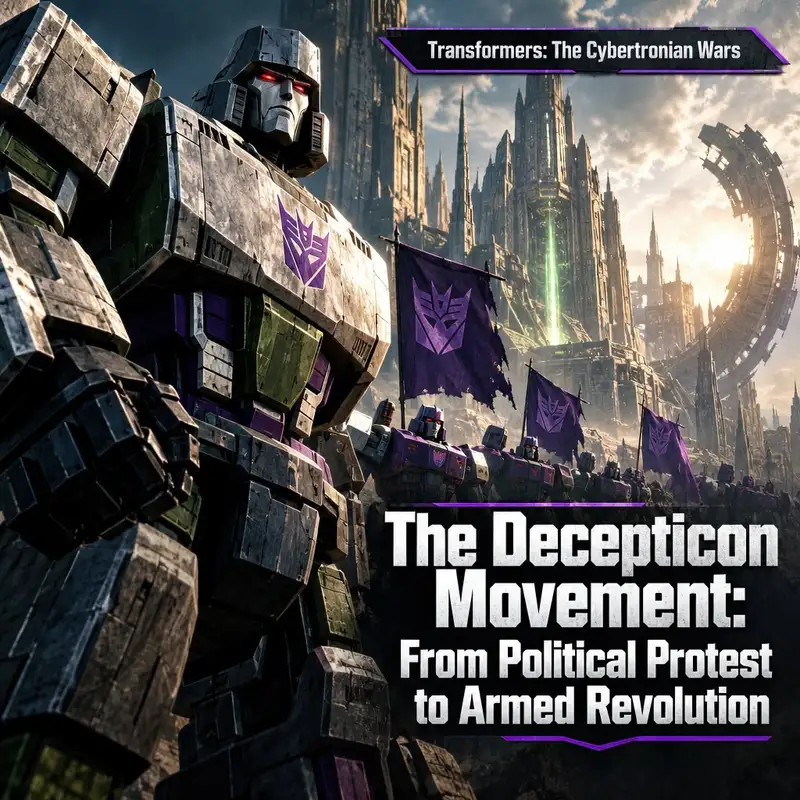
The Decepticon Movement: From Political Protest to Armed Revolution
At Outpost C Twelve, the Senate’s promise of orderly progress arrived as a threat to the workers who kept the mines running. Senator Decimus announced that the mining workforce would be replaced. A miner protested. An Autobot security officer answered that protest with lethal force. Megatron then struck back, attacking the officer and wounding Decimus. In IDW’s comic history that began in two thousand five, this was not the beginning of Cybertron’s injustice, and it was not yet the beginning of the planetary war. It was the instant when a long political crisis crossed into open defiance. The question is not whether the killing made anger understandable. It plainly did. The harder question is what happened after anger found an organization, a city, armed followers, and a leader prepared to turn outrage into a claim on power. The shot at Outpost C Twelve exposed the Senate’s methods. Megatron’s response began a chain of decisions that made armed rule increasingly likely.
Cybertron before the uprising was governed through a hierarchy later described as Functionism. In broad terms, Functionism treated a Cybertronian’s alternate mode, assigned purpose, and presumed utility as evidence of social worth. A being built or categorized for mining, transport, administration, security, or some other role could find that designation shaping access to work, status, education, and political influence. The details are not always identical across every later IDW story. The system was elaborated and reinterpreted as the continuity developed. But its central political effect is clear enough. Cybertron’s social order taught many citizens that function was destiny, and that the ruling class had the authority to decide which destinies mattered.
The Senate did not necessarily understand itself as a villainous institution. Its defenders could present hierarchy as stability, specialized labor as efficiency, and security enforcement as the price of public order. A civilization of immense cities, industrial systems, archives, transport networks, and energy demands could certainly make a case for coordination. The problem was that coordination had become exclusion. Law existed, but meaningful access to law was uneven. Public order existed, but it was enforced most sharply against people with little political protection. Labor had dignity in official rhetoric, yet workers could discover that their role was disposable when machines, management decisions, or elite convenience made them inconvenient.
That vulnerability mattered. A miner facing replacement was more than losing a job in the ordinary sense. Under a social order that linked identity to assigned function, replacement carried a deeper threat. It suggested that a Cybertronian could be discarded not only from employment, but from civic significance. The Senate had created a society in which people were expected to accept a place, while giving too many of them no credible path to challenge the people who assigned it. Systems like that often appear durable. They can manage routine complaint, reward loyal intermediaries, and suppress isolated dissent. What they struggle to survive is organized criticism that identifies the structure itself as the problem.
Megatron’s importance began before he commanded an army. Later IDW stories portray him as a miner, a laboring Cybertronian who also developed into a political writer and critic of the existing order. His ideas became associated with a program called Towards Peace. The surviving record is distributed across stories written at different times, and it should not be forced into one perfectly smooth biography. Still, the broad political outline is significant. Before Megatron became the warlord known across Cybertron and beyond, he was presented as someone who argued that the system could not justify assigning civic worth according to function.
That gave him an advantage no weapon could provide. Megatron could speak from inside the population most harmed by the prevailing hierarchy. He did not need to explain to miners, industrial workers, and marginalized urban citizens that the Senate was distant from their lives. They already knew it. What he offered was a language for connecting individual frustration to a larger political diagnosis. A worker was not unfortunate because of personal failure. A worker was constrained by a system designed to preserve privilege. That argument could be persuasive because it addressed real conditions rather than inventing imaginary persecution.
His earlier program also appears to have included peaceful reform. That point requires care. It does not mean every person attracted to Megatron’s cause was nonviolent. It does not mean that all his associates believed in the same future. It does not mean that he never possessed anger, ambition, or a willingness to intimidate opponents. Political movements are rarely pure at their beginning. They attract reformers, radicals, wounded idealists, opportunists, and people who simply need protection. But the difference between demanding institutional change and commanding an armed faction is still important. Megatron’s critique of hierarchy was not automatically the same thing as his later claim to rule Cybertron.
The Senate’s response helped collapse that distinction. Rather than treating dissent as evidence that reform was necessary, the state increasingly treated it as a security threat. Surveillance, legal restrictions, political exclusion, and the removal of troublesome voices narrowed the space in which peaceful opposition could operate. Megatron was pushed away from the political center and into distant mining work. The official logic may have been containment. Remove the agitator, isolate his influence, restore calm. It was a familiar calculation, and it was strategically shortsighted.
Repression can weaken a movement when it isolates leaders from their supporters and leaves those supporters convinced that change is impossible. It can also strengthen a movement when punishment confirms everything the movement has been saying. Megatron’s argument was that Cybertron’s hierarchy could not tolerate equality. When the Senate used its institutions to silence him, it supplied evidence for that argument. The state did more than disagree with him. It demonstrated that the rules were designed to protect the people already in power.
There was an intelligence failure in that response. The Senate and its security institutions appear to have measured danger through visible protest, formal political position, and immediate public order. They underestimated informal networks, private resentment, labor solidarity, and the effect of treating criticism as disloyalty. They saw an individual dissident who could be removed. They did not adequately see a growing constituency that could survive his removal. In practical terms, the crackdown also taught opponents how to organize outside normal political channels. Once lawful meetings, publications, and representation become dangerous, movements move into private spaces, coded relationships, clandestine finance, and personal loyalty.
None of this made later Decepticon violence inevitable. Repression explains conditions. It does not erase choice. The Senate created powerful incentives for radicalization, but Megatron and his followers still chose their methods, their targets, and their definition of victory. They could have pursued reform, sabotage, self-defense, negotiation, escape, or armed revolt in different proportions. The closing of peaceful channels did not compel the destruction of every political limit. It made such destruction easier to justify, easier to recruit for, and harder for frightened citizens to resist.
Kaon became the place where political isolation turned into organizational opportunity. It was an industrial city with its own alienated population, criminal networks, labor grievances, and distance from the polished legitimacy of the Senate’s center. The comics do not provide a reliable census, detailed map, or precise account of its economic output. They do establish something more useful for understanding the uprising. Kaon offered spaces beyond ordinary Senate control. It was a city where citizens who had little faith in official institutions could find alternative sources of income, status, protection, and belonging.
The illegal gladiatorial pits were central to that world. They were more than entertainment venues, and they were more than places where Megatron demonstrated personal strength. They functioned as parallel institutions. They brought together fighters, workers, gamblers, spectators, criminal intermediaries, and people searching for a place outside the Functionist hierarchy. The pits created networks. They generated money. They made reputations. They offered physical training to combatants who might later serve a political cause. They also turned public spectacle into recruitment, allowing a movement to gain visibility among citizens who might never read a political tract or attend a formal meeting.
For Megatron, the pits solved several problems at once. A reformer excluded from official politics needed an audience. A future insurgent needed reliable followers. A movement under surveillance needed spaces where loyalty could be tested. The arenas provided all three. Gladiatorial combat made Megatron visible as a figure who could endure punishment, defeat rivals, and command a crowd. In a society that had taught many citizens to accept a function assigned from above, the spectacle of a miner making himself impossible to ignore had obvious political appeal.
But the pits also changed the character of the movement. They trained followers to connect credibility with violence, survival, and dominance. A leader who prevailed in the arena did more than persuade. He proved that he could impose his will. That mattered because revolutions require courage, but it also carried a cost. Political disagreement began to share space with a culture in which humiliation, intimidation, and physical defeat were treated as natural forms of judgment. The organization that emerged from Kaon would not be shaped only by speeches about justice. It would also be shaped by combatants accustomed to personal power and crowds accustomed to seeing force settle disputes.
The people drawn into this world were not one social bloc. Miners had their own grievances. Gladiators had their own ambitions. Urban workers could seek dignity or security. Criminal intermediaries could see profit. Spectators could be attracted by excitement, revenge, or the hope that someone powerful might finally challenge the Senate. Some supporters may have believed deeply in political emancipation. Others may have been drawn to Megatron himself, to the status offered by the movement, or to the prospect of overturning an order that had never valued them. A coalition can be broad without being coherent.
Kaon therefore gave Megatron an operational base, not a state. It gave him fighters, access to a public, clandestine infrastructure, and a social environment in which the Senate’s legitimacy was weak. It did not yet give him control of Cybertron’s industry, communications, energon distribution, or transportation networks. It did not give him a recognized government. It did not settle how the movement would administer justice, protect civilians, or handle internal disagreement. Those questions would become more urgent as his followers moved from protest into armed action.
The public emergence of the Decepticons marked another decisive change. A name can appear cosmetic from a distance, especially in a conflict filled with symbols and faction insignia. In reality, names create political boundaries. They turn scattered grievance into an identity. They tell supporters that they belong to something larger than a workplace, neighborhood, or private circle. They tell neutrals that remaining neutral may become harder. And they tell defenders of the existing order that they now face an organized opponent rather than a collection of isolated complaints.
When Megatron called allies and supporters to gather in Kaon, the movement became visibly larger than his original circle. The Decepticon name gave its participants a banner under which different motives could coexist. For some, it meant liberation from an unjust social order. For others, it meant protection against Senate security forces. For some fighters, it offered rank and status unavailable through ordinary civic life. For ambitious insiders, it presented an opportunity to rise within a new elite. For followers of Megatron’s charisma, it promised that a leader who had defied the system might be strong enough to replace it.
That breadth was a source of power, but it also contained the future problem. A movement built from several grievances must decide which grievances it will address and which it will exploit. It must decide whether its institutions will permit dissent after victory. It must decide whether fighters are citizens, servants, or instruments. In Kaon, Megatron’s authority was beginning to move beyond persuasive influence. He was no longer only the writer who named injustice. He was becoming the leader of an organized body capable of discipline, intimidation, and collective violence.
Faction identity also began to replace civic identity. Under the Senate, citizens had been divided by assigned function and social rank. The Decepticon movement offered a different division. The crucial question was increasingly not what role one had been assigned, but whether one stood with the movement or against it. That could be liberating for those previously excluded. It could also become dangerous for anyone who opposed the Senate without accepting Megatron’s command. Once politics divides society into loyalists, enemies, and suspect neutrals, a revolution can begin reproducing the coercive habits it claims to overthrow.
Sentinel Prime’s raid on the Kaon rally accelerated that process. This Sentinel Prime was the prewar political-security leader of this specific IDW history, not a version from another animated or film continuity. His intervention had a straightforward tactical logic. A growing public gathering around an outlaw movement threatened public order. Arrest the visible leaders. Disperse the crowd. Demonstrate that the state retains control. Prevent an illegal assembly from becoming an armed uprising. From the viewpoint of an institution accustomed to governing through hierarchy and security enforcement, the operation likely appeared necessary.
The problem was that tactical logic did not answer the political problem. The raid treated the rally as a criminal disturbance rather than as a movement with popular sympathy, underground infrastructure, and access to people inside the system. It assumed that detention would remove the danger. Instead, detention concentrated the movement’s visible leadership, dramatized state coercion, and supplied Megatron with a powerful narrative of persecution. The Senate could now claim that it had prevented disorder. Megatron could claim that peaceful assembly had no protected place under the existing regime.
The Autobots’ role at this stage deserves precision. They were not yet the democratic resistance force of later wartime narratives. In this period, Autobot security institutions were deeply implicated in enforcing the Senate’s authority. That did not make every Autobot identical in belief or conduct. Security personnel, administrators, soldiers, and civilians could have had different views of the system they served. But institutionally, the raid demonstrated that Autobot force was being used to preserve an existing political order. For citizens who had already experienced that order as unjust, the distinction between public security and political repression could become very thin.
Detention became a political battlefield. Arresting leaders can break a movement if the state controls information, isolates prisoners, and prevents outside support. It can also fail when prisoners have allies, when the arrest becomes public theater, or when the state mistakes formal custody for actual control. Megatron understood that imprisonment could create access. The Senate had brought important Decepticon figures closer to the center of power than they might otherwise have reached. The captured movement was more than a defeated movement. It was a potential infiltration force.
Megatron’s willingness to allow that capture reveals the transformation already underway. A reform advocate seeks an audience with institutions. An insurgent commander looks for vulnerabilities in them. The raid gave him both an enemy action to exploit and an opening into the Senate’s heart. The authorities believed they had contained a gathering in Kaon. In effect, they had begun moving the Decepticon crisis toward the very institution whose legitimacy was already collapsing.
The Senate assault was not successful merely because guards failed or because the Decepticons possessed superior firepower. Its deeper cause was institutional access. Starscream’s role involved bargaining, political ambition, and the use of insider opportunity. Soundwave’s role involved connections, information, and access to the machinery of the old order. Their motives were not identical, and neither should be reduced to a familiar stereotype borrowed from another version of the franchise. Starscream was more than treacherous because he was Starscream. Soundwave was more than an all-seeing intelligence officer because he was Soundwave. In this moment, both were useful because the movement had attracted figures who understood the system from within.
That was the Senate’s real vulnerability. It assumed that formal position produced reliable loyalty. It assumed that a citizen embedded in an institution would defend that institution when the crisis came. Yet rigid hierarchies often create their own defectors. Ambitious figures resent blocked advancement. Marginalized figures resent exclusion. Officials who understand the system’s weaknesses can become more dangerous than outsiders who merely hate it. Security procedures can protect doors, weapons, and records. They cannot guarantee that the people authorized to use those systems believe in the regime they serve.
The Decepticons used access to free and arm prisoners. The movement crossed an operational threshold. Until then, it had been a mixture of political dissent, clandestine organization, public mobilization, and localized violence. The Senate assault made it an armed strike against the governing center. The objective was no longer to force recognition, secure reforms, or demonstrate the system’s injustice. The objective was to destroy the institution that claimed authority over Cybertron and replace it with revolutionary power.
The killing of the Senators was therefore a political turning point as much as a military one. A government can survive protest. It can sometimes survive corruption scandals, labor unrest, defections, and even localized rebellion. It cannot survive if its leadership is killed, its security apparatus is breached, and a rival movement successfully presents violence as the new source of authority. By assaulting the Senate, Megatron abandoned any serious claim that he was seeking recognition inside the constitutional order. He was now pursuing its destruction.
His acquisition of the fusion cannon belongs in that context. The weapon became an enduring emblem of Megatron’s military identity, but its importance here is not a matter of technical specification. The comics do not require an estimate of range, yield, or ammunition capacity to establish its meaning. The fusion cannon marked the visible union of political leadership and personal violence. Megatron was no longer simply associated with an argument against hierarchy. He was increasingly identified with the capacity to defeat opponents directly, publicly, and decisively.
Destroying the Senate did not automatically mean controlling Kaon. Institutions can collapse quickly. Territorial authority is harder to establish. The Decepticons still had to defeat organized security forces, secure a physical base, hold their followers together, and persuade or coerce the city’s population into accepting the new reality. Revolution had moved from the language of protest into the more difficult work of armed control.
The Battle for Kaon demonstrated what the Decepticons had gained from their earlier transformation. They could mobilize fighters, exploit urban support, direct violence against elite and security targets, and operate with a command structure centered on Megatron. Sentinel Prime responded with the Apex Armor, an extraordinary military asset intended to restore the balance and crush the uprising. The precise technical limits of that armor matter less than its political role. It represented the old order’s attempt to answer a legitimacy crisis with concentrated force.
Megatron defeated Sentinel and broke the immediate resistance. Prowl ordered an Autobot withdrawal. In the immediate fight, the result was clear. The Decepticon leader had defeated the most visible security authority opposing him in Kaon. His followers had survived the confrontation and established themselves as the dominant armed force in the city. The old regime’s immediate capacity to dictate events there had collapsed.
For the operation as a whole, the victory was equally important. Kaon became a Decepticon headquarters and a secure political base. A movement that had depended on illegal arenas, underground networks, and temporary gatherings now possessed territory associated with its own authority. It had a place from which to recruit, organize, store resources, hold prisoners, conduct propaganda, and plan further operations. Even without reliable numbers for weapons, fighters, or supplies, the strategic value of a defended urban center is obvious. Territory allows a movement to act less like a hidden network and more like a rival government.
But Kaon was not Cybertron. The battle did not conquer the planet. It did not resolve control of industry, energon routes, communications, transport, archives, or other cities. It did not cause every security force to surrender or every citizen to join the Decepticons. It did not create a settled peace. For the wider war, Kaon marked the beginning of a wider civil war, not its conclusion. The old order had lost its unquestioned authority. The new order had not yet demonstrated that it could govern anything beyond the reach of its weapons.
The civilian meaning of the battle was also complicated. Attacking elite institutions could be understood as striking the machinery of oppression. Yet public violence changes the character of a city. Administrative centers, security positions, and symbols of privilege become battlefields. Citizens who had opposed the Senate could still fear the armed faction replacing it. Workers who had sought dignity could discover that military necessity now governed daily life. The destruction of oppressive authority is not the same thing as the creation of safe or inclusive public order.
Megatron’s next act made the nature of the new authority unmistakable. He transformed the remains of the defeated Apex Armor into a throne. It was political theater, but political theater is not trivial in a revolution. Symbols teach followers what power looks like. The throne declared that the old security order had been beaten, broken down, and repurposed beneath Megatron’s command. It linked his personal victory to the physical remains of the institution that had tried to contain him. It also announced that the Decepticon movement now had a center.
That image exposed a profound contradiction. The Decepticons had emerged from opposition to a society that assigned value from above and concentrated dignity among the privileged. Yet their new authority was visibly organized around one victorious commander elevated above his followers. Megatron’s legitimacy no longer depended primarily on the strength of his critique. It depended on military success, possession of territory, and the loyalty of armed supporters. The writer had become an organizer. The organizer had become a commander. The commander was becoming the person around whom the movement’s entire political meaning revolved.
Centralized personal authority can be effective in the short term. It speeds decision-making. It gives a fragmented coalition a clear direction. It allows a movement to respond rapidly to attack. It can prevent internal disagreements from paralyzing an uprising in its vulnerable early stages. But it also creates serious institutional weaknesses. When authority rests on one leader’s charisma and battlefield success, accountability becomes difficult. Dissent can look like betrayal. Loyalty tests become more valuable than competence. Ambitious subordinates become threats rather than partners. And succession becomes a crisis waiting for the first defeat, disappearance, or challenge to the leader’s prestige.
The throne did not mean that Kaon instantly became a complete Decepticon state with stable ministries, an established economy, a universal legal system, and broad consent from its population. The comics do not provide that kind of administrative inventory. What it did establish was more basic. The Decepticons possessed territory, symbols, armed followers, and a leader who increasingly treated command as personal possession. They had gained the essential ingredients of revolutionary rule. Whether that rule could remain faithful to the movement’s original critique was another matter.
The seizure of Kaon gave the Decepticons substantial advantages. They had a headquarters, a visible victory, recruitment momentum, access to weapons, and a reputation for strength that could attract new allies or frighten potential opponents into submission. They had destroyed the Senate’s immediate authority in the city and demonstrated that the political order was not invulnerable. For a movement built among citizens taught that their assigned place could never change, that proof had enormous psychological value. The Senate had seemed permanent. Kaon proved otherwise.
The Decepticons also paid a political price for the methods that brought them victory. Their original critique of inequality became harder to separate from revenge, terror, and forced obedience. Every movement that takes up arms must confront this danger. Violence can remove an oppressive barrier. It can also become the simplest tool available to leaders who no longer wish to persuade. A cause that begins by demanding dignity can lose its limit when it decides that all opposition is evidence of corruption and that all restraint is weakness.
This was more than a matter of individual moral decline. It was institutional. The gladiatorial culture had elevated personal dominance. Repression had encouraged clandestine discipline. The raid had validated a narrative of persecution. The Senate assault had rewarded infiltration and decisive violence. The battle for Kaon had made military success the basis of political authority. Each step made the next one easier. By the time Megatron sat on the remains of the Apex Armor, the movement’s internal logic had changed. It no longer existed chiefly to force Cybertron to reform. It existed to seize and hold power.
The Autobot response would have to confront that reality, but the collapse of Senate legitimacy did not automatically make the Autobots legitimate heirs to Cybertron. They faced their own political problem. The old order had failed to absorb dissent and had used security forces against the people it governed. Any opposition to the Decepticons would need more than weapons. It would need an alternative vision of law, civilian protection, representation, and social worth. A faction cannot defeat a revolution merely by reminding citizens that the previous government had offices and procedures. It must show why the next government would be different.
The emerging conflict was therefore about more than territory. It was about who could plausibly claim to represent Cybertron after the Senate’s destruction. Megatron could claim that he had broken a system that treated too many citizens as expendable. His opponents could claim that he had replaced political reform with military dictatorship. Both claims contained truth. The tragedy was that Cybertron’s citizens were forced to choose within a political landscape where the old order had discredited itself and the new movement was already learning to govern through command.
The Decepticon movement was not a baseless eruption of evil. It grew from real inequality, rigid social assignment, political exclusion, and a Senate that answered criticism with coercion. Megatron’s early appeal rested on the fact that he named grievances the governing order could not honestly dismiss. His movement became powerful because too many Cybertronians had reason to believe that peaceful reform would be ignored, managed, or punished.
Kaon marked the point at which that movement ceased primarily to demand change and began to seize power through organized violence. The transformation was institutional as well as personal. Megatron became more than a writer because he acquired networks. He became more than an organizer because he acquired fighters. He became more than a commander because victory allowed his personal authority to stand in for the political future of the movement itself.
Cybertron’s Senate failed because it could not reform a society divided by assigned worth. The Decepticon answer did more than correct that failure. It replaced a decaying hierarchy with a revolution increasingly unable to survive without coercion, and it placed the freedom of Cybertron’s people beneath the command of the leader who claimed to liberate them.