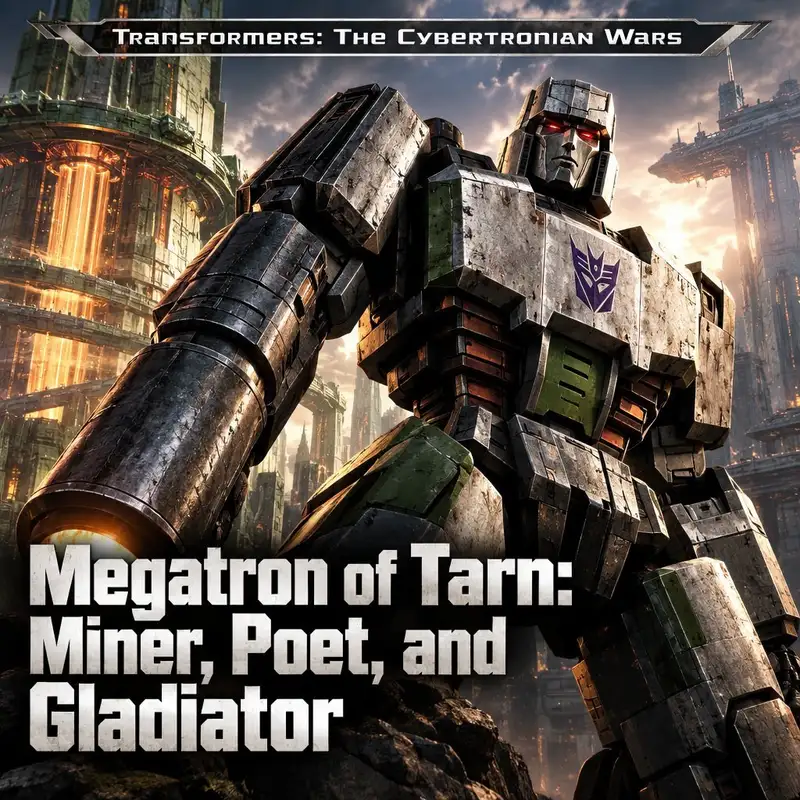
Megatron of Tarn: Miner, Poet, and Gladiator
At the Messatine mining facility, Terminus is badly injured, and the system around him has already made its judgment. Repair resources are scarce. Energon is controlled. A worker who can no longer produce is becoming an expense. Megatron does what the institution will not. He shares his own energon to keep Terminus alive. It is a small act beside the later destruction of cities and governments, but it explains more than any arena duel. Before Megatron became a warlord, he learned what Cybertron’s ruling order believed a worker was worth.
This is the Megatron of I D W’s 2005 comic continuity, a version separate from the gladiator of the Aligned games, the D-Sixteen of Transformers One, and every other Megatron who carries the same name. His history is not told in one clean account. Megatron Origin presents the explosive phase of his rise. Later stories, especially Chaos Theory and More Than Meets the Eye, add the life of the miner, writer, friend, and political dissident who existed before the revolution became an army.
That layered record matters because it prevents an easy answer. Megatron was more than born violent and waiting for an excuse. Nor were the injustices he witnessed a moral license for the dictatorship he later built. His rise is the history of a society that could not reform its inequalities, a state that answered criticism with coercion, and a revolutionary leader who discovered that violence produced a kind of authority argument alone could not.
Messatine was more than a mine. It was part of Cybertron’s industrial foundation, one of the places where energon extraction, labor discipline, and social hierarchy met in plain view. Cybertronian bodies might be mechanical, but their dependence on fuel, maintenance, and repair created forms of vulnerability that were both physical and political. A worker injured in the wrong place, without the right status or patronage, could be treated as replaceable hardware rather than as a citizen.
The Cybertron of this period possessed a Senate, advanced science, security institutions, cultural prestige, and a dense system of social functions. It was not a simple wasteland ruled by open military tyranny. That was part of the problem. The system could describe itself as orderly, civilized, and efficient while assigning unequal value to different kinds of Cybertronian life. Political participation, social standing, access to resources, and freedom from arbitrary control did not reach everyone equally.
Not every Cybertronian suffered in the same way. Some benefited from the system. Some served it sincerely. Some probably believed that a function-based society was stable because it gave every citizen a recognized place. But for workers in places like Messatine, stability could look very much like confinement. Their labor sustained a civilization whose most powerful institutions remained distant, insulated, and comfortable with the costs imposed on those below them.
Terminus mattered to Megatron because he was more than a fellow laborer. He was a friend, a confidant, a proofreader, and a distributor of Megatron’s political writing. Their relationship joined private loyalty to public dissent. When Megatron shared energon with Terminus, he was not making a speech about solidarity. He was practicing it under conditions where the official system had failed. That experience gave his later political language a material foundation. Inequality was not an abstraction. It was visible in damaged bodies and denied repairs.
Megatron’s early political identity was therefore not created in Kaon’s gladiatorial pits. He had already become a writer. Calling him a poet is useful if it does not make him sound like a detached artist. His writing had force because it combined language, memory, grievance, and political argument. He criticized a society that assigned identity through function, hierarchy, and inherited status. He argued against the idea that a Cybertronian’s purpose should be imposed by those already holding power.
His work circulated through channels outside official approval. That fact made it dangerous. A government can arrest a speaker standing in a public square. It has a harder time suppressing an idea carried from worker to worker, copied, discussed, remembered, and passed through networks of trust. Terminus helped create such a network. Before Megatron commanded fighters, he had readers. Before he held territory, he had influence among people who recognized their own lives in his criticism.
This was an intelligence problem as much as a political one. The Senate and its security institutions could identify an agitator, monitor an organization, or close a gathering. They could not easily measure how far a political text had traveled or what private discussions it had begun. Megatron’s writings gave scattered frustrations a vocabulary. They suggested that isolation was not natural, and that the social order was not inevitable.
That did not mean Megatron had a finished program for government. The surviving record supports a serious critic of hierarchy and exclusion. It does not provide a complete democratic blueprint ready to replace the Senate. Revolutionary movements often begin that way. They are strongest at naming what is intolerable. They are less prepared to answer the harder question of how power should be distributed after the old system is broken.
The Senate’s response made that weakness more dangerous. Rather than treating Megatron’s criticism as evidence of a political crisis, elements of the state treated him as a threat to be neutralized. Surveillance, censorship, transfer, and intimidation were available tools. The most revealing instrument was shadowplay, a form of invasive mnemosurgical alteration. It was not ordinary interrogation. It was an attempt to reach into a Cybertronian mind and alter the capacity for dissent itself.
Trepan begins the procedure on Megatron, though it is interrupted before his personality is fundamentally rewritten. The interruption matters. Megatron was not remade into a revolutionary by a completed act of mind control. But the attempt exposed the regime’s character. A system that claims to preserve order while considering the alteration of political opponents has already admitted that persuasion is no longer enough to sustain its authority.
For Megatron, the experience also had an enduring psychological meaning. Later stories make clear that mnemosurgery and memory manipulation remained sources of fear and anger for him. That reaction was more than personal trauma detached from politics. Shadowplay made the political argument intimate. The Senate did more than reject what he said. It considered changing the person who could say it.
There was a strategic cost to that repression. The state had hoped to make Megatron harmless. Instead, it gave him evidence that its institutions could not tolerate genuine reform. A government can survive criticism when citizens believe criticism may still change policy. Once dissenters conclude that the system will answer them with disappearance, coercion, or mental violation, restraint begins to look less like principle and more like surrender.
Still, repression alone did not determine what Megatron became. It narrowed his choices, but it did not erase them. There remained a difference between resisting an unjust order and building a movement around fear, execution, and personal command. The importance of Megatron’s early life is not that it excuses his later conduct. It is that it shows why so many Cybertronians could recognize the truth in his accusations before they understood the cost of following him.
Megatron was transferred to Mining Outpost C-12, another place where the economy of Cybertron became a political weapon. Senator Decimus arrived to announce the mine’s closure. Automation and cost reduction were presented as administrative logic. The language was efficient, perhaps even familiar to those accustomed to managing industrial decline. But efficiency for the Senate meant insecurity for the workers whose lives were organized around the facility.
A worker protested. Autobot security responded with lethal force. The event is important not because it proves that every Autobot was cruel, or because it makes all later Autobots responsible for one officer’s decision. At this stage, Autobot security functioned as part of the state’s enforcement apparatus. Its personnel were trained to preserve order. In C-12, preserving order meant protecting the authority of a senator against a worker whose protest had become inconvenient.
Megatron retaliated. He injured Decimus and killed the security officer. This was the decisive escalation in his political life. He had been a writer whose arguments circulated underground. He had endured surveillance and attempted shadowplay. Now he had entered lethal conflict with the state. The killing may have begun in anger rather than as a carefully designed revolutionary operation, but its consequences were strategic. The government would no longer regard Megatron as merely a dissident voice.
That distinction matters because revolutions often acquire momentum through events their participants did not fully plan. One death does not create a civil war by itself. But it changes the categories through which every later decision is understood. Authorities see an insurgent. Supporters see someone who acted when institutions failed. Neutrals see danger approaching. The space for reform contracts, while the appeal of force becomes easier to imagine.
Megatron and other prisoners seized their transport vessel. Rumble and Frenzy were among those involved in the escape. The action transformed a scattered group of detainees into fugitives with a shared interest in survival. Prison radicalization is not mysterious. When a state criminalizes political opponents, confines them together, and gives them little reason to trust legal process, it may create the networks it was trying to destroy.
The escape also changed Megatron’s operational position. He no longer needed only readers and sympathizers. He needed transport, safe locations, communications, trusted companions, and access to people willing to take risks. A political movement can survive on clandestine circulation for some time. An armed movement requires infrastructure. It must move people, hide weapons, repair injuries, identify infiltrators, and decide who can be trusted with sensitive information.
Sentinel Prime, the leading figure in the security establishment, initially treated the disturbance as a local problem. He delegated assessment to Prowl. This was not necessarily irrational from the information available at the time. Governments receive constant reports of unrest, crime, labor conflict, and fugitives. But Sentinel’s system saw separate incidents where a larger convergence was taking place. It saw a security problem, not a political crisis joining worker grievance, underground writing, imprisonment, and public anger.
That intelligence failure gave Megatron time. He and his companions headed for Kaon, a city whose underground institutions had already made it fertile ground for a different kind of political education. Kaon was not just a dangerous place on the edge of respectable Cybertronian society. It was a criminal and gladiatorial center, where violence had been organized into spectacle, commerce, reputation, and social advancement.
In Kaon’s arenas, combat was more than a means of settling a dispute. It was public theater. Fighters gained attention, wealth, fear, followers, and status. The arena economy rewarded those who could survive, dominate, and satisfy a crowd that had been taught to consume violence as entertainment. It offered Megatron something the Senate never would: a platform beyond official permission.
His early fights reveal an important moral break. Megatron hesitates when faced with a defeated opponent. The arena demands a killing. He complies. The scene should not be used to invent a pure pacifist phase that the record does not support. Megatron was already angry, politically committed, and capable of violence. But Kaon taught him something specific. Mercy could be read as weakness. Killing could establish credibility. Public violence could turn a fighter into a figure of consequence.
That was the political education of the arena. It did more than sharpen Megatron’s combat ability. It trained him to associate authority with dominance before an audience. In the mine, solidarity had meant sharing energon with an injured friend. In the arena, solidarity was increasingly built through admiration for a champion who could punish enemies. The difference between those models would shape everything that followed.
Arena combat gave Megatron tactical credibility. He learned to fight, endure, intimidate, and command attention under extreme pressure. It also produced a pool of hardened associates who understood the value of discipline, loyalty, and brutality. But the arena’s greater contribution was political. It gave Megatron a constituency outside the institutions that had excluded him. His supporters did not need Senate recognition to see him as important. They had seen him win.
That kind of legitimacy is powerful and unstable. Formal institutions distribute authority through office, procedure, law, or tradition. Charismatic authority depends on the repeated demonstration that one person is exceptional. It can mobilize people quickly because it feels immediate and personal. It can also become dangerous because a movement organized around one leader’s victories has difficulty questioning that leader when victory becomes uncertain.
Kaon’s crowds did not create Megatron’s critique of Cybertronian inequality. They changed the instrument through which he pursued it. His writing had asked readers to reconsider the system. His fights demanded that spectators choose a side. The first method created debate, however constrained. The second created allegiance. Once political identity becomes tied to a champion’s public triumphs, dissent within the movement becomes easier to portray as betrayal.
Megatron’s rise also attracted people who saw opportunity rather than justice. Ratbat recognized the potential leverage in the growing gladiatorial movement. His relationship to Megatron was instrumental. He did not need to share every principle of the miner’s political writing to understand that an angry public, a famous fighter, and a discredited security establishment could be useful.
Soundwave became a vital intermediary in this process. He provided access to weapons, recruits, intelligence, and organizational connections. Charisma can gather an audience, but it cannot by itself sustain an armed organization. Weapons must be acquired and concealed. Damaged fighters need repair. Messages need to move through hostile territory. Funds or equivalent resources must be found. Secure meeting places matter. So do people capable of coordinating activity without requiring the leader’s presence at every moment.
Soundwave’s importance lay in helping convert Megatron’s reputation into capacity. He represented the machinery behind the spectacle. A revolutionary force does not emerge because a crowd applauds. It emerges when applause is connected to supply, communications, recruitment, and internal discipline. The early Decepticons were not a finished army waiting offstage. They were an improvised coalition whose members brought different skills, ambitions, and vulnerabilities.
Starscream, Thundercracker, and Skywarp joined the expanding force. The Constructicons contributed repair and modification capacity. Each mattered because a movement cannot be built from one kind of talent. It needs fighters, organizers, technicians, transport, intelligence, and people willing to take responsibility for practical work. Yet those contributions also created future problems. An alliance made from grievance, criminal networks, personal ambition, and political idealism may be formidable in a crisis. It may have very little agreement about what happens after victory.
Starscream’s behavior was an early warning. He was ambitious, capable, and willing to bargain for his own advantage when pressure mounted. That did not make him uniquely responsible for the movement’s later instability. It showed that Megatron’s coalition contained people who saw the revolution as a route to personal advancement. A leader can use such people in the short term. The price is that loyalty becomes transactional, and internal rivalry becomes part of the command system.
The crucial point is that Megatron’s rise required more than personal anger. His writings supplied an ideology. Kaon supplied fame. Ratbat and Soundwave supplied access and organization. Fighters supplied force. Repair crews and technical specialists supplied endurance. The Senate supplied a steady stream of evidence that it preferred control to reform. Together, those conditions allowed a dissenting movement to become an armed one.
Megatron publicly consolidated the Decepticon identity during this period. The exact origin of the name and emblem is complicated by later I D W stories, which suggest that the political identity did not spring fully formed from a single speech or one individual decision. That uncertainty does not weaken the historical point. The movement became recognizable as something more than a collection of miners, fugitives, prisoners, and gladiators.
A name changed the political landscape. Once supporters could call themselves Decepticons, they possessed a visible identity, a set of loyalties, a public enemy, and a claim to collective purpose. The term could travel through Kaon’s underworld, through worker networks, and through the spaces where official authority had lost credibility. It gave scattered frustration a banner. It also began to replace civic identity with factional identity.
That replacement carried consequences. A worker might disagree with a senator without ceasing to be part of Cybertron’s political community. A Decepticon increasingly understood the Senate, its security forces, and eventually its supporters as belonging to an opposing camp. The conflict no longer concerned only reforming institutions. It became a struggle over who represented Cybertron itself.
Named movements can still negotiate. They can establish platforms, elect representatives, make compromises, and accept limits. But a movement whose authority rests increasingly on armed strength and one leader’s fame faces a more difficult path. The leader’s success becomes proof of the cause. The cause becomes proof that the leader must be obeyed. Accountability begins to look like hesitation, and hesitation becomes easy to label as weakness.
The planned public execution of Senator Decimus revealed how far the struggle had moved. Decimus was more than an individual target. He had become a symbol of the governing order that had closed mines, dismissed workers, and relied on security force to suppress protest. For Megatron’s supporters, punishing him could appear to be justice. But the intended execution was also political theater. It proposed to replace legal authority with revolutionary punishment performed before a crowd.
Public punishment has a particular logic. It does more than remove an enemy. It demonstrates who has the power to define guilt, assign blame, and decide whether mercy is possible. In Kaon, the arena had already taught the value of spectacle. The Decimus rally brought that lesson into politics. The movement was no longer only criticizing a system that treated workers as expendable. It was preparing to demonstrate that enemies of the movement could be made expendable in return.
Sentinel intervened, and many Decepticon supporters were arrested. The crackdown damaged the movement’s immediate position, but it also deepened the political divide. To people already convinced that the Senate could not be reformed, mass arrests looked like confirmation. To government officials, the planned execution confirmed that they were confronting more than ordinary dissent. Each side now possessed evidence for its own darkest assumptions about the other.
The arrests also exposed differences within Megatron’s coalition. Soundwave avoided custody through his Senate connections. Starscream secured his own freedom through bargaining. These details do not make either figure a simple villain in a story where everyone else was pure. They demonstrate that revolutionary networks are rarely equal communities. Access to power, information, and protection remains uneven even among those claiming to overthrow hierarchy.
For ordinary supporters, the costs were more immediate. Workers, prisoners, Kaon fighters, and excluded citizens became the people most likely to be detained, injured, or drawn into escalating violence. They bore the risk while more connected figures could sometimes maneuver through institutions still available to them. This is a recurring danger in revolutionary politics. A movement may speak for the dispossessed while reproducing its own hierarchy of safety and sacrifice.
The crisis soon exceeded arrests and rallies. Decepticon forces seized weapons. Soundwave and Starscream helped manipulate events around the Senate. Violence spread through Kaon. The movement had achieved a tactical transformation. It was no longer an underground current of political literature backed by a famous fighter. It had become an armed challenge to the state.
That did not mean it was ready to govern. Seizing weapons is not the same as building supply systems. Winning street-level engagements is not the same as holding a city. A force organized around personal loyalty may fight with great cohesion, but it still needs command procedures, repair capacity, reliable communications, and a way to distinguish orders from rumor. Above all, it needs a political answer for those who do not want either Senate repression or Decepticon rule.
Neither side had such an answer at this stage. The Senate’s actions validated the Decepticon claim that the old order depended on coercion. The Decepticons’ increasing violence validated the state’s demand for emergency powers. This was the trap of the opening civil conflict. Repression and insurgency fed each other. The more force the state used, the more credible Megatron’s warnings appeared. The more Megatron relied on force, the easier it became for the state to depict all dissent as a security threat.
Sentinel Prime responded with the Apex Armor, a secret super-heavy battlesuit. It was not standard Autobot equipment, and it should not be treated as proof that Cybertron could routinely field such systems. Its importance was symbolic as well as military. Sentinel was trying to restore the authority of the state through overwhelming visible power. The message was clear enough. The existing order still possessed weapons that the insurgents could not match.
The choice also revealed Sentinel’s position. Political legitimacy had eroded so badly that the security leader was forced to make his case in armor. In a healthier system, an officer’s authority would rest on law, trust, and institutions capable of absorbing dissent. Sentinel’s authority now depended on demonstrating that he could crush the challenge personally. The state and its opponent were beginning to mirror each other in a destructive way.
Megatron defeated and killed Sentinel in single combat. Tactically, the result removed the immediate leader of the security response. Operationally, it gave the uprising momentum, confidence, and a myth of victory. A fighter from the margins had defeated the armored representative of established authority. For people who had experienced Cybertron as a hierarchy designed to protect the powerful, the image must have carried enormous force.
But the political meaning of the victory was more troubling. Megatron took the remains of the Apex Armor and used them as a throne. The image made visible what his movement was becoming. The miner who had learned that injured workers could be discarded had not just defeated a system of domination. He had begun to claim domination’s symbols for himself.
A throne is not a repair facility, an elected assembly, a fair labor system, or a guarantee of political participation. It is an announcement that authority resides in the one who sits above others. Megatron’s victory did not solve the question that had driven his rebellion. It changed the person empowered to answer it. The Senate’s hierarchy had lost its defender. In its place, the Decepticon movement was increasingly organized around the supremacy of its commander.
This was not the sole cause of the Great War. Cybertron’s descent into open conflict had deeper roots in inequality, repression, institutional failure, and the militarization of political identity. The fall of Sentinel did not create those conditions. It was, however, a decisive rupture. It showed that the state could be beaten. It showed that Megatron could defeat its most visible champion. And it made compromise much harder for every faction that remained.
Later I D W stories deepen this history rather than replacing it. Chaos Theory and More Than Meets the Eye return attention to Megatron’s writing, his relationship with Terminus, and the coercive nature of the society he opposed. They remind us that Megatron Origin captures a crucial escalation, not the whole interior history of the man who became Decepticon leader. The miner, the political writer, and the gladiator are not separate biographies. They are stages that shaped one another.
The miner taught Megatron the experience of being treated as expendable. The writer gave him language to explain why that experience was political rather than merely personal. The friend who shared energon with Terminus demonstrated that he could understand loyalty as mutual care. The gladiator taught him that violence could produce attention, fear, and obedience faster than persuasion. The revolutionary commander learned to fuse all those lessons into a movement centered on himself.
That fusion made him formidable. Megatron could speak to real injury because he had lived close to it. He could inspire followers because his criticism of Cybertron’s hierarchy was not invented. He could organize fighters because Kaon had made him famous and because allies provided the practical systems that armed struggle required. He could defeat representatives of the old order because that order had spent too long confusing control with legitimacy.
It also made him dangerous. A movement that begins by demanding self-determination can become authoritarian when it treats disagreement as sabotage, fear as discipline, and military success as proof that its leader should not be questioned. Megatron’s early Decepticons drew strength from workers, prisoners, fighters, dissidents, criminals, and citizens excluded from meaningful power. Yet as the movement hardened, those people were increasingly asked not to shape its future, but to serve the will of the commander who claimed to embody it.
The Senate destroyed much of its own moral authority by accepting exploitation, unequal repair, political exclusion, and mind-control tactics as tools of order. Megatron’s critique of that system was not false. His error, and eventually his crime, was to conclude that force, spectacle, and obedience to himself were the only means by which Cybertron could be changed. He did not build a freer political order from the ruins of inequality. He turned the injured, excluded, and angry into the base of a movement whose legitimacy increasingly rested on one leader’s capacity to punish his enemies.