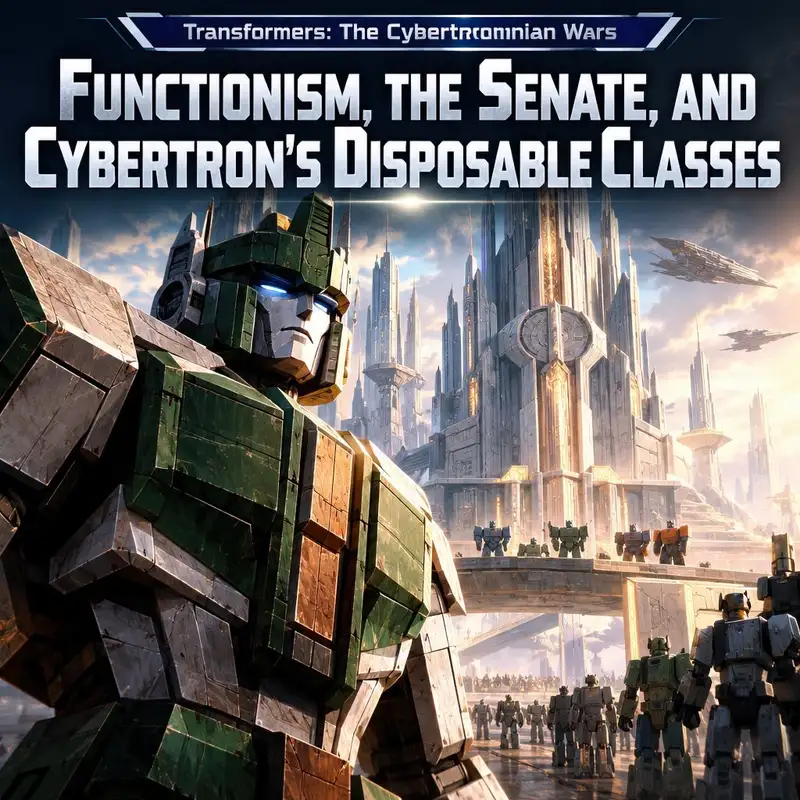
Functionism, the Senate, and Cybertron’s Disposable Classes
In the Functionist reality encountered in More Than Meets the Eye, the state reaches a conclusion that ought to be impossible in any society that recognizes its citizens as persons. Some Cybertronians, it decides, are no longer useful. Their alternate modes are obsolete. Their work can be replaced. Their bodies no longer justify the energon, space, and institutional attention required to sustain them. They are recalled, removed, and marked for destruction. A living population is converted into an administrative surplus.
That is the point at which Functionism becomes easiest to understand and hardest to excuse. It is more than a system that assigns work according to aptitude. It is a system in which a ruling order claims the power to decide that usefulness determines worth. The victims are not naturally disposable. They are made disposable by an institution that has learned to describe political violence as efficient management.
This is the 2005 I D W comic continuity, whose prewar Cybertron was shaped by an old political order of Senators, Primes, security forces, industrial authorities, and specialized institutions. The stories do not provide one clean founding document for Functionism, nor do they establish that every Cybertronian lived under precisely the same rules. But they establish the central principle clearly enough. A Cybertronian’s alternate mode was expected to define the place they could occupy in society.
A vehicle form, industrial body, flight mode, storage capacity, or other physical capability was not treated as one feature among many. It became a social verdict. It shaped the work available to a citizen, the respect they could expect, the degree of autonomy they possessed, and the kind of future others considered reasonable for them. A society built around transformation had turned transformation into destiny.
The horror of the Functionist reality was not therefore an inexplicable break with Cybertron’s past. It was an escalation of an older political logic. Once the state accepts that a body has one proper use, it can begin by restricting careers. It can continue by restricting movement, status, and political voice. In a crisis, it can decide that those without an approved use have no claim on survival.
Functionism did offer an apparent answer to real administrative problems. Cybertron was an industrial civilization on a planetary scale. It needed miners, refinery workers, transport specialists, construction crews, archivists, data handlers, medics, engineers, security personnel, and military forces. A government that could identify physical capabilities and direct labor toward urgent needs might appear orderly, practical, and even humane. It could claim to prevent waste, match workers to tasks, and keep vital systems running.
There is nothing inherently oppressive about recognizing that different people possess different talents, bodies, or skills. A transforming civilization would have genuine reasons to consider how a mining vehicle, an aerial scout, a freight carrier, or a data-storage specialist might contribute to common survival. The problem began when that practical observation became a theory of permanent social rank.
Functionism treated the relationship between body and labor as though it were objective, natural, and beyond politics. That was useful to those who benefited from it. A Senator could present inequality not as a choice made by the powerful, but as a neutral consequence of function. A worker denied advancement could be told that the system was not discriminating against them. It was simply recognizing what they were.
That is one of the enduring strengths of caste systems. Their defenders rarely describe themselves as defenders of caste. They speak of efficiency, stability, tradition, order, and the proper use of resources. They describe hierarchy as though it emerged from the world itself, rather than from institutions that reward some people and constrain others.
The precise origins of Functionism remain incomplete in the surviving record. We do not know one exact moment when Cybertronian society collectively decided that alternate modes should carry such immense political meaning. We do know that by the late prewar era, the idea had become embedded deeply enough to shape government, labor, security, and public expectations. It did not require every official to agree on every detail. It only required enough powerful institutions to act as though the system were inevitable.
The Senate stood at the center of that political world, but it is important not to simplify Cybertron into a one-person dictatorship. The Senate was a governing institution, not a single mind. Prime-era authority existed alongside senatorial power. Police and security personnel possessed their own chains of command. Specialized institutions exercised influence over research, punishment, and social control. Individual Senators could compete, conceal information, and pursue private interests while still defending the broader order that protected them.
That divided authority made the system more durable, not less. In a simple dictatorship, responsibility is concentrated and visible. In a layered political system, each office can claim that someone else made the decisive choice. Senators can blame security officials. Security officials can cite legal mandates. Administrators can invoke technical necessity. Institutions can claim they are only carrying out procedures. The result is a government in which accountability becomes diffuse while coercion remains highly organized.
The Senate did not need to announce that some Cybertronians mattered less than others. It could maintain the same effect through classifications, appointments, access restrictions, professional expectations, and the quiet assumption that certain lives belonged in certain places. It could call this governance. Those subjected to it understood the more immediate reality. Their function determined not just how they worked, but how seriously the state treated their ambitions, grievances, and rights.
This mattered especially in the political economy of Cybertron. Energon extraction, transport, refining, manufacturing, construction, and repair were not ceremonial functions. They sustained the civilization. A planetary government could not endure without those who kept mines operating, moved materials, maintained infrastructure, and performed difficult labor under dangerous conditions. Yet the people who carried those burdens did not necessarily receive equal standing within the political system they supported.
Mining became one of the clearest symbols of this imbalance. The work was vital, but its association with low status made it politically revealing. A society could depend on miners for its energy and industrial continuity while granting them limited influence over the laws, offices, and institutions that governed them. The workers were indispensable when the energon supply required labor. They were treated as lesser when they demanded recognition.
That contradiction is dangerous in any industrial society. The people who keep the system running may accept hardship when they believe they have a stake in the future. They become far less likely to accept it when hardship appears permanent, inherited, and politically protected. A state that treats essential workers as fixed components rather than citizens may preserve order for a time. It also accumulates resentment in the very places where its material strength is produced.
Functionism imposed more than economic limitations. It also imposed social stigma. A mode associated with labor could become a mark of presumed inferiority. A body that did not fit accepted categories could inspire suspicion. Citizens could find their choices narrowed before they had made them. Their alternate mode did more than affect how they moved through Cybertron. It affected how Cybertron allowed them to imagine a life.
The instability of that arrangement was not caused by one speech, one criminal act, or one ambitious leader. It developed because the ruling order could not, or would not, separate social value from approved function. It demanded loyalty from people who had little reason to believe that loyalty would ever be rewarded with equal dignity. The system’s defenders called this stability. To many of those beneath it, it looked like a permanent refusal to listen.
Megatron’s early significance begins in that political landscape. In Megatron Origin, he emerges from a low-status labor background and develops into a public critic of the existing order. His path includes mining, political writing, arrest, gladiatorial violence, and the formation of a movement that would eventually become the Decepticons. Those experiences should not be compressed into one simple legend. What matters is that his early appeal drew force from grievances that Cybertron’s ruling institutions had made impossible to ignore.
Before he became the commander of a vast military faction, Megatron spoke to people who believed that the old order had classified them before they had been heard. He challenged hierarchy, exclusion, and the assumption that a privileged political class possessed the right to define everyone else’s place. His critique was compelling not because every conclusion he reached was correct, but because the system he attacked had real victims.
The difference has consequences. Megatron’s original criticism of Functionist inequality does not justify the later conduct of the Decepticon war. Revolutionary language can identify a genuine injustice and still become the language of conquest. A movement can begin by demanding dignity and end by demanding obedience. Megatron’s later regime would demonstrate that he had not escaped the deeper temptation that corrupted the Senate: the temptation to subordinate persons to the needs of power.
But early on, the Decepticon movement offered something the Senate could not. It gave social grievance a political vocabulary. It allowed workers, marginalized citizens, and opponents of the existing order to see their suffering not as personal failure, but as a structural condition. That was a profound change. A citizen who believes their hardship is private may endure it in silence. A citizen who sees a pattern can organize.
The Senate faced more than an isolated insurgent or a disorderly crowd. It faced evidence that its own legitimacy was failing. The old institutions had promised a rational society governed by function and necessity. Megatron’s movement asked a dangerous question: necessary for whom? If the mines, factories, transport networks, and energy systems depended on citizens who lacked political influence, then the official story of harmonious social order had begun to collapse.
The transition from political opposition to armed struggle was not inevitable, but the closure of reform made violence more likely. When legal institutions deny meaningful redress, when public criticism is criminalized, and when security forces treat dissent as a defect to be contained, a movement can conclude that the normal political process is only another part of the machinery against it. That does not make armed rebellion morally simple. It does explain why appeals to restraint become less persuasive.
The events later examined in Chaos Theory show the crisis from a different direction. Orion Pax, still connected to the security world of prewar Cybertron, encounters Megatron and comes to see the extent of Senate corruption. Orion does not begin as a revolutionary ideologue. His importance lies in his position near the institutions of order. He represents the official who discovers that the state he serves is more than flawed, but actively structured to preserve itself.
This is a crucial point in the history of failing regimes. Governments do not collapse only because their opponents become strong. They also collapse because people within their own institutions lose faith in the information they receive, the orders they are expected to carry out, and the moral purpose of the system they are meant to defend. A security officer can endure danger. It is harder to endure the discovery that the danger is being manipulated from above.
Orion’s growing awareness complicates any simple story of Autobots against Decepticons. Before the familiar factions harden into armies, there is a political struggle over whether Cybertron’s institutions can be trusted at all. Megatron identifies the injustice of the existing order. Orion learns that the state’s defenders are not reliably defending justice. Neither realization settles what should come next. Both make the old arrangement far more difficult to sustain.
The Senate’s failure was also an intelligence failure. A government needs accurate information about discontent, labor conditions, factional organization, and the willingness of its own personnel to enforce policy. But institutions devoted to protecting elite interests often filter information before it reaches decision-makers. Reports become safer when they confirm the assumptions of those in power. Warnings are recast as disloyalty. Evidence of structural failure is dismissed as agitation.
That leaves the state blind in a very specific way. It may possess surveillance, files, police, and informants, yet still fail to understand the people it governs. It can track individuals while missing a movement. It can count protests while refusing to hear what the protests mean. It can identify Megatron as a threat without recognizing that he has become dangerous because so many citizens believe the government has already failed them.
Repression can therefore validate part of a revolutionary diagnosis even when the revolutionaries later commit crimes of their own. When the Senate answers criticism with concealment, arrests, and political manipulation, it strengthens the claim that the system cannot reform itself. The regime may believe it is preventing disorder. In practice, it is teaching citizens that lawful channels have no value.
The response seen in Shadowplay is more direct and more disturbing. The investigation surrounding the death of Nominus Prime exposes a political apparatus willing to use murder, manipulation, false evidence, and manufactured crisis to control a growing challenge. The Senate is not presented as one uniform conspiracy in which every Senator knows every operation. But the story reveals a machinery of regime preservation that reaches beyond ordinary corruption.
Its purpose was more than to punish specific offenders. It was to shape the political environment. The Decepticon challenge had to be discredited. Public fear had to be directed. Emergency authority had to appear necessary. Dissent had to become synonymous with danger. In that environment, a government could present its own coercive actions as defensive measures, even when those actions helped create the instability it claimed to oppose.
This is how internal security becomes something more than law enforcement. In a constitutional order, security institutions are supposed to protect citizens and uphold public rules. In a regime devoted first to self-preservation, the same institutions can become tools for deciding which facts may be known, which threats may be named, and which people may be treated as legitimate political actors. The question is no longer whether the state is secure. The question becomes whether the state’s rulers remain secure.
False evidence is especially corrosive because it damages more than the immediate target. It compromises every later decision that depends on public trust. Commanders receive distorted intelligence. Investigators inherit fabricated records. Citizens learn that official claims may be instruments of factional warfare. Even officials acting in good faith find themselves serving a narrative built by people who assume that truth is expendable.
The Senate’s methods also reveal its underlying view of dissent. A citizen who disagreed with Functionism was not necessarily treated as someone with a competing political argument. They could be treated as a problem of containment. Their opposition could be described as criminal, irrational, pathological, or manipulated by hostile forces. That framing was politically convenient because it avoided the harder question of whether the dissenter was right.
The investigation into Nominus Prime’s death therefore becomes more than a mystery inside the old government. It is evidence that official institutions were actively producing the crisis they claimed to suppress. The Senate wanted to manage the Decepticon threat, but its methods made the broader social conflict more explosive. By replacing reform with deception, it transformed a political challenge into a struggle over whether reality itself could be trusted.
The clearest demonstration of Functionist power appears in the fate of the Senator who would later be known as Shockwave. His story is important not because it explains every feature of his later career, but because it shows what the state could do when a prominent figure ceased to fit its preferred order. Before his transformation into the cold strategist familiar from later events, he was an expressive political figure capable of sympathy, argument, and dissent.
The punishment imposed upon him was empurata, a bodily mutilation that replaced his face and hands with forms intended to mark and degrade him. In this continuity, the procedure was not a routine medical reformatting. It was punitive political violence. It remade his appearance in order to proclaim the state’s authority over his body and identity.
That bodily punishment was paired with Shadowplay, a form of mental alteration. The process was intended to suppress or rewrite aspects of personality and emotional life. The details should not be treated as a universal account of Cybertronian minds, memories, or sparks. This is an I D W-specific atrocity, carried out through institutions that possessed the means and the will to alter a person at the level of thought.
Together, empurata and Shadowplay reveal the full reach of the regime. Functionism did more than say, “You should work here.” It claimed the authority to decide what a body should look like, what emotions a mind should contain, and what kind of person could safely participate in politics. A dissenter was not only defeated in argument. He was reconstructed as an example.
The political purpose of such punishment extends beyond the victim. It warns everyone else that status is conditional. A Senator, someone with access to formal political life, could be stripped of face, hands, emotional capacity, and public identity when he challenged the wrong interests. For a miner, laborer, outlier, or ordinary citizen, the lesson would have been unmistakable. If the system could do this to someone inside the political class, it could do far worse to someone with less protection.
The case also shows why authoritarian institutions often rely on both spectacle and secrecy. The visible mutilation creates fear. The hidden mental alteration prevents the victim from easily explaining what has been done. The state can preserve a public image of procedure while concealing the extent of its control. It can turn a person into a warning and then erase the evidence that the warning was deliberate.
Outliers expose the same principle on a wider scale. In this continuity, outliers are Cybertronians whose unusual abilities or bodies do not fit comfortably within the expected relationship between alternate mode and social function. Their exceptional qualities might seem, at first glance, like an advantage to a civilization under strain. But to a state that depends on classification, exception can look like a threat.
An outlier makes the Functionist claim harder to sustain. If a citizen can possess capabilities that exceed or confound the role assigned to their mode, then the system’s supposedly natural categories begin to look political. The problem goes beyond the outlier’s unusual nature. The problem is that the outlier proves the categories are not complete.
The Institute and related mechanisms of control demonstrate how the state responded to such difficulty. The record supports a pattern of surveillance, coercive normalization, bodily modification, mental control, and suppression. It does not establish that every outlier endured the same procedure or suffered the same fate. A system can be cruel without applying cruelty identically in every case. Its defining feature is the power to decide who is normal, who is dangerous, and who may be remade.
Exceptional ability thus became politically suspect. A citizen whose body did not remain legible to the bureaucracy might be viewed not as an individual with unusual potential, but as a security risk. Functionism needed people to be predictable. It needed bodies to reveal social purpose at a glance. An outlier disrupted that confidence, and so difference itself became evidence of possible disloyalty.
This had consequences far beyond the people directly targeted. When a government treats variation as pathology, everyone learns to conceal what makes them different. Talent becomes dangerous if it cannot be categorized. Curiosity becomes risky if it leads outside an approved role. Citizens begin to police themselves, not because every official is watching, but because the costs of being noticed are too high.
That is the deeper violence of Functionism. It did more than exploit labor. It narrowed the range of lives Cybertronians could safely live. It converted bodies into files, capabilities into assigned functions, and political disagreement into a defect that might be corrected through force. In doing so, it weakened the society it claimed to protect. A civilization that fears its own variety becomes less adaptable, less honest, and more dependent on coercion.
The Decepticon challenge disrupted this system, but disruption is not the same as liberation. The political cycle that followed is painfully familiar. Inequality generated dissent. Repression strengthened dissent. Acts of violence allowed the Senate to demand greater emergency authority. Emergency authority deepened repression. Each side could point to the other’s actions as proof that harsher measures were necessary.
This feedback loop helped transform political conflict into civil war. Megatron’s movement gained strength by organizing resentment that the state had ignored. The Senate’s coercive response helped militarize that resentment. Citizens who might once have supported reform could come to believe that reform was impossible. Security personnel who might once have trusted the government could begin to doubt the legitimacy of their orders. The space between protest and armed resistance narrowed.
Functionism was a major structural cause of this crisis, but it was not the sole explanation for every later decision. Civil wars are not produced by one institution alone. Personal ambition, factional rivalry, military opportunity, fear, revenge, and the momentum of violence all matter. Megatron’s later choices mattered. The actions of his commanders mattered. The decisions made by those who opposed him mattered. Historical explanation is not moral absolution.
Still, the Senate’s leaders could not plausibly present themselves as neutral defenders of peace. They had defended a hierarchy that denied meaningful political equality. They had used deception to preserve their position. They had treated dissent as a security defect. They had shown that the state could alter bodies and minds when ordinary coercion was insufficient. Their policies did more than fail to stop the revolution. They helped make the revolution credible.
The Decepticon movement, meanwhile, demonstrated another tragic pattern. A cause may begin by naming the right enemy and still become destructive when it substitutes domination for justice. Megatron’s early critique gained power because Functionism had degraded real lives. But once the movement became an armed machine, it developed its own hierarchies, its own coercive practices, and its own demands for obedience. The old language of liberation could survive even as the reality moved far from it.
The war shattered the prewar order, but it did not fulfill the equality that many of its earliest supporters had sought. That failure matters when considering the alternate Functionist reality. It would be comforting to imagine that the only alternatives were the Senate’s caste system or Megatron’s war. The comics reject that comfort. They show how a society can avoid one catastrophe and still descend into another.
Elegant Chaos presents a parallel Cybertron in which the familiar revolutionary disruption does not produce the main timeline’s Autobot-Decepticon war. This is more than the future of the primary I D W history, and it should not be treated as a discarded hypothetical. The story establishes a persisting alternate reality in which Functionist authority survives and becomes more extreme.
The value of that reality is analytical. It tests the idea that the absence of open civil war would automatically have meant peace, prosperity, or justice. It shows something more troubling. A regime can be orderly, durable, and catastrophically violent at the same time. It can preserve streets, offices, records, and chains of command while deciding that entire categories of citizens no longer deserve to exist.
In that world, the Functionist Council carries the old classificatory logic toward exterminatory policy. Cybertronians judged obsolete, insufficiently useful, or economically unnecessary are treated as a burden on society. Data-storage-class beings and others whose modes no longer meet the state’s standard of value become targets. Their destruction is not presented as a battlefield accident. It is policy.
The state’s reasoning is recognizable because it is so bureaucratic. Resources are finite. Social needs are changing. Some functions are no longer required. Certain bodies are judged inefficient. None of these claims logically requires murder. The leap occurs when officials decide that citizens exist only to serve an assigned purpose. Once that premise is accepted, the loss of purpose can be made to look like the loss of a right to live.
The Functionist reality is therefore not a peaceful Cybertron with unpleasant social customs. It is a warning about authoritarian stability. Its rulers do not need an invading army or a prolonged frontline war to destroy whole classes. They can use registries, recalls, transport networks, security institutions, and administrative language. They can make disappearance resemble maintenance.
This is why the term disposable class must be understood politically. A disposable class is not a group whose members lack ability, intelligence, dignity, or potential. It is a group that those in power have defined as expendable. The designation reveals the moral bankruptcy of the regime, not the value of the people marked by it.
The alternate reality also shows the danger of treating war as the only visible form of violence. Open civil war is loud. It produces battles, shattered cities, military commands, and public acts of destruction. Bureaucratic violence can be quieter. It operates through notices, classifications, detention, reassignment, altered records, and sealed decisions. It may appear less dramatic to those not targeted. For its victims, the result can be just as final.
Functionism’s central crime was not that it recognized different Cybertronians possessed different capabilities. Every society must find ways to coordinate skill, labor, and public need. The crime was allowing a ruling order to decide that capability determined worth. It transformed the practical question of what someone could do into the political question of whether they deserved freedom, status, safety, and life.
The Senate defended that principle through exclusion, falsified intelligence, bodily punishment, and mental control. It preserved hierarchy by treating dissent as defect. It made citizens fear the consequences of being unusual, ambitious, or politically awake. In doing so, it helped create the revolt it feared. The state’s greatest failure was not administrative inefficiency. It was the belief that society could remain stable while denying personhood to those whose bodies did not fit the preferences of the powerful.
Megatron’s early critique drew force from that genuine injustice. His movement spoke to people who had been told, in effect, that their function was their fate. But the later Decepticon war repeated the larger error in another form. Where Functionism subordinated persons to assigned utility, Decepticon rule too often subordinated persons to military power. Neither a Senate chamber nor a revolutionary army becomes just merely by claiming necessity.
The main timeline’s war destroyed the old Functionist order without delivering the equality its earliest opponents had hoped for. The alternate Functionist reality reveals the other danger: a peaceful-looking Cybertron in which the state no longer requires war to make whole classes disappear.