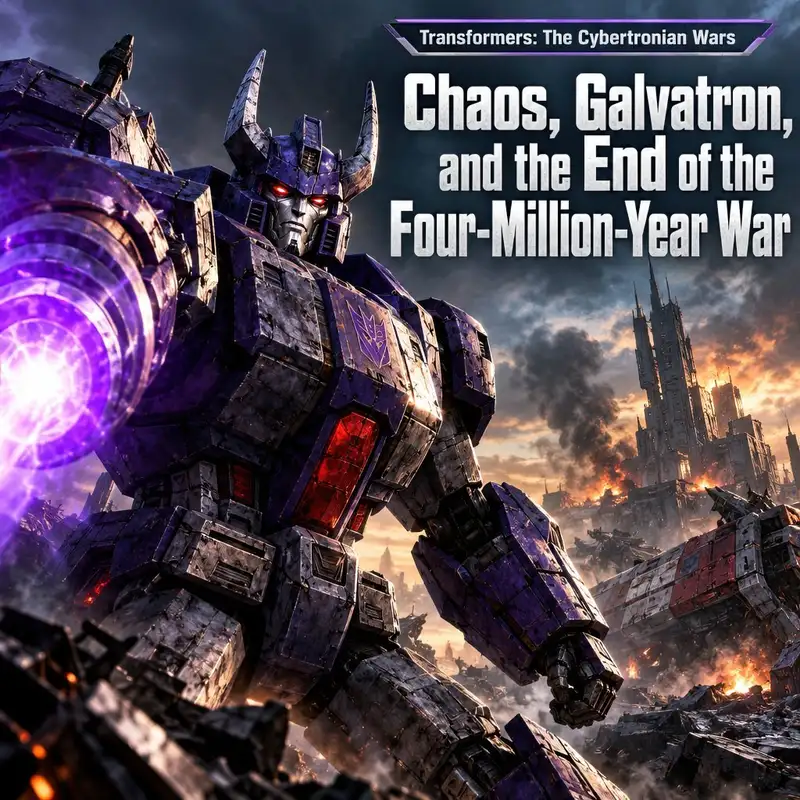
Chaos, Galvatron, and the End of the Four-Million-Year War
On Chaar, the Decepticons do not look like the survivors of a war that has ended. They are hungry for energon, divided by hardship, and reduced to arguing over the scraps that keep their systems running. Cybertron has been retaken by the Autobots. Unicron has been destroyed. Megatron, the commander who carried the Decepticon cause through its most decisive campaigns, is gone. Yet his followers remain armed, organized enough to act, and desperate enough to gamble everything on recovering the new leader drifting in space: Galvatron.
That is the first caution in any claim that the long Autobot-Decepticon war ended in the year two thousand five. A faction can lose its capital, its principal commander, and its immediate campaign without disappearing. Military defeat and political extinction are different conditions. The Decepticons on Chaar have lost territory, supply, and confidence. They have not lost their identity, their chain of command, or their reason to fear an Autobot-controlled Cybertron.
The title of this history also requires one correction. The war was not, in the American animated record, a four-million-year war. Four million years is chiefly the period during which the Ark, its Autobot crew, and the pursuing Decepticons lay dormant on prehistoric Earth. The conflict itself reaches farther back. In “War Dawn,” the cartoon places the emergence of Megatron’s movement and Orion Pax’s transformation into Optimus Prime roughly nine million years before the series’ present.
The exact chronology is not a model of military record keeping. The cartoon’s ancient dates, technology, and historical memories do not always form a perfectly measured sequence. But the broad distinction matters. Four million years of stasis interrupted the war’s active theater. They did not settle its causes. When the Ark awoke in nineteen eighty-four, the old conflict resumed in a new environment, with a new source of energy, new allies, and a new planet at risk.
Before there were Autobot missions on Earth, there was a Cybertronian society that still believed it had entered a golden age. “War Dawn” shows Orion Pax as a dock worker, Ariel employed in an energy facility, and Dion as their associate. It is a brief picture, but an important one. The war did not begin in a lifeless wasteland where conflict was inevitable. It emerged from a society with labor, infrastructure, energy distribution, social roles, and enough stability for its inhabitants to imagine that order would continue.
Megatron’s rising force broke that confidence. His flying warriors possessed a military advantage over Cybertronians who had not been built or equipped for a sudden political struggle. Orion, Ariel, and Dion were attacked after being drawn toward Megatron’s faction. Alpha Trion rebuilt Orion as Optimus Prime and Ariel as Elita One. That reconstruction became one of the war’s founding moments, not because it explains every later Autobot and Decepticon belief, but because it shows how rapidly political violence changed bodies, roles, and loyalties.
The later war is often remembered through its famous leaders, but its first lesson is institutional. A prosperous society had failed to prevent armed factions from becoming the authority that mattered. Megatron’s rise is not given a full political program in this animated continuity. The cartoon does not provide a detailed account of Decepticon recruitment, constitutional collapse, or the exact grievances that persuaded so many Cybertronians to follow him. What it does establish is the conversion of political force into military advantage, and military advantage into a struggle for control of Cybertron itself.
Over time, the conflict exhausted the planet’s energy and damaged the conditions necessary for ordinary life. The Ark’s departure was therefore more than a dramatic relocation. It was a logistical response to a failing strategic environment. The Autobots sought energy beyond Cybertron, while the Decepticons pursued them. Their crash on Earth froze the immediate contest, but neither side chose peace. Both sides were trapped in stasis, with the war suspended by accident rather than resolved by negotiation.
When the Ark reactivated in nineteen eighty-four, Earth became a second front in a conflict that had already outlived any ordinary human political memory. The planet offered energy resources, industrial sites, concealment, and access to a developing civilization that did not understand the scale of the war entering its territory. It also offered a problem. Cybertronians could use Earth’s roads, skies, factories, and fuel supplies, but they could not just take what they needed without attracting human attention, resistance, or alliance.
Megatron’s Earth strategy was never merely a series of raids against the Autobots. He sought resources that could restore Decepticon power and, eventually, alter the balance on Cybertron. The Decepticons could exploit Earth’s energy, but exploitation did not solve their long-term position. They still needed secure transport, functioning equipment, reliable bases, and a way to survive Autobot interference. Their alternate modes provided mobility and concealment. They did not eliminate maintenance, intelligence failures, or the strategic problem of operating far from the world they intended to rule.
For the Autobots, Earth was both sanctuary and obligation. Human allies gave them local knowledge, access, and a moral reason to limit the violence of an interstellar war. But personal friendships did not amount to a treaty with all humanity, and protecting Earth repeatedly forced the Autobots to divide their attention between immediate civilian danger and the larger struggle for Cybertron. The old civil war became interplanetary. It now involved human governments, human communities, and worlds that had not chosen to inherit Cybertron’s political collapse.
By the year two thousand five, that dispersed conflict became concentrated around Autobot City. Megatron’s attack was more than a raid for prestige. It was an attempt to decapitate Autobot command, remove Optimus Prime, disrupt the defenders’ coordination, and seize the initiative at a moment when the Matrix of Leadership had become strategically important. An attack on a city can have several purposes at once. It can destroy infrastructure, kill leaders, damage morale, and demonstrate that no rear area is safe.
Megatron achieved part of that aim. Optimus Prime was mortally wounded. Autobot leadership was thrown into crisis. Even a force with capable officers and veterans can be shaken when its commander is lost during a major battle. The Decepticons did not gain a stable victory from the attack, but they created an opening. In military terms, they imposed a cost on the Autobots that could not be repaired simply by holding the field after the fighting moved elsewhere.
Then the Decepticons suffered a command failure of their own. After the retreat, Starscream disposed of the damaged Megatron rather than preserving the leader who had built and held together the Decepticon war machine. That act was more than personal treachery. It exposed a deeper weakness. Megatron’s command system had no secure and accepted process of succession. It rested heavily on fear, personal authority, and the capacity of one leader to dominate ambitious subordinates.
A military organization can survive the loss of a commander when its institutions are stronger than its personalities. The Decepticons did survive, but not because they had solved that problem. They survived because a far greater power intervened. Unicron found Megatron drifting in space and rebuilt him as Galvatron. He also created or reformatted new senior servants, including Cyclonus, Scourge, and the Sweeps. The result was not a normal change of command. It was a coercive reconstruction directed by an outside actor with his own objective.
Galvatron inherited Megatron’s place in the Decepticon hierarchy, and he carried enough continuity of purpose and authority to command the surviving forces. But it is too simple to call him merely Megatron in a different body. The film establishes that Unicron remade him. It does not give listeners a complete theory of what that process preserved, altered, or intensified within his identity. Galvatron is best understood as both successor and instrument: a leader drawn from Megatron’s command legacy, but empowered and constrained by Unicron’s demand for the Matrix.
That demand changed the immediate war. Unicron did not join the Decepticons as an ally seeking Cybertronian political control. He used Galvatron to obtain an artifact that threatened him. The Matrix mattered because it was the one demonstrated means of destroying Unicron. It was not a conventional weapon to be assigned to every unit or manufactured in quantity. Its importance came from uniqueness, symbolism, and the fact that control of it could determine the survival of the most powerful force in the conflict.
Galvatron’s mission therefore began under external coercion. But when he seized the Matrix, he tried to use it not just to obey Unicron or preserve himself, but to command Unicron. That decision reveals the old logic of the war still operating inside the new crisis. Galvatron treated possession of decisive power as a route to supremacy. He did not see the artifact as a burden to be denied to all sides. He saw it as a means to reverse his position and place even Unicron beneath his authority.
Unicron’s response made clear how badly Galvatron had misjudged the relationship. Galvatron had been granted power, but not independence. The moment he tried to turn Unicron’s demand into his own command arrangement, he was punished. The episode’s great cosmic conflict was therefore also a command crisis. Megatron’s old Decepticon order had collapsed. Galvatron had not yet built a stable replacement. And the force that had empowered him was never interested in creating one.
The final battle centered on Cybertron, but its meaning must be separated into levels. Tactically, Unicron was destroyed and Galvatron was expelled into space. Operationally, the Autobots recovered their homeworld. That mattered enormously. Cybertron was a source of political legitimacy, industrial capacity, repair infrastructure, historical memory, and strategic location. Whoever held it possessed more than a flag over a capital. They held the machinery needed to begin restoring a damaged civilization.
Strategically, however, the Decepticons were disrupted rather than eliminated. Their central leadership had been shattered, their position on Cybertron had collapsed, and their forces had been scattered. Yet no comprehensive surrender followed. The film does not show a prisoner policy, a demobilization process, a reconstruction agreement, a settlement for Decepticon-held territories, or any political arrangement through which former enemies might become citizens rather than future insurgents. The Autobots had won the planet. They had not yet made peace.
Politically, Hot Rod’s transformation into Rodimus Prime gave the Autobots a successor with the Matrix and the authority attached to it. That was a vital act of continuity during a leadership emergency. But symbolic legitimacy is not the same as a functioning postwar order. Rodimus inherited a liberated Cybertron and a military victory. He also inherited exhausted institutions, an enemy in exile, uncertainty about command, and a world whose recent history had been shaped by invasion, evacuation, and planetary danger.
The opening of season three makes the limits of victory visible. Cybertron is back in Autobot hands. The Decepticons have retreated to Chaar, a harsh world where energon scarcity drives them into disorder. Their condition is miserable, but misery does not necessarily produce surrender. It can also produce radicalization, predation, and a willingness to accept increasingly dangerous plans. A force that cannot govern may still raid. A faction that cannot feed itself may still destroy what its enemy has recovered.
Cyclonus and Scourge understand that the Decepticons need Galvatron. Their effort to recover him is a logistical operation as much as a personal act of loyalty. They require mobility, information, and the ability to search beyond their immediate refuge. More importantly, they need a commander who can impose coherence on a fractured group. Their dependence on Galvatron demonstrates both Decepticon resilience and Decepticon fragility. The organization persists, but it repeatedly seeks salvation in one dominant figure.
Autobot control of Cybertron offered clear advantages. The planet remained central to energy systems, repair facilities, communications, and the political imagination of Cybertronians on both sides. It was the place whose liberation could be described as the recovery of home. But holding Cybertron did not automatically seal every route through space, erase Decepticon networks, or prevent enemies from finding support on other worlds. A capital can be secure enough to govern from and still vulnerable enough to threaten.
Rodimus faced that problem without the benefit of a detailed constitutional settlement shown on screen. His authority was real, especially as bearer of the Matrix, but the postwar order around him remained thinly defined. The Autobots were no longer simply a resistance force fighting to survive. They now had to defend a planet, manage reconstruction, respond to external threats, and decide what victory meant when their enemies had not accepted defeat. Those are different tasks, and armies that excel at one do not automatically master the others.
“Chaos” provides the clearest case study of this transformed war. Galvatron, restored to command, does not arrive with an army capable of retaking Cybertron and governing it. Instead, he seeks death crystals on the world of Dredd. The crystals can power a cannon intended to destroy Cybertron. This is not conventional conquest. It is a denial strategy. If the Decepticons cannot hold the homeworld, Galvatron is prepared to make it impossible for the Autobots to hold it either.
The plan has a brutal strategic logic. Cybertron is more valuable to the Autobots than a distant battlefield because it is their political center, their industrial base, and the visible proof that their cause has survived. Destroying it would not automatically make Galvatron capable of governing the remains, but it could deprive the Autobots of the principal achievement of their victory over Unicron. In that sense, the death-crystal cannon is an attempt to turn Decepticon weakness into leverage.
It is also a sign of constraint. The weapon depends on a particular resource, a particular location, and a particular process. Galvatron cannot produce planetary destruction as a routine Decepticon capability. He must obtain the death crystals from Dredd and use the equipment available there. The operation requires access, security, and enough time to prepare the attack. Its danger is immense, but its very uniqueness creates vulnerabilities. A weapon tied to one site can be found, infiltrated, disrupted, or destroyed.
That is why intelligence matters in “Chaos.” The Autobots do not face an abstract threat called Decepticon power. They must identify the specific resource being gathered, the purpose it serves, and the path by which Galvatron intends to use it. Their response depends on reconnaissance and mobility across peripheral worlds. Cybertron may be the central objective, but the decisive action occurs far from Cybertron itself. A planetary defense can fail if it watches only its own skies and ignores the distant systems where an enemy prepares the means of attack.
The immediate military outcome is clear enough. Galvatron’s death-crystal threat is stopped. Cybertron survives. But that tactical success should not be mistaken for a final resolution. Galvatron has demonstrated that a resource-starved exile force can still gather specialists, exploit local technology, and threaten the enemy’s capital. The Decepticons may lack the capacity to administer Cybertron, yet they retain the capacity to make Cybertron insecure. That is the condition of a war that has shifted from contest for control to contest over whether control can endure.
Galvatron’s choice is not irrational simply because it is catastrophic. From his position, the Autobot recovery of Cybertron has changed the balance against him. He cannot easily match their infrastructure or legitimacy. Destruction offers a way to deny them the fruits of victory. But it also narrows the Decepticon political horizon. A movement that once sought mastery over Cybertron is increasingly driven by survival, vengeance, and the need to prevent the enemy from consolidating peace.
That narrowing has consequences for command. A leader whose strategy depends on terror and denial can keep followers aligned for a time, particularly when they share hunger and exile. Yet such a strategy offers little future beyond the next raid. It does not answer how energon shortages will be solved, how civilians will be governed, or how a Decepticon state could survive after destroying the infrastructure it claims to want. It substitutes immediate coercion for a political program.
“Chaos” is not only a story about Galvatron’s weapon. It is also a story about Kup and the kind of damage long wars leave behind even when the principal battlefield has moved on. Kup remembers an earlier captivity among the Orbs, who enslaved other robots. During that episode in his past, he encountered Chaos, a dangerous figure associated with the Orbs, and fled rather than remain with those still imprisoned. The memory has remained with him as guilt.
Kup’s experience should not be inflated into a complete history of the war or a judgment on every Autobot. It is personal testimony about a moment of fear, coercion, and failure. But personal testimony matters because wars are not experienced only through commanders, artifacts, and strategic maps. They are experienced by prisoners, forced laborers, survivors, and those who live with the knowledge that they escaped while others did not.
The rescue mission in “Chaos” therefore has a second objective. Stopping Galvatron’s cannon protects Cybertron from a strategic attack. Helping those held by the Orbs addresses a different kind of consequence: the persistence of captivity and exploitation beyond the main front. These goals overlap, but they should not be confused. A commander can prevent a planetary catastrophe and still neglect the people trapped in the smaller systems that war has made profitable for slavers, opportunists, and local tyrants.
Kup’s return to confront Chaos does not erase what happened in the past. It does not restore the years taken from those imprisoned, and it does not turn survivor guilt into a simple story of redemption. What it does show is that liberation has a moral dimension beyond territorial recovery. Cybertron can be retaken, energon systems can be restored, and banners can change over a city. None of that automatically recovers the persons who were abandoned, enslaved, displaced, or forgotten while the larger war continued elsewhere.
That is one reason the idea of a clean ending fails. The end of a battle is not the end of a prisoner system. The end of an occupation is not the end of trauma. The defeat of a leader is not the end of the institutions, habits, and peripheral violence that grew under the protection of war. “Chaos” makes the post-Unicron conflict look less like an epilogue and more like a dangerous period in which old wounds and new weapons coexist.
The next great crisis proves that even direct cooperation between Autobots and Decepticons does not necessarily create reconciliation. In “The Return of Optimus Prime,” the Hate Plague spreads across the galaxy after human revenge and an accidental release of destructive spores. The plague does not respect faction symbols. Autobots and Decepticons are both threatened, and the conflict becomes a survival emergency in which previous military calculations lose their immediate value.
Galvatron’s response is practical. He works with Optimus Prime because the alternative is shared destruction. Optimus, restored to life, regains the Matrix and uses its accumulated wisdom to end the plague. The two leaders can cooperate because the threat is greater than their rivalry for the moment. Their brief agreement is significant. It shows that the factions are not biologically or metaphysically incapable of coordination. They can recognize common interests when survival requires it.
But necessity is not peace. Galvatron’s declaration that there would be no war that day is precisely limited. It suspends conflict under extraordinary conditions. It does not establish mutual recognition, disarmament, accountability, borders, prisoner exchange, political representation, or any process for addressing the grievances and atrocities accumulated over millions of years. The ceasefire is a battlefield expedient. It is not a treaty.
The episode also reveals how fragile such cooperation can be when it depends on exceptional leadership and exceptional danger. Optimus and Galvatron do not build an institution capable of managing future disputes. They act because the plague threatens both their forces. Once the emergency passes, the old incentives return. The Autobots still hold Cybertron. The Decepticons remain excluded from that recovered center of power. Galvatron remains a commander whose authority depends on restoring Decepticon strength.
“The Rebirth,” the final American animated story, removes any remaining doubt that the war has not received a conclusive ending. Galvatron returns as an active threat. His plan involves Zarak, Scorponok, the Plasma Energy Chamber, Cybertron’s energy systems, and a scheme that endangers Earth’s sun. The details belong to a different technological crisis than the death-crystal cannon or the Matrix. The Plasma Energy Chamber is not Unicron, and it is not a substitute Matrix. It is a separate system with its own destructive potential and its own strategic stakes.
The plan demonstrates the continuing danger of controlling strategic energy systems without political restraint. Earth and Cybertron are linked by the consequences of Galvatron’s actions. The threat is no longer confined to a raid against an Autobot city or a battle over a single artifact. It reaches into the conditions that allow worlds to remain habitable and civilizations to function. A struggle over energy can become a struggle over survival when leaders treat planetary systems as instruments of coercion.
Galvatron’s approach is reckless, but it follows the pattern established after the fall of Cybertron. He cannot restore Decepticon dominance through ordinary political means. He seeks decisive leverage through exceptional technology, external allies, and threats so large that the Autobots must respond. Such methods can create temporary initiative. They can force an enemy to divert forces and accept risk. They can also endanger the very resources a future government would need, making victory indistinguishable from ruin.
The crisis ends with Cybertron re-energized, and the planet is described as entering a second Golden Age. That achievement is not trivial. Energy restoration offers the possibility of industrial recovery, renewed repair capacity, and an end to the deprivation that has shaped so much of Cybertronian conflict. A society whose energy systems are failing cannot easily rebuild cities, care for damaged citizens, or demobilize its armed forces. Restored power creates opportunities that years of war had denied.
Yet opportunity is not settlement. The American animated record does not show the Decepticons disbanding, accepting a political order, or reconciling with the Autobots after Cybertron’s restoration. It does not show a process for reintegrating fighters, prosecuting crimes, compensating victims, or dismantling the institutions of permanent war. Instead, the final image leaves Galvatron and Zarak alive, active, and plotting. The planet has regained power, but the threat has not been politically extinguished.
That unresolved ending is appropriate to the history the cartoon has presented. The destruction of Unicron ended an immediate existential crisis. It also ended Megatron’s old command order. The Decepticons lost Cybertron, and Rodimus Prime gained the Matrix and the title of Prime. Later, Cybertron’s energy was restored. Each of these was a major turning point. None of them, by itself, created the machinery of peace.
The war persisted because its institutions persisted. Decepticon command survived through exile, loyal subordinates, and the repeated recovery of charismatic leaders. Autobot victory produced control of Cybertron, but not a detailed political settlement that could absorb or neutralize a defeated enemy. Resource scarcity pushed the Decepticons toward desperate operations. Unique artifacts and planetary systems offered chances for sudden advantage, but also encouraged leaders to seek decisive destruction rather than durable governance.
Galvatron represents this final phase of the war. He is more than Megatron returned under a new name, nor is he an entirely separate political phenomenon. He is the product of an old command system shattered by internal rivalry and then rebuilt through Unicron’s coercion. Under Galvatron, the conflict becomes more fragmented and, in some ways, more dangerous. The objective increasingly shifts from taking Cybertron to denying Cybertron to the Autobots, even if that denial risks destroying the world both factions claim as home.
So the long Sunbow war did not end when Unicron died. It did not end when Cybertron was retaken. It did not end when Galvatron briefly accepted cooperation during the Hate Plague, and it did not end when Cybertron entered a second Golden Age. Those events removed threats, restored power, and changed leadership. They did not produce surrender, reconciliation, demobilization, or trust.
A restored planet can support reconstruction, but it cannot by itself rebuild a political community. It cannot disarm enemies who still see survival in sabotage. It cannot recover every prisoner, erase every memory of abandonment, or make millions of years of factional identity disappear. The war’s final American animated record is therefore not a story of a clean conclusion. It is the story of a civilization that recovered its energy before it recovered peace.