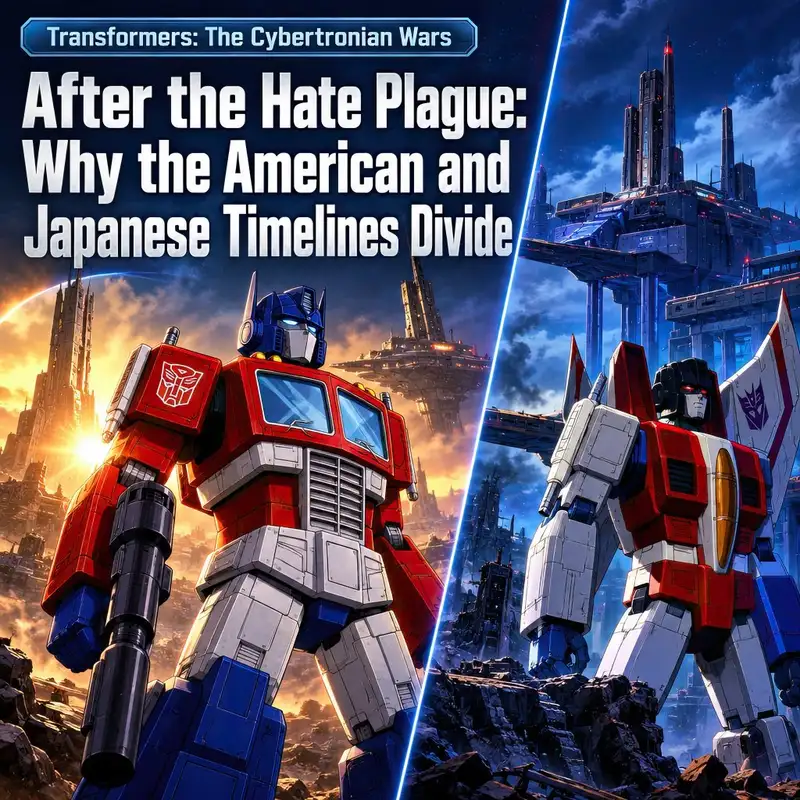
After the Hate Plague: Why the American and Japanese Timelines Divide
The Hate Plague had been cured. Optimus Prime had returned from death. Galvatron’s attempt to turn fear and anger into a weapon had failed because the plague consumed Decepticons and Autobots alike. For a brief moment, the old war appeared to have exhausted itself. The leader most associated with Autobot survival was back. The immediate emergency had passed. Cybertron, Earth, and the scattered survivors of a long conflict seemed to have been given an opening for recovery.
That ending was shared by two versions of Generation One animation. In the American cartoon, Optimus Prime’s restoration closed the third season and led into a short final crisis called “The Rebirth.” In Japan, where the same imported material had been presented as Transformers 2010, Convoy’s restoration became the starting point for a new domestic series, Transformers: The Headmasters. Both histories begin with the same apparent promise. Neither gives that promise the same meaning.
In the American branch, peace is interrupted by the theft of a key to an ancient power system. The crisis is dangerous, even cosmic in scale, but it is concentrated around a unique artifact and resolved through a new alliance. In the Japanese branch, the next crisis is broader. Cybertron’s survival depends on contested planetary systems, distant bases, returning exiles, and a war that has not truly ended. The question is more than who can stop the next catastrophe. It is whether a civilization can remain stable when its old war has scattered populations, militarized institutions, and left its home world vulnerable.
The divergence was not caused by Optimus Prime making a different decision, or Galvatron suddenly acquiring a new ideology. It began outside the fiction, with a different choice of sequel. The United States aired “The Rebirth” as a three-part fourth-season conclusion. Japan did not incorporate that miniseries into its television continuation. Instead, Takara commissioned a new Japanese-produced series from Toei Animation, Transformers: The Headmasters, which ran far longer and created its own post-plague future.
That production decision matters because sequels do more than add characters. They decide which previous problems still exist, which institutions matter, and what technologies mean. A story that follows “The Rebirth” must account for Nebulos, the Plasma Energy Chamber, and a new generation of organic-Cybertronian partnerships. A story that follows The Headmasters instead must create a different origin for Headmasters, a different strategic map, and a different explanation for why the war continues after Convoy has returned.
The available record establishes the choice, but not one simple commercial motive behind it. It is tempting to claim that Japan rejected the American finale because of ratings, toy sales, censorship, or creative dissatisfaction. Those explanations circulate easily because “The Rebirth” is compressed, peculiar, and very different in tone from The Headmasters. But a historian needs firmer evidence than a plausible opinion. What can be said is that the Japanese continuation replaced the American fourth season’s narrative position with a new series of its own.
The result is not one timeline with a few contradictory details around the edges. It is a fork in history. The shared material remains important. Both branches inherit the Autobot-Decepticon war, the destruction caused by Unicron, Rodimus Prime’s difficult period of leadership, Galvatron’s return, and the Hate Plague crisis. But after Optimus Prime is restored, the two histories begin asking different questions about war, reconstruction, and survival.
“The Rebirth” begins from a condition of relative peace. That phrase should be handled carefully. The American finale does not offer a detailed account of demobilization, elections, reconstruction ministries, prisoner policy, or a constitutional settlement between former combatants. It does not prove that the Decepticons have accepted defeat, or that Cybertronian society has solved the grievances and damage created by the war. It establishes something narrower, but still significant. The immediate period after the Hate Plague is calmer than the crises that came before it.
Optimus Prime’s return restores a familiar center of Autobot authority. Rodimus Prime, who had carried the burden of leadership after Optimus’s death, is no longer the sole political and military symbol of the Autobots. That is not necessarily a rejection of Rodimus as a commander. It is the return of a leader whose name, Matrix, and record carry exceptional legitimacy in this version of the story. In a society shaken by plague, invasion, and repeated existential emergencies, legitimacy has practical value. It helps forces cooperate before they have time to argue over every order.
The Decepticons, however, have not ceased to be a military threat. Their next operation is not a general invasion of Earth or an attempt to seize every major Cybertronian city. It is an effort to obtain the key to the Plasma Energy Chamber. That distinction defines the logic of “The Rebirth.” The conflict is built around access to a singular strategic system. Whoever holds the key and understands how to use it can turn an ancient mechanism into a weapon of extraordinary consequence.
This makes the American finale an artifact-access crisis. The Decepticons gain initiative not because the story establishes a vast new industrial base or a superior conventional army, but because they acquire the means to activate something no ordinary force can replicate. In military terms, the center of gravity is not a factory network, a population center, or a fleet. It is control of a dangerous capability whose value comes from rarity.
The Plasma Energy Chamber is tied to Cybertron’s distant past and carries consequences beyond ordinary energon supply. It should not be described as a mine, refinery, or renewable industrial resource. Its importance lies in activation and release, not in routine logistics. The Chamber is a strategic exception. It is the kind of asset that can alter a war quickly while also creating dependence on a single key, a single location, and a poorly understood system.
Galvatron’s use of the Chamber demonstrates that danger. The energy released does not remain neatly contained within Cybertronian politics. It affects the Autobots and places Earth’s sun at risk. The crisis becomes planetary and stellar in scope, but its operational structure remains focused. The decisive questions are who possesses the key, who can reach the Chamber, who can survive its effects, and who can prevent activation from becoming irreversible.
That concentrated structure gives “The Rebirth” an unusual shape. A broad civil war is compressed into an emergency surrounding one ancient system. The Decepticons still matter as an organized hostile force, and Galvatron remains the immediate threat, but the finale does not attempt to map a long campaign across multiple fronts. Instead, it treats the Chamber as a force multiplier so large that conventional distinctions between local battle and strategic catastrophe begin to collapse.
There is an intelligence lesson in that structure. A unique artifact is often most dangerous before anyone fully understands it. Possession is not the same as control, and control is not the same as safe operation. Galvatron’s initiative comes from access, but the Chamber’s effects exceed the tidy assumptions of a conventional weapons program. Ancient systems have a habit of arriving with incomplete manuals, uncertain safeguards, and consequences that no commander has properly modeled. Cybertronian history contains many such procurement problems, though few with such severe consequences for a nearby star.
The American answer to this emergency arrives on Nebulos. There, the conflict brings Cybertronians into direct partnership with an organic population. This is the origin of the American animated branch’s Headmasters and Targetmasters. The distinction matters because these are more than Cybertronians who happen to possess a new alternate mode or a detachable component. The new systems emerge from cooperation between two sentient species drawn together by war.
Nebulans are not spare parts. They are inhabitants of a world affected by an alien conflict and then placed inside its military and technological arrangements. The partnership changes their political position. They are no longer merely civilians caught near a battlefield, nor simply allies offering local knowledge. They become essential participants in the functioning of Cybertronian bodies and weapons. That creates a bond of mutual dependence, but dependence is not the same as equality. The story does not provide a full account of how these relationships are governed, negotiated, or regulated.
What it does establish is that American Headmaster and Targetmaster technology is binary. Cybertronian and Nebulan partners share a system in which body, weapon, mobility, and decision-making are linked. The arrangement is therefore both tactical and social. It can increase capability, but it also requires trust, coordination, and compatibility under combat conditions. If one partner is endangered, captured, deceived, or unwilling, the military system is affected. The technology does not erase personhood. It makes personhood a central part of the weapon system.
That is a very different proposition from simply manufacturing more armored soldiers. A conventional military can treat a vehicle or weapon as an object to be issued, maintained, replaced, and reassigned. A binary partnership cannot be understood so impersonally. Its effectiveness depends on relationships between individuals, including an organic population whose consent and welfare cannot be reduced to a line in an equipment inventory.
The American branch therefore frames technological adaptation as alliance warfare. The Autobots do not resolve the crisis by uncovering a lost caste of Cybertronian specialists. They build new capacities through cooperation with Nebulans. The war spreads across species, but so does resistance to the Decepticons. This is a hopeful development, although it also leaves serious questions outside the frame. A partnership formed under immediate threat may survive peace, but wartime necessity does not automatically answer questions of citizenship, autonomy, command authority, or long-term political rights.
The same is true of the Targetmasters. They represent more than a new category of firepower. Their existence indicates that the alliance reaches down into the practical organization of combat. Weapons, bodies, and partners are integrated. The battlefield becomes a place where political trust has immediate mechanical consequences. That is not unique to Cybertronian warfare. Human history offers many examples of armies discovering that coalition operations depend less on rhetoric than on whether separate forces can communicate, supply one another, and accept shared risk.
Fortress Maximus makes the American branch’s logic visible at its largest scale. His creation connects Spike, Cerebros, the Nebulan Hive, and Cybertronian technology in a single super-heavy asset. The details are fantastical, as they should be in this setting, but the strategic meaning is clear. Fortress Maximus is not just a larger warrior appearing at the end of a story. He is the physical expression of an interspecies alliance forged during crisis.
A giant asset does not automatically solve every military problem. It requires coordination, secure control, energy, repair, and a purpose that fits the wider campaign. But in “The Rebirth,” Fortress Maximus helps meet an emergency that conventional forces cannot handle alone. The story gives the alliance a visible strategic result. Cooperation across species produces a capability capable of standing against Galvatron’s attempt to exploit the Plasma Energy Chamber.
The immediate outcome is the containment of the crisis. Earth’s sun is saved. The Chamber’s threat is resolved. The Decepticons are prevented from translating possession of the key into permanent strategic control. The conclusion then points toward a restored Golden Age for Cybertron. That language should not be inflated into a fully documented peace settlement. The series does not explain who governs, how former enemies are treated, or how a war-ravaged planet rebuilds every damaged institution.
Still, the direction of the ending is unmistakable. The American branch imagines that prosperity and recovery can return after the final emergency has been overcome. Peace is not presented as effortless, and the Decepticons have not been analyzed out of existence. But the story’s horizon is reconstruction. The future belongs, at least in principle, to restoration rather than to another generation of total war.
Japan’s sequel begins from the same restored leader and arrives at a different horizon. Transformers: The Headmasters opens in the year 2011, after the events associated with Convoy’s return and the end of the Hate Plague. But its political geography immediately signals that the war is not entering a quiet period. The Cybertrons, the Japanese name for Autobots, operate from headquarters on Athenia. Galvatron’s Destrons, the Japanese name for Decepticons, are established on the dark planet Charr.
This is more than a change of scenery. Athenia and Charr represent separated command centers in an interplanetary struggle. The conflict is no longer organized around one artifact crisis moving rapidly toward a finale. It is distributed across worlds, bases, routes, and populations. Distance matters again. So do communications, reinforcement, transport, intelligence, and the ability of political leaders to maintain command over forces that may be operating far from Cybertron itself.
The new strategic map also changes the meaning of security. A headquarters on another planet may provide safety, depth, and room to organize. It may also reveal that Cybertron is not secure enough to serve as the only center of government and military command. A fortified enemy base offers Galvatron a refuge and a place to concentrate his followers, but it also ties Decepticon power to supply routes and political loyalty beyond the immediate battlefield.
This is the setting into which the Japanese Headmasters arrive. Their origin is one of the clearest signs that the timelines have truly divided. In the American branch, Headmasters are created through binary partnerships with Nebulans. In The Headmasters, they are small Cybertronians who fled Cybertron long before the current war and established themselves on the harsh world of Master. Their history is not an alliance with organics. It is a history of Cybertronian exile.
The survivors on Master developed larger bodies known as Transtectors. They connect to these bodies as heads, creating the Japanese series’ Headmaster system. It is easy to hear the familiar word Headmaster and assume that the underlying technology must be equivalent to the American version. It is not. The shared label conceals different social histories, different engineering assumptions, and different political consequences.
The Japanese Headmasters are not Nebulans transformed by contact with Cybertronian war. They are Cybertronians whose community was reshaped by displacement. They left their original world during an ancient conflict, survived in a hostile environment, and created a body system suited to their circumstances. Their return is therefore not merely the arrival of reinforcements. It is the return of a diaspora, a population that shares Cybertronian origins but has developed outside Cybertronian institutions.
That makes their presence politically significant. Exiled communities often preserve memories that the homeland has forgotten, simplify old loyalties, or develop new identities around survival. They may return as liberators, outsiders, claimants, allies, or all four at once. The Headmasters of Master bring military value, but they also bring a separate experience of what it means to be Cybertronian. Their history was not formed in Iacon, Earth, Athenia, or Charr. It was formed under the pressure of a difficult exile.
The Transtector system reflects that history. It is a body-construction and body-control arrangement developed by Cybertronians for Cybertronian survival. The series does not provide enough detail to map every stage of its industrial development, and there is no need to invent a factory order of battle. But the basic implication is important. A distinct community created, maintained, trained with, and relied upon a different bodily system over a long period.
That requires more than clever engineering. It implies a tradition of maintenance, education, adaptation, and command. A population that survives through a specialized body system must organize its society around the system’s vulnerabilities as well as its strengths. It must preserve knowledge, recover damaged equipment, train new users, and decide who controls the larger bodies. The Headmasters are more than soldiers wearing equipment. Their technology is part of the way their community endured exile.
This is why the Japanese series treats the arrival of figures such as Fortress and the other Cybertron Headmasters differently from an alliance with Nebulan partners. They are returning people, not newly recruited auxiliaries. They expand the available military capability of the Cybertrons, but they also complicate the political landscape. The old civil war must now accommodate a population that has its own memory of ancient displacement and its own means of survival.
On the Destron side, the new Headmaster forces and the power associated with Scorponok, also known as MegaZarak, reinforce the sense that this is not a short coda to the old war. The conflict is renewing itself through new formations, new command relationships, and new technologies. Galvatron remains a central hostile leader, but his war now operates within a more crowded military environment. Personal authority matters, yet it cannot by itself explain every force entering the field.
The strategic center of The Headmasters is also different. In “The Rebirth,” the struggle is organized around the Plasma Energy Chamber, a unique system whose activation creates catastrophe. In the Japanese series, Vector Sigma becomes central to the survival of Cybertron. Vector Sigma is more than another prize to be seized for prestige. The conflict over it concerns planetary systems and the ability of Cybertron itself to remain viable.
That changes the nature of the campaign. A fight over a weapon may be decisive because the weapon can destroy an enemy. A fight over central infrastructure is more fundamental. It concerns whether the population, industry, command structure, and physical environment of a world can continue to function. The difference between the two is not absolute. The Plasma Energy Chamber also threatens vast consequences. But Vector Sigma places Cybertron’s continued existence closer to the center of the war.
In such a conflict, command legitimacy becomes inseparable from protection. A leader cannot rely only on title, courage, or a record of past victories. The leader must demonstrate that the institutions and systems sustaining Cybertron can be preserved. If those systems fail, a military victory elsewhere may become meaningless. A faction can defeat an enemy force and still lose its home world to collapse.
The civilian implications are substantial, even when the series focuses on named warriors and dramatic operations. A crisis in Cybertron’s central systems is not confined to those holding weapons. It affects every population dependent on the planet’s functioning infrastructure. Repair, energy distribution, shelter, transport, archives, and ordinary social life all become vulnerable. A planetary systems failure is more than a technical emergency. It is a crisis of civilian survival.
The Japanese branch therefore brings the war back toward Cybertron as a strategic system. Earth remains important, and distant worlds matter, but the home planet is no longer simply the symbol of what both sides claim to be fighting for. It is an active and endangered theater. The war is about who can preserve it, who can control it, and whether it can survive the accumulated damage of centuries of conflict.
This shift also changes the role of Convoy. At the opening of The Headmasters, his restoration gives the Cybertrons a recognizable leader, much as Optimus Prime’s return does in the American branch. Rodimus Prime, known in Japanese usage as Hot Rodimus, becomes a transitional rather than central figure. The return of Convoy resolves one immediate problem of authority. It does not resolve the deeper problem of institutional resilience.
This is an important distinction in any military history. A respected commander can restore morale, discipline, and coalition confidence. He can unify scattered units and make difficult decisions credible. But an institution that depends entirely on one individual remains fragile. The more prolonged and dispersed the conflict becomes, the more command has to survive distance, casualty, rivalry, and succession. A leader can be decisive without being sufficient.
Galvatron’s Destrons illustrate the same problem from the opposing side. They remain an organized military threat with a base on Charr, but their ability to continue the war depends on more than Galvatron’s personal presence. They require commanders, forces, access to strategic systems, and a political structure capable of sustaining conflict across multiple worlds. The series does not reduce the Destrons to a single villain and a line of subordinates. It presents an enemy force embedded in the continuing military geography of the post-plague era.
For the Cybertrons, the returning Headmasters create both opportunity and complexity. New allies can strengthen a force, but integration is not automatic. Different communities bring different habits, technologies, histories, and assumptions about command. The series does not turn this into a bureaucratic seminar, thankfully, but the strategic reality remains. A coalition becomes stronger only when it can coordinate. Otherwise, it becomes larger and more difficult to direct.
The question of succession grows sharper as the war continues. Convoy’s presence gives the Cybertrons a powerful symbol of continuity with the earlier struggle. Yet The Headmasters does not treat his return as a permanent cure for political instability. It recognizes, through its later events, that a society cannot base all survival on the assumption that one revered leader will always be present to intervene at the final moment.
Convoy’s second death must be understood in that context. It is more than a repetition for shock value, and it should not be reduced to a running joke about Cybertronian leaders returning from destruction. His sacrifice is tied to the vulnerability of Cybertron’s central systems and to the scale of the crisis facing the planet. The event demonstrates the cost of a war in which the survival of the home world has become inseparable from the actions of individual commanders.
In the immediate fight, a leader’s sacrifice can resolve an immediate threat. It can stop a system from failing, buy time for an evacuation, deny an enemy a decisive advantage, or prevent the destruction of a world. At the strategic scale, however, sacrifice does not remove the underlying requirement for institutions. Cybertron survives, but its political and military future still has to be carried by those who remain.
This is the hard lesson embedded in the Japanese continuation. Restoration is not the same as stability. Convoy’s return may restore confidence after the Hate Plague, but confidence alone cannot settle a war shaped by exile, dispersed command, contested infrastructure, and hostile forces with their own bases and ambitions. The continued conflict outlives the person most capable of symbolizing unity.
The American branch reaches a different conclusion because it frames its final crisis differently. “The Rebirth” asks whether the Autobots and their Nebulan allies can prevent Galvatron from turning the Plasma Energy Chamber into a disaster. Its answer is yes. The emergency is contained, the alliance proves its value, and Cybertron moves toward renewed prosperity. The ending leaves many political questions unanswered, but it points toward recovery as a plausible direction.
The Japanese branch asks whether Cybertron can survive when the war itself has become embedded in the structure of its society. Its answer is more severe. New military technologies do not arrive as a clean alliance with another people. They arrive through the return of a displaced Cybertronian population. The decisive strategic object is not only an ancient weapon, but the system sustaining the planet. And the restored leader cannot remain the sole guarantee of continuity.
Neither ending should be treated as more legitimate merely because one was broadcast in one country and the other in another. They are answers to different narrative problems. The American finale is compact, artifact-centered, and directed toward reconstruction. The Japanese continuation is longer, more geographically dispersed, and directed toward the consequences of an unresolved civil war. Each branch uses familiar names and designs, but familiar names do not make their institutions identical.
The Headmaster distinction captures the divide with unusual clarity. In the American branch, the technology comes from a wartime partnership between Cybertronians and Nebulans. Its central meaning is alliance. In the Japanese branch, the technology comes from Cybertronians who survived exile on Master by developing Transtectors. Its central meaning is diaspora, adaptation, and return. The word is the same. The historical content is not.
The same is true of Fortress Maximus. In the American finale, he embodies an interspecies integration created during a crisis on Nebulos. In the Japanese television branch, the surrounding Headmaster system belongs to an entirely different history of displaced Cybertronian communities and their return to a still-divided war. Treating these versions as interchangeable would erase the political meaning each story assigns to technology.
The timelines divide because “The Rebirth” was not adopted as Japan’s sequel. Once that production choice was made, The Headmasters had to supply its own future. It supplied a new military geography, new populations, a different Headmaster system, a renewed struggle over Cybertron’s survival, and a harsher test of leadership. The American branch imagines that peace can begin after one final emergency is overcome. The Japanese branch argues that peace cannot be restored by curing a plague or returning a leader when the war’s exiles, institutions, and planetary wounds remain unresolved.