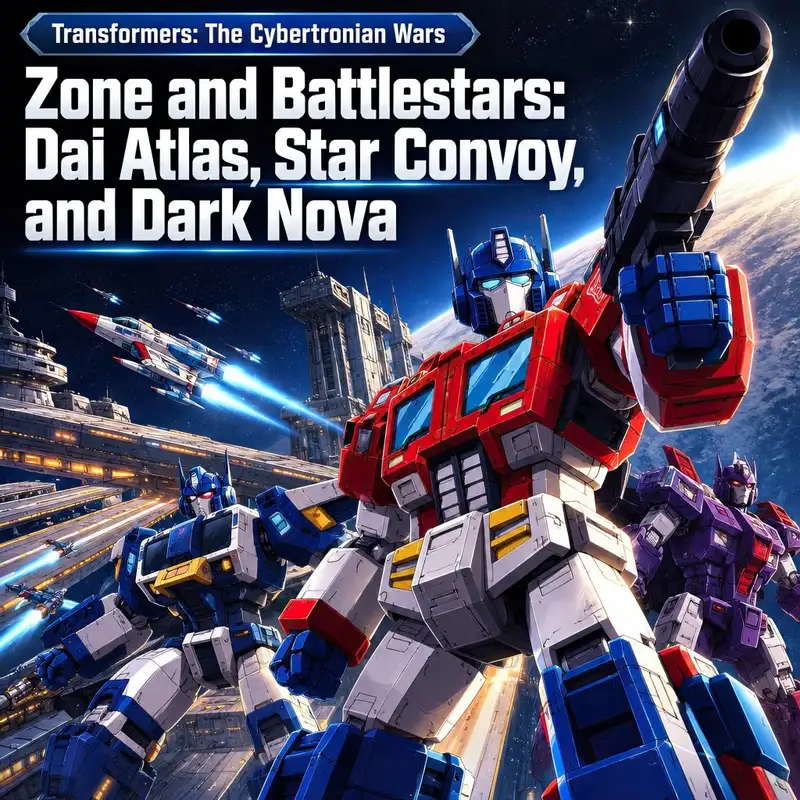
Zone and Battlestars: Dai Atlas, Star Convoy, and Dark Nova
Planet Zone was under attack because it held more than fuel. The Nine Great Demon Generals had already destroyed Planet Feminia, demonstrating that their campaign was not a raid for supplies or a contest for prestige. They were moving against the infrastructure that could sustain an entire war. On Zone, they sought Energon Z. Beneath Earth, they sought the Zodiac, an immense source of power tied to that energy system. At the same moment, the Autobots faced a second crisis. Victory Saber, the commander who represented the existing order after the events of Victory, had been critically damaged. The question was no longer only how to hold a fortress. It was who could lawfully command the defense while the old commander could not.
This is the late Japanese Generation One history, specifically the material surrounding the nineteen ninety Transformers: Zone original video animation and the magazine stories that continued it. It follows the Japanese animated branch after Victory. It does not follow the American animated continuation after The Rebirth, and it does not use the later histories of Marvel Comics, Beast Wars, or the modern Legends stories. The distinction matters because this era developed its own line of succession, its own strategic artifacts, and its own account of how an Autobot command structure survived repeated losses.
Zone is unusual because it was not a complete television series. The animated portion is a single original video animation. Its immediate crisis is clear, but its wider conflict continues through illustrated children’s-magazine stories. That gives the history a compressed quality. Battles appear suddenly. New commanders arrive with little of the slow political development that a long series might have provided. Yet the essential problem remains coherent. The Autobots are trying to defend energy infrastructure, preserve command legitimacy, and prevent an enemy from turning extraordinary technology into permanent political control.
The Nine Great Demon Generals were not dangerous merely because there were many of them. They represented a distributed strike force under the larger direction of Violen Jiger. Their attacks demonstrated an ability to move between worlds, destroy defended targets, and pursue strategic resources rather than isolated victories. Planet Feminia’s destruction established the stakes. Planet Zone then became the next objective because it was both an Autobot-held installation and a node in a larger energy network. An army can lose a skirmish and recover. It is much harder to recover when the facilities that power, repair, and coordinate that army are destroyed.
Energon Z is central to the story, although the surviving material does not provide a useful engineering specification for it. We are not given a production rate, an equivalent number of conventional fuel reserves, or a reliable measure of its output. What the story establishes is more important than a fictional number. Energon Z mattered enough to justify planetary assault. It was associated with the Zodiac, and the Zodiac mattered enough to draw the conflict toward Earth. In military terms, that makes it a strategic resource. It was more than ammunition waiting in a warehouse. It was a source of power with consequences far beyond one battlefield.
Planet Zone therefore functioned as more than a location for an action sequence. It was a fixed installation, an energy site, a base, and a logistical objective. Fixed sites have advantages. They can store equipment, support repairs, concentrate defenses, and protect specialized knowledge. They also create vulnerabilities. An enemy knows where to strike. A defender cannot simply withdraw without surrendering the infrastructure that makes future operations possible. The battle for Zone was shaped by that tension. The Autobots needed to defend a place. Their opponents needed only to seize, damage, or exploit it.
Earth’s importance was narrower, but no less consequential. In this story, Earth mattered because the Zodiac was hidden beneath it. The planet was a strategic location because of what lay below its surface, not because the narrative was building a detailed human-Cybertronian alliance or describing a global human military response. The surviving account offers no reliable order of battle for Earth’s governments, no established chain of human command, and no detailed civilian perspective. It would be easy to import those things from other Transformers histories. It would also be wrong.
That requirement made command continuity urgent. Resources cannot defend themselves. The Zodiac could be secured, Energon Z could be protected, and defenders could win local engagements, but none of that answered the question of who could coordinate the wider response. Victory Saber’s damage created a leadership crisis because he was more than an individual combatant. He was the recognized commander at the top of the Japanese post-Victory Autobot order. When a commander at that level is incapacitated, the problem is more than medical. It is institutional.
Victory Saber embodied a combined form of authority. He was the union of Star Saber and Victory Leo, and his condition represented the vulnerability of a command structure built around exceptional figures. The Autobots did not have the luxury of suspending operations while they waited to see whether he could return to active leadership. Planet Zone remained under threat. The Demon Generals remained active. The Zodiac remained contested. In such circumstances, an army either has a succession process or discovers, usually at great cost, that it had mistaken personal loyalty for an institution.
Dai Atlas became the answer to that immediate problem. His elevation to Supreme Commander was not presented as a simple contest of strength. He did not replace Victory Saber because he had defeated him or because he was merely the newest and largest warrior on the field. His authority emerged through the existing command structure during an emergency. Victory Saber’s inability to continue made a transfer necessary, and Dai Atlas received the authority to act. A capable combatant can win a duel. A Supreme Commander needs recognized authority to direct forces, allocate resources, and make decisions that bind others.
Dai Atlas also should not be understood as directly replacing Optimus Prime. In Japanese terminology, Optimus Prime is Convoy, but the late Japanese Generation One leadership sequence had moved through several commanders and several eras of war. Dai Atlas succeeded Victory Saber within that specific post-Victory order. The office he inherited was shaped by current needs: defense of Zone, custody of extraordinary energy systems, and the coordination of mobile forces against a threat that did not respect planetary boundaries. His legitimacy came from continuity, not nostalgia.
Sonic Bomber became an important partner in that effort. Together with Dai Atlas, he represented a form of leadership suited to the new campaign. Their significance was not only personal. They were part of a broader late-era military imagination built around units that could shift roles, combine capabilities, and move quickly among dispersed crises. This was a setting in which an enemy could attack a world, seek an artifact on another world, and force defenders to choose between holding a base and pursuing an escaping threat.
The Powered Masters illustrate that doctrine. Dai Atlas, Sonic Bomber, and later Road Fire were more than a collection of impressive bodies designed for separate duels. Their combined form, Big Powered, represented coordination. Combination systems can concentrate capability, but they also create command problems. The participants must arrive at the right place, maintain communication, trust one another’s timing, and act as a coherent unit under pressure. A combined form may be stronger in a direct confrontation, but it is not automatically more flexible. It can also become dependent on the cohesion of the individuals who create it.
The magazine continuation expands this side of the conflict. It introduces Road Fire and develops the Powered Masters more fully than the single animated episode could. The continuation is connected to the Zone story, but it should not be treated as one identical visual record. The original video animation and the illustrated pages were different presentations made for different formats. What they share is the larger campaign: an Autobot command in transition, a battle over exceptional energy resources, and an escalating effort to defeat Violen Jiger’s forces.
The original video animation resolves part of that crisis, but not all of it. Four of the Nine Great Demon Generals are defeated, and the Autobots gain possession of the Zodiac. Those are significant achievements. They deny the enemy immediate access to a strategic resource and show that the new command can direct effective resistance. But neither result is a complete settlement. Defeating several enemy commanders is not the same as dismantling the organization that sent them. Capturing an artifact is not the same as making it safe, understood, or permanently useful.
Violen Jiger remained the larger threat behind the campaign. The subsequent magazine stories carry the conflict forward toward a confrontation with him. Their importance lies less in the details of every clash than in what they establish about the Zone crisis. The Autobots had achieved operational success. They had defended a crucial installation, acquired the Zodiac, and elevated Dai Atlas without a visible collapse of discipline. Yet the enemy’s strategic system had not been eliminated. The campaign could continue because the forces behind it retained initiative, mobility, and a willingness to pursue power through destruction.
The move from Zone into Return of Convoy, often called Battlestars, develops that problem in a different form. Battlestars was not a television sequel. It was a manga special and a sequence of illustrated story pages associated with the Return of Convoy product line. The format matters because the story carries large political and military claims in a very condensed space. New powers emerge. Old leaders return. Enemy bodies are rebuilt into stronger forms. But beneath that heightened imagery lies a serious question about how a military organization handles authority after repeated disruption.
Dai Atlas remains essential to the transition. He does not vanish merely because the next phase turns toward the possible return of Convoy. Instead, he organizes or authorizes a special formation, the Battlestars, and distributes responsibility for an extraordinary mission. This is an important sign of institutional maturity. A commander who treats every major operation as a personal test of status will usually weaken the organization beneath him. Dai Atlas instead permits authority to be delegated without surrendering the larger legitimacy of his office.
Sky Garry becomes central in this arrangement. He is entrusted with the Zodiac and given temporary Supreme Command for the mission to restore Convoy. That temporary status is more significant than it may first appear. Sky Garry is more than serving as an escort for a famous hero. He is exercising operational authority during a period when the Autobots must protect an artifact, prepare a restoration effort, and respond to an enemy that is manipulating identity itself. His command is functional because it is limited, assigned, and connected to a defined objective.
Grandus adds another layer to the Battlestars’ military function. It is tempting to describe Grandus merely as a very large combatant, but that misses the strategic role. Grandus is a mobile base and support asset. In a conflict spread across worlds and shaped by rare energy sources, a formation needs more than fighters. It needs transport, a protected place for coordination, heavy support, and a platform that can move with the operation rather than remain tied to one vulnerable installation. Grandus represents that capacity.
This distributed structure also protected the Autobots from one of the most common failures in heroic war narratives. They did more than wait for an old leader to return and solve the problem. Dai Atlas held institutional authority. Sky Garry exercised temporary operational command. The Battlestars conducted the mission. The restoration of Convoy was pursued within an existing chain of responsibility. That does not remove the symbolic importance of his return. It does mean the Autobots were not entirely dependent on a single absent figure.
Their enemy approached the same problem from the opposite direction. Dark Nova appears as a mysterious external or supernatural force associated with the Decepticon side of the conflict. The surviving core story does not securely establish Dark Nova as Unicron, despite visual and catalog associations that later encouraged such speculation. Nor does it provide a settled biography that would explain every origin, motive, or cosmic connection. What the story clearly establishes is Dark Nova’s method. He uses restoration, reformatting, and controlled bodies as instruments of war.
Dark Nova commands Galaman and Novaroid forces. These forces give the antagonist a form of rapid force generation. Instead of building support through recruitment, maintaining loyalty through a political movement, or visibly mobilizing a conventional industrial base, Dark Nova can produce or restore assets through exceptional means. That offers obvious advantages. A defeated commander can be returned to the field. A new body can be made to serve an existing plan. A force can appear without the long process of persuasion, training, and institutional development.
Dark Nova’s restoration of the buried Galvatron illustrates this approach. In the Battlestars material, the restored enemy is associated with the name Super Megatron and later with more powerful forms. The terminology creates some ambiguity because Japanese Generation One history generally follows the familiar progression in which Megatron became Galvatron, while this later story uses names and forms in its own heightened fashion. The safest conclusion is the most immediate one. Dark Nova restores a Galvatron-associated Decepticon threat and turns that restored figure into the core of a renewed offensive.
The point is not to settle every naming question across the franchise. The point is to understand the political utility of the restoration. Dark Nova does more than recover a veteran commander. He reintroduces a recognizable enemy symbol in a stronger and more visibly artificial form. The body carries history. It evokes earlier war, earlier fear, and earlier factional identity. Reformatting turns that history into a weapon. It tells allies and enemies alike that the old conflict can be revived, enlarged, and directed toward a new objective.
That objective includes Earth. Dark Nova’s campaign threatens to consume or drain Earth in pursuit of energy and strategic power. Once again, the conflict is not only about personal rivalry. The enemy seeks control over a resource system that could sustain further domination. Earth is exposed because the Zodiac and related power remain central to the war. The narrative does not offer a detailed picture of Earth’s civilian society under attack, but the threat is plainly planetary in scale. A power source beneath a living world is never just a military prize. Its exploitation places everyone on that world at risk.
Dark Nova’s most sophisticated weapon, however, is not Super Megatron. It is False Convoy. Dark Nova revives Optimus Prime’s body as an enemy-controlled imitation. False Convoy is not the authentic return of Optimus. He is a counterfeit body, a familiar image turned against those who once followed it. That makes him more than another combatant. He is a counterintelligence weapon. His existence attacks the ability of the Autobots to recognize authority, trust visual evidence, and distinguish memory from reality.
In a war between transforming mechanical life forms, identity is never reducible to a chassis. Bodies can be repaired, reformatted, damaged, rebuilt, or disguised in ways that human observers might find difficult to comprehend. But the story does not require a universal theory of sparks or consciousness to make False Convoy disturbing. The basic problem is clear. A body that looks like a lost leader can exploit the loyalty attached to that leader. It can confuse soldiers who remember him, manipulate allies who want to believe he has returned, and undermine commanders whose authority depends on shared recognition.
False Convoy therefore represents a form of political warfare. Dark Nova tries to seize not only territory or energy, but the Autobots’ historical memory. The false return says that leadership can be manufactured. It suggests that an enemy can take a revered body, attach a new command signal to it, and turn old loyalty into a vulnerability. This is more dangerous than a simple impersonation. An ordinary infiltrator must remain hidden. False Convoy can appear openly because recognition itself becomes the attack surface.
The Autobots’ response reveals an important distinction. Defeating False Convoy is necessary, but it does not resolve the damage caused by the deception. Once the enemy has demonstrated that an old body can be restored as a puppet, the question of Convoy’s real return becomes more difficult. The Autobots cannot simply declare that any reconstructed leader is authentic. They must establish a difference between a controlled imitation and the restoration of the person whose authority they seek to recover.
That difference makes the return of Star Convoy politically significant. In Japanese usage, Convoy is the name for the leader known in English as Optimus Prime. When the Autobots restore him as Star Convoy, they are not conducting ordinary field repair. They are undertaking an exceptional, resource-intensive operation. It requires the Zodiac, related Zone energy, technical capacity, surviving remains, and the authorization of the commanders responsible for all of those resources. The story treats this as rare and consequential. It should not be read as proof that death has become irrelevant.
Resurrection, in this context, is a logistical problem as much as a spiritual or emotional one. A damaged or absent leader cannot be restored through sentiment alone. The Autobots need access to an extraordinary artifact. They need enough energy to activate whatever process the restoration requires. They need a secure site, personnel capable of conducting the work, and a command structure willing to accept the political consequences. Every one of those requirements creates vulnerability. An enemy can attack the facility, seize the artifact, compromise the process, or exploit uncertainty about the result.
The decision to proceed was shaped by more than the desire for another powerful fighter. Star Convoy offered military experience, morale, historical continuity, and a symbol that could unify forces facing an enemy who had already weaponized the image of the old commander. His return told the Autobots that Dark Nova did not own the past simply because he could counterfeit it. The authentic leader, or at least the story’s authenticated restoration of that leader, could return under Autobot control rather than as an instrument of enemy manipulation.
Even so, Star Convoy’s restoration creates a delicate political situation. Dai Atlas had already become Supreme Commander through an emergency but legitimate succession. Sky Garry had exercised temporary command over the restoration mission. If Star Convoy’s return simply erased those developments, then the Autobots would have sent a damaging message. It would suggest that institutions matter only until a more famous leader becomes available. The story instead works best when understood as a layered command system. Dai Atlas preserves the succession. Sky Garry proves delegated command can function. Star Convoy restores a deeper symbolic continuity.
The Battlestars embody that compromise. They are a strategic formation in which Star Convoy does not operate alone. Sky Garry remains important. Grandus provides mobile-base capability. Associated units provide support and mobility. Their linked forms combine transport, heavy firepower, command presence, and operational reach. The concept is less about a handful of heroes standing apart from the army than about creating a deployable command-and-support system capable of operating where fixed bases may be vulnerable.
That stands in sharp contrast to Dark Nova’s model. Dark Nova centralizes power through reformatting, restoration, and direct manipulation. The Autobots distribute power through delegated command and linked support. Neither model is free from risk. The Autobot approach requires trust, shared legitimacy, and coordination among leaders with overlapping authority. Dark Nova’s approach can act quickly and impose unity by force. Yet the difference becomes decisive when the war turns against the central controller. Cooperative institutions can continue after one leader is damaged. A system built on artificial obedience can struggle to survive the loss of its maker.
Dark Nova answers the Autobot restoration of Star Convoy with further escalation. The restored enemy advances from Super Megatron to Ultra Megatron. These changes are more than cosmetic upgrades. They represent the logic of Dark Nova’s strategy taken to its extreme. When ordinary force does not achieve the objective, the answer is more reformatting, more concentration of power, and a larger body through which the controller can impose the result. Rather than creating a durable political order, Dark Nova continually seeks a stronger instrument.
The final escalation comes when Dark Nova merges with Ultra Megatron to create Star Giant. The name itself conveys the scale of the threat, but the military significance is more specific. Star Giant is presented as a form that cannot be defeated through ordinary external attack. The Autobots cannot simply stand at range and apply more firepower until the problem disappears. They face an enemy whose defensive configuration requires a different method. This is a classic operational dilemma. When an opponent’s exterior cannot be reliably penetrated, the attacker must seek access to the system that sustains it.
The reported solution is extraordinary but tightly tied to this particular crisis. The Autobots allow themselves to be swallowed by Star Giant, then attack from within and escape before the entity’s destruction. It is not a general doctrine for defeating every large Transformer, every combined body, or every future superweapon. The tactic works because of the particular vulnerability created by Star Giant’s form and the willingness of the Battlestars to accept extreme risk. It is a solution born from intelligence, timing, and the ability to act as a coordinated team under conditions where withdrawal would leave the enemy intact.
There is also a moral and command dimension to that operation. Allowing a force to be swallowed is not a casual maneuver. It places personnel inside an enemy system with uncertain routes of escape, uncertain internal defenses, and little margin for error. A commander who orders such an action must believe that ordinary alternatives have failed or are insufficient. The story presents the operation as necessary against a threat beyond conventional attack, but it does not make the risks disappear. The Battlestars’ success depends on trust among the participants and on the leadership’s willingness to use a dangerous method when less dangerous methods no longer promise success.
Star Giant’s destruction achieves a tactical victory. The immediate giant threat is defeated, and Dark Nova’s attempt to overwhelm the Autobots through a final concentration of artificial power is checked. Yet the surviving material does not support a perfectly tidy account of every remnant, every surviving antagonist, or every final consequence for Ultra Megatron. Later summaries and continuations handle such questions differently. What can be said with confidence is that the destruction of Star Giant ends the immediate form of the crisis. It never establishes that every enemy possibility has vanished forever.
Across the campaign, the Autobots have preserved the Zodiac and maintained the ability to field mobile command-and-support assets. That matters because the campaign was always about more than a duel with a revived Decepticon. Dark Nova sought strategic energy and the political leverage that came with it. By retaining the Zodiac and preventing the enemy from monopolizing its power, the Autobots deny Dark Nova the immediate means to convert extraordinary technology into uncontested domination.
At the strategic scale, however, the settlement remains incomplete. The Decepticon problem in this late Japanese Generation One era is adaptable. It can produce new leaders, new bodies, new combinations, and new attempts to seize power through technological advantage. A single victory cannot erase the wider conditions of recurring conflict. The next material, Operation Combination, shifts attention toward other Decepticon leadership and combiner warfare. That later transition is not a full resolution to Zone and Battlestars. It is evidence that the war’s political and military pressures continued to generate new forms.
The political outcome is more interesting than the tactical climax. Dai Atlas’s succession survives. He proves that the Autobot command structure can endure the incapacitation of Victory Saber. Sky Garry’s temporary authority demonstrates that a mission can be delegated without dissolving the chain of command. Star Convoy’s restoration returns a powerful symbol of continuity, morale, and historical leadership. Rather than a single uninterrupted line of heroic command, the Autobots preserve themselves through overlapping forms of legitimacy.
That does not mean the arrangement is simple. Dai Atlas represents institutional continuity in the present crisis. Star Convoy represents the return of an older and more recognizable authority. Sky Garry represents the practical necessity of temporary operational command. Each form of leadership serves a different function. The late Japanese Generation One story does not spend many pages debating constitutional theory, but its actions imply a useful principle. Armies in long wars survive not only by finding stronger weapons. They survive by ensuring that authority can be transferred, delegated, and recognized even when familiar leaders are absent.
The intelligence lesson is equally sharp. False Convoy proves that identity can be forged and weaponized. A familiar body, name, and image do not automatically establish authentic command. Recognition must be supported by trust, procedure, and evidence. The story’s answer is not a technical checklist for determining identity. It is a political answer. The Autobots distinguish Star Convoy from False Convoy because restoration occurs within a legitimate network of custody, authorization, and shared knowledge. The real return is not authenticated by appearance alone. It is authenticated by the community that accepts responsibility for it.
The civilian consequences remain the least developed part of the surviving record. Planet Feminia is destroyed. Planet Zone is attacked. Earth is threatened as the location of the Zodiac. Those events imply grave danger to populations living near strategic resources and military objectives. But the story does not provide reliable population figures, casualty totals, refugee routes, or detailed accounts of civilian government. We should not invent them to make the conflict sound more realistic. The absence itself is instructive. Late-era toy-supported war stories could portray planetary danger with enormous scale while leaving the lives beneath that scale largely unseen.
That limitation should not obscure what Zone and Battlestars are actually doing. They are more than late Japanese Generation One spectacles about increasingly powerful bodies, larger combinations, and another round of enemy upgrades. They are a compressed account of a war-torn command system under pressure. Victory Saber’s incapacitation forces a lawful transfer of authority. Dai Atlas stabilizes the institution. The struggle for Energon Z and the Zodiac makes energy infrastructure the center of strategy. Dark Nova then attempts to win not only through force, but through counterfeit identity and artificial resurrection.
Star Convoy’s return matters because it answers Dark Nova on that same field. Dark Nova can rebuild bodies, enlarge them, and turn them into instruments of control. The Autobots can also restore a lost leader, but their restoration depends on resources, consent, custody, and a functioning command structure. The difference is more than moral language. It is military and political reality. A body can be manufactured or manipulated. Authority cannot be manufactured so easily.