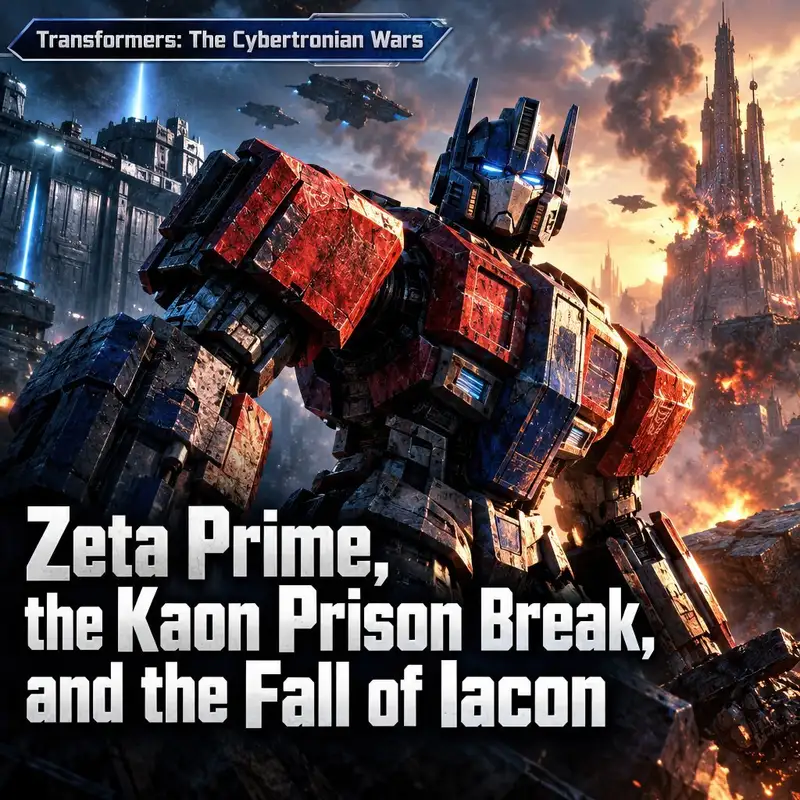
Zeta Prime, the Kaon Prison Break, and the Fall of Iacon
Megatron’s assault on Iacon was not designed as a simple contest for streets, towers, or defensive walls. In the main-console and PC campaign of Transformers: War for Cybertron, the visible battle served another purpose. Starscream was ordered to keep Zeta Prime’s forces under direct pressure, fixing the Autobots in place and forcing them to spend attention, ammunition, and command capacity on the immediate attack. Behind that struggle, Megatron moved with Soundwave and Breakdown through Iacon’s defensive depth.
Their objective was what they believed to be the Omega Key, a means of reaching Cybertron’s Core and controlling the source of the planet’s power. That distinction mattered. A city can survive bombardment, even heavy bombardment, if its government, communications, energy system, and strategic reserves remain functional. But a force that gains access to the planetary system sustaining those institutions can turn a battle for one capital into a campaign for Cybertron itself. Iacon was still fighting. Its defensive lines had not just vanished. Yet its strategic defeat was already being prepared behind those lines.
Zeta Prime understood enough of Megatron’s intention to prepare a defense. He did not wait passively for the Decepticons to locate the supposed key. Instead, he drew them into a fortified chamber where the terrain, machinery, and defensive systems favored him. Zeta could project energon duplicates, create a powerful shield, and control the engagement space with a degree of precision that made a direct assault costly. This was not merely a personal duel between two leaders. Zeta’s authority rested on a larger structure: Iacon’s defenses, the High Council, the city’s communications, and the systems built to protect the route to the Core. His chamber was an expression of that institutional power. It also revealed its weakness.
The shield and clone systems required time to recharge. Once Soundwave identified that recovery cycle, Megatron no longer needed to defeat Zeta on terms favorable to Zeta. He needed only to attack the machinery that made Zeta’s defense possible. That is what the Decepticons did. The decisive act was not a clean victory in combat. It was the destruction of the system sustaining the defender’s control of the room. Zeta had anticipated intrusion, and his preparations delayed it. But he had built a defense dependent on a technical rhythm his enemies could observe, exploit, and finally break. Tactical ingenuity could not compensate for an operational system with a single exposed point of failure.
The device Megatron recovered was not, in fact, the Omega Key in the ordinary sense of a portable artifact that could simply be seized and used. It was an activation mechanism. Its purpose was to awaken Omega Supreme, the immense guardian that stood between the Decepticons and Cybertron’s Core. In the game’s own logic, Omega Supreme was the real key to the problem. He was both a defender and an access mechanism, a living strategic barrier whose mission was to destroy Megatron before Megatron could continue toward the Core. That revelation changed the character of the campaign. The Decepticons had not found a tool that would hand them control of Cybertron. They had triggered the planet’s final guardian.
Omega Supreme’s arrival denied Megatron an immediate breakthrough. Raw aggression was not enough. The Decepticons had to study the guardian, maneuver around his attacks, exploit fixed ion turrets, use the environment for cover, and identify the systems on which his recovery depended. Their success was therefore not proof that any Decepticon force could casually defeat a Titan-scale defender. The game shows a specific operation against a specific guardian under unusual conditions. Megatron’s forces learned that Omega could be damaged, that his repair cycles mattered, and that Dark Energon could corrupt systems that ordinary weapons could not reliably overcome. The guardian’s size and firepower gave him battlefield dominance, but they did not make him independent of maintenance, energy, or vulnerability to contamination.
Dark Energon was central to this effort. In this continuity, it was not just a more powerful fuel or a dramatic visual effect. It was a dangerous strategic technology. It empowered Megatron’s campaign, enabled corruption, and created access to systems that should have remained beyond Decepticon reach. Megatron spoke of it as the means by which he would restore Cybertron’s former glory. That was a political claim, and a self-serving one. The events that followed showed that Dark Energon could produce leverage and destruction. They did not prove that it could heal the world Megatron was poisoning in order to control it.
When Omega Supreme was disabled and corrupted, Iacon lost more than a powerful defender. It lost its ultimate reserve. The Decepticons had degraded the city’s defensive architecture in sequence: first the protected command chamber, then Zeta Prime’s ability to direct its systems, then the guardian protecting the Core route. Megatron had not simply beaten an Autobot leader. He had broken through the layers that made Iacon governable and defensible.
Zeta Prime survived the destruction of his defenses, but only barely. Critically damaged, he was taken from Iacon to the Kaon Prison Complex. That transfer carried political meaning as well as military value. A captured Prime was not just an enemy officer removed from the battlefield. Zeta represented the recognized Autobot leadership order at the moment when Iacon’s defenses were failing. Holding him gave Megatron a hostage, a propaganda opportunity, a source of intelligence, and a way to demonstrate that Decepticon power extended beyond raids and battlefield victories. It could imprison the leader of its enemy inside a facility built to make resistance appear futile.
Kaon was more than a dungeon with a familiar name. The game presents it as a coercive institution. It contained prisoners, execution systems, layered security, and industrial infrastructure connected to the Decepticon war effort. Its Energon Bridge powered Megatron’s orbital station. That detail matters because it links detention to the larger military system. The prison was not isolated from the war. It was part of the machinery that sustained Decepticon coercion across the planet. Energy passed through Kaon to support orbital firepower, while prisoners were held within the same controlled environment. The game does not provide a complete map of Decepticon logistics, nor does it establish that every Decepticon facility functioned in the same way. But it does establish a material connection between imprisonment, energy transmission, and military power.
The capture of Zeta also deepened Iacon’s crisis. The city had lost its recognized leader at the same time that its defensive systems were being penetrated and its ultimate guardian was being neutralized. Command did not disappear in a single explosion. It became fragmented. Some forces remained in the field. Defensive infrastructure still existed, though damaged. But the political center of Autobot resistance had been removed, and the city’s ability to coordinate its own survival was under direct pressure. This was the setting into which Optimus emerged. Not as an already confirmed Prime, and not as the beneficiary of a stable handover, but as a commander operating amid the wreckage of an existing order.
When the Autobot campaign reaches Iacon, the city is described as lying in ruins and Zeta Prime is presumed defeated. Optimus is present as a field commander, not yet as the formally recognized leader of all Autobots. That distinction is essential. In this game’s history, Optimus does not begin the crisis with unquestioned constitutional, spiritual, or political authority. He earns practical authority because the situation requires someone to make decisions while the formal leadership structure is absent.
The immediate priorities were not glamorous, but they were decisive. The Autobots needed to restore Iacon’s planetary guns, reduce Decepticon air pressure, reestablish communications, and regain access to the Decagon. Each task addressed a different part of the city’s survival. The guns mattered because Iacon could not function while hostile air power and orbital pressure went unanswered. Communications mattered because scattered defenders cannot become a coherent force merely by sharing a symbol or a common enemy. They need warning, coordination, orders, intelligence, and the ability to identify where help is needed. The Decagon mattered because it was part of the network through which Iacon could act as a city rather than a collection of isolated strongpoints.
Optimus, Bumblebee, and Ratchet therefore fought a defensive campaign whose purpose was not simply to eliminate Decepticons in the streets. They were trying to make Iacon function again. Bumblebee carried messages and joined the fighting. Ratchet provided technical and medical support. Optimus directed the movement toward objectives that would restore the city’s capacity to communicate and defend itself. This was practical command in the clearest sense. There was no ceremonial transfer of power. There was only a damaged capital, dispersed defenders, and a commander who could identify the systems that had to be recovered before any larger decision became possible.
That work produced a limited counteroffensive. The planetary guns helped clear the skies. The Autobots pushed through damaged infrastructure and restored the Decagon’s communications grid. Starscream attacked the command position, but the Autobots drove him back and forced a retreat. At the tactical level, these were real gains. Important defensive positions were recovered. The city could transmit again. The Decepticons could no longer assume that Iacon had become silent, blind, and unable to coordinate.
The wider operational effect was even more important. Restored communications allowed the Autobots to do more than endure. They could receive information, organize a response beyond the nearest firefight, and reconnect separated elements of their defense. A city that can communicate can still make choices. It can redirect forces, warn threatened sectors, coordinate rescue, and preserve a sense that its government has not just dissolved into rubble.
But the success had limits. Iacon was not secure. Starscream’s withdrawal was not the collapse of Decepticon power. The planetary guns did not undo the damage already done to Omega Supreme or restore Zeta Prime’s command. Most importantly, the fighting around Iacon did not resolve the crisis developing at Cybertron’s Core. The Autobots had regained a measure of tactical and operational control, but their strategic position remained fragile. They could defend systems. They could not yet repair the political order that had relied on those systems.
Then the restored network produced a transmission that should not have been possible. The signal carried Zeta Prime’s unique data signature. If authentic, it meant that Zeta had survived his defeat and was being held somewhere within Decepticon-controlled territory. Ratchet had reason to doubt it. The Autobots had seen the apparent wreckage of Zeta’s fall. A signal can be forged, manipulated, or sent under coercion. In a war shaped by infiltration, corrupted machinery, and enemy control of communications, authenticity could not be assumed merely because a message carried the right identifying pattern.
Optimus nevertheless chose to investigate. This was not simple trust, and it was not the kind of decision that can be reduced to personal loyalty. The signal might have been a trap. In fact, it was part of a trap. But the possible recovery of Zeta Prime carried immense military and political weight. If Zeta lived, he remained the recognized leader whose return might stabilize the Autobots at the exact moment Iacon’s institutions were under strain. Even if his condition made a return to full command uncertain, abandoning him without investigation would have had consequences for morale, legitimacy, and the Autobot understanding of what leadership required.
Optimus accepted the risk because the alternative carried its own danger. A commander cannot preserve a force by refusing every uncertain mission. The question is whether the possible gain justifies the exposure. Here, the potential gain was not merely the rescue of one prisoner. It was the recovery of the head of the existing political order. The decision also demonstrated something about Optimus’s command style before he became Prime. He did not wait for formal authority to make every choice for him. He weighed incomplete intelligence, understood the danger, and committed a small team to an operation that could either recover Zeta or reveal the depth of Megatron’s control.
The plan itself reflected the limited options available. Optimus, Bumblebee, and Sideswipe deliberately allowed themselves to be captured in order to enter Kaon Prison from within. This was not a clean covert insertion. They were not slipping through an unnoticed access hatch with a secure extraction route and a detailed map. They were placing themselves at the mercy of an enemy facility designed to contain, identify, and kill prisoners. The strategy depended on creating opportunity from captivity. It was bold, but it was also an acknowledgment that the Autobots lacked a safer way to reach Zeta inside the complex.
The danger became immediately clear. The team was nearly executed by firing squad before Air Raid intervened. Kaon’s security did not treat prisoners as a routine administrative burden. Its systems were organized around coercion, intimidation, and lethal control. Once the Autobots escaped confinement, they faced another problem. The prison held other captives. The game does not establish the identities, numbers, or full legal status of everyone detained there, and it would be wrong to invent those details. Yet their presence changed the operation. A rescue force that discovers prisoners cannot regard them merely as scenery. Their liberation became both a moral obligation and a tactical opportunity.
The Autobots released the prisoners and created a diversion within the complex. Air Raid was assigned to escort the liberated group back toward Iacon, while Optimus, Bumblebee, and Sideswipe continued deeper into Kaon to locate Zeta. This division of labor was militarily sensible, but dangerous. It prevented the main rescue team from being burdened with the entire withdrawal, while giving the released prisoners an escort through hostile territory. It also meant that the operation now had multiple objectives: recover Zeta, preserve the freed prisoners, disrupt Kaon’s security network, and escape a facility still under Decepticon control.
The prison break exposed a weakness in Megatron’s coercive system. Any detention regime depends on more than walls and weapons. It depends on controlled movement, reliable communications, disciplined guards, and the belief among prisoners that escape is impossible. Once prisoners were released and security forces had to respond across several parts of the complex, Kaon’s apparent order became a liability. Its systems were interconnected. Disruption in one sector could compel a response elsewhere. The prison had been built to contain resistance, but in the course of the break it became a battlefield whose very concentration of captives created a source of instability.
That did not mean Megatron had lost control of the operation. The rescue was unfolding inside his design. The Zeta transmission had been used to draw Optimus into Kaon. Megatron revealed the trap openly once the Autobots were deep enough inside the complex that escape would be difficult. His message was strategic as much as personal. The Autobots, he argued, faced a choice: abandon Cybertron or remain and face annihilation. It was an ultimatum framed as inevitability. Megatron presented his own plan as the only path to Cybertron’s restoration, claiming that Dark Energon would give him the power to revive the world’s former strength.
The evidence available in the campaign does not support accepting that claim at face value. Megatron’s program did produce power. It also corrupted Omega Supreme, opened the route to the Core, and damaged the planetary systems on which Cybertron depended. His language of restoration was therefore inseparable from a policy of contamination and coercion. He did not offer a demonstrated reconstruction plan. He offered domination over a world he was willing to endanger in order to win the war.
Soundwave was indispensable to that system. In this game, he is not just a communications specialist standing beside Megatron. He functions as an intelligence officer, systems analyst, technical adviser, prison-security coordinator, and tactical support commander. He had identified the weakness in Zeta Prime’s defensive chamber. He traced and exploited communications. At Kaon, he directed layered security and deployed Frenzy, Rumble, and Laserbeak as subordinate combat assets. Their presence was not simply a parade of recognizable names. It showed how Soundwave extended his reach through specialized tools and personnel. A prison does not defend itself by architecture alone. It relies on surveillance, response forces, technical control, and the ability to isolate intruders before they can turn disorder into escape.
Megatron’s command structure was effective at coercion because it concentrated authority. He could force Starscream to continue an assault even when Starscream preferred retreat. He could use Soundwave’s analysis to exploit technical weaknesses. He could turn a prison into a trap and an energy bridge into support for orbital power. But that effectiveness rested heavily on Megatron’s personal will and on technologies that were destructive even to the planet he claimed to save. It was a formidable war machine. It was not evidence of stable governance.
The Autobots escaped the trap, but escaping did not restore the earlier political order. By the time Optimus and his team reached Zeta Prime, the purpose of the rescue had changed. Zeta was connected to a life-draining apparatus. Soundwave sought to exploit the Prime’s remaining life energy to restore himself, turning captivity into extraction. That detail made Kaon’s brutality explicit. Zeta was not just held for negotiation or public display. His damaged body was being used as a resource by the Decepticon system.
Optimus and his team drove Soundwave off, but the rescue came too late to save Zeta. He was recovered alive only long enough to make clear that he could not survive. His death is final within the game’s narrative. There is no later revelation that he was secretly rebuilt, no ambiguous disappearance, and no suggestion that the Autobots might simply repair the damage away. The prison break ended Zeta’s captivity. It did not reverse the injuries inflicted by the fall of his defenses, his capture, and the extraction process inside Kaon.
The personal loss was immediate. Zeta had been an established leader, and the Autobots who reached him did not recover an abstraction. They recovered a dying comrade and commander. Yet the institutional consequences were equally severe. The Prime whose existence had justified the dangerous mission was now gone. The operation had succeeded tactically in several ways. Prisoners were liberated. Kaon’s security was disrupted. A Decepticon trap was survived. The Autobots had proved that Megatron’s coercive institutions could be penetrated from within. But politically, the rescue confirmed a succession crisis rather than resolving it.
There was also a moral consequence. Kaon demonstrated the nature of Decepticon power in this phase of the war. Its detention was extractive and lethal. Prisoners were threatened with execution. Zeta’s remaining life was treated as something to be harvested. The facility’s connection to the orbital station showed that coercion, energy control, and military pressure were parts of one system. The game does not require us to invent a complete legal code or prison bureaucracy to see what Kaon represented. It was a place where the Decepticons converted captured opponents into leverage, labor within a controlled system, and disposable obstacles to their larger campaign.
When Optimus returned Zeta’s body to the High Council, the war’s military crisis became a constitutional necessity. The Council’s broader powers are not fully documented in the game. It would be too much to describe it as a complete democratic government or a unified constitutional body with clearly defined procedures. What the story does establish is that the Council selects Primes, and that Primes are expected to lead and protect Cybertron. With Zeta dead, the Council had to confront the question of who could exercise that role while Iacon remained under threat and Cybertron itself approached catastrophe.
Optimus did not immediately embrace the title. His reluctance matters because it separates the office from personal ambition. He had exercised leadership in practice. He had helped restore Iacon’s defenses, accepted the risk of investigating Zeta’s signal, led the prison operation, and returned with proof that the existing Prime could not be saved. Yet practical command and formal legitimacy are not the same thing. A field commander can direct a battle. A Prime must carry a broader burden: political authority, military responsibility, and the symbolic duty to protect a civilization in crisis.
The Council recognized in Optimus the courage and influence needed for that role. Their judgment was not based on a single victory. In fact, the defining circumstances around him were full of loss. Iacon had been devastated. Zeta had died. The Decepticons had reached the Core route. What distinguished Optimus was his ability to connect immediate military action to the survival of the larger community. He understood that communications had to be restored before a city could act. He understood that Zeta could not simply be abandoned when a credible signal appeared. He understood that prisoners inside Kaon were not expendable once the rescue team had the means to free them. Those choices did not make him infallible. They showed a command instinct directed toward preserving people and institutions rather than merely holding ground.
His legitimacy developed in layers. First came practical authority in Iacon, where others followed his decisions because the emergency required leadership. Then came operational judgment at Kaon, where he accepted a dangerous mission for both personal and political reasons. Then came recognition by the High Council, the institution charged with selecting Primes. Finally came confirmation at Cybertron’s Core itself.
The journey to the Core made clear why this final recognition was necessary. Optimus went with Ironhide and Warpath, heavy combat allies suited to a route where direct force would still be required. They confronted a corrupted creature feeding on Dark Energon, an immediate manifestation of the contamination Megatron had unleashed. When the Autobots defeated it and reached the Core, they learned that the damage was deeper than a localized infection or a temporary military setback. The Core explained that its spark had been compromised. It could survive only by shutting down for millions of years, leaving Cybertron cold and barren while it recovered.
The Core gave part of its own spark to the Matrix of Leadership, along with the collective wisdom of the Primes. This is a continuity-specific account of the Matrix. It should not be treated as a universal explanation for every Matrix in every Transformers history. Here, its importance was not that it magically solved the war. It did not cleanse Cybertron, rebuild Iacon, restore Zeta, or defeat Megatron by itself. Instead, it bound Optimus’s new authority to the survival of the planet and to the accumulated responsibility associated with earlier Primes. The title of Prime was no longer only a Council decision. It was recognized by the very planetary system whose collapse now defined the war.
That convergence matters. Optimus became Prime when institutional recognition, battlefield record, and planetary authority came together under emergency conditions. The Matrix did not create leadership out of nothing. It confirmed a leader who had already been forced to act before formal succession could catch up with events.
The fall of Iacon, then, was not a clean Decepticon conquest in which every district was permanently occupied, every Autobot captured, and the city erased from the map. The game does not establish that. Iacon’s defenders reclaimed important systems. Its planetary guns operated again. The Decagon’s communications grid was restored. Starscream was driven back from a command attack. Prisoners escaped Kaon and were escorted toward Autobot lines. Those were not meaningless gestures. They were tactical and operational successes achieved under extreme pressure.
But they could not reverse the larger collapse. Iacon had lost Zeta Prime. Its defensive architecture had been penetrated. Omega Supreme, its ultimate guardian, had been corrupted and disabled. Megatron had gained access to the Core route. And the Core itself was damaged badly enough that Cybertron could not remain active and habitable in the form its defenders had known. Holding a capital is not the same as preserving a civilization. The Autobots could still contest Iacon. They could not make it the stable political anchor it had been before Megatron’s offensive.
The Core’s decision to shut down transformed every remaining military calculation. A city defense assumes that the city can sustain its population, power its systems, repair damage, and serve as a base for further operations. Once Cybertron’s energy source had to enter a shutdown lasting millions of years, those assumptions collapsed. The problem was no longer how to defend Iacon at any cost. It was how to preserve Autobots and civilians through an evacuation from a world that could no longer support them.
Optimus ordered the evacuation of the Autobot cities. This was his defining strategic decision. It was not a declaration that Megatron had achieved legitimate rule. Nor was it surrender in the ordinary sense. The Decepticons had gained access to the planet’s most vital systems, but their method had damaged the very world they sought to dominate. The Autobots’ answer was to preserve what could still be preserved: people, ships, memory, command capacity, and the possibility that their political cause could survive beyond Cybertron.
The outcomes must be kept separate. Tactically, the Autobots restored defenses, resisted Decepticon pressure, and escaped Kaon with liberated prisoners. Operationally, they regained enough communications and coordination to conduct rescue, organize withdrawal, and avoid total collapse in Iacon’s ruins. Strategically, however, the Core crisis made the long-term defense of Cybertron unsustainable. Politically, Zeta Prime’s death ended one leadership order, while Optimus’s elevation began another. Logistically and socially, evacuation became necessary because a cold and dormant Cybertron could not support the population whose survival the Autobots claimed to defend.
The Kaon prison break mattered because it transformed Zeta Prime’s apparent disappearance into a confirmed succession crisis. It showed that Iacon’s damaged defenses could be repaired only temporarily, that Decepticon coercion could be disrupted but not wished away, and that the war had reached a point where symbolic possession of the capital was less important than the survival of the people connected to it. Optimus Prime’s first great act of command was not winning Iacon back. It was recognizing that the Autobots could abandon a failing capital without abandoning the cause for which they were fighting.