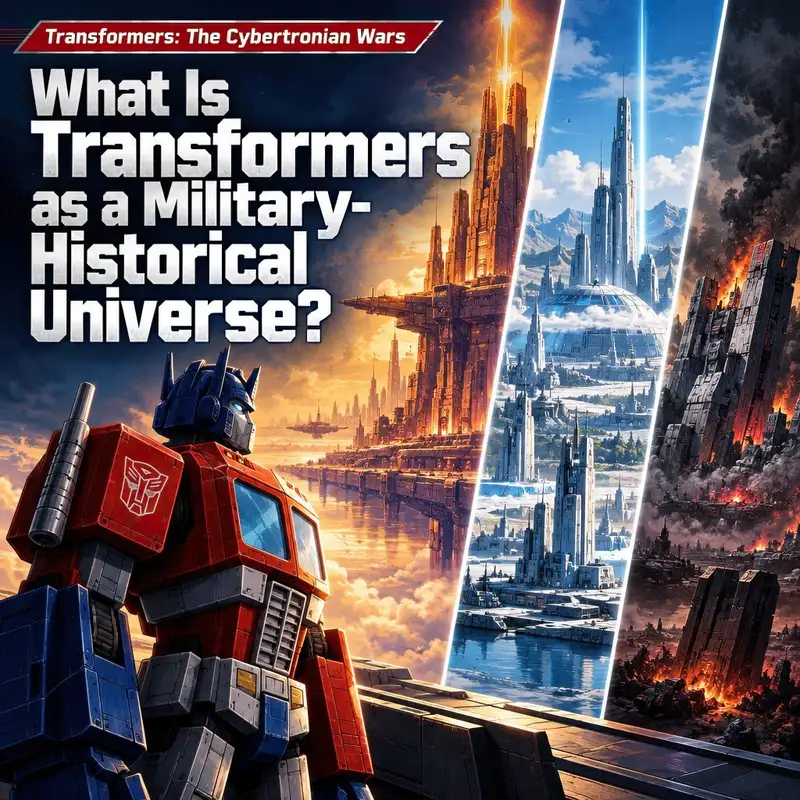
What Is Transformers as a Military-Historical Universe?
A listener can move from one Transformers story to another and find the same names waiting there. Optimus Prime and Megatron are at war. Cybertron is under threat. Autobots and Decepticons carry familiar symbols. Somewhere nearby, there may be a Matrix, an AllSpark, an ancient city, a starship called the Ark, or a warning that an artifact must not fall into enemy hands.
Then the details change. Optimus may be a head of state, a battlefield commander, a reluctant civilian leader, or a young worker who has not yet become Optimus Prime. Megatron may be a revolutionary, a military strongman, a gladiator, a miner, a criminal leader, or a figure shaped by an entirely different betrayal. Cybertron may be a dying industrial planet, a functioning but unequal society, an occupied homeland, an evacuated ruin, or a city-world whose past has been deliberately concealed.
Those changes are not just mistakes waiting to be repaired by a sufficiently determined fan with a timeline chart. They are the central fact of the franchise. Transformers is not one uninterrupted history. It is a family of related histories, told through animation, comics, films, novels, games, toys, and other media. The names recur because the questions recur. The events do not necessarily recur in the same way.
That distinction is useful. Franchise continuity is the broad inheritance of ideas, images, character concepts, and conflicts. It is why an Autobot insignia means something to an audience even when the institution carrying it has changed. Narrative continuity is narrower. It is the specific history established by one released story, or by a group of stories that explicitly belong together.
A military historian would call this a problem of records. Several accounts may describe a war between factions with the same names, fought on a world called Cybertron, led by figures called Optimus Prime and Megatron. But if those accounts disagree about the governments involved, the causes of the war, the technology available, and the outcome, they are not fragments of one damaged archive. They are separate historical files.
That does not make the franchise incoherent. It makes it comparative. Each new version can ask a familiar question under different conditions. What happens when a rigid society cannot reform? What happens when a movement against inequality becomes an army? What happens when survival requires exile? What happens when a distant planet becomes the battlefield for a conflict it did not create? And what happens after the shooting stops, when a civilization must decide whether it has defeated an enemy or merely inherited a war?
Transformers began in the United States in nineteen eighty-four through a combination of toys, Marvel comics, and the animated series The Transformers. The launch was coordinated, but it did not create one perfectly unified account. The comic and cartoon shared basic ideas, recognizable characters, and a war between Autobots and Decepticons. They also developed different histories, different political structures, and different answers to important questions.
That early split established a habit that would shape the franchise for decades. Familiar concepts could move from one medium to another without carrying every detail of their previous biography. A character could retain a name and visual role while receiving a different past. A city, artifact, or faction could return with a new strategic purpose. What looked like repetition was often reinterpretation.
The American animated branch, including the nineteen eighty-six film, developed one screen history of the long Autobot-Decepticon war, the struggle on Earth, and a later change in political and military leadership. That film matters enormously inside its own animated record. It does not by itself explain the history of Marvel’s comic Cybertron, Japanese sequel animation, later Beast Era stories, or modern films.
Marvel’s comics offered another early record, one that eventually expanded through American and British publication in ways the cartoon never did. It carried its own political assumptions, cosmic mythology, military reversals, and future histories. The fact that both branches used names such as Optimus Prime, Shockwave, or Galvatron did not make those figures interchangeable. They occupied different institutions and made decisions under different circumstances.
Japanese animation and print material developed further branches, sometimes adapting familiar premises and sometimes carrying them into new directions. Later decades repeated the pattern through new animated series, game universes, film continuities, comic relaunches, and alternate worlds. The franchise did not abandon its past. It used its past as a working vocabulary.
That vocabulary is why Transformers can be read as military history rather than simply a sequence of battles. The stories repeatedly return to questions of political legitimacy, energy supply, industrial capacity, intelligence, occupation, civil resistance, alliance, and reconstruction. The participants are mechanical beings, but the problems are recognizably social. A sentient machine civilization still needs a government, a power grid, transport routes, repair facilities, trained specialists, and some answer to the question of who has the right to command.
Cybertron itself is therefore never just a backdrop. It is often the strategic center of the story, but its condition changes from continuity to continuity. In one account, it may be a homeland drained by a war that has gone on too long. In another, it may be a prosperous society whose institutions concealed severe inequality. In another, it is a postwar world trying to govern former enemies. In still another, it is a city civilization shaped by deception, restricted opportunity, and a struggle over the very right to transform.
The Generation One animated history gives Cybertron the character of a lost home. The war reaches Earth after the opposing forces leave their planet, and the distant conflict becomes an exile war. Earth matters because it provides refuge, resources, concealment, and a new theater of operations. Cybertron remains emotionally and strategically important, but the war can continue far from it.
The 2005 I D W comic continuity approaches the prewar world differently. Its Cybertron is more than a planet waiting to be invaded or abandoned: it is a society with social hierarchy, political exclusion, institutional violence, and contested ideas of citizenship. In that setting, war is more than a clash between two eternal species: it is the outcome of a political crisis that existing institutions fail to contain.
Transformers One offers another distinct account. Its Cybertronian society includes miners, transformation cogs, a ruling order, and a concealed history of authority. Its Orion Pax and Dee Sixteen are not imported from any earlier comic, cartoon, or film record. The story uses familiar names to examine a different society and a different collapse of trust. The military importance of that setting lies in the way power is concentrated before open war even begins.
EarthSpark presents yet another political landscape. It is not a straightforward retelling of a civil war’s opening phase, but a postwar world where former combatants, human communities, new institutions, and Transformers born on Earth must negotiate what peace actually means. The question is no longer only who wins Cybertron. It is who belongs in a society after a long conflict has rearranged every category of trust.
These differences matter because history begins with institutions, not with the most famous commanders. Before asking whether Optimus made the right operational choice, it helps to ask what authority he possessed. Was he recognized by a government? Did he lead a resistance? Did he command a small expeditionary force? Did his legitimacy come from law, religion, military necessity, or personal reputation?
The same applies to Megatron. Before treating him as a universal enemy commander, a historian has to establish which Megatron is under examination. What grievance, ideology, ambition, or opportunity gave him influence? Did he inherit a military system, build one from a political movement, seize control of a fractured state, or exploit a society already coming apart? The answer changes the war.
This is also why Cybertronian origin stories must remain where they belong. Some continuities invoke Primus. Others use the AllSpark, Vector Sigma, Quintesson creation stories, forging, protoforms, transformation cogs, or accounts that remain uncertain or disputed. These are not interchangeable pieces of one cosmic operating manual. They are part of the political and religious history of their own worlds.
An origin story can justify a social order. It can define who is considered natural, legitimate, chosen, constructed, expendable, or entitled to rule. It can also be propaganda. When a government, priesthood, archive, or military command claims to possess the true account of Cybertron’s past, the historian should ask who benefits from that certainty.
The Autobots and Decepticons require the same care. They are usually factions, not biological species. An Autobot is not born with an Autobot spark. A Decepticon is not a separate kind of machine life. The labels normally describe political allegiance, institutional membership, military affiliation, or identity formed through conflict.
In one branch, the Autobots may function as a resistance movement defending civilians against a conquering force. In another, they may be part of a government, a security structure, a civic coalition, or a small group of explorers pulled into a much larger war. Their symbol may represent liberation, lawful authority, military command, exile, or a difficult postwar inheritance.
The Decepticons vary just as much. They may begin as a revolutionary movement, a separatist force, a military faction, a criminal network, an occupation regime, or an authoritarian army. Some stories examine real grievances behind their support. Social exclusion, caste restrictions, unequal access to power, contempt for labor, or political repression can make a movement attractive before it becomes openly violent.
That does not excuse what follows. A cause may begin with a legitimate complaint and still become an instrument of conquest, terror, forced labor, repression, or dictatorship. The history of revolutions offers no shortage of examples. A movement can condemn hierarchy while building a more brutal hierarchy of its own. It can promise representation, then define dissent as treason once it controls the guns, the archives, and the fuel supply.
The Autobots should not receive a blank check simply because they oppose that outcome. A faction that claims to defend freedom can still make poor decisions, use emergency authority too broadly, conceal information, rely on unaccountable commanders, or fail to build institutions capable of surviving the war. Military necessity is a powerful argument. It is also one of the oldest excuses for avoiding political reform.
The important question is not whether one emblem is permanently virtuous and the other permanently corrupt. The question is what each faction becomes under pressure. Who recruits? Who commands? Who provides repair and energon? Who controls communications? Who protects civilians, and who decides which civilians count? Those are the questions that convert a familiar conflict into a historical study.
Civil wars rarely begin as conventional wars. They begin with institutions that no longer command confidence. A legislature ignores a social class. A police force serves a narrow elite. A resource system turns scarcity into a privilege. Reformers discover that peaceful participation changes nothing. Security agencies respond to dissent with surveillance, detention, or violence. Leaders who promise action gain an audience because the established order has failed to offer dignity.
Transformers stories repeatedly use versions of this pattern. The details differ, and they should not be forced together, but the political sequence is recognizable. A grievance becomes an organization. An organization develops symbols, myths, and leaders. It acquires weapons, recruits veterans, or finds supporters in the security forces. A government responds unevenly. Moderates lose influence. Neutrality becomes dangerous.
At that point, violence is no longer only tactical. A raid, assassination, or riot may be a localized event. Militarization is broader. It occurs when political identity becomes inseparable from armed capacity. Factories change production. Archives become targets. Communications systems carry propaganda and orders. Cities are divided by checkpoints, patrols, and faction control. Citizens are asked to prove loyalty before they can obtain work, energy, repair, or safety.
This is the moment when civil society begins to collapse into factional society. A resident is no longer first a worker, scholar, medic, engineer, or neighbor. They become an Autobot sympathizer, a Decepticon collaborator, an unreliable neutral, or a possible security threat. In any war, that is a dangerous transformation. In a machine civilization, where access to energy and repair can determine survival, it is especially dangerous.
The recurring pattern across Transformers is not that every war begins in exactly the same way. It is that political identity can harden into military identity so completely that victory appears easier to imagine than reconciliation. Once a faction has organized its entire society around the conflict, peace becomes more than a ceasefire. It threatens careers, myths, chains of command, and the moral story each side tells about itself.
War also requires sustainment. Cybertronians may not eat human food, but they are not free from logistics. They require energy, repair, replacement parts, secure facilities, transport, specialists, and time. An army that cannot maintain damaged personnel eventually discovers that battlefield success has an expiration date.
Energon is central to many Transformers stories, but it should never be treated as one standardized substance across the franchise. Depending on the continuity, it may function as fuel, nourishment, a strategic commodity, a raw resource, a dangerous experimental material, or something with religious and biological significance. Its color, scarcity, effect, and method of use vary. The military problem does not.
Someone must extract it. Someone must refine it. Someone must move it through contested territory, store it safely, protect it from sabotage, and decide whether it goes to civilians, hospitals, factories, ships, or front-line forces. A leader who controls an energon source has gained leverage. That is not the same as possessing a durable war economy.
A captured mine does not repair damaged troops by itself. A laboratory breakthrough does not produce a reliable fuel supply without equipment, trained workers, security, and distribution. A relic that produces extraordinary power may be decisive in one operation while remaining impossible to reproduce. Military history is full of commanders who mistook possession of a resource for mastery of a system.
The industrial side matters just as much. Shipyards, refineries, foundries, archives, repair bays, weapons facilities, and construction centers are not glamorous in the way a duel between leaders can be. They are often more important. A faction that can replace ships, restore infrastructure, train technicians, and recover damaged personnel may survive setbacks that would destroy a force dependent on one fortress, one artifact, or one charismatic commander.
Cybertronian body construction adds another layer of complexity. In some continuities, the creation of a body is closely connected to the creation of a person. In others, those questions are separate. A chassis can be built, but a spark, mind, or identity may require something more. The historian must resist easy analogies. Building a vehicle is not necessarily the same thing as creating a soldier.
Civilian access to energy and repair becomes political power. A regime that rations energon can reward loyalty and punish dissent. A resistance that protects repair facilities can build legitimacy. An occupying army that seizes transport routes may control a city without winning the affection of its inhabitants. The administrative side of war is often where the future is decided.
Transformation changes military operations, but it does not abolish geography. A ground vehicle mode may improve mobility on roads, offer cargo capacity, or allow a Cybertronian to blend into civilian traffic. An aircraft mode may provide reconnaissance, reach, and rapid response. A beast mode may offer concealment in a particular environment. A spacecraft mode may open routes unavailable to ground forces.
None of those advantages is automatic. Roads can be blocked. Terrain can be unsuitable. Local infrastructure may not support the disguise. A vehicle form can attract attention through behavior, heat, energy signature, language, registration, or the simple difficulty of explaining why a parked truck appears to be conducting surveillance. Concealment is not invisibility. It is a temporary advantage that depends on context.
Transformation also does not eliminate maintenance. A damaged conversion system, depleted energy reserve, compromised sensor suite, or unsuitable environment can narrow a character’s options quickly. A vehicle mode is a capability, not a guarantee. It changes how a force can move, not whether it can sustain a campaign.
Strategic mobility has its own systems. Space bridges, ground bridges, transwarp devices, and starships can compress distance, but they introduce new dependencies. A bridge may require power, coordinates, operators, fixed infrastructure, a stable destination, or protection from interference. A ship requires navigation, repair, fuel, crew, and a route that the enemy may contest.
Forces that can move still need information. The phrase robots in disguise may sound like a simple adventure premise, but it describes an intelligence problem. A disguise must deceive more than the eye. It must survive records checks, surveillance, behavioral scrutiny, energy detection, and local knowledge. It must also account for the fact that a sentient alien vehicle may have very different ideas about normal traffic behavior.
Espionage in Transformers can involve infiltration, false identities, intercepted transmissions, hacking, compromised archives, altered memories, remote systems, and double agents. It can also involve the oldest intelligence failure of all: a commander believing what they want to believe because the information confirms a useful story.
Recurring figures such as Soundwave, Shockwave, Prowl, or various Cybertronian computers are often associated with intelligence, surveillance, or technical knowledge. That association does not grant universal omniscience. Their roles, abilities, loyalties, and limits change across continuities. A system may be advanced and still be deceived, outdated, manipulated, physically inaccessible, or constrained by bad assumptions.
Archives are evidence, not automatic truth. A sacred text may preserve an ancient memory while serving a modern political agenda. A government record may accurately describe infrastructure while concealing repression. A personal memory may be sincere and still incomplete. In some stories, memory itself can be altered, suppressed, copied, or weaponized. The historian has to ask not only what the record says, but who made it, under what conditions, and what it was meant to prove.
This discipline becomes even more important when a Cybertronian war reaches another world. Earth is often a refuge, a resource base, a battlefield, and a political complication all at once. It is never simply an empty stage where alien factions settle an old argument.
Humanity is not one actor. A family that shelters an Autobot has different interests from a national military. A police agency, intelligence service, corporation, scientific laboratory, elected government, resistance group, and civilian population may all respond differently to the discovery of Cybertronian life. One government’s secret alliance does not constitute humanity’s consent.
Colonies and other societies deserve the same attention. A colony world may be a refuge, a source of resources, a strategic outpost, a target for occupation, or a community with interests of its own. It should not be read as a blank extension of Cybertron. Distance can create distinct political identities, separate economic needs, and resentment toward a homeland that remembers a colony only when it needs reinforcements or raw materials.
When a war spreads beyond Cybertron, it multiplies the number of actors without resolving the original conflict. New allies can provide security, but they can also deepen dependency. A local population may welcome protection while resisting foreign command. An artifact recovered on another world may shift the military balance while creating an international crisis. The war becomes larger, but not necessarily clearer.
The Beast Era demonstrates why familiar terminology requires particular care. Beast Wars and Beast Machines establish a future setting with Maximals, Predacons, prehistoric Earth, time intervention, sparks, altered bodies, and a transformed Cybertronian political environment. These are not just Autobots and Decepticons wearing different alternate modes.
Maximals and Predacons may carry the memory of earlier factional conflict, but they must be understood according to their own branch. They are not automatically biological descendants of named Autobots and Decepticons, and their institutions, legal status, and military roles are not inherited by simple analogy. A future political label does not settle a question of ancestry, ideology, or personal loyalty.
The Beast Wars conflict also shows how time changes military analysis. An action in the past may threaten the conditions that allowed future participants to exist. A tactical opportunity may therefore carry a strategic and personal cost far beyond the immediate battlefield. Time travel does not remove uncertainty. It intensifies it, because the participants may not know whether they are preserving history, damaging it, or acting inside a future that has already changed.
Beast Machines adds different questions about Cybertronian bodies, technology, organic transformation, governance, and identity. It cannot be used as a universal explanation for what all Cybertronians are or should become. Its concepts belong to its own philosophical and political setting.
Across the franchise, sparks, bodies, memory, reformatting, repair, resurrection, and protoforms have different meanings. A destroyed body does not always settle the question of death. A recovered memory does not always settle the question of identity. A rebuilt chassis may represent medical survival, replacement, transformation, duplication, or something more ambiguous. The answer depends on the source.
What remains consistent is the moral importance of the question. Cybertronians are not disposable equipment simply because their bodies are technological. Injury can involve loss of mobility, memory, autonomy, identity, and access to community. Forced alteration, reprogramming, memory manipulation, imprisonment, and exploitation are not trivial because the victims are machines. In many stories, they are among the most serious violations the setting can depict.
Here, military history and moral history meet. War changes bodies, but it also changes the institutions that decide which bodies receive repair, which are treated as property, which are classified as enemies, and which are allowed to return to civilian life. A society may survive a battle and still be damaged by the rules it accepted in order to fight it.
So how should a listener approach a Transformers war without flattening it into a list of characters and explosions? Begin by identifying the exact continuity and controlling work. Is this the American Generation One cartoon, Marvel’s comics, a Japanese series, an I D W publication, an Aligned game, a live-action film branch, EarthSpark, Skybound’s Energon Universe, or Transformers One? The title alone is not always enough.
Next, establish the era and theater. Where is the action taking place? Is this a prewar political crisis on Cybertron, an occupation of a colony, a covert struggle on Earth, an evacuation through space, a future conflict shaped by time travel, or a postwar dispute over reconstruction? The answer determines what resources, institutions, and risks matter.
Then identify the participants as they exist in that record. Which version of Optimus Prime is present? What authority does this Megatron hold? Are the Autobots a government, resistance, expeditionary force, or civic coalition? Are the Decepticons an insurgency, army, criminal network, occupation authority, or fractured remnant? What do the human participants know, and which human institutions are actually involved?
After that, separate direct evidence from claims inside the story. A battle shown on screen is not the same kind of evidence as a politician’s speech about that battle. A sacred archive, intelligence briefing, damaged memory, faction manifesto, and toy biography do not carry equal weight. Marketing material can tell us that a product exists. It cannot settle a disputed event inside a narrative that says otherwise.
The next question is practical. What did each actor want, and what did they have? Political objectives matter, but so do energon supplies, repair facilities, transport routes, ships, skilled personnel, communications, intelligence, industrial capacity, and civilian support. A faction may possess a powerful artifact and still lack the ability to hold territory. Another may lose a duel and retain the factories that decide the next campaign.
Here, levels of war need to remain distinct. A tactical success is a local achievement. A raid captures a facility. A duel removes a commander. An infiltration reveals a secret. An operational success changes movement, reinforcement, supply, or the shape of a campaign. A strategic success changes the survival of a faction, control of a world, or access to a vital resource. A political success creates legitimacy that can outlast the battlefield.
These outcomes do not always align. A faction can win a battle and lose public support. It can capture a city while destroying the infrastructure needed to govern it. It can eliminate a leader and create a succession crisis. It can save Earth in the short term while leaving humans more fearful of Cybertronian presence. It can restore a planet’s power while failing to reconcile those who fought over it.
Artifacts, Titans, combiners, and other extraordinary systems should be treated with the same discipline. The first question is not just what they can destroy. The better questions are who controls them, who can operate them, how they are fueled, how they are defended, whether they can be repaired, and what political authority their possession creates.
A Titan can dominate a battlefield while depending on infrastructure and command systems that make it vulnerable. A combiner can provide formidable force while raising questions of coordination, consent, stability, and maintenance. A sacred artifact can grant legitimacy to a leader while also making the entire political order dependent on one irreplaceable object. Great power is not the same as durable power.
This approach does not require a listener to memorize every publication date, alternate name, or disputed continuity label. It requires a simpler habit. Before carrying a fact from one story into another, ask whether the new story actually establishes it. If it does not, the familiar name may be a connection of theme rather than a connection of history.
That habit protects the characters as well. It prevents a version of Optimus Prime from being praised or condemned for another version’s decisions. It prevents Megatron from being reduced to a composite of incompatible origins. It prevents a new Cybertron from being judged solely by an older map. It also allows each work to make its own argument about authority, rebellion, violence, sacrifice, and peace.
Transformers is not one military-historical universe in the strict chronological sense. It is a family of military histories linked by recurring symbols, political questions, technological anxieties, and the enduring image of a civilization whose people can transform themselves to survive. That makes comparison useful, but only after the boundaries are clear. The same name can describe a commander, institution, artifact, or crisis whose meaning changes completely from one continuity to another.
The wars endure because they are rarely only contests over firepower. They are struggles over belonging, government, energy, memory, security, and the ability of a damaged society to rebuild without reproducing the conditions that destroyed it. One history may show reform failing before war begins. Another may turn exile into the central military fact. Another may discover that defeating an enemy is easier than building a shared future. The recurring names invite us back, but the separate continuities let each version ask the harder question in its own way: not simply who wins, but whether anyone learns how to end the war without rebuilding it in another form.