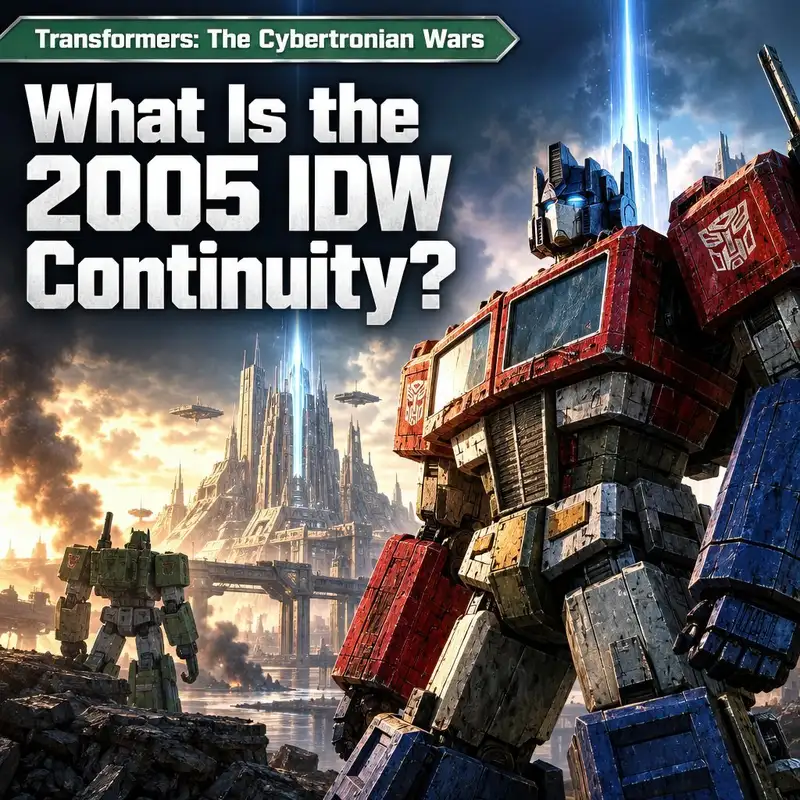
What Is the 2005 IDW Continuity?
Earth did not discover a crashed starship and then slowly learn that an old war had followed it across the stars. In the 2005 I D W comic continuity, Earth discovers something more unsettling. Alien combatants are already present. They have already chosen sides. They are already using disguises, surveillance, human infrastructure, and local confusion to continue a conflict whose origins are largely hidden from the people caught inside it.
That opening condition matters. In the early Earth stories, civilians such as Verity Carlo, Hunter O'Nion, and Jimmy do not receive a clean briefing from a legitimate government or a unified alien command. They encounter armed Cybertronians amid secrecy, manipulation, and escalating violence. Human authorities, corporations, military organizations, and intelligence services all possess fragments of the picture. None has informed consent from the population now living beside an off-world war.
This is the first answer to what makes the 2005 I D W continuity distinct. It begins in the middle, not at a founding myth. The Autobots and Decepticons arrive on Earth carrying a long war, a ruined homeworld, damaged institutions, and political memories that human witnesses cannot immediately interpret. The comics then spend years widening the lens. They ask not only who is fighting, but what kind of society created the war, what the war did to its participants, and whether any victory can produce a livable peace.
The result is not one simple linear series. It is an interconnected comic history published through miniseries, ongoing titles, annuals, one-shots, and later crossover events. A reader may encounter an intelligence operation on Earth, a brutal military mission, a Senate debate from the distant past, and a postwar argument on Cybertron that all belong to the same broad historical record. The continuity expands because its questions expand.
It began as a Generation One-inspired reboot, using familiar names and symbols while giving them new biographies and a new strategic setting. It did not inherit the history of the American animated series, Marvel’s Transformers comics, Dreamwave’s comics, the live-action films, or the later I D W reboot that began in 2019. Nor did it become the later Skybound Energon Universe. Similar names are recurring ideas, not shared citizens of one universal timeline.
The common labels, 2005 I D W continuity, I D W One, and I D W Generation One, are useful publishing shorthand. They are not names that ordinary Cybertronians necessarily use for their own world. What holds the setting together is the released narrative connection among its stories. The record changes in emphasis, and sometimes later stories revise or reframe earlier ones. That does not make every change a separate universe. It makes the continuity resemble a long and imperfect historical archive.
Its central arc can be understood in three movements. First comes the hidden war, fought from a depleted Cybertron and spread through covert operations on Earth and other worlds. Then comes the deeper reconstruction of the war’s political origins, especially the social order that made revolution possible and the way that revolution became militarized. Finally comes the long postwar question: how do former enemies, civilians, colonies, and veterans build institutions after a conflict that has shaped nearly every part of their society?
To understand why the combatants reached Earth as secretive, divided, and exhausted forces, it is necessary to look back at the Cybertron they left behind. Later I D W stories present a prewar civilization marked by hierarchy, political exclusion, and a social system known as Functionism. Functionism was more than a matter of occupational specialization. It connected a Cybertronian’s assigned function to social value, political opportunity, and expectations about what kind of life that individual was permitted to lead.
In practice, this made the state appear orderly to those protected by it and stifling to many who were not. A civilization can be technologically sophisticated, ancient, and administratively capable while still denying meaningful participation to large portions of its population. The Senate and its associated institutions could preserve stability for established interests. They were much less capable of recognizing that stability without legitimacy is often only delayed crisis.
The later comics do not provide one perfectly smooth and uncontested documentary account of that era. Different stories add details, recontextualize characters, and reveal that records themselves may have been incomplete, manipulated, or interpreted through factional memory. That uncertainty is part of the setting’s historical texture. The key point is clear enough. The prewar order did not collapse because everyone suddenly became irrational. It lost the ability to persuade many Cybertronians that reform from within was possible.
Functionism is especially important because it turns personal frustration into a structural political grievance. If an individual’s role, body, employment, and social standing are treated as destiny, then disagreement becomes more than a dispute over policy. It becomes a challenge to the civilization’s definition of personhood. The system did more than distribute jobs. It distributed dignity, authority, and the right to imagine a different future.
That failure created an opening for political movements that promised recognition and change. But the same conditions also made peaceful reform difficult. When a ruling order treats dissent as disorder rather than as a warning, opposition movements tend to develop outside the institutions that are supposed to absorb them. The conflict then becomes a contest not over legislation, but over who has the right to define the state.
Megatron emerges from this environment as more than a conventional military villain. In this continuity, his early history includes labor, political dissent, gladiatorial spectacle, and revolutionary organizing. The precise fit between the early account in Megatron Origin and later prewar stories is not seamless. Later comics broaden and adjust the picture. But the combined record presents a leader shaped by genuine inequality and by a belief that Cybertron’s existing order could not be repaired through polite appeals to the people benefiting from it.
That matters because it explains why the Decepticon cause attracted support. A movement does not become dangerous merely because its leader is charismatic. It becomes dangerous when it gives language to grievances that institutions have ignored. Megatron could speak to Cybertronians who felt trapped by function, alienated from political authority, or humiliated by a society that treated their assigned role as their permanent worth.
Gladiatorial combat also gave the movement a public language of strength, defiance, and spectacle. It made political conflict visible in a culture where status had often been carefully managed from above. Yet spectacle is not the same as organization. To challenge a state, a movement needs recruitment, communications, loyalty, coercive capacity, and people willing to take risks on behalf of a shared cause. The Decepticons developed those tools.
At that point, the critical transformation begins. A reform movement can use force while still claiming that force is temporary, defensive, or directed toward political change. But an armed organization develops interests of its own. It requires commanders, security systems, discipline, intelligence networks, safe facilities, supply, and mechanisms for dealing with internal dissent. The apparatus built to defeat oppression can become increasingly hostile to anyone who questions the apparatus itself.
Megatron’s grievance did not disappear as his power grew. It was absorbed into a new political structure centered on personal authority, military hierarchy, and conquest. The Decepticon identity changed with the war. It came to include revolutionary rhetoric, but also occupation, coercion, fear, and a command system that increasingly treated disagreement as betrayal. The original critique of inequality remains historically relevant. It does not excuse what the Decepticon war machine later became.
It is important not to flatten that war machine into one organization with one purpose. Megatron’s personal authority, Soundwave’s intelligence networks, Shockwave’s scientific projects, the Decepticon Justice Division, front-line commands, and occupation forces did not all perform the same function. Some members may have retained political ideals. Others served from fear, ambition, professional loyalty, or simple lack of alternatives. Civil wars rarely preserve the moral clarity their founding speeches promised.
The Autobots, likewise, are not a separate biological species born to oppose the Decepticons. In the 2005 I D W history, they emerge through changing political and military circumstances. They become a coalition of resistance, defense, civic association, and wartime command. Their identity is shaped by opposition to Decepticon rule, but also by the failure of the old order that made that rule possible.
Orion Pax, later Optimus Prime, belongs to this history, but not as a universal template imported from another version of Transformers. His authority develops through the particular political and military pressures of this continuity. He becomes important because he combines moral credibility with the ability to command under conditions of civil war. Those are related qualities, but they are not identical. A leader may inspire confidence while still facing divided institutions, incomplete information, compromised allies, and the brutal necessities of survival.
The Autobot cause also draws on people and institutions that do not fit neatly into a heroic legend. Security personnel, administrators, intelligence specialists, medics, engineers, ordinary civilians, and armed resistance groups all become involved as the state fails and violence spreads. Civil war has a way of converting professions into military functions. Police work becomes counterinsurgency. Engineering becomes fortification and sabotage. Information management becomes propaganda and espionage. Survival becomes a political act.
Figures such as Prowl demonstrate the uncomfortable overlap between security and resistance. A force fighting an authoritarian enemy may still inherit methods, personnel, and habits from the institutions that failed before the war. This is one reason the continuity does not present the Autobots as a finished democratic alternative waiting to take power. They are shaped by emergency. Their virtues are real, but so are the risks created when military necessity becomes the normal basis of political authority.
Once neither side could restore the old political order, the conflict became more than a battle for one capital or one government. It became a dispersed interstellar war. Cybertron remained symbolically and materially central, but forces fought across planets, colonies, ships, stations, and remote installations. A commander could win a local engagement without solving the larger war. A city could be liberated while an enemy fleet remained intact. A defeated faction could survive by withdrawing, reorganizing, and finding another theater.
The early I D W comics establish this strategic condition with unusual clarity. In Infiltration, Stormbringer, Escalation, Devastation, and Revelation, Cybertron is not a healthy capital dispatching unlimited resources to distant battlefields. It is devastated, exhausted, and in many respects abandoned. Energon scarcity and damaged infrastructure are more than visual atmosphere. They shape what forces can operate, where they can travel, how they repair themselves, and why off-world resources matter.
A machine civilization still has logistics. Cybertronians may not eat human food, but they require energy, parts, skilled repair, secure facilities, transport, and communication. A damaged fighter must be recovered before capture or irreversible failure. A ship must have a route, a crew, a destination, and some means of maintaining itself. A hidden cell must protect its identity while finding fuel and replacement equipment. The comics do not always provide a complete supply ledger, but the strategic pressures are present throughout.
Earth becomes one of the most important covert theaters in that wider war. It offers resources, infrastructure, population centers, and a technologically developing society that does not yet understand the conflict moving through it. Alternate modes help Cybertronians navigate this environment, but disguise is not a complete strategic solution. A vehicle form may conceal a body, yet behavior, energy signatures, communications, unusual damage, and sudden violence all threaten exposure.
The early Earth operations are therefore as much about intelligence as combat. Autobots and Decepticons gather information, protect secrets, exploit human ignorance, and attempt to prevent the other side from gaining a decisive local advantage. Human civilians are more than witnesses to spectacular encounters. They are drawn into an undeclared conflict by forces that have not asked whether Earth wishes to become a battlefield.
That lack of consent has political consequences. Human institutions do not respond as a single united species. Some individuals seek understanding. Some organizations seek weapons, leverage, or control. Some see Cybertronians as allies, while others see them as an unacceptable threat operating inside civilian infrastructure. These responses are not irrational. A hidden alien war creates genuine security concerns. But fear can also become a justification for exploitation, secret detention, reckless reverse engineering, or policies that treat sentient beings as salvage.
The Earth stories also make clear that the planet is not the whole war. Operations elsewhere reveal a conflict spread across worlds that differ in resources, political status, strategic value, and exposure to direct fighting. Cybertronian forces can cross enormous distances, but that does not make distance irrelevant. Ships, routes, quantum-jump systems, local support, repair capacity, and secure information still determine where power can be applied. Mobility changes the map. It does not abolish it.
The first major body of comics is therefore not just a run of adventures featuring familiar robots in a new setting. It is a picture of a war conducted by exhausted forces that can no longer assume a secure homeland. The Autobots and Decepticons have become mobile military and political communities. Their operations on Earth are shaped by the collapse behind them as much as by the objectives in front of them.
As the continuity develops, other stories deepen the moral and institutional terrain. Spotlight: Shockwave, The Last Stand of the Wreckers, and Chaos Theory do not just add more characters to the conflict. They show that the war has produced specialized formations, hidden programs, damaged memories, compromised chains of command, and histories that neither side fully controls.
The Wreckers are especially useful for understanding the continuity’s military outlook. They are not important simply because they are an elite team with a dramatic reputation. They demonstrate the cost of a force designed for missions too dangerous, politically sensitive, or destructive for ordinary units. Elite formations can solve immediate problems. They can also become instruments for operations that commanders prefer not to explain publicly, and they often carry the psychological and physical consequences long after the mission ends.
The Wreckers’ history also warns against treating military effectiveness as moral simplicity. A unit may perform courageously while being sent into a flawed plan. Its members may trust one another while distrusting the institutions directing them. Its survival may depend on improvisation, deception, and ruthless choices that would be unacceptable in peacetime. The continuity repeatedly returns to the question of what war asks people to become, and whether society knows what to do with them afterward.
Shockwave’s role introduces another recurring problem: the danger of hidden knowledge. His projects, experiments, and long-range designs become increasingly significant as the continuity expands into ancient Cybertronian history, colony worlds, Ore-Thirteen, and the Regenesis project. Yet it would be a mistake to say that Shockwave secretly planned everything. The record does not support a single mastermind explanation for every political failure, battlefield decision, or personal betrayal.
What Shockwave represents is more troubling and more plausible. He represents compartmentalized knowledge. A scientist or strategist can shape events for years by controlling access to information, withholding consequences, manipulating records, and treating people as variables in an experiment. His influence matters because other actors make decisions without knowing the full design around them. Intelligence failure in this continuity often begins not with stupidity, but with someone else possessing a carefully guarded fragment of the truth.
Memory itself becomes a political and military battleground. The I D W setting includes methods of memory alteration and psychological manipulation that are specific to its own history. Such practices matter because they challenge the ordinary assumptions behind trust, testimony, and accountability. A veteran may remember an event incorrectly. A commander may have been deliberately misled. A public record may conceal the circumstances under which a policy was made. Peace becomes harder when even the past is contested terrain.
The continuity then undergoes a conspicuous change in emphasis with All Hail Megatron. The Decepticon conflict on Earth becomes more overt. The story presents a recognizable occupation scenario, in which Decepticon power is exercised openly and the Autobots are absent, scattered, or struggling to respond. The war is no longer concealed behind local incidents and uncertain intelligence. It is visible in the streets, in governments, and in the choices faced by civilians.
This shift reflects a real creative transition in the comics, but it remains part of the same released continuity. Later stories work to connect its events with the earlier Earth material rather than treating it as a separate universe. The fit is not always elegant. That is not unusual in a long-running comic history. Historical records assembled over many years often contain changed emphases, revised assumptions, and attempts to connect campaigns that were not originally designed as one seamless plan.
All Hail Megatron also reinforces a central political lesson. Entering a planet and defeating its organized defenders is not the same as governing it. Occupation requires more than military access. It requires administration, intelligence, transport, discipline, and some way to manage the population’s hostility. A force can dominate public space while lacking legitimacy, local knowledge, and a durable political program. Terror may suppress open resistance for a time. It rarely creates consent.
The end of the central Autobot-Decepticon war comes gradually through the material that follows. The question is no longer only whether the Autobots can survive Decepticon offensives or whether Megatron can retain military control. It becomes whether either side can imagine a future not defined by perpetual mobilization. The formal end of a war is a major political event. It is not the same thing as peace.
The Death of Optimus Prime marks this transition with particular force. Optimus Prime’s moral authority had helped hold together a wartime cause, but his position also obscured a difficult institutional question. If a society has depended on one leader’s reputation, sacrifice, and battlefield legitimacy, what happens when that leader refuses, loses, or cannot exercise direct political control? The departure from simple personal leadership creates space for civilian government, but it also reveals how little agreement exists about what that government should be.
Postwar Cybertron faces demobilization, prisoners, returning populations, damaged infrastructure, unresolved crimes, and factions that have learned to see one another through the categories of war. A Decepticon symbol can mean personal conviction, coercion, past service, fear, or a continuing claim to power. An Autobot identity can mean liberation, military hierarchy, political privilege, or association with an army that now occupies civic space. Symbols do not disappear simply because the shooting has slowed.
The practical problems are equally severe. Who controls repair facilities? Who allocates energon? Who has authority over weapons, ships, archives, and security personnel? Which veterans return to civilian life, and which remain armed because they have nowhere else to go? What happens to prisoners? How should responsibility be assigned when a war has involved commanders, intelligence networks, coerced labor, occupation administrations, and people who simply tried to survive?
These questions explain why postwar I D W is not a victory parade. Removing a regime’s ability to rule may be a military success. It does not automatically establish a state capable of governing fairly. A society emerging from civil war needs procedures, legitimacy, and institutions that can survive disagreement. It must decide whether reconciliation means amnesty, accountability, selective forgiveness, or some unstable mixture of all three.
The postwar continuity divides much of its attention between two major theaters. One is Cybertron itself, where former combatants and civilians attempt to construct a new political order. The other is the Lost Light, a starship whose mission carries veterans, former enemies, specialists, prisoners, and damaged survivors into deep space. These stories have different tones and settings, but they examine the same historical problem from different angles.
On Cybertron, Robots in Disguise follows the difficult effort to govern after the war. Bumblebee becomes important not because he is simply a familiar Autobot name, but because he represents a leadership model trying to operate beyond the old wartime command structure. His authority is constrained by competing constituencies, uncertain legitimacy, and the return of people who do not accept that the Autobots should automatically inherit political control.
Among those groups are the NAILs, the Non-Aligned Indigenous Lifeforms. The name is cumbersome, but the political point is direct. These are Cybertronians who reject identification with either of the old military blocs, or who return to a homeworld in which they do not see themselves represented by Autobot and Decepticon veterans. They are not a third species. They are a constituency created by the fact that a civil war’s dominant factions rarely represent everyone who survived it.
The NAILs expose a common postwar illusion. The victorious side often believes that ending the old regime has cleared the path for legitimate government. But people who were not part of the victory may see only another armed faction claiming authority. Their grievance is not necessarily nostalgia for the defeated order. It may be a demand not to be governed forever by the identities and institutions created during the war.
Starscream’s role in postwar politics sharpens this tension. In another setting, it would be easy to treat him only as a familiar rival and opportunist. Here, his importance lies in the fact that postwar systems can elevate figures who understand resentment, factional division, and the weakness of improvised institutions. Political survival does not require moral consistency. It often requires recognizing where official authority lacks popular trust.
Windblade and the growing importance of Caminus and other colonies further widen the political map. Cybertron is still a historic center, but it is not the only place where Cybertronian life developed during the long conflict. Colonies have their own interests, memories, resources, and claims to representation. A postwar government that treats them as distant dependents risks recreating the exclusion that helped produce the original catastrophe.
The Lost Light offers a different kind of postwar society. Its stated mission is the search for the Knights of Cybertron, a goal that combines exploration, history, belief, and the hope of finding something beyond the exhaustion of war. But its practical importance is more immediate. It is a mobile community carrying people who do not fit easily into a stable settlement on Cybertron.
The ship contains veterans, former Decepticons, prisoners, technicians, medics, scientists, officers, and people carrying damaged memories or unresolved guilt. In ordinary military terms, it is a vessel with a mission and a crew. In political terms, it is an improvised society at a distance from established institutions. Its members must create rules, trust relationships, and forms of accountability while traveling beyond the easy reach of any settled government.
That makes the Lost Light central to the continuity without making it the whole continuity. Its character-centered stories explore trauma, identity, friendship, memory, and personal repair. Yet these are more than private concerns. A society attempting reintegration must decide whether people can change, what evidence is needed to trust them, and how much of a person’s wartime identity should define their future. A crew cannot function if every former enemy is presumed permanently guilty, but it cannot function if past harm is simply ignored.
The distance from Cybertron also creates freedom and danger. A ship can escape some of the deadlock of postwar politics. It can also escape oversight. Its officers must make decisions with incomplete information, limited repair capacity, uncertain resupply, and no guarantee that help can arrive quickly. In deep space, the old war remains present not only in hostile forces, but in the habits and injuries carried by the people aboard.
Dark Cybertron reconnects these two theaters. It brings the political fragility of the rebuilt homeworld into contact with long-buried strategic threats, including Shockwave’s plans, the Regenesis project, the Dead Universe, and dangers reaching across Cybertron and its colonies. The event matters not just because it is large. It demonstrates that postwar governments cannot isolate domestic reconstruction from the infrastructure, secrets, and unfinished operations inherited from the war.
A state may believe it is debating representation, security reform, or resource allocation, only to discover that ancient systems and concealed projects are already shaping its options. The lesson is not that ordinary politics is irrelevant beside cosmic danger. It is the opposite. Political weakness makes extraordinary threats harder to manage. A government without trusted institutions struggles to mobilize its people, share intelligence, coordinate with colonies, or explain why emergency powers are suddenly necessary.
This is where the 2005 I D W continuity becomes much broader than a story of Autobots pursuing Decepticons across familiar battlefields. It becomes a study of diaspora and reconstruction. Cybertronians have lived through exile, colony formation, wartime separation, occupation, and the creation of communities far from their ancestral world. A return to Cybertron can be emotionally powerful without resolving the political claims of everyone who built a life elsewhere.
Earth-Cybertron relations become more institutional as well. Early stories often present Earth as a covert battlefield where civilians learn too late that alien forces are operating nearby. Later stories must deal with diplomacy, sovereignty, intelligence sharing, and the problem of powerful Cybertronian populations living alongside human governments. Personal friendships remain important, but they cannot substitute for treaties, procedures, and accountability between worlds.
For Cybertronian and human leaders, that expansion complicates sovereignty. Intelligence shared with one ally may expose another. A defensive action on Earth may be interpreted as intervention by an outside power. A military alliance may be necessary against a common threat while still producing resentment over secrecy, jurisdiction, and control of dangerous technology. Shared enemies can create cooperation. They do not automatically create trust.
The final great crisis comes with Unicron. By this point, the continuity has moved far beyond the small covert operations that opened its Earth phase. The stakes are enormous, involving survival on a scale that demands coordination among people who have spent much of their history divided by war, ideology, and geography. Yet even a crisis of this magnitude does not erase the political history that came before it.
Optimus Prime number twenty-five serves as an epilogue to this final period and to the wider continuity. The story does not transform smoothly into the separate 2019 I D W reboot. The 2005 history ends as its own long record, with many themes resolved and others left in the condition familiar to real postwar societies: managed rather than permanently solved.
The 2005 I D W continuity is distinct because it transforms familiar names and faction symbols into a sustained history of political breakdown, militarized revolution, dispersed interstellar war, and incomplete reconstruction. Its defining question extends beyond whether Autobots defeat Decepticons. It is whether a society that survived caste hierarchy, occupation, atrocity, exile, and factional war can create institutions strong enough to outlast the leaders and myths that carried it through the conflict.