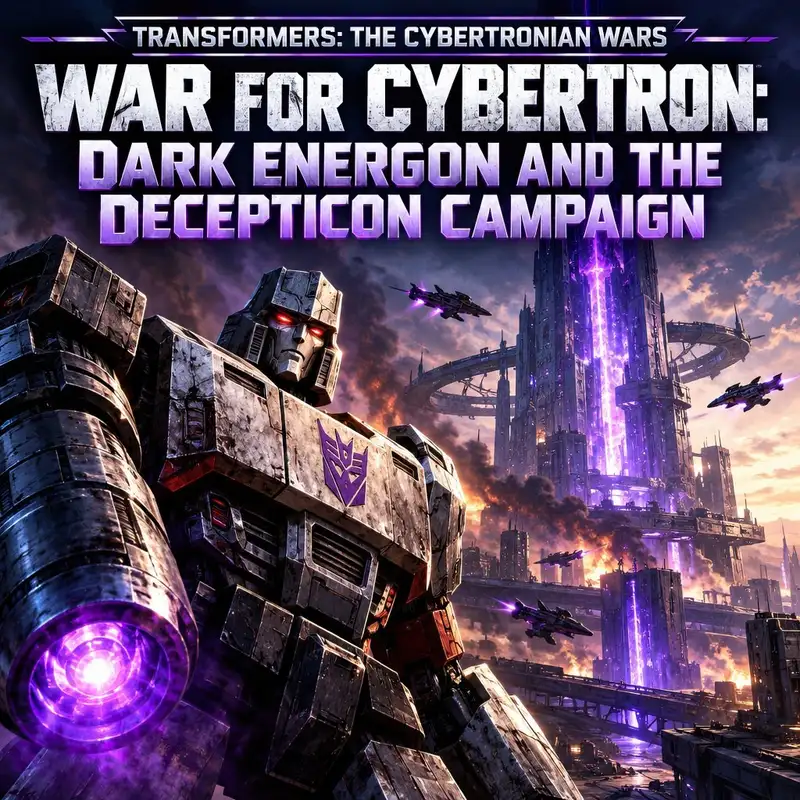
War for Cybertron: Dark Energon and the Decepticon Campaign
Megatron stands at the threshold of Cybertron’s Core with the last guardian overcome behind him. By this point, the immediate military question has already been answered. Trypticon Station has been taken. An Energon Bridge has been partially restored. Iacon has been breached. Zeta Prime has been captured. Omega Supreme has been defeated. The question now is what Megatron intends to do with access to the system at the center of the world he claims to conquer.
In the 2010 game Transformers: War for Cybertron, Dark Energon is not just a stronger fuel or a battlefield enhancement. It becomes the instrument through which Megatron links personal power, industrial capacity, strategic mobility, political coercion, and planetary infrastructure. His campaign is coherent because each objective enables the next. It is catastrophic because the final objective turns Cybertron’s own sustaining systems into a weapon.
This is the Decepticon campaign from the High Moon Studios game, set during an existing civil war on Cybertron and before the war reaches Earth. The campaign occurs before the game’s Autobot story, even though players may select either side from the menu. That sequencing matters. The Decepticon operations create the emergency the Autobots later inherit. Megatron does not just exploit a crisis. He manufactures a larger one.
The campaign begins with a civil war already well underway. The Autobots still possess major institutions, most visibly Iacon, their capital and command center. They also hold defensive systems, secure energy infrastructure, and the authority associated with Zeta Prime’s leadership. The Decepticons are not an insurgency taking its first uncertain steps. They are already a capable military force under Megatron’s personal command.
The game gives far clearer evidence of Megatron’s appetite for power than it does of the detailed social grievances that may have preceded the war. It would be a mistake to invent a complete revolutionary biography from this campaign alone. What the record does show is a leader who sees the existing order as something to be broken, occupied, and replaced. He is not pursuing a limited concession from Iacon. He is pursuing command of Cybertron.
That distinction shapes the campaign. Megatron does not begin by seeking a symbolic duel or an ordinary territorial victory. He targets systems that allow a planet to function. Energy production, transfer networks, capital defenses, political leadership, and the Core itself are all more important than any isolated battlefield. He understands that a war for Cybertron cannot be won solely by defeating soldiers. It must also be won by controlling what those soldiers defend.
The first decisive objective is Trypticon Station, an orbital facility associated with Dark Energon research and production. Its location matters. An installation in orbit can serve as more than a laboratory. It can provide a protected industrial site, a platform above the planet’s surface, and a connection to systems that ground forces may not be able to reach quickly. It is not evidence of a complete Decepticon fleet doctrine, but it is a substantial strategic asset.
Dark Energon itself is dangerous precisely because it is useful. In this game, it visibly empowers Megatron and can be used to contaminate or disrupt other systems. Its effects are dramatic, but the campaign does not provide a universal scientific theory for it. It does not establish that Dark Energon always has the same origin, biological effect, or strategic meaning in every Transformers story. Here, it is a hazardous resource connected to the fate of Cybertron.
Trypticon Station is guarded by Starscream, identified at this stage as a neutral Sky Commander rather than a settled Decepticon subordinate. That status is important. Starscream is not simply another enemy standing between Megatron and a prize. He controls access to a facility, understands its systems, and represents an independent source of military and technical power. Taking the station means deciding what to do with the specialist who made it valuable.
Megatron attacks alongside Brawl and Barricade. Their presence suggests the practical composition of the operation. This is not a ceremonial seizure of a scientific outpost. It combines direct assault, close-range combat, security penetration, and the intimidation necessary to break a defended installation. Megatron’s forces do not need to destroy every asset on the station. They need to seize the parts that matter before their opponents can deny them.
The immediate tactical result is clear. Megatron defeats Starscream and captures Trypticon Station. The operational result is more significant. The Decepticons gain access to Dark Energon production and to the infrastructure surrounding it. They have acquired a place from which the substance can be studied, stored, and potentially integrated into a broader campaign. A rare resource ceases to be merely a discovery once someone controls the means of producing and moving it.
The strategic consequence is larger still. Megatron has gained a possible answer to Cybertron’s military balance. The Autobots may still hold Iacon and its defenses, but their position is no longer secure if the Decepticons can build a new power center beyond the capital’s immediate reach. Trypticon Station gives Megatron a base from which to challenge the institutions that had previously contained him.
Capturing the station also reveals the campaign’s central pattern. Megatron does not treat Dark Energon as a trophy. He treats it as part of an interconnected system. A production facility has value only if it can be powered, defended, staffed, and connected to wider operations. A substance that cannot be delivered where it matters is a laboratory curiosity. A weapon that cannot be sustained becomes a brief and expensive spectacle.
Megatron first turns Dark Energon into spectacle by using it on himself. The game shows an infusion that visibly alters and empowers him. The exact medical or mechanical process is not explained in a way that supports a complete theory of Cybertronian biology. We do not know from this event alone whether every Cybertronian could endure it, whether the effect is stable, or whether it can be reproduced safely at scale.
What is clear is the political meaning. Megatron demonstrates that he is prepared to accept a danger others may reject. In a movement built around personal authority, that has value. The leader appears not just stronger, but exceptional. Dark Energon becomes part weapon and part claim to legitimacy. Megatron presents himself as the commander willing to cross boundaries that conventional authority, scientific caution, or institutional restraint might preserve.
That kind of leadership can be persuasive in wartime. It can also be ruinous. A leader who makes personal risk the proof of political vision encourages subordinates to treat restraint as weakness. The issue is not that Megatron is brave. The issue is that he transforms a hazardous and poorly understood resource into a test of loyalty and will. The substance becomes associated with his authority before its long-term consequences are understood.
Starscream responds to the new balance of power with a bargain. Having been defeated, he offers service to Megatron in exchange for access to Dark Energon and the process surrounding its production. The arrangement gives Megatron something he needs. Starscream knows the station and its technology. He can help convert the seizure from an act of destruction into an operational capability.
But this is not the same as trust. Starscream’s loyalty is transactional from the beginning. He has not been persuaded by a shared political settlement or incorporated into a durable institution. He has calculated that Megatron’s access to Dark Energon offers opportunity. Megatron gains technical expertise, aerospace capability, and a useful subordinate. He also gains a specialist with his own ambitions and with intimate knowledge of a uniquely important asset.
This is one of the weaknesses hidden inside the Decepticon campaign’s early success. Highly personal command can be quick. Megatron identifies talent, defeats resistance, and makes a bargain without waiting for a committee, court, or chain of civilian authority. Yet that speed comes at a cost. His system depends on exceptional individuals who are bound by fear, access, and advantage rather than durable loyalty.
Starscream’s defection is therefore a force multiplier and a vulnerability. Without his knowledge, Trypticon Station is less useful. With him, the Decepticons can begin to understand how the station fits into Cybertron’s energy systems. But any command structure that relies on a defector’s specialized knowledge must also manage the fact that the defector knows how to withhold it, misuse it, or sell it elsewhere.
The next problem is logistical. Dark Energon production at Trypticon Station does not automatically mean that the station has the energy or infrastructure required to function at full potential. Megatron has captured an industrial node, but he has not yet solved the problem of supply. His new asset requires power, connection, and access to an older network that reaches beyond the station itself.
That responsibility falls to Starscream, accompanied by Skywarp and Thundercracker. Their mission is to reactivate a long-dormant Energon Bridge connected to Trypticon Station. The name can be misleading if treated too casually. In this context, the bridge is not simply an unlimited portal for soldiers and vehicles. It is part of an energy-transfer system. Its strategic value lies in its ability to connect power and infrastructure across a wider operating environment.
The mission takes the Decepticon fliers into old and defended systems. They must restore power, navigate aging infrastructure, bypass Autobot resistance, and confront the guardian assigned to protect the bridge. The details matter because they demonstrate that even a technologically advanced civilization remains dependent on physical networks. Ancient machinery does not become available merely because a commander wants it.
The seeker team’s alternate modes provide real advantages. Their mobility allows them to reach dispersed infrastructure, approach from directions less accessible to ground forces, and react quickly within a damaged environment. But their flight does not eliminate the problem of fixed nodes. A bridge still has terminals. Power still has to be routed. Defenses still have to be neutralized. Specialized operators still have to understand what they are restoring.
Autobot interference complicates the operation. The Decepticons are forced to use a backup route, and they discover that their access remains incomplete. The Autobots have severed the connection with locks protected by Omega Key encryption. This is a useful reminder that infrastructure warfare is not only about owning machinery. It is also about authentication, access control, and the ability to deny an enemy the systems it has captured.
The bridge can be reactivated only partially. For Megatron, that is not enough. A superweapon, industrial complex, or orbital station cannot be sustained by wishful thinking. It needs reliable energy. The Decepticons have found Dark Energon, taken the facility that produces it, and reopened part of a route to power that facility. Yet one missing key still prevents the system from operating as Megatron intends.
The campaign changes direction at this point. Megatron’s next objective is not chosen because Iacon is merely the largest available target. It is chosen because the city contains the authority, security apparatus, and access mechanism standing between Trypticon Station and full operational power. The Omega Key is held by Zeta Prime. To complete the energy-transfer system, Megatron must break the Autobot capital.
Iacon is more than a city. It is the political and institutional center of Autobot rule. It houses defenses, command functions, and civic authority. A refinery can be seized without necessarily changing who governs a world. An orbital station can be captured without immediately breaking a rival’s legitimacy. But an assault on the capital announces that the Decepticons intend not just to raid the existing order, but to displace it.
Zeta Prime’s position matters for the same reason. He is not only a battlefield opponent. He embodies formal Autobot leadership. Capturing or defeating him threatens command cohesion, weakens the authority of the institutions he represents, and creates a visible demonstration that the capital’s security can fail. Megatron’s war is fought with weapons, but it is also fought against the confidence that keeps a political system functioning under pressure.
The Decepticon objective is precise. They need to breach Iacon’s defenses, seize the Omega Key from Zeta Prime, and use that key to resolve the blockage preventing full access to the Energon Bridge. This is a campaign of dependencies. Trypticon Station requires energy. The bridge requires the Omega Key. The Omega Key is held by the leader of the city that stands against Megatron.
Megatron enters Iacon with Soundwave and Breakdown. Again, the selection of personnel reveals something about the operation. Megatron brings direct command authority and formidable combat power. Breakdown provides mission-level assault capability. Soundwave contributes intelligence and technical support. The task requires more than brute force. The Decepticons must understand enough of Iacon’s systems to turn the city’s defenses against its defenders.
Their route takes them through the Stellar Galleries and into the defensive network surrounding the capital. The campaign does not establish every detail of Iacon’s civil administration or every element of its military order. It does establish that the city is protected by layered security and that breaking it requires deliberate sabotage. The Decepticons are not simply driving through undefended streets. They are attacking an organized system.
Dark Energon charges become one of the tools used in that attack. Their significance is not just explosive. They are employed against Iacon’s security infrastructure, undermining the systems that coordinate defense. This is Dark Energon in a new role. At Trypticon Station, it was a resource to be acquired. In Megatron’s body, it was an assertion of exceptional power. In Iacon, it becomes an instrument of sabotage.
The distinction matters. A force that can destroy a wall has achieved a tactical capability. A force that can disrupt the security network behind the wall has attacked command and control. The Decepticons use Dark Energon to create openings in the Autobot defense system, reducing the ability of Iacon’s institutions to respond coherently. They attack not just defenders, but the mechanisms that allow defenders to act as a coordinated force.
Soundwave’s role should not be exaggerated into omniscience. The game does not show him knowing every Autobot plan or effortlessly penetrating every system. What it does show is a specialist supporting an operation in which information, access, and technical understanding matter. Megatron’s campaign depends on officers who can identify weaknesses in complex infrastructure and exploit them under combat conditions.
Breakdown’s contribution is equally practical. Once a security system has been compromised, the Decepticons still need forces capable of pushing through contested ground. Sabotage creates opportunity. It does not occupy a capital. The campaign repeatedly combines technical disruption with direct assault. This is why Megatron’s strategy is more dangerous than a series of isolated raids. He uses specialists to open doors, then uses force to move through them.
The assault succeeds. Zeta Prime is defeated and captured, and the Omega Key is taken. In the immediate battle, the Decepticons have compromised Iacon’s security and overcome its leader. Beyond the battlefield, they have gained the item required to move beyond the incomplete Energon Bridge. Politically, they have struck a severe blow against Autobot authority by demonstrating that the capital and its Prime can be reached.
But the fall of a capital is not the end of a war. A city can be damaged, a leader can be captured, and a faction can still retain forces, allies, and the ability to resist. The Autobots are not erased from Cybertron because Zeta Prime is taken. Megatron has weakened their institutional position, but he has not solved the larger problem of governing a world that remains contested and increasingly unstable.
The damage to Iacon also has a civilian meaning, even though the game offers limited individual civilian testimony. Capitals are not only military headquarters. They are places where energy, transport, repair, archives, communication, and ordinary civic life are concentrated. When a force attacks a city’s security infrastructure, the consequences do not remain neatly inside a command bunker. Systems that defend a capital often support the society around it.
The Omega Key does not simply open a door into Cybertron’s Core. Instead, it activates or summons Omega Supreme, the great guardian associated with the Core. This is the point at which Megatron’s operation meets a defense system designed to prevent precisely this kind of factional seizure. The key confirms access to a deeper layer of planetary infrastructure. It also triggers the obstacle that makes that access dangerous.
Omega Supreme should not be understood merely as a very large opponent at the end of a battle. He is a strategic defense asset. His purpose is to protect the Core and deny unauthorized forces the ability to manipulate Cybertron’s deepest systems. The campaign does not provide reliable measurements for his size, weapon output, or the numbers of troops involved in the confrontation. It does make his strategic role unmistakable.
Megatron has reached the limits of ordinary assault. The Decepticons cannot quickly solve the Omega problem through conventional firepower alone. A guardian linked to a protected system, supported by regeneration and fixed energy resources, cannot be treated like an isolated enemy commander. Its resilience is institutional as much as physical. To defeat it, Megatron must identify what sustains it.
That realization produces the logic of the chapter called Death of Hope. Megatron’s forces do not just try to overcome Omega Supreme’s armor. They attack the energy batteries and support systems on which the guardian depends for regeneration and defense. This is a classic systems attack. Rather than concentrating entirely on the strongest visible target, the Decepticons identify the infrastructure that makes that target difficult to defeat.
The tactical principle is sound. A defender protected by fixed support nodes may be vulnerable if those nodes can be reached, contaminated, or disabled. The challenge is considerable. The Decepticons must identify multiple energy points, fight through defenses, maintain pressure from a dangerous opponent, and carry out the sabotage before their own forces are overwhelmed. This is not a simple matter of possessing Dark Energon. It requires planning and execution.
Dark Energon is used here as a contaminant and denial weapon. It can interfere with systems that would otherwise sustain Omega Supreme. That makes it more strategically significant than a personal enhancement. Megatron has converted a hazardous resource into a method of defeating infrastructure. The same substance that altered him can now undermine a guardian by corrupting the systems that keep that guardian operational.
The achievement is real. Megatron has found a way around a defense system designed to resist direct attack. He has demonstrated the ability to combine intelligence, mobility, sabotage, and concentrated force. His campaign does not succeed because Dark Energon magically solves every problem. It succeeds because he repeatedly asks what supports the obstacle in front of him, then directs his forces against that support.
Yet there is a grim symmetry in the method. Omega Supreme protects Cybertron’s Core through an energy network. Megatron defeats the guardian by contaminating that network. The Decepticons are learning that Dark Energon can be used to make vital systems fail. But every time they apply that lesson, they become more dependent on the idea that Cybertron’s infrastructure is expendable.
This is the difference between a military solution and a political solution. A military commander may decide that destroying an enemy’s support network is necessary. A ruler must then ask whether the network can be restored, who will live with the damage, and whether the object being seized will still be worth possessing. Megatron’s campaign is extraordinarily effective at the first question. It shows much less concern for the second.
Once Omega Supreme’s support systems have been compromised, the campaign shifts from containment to penetration. The guardian remains a serious obstacle, but he no longer possesses the same ability to recover and hold the line. The Decepticons can press into his defenses, destroy the systems protecting his internal chamber, and neutralize the final barrier between themselves and the Core.
The final battle should not be mistaken for a precise account of force ratios or weapon yields. The game presents an action sequence, not a staff report with verified numbers. What matters historically is the result. Omega Supreme is defeated, overcome as the guardian of the Core. The Decepticons do not simply win another engagement. They remove the last physical and institutional defense separating a factional army from the planetary center of power.
Megatron’s earlier objectives now reveal their full logic. Trypticon Station gave him Dark Energon production. Starscream supplied vital technical knowledge. The Energon Bridge promised the energy connection needed to exploit the station. The assault on Iacon provided the Omega Key. The key brought Omega Supreme into the conflict. Dark Energon sabotage weakened Omega’s support network. The guardian’s defeat opened the path to the Core.
This is why the campaign can appear, at first glance, to vindicate Megatron’s strategy. He has not wandered from target to target. Every operation supports the next one. He identifies decisive nodes and acts against them in sequence. He understands that control of a world depends on infrastructure, not just battlefield prestige. In purely operational terms, it is a formidable campaign.
It is also a campaign whose success contains its own failure. By the time Megatron reaches the Core, he has constructed a chain of power dependent on a volatile substance, a captured orbital station, compromised energy systems, a defector’s expertise, and the destruction or corruption of safeguards that once protected Cybertron as a whole. He has gained access, but access is not the same as sustainable control.
At the Core, Megatron infuses Cybertron’s central system with Dark Energon. This is the act that turns the campaign from a struggle for domination into a threat to the planet itself. The immediate meaning is unmistakable. Megatron has reached the deepest source of authority and material power available to him. He has accomplished what the capture of Trypticon Station, the bridge operation, the fall of Iacon, and the defeat of Omega Supreme were intended to make possible.
The later Autobot campaign establishes the consequences of that act. Cybertron’s Core is corrupted. Trypticon Station becomes a major Decepticon weapon. The planet moves toward shutdown, infrastructure failure, and eventual evacuation. These later consequences should not be confused with a detailed scientific explanation of every mechanism involved. The game establishes the result clearly enough. Dark Energon at the Core does not restore Cybertron. It destabilizes it.
In the immediate fight, Megatron has won. Omega Supreme has been overcome, and the Core has been accessed. The Decepticons have also gained or threatened control over decisive infrastructure. Their enemy’s capital has been breached, its leader captured, and a key defensive asset neutralized. The campaign delivers the kind of cascading operational success that military planners seek.
At the larger scale, however, the value of conquest begins to collapse. A faction may seize the systems that sustain a world and still damage them so severely that the world can no longer sustain the faction. Megatron has not captured a functioning Cybertron ready to be governed. He has helped create a Cybertron whose energy systems, defenses, and civic institutions are failing under the pressure of war and contamination.
The political consequences are equally severe. Megatron demonstrates power, but power alone does not create a durable government. A capital can be broken by force. A Prime can be captured. A guardian can be disabled. None of those achievements automatically provide a plan for repair, energy distribution, civilian security, or legitimacy among those who now fear the victors as much as they feared their old rulers.
The civilian cost follows from that failure. The game does not linger on extensive individual stories of displaced Cybertronians, but the wider condition is clear. A world approaching shutdown is a world in which repair systems, transit routes, energy access, and shelter become matters of survival. Evacuation is not merely a military redeployment. It is the loss of a homeland because the systems that made it habitable can no longer be trusted.
Megatron’s use of Dark Energon therefore changes meaning at every stage of the campaign. At Trypticon Station, it is an industrial prize. In his own body, it is a demonstration of risk and authority. At the Energon Bridge, it becomes dependent on logistical infrastructure. In Iacon, it serves as an instrument of sabotage. Against Omega Supreme, it becomes a denial weapon. At the Core, it becomes planetary contamination.
That progression explains both Megatron’s success and his failure. He sees that power lies in connected systems rather than isolated battles. He captures the means to produce Dark Energon, secures the expertise to use it, seeks the network needed to sustain it, strikes the capital that blocks access, defeats the guardian protecting the Core, and finally reaches the center of Cybertronian power.
But the same logic that makes the campaign operationally sophisticated makes it strategically self-defeating. Megatron treats every obstacle as a system to be exploited or corrupted. He does not distinguish clearly enough between the institutions that resist his rule and the infrastructure without which any rule becomes impossible. His campaign is designed to seize Cybertron, but its final act makes Cybertron less capable of surviving anyone’s victory.
The Decepticons gain temporary dominance because they control the initiative and understand the value of strategic nodes. Yet their position remains fragile. Dark Energon is hazardous. Trypticon Station is a unique asset rather than a broad industrial base. The Energon Bridge depends on fixed infrastructure and restricted access. Starscream’s expertise is useful but politically unreliable. Megatron’s authority is powerful, but it remains concentrated in one commander’s will.
A sustainable settlement would require more than fear, captured leaders, and corrupted systems. It would require functioning energy distribution, repair capacity, security accepted by more than the victors, and institutions able to outlast a single leader’s campaign. Megatron achieves coercive access to Cybertron’s foundations. He does not build a political order capable of preserving them.
The Dark Energon campaign marks a transition in the war. It begins as a Decepticon effort to seize advantage within an existing civil conflict. It ends with the corruption of the planet itself. After the Core is poisoned, the struggle is no longer only over who will command Cybertron. It is over whether Cybertron can remain a viable world at all.
Megatron wins because he understands that wars are decided through networks of production, energy, access, command, and defense. He loses the larger purpose because he turns those networks into targets so completely that conquest becomes indistinguishable from planetary sabotage.