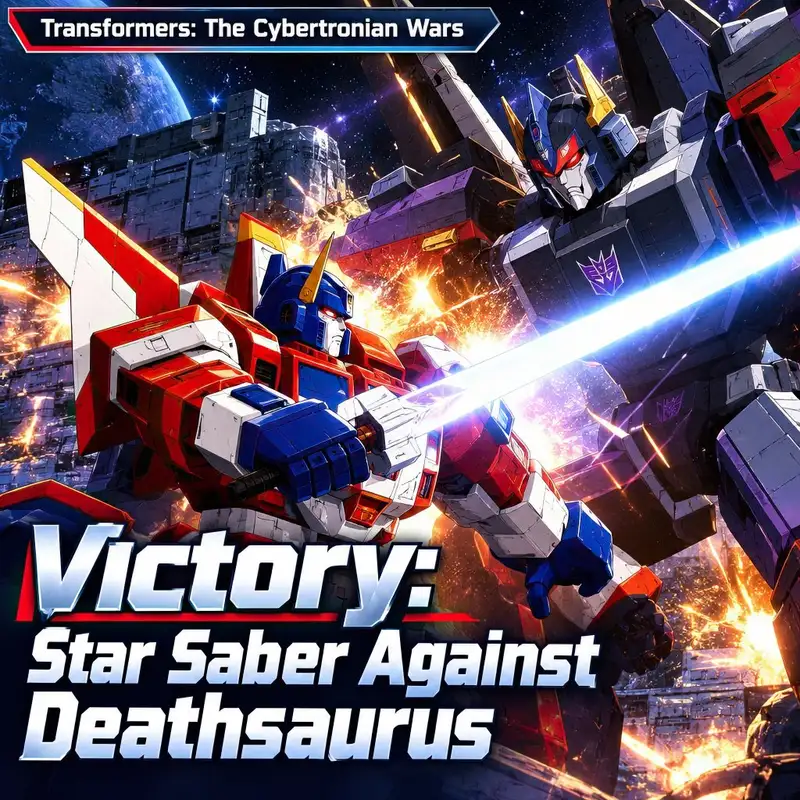
Victory: Star Saber Against Deathsaurus
The restored fortress had already crossed the line between a weapon and a strategic catastrophe. Deathsaurus had turned it toward Earth, converted its immense body into a cannon system, and prepared to fire. Below it lay an allied world with cities, energy facilities, and a civilian population that could not simply disperse when the sky became hostile. Around it, Star Saber’s defenders faced several problems at once. They had to protect Earth, contain the fortress, fight Deathsaurus’s field forces, find a way inside the enemy’s defenses, and prevent the damaged platform from becoming a falling weapon even if its cannon was stopped.
This is the final crisis of the nineteen eighty-nine Japanese animated series Fight! Super Robot Lifeform Transformers: Victory. In that source, Deathsaurus is the English rendering commonly used for the Decepticon commander called Deszaras in Japanese. His conflict with Star Saber is not presented as a detailed personal biography of two former friends or brothers. The series establishes them as enemies with a history of military confrontation. What matters is how their rivalry becomes a contest between two command systems.
Deathsaurus possesses surprise, specialized weapons, aggressive assault formations, and eventually a fortress capable of threatening an entire planet. Star Saber possesses something less dramatic but more durable. He commands a defense network that can divide missions, rescue endangered personnel, work with human allies, exploit an enemy’s command failure, and bring separate capabilities together at the moment they are needed. The final duel matters. It is not, however, the whole battle. By the time Star Saber meets Deathsaurus inside the fortress, the larger contest has already been decided by logistics, loyalty, intelligence, and the ability to keep a coalition functioning under pressure.
The fortress did not appear above Earth by accident. Its return was the culmination of a long campaign built around energy theft, mobility, and the recovery of a weapon that Deathsaurus believed could make ordinary military resistance irrelevant. To understand why that belief failed, it helps to begin with the peace Star Saber had been assigned to defend.
Victory takes place after the conflict depicted in Super-God Masterforce. The setting is not a fully demobilized peace, nor is it a simple continuation of one uninterrupted war. The Cybertron forces and other peace-seeking extraterrestrial powers establish the Galactic Peace Alliance, and Earth is included within that arrangement. The alliance gives Star Saber a political as well as military responsibility. He is more than a wandering warrior looking for worthy opponents. He is the commander of a space defense force headquartered on Planet V, responsible for protecting allied territory across a widening theater.
Deathsaurus enters this environment as the new Decepticon Emperor of Destruction. His authority is far more concentrated. He commands the Breastforce and directs other formations, including the Dinoforce and Liokaiser, through a hierarchy centered on his own ambitions. The anime does not provide a detailed account of Decepticon civilian government or a broad political program comparable to the alliance’s stated peace mission. It does show a military leader seeking power through raids, intimidation, conquest, and access to a unique strategic asset.
Their first major encounter in the series establishes that pattern. Deathsaurus attacks the Moon base, creating an immediate crisis near Earth. The operation is useful to him for more than simple destruction. A strike against a lunar facility tests the alliance response, threatens infrastructure, and forces the defenders to choose between pursuing the attacker and protecting endangered personnel. It is a classic method of imposing initiative. The attacker decides where the emergency begins. The defender must decide what can be saved.
Star Saber confronts Deathsaurus directly. In a more conventional adventure story, that might be the moment when the central hero remains fixed on the enemy commander until one of them is defeated. Star Saber does not do that. The threat to the Moon base forces him to break away from the personal engagement and shift to protection and rescue. He gives up the possibility of immediate pursuit because the survival of personnel and infrastructure is the more urgent military requirement.
That decision is more than a moral gesture. It is command judgment. A leader who abandons a threatened base in order to continue a duel may win prestige and lose the defensive position that made the duel necessary. Moon facilities near Earth are not decorative scenery. They are part of the wider security architecture. Their loss would damage the alliance, endanger those stationed there, and reward Deathsaurus’s attempt to turn a raid into a political demonstration of weakness.
Deathsaurus is checked, but he is not destroyed. Star Saber protects the base and defeats him in the immediate confrontation, yet the Decepticon commander remains capable of continuing the offensive. The tactical result favors Star Saber. The strategic result is less final. Deathsaurus has learned that he can force Star Saber to divide attention between direct combat and civilian or infrastructure defense. Star Saber has learned that his enemy will use threatened populations and exposed facilities to create openings.
Deathsaurus’s campaign is built around a simple but demanding strategic idea. He needs energy. Not merely enough energy for a raid or a single battle, but enough to restore and operate a dormant fortress hidden in the Dark Nebula. The fortress had been sealed after an earlier conflict with Star Saber’s forces. Its importance is clear even without assigning it an unsupported size, range, or energy yield. It is a mobile platform with the capacity to destroy planets. If Deathsaurus can return it to service, he can threaten worlds that ordinary formations cannot protect by direct combat alone.
This objective gives his raids a logistical purpose. He is not stealing energy at random. He is building toward activation. Earth’s energy facilities, industrial sites, and other sources become targets because they can feed the larger project. A raid may look local to those caught in it, but in Deathsaurus’s strategy each successful seizure contributes to a future concentration of force. That is what makes the campaign dangerous. He is using dispersed attacks to create one overwhelming weapon.
Thunder Arrow gives Deathsaurus a means of moving forces between targets and shifting pressure rapidly. The Breastforce and other Decepticon units provide the striking power for these operations. The Dinoforce can be sent into dangerous assaults. Liokaiser offers a major concentration of combat strength when Deathsaurus needs more than an ordinary raid. These formations are more than a roster of colorful specialists. They are the tools through which Deathsaurus tries to keep the defenders reacting while he accumulates the energy required for the fortress.
The Dark Nebula is where the danger becomes immediate. Deathsaurus and the Dinoforce reach the sealed fortress and begin restoring it. The earlier struggle that left it trapped is important, but the anime does not require a precise date for that past battle. What matters is the historical relationship. Star Saber had already faced the fortress as a strategic threat. He and his forces had deprived it of power and sealed it away rather than allowing it to remain available for future Decepticon use.
Deathsaurus’s return to the fortress is therefore an attempt to reverse an old defeat. It is also an attempt to change the terms of the war. If he can restore the platform, Star Saber’s mobile defense forces may no longer be able to rely on maneuver, local superiority, or rescue operations. They will have to confront a weapon system designed to dominate the theater from a distance.
The partially restored fortress immediately demonstrates why Deathsaurus has taken such risks. Its Living Metal-Destroying Cannon nearly kills Star Saber. The weapon is not treated as a routine rifle that can be fielded across every Decepticon unit. It is an exceptional threat connected to the fortress and its available power. Star Saber survives, but the encounter establishes a hard truth for the defenders. Courage and skill do not make a commander immune to an enemy who has achieved temporary technological superiority.
Deathsaurus comes close to ending the rivalry in that moment. Had Star Saber died, the Galactic Peace Alliance would have lost its principal military commander at the very point when the fortress was returning to service. The psychological effect alone would have been significant. More important, Deathsaurus would have removed the opponent who understood the fortress from the earlier conflict. A unique weapon is especially dangerous when it is controlled by a leader who has already identified the one commander most capable of opposing it.
But the cannon does not complete the kill. The fortress has consumed Deathsaurus’s available energy. He has enough power to produce a devastating local effect, but not enough to sustain the firing sequence needed to finish Star Saber. The failure is not caused by a sudden loss of nerve. It is a logistical failure. Deathsaurus has restored capability without yet securing endurance.
That moment reveals the weakness at the center of the fortress strategy. A superweapon can create a tactical shock. It can nearly destroy an enemy commander. It can force defenders to reconsider their assumptions. But if it cannot remain powered, protected, supplied, and controlled, then its apparent superiority may be temporary. The weapon has changed the balance of the campaign, but it has not ended the campaign.
Star Saber survives, though survival by itself is not victory. The defenders still face an enemy who has located the fortress, demonstrated part of its arsenal, and made clear that future raids will be tied to its full restoration. Star Saber’s response cannot simply be to seek another duel. He must preserve a force capable of operating across several crises at once.
Galaxy Shuttle serves another essential function. The defense of multiple worlds depends on transport. A commander cannot reinforce an endangered position, evacuate personnel, or move an elite team toward an orbital target without a means of reaching it. In a war spread between Earth, Planet V, the Dark Nebula, and other locations, strategic movement is as important as personal combat ability. A force that can respond quickly may not always win the first engagement, but it can prevent a local disaster from becoming irreversible.
Jean, Star Saber’s adopted human son, represents the human stake in this conflict. He is more than an observer placed near Cybertronian events so that the audience has someone small to look at while giant machines fight. His connection to Star Saber gives the war a human dimension, but his later role also shows that humans can become participants in the defense of their own world. He understands the danger not as an abstract interstellar issue but as a threat to people, places, and relationships on Earth.
Star Saber’s repeated concern for civilians and endangered personnel is therefore not separate from strategy. It builds trust. It keeps allied populations from becoming disposable terrain. It also preserves the human cooperation that becomes vital in the final campaign. A commander who regards civilians only as obstacles or hostages may create immediate fear, but fear does not reliably produce durable cooperation. Deathsaurus gains access to energy through coercion and attack. Star Saber gains something harder to manufacture: allies willing to act when the crisis reaches its worst point.
The contrast becomes sharper as Deathsaurus pushes the fortress project forward. He is willing to accept enormous risk to his own subordinate formations if that risk brings the weapon closer to full activation. The Dinoforce are particularly important in showing the cost of that choice. They are used as assault troops and sent into dangerous situations. Their value in Deathsaurus’s command system is increasingly defined by what they can sacrifice for the fortress campaign.
While Deathsaurus pursues concentration, Star Saber’s side adapts to loss. God Ginrai is mortally damaged during the conflict. The event could have removed a major Cybertronian leader and reduced the defenders at the moment they most needed experienced personnel. Instead, God Ginrai is reconstructed as Victory Leo. The transformation is significant not because it provides a convenient new body for a familiar character, but because it restores an important capability to the defense network.
Victory Leo is more than another powerful warrior added to Star Saber’s roster. He becomes a partner capable of combining with Star Saber to form Victory Saber. This combined form changes the operational balance. It gives Star Saber greater reach and force against threats that had previously exceeded the ability of ordinary formations to handle. It also gives the commander a trusted partner in the central fight against Deathsaurus and Liokaiser.
The importance of Victory Saber should not be exaggerated into a franchise-wide claim about who is strongest. The combination matters in this specific crisis because the defenders face a set of enemies and weapons that have already demonstrated their ability to overwhelm individual units. Victory Saber creates a concentrated answer to concentrated Decepticon power. But it remains part of a larger system. It cannot defend every civilian site, transport every team, gather every piece of intelligence, and disable the fortress from the outside.
The reconstruction of God Ginrai also demonstrates an institutional difference between the two sides. Star Saber’s force does more than collapse when a key figure is badly damaged. It finds a way to recover and integrate that person into a new role. The process is not presented as effortless. It follows severe loss. Yet the defense force treats the damaged leader as someone worth restoring, not as a spent resource to be abandoned once his previous function is gone.
That choice has practical consequences. Victory Leo strengthens Star Saber’s combat capacity. It also deepens cohesion. The defense force has evidence that service does not end the moment a warrior becomes inconvenient. Deathsaurus’s subordinates receive the opposite lesson. They are valuable only while they can advance the fortress project. This difference in treatment will become decisive when the Decepticon campaign reaches Earth.
Deathsaurus continues obtaining the energy needed for full activation. One of the major final steps involves Atlantis. The energy taken there is transferred into the fortress, giving Deathsaurus the power required to make it mobile and bring it toward Earth. The long campaign of raids, theft, and concentration has finally produced its intended operational result. The fortress is no longer merely a sealed relic in the Dark Nebula or a partially awakened danger. It becomes an active strategic platform entering the Earth theater.
In episode thirty-six, its arrival changes the nature of the war. The fortress launches meteor-like bombardment against Earth. The visual effect is widespread destruction and defensive overload. The series never establishes a precise casualty count, missile inventory, or destructive yield, and it does not need to. The operational fact is plain. Ordinary defensive formations cannot simply fly toward the fortress and expect to stop it through direct fire alone.
On the battlefield, the bombardment damages the surface and creates immediate danger for civilians and defenders. Operationally, it forces Star Saber’s command to divide attention among interception, rescue, local defense, and counterattack. Strategically, Deathsaurus now has the ability to threaten Earth as a whole rather than merely raid selected facilities. His energy campaign has achieved mobility and firepower. The fortress has become the center of gravity of the conflict.
This is the moment when a commander with a narrowly personal force might fail. If Star Saber relied only on his own combat skill, he would face an impossible choice. He could pursue Deathsaurus and leave Earth’s defenders without coordination. He could remain on Earth and allow the fortress to maneuver freely. He could engage the enemy’s strongest units and leave the bombardment unanswered. No single body, no matter how capable, can solve all of those problems at once.
Star Saber responds by distributing missions. The Brainmasters are dispatched aboard Galaxy Shuttle. Greatshot joins the effort to intercept the threat. Other teams remain tied to defense and rescue. The details matter because they show the difference between a collection of heroes and a functioning command. The Brainmasters are not sent merely because they are available for another fight. They are used as a mobile formation capable of reaching the fortress theater. Galaxy Shuttle is more than transportation in the background. It is what makes that response possible.
The defense effort is imperfect because the situation is imperfect. The fortress has already achieved surprise and destructive momentum. The defenders cannot erase the damage that has begun. Their task is to prevent a temporary Decepticon advantage from becoming irreversible planetary defeat. That means buying time, protecting vulnerable targets, containing enemy formations, and finding a weakness before Deathsaurus can complete his final firing sequence.
Deathsaurus’s greatest success reveals the weakness of his command model. The fortress bombardment does not distinguish carefully between enemies and the Decepticon troops he has left behind on Earth. The Dinoforce, who have been used repeatedly in support of the campaign, are endangered by the attack. Their commander, Gōryū, gradually realizes what has happened. Deathsaurus has prioritized the fortress over the survival of the forces beneath it.
This is not a broad ideological conversion scene in which Gōryū suddenly embraces the Galactic Peace Alliance or becomes an Autobot. The immediate issue is much more direct. He has been abandoned by his own commander. The realization comes from battlefield experience. A leader who claims absolute authority has demonstrated that his followers are expendable once their utility has ended.
The Autobots’ treatment of the injured Gōryū creates an opening that Deathsaurus’s command style cannot easily anticipate. Star Saber’s side does not need to pretend that Gōryū has become a trusted ally overnight. They respond to an injured enemy as a person in need of aid. That humanitarian act has moral value in its own right. It also has intelligence value. Respectful treatment creates a possibility for communication where fear and abandonment have destroyed loyalty.
Through this opening, Jean learns of a crucial vulnerability inside the fortress. Its weapons are controlled through an internal power source. The significance of this information is difficult to overstate. Until that point, the defenders know the fortress is powerful, mobile, and capable of overwhelming direct resistance. They do not possess a reliable means of neutralizing it. Gōryū’s knowledge turns an apparently invulnerable strategic platform into a system with a critical internal dependency.
The decisive intelligence does not come from a superior sensor sweep or a brilliant surveillance device. It comes from enemy command failure. Deathsaurus’s willingness to abandon his troops creates the human, or rather Cybertronian, conditions under which information can escape. A force can possess formidable weapons and still lose because it destroys the trust needed to protect those weapons’ secrets.
The final battle in episode thirty-seven is therefore not a single clash between Star Saber and Deathsaurus. It is a combined operation conducted under extreme pressure. Earth still needs protection. The fortress still needs to be intercepted. Liokaiser remains a major combat threat. Supporting formations must be kept from collapsing under bombardment. Jean must be brought close enough to the enemy system to exploit the intelligence gained from Gōryū. Star Saber and Victory Leo must maneuver toward the fortress without assuming that their own combined power can solve every mission alone.
Landcross, Road Caesar, Greatshot, Victory Leo, Star Saber, Jean, and the supporting defenders each contribute to different parts of the operation. Their actions are connected by a shared objective: prevent the fortress from firing and prevent it from destroying Earth. Some forces fight to contain enemy units. Some defend the surface. Some create access. Some engage Liokaiser. Some move toward the fortress itself. This is the kind of battle that can look chaotic from the ground because it contains several simultaneous fights. In command terms, it has a clear logic. Each mission supports the others.
The first essential task is preserving enough defensive space for the penetration effort to occur. If every available defender is pinned down by Liokaiser or the fortress’s bombardment, then no one can reach the internal weakness. If Earth’s surface defenses collapse entirely, then disabling the cannon may come too late to protect the population beneath it. The defenders must therefore accept that they cannot win every local exchange cleanly. They must hold the situation together long enough for the decisive mission to succeed.
The second task is preventing Deathsaurus from using his strongest field units to seal off the fortress. Liokaiser is dangerous precisely because it can occupy major defenders and deny them freedom of movement. A powerful combiner does not need to destroy the entire enemy force to be operationally effective. It only needs to delay key units at the moment they are required elsewhere. The defenders’ answer is not to assume that one fighter can defeat every threat. They allocate their own combined and elite capabilities to keep routes open.
The third task is the penetration mission. Jean uses Illumina Two to reach the fortress’s internal power source and destroy it. This action is decisive because the fortress’s weapon architecture depends on that source. The largest Decepticon platform in the war is vulnerable not because its armor suddenly disappears, but because its power system can be interrupted from within. Once that happens, the cannon system loses the ability to impose its will on the entire theater.
Jean’s role should not be misunderstood as the isolated triumph of one human against an enemy too large for the Cybertronians to handle. He can act because a broader operation has created the opportunity. Other defenders absorb attacks, contain enemy forces, transport teams, and keep the fortress from completing its mission before he reaches the target. His action is the final link in a chain of command decisions, intelligence sharing, and battlefield cooperation.
At the same time, the fact that Jean can perform the mission matters profoundly. The fortress is designed around Deathsaurus’s concentrated power. It is oriented toward large-scale destruction and the defeat of major enemy formations. Its weakness is exposed by an infiltration operation using information obtained through humane treatment of an abandoned enemy. This is not the kind of problem that can be solved by simply adding more firepower to the outer hull.
When the internal power source is destroyed, the tactical balance shifts immediately. The fortress’s weapons are disabled. Deathsaurus loses the advantage that had allowed him to threaten Earth from beyond the reach of ordinary defenders. The platform remains dangerous. It still contains enemy forces. It still has mass, momentum, and destructive potential. But it no longer commands the battle through an overwhelming cannon system.
Operationally, this is the turning point. Star Saber’s side has not yet defeated Deathsaurus personally. It has not yet ensured Earth’s safety. What it has done is reduce the enemy’s greatest asset from an uncontestable strategic platform to a crippled target that must now be defended, escaped from, or destroyed. Deathsaurus’s campaign had concentrated everything around the fortress. Once the fortress loses its power source, the centralization that once gave him strength becomes a trap.
Only after that system is disabled does the personal rivalry become militarily decisive. Star Saber enters the fortress and fights Deathsaurus directly. The duel is fierce because Deathsaurus remains a formidable commander and combatant even after his grand design has begun to fail. His earlier successes were real. He gathered energy, revived the fortress, nearly killed Star Saber, and brought Earth under direct strategic threat. The final battle does not erase those achievements. It shows their limits.
Star Saber wounds Deathsaurus, destroying one of his eyes and driving his blade through his chest. The damage ends Deathsaurus’s ability to control the battle from the fortress, but it does not immediately remove him from the conflict. Even badly wounded, he retains enough presence and determination to initiate one final act. He sends the crippled fortress onto a collision course with Earth and ejects himself into space.
That decision is revealing. Deathsaurus has lost the weapon system that was supposed to secure victory, but he still attempts to turn its remaining mass into a final instrument of destruction. The fortress no longer needs to fire a cannon to threaten Earth. A damaged platform falling toward the planet can still become catastrophic. This is another reminder that defeating a commander in combat does not automatically remove the operational consequences of the commander’s earlier decisions.
Star Saber and Victory Leo then combine as Victory Saber and destroy the fortress before it can strike Earth. The combination provides the necessary offensive power at the final moment, but its success depends on everything that came before it. Victory Saber reaches a crippled fortress, not a fully functioning one. Jean has already destroyed the internal power source. Other defenders have already contained enemy formations and preserved the conditions for the final attack. The coalition has made the decisive blow possible.
Deathsaurus’s fate remains uncertain. The series shows him wounded and drifting away in space after leaving the fortress. It provides no confirmed death scene. The immediate military outcome is clear enough. His fortress is destroyed, Earth is saved, and his attempt to create durable strategic control through a single overwhelming weapon has failed. But the absence of a confirmed death is a reminder that the destruction of a platform and the removal of a leader are not always the same event.
Star Saber’s victory rests on a different form of strength. He does not win because every unit under his command is stronger than its opponent. The fortress proves that direct force has limits. He wins because his command can preserve multiple capabilities at once. It can rescue personnel. It can defend civilians. It can move formations through Galaxy Shuttle. It can deploy combined forces such as Road Caesar. It can integrate Greatshot and other defenders into a common effort. It can adapt after God Ginrai’s damage by rebuilding him as Victory Leo. It can work with Jean and use human participation as part of the operation rather than treating Earth as passive terrain.
Most importantly, Star Saber’s command produces the trust that makes intelligence and cooperation possible. His refusal to treat allies, civilians, and even wounded enemies as disposable is not a moral ornament added after the battle. It is a combat resource. It gives the defenders relationships Deathsaurus lacks. Those relationships create information, access, resilience, and the willingness to keep fighting when the fortress makes direct victory appear impossible.
The final duel between Star Saber and Deathsaurus is therefore the culmination of a larger command failure. Deathsaurus builds a campaign around concentrated power and discovers too late that no fortress can replace loyal subordinates, protected systems, reliable supply, and a defense network able to respond in several places at once. Star Saber’s sword ends the personal confrontation, and Victory Saber destroys the falling fortress, but the decisive advantage was created by a coalition that remained capable of rescue, adaptation, infiltration, and mutual protection when Deathsaurus’s single great weapon began to fail.