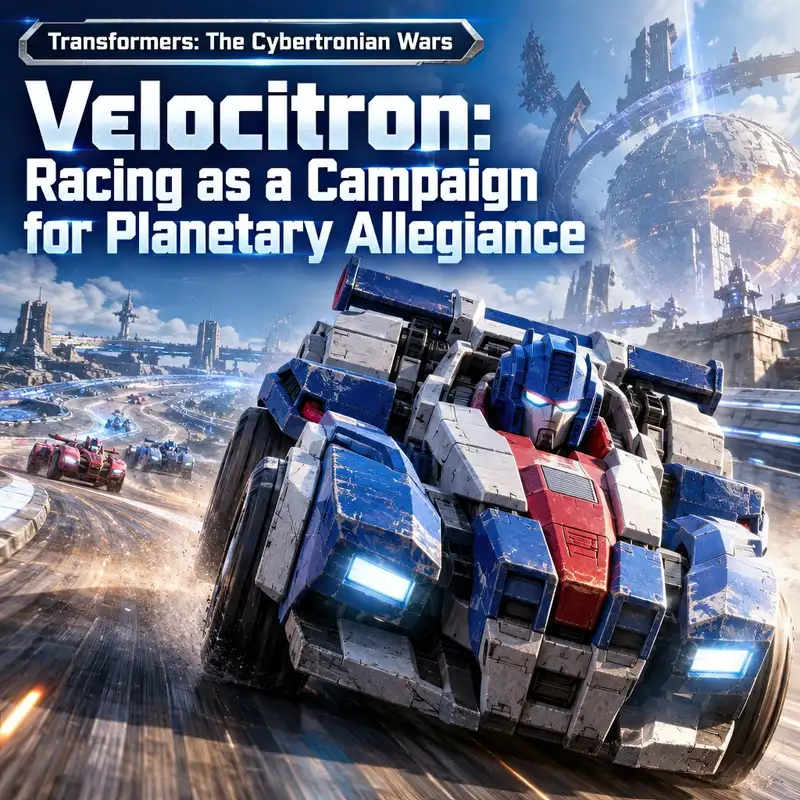
Velocitron: Racing as a Campaign for Planetary Allegiance
Delta was running from the sun when Windblade entered the mind beneath it. The capital of Velocitron moved across a scorched world on the body of the Titan Navitas, a vast sentient being whose failing systems had become part of the planet’s daily survival. Windblade, Chromia, and Clocker were trying to reach the controls of a racecourse inside that moving city. Above them, Blurr was competing in the Benefit, a contest where racers could injure one another and where winning meant more than a trophy. The political future of Velocitron was being decided at speed, while the being carrying its capital had been neglected nearly to cognitive collapse.
This was not a sporting festival with diplomatic guests in the stands. In the 2005 I D W continuity, during Cybertron’s difficult postwar reconstruction, the race was the diplomatic operation. Cybertron wanted Velocitron to join the proposed Council of Worlds. Velocitron’s leaders would consider the proposal, but only if Cybertron could prevail under Velocitronian terms. A visiting racer had to win the Benefit, and the victory had to be memorable enough to create public momentum. The challenge was more than to prove that Blurr was fast. It was to make an alliance with Cybertron look legitimate to a society that treated competitive performance as political authority.
That made the mission unusually revealing. A colony’s connection to the emerging interstellar order would not be settled by a treaty, a military guarantee, or a formal exchange of ambassadors alone. It would be settled by a public contest, shaped by local rivalries, violence, infrastructure, and the approval of a crowd. Windblade’s delegation had arrived with a political objective, but it could not reach that objective through ordinary diplomatic procedure. Before it could persuade Velocitron to join the Council, it had to understand why a race carried the force of a constitutional decision.
Velocitron was a former Cybertronian colony, but distance and separate development had given it its own political culture. Its inhabitants had pursued improved energy sources, then increasingly directed that pursuit toward speed. The available history does not provide a complete economic record of the colony’s mines, refineries, or industrial output. It does establish the larger pattern. Energy and motion became linked in Velocitronian life. To be faster was more than to travel more efficiently. It was to demonstrate mastery, status, and the capacity to compete in a demanding environment.
The planet itself helped create that obsession. Velocitron’s sun made the surface dangerous enough that its cities had to remain mobile. Movement was a survival requirement before it became a public ideal. A stationary settlement could not simply wait for the planet’s conditions to improve. It had to keep ahead of advancing heat and light. Mobility was therefore built into urban life, infrastructure, and political imagination. The colony did not become fascinated with racing because it had somehow forgotten the practical value of speed. It became fascinated with speed because survival had taught its population that remaining still could be fatal.
Delta, the capital, embodied that history. It was more than a city with vehicles and roads. It traveled on Navitas, a Titan whose immense body functioned as the foundation of the capital’s continued movement. The city’s inhabitants depended on him whether they thought about him or not. Roads, racecourses, government, and daily life existed because Navitas carried them across a hazardous world. The arrangement turned a sentient being into the center of Velocitronian infrastructure. It also created a serious civic obligation: a society dependent on Navitas needed to care for the mind and systems that kept Delta alive.
Instead, the story reveals a contradiction. Velocitron had elevated motion into a public virtue, but it had allowed the Titan making that motion possible to recede from civic concern. Navitas had become so neglected that his cognition was impaired. He forgot Windblade during their conversation. He remained powerful enough to carry the city, yet he was no longer receiving the attention necessary for clear thought and reliable communication. Velocitron’s celebrated culture of speed rested on infrastructure it had learned to treat as invisible.
That pattern matters because societies often mistake the visible achievement for the system that sustains it. A winning racer is visible. A cheering crowd is visible. A capital racing across a sun-scorched plain is certainly visible. Maintenance, care, institutional memory, and the welfare of a Titan beneath the city are easier to ignore. Velocitron’s political order rewarded the public display of performance. Its most essential dependency was left in the background. Windblade’s mission would exploit that contradiction, but it could not solve it.
Velocitron’s hierarchy made speed a civic credential. Moonracer, the colony’s ambassador, explained that racers occupied the highest social tier. Direct support personnel held a respected position beneath them. Others occupied a lower-status remainder of society. That arrangement was not presented as a conventional democracy, monarchy, or military dictatorship. It was a performance-based hierarchy, deeply rooted in the colony’s social habits. The ability to race, or to directly sustain racers, shaped who received standing, recognition, and influence.
Moonracer’s own position made the logic plain. She became an ambassador after keeping pace with the mobile capital for an entire day. The accomplishment demonstrated endurance, skill, and determination. It also revealed the narrow basis on which Velocitronian authority could be awarded. An ambassador normally gains influence through appointment, education, political trust, family connection, election, or institutional service. On Velocitron, the decisive qualification was physical performance in the colony’s defining activity. The system treated speed as evidence that a person deserved a public voice.
There is a certain practical intelligence in that tradition. On a world where cities had to move, competence in mobility was not meaningless. Racers understood the terrain, the dangers of high-speed travel, and the culture that held the colony together. Direct support personnel also mattered because racing required maintenance, preparation, navigation, and logistics. A successful racer was never truly an individual achievement. Speed depended on labor, technical knowledge, and support systems. Velocitron at least recognized some of that supporting work.
But the hierarchy also narrowed political legitimacy. It placed exceptional value on a particular kind of performance and treated that value as a basis for social rank. The colony had converted a survival adaptation into a permanent political filter. Those who could race gained prestige. Those close to racing gained reflected status. Those outside that world did not necessarily lose all agency, but they possessed less visible standing in the political order. A society can value expertise without allowing expertise in one field to dominate every question of public life. Velocitron had not drawn that line clearly.
The Benefit race was therefore not an odd interruption in an otherwise familiar government. It was an expression of the government Velocitron had built. Leadership depended on public recognition within a culture of competition. Rivalries could be fought through visible performance. The crowd’s reaction mattered because the crowd was part of the process that gave leaders room to act. A leader who could not command excitement, admiration, or confidence through the language of speed was vulnerable, whatever formal authority they possessed.
Override held the leading position on Velocitron, but her authority was insecure. Ransack challenged her, and the race became entangled with that internal contest. The available account does not establish a detailed ideology for Ransack, a conventional military organization under his command, or a fully developed plan to seize power. It would be too simple to describe him as a coup leader waiting for a chance to strike. What matters is that Override needed political leverage. She could not align Velocitron with Cybertron merely because she preferred the proposal. She needed a form of public authorization that would strengthen her position against a rival.
At this point, the Council of Worlds enters the story. Cybertron had emerged from a devastating civil war, but military survival had not created a stable political settlement. The planet needed relationships with its colonies, many of which had developed in isolation and had little reason to accept renewed central authority automatically. The Council of Worlds was an attempt to build an interstellar framework in which Cybertron and the colonies could negotiate a shared future. It was not yet a finished federal government with settled powers, trusted institutions, and universal allegiance. It was a project.
That distinction is important. A government recovering from civil war often believes that reconstruction begins when it restores its own capital, reopens its own systems, and appoints its own leaders. Colonies may see the matter differently. They have their own histories, fears, social arrangements, and memories of separation. A call for unity can sound like an offer of participation, or it can sound like a demand that distant authority return under a new name. Cybertron could not simply declare that the war was over and expect every colony to treat the declaration as binding.
Velocitron mattered because it was an autonomous society with a strong public culture, not because it represented a convenient mark on a strategic map. Its participation could strengthen the Council’s claim to represent more than Cybertron itself. It could demonstrate that former colonies were joining through negotiation rather than being absorbed through coercion. But such a success would only carry weight if Velocitronians could recognize the agreement as their own decision. A treaty imposed from above might produce nominal alignment. It would not produce durable legitimacy.
Windblade understood that problem better than a delegation focused only on formal procedure might have done. As a Cityspeaker from Caminus, she had unusual abilities and unusual moral authority, especially in her relationship with Titans. Yet she was not the sovereign ruler of Cybertron, and she could not command Velocitron to accept the Council. Her task required negotiation, cultural intelligence, technical access, and political judgment. She had to learn which local institutions actually decided the issue, not merely which figures held impressive titles.
Starscream’s presence made the campaign more complicated. He was the ruler of Cybertron, and he was pursuing colony alliances of his own. The effort to recruit worlds into the Council was not a neutral administrative program conducted by a unified government. It was also a contest over the shape of postwar authority. Windblade sought an interstellar political order capable of including independent societies. Starscream sought influence over that same emerging order. Their competition gave every successful mission additional weight.
Velocitron was therefore a test of more than diplomacy. It tested whether Cybertron could persuade a colony without treating the colony as a subordinate prize. It tested whether Windblade could achieve a meaningful victory while working within a political environment designed by another society. And it tested whether a public display could become the basis for an agreement without reducing that agreement to theater. The race would not settle every question surrounding the Council of Worlds, but it could establish a precedent. It could show that alignment was possible on terms other than force.
Moonracer provided the critical intelligence. Conventional negotiation could not simply move around the Benefit. To gain real traction, the Cybertronian proposal needed a victory in the race. Even that was not enough by itself. Blurr had to win in a way that captured public attention, because Override needed the political cover that only mass enthusiasm could provide. A narrow, forgettable finish might establish technical success without shifting the balance inside Velocitronian politics. The colony’s internal culture demanded spectacle as well as victory.
The Benefit thus functioned as a referendum without being a formal ballot. It was a leadership contest without being a conventional election. It was a diplomatic condition without being a treaty conference. Its rules were embedded in public custom rather than constitutional text. That made the race difficult for outsiders to understand, but it did not make it irrational from the Velocitronian perspective. The race created a shared event in which leaders, rivals, racers, support crews, and spectators could witness whether the proposed alliance had earned a place in the colony’s civic imagination.
Blurr became the visible instrument of that campaign. His speed made him a natural choice, but the selection carried political meaning. He was more than being asked to defeat local racers. He was being asked to perform Cybertronian credibility before a skeptical public. He had to show that an outsider could meet Velocitron at its own standard without appearing to mock or dominate it. A racer could reach parts of Velocitronian political culture that an ambassador, a council representative, or a security escort could not.
Knock Out, one of Velocitron’s delegates, recognized Blurr and doubted that he could succeed. His skepticism mattered because it represented a local judgment, not because it spoke for every Velocitronian. The delegation could not assume that familiar Cybertronian names or reputations would carry weight on the colony. Blurr was entering a contest shaped by home advantage, local knowledge, and norms outsiders might find unacceptable. He had speed, but the political system around the race had been built by Velocitronians for Velocitronians.
The Benefit was also dangerous. It had no protective code separating sport from violence. Racers used blades and other equipment to harm competitors. That did not turn the event into a conventional battle, but it did blur the distinction between athletic performance and coercion. The colony had normalized a level of physical danger in its principal civic spectacle. A racer was expected not only to be fast, but to survive a field in which rivals could convert speed, equipment, and aggression into political advantage.
Blurr refused to answer violence with violence. That choice imposed a risk. In a contest where others were prepared to disable opponents, refusing to retaliate could leave him exposed. It would be sentimental to pretend that restraint was costless, or that it automatically guaranteed victory. It did neither. But it carried political value. Blurr’s conduct suggested that Cybertron could compete without embracing every coercive practice built into Velocitron’s culture of public rivalry.
The message worked because it was conveyed through action rather than lecture. Blurr did not need to tell Velocitronians that their society was flawed. An outsider arriving to condemn local traditions would have been unlikely to gain trust. Instead, his restraint created contrast. He accepted the challenge of the race, acknowledged its importance, and declined to make injury his own route to success. That did not erase the violence of the Benefit, but it gave spectators a different model of what excellence might look like.
Still, ethical presentation was not enough. Blurr could not simply be admirable and expect the political mission to succeed. The race favored participants who knew the course, understood the hazards, and were prepared to use violence. Cybertron’s delegation needed another advantage. That advantage lay beneath Delta, inside the systems of Navitas. Windblade’s parallel operation would shape the decisive terrain of the race, while Blurr provided the visible performance above it.
Windblade entered Navitas’s brain chamber with Chromia and Clocker because the Titan was more than the foundation under Delta. He was connected to the city’s movement and to the systems that controlled the racecourse. The mission required access to a living infrastructure network. This was not like entering an empty control room or overriding a machine that existed only to obey. Navitas was a person, though one whose personhood had been obscured by the colony’s dependence on his body.
His impaired memory made the encounter troubling. Navitas forgot Windblade during their conversation. The damage was not a minor inconvenience. It showed the cost of treating essential sentient infrastructure as if it required no care beyond continued operation. The Titan still moved. Delta still survived. That visible success appears to have allowed Velocitronian society to overlook his decline. But functioning at the most basic level is not the same as being healthy, aware, respected, or capable of giving meaningful consent.
Windblade’s Cityspeaker abilities gave her a way to communicate with Navitas and understand the systems around him. Those abilities did not make her omnipotent. She could not fully repair his cognition in the middle of a diplomatic crisis. She could not merge with him, take permanent command of him, or restore all the care that Velocitron had failed to provide over time. Her access was real, but limited. She was working inside a damaged mind under pressure, with a race underway and a political opportunity that might disappear within moments.
This was the hidden operational problem of the Benefit. On the surface, the mission appeared to depend on Blurr’s ability to outpace his rivals. Beneath the capital, it depended on whether Windblade could navigate a neglected Titan’s systems, identify the controls that mattered, and act without causing greater harm. Chromia and Clocker supported that effort because diplomatic success required security, technical movement, and assistance in hazardous infrastructure. No serious operation, even one centered on racing, is ever carried by the public champion alone.
There was also an ethical problem. Windblade’s delegation had come to secure Velocitron’s alignment through local forms of legitimacy. Yet Windblade was now accessing the systems beneath that legitimacy without public disclosure. She was not conquering the colony. She was not overthrowing Override. But she was intervening in the physical conditions of the contest that would authorize the alliance. The mission’s urgency and its political purpose explain the choice. They do not remove the ambiguity.
Windblade found the systems governing the racetrack and altered the layout. Obstacles impeded Blurr’s rivals. Ramps gave Blurr opportunities to make the kind of spectacular progress that the political situation required. This was more than assistance at the margins. Blurr did not win through natural speed alone. Windblade’s intervention was essential to the result shown in the story. The alliance campaign succeeded through a combination of Blurr’s skill, his conduct under pressure, and Windblade’s concealed use of infrastructure.
From an operational perspective, the decision was precise. Windblade did not need to seize Delta, defeat every competitor, or impose Cybertronian rule. She needed to alter a narrow piece of decisive terrain. The track was where Velocitron’s political culture translated performance into authority. By shaping the course, she shaped the conditions under which public legitimacy would be produced. In military terms, she identified the point where a small intervention could influence a much larger political outcome.
That does not make the intervention uncomplicated. The race had already blurred sport and violence, and Windblade added another layer by using privileged access to hidden systems. The spectators saw Blurr’s victory, not the full machinery behind it. They responded to an event that was genuine in one sense and engineered in another. Blurr truly raced. He truly accepted danger. He truly refused to answer violence with violence. Yet the final result depended on assistance unavailable to the other racers.
The political value of the intervention lay in its restraint. Windblade did not attempt to dictate the crowd’s response. She could shape the racecourse, but she could not force Velocitronians to cheer, compel Override to submit the alliance proposal, or guarantee that the colony would accept Cybertron’s offer. The delegation could create an opening. It could not manufacture durable consent by technical means alone. That remaining space for public response is what allowed the victory to become politically meaningful rather than merely theatrical.
Blurr’s win was spectacular enough to meet the condition Moonracer had identified. The result did not matter solely because he crossed the course ahead of other racers. It mattered because the performance created a moment in which Cybertronian participation became exciting rather than abstract. The public could see an outsider meet Velocitron’s central standard while behaving differently from the competitors who had relied on violence. He had not rejected the colony’s language of speed. He had broadened the meaning of what that language could express.
After the victory, Blurr presented alliance with Cybertron as an opportunity to race on new worlds. That was a well-judged political appeal. He did not frame the Council as a command structure that would regulate Velocitron from afar. He presented it as expanded movement, access, and possibility. For a society built around speed, the promise of new routes and new worlds spoke more directly than a distant constitutional theory could have done. The offer connected interstellar cooperation to a local aspiration.
Override then put the question before the crowd. Its enthusiastic response gave the alliance public authorization within the political process Velocitron recognized. This was a real achievement. The colony was more than occupied, threatened, or administratively absorbed. Its leadership and public culture had been engaged. The crowd’s reaction gave Override the leverage she needed to align Velocitron with Cybertron while facing pressure from Ransack. Windblade had found a way to translate an interstellar project into local political language.
Yet the scene should not be mistaken for unanimous consent or a completed constitutional settlement. The story shows mass enthusiasm, not a formal ballot counting every resident’s vote. It does not establish that all Velocitronians supported the decision, that all status groups possessed equal influence, or that opposition disappeared when the crowd cheered. Public approval can be politically powerful without being universal. A moment of shared excitement can authorize a decision without resolving every grievance that existed before the race.
In the immediate fight, the mission succeeded. Blurr won the Benefit. Windblade and her team gained access to the systems that could shape the decisive terrain. Chromia and Clocker helped make the operation possible beneath a moving capital. The delegation overcame a condition designed to prevent ordinary diplomacy from working. They did so without turning the mission into an open seizure of power or a straightforward confrontation with Velocitron’s leadership.
Across the operation, the delegation converted uncertainty into a public success. Velocitron had not rejected Cybertron outright, but its political culture made formal negotiation insufficient. Moonracer’s local knowledge identified the real point of decision. Blurr’s race gave the proposal a visible champion. Windblade’s intervention made the required spectacle possible. Override translated that spectacle into authorization. Each participant handled a different part of the problem. The result was not the triumph of one individual, but the coordination of political understanding, technical access, and public performance.
At the scale of the conflict, Cybertron gained a colony partner for the Council of Worlds. That mattered because the Council needed to become more than an institution declared by Cybertron’s rulers. Velocitron’s alignment suggested that separate worlds could enter the new order through their own political forms. The agreement also gave Windblade a meaningful success in the wider contest over reconstruction. In a period when Starscream was pursuing colony relationships of his own, every alliance helped shape who would define the terms of postwar governance.
Politically, Override gained breathing room against her rival. The alliance was more than Windblade’s achievement imposed upon Velocitron. Override had to be able to present it as a locally valid decision. The crowd gave her that opportunity. But this also meant that the agreement became entangled with her position. If the alliance strengthened Override, it could be portrayed by rivals as her project. A decision made through public spectacle can consolidate leadership, but it can also become a weapon in an internal contest.
Institutionally, the mission demonstrated a difficult truth about the Council of Worlds. A representative interstellar order could not become legitimate by insisting that every world adopt the same procedure. Cybertron had to accommodate local political forms, even when those forms were strange, unequal, or uncomfortable. That flexibility made cooperation possible. It also created a problem. If the Council accepted every local mechanism of legitimacy without question, it might incorporate systems that denied equal standing to large parts of their populations.
For civilians, the crowd was not passive scenery. Velocitronians supplied the public response on which Override’s decision depended. Their enthusiasm mattered. But the colony’s hierarchy still shaped who possessed durable status and direct influence. Racers and their support networks stood closest to political visibility. Others could cheer, approve, and participate in the public moment, yet still remain outside the highest tier of civic authority. The race generated a mandate, but it did not remake Velocitron’s social order.
Velocitron’s deeper vulnerabilities remained visible throughout the mission. Its leadership depended heavily on performance and public excitement. Its social hierarchy treated athletic ability and proximity to racers as civic credentials. Its internal rivalry could turn an alliance into an instrument of factional advantage. And its mobile capital depended on Navitas, a sentient Titan whose impaired cognition suggested a profound failure of maintenance and care. The colony had mastered motion while neglecting the being that made continued motion possible.
The mission also raised questions about means. Windblade’s use of Navitas’s systems was effective, but it depended on an impaired Titan who had not been properly cared for. The intervention helped produce a victory that opened Velocitron to the Council of Worlds. It also demonstrated how easily political outcomes could depend on access to hidden infrastructure. A society that treats its sentient foundations as invisible machinery makes itself vulnerable not only to neglect, but to manipulation by those who understand the machinery better than its own leaders do.
No immediate collapse follows from the alliance in this story. It would go beyond the evidence to claim that Velocitron’s decision failed, that public enthusiasm vanished, or that Ransack immediately overturned the result. The point is not that the Benefit solved nothing. It solved a specific problem. It enabled alignment at a moment when conventional diplomacy lacked authority. Its limitations become clear only when we ask it to do work that no race, however dramatic, can accomplish by itself.
Windblade’s success did not end the wider recruitment campaign. Almost immediately, attention shifted toward another colony, Eukaris, where Starscream was also active. The Council of Worlds remained a contested project, shaped by different leaders, different worlds, and different visions of postwar authority. Velocitron was one gain, not a final settlement. Reconstruction across an interstellar civilization could not be completed by collecting symbolic victories. Each world brought its own institutions, inequalities, historical memories, and conditions for trust.
That is why the Benefit race matters beyond its immediate spectacle. It shows diplomacy operating under unfamiliar constitutional conditions. It shows that cultural intelligence can be as important as formal authority. It shows that a racer can become a political messenger, that a Titan can be both infrastructure and neglected citizen, and that a crowd can authorize a decision without resolving the structural weaknesses beneath it. Most of all, it shows that rebuilding after civil war requires more than defeating an enemy or restoring a capital.
Velocitron joined because Windblade understood that legitimacy had to be translated into the symbols and institutions Velocitronians recognized. The alliance was a real political achievement, not an empty stunt. But the campaign also demonstrated that legitimacy won through spectacle remains incomplete when civic status is unequal, leadership is insecure, and the sentient infrastructure sustaining society has been allowed to disappear from civic concern.