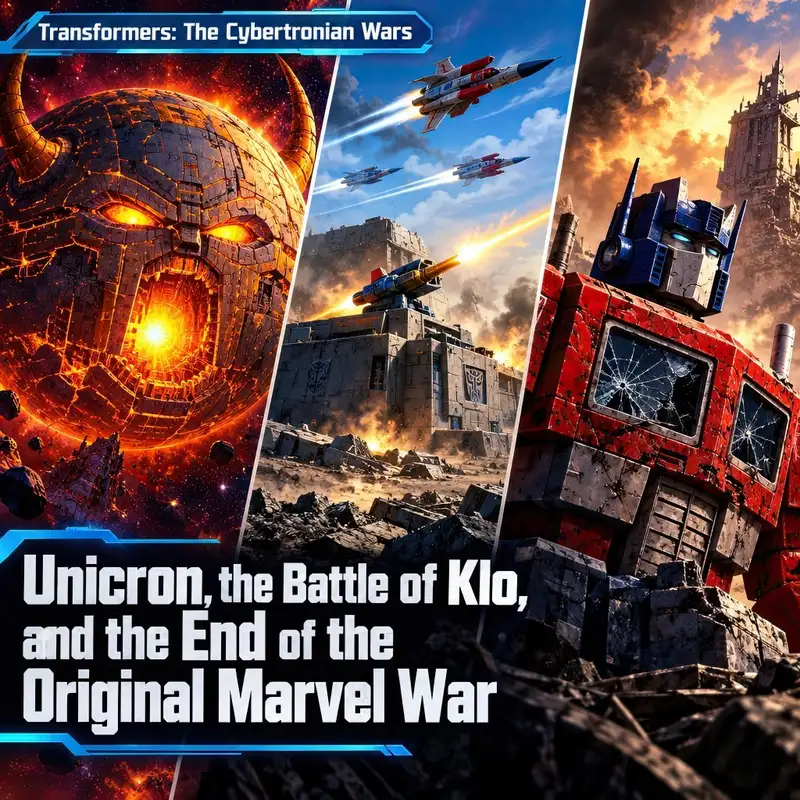
Unicron, the Battle of Klo, and the End of the Original Marvel War
Unicron was gone. That should have been the end of the war.
In Marvel’s original Transformers comic history, Optimus Prime had used the Creation Matrix to destroy the planet-eater threatening Cybertron. The immediate danger had been absolute. Unicron did not offer terms, occupy cities, or seek political obedience. He came to consume the world that both Autobots and Decepticons still regarded as home. Against that threat, old enemies had fought beside one another because survival left them no credible alternative.
Yet when the battle ended, Cybertron was still breaking apart. Optimus Prime was dead. The alliance had no agreed government, no reconstruction authority, no secure transport system, and no settlement for the armies that had just fought together. The Decepticons still had weapons, commanders, and reasons to fear an Autobot recovery. The Autobots had survivors, but not the institutions needed to turn survival into stability.
For that reason, the final phase of Marvel’s original war takes place after Unicron’s defeat rather than ending with it. The cosmic emergency was only the first crisis. The second was political and military. Who would control the surviving Cybertronian population? Where would the armies go? Who would command them? And could either faction establish a future before the ruins of Cybertron swallowed the remnants of the old world?
The answer led to Klo, a world selected by the Decepticons as a new base. There, under Bludgeon’s practical command, the Decepticons came close to winning the post-Cybertron war. The Autobots survived only because a power outside normal military planning intervened. The Last Autobot restored what ordinary command, repair, and industry could not.
The result gave Marvel’s original American comic series its ending. But it also makes that ending more complicated than a victory parade. Unicron’s destruction saved Cybertronian life from extinction. It did not produce peace. Cybertron’s restoration gave the Autobots a future. It did not demonstrate that the political causes, armed organizations, or memories of the war had been resolved.
This is Marvel’s comic continuity, not the history of the nineteen eighty-six animated film. The Unicron story here uses its own Creation Matrix, its own political setting, and its own sequence of leadership crises. There is no Rodimus Prime taking command after the battle, no animated-film year two thousand five, and no reason to import later screen history into this ending. Marvel’s war closes on its own terms, with a devastated homeworld, a disputed successor order, and a final battle far from Cybertron itself.
To understand why Klo mattered, it helps to understand what Unicron represented in this particular comic history. Marvel had already established a creation account in which Primus and Unicron were opposed cosmic beings. Primus created the Transformers as instruments in that struggle. It was a mythic explanation with direct strategic consequences. The conflict between Autobots and Decepticons was no longer only a civil war over Cybertronian power. It unfolded within a much older danger, one that threatened the existence of Cybertronian life itself.
That origin account belongs to this Marvel continuity. It should not be read as a universal explanation for every version of Cybertron, Unicron, or the Transformers. Across the franchise, those names have carried very different histories. Here, however, the Primus-Unicron struggle helps explain why the Creation Matrix mattered so much. It was not just a badge of leadership or a source of general wisdom. It was a singular strategic instrument tied to the oldest threat in the setting.
The difficulty was that the Autobots did not possess that instrument when they most needed it. During the Matrix Quest, the Creation Matrix had been lost and then seized by Thunderwing. His possession of it did not turn him into a stable guardian of Cybertronian life. It corrupted him. The Matrix became an example of a recurring military problem: a unique asset may be decisive, but only if it can be controlled, understood, and employed before the crisis arrives.
No ordinary Autobot weapons system could be treated as a reliable substitute. The comic never provides a technical manual explaining exactly why every conventional weapon would fail against Unicron. It does establish the larger point. Unicron was too vast and too destructive for the usual calculations of force balance. The Autobots faced a threat against which courage, local victories, and familiar battlefield equipment were insufficient.
That dependence on a single artifact created vulnerability. An army can lose a tank, a ship, or even a commander and still retain some of its operational capacity. Losing the only known instrument capable of defeating the enemy is a different matter. It turns strategy into a search operation. It makes leadership dependent on uncertain intelligence. And it creates opportunities for rivals, opportunists, and unstable actors to determine the survival of everyone else.
The Matrix’s eventual recovery did not solve those problems cleanly. It placed the Autobots in possession of a weapon they desperately needed, but it did not restore a functioning political order. It did not make the Decepticons trustworthy. It did not rebuild Cybertron’s defenses. And it did not guarantee that Optimus Prime would survive using it.
In the final approach of Unicron, Optimus faced a problem that few commanders encounter. His enemy was not just stronger. The enemy made ordinary factional rivalry irrelevant. Autobots and Decepticons could continue their civil war only if there was still a Cybertron to fight over.
That realization produced an alliance of necessity. Optimus sought to unite the factions against Unicron. It was not a reconciliation. It was not evidence that the old political conflict had faded away. It was an emergency coalition formed because the destruction of Cybertron would destroy both sides.
The Decepticon side was already fractured. Familiar names such as Galvatron, Shockwave, Scorponok, and others represented competing claims, ambitions, and centers of force. Their disagreements mattered because the Decepticons were not functioning as a unified state with an uncontested chain of command. They were a war movement and military organization whose leadership had been repeatedly disrupted by defeat, absence, personal rivalry, and the appearance of powerful figures with incompatible agendas.
That fragmentation did not make the Decepticons harmless. In fact, it made them difficult to predict. A centralized government can negotiate, issue orders, discipline subordinates, and make commitments that may endure beyond one battle. A fractured armed faction can still coordinate when interests align, but its promises are weaker. Individual commanders may preserve their own forces, pursue private objectives, or reinterpret the common mission once the immediate danger changes.
The Autobots faced a related problem from the other direction. They had a more coherent moral and military center in Optimus Prime, but their own capacity depended heavily on him. His authority was personal as well as institutional. He could frame the defense of Cybertron as a shared obligation. He could persuade former enemies to fight beside his forces. But he could not make mutual distrust disappear by issuing an order.
For the alliance, the immediate threat did the work that diplomacy could not. Unicron was visible. His purpose was unmistakable. No Decepticon commander needed to accept Autobot political ideals in order to understand that annihilation was bad for business, bad for conquest, and bad for continued existence. The coalition’s objective was brutally simple. Stop Unicron before he consumed Cybertron.
That clarity is one reason the alliance could function at all. It did not need a constitution, a power-sharing agreement, or a shared vision of the future. It needed temporary coordination. In military history, such coalitions are often stronger than they appear when the common danger is immediate. They are also often weaker than they appear once that danger is removed.
The very fact that Autobots and Decepticons could unite against Unicron demonstrates that their civil war was not driven by some unavoidable biological hostility. They could recognize a shared danger. They could fight in the same defense. But emergency cooperation is not the same as political trust. The alliance had no demonstrated answer to questions that would matter the moment Unicron was gone. Who would control Cybertron? Who would command its armed forces? What would happen to Decepticon troops? Who would manage evacuation, repair, energy, and reconstruction?
Those unanswered questions became urgent when Unicron reached Cybertron.
The attack on Cybertron was not a conventional planetary battle in which opposing armies sought control of defined ground. Unicron’s scale and destructive capacity erased the normal distinction between front line and rear area. Infrastructure was not just supporting the battle. Infrastructure was under direct attack. Cities, energy systems, transport routes, archives, command facilities, and whatever remained of civilian shelter all became part of the battlefield because the planet itself was being torn apart.
In a normal campaign, a commander may trade territory for time. A force can retreat, regroup, and establish another defensive line. Cybertron’s defenders had little room for that kind of operational depth. The world was both their capital and their industrial base. Damage to Cybertron was damage to the ability to repair bodies, sustain ships, produce equipment, coordinate survivors, and preserve the political memory of the society that had existed before the war.
The destruction also blurred the line between military and civilian loss. The comic does not supply a reliable casualty count. It never provides a complete map of which cities fell, which populations escaped, or how many Cybertronians remained active. There is no need to invent those figures. The strategic effect is clear enough. The homeworld was no longer a secure base. Its systems were failing, its population was endangered, and its remaining military forces were being reduced to scattered survivors.
Optimus Prime used the Creation Matrix against Unicron. The act succeeded in the narrowest and most necessary sense. Unicron was destroyed. The civilization-threatening enemy was stopped. But the victory cost Optimus his life.
That death mattered for more than symbolic reasons. Optimus had been the figure most capable of holding together the emergency coalition. He carried moral authority among Autobots and enough military credibility that even hostile Decepticons had to reckon with him. His loss removed a commander at the precise moment when the surviving Cybertronians needed someone able to move from wartime coalition management to the politics of survival.
The battle therefore produced two outcomes at once. Tactically and strategically, Unicron had been defeated. Cybertronian life had escaped immediate extinction. But politically and institutionally, the defenders were in a worse position than before. Their planet was crippled. Their forces were depleted. Their command arrangements were improvised. Their alliance had achieved its single agreed purpose and was now free to collapse.
This is the central paradox of the Marvel finale. The greatest victory in the war creates the conditions for its final military crisis. The destruction of Unicron did not restore the old order. It destroyed much of the physical and political foundation on which any new order would have to be built.
The next issues make that clear. Cybertron was dying or breaking apart. The status of Primus and the planetary system had become part of the emergency, but the immediate practical problem was plain. Survivors needed to leave, find secure ground, preserve their people, and decide who would exercise authority while the old homeworld failed around them.
That is a very different task from defeating an enemy in battle.
The Decepticons faced their own crisis of authority. Their old leadership had not produced a stable succession. Megatron, Galvatron, Shockwave, Scorponok, and other figures represented overlapping claims and ambitions rather than a clean transfer of command. But the absence of a recognized government did not prevent Decepticon forces from acting. Armed organizations can continue operating through local commanders, surviving cadres, and temporary coalitions long after their central institutions have broken down.
The question was no longer whether the old Cybertron could be preserved. It was whether a successor society could be created before the factions destroyed one another in the search for a new base.
The attempted exodus showed why that would be difficult. Leaving a dying planet is not just a matter of possessing spacecraft. Ships must be intact. They require power, crews, navigation, repair support, and destinations. Departure points must be secured. Supplies and wounded personnel must be loaded. Commanders need communications. And every group involved must decide whether its immediate survival is better served by cooperation or by denying resources to rivals.
The surviving Cybertronians did not have the luxury of planning a calm, orderly migration. Their transport assets were contested. Their political trust was exhausted. Their homeworld was collapsing. And the old alliance had lost the pressure that had held it together.
The Ark became more than a ship in this crisis. It was a transport asset, a command location, and a symbol of control over mobility. Whoever controlled a functioning vessel could move personnel, weapons, intelligence, and political authority away from Cybertron. That made it valuable even to leaders who could not agree on the destination.
Conflict aboard the Ark, involving Galvatron, Megatron, and Shockwave, demonstrates the wider problem without needing to become the center of this story. The Decepticons were still divided. They contained commanders who could contest one another as fiercely as they contested the Autobots. But division did not remove their capacity for violence. It simply made their future behavior more opportunistic and less predictable.
Here, the old civil war survived the destruction of its original battlefield. Cybertron had been the political center, industrial base, and symbolic homeland of both factions. Its collapse should have made continued war irrational in one sense. There was less left to conquer. But it also made continued conflict more likely in another. Scarcity, displacement, and leadership collapse magnified the value of every ship, every safe world, every repair facility, and every defensible base.
The Decepticons did not need to restore their former empire in order to remain a threat. They needed territory from which to regroup. They needed a place where their surviving forces could repair, organize, recruit if possible, and preserve a political identity built around Decepticon power. In the aftermath of Cybertron’s collapse, even a modest base could become the foundation of a successor state.
For that reason, Klo mattered.
Klo was not just a name attached to the final battle. It was a prospective Decepticon refuge and base of operations. In the logic of the crisis, it offered what the shattered Cybertronian forces no longer possessed: a place to stand. A world under Decepticon control could provide security, staging space, and the political claim that the Decepticon cause had survived the destruction of Cybertron.
The comic never provides a full economic survey of Klo. It never establishes exact resource deposits, population totals, defensive terrain, or a formal campaign map. Those details are unknown. What is established is sufficient. The Decepticons selected Klo because they needed a new position of strength, and the Autobots understood that allowing them to secure such a position would shape the entire post-Unicron balance.
For Klo’s inhabitants, this was not an abstract continuation of Cybertronian factional politics. A Decepticon relocation meant conquest imposed upon a world outside the original war. The struggle for a new base carried the familiar civilian consequences of occupation. Control of local space, infrastructure, energy, movement, and political authority would pass to an armed force whose own survival depended on securing them.
Bludgeon emerged as the effective Decepticon commander in this situation. His authority is best understood as practical rather than constitutional. The comic never shows a formal election, a settled succession process, or universal Decepticon acceptance of his leadership. Instead, Bludgeon’s position appears to arise from survival, force, and the vacuum left by the failures or absences of older claimants.
That kind of command can be powerful in a crisis. Soldiers and subordinate leaders do not always require a formal constitution when the alternatives are confusion, dispersal, or destruction. A commander who can lead surviving units toward a defensible objective may gain obedience because he offers immediate purpose. Bludgeon did not need to resolve every Decepticon dispute in order to direct an offensive. He needed enough cohesion to seize the initiative.
And at Klo, he had it.
The Battle of Klo unfolded under conditions that favored the Decepticons. The Autobots were exhausted by the defense against Unicron, weakened by the failed exodus, and deprived of their most important leader. Their forces had not emerged from the collapse of Cybertron as a unified, rested army with secure supply lines. They were survivors trying to prevent their enemy from converting disaster into a new political order.
The Decepticons, meanwhile, had a clearer immediate objective. They wanted Klo. They wanted a base. They wanted to prevent the Autobots from recovering enough strength to challenge them. In the short term, that is often enough to produce operational advantage. A force with a concrete destination can concentrate effort even when its larger political program remains unstable.
The Autobots had to solve several problems at once. They had to survive. They had to prevent the Decepticons from establishing control over Klo. They had to preserve some claim to a future beyond the ruins of Cybertron. And they had to do all of this while their organization remained damaged by the loss of Optimus and the wider disintegration of their homeworld.
The Decepticon attack was therefore more than a fight between surviving combatants. It was an attempt to determine which faction would become the only organized Cybertronian military power in the immediate theater. If Bludgeon secured Klo and destroyed or dispersed the remaining Autobots, the Decepticons would possess more than a tactical victory. They would possess territory, initiative, and the ability to define the terms of recovery.
The Decepticons had mobility, purpose, and momentum. The Autobots were trapped in a situation where every loss was harder to replace. A damaged soldier was not just one casualty among many. In the post-Unicron environment, every damaged body represented a potential permanent reduction in the ability to defend, repair, transport, and govern.
For that reason, the opening of the final issue is so bleak for the Autobots. They are losing not because Bludgeon has discovered a magical weapon or because the Decepticons have become a stable empire overnight. They are losing because the Decepticons have reached the battlefield with enough organized force to exploit Autobot exhaustion. The strategic destruction of Cybertron has become an operational advantage for the faction better able to act before the survivors rebuild.
Bludgeon’s position was not invulnerable. His own force came from a fragmented Decepticon movement. His ability to establish a lasting regime depended on victory at Klo and on the continued weakness of the Autobots. But those conditions appeared close to being met. The Decepticons were not required to solve every internal rivalry before winning. They only had to defeat the people standing between them and a new base.
The struggle also confirms that the war remained dispersed. Unicron’s destruction had not disarmed every Decepticon force or brought every commander under one authority. Issue seventy-nine’s Earth-side conflict, involving Galvatron and Fortress Maximus, illustrates this without becoming a second finale. Galvatron survives the Ark’s crash, attacks humans, and fights Fortress Maximus. The details belong to a separate theater, but their meaning is relevant.
Klo was the most important immediate decision point because it offered the possibility of consolidating that scattered violence into a new Decepticon position. If the Decepticons could establish themselves there, they would no longer be merely remnants. They would become a force with a base, a population under their control, and a platform for future operations.
The Autobots could not stop that outcome through normal means alone. They were too depleted. Their leadership was too fractured. Cybertron could not provide the industrial and political depth it once had. At the moment when Bludgeon appeared ready to secure victory, the balance changed through the intervention of the Last Autobot.
The Last Autobot is an exceptional restoration reserve, not evidence that ordinary Cybertronian medicine can revive any fallen soldier or rebuild a devastated world at will. His intervention belongs to the ancient layer of Marvel's history in which Primus, the Matrix, and Cybertron itself have become active forces in the war. That is why his arrival matters: conventional command has run out of reserves, and he can restore people and strategic depth on a scale no surviving Autobot unit could match.
At the center of that restoration is Hi-Q, previously linked to Optimus Prime through the Powermaster arrangement. In the finale he becomes the basis for a new Optimus Prime, formed from Hi-Q and Prime-derived identity material. The story establishes continuity of memory and leadership, but it does not fully settle the metaphysical boundary between resurrection, transformation, and a new individual carrying Prime's identity.
Operationally, the uncertainty does not prevent the new Optimus from becoming the center around which the Autobots reorganize. Ethically, however, Hi-Q should not be treated as disposable raw material, and the ambiguity still matters in a society where bodies can be reformatted and memories preserved. The restoration solves an immediate command crisis without giving the story a simple answer to what, exactly, makes a returned leader the same person who was lost.
The Last Autobot also revives fallen Autobots. Again, this should be understood as a singular intervention, not as a newly available military doctrine. There is no indication that every future casualty can be restored at the same cost, by the same means, or under ordinary battlefield conditions. The effect is extraordinary because the crisis is extraordinary.
Cybertron itself is restored through the Last Autobot’s power and the energy associated with the Matrix’s final use. This reversal restores strategic depth. The Autobots are no longer only a shrinking refugee force attempting to prevent the Decepticons from claiming a new world. Their homeworld, political center, and potential industrial foundation are returned to them.
Restoration does not instantly answer every practical question. A planet restored is not automatically a government rebuilt. Revived soldiers do not by themselves form a stable civil administration. Damaged trust does not disappear because the lights come back on. But the restoration changes what is possible. The Autobots are no longer fighting from the assumption that their civilization has already been destroyed.
That changes Klo.
When the restored Optimus Prime and the Last Autobot intervene, Bludgeon’s military calculation collapses. The Decepticons had relied on Autobot exhaustion, reduced numbers, shattered leadership, and the absence of Cybertronian strategic depth. The restoration strips away those advantages. The enemy they expected to finish is no longer a dying remnant.
In direct combat terms, the Autobots survive the battle. Across the campaign, the Decepticon project to secure Klo as a new base fails. For the larger war, Cybertron is restored and the immediate prospect of Autobot extinction is removed. Those are enormous changes, but they are not identical changes.
The Decepticons withdraw. That decision makes military sense. Bludgeon’s forces had sought a favorable contest against depleted survivors. Instead, they faced renewed Autobot opposition, the return of Optimus Prime as a unifying commander, and the intervention of a being whose capabilities they could not plausibly match through ordinary force. Continuing the battle would risk turning a near victory into the destruction of the surviving Decepticon force.
Withdrawal, however, is not surrender. The Decepticons are still organized enough to retreat. They retain personnel, factional identity, and at least some capacity to rebuild. They have lost their attempt to dictate the immediate post-Unicron order, but they have not been shown accepting Autobot legitimacy, renouncing their cause, disarming, or entering a negotiated settlement.
That distinction is the heart of the finale. The Autobots win because the Decepticons can no longer impose a successor state at Klo. The restored balance makes Decepticon conquest too costly and too uncertain. But the victory is not a demonstration that the political conflict has been resolved through reconciliation or institutional reform.
Optimus Prime declares that the war is over. Within the original American Marvel series, that declaration closes the era. It is the final statement of an eighty-issue run that had carried the Autobots and Decepticons through invasion, exile, internal conflict, changing leadership, alien intervention, and the destruction of their homeworld.
As narrative closure, the declaration works. The immediate military emergency has been reversed. Unicron is destroyed. Cybertron is restored. The Autobots are no longer facing extinction. The Decepticons have been forced out of Klo and denied the chance to establish a new center of power in the ruins of the old war.
As a peace settlement, the declaration is less complete. The comic never shows a detailed disarmament process. It never establishes how Decepticon prisoners are treated, whether Decepticon civilians exist outside the surviving armed forces, or what political status former enemies will hold on a restored Cybertron. It does not lay out a reconstruction government, an accountability system, a security-sector reform plan, or a durable arrangement for worlds caught between the factions.
Those omissions are not failures of imagination so much as reminders of what the story’s ending is designed to accomplish. It ends a war narrative. It never provides a full constitutional history of the peace that follows. The final issues are interested in survival, restoration, and the reversal of apparent defeat. They are not a treaty conference.
Later Marvel continuity would return to conflict in Generation Two, which reinforces the point without changing the meaning of issue eighty. The original run ends an era. It does not prove that every grievance, military network, or political ambition has vanished forever.
The Battle of Klo shows why destroying the greatest enemy is not the same as ending a war. Unicron's defeat removes the threat of extinction, but leaves Cybertron without the infrastructure, political center, and stable command structure needed to convert survival into peace. Bludgeon exploits that vacuum almost immediately. His offensive demonstrates how quickly a heavily armed faction can turn the absence of a settlement into a new campaign for power.
The Last Autobot restores enough of Cybertron's material and human foundation for the Autobots to deny the Decepticons a successor order, while the new Optimus restores a center of leadership even if the exact nature of that identity remains complicated. What returns is possibility, not a finished peace. Marvel's original war ends because the Decepticons can no longer dictate the immediate post-Unicron future. The survivors have won the chance to build something after the war, and the final challenge is whether they can turn that chance into an order that does not simply produce the next one.