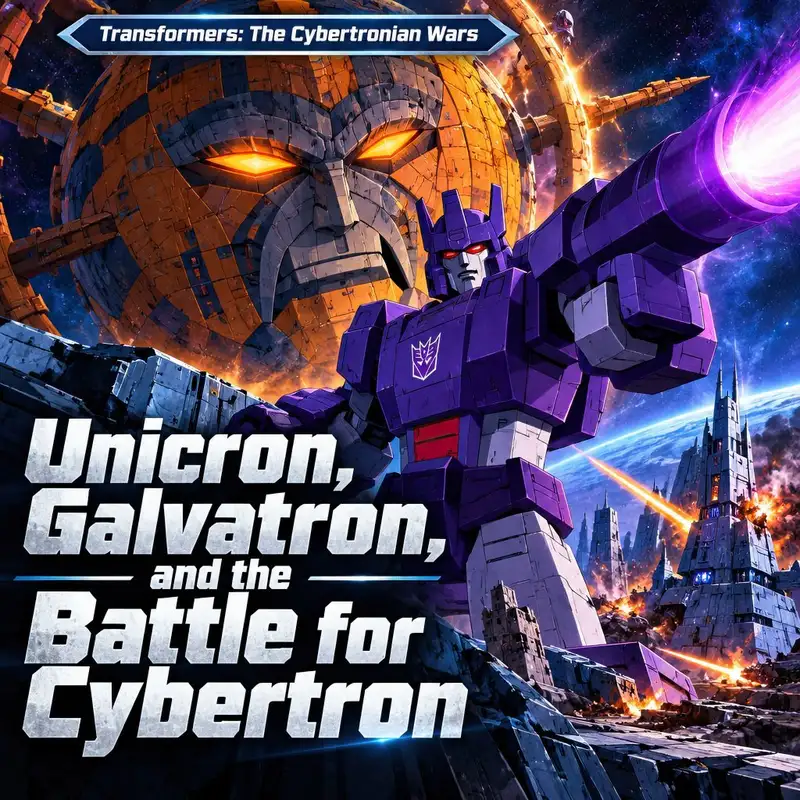
Unicron, Galvatron, and the Battle for Cybertron [Cartoon]
A moon disappears first. From Cybertron, the defenders can see the result before they can understand the weapon. A world-sized body moves through space, opens its vast mechanical jaws, and consumes the moon along with the installations built upon it. The weapons fired in response do not slow it. The defenders are not facing an enemy fleet, an invading army, or even a conventional superweapon. They are watching the destruction of the terrain from which they expected to fight.
In the American animated history of The Transformers: The Movie, the year is two thousand five. Cybertron is already a contested homeworld. The Decepticons hold the planet, while the Autobots prepare an effort to retake it from bases on Cybertron’s moons. Their war is a struggle over political authority, military infrastructure, and the right to determine Cybertron’s future. Then Unicron arrives, and that civil war acquires a more immediate problem. Whoever wins Cybertron will inherit nothing if Cybertron is consumed.
That distinction matters. Decepticon control of Cybertron is occupation by a rival Cybertronian faction. It can be resisted, challenged, and eventually overturned by military and political action. Unicron’s approach is something different. He does not seek a negotiated settlement, a tribute system, or a change in government. He treats worlds as objects to be consumed. Later, he will treat Cybertron as something still more useful: potential material for a replacement body.
The attack on the moons demonstrates why ordinary defense planning fails. Moon bases are fixed positions. They have weapons, personnel, communications, and presumably some expectation that their distance from Cybertron provides warning and defensive depth. Against a conventional attacker, that arrangement might delay an advance or secure approaches to the planet. Against Unicron, it becomes a series of isolated targets with no meaningful avenue of retreat.
The film never provides reliable technical figures for Unicron’s size, firepower, or energy reserves, and it does not need to. The operational fact is plain. He is large enough to consume celestial bodies and resilient enough that the weapons used against him have no visible strategic effect. A defensive force can damage an attacker only if it can reach a vulnerable system, disrupt its movement, or deny it the objective. The moon bases can do none of those things from outside.
For Cybertron, that produces an immediate strategic crisis. Fixed defenses cannot hold a perimeter around a planet when the attacker can dismantle the perimeter itself. Conventional attrition is equally unpromising. The defenders do not have time to wear Unicron down, and there is no indication that their weapons can impose the kind of losses that would alter his behavior. Survival depends on discovering a specific vulnerability and reaching it before Cybertron becomes the next object in his path.
The danger is not just physical destruction. Cybertron is a homeworld, an industrial center, a political symbol, and the place around which both Autobot and Decepticon claims to legitimacy have been organized. Its loss would end more than a campaign. It would scatter surviving Cybertronians, destroy infrastructure and archives, and leave the war’s remaining factions without the world they have spent so long trying to govern. Even enemies have a shared interest in preventing that outcome.
Unicron’s arrival also exposes another vulnerability, far from Cybertron. Megatron has just suffered defeat at Autobot City on Earth. The battle leaves him damaged, isolated, and abandoned by his own subordinates during their withdrawal into space. His political position is nearly as exposed as Cybertron’s moon defenses. He remains a formidable commander, but at that moment he has no secure base, no dependable chain of command, and no ability to dictate terms to anyone.
Unicron finds him in that condition. The planet-eater offers what Megatron lacks: a new body, new troops, transport, and the means to return to the war. The price is the destruction of the Matrix of Leadership, an artifact then carried by the Autobots and understood to be capable of threatening Unicron. The arrangement is often described as a bargain, but its coercive nature should not be missed. Megatron is not negotiating from strength. He is accepting survival and renewed power from an entity that can destroy worlds.
Unicron reforms Megatron into Galvatron. Other wounded Decepticons are remade as Cyclonus, Scourge, and the Sweeps. The film establishes continuity between Megatron and Galvatron. Galvatron remembers his former identity, his enemies, and his ambitions. Meanwhile, the reformatting places him in a radically altered strategic position. He has received a new body and new capabilities, but he has also accepted a mission from the being that made those changes possible.
The story does not systematically explain whether reformatting changed Galvatron’s psychology, judgment, or emotional stability. It is safer to say that the transformation intensifies an existing problem of command. Megatron had sought control over the Decepticons and victory over the Autobots. Galvatron now seeks those things while serving a patron powerful enough to destroy him if he fails. His ambition survives. His independence does not.
Unicron’s instructions are direct. Galvatron is to destroy the Matrix. That objective has military logic. The Matrix is a unique threat, and Unicron wants it removed before he reaches Cybertron. Yet Galvatron quickly begins to interpret the artifact in a different way. If the Matrix can threaten Unicron, perhaps it can also be used to command him. That thought is understandable. It is also the central intelligence failure of Galvatron’s campaign.
Knowing that an object can harm an adversary is not the same as knowing how to control it. Possessing an artifact is not the same as activating it. Galvatron understands the Matrix as a source of power, but he does not understand its relationship to Autobot leadership, its limits, or what it requires from a bearer. He mistakes access for mastery. In a war full of ancient technology and poorly understood systems, that is a particularly dangerous error.
Galvatron’s first major political act after returning to Cybertron is not a battle against the Autobots. It is the killing of Starscream. At the moment Galvatron arrives, Starscream is attempting to claim Decepticon leadership through a coronation ceremony. The event is not just comic vanity or personal ambition. It reveals a genuine succession problem. Megatron has disappeared. The Decepticons have withdrawn from Earth under pressure. Their leadership structure has no secure constitutional process for replacing a fallen supreme commander.
Galvatron resolves that problem through immediate violence. He identifies himself as Megatron reborn, destroys Starscream, and takes command in front of the assembled Decepticons. The execution settles the immediate question of who is strongest. It never establishes a durable system of authority. Fear can compel obedience in the short term, particularly within a military faction already accustomed to personal rule. It cannot guarantee loyalty when supplies fail, when setbacks accumulate, or when another claimant sees an opening.
The Decepticon command is therefore more complicated than a simple hierarchy beneath Galvatron. Cyclonus becomes a notably loyal subordinate. Scourge commands the Sweeps and acts with his own judgment when circumstances demand it. Other Decepticons remain attached to the faction for survival, opportunity, personal loyalty, or lack of alternatives. Their obedience reflects battlefield necessity as much as ideological unity. Galvatron has seized command, but he has not created an institution that can function independently of his presence.
The Autobots face a contrasting succession crisis. Optimus Prime has been mortally damaged during the defense of Autobot City. Before his death, he entrusts the Matrix to Ultra Magnus. The transfer gives Magnus possession of the object, but possession alone does not resolve the wider question of authority. An army under pressure needs orders, transport, secure communications, and confidence that someone can make decisions when the situation changes. A sacred or symbolic inheritance can help, but it cannot substitute for all of those things.
Ultra Magnus is an experienced commander, and the Autobots continue to operate under extreme pressure. Yet the Matrix does not respond to him in the way their situation requires. The film treats that inability carefully. Magnus is not exposed as a fraud, nor is he reduced to an unworthy caretaker. He carries the Matrix because Optimus chose him, and he accepts the burden. But the artifact’s power cannot simply be forced into operation by rank, courage, or desperation.
This matters because the Autobots are fighting across several theaters at once. Cybertron is threatened by Unicron. Earth remains a battlefield, with Autobot City exposed to renewed Decepticon attack. Cybertron’s moons are being destroyed or overrun. Shuttles and smaller craft become essential because they allow damaged forces to escape, regroup, and move between worlds. The Autobots cannot place every fighter around Cybertron when Galvatron is still hunting the Matrix elsewhere.
Their human allies are part of this dispersed defense. Spike and Daniel do not command the Autobot war, and they do not represent humanity as a whole. But they are operational participants. They move with Autobot forces, survive the withdrawal from Earth, and later contribute to the internal assault against Unicron. Their role matters because a crisis on this scale is not solved only by the largest weapons. It also depends on small teams reaching places that larger forces cannot.
The retreat from Autobot City demonstrates the difficulty of maintaining cohesion under pressure. The Autobots must evacuate personnel, preserve the Matrix, evade Decepticon pursuit, and find a place where repairs can be made. They are not conducting a clean withdrawal to a prepared reserve position. They are moving through hostile space while their enemy has regained an aggressive leader and while Unicron is closing on Cybertron. Under those conditions, any damaged shuttle, lost route, or failed rendezvous can become strategically significant.
Galvatron intercepts the Autobots and captures the Matrix from Ultra Magnus. Magnus is badly damaged in the process. The scene has often been treated as a measure of Galvatron’s brute force, but its larger importance is logistical. The Autobots lose their designated bearer, their most important artifact, and a senior commander in a single setback. Had they lacked a place to regroup, that could have become the collapse of their entire operational effort.
Instead, the Autobots reach Junkion. The Junkions provide repairs, vessels, and an emergency partnership based on common interest. Ultra Magnus is rebuilt from recoverable components. That restoration is not the same as proof that Cybertronian losses are trivial. The process depends on surviving parts, technical expertise, facilities, time, and allies willing to devote resources to the work. It demonstrates resilience, not immortality. A force that can recover damaged personnel has an advantage, but it still pays for that advantage in material and time.
The Junkions also alter the Autobots’ mobility. Their support gives the Autobots the means to return to the fight rather than remain scattered survivors. This is a useful reminder that alliances are often sustained by practical capabilities. The Junkions are not just reinforcements arriving for dramatic effect. They provide repair capacity, transport, and combat assistance at the moment the Autobots need all three. In a dispersed interplanetary war, a friendly port can matter as much as a battlefield victory.
Meanwhile, Galvatron has the Matrix but cannot make it serve his purpose. He attempts to use it against Unicron and discovers the difference between holding power and commanding it. The Matrix will not open for him. When he tries to order Unicron into obedience, the response is immediate and humiliating. Unicron does not recognize Galvatron as a partner, successor, or equal. He recognizes him as an instrument that has failed to complete an assigned task.
Galvatron’s position is now strategically disastrous. He has betrayed Unicron’s instructions by attempting to use the Matrix for himself. He has not gained the ability to activate the artifact. And he has placed himself within reach of the entity whose power he wanted to appropriate. His plan rested on a borrowed source of force without a reliable means of control. That is more than a personal failure: it is a command failure built into the entire arrangement.
Unicron then transforms and attacks Cybertron directly. The visual scale is extraordinary, but the military meaning is more important than the spectacle. Cybertron is no longer a defended planet facing a distant approach. It is under direct assault by a hostile mechanical body whose hands and weapons can reach its surface. The line between battlefield, city, infrastructure, and planetary body begins to collapse. A strike against Unicron is also a strike conducted in immediate proximity to the world the Autobots are trying to save.
At that point, three incompatible projects are competing for Cybertron. Unicron seeks consumption. He wants the planet destroyed or repurposed according to his own needs. Galvatron seeks domination. He wants to turn Unicron’s power into the instrument of Decepticon supremacy, even if he has no stable means of doing so. The Autobots seek preservation. They want Cybertron to survive and to be reclaimed from Decepticon rule, but they cannot permit either Galvatron or Unicron to control the planet.
These objectives are not variations of the same campaign. Unicron does not need Cybertronian consent. Galvatron needs a surviving Cybertron to rule, but his pursuit of cosmic power places that very survival at risk. The Autobots need to save the world without destroying it in the process. Their objective is therefore the most constrained. They must fight both an internal political enemy and an external existential threat while preserving enough of Cybertron’s future to make victory meaningful.
The Decepticons are endangered by Unicron as well. Their earlier control of Cybertron offers no protection if the planet itself is dismembered. This does not make them allies of the Autobots, and it does not erase the violence of their occupation. It does reveal a hard strategic fact. A faction can become so focused on defeating its immediate rival that it overlooks the conditions necessary for any victory to matter. Galvatron’s attempt to control Unicron is the clearest expression of that blindness.
The Autobots eventually accept that Unicron cannot be defeated from outside. Conventional weapons have failed. The Matrix is somewhere inside the enemy, and the only remaining option is an internal assault. This is not a normal boarding action. Unicron is not an ordinary ship or fortress. He is a transforming, hostile planetary-scale entity with internal defenses, shifting spaces, and the ability to destroy the world outside even while intruders move through his body.
The operation depends on mobility, improvisation, and incomplete intelligence. The Autobots know that they must reach the Matrix’s point of use. They do not possess a detailed map of Unicron’s interior or a reliable way to predict how long they will have before Cybertron is destroyed. They are also attempting to extract people from a living weapon after it has been activated. Any assault plan under those conditions is less a matter of certainty than of finding the one remaining path that might work.
Daniel’s role during the assault illustrates the value of small-team access. In an exo-suit, he can move through spaces and engage problems that a larger combat formation cannot address as easily. His intervention helps free the Autobot effort at a critical moment. Spike, meanwhile, remains involved in the movement and survival of the group. Neither human is presented as replacing Cybertronian forces. Their importance lies in the fact that a complex operation often depends on participants with different sizes, equipment, and opportunities.
Inside Unicron, the conflict between Hot Rod and Galvatron becomes decisive. Galvatron still possesses the Matrix, but he has not mastered it. Hot Rod’s intervention takes the artifact from him and changes the succession crisis that has followed Optimus Prime’s death. The moment is personal, but its consequences are institutional. The Matrix passes from an enemy who sees it as a tool of domination to an Autobot who is able to activate it.
Hot Rod’s transformation into Rodimus Prime is more than an upgrade in combat capability: it is a transfer of symbolic and practical authority. The Autobots have been fighting with an unresolved question at their center. Optimus is gone. Ultra Magnus has carried the Matrix but cannot open it. The chain of command has continued, but the leadership object that holds exceptional meaning within this society has not yet found a bearer capable of using it. Rodimus changes that.
The Matrix opens within Unicron. Its energy destroys the active body that has been attacking Cybertron. Galvatron is removed from the immediate struggle, cast away from the battle after his own attempt at mastery has failed. The Autobots escape as Unicron’s body breaks apart. Cybertron survives. In tactical terms, the immediate attacker is defeated. In mission terms, the Autobots have prevented the destruction of their homeworld. In political terms, Rodimus Prime emerges as the new Autobot leader.
Yet this is not the end of every problem created by the crisis. The film destroys Unicron’s active body, but it does not erase all of him. His severed head remains in orbit around Cybertron. That remnant is not a harmless monument or ordinary wreckage. Its survival means that the physical evidence of the threat remains close to the world it nearly destroyed. The war has also left the Autobots with a damaged planet, a new leader, and surviving Decepticon enemies.
The film’s closing sense of liberation is understandable. Cybertron has been saved from immediate destruction, and the Autobots have regained the possibility of political control. But survival creates a settlement, not peace. Destroying Unicron does not by itself demobilize Decepticon forces. It never resolves the loyalties of those who served under Megatron or Galvatron. It does not restore infrastructure, repair every damaged body, or answer how a society shaped by war will govern itself after victory.
The opening episodes of season three, especially Five Faces of Darkness, make that clear. The Autobots hold Cybertron under Rodimus Prime. The Decepticons have been pushed to Chaar, a harsh and resource-poor refuge. Their condition is weaker than it was when they controlled Cybertron, and energon scarcity becomes part of their strategic predicament. But exile is not surrender. It can preserve a faction’s leadership, personnel, identity, and capacity to act while denying it the advantages of a stable home base.
Chaar is therefore important not because it is an impressive fortress, but because it demonstrates the endurance of defeated political movements. The Decepticons no longer hold Cybertron’s central infrastructure. They lack comfort, security, and reliable resources. Yet those hardships do not dissolve the faction. Deprivation can create pressure for surrender, but it can also harden discipline, intensify rivalry, and make every available source of supply or transport more valuable.
Galvatron eventually returns to Decepticon leadership. His recovery confirms that removing him from the final battle inside Unicron did not permanently solve the Decepticon command problem. The faction now operates under conditions of exile and scarcity, but the old pattern remains. Galvatron’s authority depends heavily on personal force and fear. Cyclonus continues to display strong loyalty. Other Decepticons respond to setbacks with frustration, opportunism, or open resistance. The command system remains brittle because it is centered on a leader rather than durable procedures.
Blitzwing’s temporary opposition during this period is revealing. It does not mean that the Decepticons have developed a healthy system of internal debate. It means that hardship exposes the limits of command by intimidation. When a leader cannot reliably provide victory, energon, or safety, subordinates begin to calculate alternatives. Galvatron can suppress some of that dissent, but suppression is not the same as resolving the causes of discontent.
The Autobots, meanwhile, face the burdens of holding Cybertron. Reclaiming a world requires more than driving the enemy from its capital. It requires access to repair facilities, transport routes, energy systems, communications, and defensive infrastructure. It requires deciding who speaks for the planet and how former enemies, neutral civilians, and returning allies will be treated. The animated series does not provide a full constitutional history of Rodimus Prime’s government, so it would be wrong to invent one. But the military problem is evident. Occupation has ended for the Autobots only if governance can follow.
The conflict involving Metroplex and Trypticon helps show why infrastructure remains central after Unicron’s defeat. These city-former systems are not just enormous fighters deployed for dramatic escalation. They are mobile bases with strategic roles tied to defense, movement, transformation technology, and access to repair. A city-former can carry the functions of a fortified installation into a contested area, but it also creates immense maintenance and command requirements.
When Metroplex’s transformation systems are damaged, the consequences extend beyond one individual’s ability to enter combat mode. A failure in a transformation cog affects readiness. It can prevent a major asset from shifting between its civilian, defensive, and mobile functions at the moment that flexibility is most needed. Trypticon’s own capabilities likewise make him more than a Decepticon weapon. He is part of the wider struggle over who can protect, move through, and operate within Cybertronian infrastructure.
These systems reveal a larger truth about sovereignty. Controlling Cybertron is not the same as occupying a visible patch of ground. It means controlling energy networks, repair bays, transport hubs, command centers, data systems, and the specialized knowledge required to maintain them. A faction that loses its cities and industrial support may still field fighters. It will struggle, however, to replace losses, restore damaged heavy assets, and sustain complex operations across worlds.
Unicron’s remains ensure that the post-film settlement never becomes fully secure. In Ghost in the Machine, Starscream’s ghost reactivates Unicron’s severed head. The episode should not be read as proof that every apparent Cybertronian death is reversible or that Unicron had simply survived unchanged. It establishes something narrower and more troubling. The head remains active enough to perceive, threaten, and pursue a new plan for survival.
That plan is not a repetition of the original attack. Unicron seeks components from Cybertronian strategic systems. He demands Metroplex’s eyes, Trypticon’s transformation cog, and a connection to Cybertron. The objective is to use Cybertron itself as a replacement body. The threat has evolved from consumption to appropriation. Instead of destroying the world outright, Unicron aims to seize its physical and technological substance for his own continued existence.
The choice of components is significant. Metroplex’s eyes are not just trophies, and Trypticon’s cog is not just a convenient piece of machinery. Unicron is seeking perception, transformation capability, and access to the planet he intends to inhabit. The episode never provides a complete engineering explanation, and none is necessary. Its strategic meaning is clear. Unicron’s remains can still turn Cybertronian infrastructure into a vulnerability if they are allowed to connect to it.
Starscream’s involvement adds another layer to the crisis. His ghost acts from personal grievance and ambition, not from a coherent plan for Cybertronian survival. That is consistent with the broader pattern of succession and resentment that has shaped Decepticon politics. A dead claimant to leadership can still exploit a surviving strategic threat if the conditions for revenge and manipulation remain available. The danger is not only Unicron’s power. It is the willingness of others to gamble with Cybertron in pursuit of narrower objectives.
Scourge’s conduct in the episode is equally important. He does not just accept every scheme offered by a superior force. When the plan threatens Cybertron on a fundamental level, he breaks from it. This does not transform Scourge into an Autobot, nor does it suggest that the Decepticons have abandoned their war against the Autobots. It does show that Decepticon identity is not identical to obedience toward any being who promises power. Individual judgment and self-preservation still matter.
The Autobots prevent Unicron’s reconnection to Cybertron through sabotage involving energon. The action is a limited but effective denial operation. They do not need to destroy every remnant of Unicron or solve every mystery surrounding his survival. They need to prevent the specific integration that would give him a new body and place Cybertron under his direct control. In this respect, the operation resembles the earlier internal assault. The defenders succeed by identifying the crucial point of failure, not by matching Unicron’s scale.
Even then, the episode does not provide complete closure. Unicron’s eye remains active. The immediate plan has been frustrated, but the surviving head remains evidence that the earlier victory was incomplete. Cybertron has escaped destruction twice, first from the active body and then from the attempted reconstruction. Yet the planet continues to exist beside a hostile remnant of the force that nearly consumed it. That is not a stable security environment.
The battle for Cybertron becomes a three-sided struggle because each power wants the planet for a different reason. Unicron sees prey and, eventually, a possible body. Galvatron wants the center of Decepticon supremacy but tries to secure it through a cosmic power he cannot truly command. The Autobots want a homeworld that must remain alive before questions of government, legitimacy, or reconstruction can matter at all. Survival becomes the precondition for politics.
Destroying Unicron's active body therefore ends the existential attack without ending the Cybertronian conflict. Galvatron survives. The Decepticons are scattered rather than reconciled. Cybertron is saved but damaged, and Rodimus Prime inherits not a clean victory but the burden of rebuilding a political center after catastrophe. The planet's survival is decisive, yet peace requires something Unicron's destruction cannot provide: institutions, infrastructure, and a form of authority strong enough to prevent the next struggle for power from emerging out of the ruins.