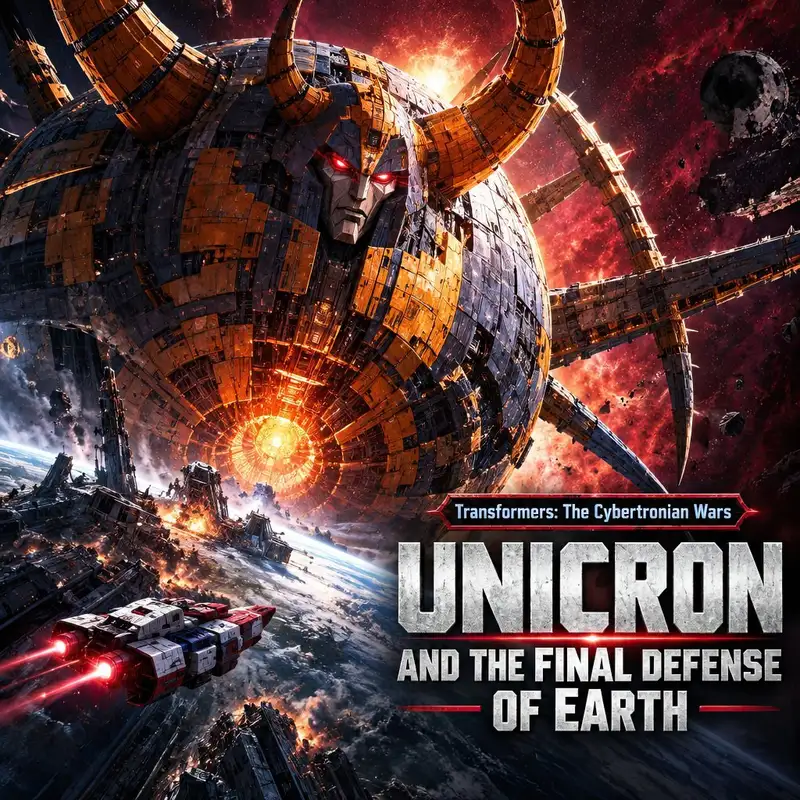
Unicron and the Final Defense of Earth
The decisive moment comes after the apparent victory. Scourge, Unicron’s herald on Earth, has been defeated. The force he assembled around the Transwarp Key is breaking apart. Yet the Key itself is still active, the portal above the battlefield is collapsing unevenly, and Unicron is close enough for his vast form to dominate the sky beyond it. Optimus Prime cannot simply claim the device, shut down the machinery, and lead his Autobots home. The control system has been damaged. The only reliable way to deny Unicron the route is to destroy the route.
That choice defines the final defense of Earth in the live-action history of Bumblebee and Rise of the Beasts. The coalition does not destroy Unicron. It does not storm his world, defeat his fleet, or discover a weapon capable of matching his scale. It conducts a denial operation. It removes the access point, eliminates the local commander who made the invasion possible, and accepts a severe strategic cost. Earth survives because its defenders decide that the Transwarp Key must no longer belong to anyone.
That difference matters in practice. A conventional military victory destroys, captures, or compels an enemy force. This was different. Unicron remained beyond Earth, alive and hostile. The defenders could only prevent him from using a particular corridor through space and time. Their success was immediate, necessary, and incomplete. They saved a world, but they did not end the larger danger.
The Transwarp Key was the center of that danger because it was never merely an artifact of power. It was a strategic-mobility system. In the film’s account, it could open passages across immense distance and through time itself. For a stranded force, that made it a possible road home. For Unicron, it offered something more consequential. It offered a direct route to Earth.
That double purpose explains why every major participant wanted the Key for a different reason. The Autobots saw a chance to return to Cybertron after years of isolation. The Maximals saw a responsibility to keep the Key hidden, because they had already seen what happened when Unicron gained access to a world. Scourge and the Terrorcons saw it as their mission objective. Noah Diaz saw a device that could turn his planet into the next target. Elena Wallace saw an ancient object whose symbols and hidden history had suddenly become matters of survival.
The Maximals’ warning came from experience. Long before the events of nineteen ninety-four, Unicron attacked their homeworld. The film presents this history through the testimony of Optimus Primal and the visual record associated with it. The exact political history of that world is not developed. What matters is the operational sequence. Unicron pursued the Transwarp Key. His herald, Scourge, led the hunt. The Maximals faced a choice between holding their ground and preserving the artifact that might keep another world from sharing their fate.
Apelinq, the Maximal commander, made that choice possible. He remained behind to delay Scourge while Optimus Primal and the other survivors escaped with the Key. The film does not provide a full campaign history of that defense, and it does not need to. Apelinq’s stand was a rear-guard action in the oldest military sense. It did not save the homeworld. It bought time for the mission that followed.
The Maximals escaped, but their victory was narrow and painful. Their world was consumed by Unicron. They carried away the one object that could deny him a more direct path to other worlds, then took it to Earth. Their mission was not conquest, colonization, or even a conventional search for allies. It was custody. They became survivors responsible for a weapon, a route, and a warning.
These Maximals are specific to Rise of the Beasts. They are not the Maximals of the Beast Wars television series, and their history does not involve that series’ future Cybertron, prehistoric Earth, or time conflict. In this film, they are an isolated group of protectors who have lived in concealment on Earth for an ancient span of time. Their identity is shaped less by formal government than by shared loss and a continuing obligation.
Their first decision on Earth was to divide the Key. That was sound security practice. A unique artifact is vulnerable when held in one place, one vault, or one pair of hands. By separating it into two components and concealing those components through different custodial arrangements, the Maximals made theft more difficult. They also made activation more difficult. No one who found one half could immediately use it.
The weakness of this plan was that secrecy depended on inactivity. A hidden device can remain hidden as long as it stays quiet. Once activated, it becomes a beacon. That is the larger intelligence lesson of the Key. Concealment was not the same as safety. The Maximals had reduced the chance of accidental discovery, but they had not eliminated the danger that someone would awaken the system and reveal it to the enemy already searching for it.
By nineteen ninety-four, another stranded community had arrived on Earth. Optimus Prime and the Autobots had survived the fall of Cybertron shown in Bumblebee, then established themselves in hiding on a world that was not their home. They had mobility within Earth’s human infrastructure, alternate modes that offered concealment, and a small network of allies. What they lacked was a known route back to Cybertron.
For Optimus Prime, that lack was more than personal frustration. A commander responsible for displaced personnel has obligations that extend beyond immediate survival. The Autobots were not tourists on Earth. They were refugees, soldiers, and survivors of a lost war. Their isolation limited their ability to find other Cybertronians, learn the fate of their homeworld, or restore a larger community. The Transwarp Key appeared to offer a solution to all of those problems.
That strategic hope made Prime vulnerable to compromise. The Key was dangerous, but it was also uniquely valuable. No conventional vehicle, ship, or local repair effort promised what it promised. It was a route across the divide between Earth and Cybertron. For a leader who had watched his people scatter, that possibility carried enormous weight.
The Maximals understood the same value and drew the opposite conclusion. They had already possessed the Key. They had already lost a world because Unicron sought it. Their experience taught them that the device could not safely be treated as an escape system. It was too visible when active, too important to Unicron, and too destructive in the wrong hands. Their doctrine was restraint. They had not used the Key to seek their own return because keeping it dormant protected life on Earth.
This was not a simple disagreement between courage and caution. It was a conflict between two responsibilities. Prime felt responsible for stranded Autobots and for the possibility of returning them to Cybertron. Optimus Primal felt responsible for preventing Unicron from reaching another inhabited world. Both leaders had suffered displacement. Both had lost comrades. Both understood that a road home can become an invasion route when the enemy controls the destination.
The human participants entered this conflict without formal rank, military mandate, or advance preparation. Noah Diaz was trying to hold together an ordinary family under difficult circumstances. His concerns were immediate: work, money, his younger brother’s medical needs, and the fear that one setback could become a crisis. He had prior technical training, but he was not acting as a representative of a government or an armed force. His authority came from judgment under pressure and from the fact that Earth was his home.
Elena Wallace entered through research rather than combat. Working at a museum, she recognized that a falcon artifact contained something more than a decorative object or a conventional historical mystery. Her discovery activated the first component of the Transwarp Key. That activation changed the situation at once. A buried relic became an active signal. The hidden war between the Maximals and Unicron’s forces now had a detectable point on Earth.
Elena’s role is easy to underestimate because it does not resemble battlefield command. But she possessed a form of intelligence the Cybertronians lacked. She could interpret the human history surrounding the artifact, trace the clues embedded in its design, and connect ancient symbols with a route to the second half of the Key. Her knowledge was not secondary decoration around a fight. It became access intelligence.
Noah’s encounter with Mirage brought him into the same crisis from another direction. Mirage had adopted the form of a Porsche and had learned enough about Earth to navigate its streets, but alternate-mode concealment did not make him invisible in every sense. A sentient alien vehicle with a distinct personality, unusual behavior, and a desperate need for assistance is still difficult to keep entirely outside human notice. Noah discovered him at precisely the moment when the Autobots’ hidden existence was becoming harder to sustain.
The first confrontation with Scourge demonstrated the imbalance in local combat power. Scourge was not an independent warlord seeking his own throne. He was Unicron’s herald, the field commander sent to retrieve the Key and open a route for his master. His authority came from that mission. He did not need to build a civilian administration, negotiate a treaty, or persuade Earth’s population. He needed to find the artifact, eliminate resistance, and activate it.
The Terrorcons under Scourge were therefore not an occupation force in the usual sense. Their mission was narrower and more urgent. Battletrap, Nightbird, and Scourge himself operated as a retrieval and enforcement element. They used speed, intimidation, and overwhelming violence against a small number of defenders. Their campaign did not depend on controlling cities or holding territory. It depended on gaining custody of the Key before the defenders could understand its full importance.
Scourge’s ability to detect the activated component gave him the initiative. The problem was not that Elena made an irrational choice. She had no reason to know that awakening the artifact would function as a signal to a cosmic enemy. The failure was structural. The Key had been hidden without a system capable of warning ordinary humans what activation would mean. The Maximals’ security plan survived for ages, then failed in a matter of moments once the device became active.
At the first major clash, Scourge seized the first half of the Key. Bumblebee was killed in the fighting, and the Autobots were forced into withdrawal. Airazor’s intervention prevented a complete destruction of the remaining defenders. This was more than an emotional loss. Bumblebee’s fall reduced the Autobots’ combat strength, while Scourge’s capture of the Key gave the Terrorcons both material advantage and confirmation that their target was on Earth.
The withdrawal also exposed the limits of the Autobots’ original position. They had not been prepared for a force that already understood the artifact’s strategic value. They had no established defensive network around the Key, no larger Cybertronian force to call for reinforcement, and no formal alliance with human institutions. Their small team had to improvise after the enemy had already taken the first objective.
Airazor’s role in that withdrawal was especially important because she represented the Maximals’ accumulated knowledge. She knew the history of the Key, the danger posed by Scourge, and the route toward the second component. In a small coalition, a single experienced guide can matter as much as several fighters. Such personnel connect present operations to past warnings. When they are lost, an army does more than lose firepower. It loses memory.
The surviving group learned that the second half of the Key had been moved from its original hidden temple and entrusted to human protectors connected to the Maximals’ long presence on Earth. That detail expanded the scope of the custodial mission. The Maximals had not guarded the Key entirely alone. Human communities had become part of the protective structure, preserving knowledge that neither the Autobots nor the Terrorcons fully possessed.
This was where Elena’s work became operationally decisive. The route to Peru was not obvious from raw force or alien sensors alone. It required interpretation. Symbols, artifacts, and local historical knowledge pointed toward the second Key component and toward the people who had maintained the connection to it. The ancient past was not treated as a museum display. It became the map for a modern defense operation.
The Peruvian setting mattered because it brought several strategic factors together. It was remote enough to conceal a sacred site and the Key component associated with it. It contained ancient infrastructure that could still be read by those who understood its symbols. It also provided the terrain around which the final battle would later develop: open ground, elevated approaches, volcanic structures, and a buried energon deposit whose presence would have unexpected consequences.
The film does not establish the exact age of the site, the full identity of every builder, or the scale of any larger human-Maximal network. Those gaps should remain gaps. What the story does establish is sufficient. A hidden location, a community with inherited knowledge, and an archaeological trail created a defense system that had endured through secrecy rather than through visible military strength.
That secrecy could not survive contact with Scourge. The Terrorcons followed the defenders to Peru, and the struggle for the second half of the Key became a race between interpretation and force. The defenders had local knowledge, but Scourge possessed the initiative, the first Key component, and a willingness to destroy anything between him and the objective.
Airazor’s corruption made the danger more immediate. Scourge used the dark energy associated with Unicron to infect her. This was more than a battlefield wound. It showed that Unicron’s influence could reach Earth through his agents before he physically arrived. The enemy did not need to appear in person to alter a defender’s body, undermine trust, and turn a trusted ally into a potential threat.
The film does not establish that this dark energy follows the same rules as similarly named substances in other Transformers continuities. It should be understood here through its demonstrated effect. It corrupts Airazor, compromises her control, and makes her dangerous to the people she is trying to protect. That is enough to reveal its operational significance. It is a weapon of coercion as much as destruction.
For the Maximals, Airazor’s corruption was a disaster because their force was already small and defined by survival. They were not a large army able to absorb losses through replacement. Each member carried unique experience, local knowledge, and a personal history of the world Unicron had destroyed. Losing Airazor meant losing a veteran, a scout, and a link in the group’s shared memory.
Her final request placed Optimus Primal in an impossible position. As the corruption overcame her, she asked him to kill her before she could harm Elena and the others. Primal complied. The act was not a triumphant sacrifice staged for effect. It was a grave decision made under conditions where delay could mean further deaths. The coalition lost one of its most capable protectors because the enemy had turned her own body into a threat.
That moment also altered the political meaning of the conflict. Until then, the Key might still have seemed like a disputed resource, a possible route home, or a dangerous secret. Airazor’s death made clear that Unicron’s campaign would not remain abstract. The war had reached individuals. It could corrupt defenders, exploit their loyalty, and force allies to make decisions they would never have chosen under ordinary circumstances.
Noah drew his own conclusion from the growing evidence. The remaining half of the Key was not a prize worth protecting. It was a liability. If Scourge needed both pieces to open the route, then destroying the second component before he could seize it seemed like the most direct way to save Earth. Noah attempted to do exactly that.
From Noah’s perspective, this was not reckless defiance of Cybertronian authority. He had watched the Terrorcons kill Bumblebee, seize the first half of the Key, and pursue the second across continents. He had heard what happened to the Maximals’ homeworld. He had no reason to believe Earth possessed a defense capable of surviving Unicron’s arrival. A device that could summon such a threat had to be destroyed before the threat reached his family, his city, and everyone else on the planet.
Optimus Prime stopped him. Prime still believed the Key could offer a path to Cybertron. His judgment was shaped by the Autobots’ long exile and by the possibility that this artifact might be their only known route back. He did not dismiss Earth’s danger, but he believed the Key could be secured and used before Unicron’s forces could exploit it.
That decision was understandable, but it exposed a command problem. The coalition had no shared doctrine for artifact custody. It had no agreed rule for who could authorize activation, destruction, transport, or concealment. Prime had military leadership among the Autobots, Primal had moral authority among the Maximals, Elena possessed critical interpretive knowledge, and Noah represented the people who would pay the price if Earth became exposed. None of those authorities had been integrated before the crisis.
The dispute was therefore not resolved through a mature command process. It was interrupted by Scourge’s success. He captured the second half of the Key, reunited the components, and carried them to the volcanic site where the Terrorcons could assemble the device into a portal mechanism. The defenders had spent time arguing about whether the Key should be preserved. Their enemy answered the question by taking custody of it.
This was the decisive turning point of the campaign. Until then, the conflict was an artifact hunt. The Terrorcons had one component, the defenders had another, and each side still had options. Once Scourge assembled the Key and activated the system, the struggle became a planetary-defense emergency. The defenders no longer needed to decide whether to use the Key for travel. They needed to stop the portal before Unicron crossed it.
The portal transformed the scale of the war with extraordinary speed. Tactically, the Terrorcons held the site and the machinery. Operationally, the Autobots, Maximals, Noah, and Elena had to assault a defended objective under time pressure. Strategically, Earth was no longer a hiding place for refugees or a neutral location for a buried relic. It had become Unicron’s prospective target.
For humanity, the threat was almost impossible to answer through ordinary defense. The film provides no indication that Earth’s governments had a prepared planetary-defense system, a coordinated public warning structure, or weapons designed to confront a being that consumes worlds. Human military institutions may have existed beyond the immediate events, but they were not the force standing at the portal. The people capable of acting were the small group already present.
That made the final defense an improvised coalition operation. It had no established headquarters, no common communications doctrine, no large reserve force, and no time to build trust through planning. It worked because each participant brought something the others lacked. The Autobots and Maximals could fight the Terrorcons directly. Noah could move through spaces and make decisions that a larger Cybertronian body could not always manage. Elena could interpret the Key’s controls. Together, they could reach the problem from several directions.
This was not sudden institutional unity. Prime and Noah did not become identical in outlook. The Autobots and Maximals did not erase their different experiences. What changed was their understanding of the immediate objective. Once Unicron’s portal was open, the argument over who deserved the Key became secondary. No one could safely possess it while Scourge controlled the mechanism and Unicron was approaching through it.
The direct battle against the Terrorcons created the time needed for the disabling effort. The Autobots and Maximals could not just bypass Scourge’s force and walk to the controls. They had to break through a defensive screen built around the portal. In such a small engagement, individual actions carried disproportionate weight. There was no larger formation to absorb failure. If one defender was delayed, damaged, or isolated, the mission could unravel.
Mirage’s contribution showed both the value and the cost of adaptation. He was severely damaged by Scourge, but his body was converted into an exoskeletal combat system for Noah. This allowed Noah to continue moving and fighting in close proximity to Cybertronian combatants. It was an extraordinary improvisation under battlefield conditions, not a demonstrated standard technology for human forces. The film presents it as a response to immediate necessity, not as a mature program of human-Cybertronian military integration.
The exoskeleton also changed Noah’s role. He had begun as a civilian caught in another people’s war. At the portal, he became an active participant in the assault. His courage mattered, but so did his perspective. Noah never lost sight of the fact that Earth’s survival was the mission. He had no homeland elsewhere to recover, no alternate route to protect, and no reason to gamble the planet on the hope that the Key could someday be used safely.
Elena’s work at the controls was equally important. The system could not be defeated by force alone. Someone had to understand what the ancient machinery was doing, identify how to interrupt it, and act under conditions of confusion and danger. Her role demonstrates a recurring truth in conflicts involving unique technology. Possession is not the same as understanding. Scourge possessed the Key. Elena possessed knowledge necessary to challenge its operation.
The battlefield also revealed an unexpected resource. The activation of the Key’s energy affected an energon deposit beneath the site, and Bumblebee was restored. The event altered the tactical balance by returning a lost Autobot to the fight. But it should not be treated as proof that Cybertronian death is routinely reversible or that energon deposits can reliably restore destroyed personnel. The conditions were exceptional, and the film does not establish a repeatable medical doctrine from a single event.
Bumblebee’s return had immediate battlefield value because the coalition had been operating at a severe numerical and psychological disadvantage. Yet the larger significance was more than that another fighter reappeared. It reminded the defenders that the volcanic site was not an empty arena. It was a place where ancient technology, buried energon, and the Transwarp Key interacted in ways none of the participants fully controlled.
The coalition’s strength lay in complementary action, not certainty. Prime and Primal could engage the Terrorcons. Noah could exploit Mirage’s improvised armor. Elena could work toward disabling the control system. Bumblebee’s restoration added combat power. None of them possessed a complete solution alone. The operation succeeded because they held the enemy long enough to create several partial solutions at once.
Scourge remained the central obstacle. As Unicron’s local commander, he was more than another combatant. He was the force linking the portal on Earth to the larger threat beyond it. He had located the Key, broken the defenders’ initial security, seized both components, corrupted Airazor, and brought the system to activation. Removing him would not destroy Unicron, but it would break the immediate command structure of the invasion effort.
Optimus Prime eventually defeated Scourge. The fight had personal force because Scourge had killed Bumblebee, terrorized the defenders, and embodied Unicron’s power on Earth. But its military significance was larger than revenge. Scourge’s death removed the commander most capable of stabilizing the portal operation, directing the remaining Terrorcons, and exploiting any hesitation among the defenders.
Even then, the mission was not complete. Scourge damaged the control mechanism before his defeat. The defenders could no longer assume that the Key could be safely shut down, captured, or preserved for later use. The situation had changed again. The device that had represented hope for the Autobots now represented an uncontrolled breach through which Unicron could continue to approach.
Prime’s final decision was therefore not just an act of anger or sacrifice. It was a judgment about risk. A damaged Transwarp Key could not be treated as a secure asset. Its unique value had become part of the problem. No one knew whether it could be repaired safely, how quickly Unicron’s forces might find another way to exploit it, or whether the collapsing portal could be controlled through the remaining system. Preserving the Key meant preserving the possibility of catastrophe.
Prime destroyed it. In doing so, he chose Earth over the Autobots’ best known route home. That did not mean Cybertron had ceased to matter. It meant that no responsible commander could place the survival of one distant hope above the immediate destruction of an inhabited world. The Autobots’ exile became more permanent, at least by every route then available. The cost was real, and Prime did not pretend otherwise.
The portal collapsed. The remaining Terrorcon force was neutralized or lost with the failure of the operation. Unicron was denied the route to Earth. Prime himself nearly fell into the collapsing breach, saved only through the intervention of Noah and Optimus Primal. That rescue carried its own symbolic weight. The leader who had once stopped Noah from destroying the Key was now pulled back from its destruction by the human and Maximal allies whose priorities had forced him to see the larger danger.
The outcomes must be kept separate. Tactically, the coalition defeated Scourge’s local force. At the mission level, it destroyed the Key and closed the portal. Strategically, it prevented Unicron from reaching Earth through that route. Logistically, however, the Autobots lost their known means of returning to Cybertron. Politically, Earth gained protectors but not yet a settled relationship with them.
Unicron’s status remains unresolved. The film establishes that he was blocked from Earth when the portal collapsed. It does not establish that he was destroyed, permanently banished, or rendered incapable of future action. The defenders won a defense of access, not a final war against the entity that had sent Scourge. That uncertainty matters because it prevents the ending from becoming falsely complete.
Earth, meanwhile, became the Autobots’ operational base by necessity rather than through a negotiated settlement. The Maximals remained alongside them, still defined by their protective mission. Noah and Elena emerged from the conflict as trusted human allies, but neither event created a formal government treaty, integrated human-Cybertronian command, or public political order for the planet. Those institutions had not yet been built.
The final defense of Earth succeeds because the coalition eventually recognizes a hard truth about the Transwarp Key. It cannot remain both a road home and a secure instrument against Unicron. Its strategic value is inseparable from its danger. Once Scourge activates it, preserving the Key becomes more hazardous than losing it.
Prime, Primal, Noah, Elena, and the surviving defenders therefore choose denial over possession. They sacrifice mobility, immediate hope of return, and a uniquely valuable artifact to keep a hostile power from converting Earth into its next source of sustenance. Earth is saved, but the war is not ended, because Unicron remains alive beyond the closed route and the defenders remain stranded on the world they chose to protect.