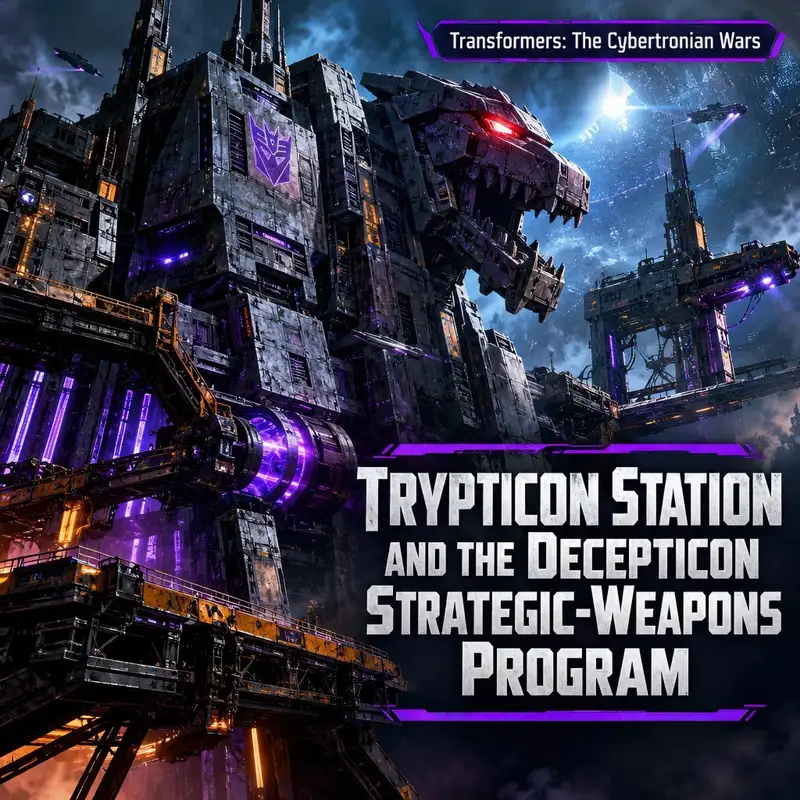
Trypticon Station and the Decepticon Strategic-Weapons Program
Autobot transports were trying to leave a dying world when fire came down from orbit. Cybertron’s Core had been infected, its energy systems were failing, and evacuation had become an operational necessity. Every transport that reached space carried more than soldiers. It carried technicians, wounded personnel, records, matériel, and the possibility that some part of Cybertronian society might survive beyond the planet. Above them stood Trypticon Station, firing into the escape route. The object blocking evacuation was not just a Decepticon fortress with large guns. It was Trypticon himself, a sentient strategic platform whose transformation into an instrument of planetary coercion had begun well before the final exodus.
This is the history presented in the 2010 War for Cybertron game campaign on console and PC. It is a pre-Earth Cybertronian war story with its own account of Dark Energon, Trypticon, and the fall of Cybertron. Other Transformers stories use the same names in different ways. They do not control this account. Here, the important question is not simply how the Decepticons found a powerful energy source. It is how Megatron turned a hazardous research installation into a connected weapons system, then why that system could threaten an evacuation without delivering lasting control of the war.
The answer begins with a distinction that Megatron understood better than many of his opponents. Winning fights is not the same as governing a planet. A force can seize a refinery, raid a city, or destroy an enemy unit and still lack the means to shape the future. Cybertron was sustained by energy, industry, transport systems, technical knowledge, and institutions able to direct all of them. If Megatron intended to dominate the planet rather than merely defeat Autobots in isolated engagements, he needed leverage over those systems.
Dark Energon appeared to offer that leverage. In this game, it is a volatile and destructive form of Energon, feared because of what exposure and mishandling can do. The Decepticons do not begin with a fully understood, mass-produced strategic resource. They begin with a dangerous possibility. Megatron sees in it a source of military power and, more importantly, a route to control over Cybertron’s own energy future. That ambition would eventually center on the Core, the system whose corruption could affect the entire planet.
The first problem was access. Dark Energon was associated with Trypticon Station, an orbital installation under Starscream’s protection. The station was not presented as a simple warehouse full of useful material. It contained laboratories, containment systems, defensive networks, technical archives, and machinery connected to Dark Energon research and production. Its position above Cybertron also gave it military value before Megatron ever controlled it. Orbit allowed surveillance over large areas, rapid access to the upper atmosphere, and the ability to strike targets below without approaching them through conventional ground defenses.
Starscream described himself as having protected the station for more than a thousand years. That statement tells us something about how he viewed his authority and the installation’s importance. It does not provide a complete, independently verified institutional history. The game does not establish who built the station, how many personnel lived or worked there, what every laboratory was designed to study, or how its full research program developed. What matters is what the campaign demonstrates. Trypticon Station possessed dangerous material, specialized equipment, defensive capacity, and knowledge that could not be replaced by merely capturing another industrial site.
That made it dual-use infrastructure. In peacetime terms, it functioned as a research and containment facility. In wartime terms, its laboratories could support weapons development, its defenses could protect a strategic asset, and its orbital position could be converted into an interdiction role. Such facilities are attractive precisely because they shorten the distance between discovery and military application. But they also create risk. A laboratory built to contain an unstable substance is not automatically ready to manufacture it at scale, deploy it in combat, and survive enemy attack while doing so.
Megatron did not inherit a finished weapon. He seized an incomplete and dangerous capability. The Decepticon assault on the station made that clear from the beginning. Megatron entered the operation with Brawl and Barricade, using direct force against Starscream’s defenses. Soundwave supported the operation through systems analysis and intelligence work. The mission was not a ceremonial transfer of authority between two allied commanders. It was an armed seizure of a strategically valuable installation whose custodian did not intend to surrender it.
The station’s defenses also revealed the limits of cyberwarfare in this conflict. Soundwave could identify systems, examine records, and search for routes into the reactor area. He could not just issue a command from outside and take possession of the facility. Starscream had blocked access to the reactor through locked routes and compartmentalized control. The Decepticons had to fight through the station physically. In a machine civilization, access control still depends on more than passwords. It depends on architecture, protected corridors, power distribution, personnel knowledge, fallback systems, and the ability to deny an intruder time and space.
The assault had four linked objectives. First, Megatron’s forces had to break through Starscream’s defenses. Then they needed access to the Dark Energon systems and enough intelligence to understand what the station contained and how it could be used. Finally, Megatron intended to eliminate Starscream’s ability to remain independent. Megatron’s forces could not simply declare the station Decepticon property. They had to turn control on paper into control over rooms, machines, access points, and personnel.
The station’s own records complicated the picture. They indicated that Dark Energon research had already produced a serious accident, an explosion destructive enough to remain relevant in the facility’s logs. That evidence matters because it establishes that the danger was not just Starscream’s caution or the Autobots’ later propaganda. The station’s custodians had direct experience with the consequences of failure. They had built containment and defense around the program because the material itself was difficult to control.
Megatron treated that risk as an opportunity. His decision was not irrational in the narrow military sense. A dangerous resource may be worth pursuing if it promises to change the balance of power. But risk acceptance is not the same as risk management. The Decepticons had captured the approaches to the reactor. They had not yet demonstrated that they understood the material, could reproduce it, could distribute it safely, or could integrate it into a broader campaign without creating vulnerabilities of their own.
Then Megatron made the choice that transformed the seizure from a raid into a political spectacle. He entered the Dark Energon containment system himself. Starscream believed direct exposure would destroy any Cybertronian who attempted it. Megatron emerged alive and empowered. The game establishes the event as exceptional. It does not establish that Dark Energon is safe, that every Cybertronian could survive it, or that direct exposure produces a predictable enhancement. Megatron’s survival proved something about Megatron in that moment. It did not establish a universal biological rule.
Its political value was immediate. Leaders in revolutionary wars often strengthen their authority by displaying qualities unavailable to ordinary followers. Megatron had not just ordered others to handle the dangerous resource. He had accepted the danger personally and survived it. To troops who already saw Dark Energon as terrifying, the act could appear as evidence of strength, destiny, or superior will. To rivals, it demonstrated that Megatron was prepared to cross thresholds they would not. The image of personal mastery became part of the resource’s military value.
Yet personal survival did not solve the industrial problem. A leader can touch a dangerous substance once and still be unable to manufacture it, transport it, or use it reliably. Megatron had gained access to Dark Energon and shown that he could endure direct contact. He had not acquired the entire technical system needed to create more. That knowledge remained with Starscream and the people familiar with Trypticon Station’s equipment.
Starscream recognized the changed balance quickly. Before the assault, he had acted as the station’s protector and commander. After Megatron demonstrated control over the resource, Starscream offered service in exchange for instruction in controlling Dark Energon. This was not a simple ideological conversion. It was a technical bargain conducted under military coercion. Megatron held armed force and the newly demonstrated ability to exploit the resource. Starscream retained critical knowledge about its production and the station built around it.
That relationship gave the Decepticon program both strength and fragility. It was strong because the two men possessed different assets. Megatron could impose decisions. Starscream could make those decisions operationally possible. It was fragile because neither had reason to trust the other completely. Megatron had seized the station through force. Starscream had surrendered only after learning that resistance would not preserve his position. The Decepticon leader needed a specialist whose independence he had just destroyed, while the specialist needed protection from the consequences of the program he had helped create.
Jetfire’s opposition showed that Starscream’s own circle was not united behind Megatron’s course. Jetfire warned against Dark Energon and against treating its destructive potential as a solution to Cybertron’s crisis. His objection was strategically important because it came from someone close enough to the station’s world to understand the danger. This was not simply Autobot resistance to a Decepticon weapon. It was dissent from within the personnel and associations connected to Starscream’s command.
Megatron’s response to such dissent was characteristic of an expanding war movement. He did not need unanimous belief. He needed obedience, expertise, and enough force to isolate those who resisted. The Decepticon coalition grew through a combination of ideology, fear, opportunity, and coercion. Trypticon Station demonstrates the coercive part of that process clearly. Megatron did not persuade Starscream by offering a shared constitutional future. He made resistance untenable, then turned the defeated custodian’s technical competence into an asset of his own command.
The decisive prize was not the Dark Energon already present in the station. Stored material can be consumed, destroyed, or captured. A manufacturing process can sustain a campaign, at least for as long as its inputs and infrastructure survive. Starscream’s knowledge therefore mattered as much as the resource itself. The Decepticons needed to reactivate an Energon Bridge, a dormant system capable of drawing Energon from Cybertron and transferring it to the orbital station.
Starscream, Skywarp, and Thundercracker undertook that task. Their mission was not just to activate a convenient piece of ancient machinery. The bridge connected the station to a larger planetary energy network. It created a supply route. Energon could be drawn from Cybertron, transmitted to Trypticon Station, processed through its systems, and used in the manufacture of Dark Energon. Each stage mattered. Without a source, the bridge carried nothing. Without the bridge, the station lacked a continuing input. Without the reactors and technical systems, raw Energon did not become the desired product. Without trained personnel, the machinery remained a hazard rather than a capability.
This is the point at which Trypticon Station ceased to be only a captured laboratory. It became part of a Decepticon industrial chain. The distinction is important because military history is full of commanders who confuse possession with capacity. Capturing a mine does not guarantee refined fuel. Capturing a refinery does not guarantee safe transport. Capturing a scientist does not guarantee reproducible production. Megatron’s program required all of these things at once: planetary energy, transmission infrastructure, specialist knowledge, station equipment, security, maintenance, and command authority.
Soundwave later reported that Dark Energon production was operating at optimal efficiency. That statement establishes that the system was functioning effectively within the campaign’s immediate conditions. It does not establish limitless output. Megatron’s language about an infinite supply should be understood as a statement of ambition, confidence, and political theater rather than a quantified industrial fact. The station depended on a bridge. The bridge depended on Cybertron. The manufacturing process depended on machinery and specialists. A system with such dependencies may be powerful, but it is not independent of failure.
The logistical vulnerability was built into the program. The Decepticons had placed a critical production system in orbit, where it was accessible to the planet’s energy network but visible and vulnerable to attack. They depended on an identifiable transmission route. They depended on personnel who could not be replaced casually. They depended on access to Cybertron even as their own wider strategy threatened the planet’s stability. Megatron had created a powerful node in a network, but a node is not the same thing as a self-sustaining industrial base.
Still, the new capability changed the war. Dark Energon was not valuable only because it could empower an individual leader or be fired from a weapon. Megatron intended to use it to alter Cybertron’s political condition at the planetary level. His objective was to introduce Dark Energon into Cybertron’s Core, corrupting the system that sustained the planet and bringing its energy supply under Decepticon control. This was the real strategic purpose of the program.
The plan required access. Omega Supreme, an Autobot guardian associated with the Omega Key, stood between the Decepticons and the Core. The key was necessary to open the path Megatron needed. That created a chain of military tasks. The Decepticons had to defeat Omega Supreme, corrupt him and gain access to the Omega Key, then use that access to reach the Core and introduce Dark Energon into Cybertron’s sustaining system.
The political objective went even further. Megatron did not seek merely to damage Cybertron. He sought control over the conditions under which Cybertronian life and industry could continue. An army that controls energy can influence repair, mobility, manufacturing, communications, and civilian survival. In that sense, the Dark Energon program was a bid for coercive government. It aimed to replace contested political authority with control over the material basis of society.
That is why Megatron’s language of restoration must be judged against his method. He presented himself as acting for Cybertron’s future, yet his means involved corrupting the system on which the planet depended. A regime may claim that it is saving a state while making the state dependent on its own emergency powers. Such claims are not automatically false, but they require scrutiny. In this case, the result was not a stable recovery. The Core’s infection accelerated Cybertron’s collapse.
The plan succeeded in the narrow sense that Dark Energon reached the Core. It failed in the broader sense that the Decepticons could not translate planetary coercion into durable political order. The planet began shutting down. A population cannot be governed effectively if its energy systems are failing, its transport routes are collapsing, and its remaining institutions are preparing to abandon the world. Megatron had gained an extraordinary form of leverage, but leverage is not the same as legitimacy, and destruction is not the same as administration.
That failure brought Trypticon Station back into the center of the war. As Cybertron deteriorated, the station’s role expanded from research site and production node into an orbital interdiction platform. From above the planet, it could observe and attack movement between the surface and space. Its weapons threatened Autobot transports before they could clear the atmosphere and enter safer routes. The high ground of orbit compressed warning time and gave the Decepticons a position from which evacuation itself became a target.
The strategic significance of this was immense. An evacuation is not a single event. It is a flow of ships, personnel, supplies, and information through limited routes. If an enemy controls the approach to orbit, it can decide which transports escape, which are destroyed, and which are forced back into a failing planet. Trypticon Station did not need to conquer every surviving Autobot formation. It only needed to make departure too dangerous for the evacuation to proceed.
The crisis also revealed the installation’s true identity. Trypticon Station was Trypticon, a massive Decepticon Transformer whose station form provided the framework for its laboratories, weapons, mobility, and defenses. The revelation mattered operationally more than theatrically. The Autobots were not attacking an unmanned structure. They were confronting a sentient combatant whose body was integrated with the strategic systems threatening the evacuation.
The game does not establish whether Trypticon chose this form, was created for it, or was altered into it by another power. It is unwise to fill those gaps with stories from other continuities. What the campaign does establish is enough. Trypticon could function as an orbital platform and transform into a colossal ground combatant. That combination allowed the Decepticons to unite research infrastructure, strategic weapons, and battlefield force in one asset.
It also imposed a difficult problem on the Autobots. A conventional ground assault could not reach an orbital station in time to protect departing transports. A direct exchange of fire against such a heavily armed platform promised poor odds. The Autobots needed to remove Trypticon’s orbital advantage first. Their response therefore began with aerospace interdiction.
Jetfire, Silverbolt, and Air Raid attacked Trypticon’s orbital systems. Their purpose was not simply to defeat a powerful enemy in a dramatic duel. It was to protect the evacuation corridor, degrade the platform’s weapons, and deny it the ability to remain above Cybertron. The distinction matters. Their mission was defined by what the transports needed, not by what would produce the most impressive individual victory.
Aerospace operations against an orbital target demand different priorities from ground combat. The attackers had to survive long enough to reach critical systems, identify what could be damaged, and force a change in Trypticon’s position. They did not need to destroy every weapon or eliminate every Decepticon advantage. They needed to reduce the station’s ability to fire on the transports and compel it toward a domain where other Autobot forces could engage.
The attack damaged Trypticon’s weapons and propulsion, forcing him down toward Cybertron. Tactically, that reduced the immediate threat from orbit. Operationally, it gave the evacuation routes a chance to function. The transports still faced a collapsing planet and an ongoing war, but they no longer had to pass beneath an unchallenged Decepticon weapons platform. That was a meaningful success, even though it did not resolve Cybertron’s larger crisis.
Forcing Trypticon down was only the first part of the problem. A disabled orbital asset can still become a formidable ground threat, especially when its structure is built around heavy armor, immense power systems, and integrated weapons. The Autobots had traded one battlefield problem for another. They had removed Trypticon from the position where he could dominate evacuation routes, but now they had to prevent him from continuing the fight on the surface.
The ground engagement exposed the limits of simply applying more firepower. Trypticon’s armor resisted ordinary attacks. The Autobots could not rely on a straightforward contest in which every weapon was aimed at the largest visible target until it fell. His durability required a different approach. The question was not whether Trypticon could be damaged in principle. The question was which systems allowed him to sustain weapons output, mobility, and power under combat conditions.
The answer lay in his heat-dissipation coils and dorsal power cores. These were not decorative weaknesses or proof that Trypticon was poorly built. They were signs of the engineering burden carried by any platform that generates and directs immense amounts of energy. Armor can protect an exterior. It cannot eliminate the need to move heat, regulate power, and maintain internal systems. A strategic platform may be difficult to destroy outright while still depending on identifiable components that keep its weapons and power plant functioning.
The Autobots adapted accordingly. Their earlier air attack had degraded Trypticon’s ability to remain in orbit and had forced the engagement into a different environment. Ground forces could now exploit systems that were exposed, reachable, or made vulnerable by the descent. This was combined-arms problem solving rather than a simple test of strength. Aerospace pressure created access and reduced mobility. Ground action targeted the machinery that made continued combat possible.
The game does not provide reliable figures for Trypticon’s armor thickness, operating temperature, power output, or weapon yield. None are needed to understand the military logic. The platform could withstand ordinary fire better than its enemies could sustain a symmetrical exchange. But it could not function without cooling and power management. By attacking those dependencies, the Autobots achieved what direct attacks on armor could not.
This is a recurring lesson in warfare involving super-heavy systems. A massive platform can dominate a battlefield through protection and firepower, yet still be vulnerable to mission failure. Mobility can be disrupted. Sensors can be degraded. Power can be interrupted. Cooling can fail. Command systems can be isolated. A force does not always need to destroy an enemy completely. It may be enough to prevent that enemy from accomplishing the mission that made it strategically important.
Trypticon’s defeat was therefore a systems failure imposed under combat conditions. The Autobots did not prove that Decepticon technology was weak. They proved that a weapon built around concentrated power also concentrated dependency. Trypticon Station had been formidable because it united orbital position, Dark Energon infrastructure, heavy weapons, and sentient mobility. Those same integrations meant that damage to critical systems could affect multiple functions at once.
The immediate outcome mattered. With Trypticon’s orbital interdiction reduced and the platform defeated, the Autobots gained a better chance to continue their evacuation. The Decepticons lost a major strategic asset. The loss did not repair Cybertron’s Core, reverse the planet’s collapse, or bring peace. It did, however, deny Megatron one of the most effective instruments for turning the evacuation into a massacre or a military disaster.
That distinction is essential. Destroying or disabling a strategic platform does not automatically destroy the army that employed it. Megatron still had command authority, loyal forces, weapons, and the political momentum of a civil war that had already consumed Cybertron. The Decepticon cause had become larger than Trypticon Station, even though the station had been central to one phase of the conflict. A dispersed force can survive the loss of a fortress. An ideology and command structure can survive the loss of a weapon.
The later events of Fall of Cybertron provide a limited coda. Trypticon is found in stasis and is eventually converted into the Decepticon flagship Nemesis. That later reuse shows that a damaged strategic asset could retain value if it remained recoverable and adaptable. It should not be read backward as proof that Trypticon Station had always been the Nemesis or that every later function was already present during the earlier campaign. The two roles belong to different stages of the game narrative.
What Trypticon Station demonstrates is that Megatron’s greatest early advantage was not Dark Energon by itself. It was his ability to combine seized research, technical specialists, a planetary supply route, military force, and a political willingness to accept catastrophic risk. He transformed a dangerous facility into a strategic system. He captured access, recruited or coerced expertise, restored the Energon Bridge, enabled production, corrupted the Core, and used orbital power to threaten the last organized exit from Cybertron.
But the program also revealed the limits of that kind of power. It depended on vulnerable infrastructure. It required Starscream’s expertise and therefore rested on an unstable command relationship. It relied on hazardous material whose use could damage the very world Megatron claimed to restore. Its orbital platform was visible, identifiable, and dependent on power-management systems that could be attacked. Most importantly, it confused coercive leverage with political control.
Megatron could corrupt Cybertron’s energy and terrorize its evacuation. He could not make a hazardous, personality-dependent, infrastructure-bound weapon into a durable settlement for the civilization he sought to rule.