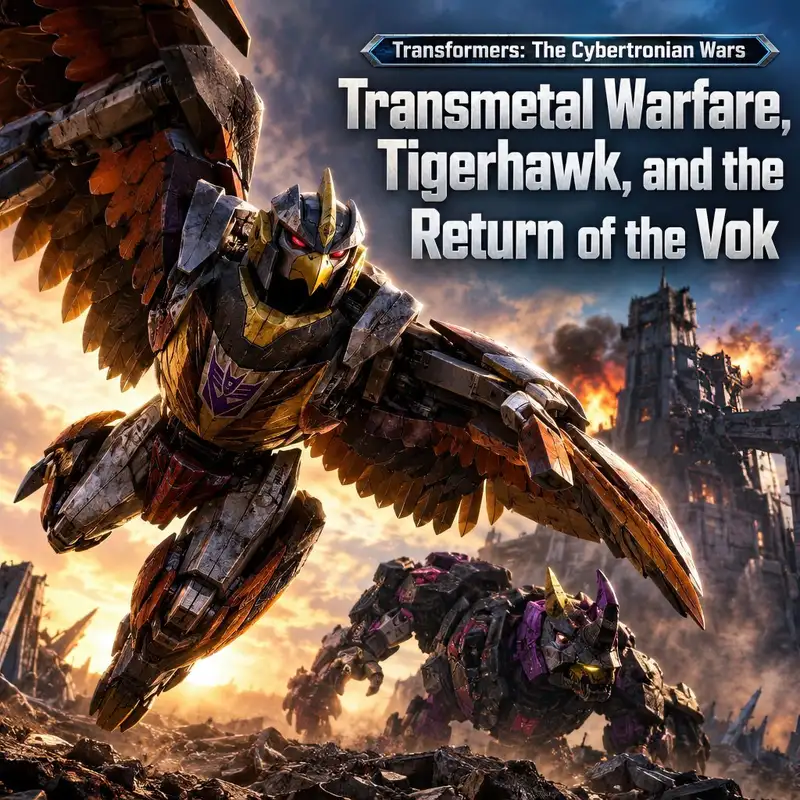
Transmetal Warfare, Tigerhawk, and the Return of the Vok
Above prehistoric Earth, a second moon reveals itself as something far more dangerous than a celestial body. It is an artificial weapon, positioned to destroy the planet beneath it. The Maximals and Predacons had believed themselves stranded in an isolated wilderness, fighting over energon, survival, and eventual return to Cybertron. In that moment, the war acquires a different scale. An outside power has judged both factions to be a threat not merely to one another, but to history itself.
This is the North American Beast Wars animated continuity, where the stranded combatants are living in Earth’s distant past. Their presence is already a temporal hazard. The Maximals and Predacons come from a future shaped by the earlier Autobot-Decepticon war, and their actions on prehistoric Earth can affect the chain of events that produced them. A damaged mountain, a lost artifact, or a battle near a sleeping Cybertronian vessel can matter far beyond the immediate battlefield.
The aliens behind the second moon are the Vok. They are not a conventional military faction with bases, divisions, and a recognizable political program. They do not arrive seeking territory, energon, or submission. They appear as remote observers and manipulators with access to technologies far beyond anything fielded by the stranded Maximals or Predacons. Their concern is the disruption of the time stream. Their remedy is planetary destruction.
The Vok identify a real danger. The Beast Wars conflict has brought future combatants into the past, and both sides possess knowledge and weapons that could alter history. But identifying danger is not the same as acquiring legitimate authority over everyone endangered by the response. The Vok’s proposed solution would erase the conflict by erasing the theater. It would destroy the prehistoric biosphere and, with it, every future dependent on that world’s survival.
The Vok therefore enter the Beast Wars as external enforcers without consent, accountability, or visible restraint. Their immense capability does not make them omniscient, benevolent, or politically legitimate. They understand enough to see temporal contamination. They do not demonstrate that they understand the individuals caught inside it, the consequences of their own methods, or the difference between preserving history and simply imposing control over it.
The Maximals and Predacons, meanwhile, are operating with partial and unequal information. Optimus Primal’s Maximals know they are displaced and endangered, but not at first the full strategic significance of their location. Megatron, leader of the Predacons, is more willing to exploit whatever advantage appears before him, yet he also lacks complete knowledge of the forces observing him. Both commands are accustomed to raids, reconnaissance, sabotage, and battles around limited resources. Neither is prepared for an adversary that can place a planet-killing device in orbit.
The Vok do not need an army to dominate the situation. Their weapon gives them coercive leverage over every living thing below. That is one of the recurring lessons of the Beast Wars. A small force can become strategically decisive when it controls something unique, whether that is a Golden Disk, a hidden ship, a spark, or an artifact no one else can reproduce. But unique power creates dependency. If the system fails, is misunderstood, or falls into the wrong hands, there may be no reserve capacity and no second chance.
Optimus Primal responds to the immediate threat by destroying the Vok weapon. It is not a ceremonial victory or a clean triumph over a known enemy. It is an emergency decision. The alternative is the destruction of Earth. The Maximal commander acts because the Vok have made continued caution impossible. A force that can destroy the world from orbit has turned every lesser dispute into a secondary concern.
The destruction of the weapon saves the planet, but it does not restore the earlier conditions of the war. Instead, the event produces a massive quantum surge, sometimes described through the series’ language of transwarp effects. The exact mechanism is less important than the consequence. Energy released during the destruction of the Vok system passes through the surviving Cybertronians and changes them. The war remains local in geography, but no longer in character.
This is the beginning of the Transmetal era. Several combatants emerge with bodies that are more overtly mechanical and that combine animal forms with vehicle-like systems in new ways. Megatron, Rattrap, Cheetor, and Tarantulas survive the event and are transformed by it. Terrorsaur and Scorponok do not. Their deaths establish that the quantum surge is not a controlled enhancement process. It is a catastrophe with uneven results, not a program administered by either command.
The term Transmetal can suggest orderly technological progress, as if the Maximals and Predacons had entered a new industrial generation together. The series presents something less stable. These new bodies are consequences of a singular event. They are not the product of a factory line, a medical doctrine, or a reliable military upgrade package. Neither Optimus Primal nor Megatron can simply order every soldier refitted. Neither side gains an institution capable of reproducing what happened.
That limitation is strategically important. A new body may improve mobility, alter weapons, or increase resilience in particular circumstances. It does not create a durable advantage unless the force can support it. Combatants still require energon. They still need repair, maintenance, intelligence, shelter, and secure communications. A warrior who moves faster across difficult terrain can still be trapped by bad intelligence. A stronger body does not make a commander wiser. A transformed soldier cannot replace a destroyed base, repair a damaged ship, or settle a political conflict.
The Transmetals do change the character of combat. Their forms blur the older distinction between beast disguise and mechanical war machine. On prehistoric Earth, that matters. The Maximals and Predacons had adopted animal modes partly as a practical adaptation to a world hostile to their normal systems. Transmetal forms preserve elements of those animal identities while introducing more visible mechanical mobility and weaponry. The battlefield becomes faster, more unpredictable, and more dependent on individual capability.
Yet this should not be mistaken for a revolution in force structure. The Beast Wars remains a small conflict fought by limited numbers of survivors. There is no evidence of mass Transmetal armies, standardized replacement bodies, or a supply system that can turn one accidental mutation into faction-wide doctrine. The value of each transformed combatant lies partly in rarity. Their bodies are exceptional assets, and exceptional assets are difficult to replace.
The Predacons benefit from Megatron’s transformation, but they also suffer losses in the same event. The Maximals gain transformed personnel of their own. Tarantulas, already an unusually independent Predacon scientist, becomes more dangerous without becoming more reliably subordinate. The quantum surge sharpens the war’s edges. It does not resolve its balance of power.
There is also a deeper change. Before the Vok intervention, the critical terrain consists of forests, caves, energon deposits, hidden bases, and the routes between them. After the intervention, the critical terrain increasingly includes history itself. The combatants are no longer only trying to outmaneuver an enemy in the present. They are discovering that the past contains vulnerabilities more decisive than any local stronghold.
Megatron understands this faster than most. His access to the Golden Disk gives him information that the Maximals do not initially possess. It is more than a map or a treasure clue. It is an intelligence advantage, revealing that the stranded forces are on prehistoric Earth and pointing toward one of the most consequential locations in their inherited history: the Ark.
The Ark is more than an abandoned vessel in this continuity. It contains the sleeping Autobots and Decepticons of the earlier war, including the original Optimus Prime and the original Megatron. For the Beast Wars combatants, these are not contemporaries in the ordinary sense. They are figures from the past whose survival is part of the causal chain that leads to the Maximal and Predacon future.
This creates an unusual but brutally clear strategic opportunity. If the Beast Wars Megatron can kill the original Optimus Prime while he lies dormant aboard the Ark, he may prevent the history that produces the future factions. The Maximals and Predacons could be erased from existence. In military terms, Megatron has found a target whose destruction promises effects far beyond its physical scale. It is a decapitation strike against history.
The plan is bold, but it rests on assumptions that no responsible commander could verify. Megatron assumes causality can be manipulated like a conventional chain of command. He assumes the removal of one historic figure will produce a future favorable to him, or at least eliminate his enemies. He assumes that he can stand outside the consequences of the alteration long enough to benefit. Most dangerously, he treats knowledge of the past as equivalent to control over it.
The attack on the Ark succeeds only in the narrowest tactical sense. The original Optimus Prime is damaged. But instead of producing a clean erasure, the injury destabilizes the time stream. A time storm begins to threaten the very future that Megatron is trying to rewrite. The result is a classic failure of strategic judgment. Megatron reaches the target. He does not control the consequences.
The Maximals are forced into a crisis of preservation rather than victory. Their mission is no longer merely to stop Megatron in the field. They must keep the original Optimus Prime alive long enough to protect the historical sequence. Blackarachnia plays a crucial role in preserving the damaged Prime. Her actions matter because the emergency cannot be solved by faction loyalty alone. The survival of history depends on technical skill, rapid adaptation, and cooperation across lines that the wider war has made hostile.
Optimus Primal then makes a decision that is as extraordinary as the earlier Transmetal event, but fundamentally different in purpose. To protect the original Optimus Prime’s spark, Primal temporarily houses it within his own body. The act is not an upgrade sought for military prestige. It is a means of preserving another person and preventing temporal collapse.
The result changes Primal into Optimal Optimus, a larger and more powerful form. But this transformation should not be treated as simply another Transmetal development. It is linked to an exceptional condition: the temporary coexistence of Primal’s body with the original Prime’s spark during a temporal emergency. The series never establishes a replicable procedure for creating such a form. There is no indication that the Maximals can manufacture Optimal bodies at will, or that they fully understand the process.
The distinction is revealing. The quantum surge transforms combatants incidentally, through exposure to a vast uncontrolled event. Primal’s change occurs while he attempts to preserve a life and stabilize history. Both outcomes involve altered bodies, but their meanings are different. One is collateral adaptation amid disaster. The other is a consequence of sacrifice, responsibility, and the peculiar vulnerability of sparks and bodies in this continuity.
The Maximals then relocate to the Ark. This is a defensible operational move. The original Optimus Prime has become a strategic center of gravity. His survival matters more than a local base or an energon cache because the timeline itself now depends upon him. Guarding the Ark means accepting a difficult mission. The Maximals must defend a site tied to a past they cannot fully alter, while fighting enemies who increasingly understand its value.
The time storm is eventually contained, but the lesson remains. The Beast Wars cannot be understood as an ordinary contest between two stranded factions after this point. The conflict has become entangled with the preservation of historical continuity. Every major attack must be measured not only by who is damaged in the present, but by what future that damage could endanger.
The Vok return to this altered war through a different kind of intervention. Earlier, Tigatron and Airazor had disappeared after contact with the Vok. Their absence had remained unresolved. They were more than missing personnel in the ordinary military sense. Their disappearance was evidence that the aliens could remove individuals from the battlefield without explanation, warning, or any visible process of consent.
When the Vok finally act again, they do not unveil another planetary weapon. They create Tigerhawk. The process is one of the most unsettling acts of technological power in the series because it is directed not at terrain, infrastructure, or a hostile force, but at the bodies and identities of two sentient Maximals.
Tigerhawk is not accurately described as Tigatron and Airazor simply combined. The sequence is more complicated. Their bodies are fused into a new form. Their sparks remain displaced and separate from that body. The Vok then inhabit the resulting construct and use it as an emissary. Tigerhawk arrives with the appearance of a powerful Maximal warrior, but at first he is not acting from the restored agency of Tigatron and Airazor.
This is a far more intrusive intervention than the quantum surge. The Transmetal event changes existing warriors amid a broader catastrophe. Tigerhawk is deliberately assembled for a mission. The Vok do more than alter circumstances around two individuals. They rearrange their bodies, separate them from their sparks, and occupy the resulting form themselves.
The ethical problem does not require a complete theory of Vok biology to be clear. The Vok treat Tigatron and Airazor as materials for an operation. They make no visible effort to obtain consent. They provide no explanation to the Maximals. They do not appear to recognize that body, spark, memory, and agency may have political and moral significance to the people whose forms they use.
Tigerhawk’s capabilities are formidable. He attacks the Predacon base with overwhelming force and receives a direct mission: eliminate Megatron. From the Vok perspective, the instruction appears simple. Megatron is a source of temporal instability. Remove him, and the problem is reduced.
But the Beast Wars have already shown why such logic is dangerously incomplete. The Beast Wars Megatron is not only a present-day commander. He carries part of the original Megatron’s spark. That connection makes his destruction potentially catastrophic. Killing him might damage the historical figure whose survival remains part of the timeline the Maximals are trying to preserve.
Optimus Primal therefore intervenes to stop Tigerhawk. On the surface, it is an extraordinary decision. A Maximal commander prevents a powerful ally from destroying the leader of the Predacons. In an ordinary war, that might appear irrational. Megatron is dangerous, aggressive, and repeatedly willing to endanger both Earth and history for personal victory.
But this is no longer an ordinary war. Primal understands that tactical logic cannot be separated from causality. The immediate elimination of an enemy commander may produce a strategic disaster if that commander is bound to a historical structure neither side fully controls. The Vok’s directive is militarily direct but politically and temporally illiterate.
Tigerhawk’s failure as a Vok instrument is therefore not a matter of insufficient firepower. He has ample power to devastate the Predacon position. The failure lies in judgment. The Vok give their emissary an objective without providing a workable understanding of the system in which that objective must be pursued. They know enough to identify Megatron as dangerous. They do not account adequately for the fact that Megatron’s existence has become entangled with the very timeline they claim to protect.
This is the weakness of external coercion. An outside power can see a threat, impose a target list, and deploy overwhelming force. It may still fail because it does not understand the relationships, obligations, and unintended consequences inside the society it is trying to manage. The Vok are technologically superior. They are not superior in every form of knowledge.
Tigerhawk is also vulnerable because the Predacons are not a unified command. Megatron leads them, but Tarantulas operates according to a broader and more secretive agenda. He is associated with the Tripredacus Council, a remote Predacon authority whose exact role and purpose remain incompletely defined in the series. Tarantulas is more than another officer carrying out Megatron’s orders. He is a covert actor with his own calculations.
That independence makes him especially dangerous. A conventional commander might see Tigerhawk primarily as an enemy weapon to evade or destroy. Tarantulas sees an intelligence opportunity. He recognizes that Tigerhawk contains an alien presence. Rather than simply fighting him in the open, Tarantulas deploys specialized spider drones, captures him, and attempts to remove the Vok entities from the constructed body.
This is an intelligence operation as much as a battlefield action. Tarantulas identifies a vulnerability in a superior force: dependence on an internal control arrangement. Tigerhawk’s power is not self-contained. His body has been assembled and occupied through a process the Vok believe they command. If that control can be disrupted, the Vok can be turned from operators into targets.
Tarantulas’ larger objective is even more extreme than Megatron’s. He intends to destroy the Ark and eliminate not just the Maximals, but the Predacons, Autobots, and Decepticons tied to that historical chain. Where Megatron seeks to manipulate the past in pursuit of advantage, Tarantulas contemplates a more comprehensive erasure.
He claims that he and the Tripredacus Council have other origins and would survive the temporal consequences. That claim should be treated carefully. It is testimony from a secretive participant with obvious reasons to exaggerate his knowledge and independence. The series does not fully explain what those other origins are. It never establishes that Tarantulas is correct, nor does it provide a final account of the Council’s relationship to the broader Predacon order.
What can be said is that Tarantulas believes himself able to stand apart from the history he wants to destroy. That belief resembles Megatron’s earlier error, though it is even more sweeping. Both figures treat causality as a weapon that can be aimed at enemies while leaving the planner intact. Neither demonstrates a credible ability to govern the aftermath.
Tarantulas’ attempt to extract the Vok presence goes wrong. The exact mechanics are not fully explained, and the episode does not provide a technical manual for alien possession, spark displacement, or the interaction between Vok entities and Cybertronian systems. What matters is the result. The Vok leave Tigerhawk’s body and enter Tarantulas. An energy discharge follows, along with an explosion involving the local energon crystals.
Tarantulas is killed. The Vok entities are also destroyed. It is a striking end for a force that had previously demonstrated the ability to threaten an entire planet and reshape Cybertronian bodies. Their power is immense, but concentrated. They are not invulnerable. Their intervention depends on systems and conditions that can be disrupted by actors operating at a much smaller scale.
The outcome also exposes a recurring danger in the Beast Wars. Actors attempting to control time, bodies, and ancient technology often discover that their own methods create the opening for disaster. Tarantulas seeks to exploit the Vok. Instead, he becomes the vessel through which their presence is destroyed. The Vok seek to impose an external solution. Instead, their occupation ends by freeing the individual they had turned into an instrument.
With the Vok gone, the sparks of Tigatron and Airazor return to Tigerhawk. The result is not a restoration of the old status quo. Tigatron and Airazor do more than resume their former separate bodies. Tigerhawk remains. But he is no longer a Vok-controlled emissary. He is presented as an independent Maximal ally, able to act with agency rather than as a platform for an external mission.
The series does not settle the philosophical question with technical precision. Is Tigerhawk one person? Is he two persons sharing one form? Is he a new composite individual created from Tigatron and Airazor’s bodies and sparks? The show does not provide a complete doctrine of Cybertronian identity capable of resolving every implication.
What it does establish is more important than a neat classification. Tigerhawk has agency. He can join the Maximal cause. He can participate in decisions and combat as someone rather than something. His personhood cannot be dismissed because his body was assembled through alien intervention, or because his origins are unusual. The Vok’s attempt to treat him as a tool does not define what he becomes after their control ends.
This is where Tigerhawk differs most sharply from the Transmetals. The Transmetal warriors remain themselves through altered bodies. Their transformations change their capabilities and perhaps their relationship to the battlefield, but they are still recognizable participants in the conflict. Tigerhawk begins as a more radical challenge. His form is constructed from the bodies of two absent individuals, animated first by alien occupants, and only later joined by the sparks connected to those bodies.
The story’s answer is not that identity is simple. It is that identity cannot be reduced to design, origin, or intended military function. A body built for a mission may become the home of a person. A weapon may acquire moral status when it can exercise agency, form loyalties, and bear the consequences of action. The Vok possess the ability to reconfigure bodies. They do not gain the authority to determine what those lives mean.
Tigerhawk’s freedom is brief. During the final conflict involving the recovered Nemesis, the ancient Decepticon warship, he fights alongside Optimus Primal against Megatron’s forces. His presence is useful. He is a capable ally in a battle where the Predacons have acquired a strategic asset of their own, one with enough destructive potential to endanger the Maximals and the wider balance of the conflict.
But Tigerhawk is killed in that final struggle. The brevity of his independent life is tragic, yet it should not be used to deny its reality. His death does not prove that the fusion was false, that his body was inevitably unstable, or that he remained merely a Vok puppet. The released story gives no basis for those conclusions. It presents him as an ally whose agency mattered, even though he had little time to exercise it.
His short service also illustrates a wider military truth. A combatant’s value cannot be measured only in years of service, body type, or firepower. Tigerhawk changes the conflict because he demonstrates that the Vok can be resisted, that their intervention can fail, and that the persons they attempt to manipulate may emerge with purposes of their own. His importance lies less in the number of battles he fights than in what his existence reveals.
The Vok began by treating Earth as a problem to be solved from above. They saw temporal disorder and prepared to destroy the planet. Their first intervention produced the quantum event that created the Transmetals. Their later intervention created Tigerhawk, an emissary whose mission ignored the complex causal danger surrounding Megatron. Their final defeat came when Tarantulas disrupted the control arrangement they had imposed.
None of this means that the Vok were powerless. They changed the war profoundly. The Transmetal transformations altered individual combat capability. The threat of the planet-destroying weapon forced the Maximals to act under existential pressure. Their abduction and reconstruction of Tigatron and Airazor produced a new individual whose existence could not have emerged through ordinary Maximal or Predacon means.
But influence is not control. The Vok cannot prevent Optimus Primal from destroying their weapon. They cannot turn Transmetals into a stable instrument of policy. They cannot eliminate Megatron without risking the very timeline they claim to defend. They cannot retain possession of Tigerhawk once their own presence becomes vulnerable. Their superiority in technology does not grant them reliable intelligence, moral legitimacy, or mastery over consequence.
The same is true, in different ways, for the Beast Wars Megatron and Tarantulas. Megatron discovers that history can be attacked, but he cannot attack it without triggering instability. Tarantulas finds a way to exploit the Vok, but his attempt to stand outside the consequences of temporal destruction ends with his own death. Each seeks a decisive mechanism that will spare him the uncertainty of ordinary conflict. Each discovers that the system is more complicated than the weapon.
For Optimus Primal, the crisis demands a different kind of command. He cannot simply pursue battlefield victory. He must preserve individuals whose survival matters to history, even when that means protecting an enemy or restraining an ally. He must accept that some of the strongest weapons on the field are too dangerous to use according to ordinary tactical logic. That restraint is not passivity. It is an understanding that force must serve an achievable political and strategic purpose.
The Transmetal era therefore does not mark a straightforward advance toward military superiority. It shows how accidental technological change can intensify a war without resolving the causes that sustain it. New forms improve some combatants. They do not end factional rivalry, repair command failures, secure the Ark, or make temporal intervention safe. Technology changes the available options. It does not decide which options are wise.
Tigerhawk carries that argument further. He is more than a stronger warrior or an unusual body configuration. He is evidence of the line between changing a person and owning one. The Vok can alter bodies, separate sparks, combine forms, and issue missions. Yet once their control ends, they cannot dictate the identity or allegiance of the life they have rearranged.
The Beast Wars become a temporal crisis because the Vok attempt to manage history through overwhelming external power. Their intervention does not solve the danger. It exposes and intensifies it. The Transmetals show that technological transformation can sharpen a conflict while leaving its deeper causes untouched. Tigerhawk shows something more troubling: power sufficient to rebuild bodies still cannot define the identity or political purpose of the lives it rearranges.