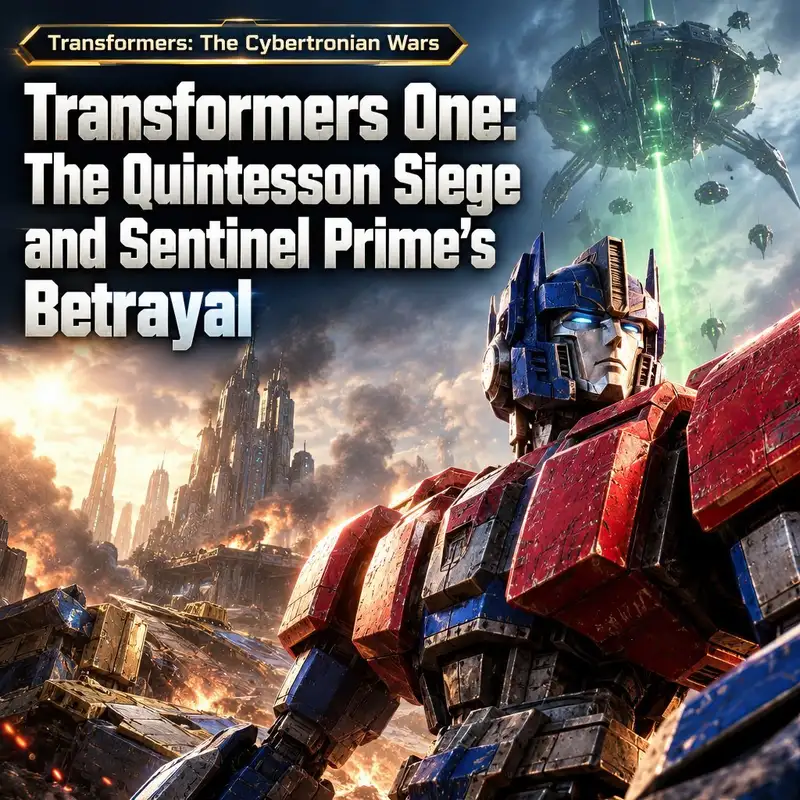
Transformers One: The Quintesson Siege and Sentinel Prime’s Betrayal
In Iacon, Energon is treated as a fact of life and a source of anxiety. It is mined, sorted, carried, and counted because Cybertron needs it to function. The workers assigned to those mines have been taught that scarcity is simply the world they inherited. The Matrix of Leadership was lost, the Energon flow diminished, and sacrifice became a civic duty. Sentinel Prime presents himself as the protector managing that sacrifice. Yet the Energon leaving Cybertron is not only sustaining its people. A concealed portion is being delivered to the Quintessons, the enemy whose earlier war supposedly belongs to a distant and defeated past.
That bargain is the starting point for understanding Sentinel Prime’s rule in Transformers One. His betrayal was not one act of treachery on an ancient battlefield, followed by a long and uncomplicated dictatorship. It was a system. Sentinel helped destroy Cybertron’s legitimate defenders, reached an accommodation with the foreign power that had attacked the planet, and built a domestic order that kept his own population dependent, immobile, and poorly informed. He turned a wartime catastrophe into a durable personal regime.
The film’s history is confined to its own Cybertron. These Quintessons are hostile alien forces involved in a war against the Primes. The story does not establish that they created Cybertronians, nor does it provide a full account of their civilization, command structure, or ultimate use for the Energon they receive. What it does establish is enough. They possessed the military strength to threaten Cybertron, and Sentinel found a way to make that threat serve his own position.
Energon, in this setting, is more than a useful fuel. It is the material link between political authority, industrial labor, and survival. Whoever controls extraction and distribution can decide who receives mobility, repair, security, and hope. Sentinel’s regime does not just respond to scarcity. It administers scarcity. The miners work under the belief that their labor is preserving Cybertron, while part of the product of that labor supports the arrangement that keeps Sentinel in power.
To understand how Sentinel gained the authority to make such a bargain, we have to return to the war that destroyed the old leadership. Cybertron was defended by the Thirteen Primes, figures who combined military, political, and spiritual importance. They held the Matrix of Leadership, and their existence represented more than a chain of command. They embodied a claim that Cybertron had defenders accountable to something greater than personal ambition.
The film does not provide a detailed constitution for the Prime order. We do not know precisely how the Thirteen divided authority, how their forces were organized, or what formal process governed strategic decisions. But the broad military problem is unmistakable. They faced a major external enemy. In such a war, command depends on intelligence, trust, and the ability to distinguish a genuine opportunity from a trap.
That dependence created the opening Sentinel needed. He was associated with the Prime command, but he was not one of the original Thirteen. His importance came from access. He could speak to the defenders of Cybertron as an insider. He could present information in the language of military urgency. And he could exploit the assumption that someone close to the command structure was working toward the same objective as everyone else.
Sentinel reported that Quintesson commanders had gathered at a vulnerable location. The report offered the Primes an opportunity that commanders in a desperate war are often inclined to seize. If the Quintesson leadership could be struck, perhaps the enemy’s offensive could be disrupted. Perhaps Cybertron could regain the initiative. The report was not dangerous because it sounded absurd. It was dangerous because it sounded plausible.
The Primes moved to attack. Instead of finding an exposed enemy command, they encountered an ambush. Quintesson forces were waiting in superior strength. The military failure was catastrophic, but it should not be misunderstood as proof that the Primes were simply incompetent. The central failure was intelligence. Their decision cycle had been manipulated by someone who knew what information would compel action and who understood the trust built into their command relationship.
Sentinel did not defeat the Primes in an open contest for leadership. He used their confidence in him to place them in a position where they could be overwhelmed. Then he made the betrayal explicit. As the Quintesson trap closed, Sentinel turned on Cybertron’s defenders and killed the Primes himself. The enemy supplied force. Sentinel supplied access, timing, and local knowledge.
The immediate tactical result was the destruction of Cybertron’s senior defenders. The operational result was even more severe. A civilization at war lost the people best positioned to coordinate resistance, interpret the crisis, and claim legitimate authority over a response. The Quintessons did not just win a battle. Cybertron’s political center was decapitated from within.
One Prime survived. Alpha Trion was grievously wounded, but not destroyed. He entered a prolonged stasis beneath the surface, hidden among the remains of the old order. His survival matters because it means Sentinel’s story was never fully secure. The new ruler could suppress records, reshape public memory, and monopolize institutions, but somewhere beneath Cybertron was an eyewitness who knew how the old leadership had actually fallen.
For Sentinel, the battlefield betrayal had to become a political settlement. He emerged as Cybertron’s apparent guardian, presenting himself as the protector who had survived a disaster that destroyed everyone else. The title Sentinel Prime carried enormous symbolic value. In a society shaped by the memory of the Primes, the name implied continuity, protection, and inherited responsibility.
But the Matrix did not validate Sentinel. He did not possess the demonstrated legitimacy of the fallen defenders, and he did not receive authority through any process the film presents as sacred or constitutional. His claim rested on performance. He wore the symbols of continuity, managed the public story of catastrophe, and placed himself at the center of Cybertron’s remaining institutions.
This is how authoritarian rule often stabilizes after a crisis. It does not require every citizen to believe every detail. It requires enough people to accept that there is no practical alternative. Sentinel could offer order after war, public ceremony after trauma, and a simple explanation for hardship. The Primes were gone. The Matrix was lost. Energon no longer flowed as it once had. Cybertron was fortunate, he implied, to have any protector at all.
The danger in such a regime is not only that it lies. It is that it turns the lie into the framework through which people understand their own lives. If scarcity is natural, then rationing appears necessary. If mobility is a privilege rather than a right, then exclusion appears normal. If the old defenders died heroically against an outside enemy, then questioning their supposed successor can be made to look reckless, ungrateful, or even disloyal.
Sentinel’s authority was therefore more than personal charisma. It rested on a carefully maintained relationship between history and material dependence. He controlled the public memory of the war, the institutions that interpreted the loss of the Matrix, and the labor system that sustained Cybertron. He did not need every worker to admire him. He needed them to believe that the conditions of their lives could not be changed.
The most important tool in that system was the transformation cog. In Transformers One, the cog is an internal mechanism that permits transformation. Its significance is physical, but also social. A Cybertronian who can transform has access to forms of movement, work, travel, and self-direction unavailable to someone who cannot. Transformation is more than a clever trick or an aesthetic feature. It is a form of autonomy.
Sentinel deprived future miners of that autonomy before they were activated. Their cogs were removed, and they were born into a condition of restricted capability. They became cogless workers, assigned to extract the Energon on which Cybertron depended. The regime taught them that this was normal. Their inability to transform was presented not as a political imposition, but as the natural condition of beings like them.
The cruelty of that system lies partly in its concealment. A population can resist hardship when it understands hardship as imposed. Resistance becomes much more difficult when people are taught that their limitations are inherent. Sentinel did not just command miners to work. He arranged society so that the miners would be less able to leave, less able to move independently, and less likely to imagine themselves as the equals of those above them.
The film does not establish that a transformation cog alone determines every form of combat ability or personal independence. Cogless miners are not portrayed as inert machinery. Orion Pax, D-16, Elita-1, and B-127 are resourceful, stubborn, and capable of acting together. Yet the denial of transformation still matters enormously. It restricts the physical range of action available to them and marks them as a subordinate population.
A miner without a cog is easier to assign to a fixed industrial role. Such a worker has fewer means of escape, fewer options for travel, and less access to the flexibility that transformation provides. That does not make every cogless Cybertronian helpless. It makes the social order more one-sided. Sentinel’s system is designed to ensure that those producing the resource cannot readily challenge the authority deciding where it goes.
This is a form of political control built into the body. The regime does not just use guards, orders, and propaganda. It shapes the physical capabilities of a laboring population. The result is a caste system in which workers are denied the tools that would allow them to become fully mobile participants in Cybertronian society.
The mining system also reveals the connection between domestic oppression and foreign collaboration. Sentinel needs Energon to maintain his arrangement with the Quintessons. He needs miners to produce that Energon. And he needs the miners to remain dependent, because a population that understood both its own stolen autonomy and the destination of its labor would be far harder to govern.
The public myth of scarcity protects this arrangement. Sentinel can claim that Cybertron is suffering because the Matrix disappeared with the Primes. That claim contains enough visible truth to be persuasive. Energon is scarce. The old order is gone. The population is anxious. But the explanation hides the political choices being made within the crisis. Scarcity becomes a natural disaster in public language, even as the regime directs valuable Energon beyond Cybertron.
This is why Sentinel’s bargain is more than a secret act of treason. It becomes the organizing principle of his government. Censorship protects the mining system. The mining system sustains the Energon deliveries. The deliveries preserve the accommodation with the Quintessons. And the continuing external threat helps justify Sentinel’s concentration of power. Each part reinforces the others.
The film does not show every official who participated in that system. We cannot responsibly assign motives to an entire bureaucracy or assume that every guard, miner supervisor, or city official knew the full truth. Authoritarian governments commonly operate through compartmentalization. Some personnel may have understood the bargain. Others may have believed the official story. Still others may simply have adapted to the world in which they found themselves.
What matters is that the system appears durable because those beneath it lack the information required to challenge it. Sentinel’s great vulnerability is more than the possibility of military defeat. It is the possibility that the people he has excluded from history might reach the evidence he failed to destroy.
That breach begins not with a planned revolution, but with curiosity and accident. Orion Pax and D-16 are miners in Iacon. They belong to the cogless population Sentinel has created, yet they do not accept their place in it with equal resignation. Orion is restless, inclined to ask questions and pursue possibilities beyond the limits imposed on him. D-16 shares his frustration, though his anger has a sharper edge and a deeper attachment to the symbols of Cybertron’s old heroic past.
Elita-1 and B-127 join the journey that takes them beyond the controlled world of Iacon. Their expedition is not a formal insurgent operation. They are not officers dispatched by a rival government, nor are they agents sent to expose Sentinel. They are workers and friends who stumble into the hidden remains of Cybertron’s suppressed history. That makes their discovery politically explosive. The regime’s secret is uncovered by the very people it had designed to remain powerless.
Their route leads them to Alpha Trion. The surviving Prime is both a witness and a living contradiction of Sentinel’s official history. He remembers the ambush, the betrayal, and the destruction of the other Primes. His testimony cannot answer every question about the ancient war, but it establishes the central fact he personally witnessed. Sentinel did not inherit a fallen world in good faith. He helped destroy its defenders.
Alpha Trion gives the four companions transformation cogs taken from the fallen Prime order. The exact original owner of each cog is less important than what the transfer means. The miners are suddenly given access to a capacity Sentinel had denied them from the beginning. They can transform. They can move through Cybertron in new ways. They can see that their supposed natural limitation was a political theft.
The immediate change is practical. Transformation offers mobility and access. It changes how they travel, fight, evade pursuit, and understand their own bodies. But it also changes the terms of their political imagination. A worker trained to accept a fixed industrial role now experiences capabilities that the ruling order had concealed. The discovery does not automatically create a coherent ideology, but it destroys the belief that the existing hierarchy is inevitable.
Orion responds to the revelation by trying to understand the wider problem. His instinct is to connect the truth about the past to the possibility of repairing Cybertron’s future. D-16 experiences the same information differently. Sentinel is not only a corrupt ruler in the abstract. He is the betrayer of the Primes, including Megatronus Prime, whom D-16 reveres. The discovery is personal, political, and moral all at once.
Elita-1 and B-127 keep the expedition grounded in the immediate realities of survival. Revelations do not move themselves from hidden ruins to the capital. Evidence must be carried. Pursuit must be evaded. Allies must be found. A revolution may begin with a truth, but truth requires practical people to move it through a hostile system.
Sentinel recognizes the danger quickly. Alpha Trion’s survival is intolerable because he can expose the founding lie of the regime. Sentinel’s response is not an attempt at public explanation or reconciliation. He tries to eliminate the witness. When he finds the group, he kills Alpha Trion, ending the last living connection to the original Prime command.
That killing is more than another act of battlefield violence. It is an attack on evidence. Sentinel understands that political rule depends on controlling the story of how that rule began. By destroying Alpha Trion, he attempts to ensure that the old order dies a second time, this time in memory. A society deprived of witnesses can be made to live inside the victor’s version of history.
Yet Alpha Trion’s death does not restore Sentinel’s monopoly on truth. The group captures Airachnid, and her memory core contains evidence of Sentinel’s Energon dealings with the Quintessons. This recovered memory does not replace Alpha Trion’s testimony. It corroborates a different layer of the case. Alpha establishes the betrayal of the Primes that he witnessed. Airachnid’s recorded memory establishes the collaboration that sustained Sentinel’s later rule.
Neither form of evidence is omniscient. Alpha cannot provide a complete history of Quintesson strategy or every decision made after the ambush. Airachnid’s memory proves the arrangement she observed, not every hidden element of Sentinel’s government. But together they are enough to break the regime’s central defense. Sentinel can no longer present himself as the isolated protector of Cybertron against an outside danger. He has been feeding that danger.
At this point, knowledge alone is not enough. A truth can destroy legitimacy, but it cannot enforce its own consequences. The group needs support, mobility, and armed protection. They find it among the High Guard, remnants of Cybertron’s earlier defense structure who exist beyond Sentinel’s official system.
The High Guard matters because it represents a form of organized force that Sentinel did not fully absorb. Led by Starscream, and including figures such as Soundwave and Shockwave, these fighters have survived outside the ruler’s approved order. They possess combat experience, group cohesion, and a reason to oppose Sentinel. They are not yet the formal Decepticon movement. At this stage, they are best understood as an armed anti-Sentinel constituency.
Their existence also demonstrates a limit in Sentinel’s control. He has dominated Iacon and the public narrative, but he has not eliminated every military survivor or every alternative network of loyalty. Exile can weaken an opposition, but it can also preserve it. Forces excluded from a regime may retain skills, weapons, memory, and resentment that become decisive when the political climate shifts.
For D-16, the High Guard offers something that Alpha Trion’s testimony cannot. It offers armed recognition. He is no longer merely a cogless miner with an impossible story. He becomes a figure whose anger and sense of betrayal resonate with experienced fighters. They already distrust Sentinel. They have already chosen resistance over submission. D-16’s call for confrontation has a natural audience among them.
For Orion, the High Guard is both an opportunity and a problem. Cybertron needs allies capable of challenging Sentinel, but an armed faction brings its own priorities. Fighters who have survived exile may not share the patience of workers who still hope for reform. They may see the exposure of Sentinel not as the beginning of a civic process, but as the opening for decisive force. Orion gains support, but not full control over what that support will demand.
The return to Iacon therefore becomes more than a mission to reveal evidence. It becomes a collision between civilians living under Sentinel’s myth, armed opponents ready to overturn him, and two former miners who now represent different possible futures. One future seeks to expose the truth, remove the tyrant, and rebuild legitimacy. The other seeks to punish betrayal through force and ensure that no restraint protects those who held power.
When Sentinel’s dealings are exposed, his protector narrative collapses. His public authority depended on the claim that he had defended Cybertron after the Primes fell. The evidence reveals the opposite. He helped destroy them. His supposed stewardship of Energon becomes visible as collaboration with the enemy. And the condition of the cogless miners becomes visible not as destiny, but as deliberate subordination.
The collapse is political before it is physical. Sentinel loses the ability to define himself as the necessary guardian of a vulnerable society. His symbols no longer mean what he says they mean. The title Prime, the story of sacrifice, and the language of protection all become evidence against him. His regime has been exposed as a structure built on betrayal abroad and deprivation at home.
But the fall of legitimacy does not automatically produce a lawful transition. Cybertron does not appear to possess a tested court ready to investigate Sentinel’s crimes. There is no established succession procedure shown operating after his exposure. No demobilization plan exists for the armed groups converging on Iacon. There is no agreed process for deciding what happens to Sentinel’s officials, guards, or supporters. The ruler can be removed quickly. The system beneath him cannot be repaired by one public revelation.
The confrontation between Orion and D-16 brings this unresolved problem into focus. Orion wants Sentinel stopped, but he also wants to prevent the new order from being founded on uncontrolled vengeance. That is not the same as forgiving Sentinel or minimizing his crimes. It is a recognition that justice and revenge are not identical, especially when the future of an entire society is being decided in the same moment.
D-16 rejects that restraint. From his perspective, Sentinel has betrayed the Primes, deceived Cybertron, exploited the miners, and sustained an enemy relationship with the Quintessons. The demand that such a figure be spared can sound like another appeal for the oppressed to accept limits while the powerful escape consequence. D-16’s anger is not without cause. The danger lies in what he concludes authority must become after the tyrant falls.
D-16 removes Sentinel’s transformation cog. The act reverses the condition imposed on the miners. Sentinel, who built a regime by denying others their ability to transform, is stripped of that capacity himself. The symbolism is deliberate and harsh. Yet the act is not a complete legal reckoning. It is punishment carried out in the midst of revolutionary violence, without a functioning civic process to determine responsibility, testimony, or accountability.
Sentinel then dies. Tactically, the threat posed by the ruler is ended. Politically, the old regime is destroyed in public. The figure who held its symbols, controlled its secret, and embodied its hierarchy is gone. But his death does not settle the harder question. Who now has the right to command? What institutions will govern Iacon? How will the mining caste be dismantled? What becomes of those who enforced Sentinel’s orders, or those who accepted his story because they had no access to another?
The conflict also costs Orion his life, at least briefly. In intervening between Sentinel and D-16, Orion is mortally wounded. His sacrifice reveals the distance already opening between the two former friends. Orion is willing to risk himself to prevent the revolution from being defined solely by punishment. D-16 is unwilling to let restraint preserve the life of the figure he believes deserves none.
Then the Matrix of Leadership acts. It accepts Orion and restores him, transforming him into Optimus Prime. Within this film, the event is a profound confirmation of Orion’s moral and political character. The Matrix does not validate Sentinel’s imitation of Prime authority. It recognizes Orion at the moment he chooses the future of Cybertron over personal power and vengeance.
But the Matrix should not be mistaken for a routine political mechanism. It is not a constitutional election that can be repeated whenever a succession crisis arises. The film presents it as an exceptional metaphysical judgment. It gives Optimus a form of symbolic legitimacy Sentinel never possessed. It does not, by itself, establish courts, ministries, labor protections, military command arrangements, or a durable settlement among the forces now gathered in Iacon.
The restoration of Energon flow changes Cybertron’s condition immediately. The scarcity regime loses the foundation on which it rested. What Sentinel had treated as permanent decline is revealed to be connected to a deeper political and spiritual wound. With the Matrix restored, Cybertron is no longer defined solely by the exhausted labor of cogless miners and the controlled distribution of a dwindling resource.
The miners receive transformation cogs. This is one of the film’s most important acts of liberation. The change is more than a reward for helping defeat Sentinel. It restores a capability withheld from an entire population. Workers who had been assigned to mining from the beginning now possess access to transformation, mobility, and a wider range of possible lives.
They are named Autobots. The name marks the beginning of a new civic identity, one rooted in autonomy after imposed dependency. Yet the film does not claim that every former miner becomes a soldier, that all social divisions vanish, or that the institutions of the old regime simply disappear. A name can unite a movement, but rebuilding a society requires more than a name.
Cybertron now has renewed Energon and a new Prime. Those are extraordinary changes. They do not automatically answer how labor will be organized, how power will be shared, or how the trauma of Sentinel’s rule will be remembered. The people emerging from the mines have gained bodily autonomy, but they are entering a political world still shaped by war, secrecy, armed factions, and unresolved anger.
D-16 does not accept Optimus Prime’s leadership. He takes the name Megatron, a decision that signals more than a change in personal identity. He rejects Orion’s interpretation of what liberation requires. Where Optimus sees the need to build legitimacy that can include a newly freed population, Megatron sees restraint as a weakness that risks preserving the habits of the old order.
The divide between them should not be reduced to a simple quarrel between former friends. Their conflict concerns the use of force, the meaning of justice, and the source of political authority. Optimus has the Matrix’s recognition, but Megatron has the loyalty of armed followers who have endured exclusion and exile. One holds extraordinary symbolic legitimacy. The other holds a substantial base of military power.
That is the central post-authoritarian problem left by Sentinel’s fall. A ruler has been exposed and removed, but the society he ruled does not possess a settled agreement about who should control armed force. The High Guard has reason to distrust any new hierarchy. Former miners have reason to demand more than symbolic change. And Megatron has reason, in his own mind, to believe that the revolution has been betrayed if it stops short of total domination over those who once ruled.
The end-credit identification of Megatron’s followers as Decepticons marks the political rupture. The name does not mean that every member of the High Guard immediately shares an identical program, nor that every opponent of Optimus has the same motive. It marks the emergence of a separate faction around Megatron’s refusal to accept the authority of the new Prime.
Transformers One ends before the completed Autobot-Decepticon war. It ends at the moment when the possibility of a peaceful settlement begins to fail. Sentinel’s regime is gone. The Quintesson bargain has been exposed. The miners have been freed from the condition imposed on them. But victory over a tyrant has not produced agreement about law, punishment, command, or the future distribution of power.
Sentinel Prime falls because his authority depended on a contradiction too large to survive exposure. Cybertron’s supposed protector had sustained his rule by feeding an external enemy and crippling his own people. The same mechanisms that made his regime durable also made it brittle. Once Alpha Trion’s testimony and Airachnid’s memory broke the official story, Sentinel had no legitimate foundation left to defend.
Yet the truth that destroys tyranny does not automatically build peace. Energon returns. Transformation is restored. Optimus Prime gains the Matrix’s recognition. But armed power remains divided, justice remains unsettled, and the revolution’s meaning is contested from its first victory. Sentinel’s betrayal ends one system of control. The struggle between Optimus and Megatron begins because Cybertron still has to decide whether liberation will become a shared civic order or another war for possession of the future.