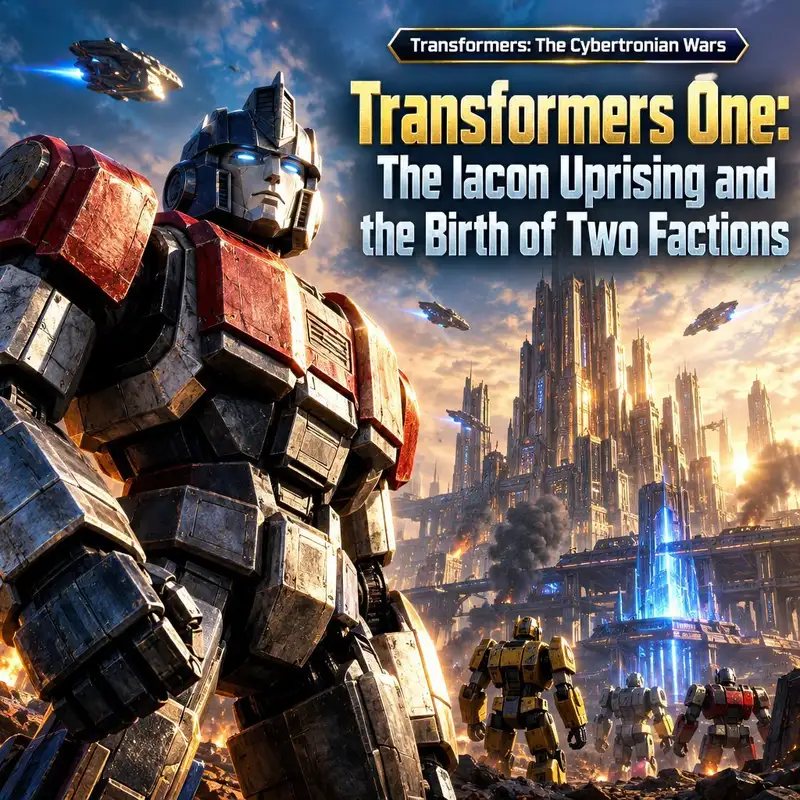
Transformers One: The Iacon Uprising and the Birth of Two Factions
Beneath Iacon, miners cut Energon from a planet that had been taught to fear its own exhaustion. They worked under a ruler who called himself Sentinel Prime, guardian of Cybertron and heir to a lost age. They were told the Matrix of Leadership had vanished with the old Primes, that Energon no longer flowed as it once had, and that the mines were therefore a necessity of survival. They were also told that they had been born unable to transform. Their stillness was presented as natural. Their dependence was presented as destiny.
That arrangement mattered because transformation was not a decorative ability in this version of Cybertron. A transformation cog allowed a Cybertronian to assume an alternate mode. It changed movement, access, work, and self-defense. A citizen who could not transform could not just take another route through the city, outrun a threat, carry out many forms of independent labor, or join a mobile armed force on equal terms. The regime had turned a technical capacity into a social boundary.
The result was a city organized around bodily dependency. Iacon had spectacle, ceremony, public enthusiasm, and a ruler who seemed endlessly available to praise courage from a safe distance. But beneath that civic theater stood an economy in which miners supplied the Energon needed to sustain Cybertron while lacking the mobility and political power to determine how that labor was used. Sentinel’s authority rested not only on guards, offices, and surveillance. It rested on the belief that the existing order was inevitable.
Transformers One is its own continuity, with its own account of Cybertron’s past. In this history, the Autobots and Decepticons do not arrive as ancient biological categories or preexisting armies. They are born during the collapse of Sentinel’s regime. The central question is not why two species began to hate each other. It is how a revolt against exploitation, undertaken by people who initially shared a common cause, became a split between two rival visions of liberation.
At the center of that split were Orion Pax and D-16. Before either name became an emblem, they were miners. They worked under the same restrictions, lived within the same managed society, and trusted one another as close friends. Their later conflict mattered precisely because it was not inevitable. They did not begin as hereditary enemies. They began as two workers trying to understand why the world they inhabited seemed so much smaller than the stories told about it.
Orion was restless in a way that institutions usually find inconvenient. He was curious about restricted places, skeptical of official answers, and willing to act before a plan had received proper authorization. That did not make him a finished leader. It made him a source of friction. He saw rules as questions to be tested, especially when those rules seemed designed to preserve somebody else’s authority.
D-16 was also frustrated, but his frustration took a different form. He admired Megatronus Prime, one of the lost heroic figures of Cybertron’s past. He wanted recognition, dignity, and proof that the miners could be more than the labor force Iacon expected them to remain. Yet he initially accepted more of Sentinel’s public story than Orion did. Sentinel appeared to be the surviving guardian of a ruined civilization. To D-16, the old Prime legacy still offered a language for honor.
Their friendship contained both possibilities. Orion wanted to find a way beyond the limits placed on them. D-16 wanted to prove that they deserved a place within the city’s hierarchy of greatness. One impulse looked outward toward a different system. The other sought respect from the symbols that system had already made powerful. The distinction was subtle at first, but revolutions often begin with such differences in emphasis. The disagreement becomes decisive only when power is suddenly available.
Elita-1 belonged to the same mining world, though she initially represented a different relationship to it. She was a supervisor, disciplined, competent, and concerned with safety and procedure. In a workplace where mistakes could be dangerous, those instincts were not trivial. Her eventual break with the system did not come from carelessness or romantic rebellion. It came from recognizing that procedure can become another instrument of injustice when the institution enforcing it is built on deception.
B-127 entered the story from Iacon’s lower systems, associated with waste management and the discarded materials of the city above. His humor and improvisation gave the group a perspective shaped by the margins of the system. Iacon had places for official ceremony, official labor, and official history. It also had places where inconvenient objects, records, and people could be sent when the city preferred not to see them.
Sentinel Prime understood the value of spectacle. The Iacon 5000, a major race staged as a morale-building public event, displayed a city supposedly united by courage, competition, and pride. It offered a controlled image of social mobility. Anyone watching could see daring contestants in motion, hear applause, and believe that Iacon rewarded initiative. Such events are useful to authoritarian systems because they allow exceptional individuals to be celebrated without changing the conditions imposed on everyone else.
Orion and D-16 entered the race without authorization. Their participation was reckless, but it also revealed something the regime preferred to keep obscured. Miners who were treated as labor inputs possessed skill, nerve, and initiative. They could adapt under pressure. They could cooperate. They could embarrass a more established competitor such as Darkwing. The problem for Sentinel was not that two miners had broken a rule. The problem was that they had become visible.
Sentinel could briefly praise them in public because a ruler confident in his own narrative can absorb a little disorder. He could present their performance as proof that Iacon welcomed ambition. But the praise did not alter their status. Once the spectacle ended, punishment followed. The lesson was clear enough. Courage was welcome when it improved Sentinel’s story. It became unacceptable when it suggested that ordinary miners might possess claims the system was not prepared to honor.
Orion, D-16, Elita-1, and B-127 left Iacon and traveled toward the forbidden surface. Their journey was physical, but it was also political. They moved beyond the managed geography of the city, beyond the mines and public platforms where Sentinel’s version of Cybertron seemed complete. Authoritarian governments rarely control information through speeches alone. They control access. They define which places are dangerous, which archives are unreliable, which questions are childish, and which memories are forbidden.
On the surface, the group encountered Alpha Trion and the remnants of the Cybertronian High Guard. The High Guard had once defended the Primes. They had survived in exile after the destruction of the old leadership and continued to oppose Sentinel. At this point, they were not Decepticons. They were an armed resistance tied to an earlier order, carrying military experience and a memory of betrayal that Iacon’s miners had never been allowed to possess.
Starscream led the High Guard before D-16 later seized control from him. Soundwave and Shockwave were among its members. Their presence showed that Sentinel’s authority had never been as complete as it appeared from beneath Iacon. There were survivors beyond the city, armed people who knew the official story was false, and veterans who had paid for that knowledge with exile. The regime’s stability depended partly on keeping these groups separated from the population it ruled.
Alpha Trion provided the rebels with more than a dramatic revelation. He supplied a competing history. According to his account, Sentinel had not just inherited authority after the Primes fell. He had betrayed them. He had worked with the Quintessons, external powers who received Energon under an arrangement that served Sentinel’s ambitions. The film establishes this collaboration and the betrayal that enabled it, but it does not provide a full account of Quintesson government, strategy, or wider objectives. Their role is significant without being fully mapped.
The important point was that Sentinel’s public identity as the last Prime concealed a crime. He had built authority from the destruction of those whose legacy he claimed to preserve. He turned a catastrophe into a political foundation. The supposed guardian of Cybertron had helped create the conditions from which he then claimed to save it.
This revelation transformed the meaning of the mines. The Energon crisis was real within the conditions Iacon faced, but Sentinel’s response was not just emergency administration. He had arranged a system that extracted labor from a population he kept dependent while Energon was also sent outward to the Quintessons. He presented sacrifice as collective necessity while concealing the political bargain behind it.
The regime’s most consequential act was the removal of transformation cogs from Cybertronians. Sentinel did not just exploit a preexisting labor class. He manufactured one. By taking the internal mechanisms that allowed people to transform, he created a population less mobile, less independent, and less able to resist. He then represented that imposed condition as ordinary life. The miners were not just told where they belonged. Their bodies had been altered to make escape from that place harder.
Sentinel’s authority had several layers. He possessed the symbolic prestige of the Prime title. He controlled the official story of the old war. He governed a city dependent on intensive mining. He held security forces and surveillance assets capable of enforcing his will. And he had separated the laboring population from both the means of mobility and the knowledge that such mobility had once been theirs. His rule was therefore not sustained by one lie, but by a system in which each lie supported the others.
The High Guard offered a military alternative, but even they did not solve the political problem. Armed resistance can expose weakness in a regime. It cannot automatically build a common future. The miners needed proof, organization, and a reason to believe that the fall of Sentinel would lead to something other than a new armed hierarchy. Orion understood that instinctively, though not yet with the authority to make it policy. D-16 understood something else. Power, once recovered, must not be surrendered again.
Alpha Trion gave the group transformation cogs taken from the fallen Primes. The cogs changed their tactical situation immediately. They gained alternate modes, increased mobility, and the ability to operate in a wider range of terrain and missions. A small group that had once been confined by the systems of Iacon could now move, pursue, evade, and fight in ways previously denied to them.
D-16 responded to his newfound power with genuine exhilaration. For someone who had spent his life being told that he was limited by nature, the discovery of an alternate mode was profoundly personal. It confirmed that Sentinel’s order had lied about him. It also made the old symbols of Prime authority newly important. If the rulers had stolen the greatness of the past, then perhaps greatness could be seized back.
Orion saw the cogs differently. They were proof that the miners had been wronged, but they also widened the circle of people who might be free. His instinct was not to establish himself above others because he had gained a special capability. It was to ask why that capability had been denied to everyone else. This difference would become the core of the divide between him and D-16.
Sentinel moved quickly once the hidden past began to surface. Airachnid, his lieutenant and enforcer, captured Alpha Trion and brought him back toward Iacon. Airachnid represented the surveillance state in a more direct form. She was more than a soldier. She was an instrument of monitoring, capture, and controlled information. Sentinel’s regime did not survive by persuading everyone. It survived by identifying threats before those threats could connect with the larger population.
Alpha Trion’s capture was a severe setback. His presence had given the rebels a living link to the past and a source of political legitimacy beyond Sentinel’s manufactured image. Sentinel killed him, eliminating a witness who could have challenged his claim in public. The act was brutal, but it also revealed a strategic weakness. A ruler who must destroy the evidence of the past is admitting that the past cannot safely be heard.
The rebels possessed an evidence chip containing proof of Sentinel’s betrayal. Yet the chip was destroyed during the struggle that followed. This was an intelligence failure with major consequences. A resistance that places all its evidence in a single physical object is vulnerable to capture, damage, or simple bad luck. The loss did not mean the truth had become false. It meant the rebels could no longer rely on possession alone. They would need another way to make the truth public.
D-16’s own capture deepened the crisis. Sentinel subjected him to psychological torment and revealed a fact that struck directly at D-16’s sense of identity. Sentinel had stolen Megatronus Prime’s cog. He branded D-16 with Megatronus’s symbol, turning an admired hero’s legacy into an instrument of humiliation. It was an act of domination carefully designed to make D-16 feel both powerless and personally violated.
The rebellion now faced a difficult transition. Its first phase had been an expedition: discover the truth, reach the surface, and learn why Iacon’s society was built as it was. The next phase was a rescue operation. Captured comrades had to be recovered, Sentinel’s security system had to be penetrated, and the regime’s command center had to be reached. Yet rescue alone would not be enough. Even if the rebels escaped with their allies, Sentinel could still portray them as criminals and preserve the larger system.
The counterattack on Iacon therefore became a combined political and military operation. The High Guard supplied combat experience. They knew how to fight an organized security force and how to operate as an armed resistance. Orion, Elita-1, and B-127 contributed mobility, local knowledge, improvisation, and a connection to the city’s working population. Their task was not just to win a series of fights. It was to convert an underground truth into a public rupture.
Elita-1 was central to that effort because she understood organization. Her earlier commitment to procedure did not disappear when she joined the revolt. It became useful in a different way. A rebellion needs courage, but it also needs coordination. It needs people who can recognize risks, keep a group moving toward an objective, and distinguish a dramatic gesture from an action that actually advances the mission. Her discipline helped turn a collection of fugitives and veterans into a force capable of acting inside a heavily controlled city.
B-127’s contribution was less formal but no less important. His experience in the lower and discarded systems of Iacon gave the group access to parts of the city that official power treated as peripheral. Revolts often depend on people who understand the hidden infrastructure beneath public order: maintenance routes, neglected spaces, improvised tools, and the practical ways in which a polished system actually functions. A regime may own the grand towers, but it still relies on somebody to know where the waste goes.
The miners were the decisive political force. Sentinel’s system had treated them as passive workers, necessary for Energon extraction but excluded from meaningful authority. Once mobilized, they became more than a labor pool. Their participation gave the uprising scale. It also gave it legitimacy. The revolt could no longer be dismissed as a raid by surface insurgents or a personal feud among exceptional figures. It became a challenge from the people whose work had sustained Iacon.
The rebels captured Airachnid. That achievement created the opportunity they had lost with the destruction of the evidence chip. Airachnid’s own memory recordings contained the proof of Sentinel’s cooperation with the Quintessons and his role in the betrayal of the Primes. The resistance shifted from guarding a small piece of evidence to broadcasting records across Iacon. It was a change in method with enormous political effect.
Information becomes powerful when it reaches the people whose obedience depends on its suppression. A secret known only to Alpha Trion, the High Guard, and a handful of miners could inspire resistance, but it could not on its own overturn a citywide political order. Airachnid’s recordings made the accusation public. They forced Iaconians to confront the gap between Sentinel’s sacred image and his actual conduct.
But Sentinel lost the narrative that made his command appear necessary and honorable. He had claimed to be the last Prime, the protector who bore the burden of Cybertron’s survival. The recordings revealed that his authority had been built on betrayal, concealment, and the subordination of his own people. Once that story became public, the miners were no longer merely suffering subjects. They were people who could identify the source of their suffering and act against it.
The fall of Sentinel’s story was as important as the fall of his defenses. His guards could still fight. His headquarters could still be defended. Yet coercion works differently once obedience is no longer supported by belief. A soldier may continue to follow orders, but the order has lost moral cover. A laborer may continue to work, but now understands the work as part of a system of exploitation. A public ceremony becomes evidence of fraud rather than a source of unity.
The uprising had now achieved its immediate operational goals. Captured allies were recovered. Sentinel’s security apparatus had been challenged from within. The evidence of treason had been broadcast. Miners had entered the struggle as political actors. The ruler’s legitimacy had shattered. What remained was the most difficult question in any revolution: what should happen to the defeated regime, and who has the authority to decide?
D-16 confronted Sentinel directly. He had every reason to hate him. Sentinel had lied to him, exploited the miners, killed Alpha Trion, and personally humiliated him. In the heat of the confrontation, D-16 wanted to kill the fallen ruler. The desire was understandable. It was also the point at which the uprising’s common cause began to break apart.
Orion intervened. His position was not that Sentinel was innocent, nor that the crimes of the regime should be forgotten. It was that the new order could not begin by treating personal execution as the first expression of liberated power. If the purpose of the uprising was to end a system in which one figure could define truth, distribute punishment, and control everyone else’s future, then the victors had to place limits on themselves as well.
D-16 rejected Orion’s restraint. In the struggle, he accidentally shot Orion. The accident did not remove the moral weight of what followed. Orion fell, and D-16 allowed him to fall. He then killed Sentinel and took Megatronus Prime’s cog for himself. These were not just flashes of anger. They formed a sequence of choices. D-16 accepted the death of a friend who had obstructed him, imposed judgment personally on a defeated enemy, and seized a symbol of Prime power as the foundation of his own authority.
The cog of Megatronus Prime carried special importance because D-16 had long admired Megatronus. Sentinel’s possession of it had represented both theft and desecration. By taking it, D-16 believed he was reclaiming something that had been stolen from Cybertron’s heroic past. But the act also marked a transformation in his political identity. The legacy of Megatronus became not a shared inheritance to be restored, but an emblem of D-16’s personal right to command.
This is where D-16 became Megatron. The name was more than a new label. It represented a new claim to authority. He had learned that the old institutions were fraudulent. He had also concluded that institutions themselves could not be trusted to restrain power. From his perspective, vulnerability had invited exploitation. Therefore power had to be concentrated in the hands of someone strong enough to prevent betrayal from happening again.
Megatron had demonstrated courage, battlefield ability, and a willingness to act when others hesitated. Those qualities made him dangerous as well as compelling. Tactical boldness can defeat a corrupt ruler. It does not automatically establish a just political order. By killing Sentinel after Orion’s intervention and by allowing Orion to fall, Megatron defined leadership as the power to settle political questions through force. His grievance remained real. His method had changed the meaning of the revolt.
Orion’s fall did not end the uprising, but it transformed its moral center. His return came through an extraordinary intervention by Primus and the spirits of the Primes. Within Transformers One, that event establishes a sacred and historical legitimacy specific to this story. It should not be treated as a universal rule for every version of Cybertron, every Matrix, or every Prime across the wider franchise.
Orion received the Matrix of Leadership and became Optimus Prime. The transformation gave him authority that Sentinel had falsely claimed. Sentinel had worn the title of Prime as a mask over betrayal. Optimus received a mandate connected to the old Primes after having demonstrated, in the crisis itself, a willingness to resist revenge and protect a shared future. The contrast was deliberate. One ruler used Prime symbolism to conceal domination. The other was elevated after arguing that power must carry responsibility.
The Matrix also restored Energon flow to Cybertron. This was more than a spiritual reward or a visual flourish. It altered the material condition that had helped sustain Sentinel’s regime. The mining system had been justified by scarcity and organized through dependence. With the Matrix restored, the political economy of the city changed. The resource crisis that had structured daily life under Sentinel no longer functioned in the same way.
The miners also regained transformation cogs. Their restoration meant more than new alternate modes. It returned mobility, dignity, and agency to people who had been physically restricted by the regime. A workforce that had been held in place could now move through its world on different terms. The effect was social as much as technical. Sentinel had governed by making citizens dependent. The restoration of cogs made that dependency harder to reproduce.
Three models of legitimacy had now appeared in rapid succession. Sentinel’s was fraudulent legitimacy, built on the stolen prestige of the Prime title, managed history, and controlled bodies. Optimus’s was restorative legitimacy, supported by the Matrix, the return of Energon, and his insistence that victory should not become arbitrary punishment. Megatron’s was revolutionary command legitimacy, rooted in military success, personal charisma, and the promise that no one would ever again be allowed to make him powerless.
The film does not show Optimus establishing a complete constitution, a representative government, or a settled postwar system for Iacon. It would be an error to assume that all political questions were resolved because Sentinel was gone and the Matrix had returned. Reconstruction requires more than the removal of a tyrant. It requires decisions about former officials, security forces, labor, public memory, and the place of those who had lived under the old regime. Those decisions remain beyond the film’s ending.
What the film does establish is that Optimus chose to oppose Megatron’s emerging rule by force. He defeated him and exiled him, along with the High Guard, from Iacon. The exile was strategically important. It removed an armed rival from the city at the moment when Cybertron’s political future was still unsettled. But it did not eliminate the rival movement. It moved the conflict beyond Iacon and gave Megatron a body of trained fighters around which to build a new faction.
Optimus named his followers the Autobots. The act of naming mattered because it created an institution where there had previously been a coalition of miners, dissidents, surface survivors, and former officials of no settled order. The Autobots were not an ancient people rediscovered after Sentinel’s fall. They were a political community formed around a particular answer to the uprising: that freedom required restored agency, shared protection, and limits on the power of the victor.
Megatron responded by reorganizing the High Guard as the Decepticons. The High Guard had existed before him as surviving defenders of the Primes and opponents of Sentinel. Under Megatron, they became something new. He adopted Megatronus Prime’s face as their insignia and placed the legacy of the fallen Prime at the center of a movement shaped by his own command. The symbol expressed injury, anger, and a claim to a stolen heritage. It also marked the conversion of resistance into a rival military identity.
The film does not establish the inner convictions of every member of the newly named Decepticons. It would be wrong to assume that each High Guard fighter embraced Megatron’s program in exactly the same way. Some may have followed his strength. Some may have shared his anger at Orion’s restraint. Some may have seen no other path after exile. Some may simply have remained within the command structure available to them. A faction can form before all its members agree on what it will become.
Still, the naming of Autobots and Decepticons was a decisive institutional rupture. A common uprising had produced rival chains of command, rival symbols, rival claims to history, and rival definitions of justice. The Autobots looked toward rebuilding a shared civic order after the exposure of Sentinel’s lies. The Decepticons looked toward a future in which power would be seized, guarded, and wielded by those strong enough to prevent their own subordination.
The tragedy of Iacon is that both sides emerged from a true revelation. Sentinel had betrayed the Primes. He had collaborated with outside powers. He had exploited miners whose transformation cogs had been taken from them. He had turned dependency into an ideology. The revolt against him was not a misunderstanding. It was a necessary response to a regime that had made deception part of the structure of daily life.
Yet the overthrow of a false order did not produce unity because Orion and D-16 answered the question of power differently. Orion Pax became Optimus Prime by treating power as a responsibility to restore freedom that had been denied to others. His restraint toward Sentinel was not forgetfulness. It was a refusal to let the new order inherit the old ruler’s belief that authority meant the right to decide life, death, and truth alone.
D-16 became Megatron because he reached the opposite conclusion. He saw power as something that had to be held personally, exercised decisively, and defended without restraint. He could no longer accept vulnerability, compromise, or a political process that might limit his judgment. The miner who had been denied agency became a leader determined never to be constrained by anyone again.
Iacon’s uprising succeeded because Sentinel’s regime depended on a lie that could not survive public evidence, and on a labor force that could not remain permanently powerless once it recovered mobility. But the victory exposed another problem that no broadcast, artifact, or battlefield success could settle. A revolution can remove a tyrant and still divide over what freedom requires. The Autobots and Decepticons were born not from different species, but from a revolt that won its first battle and lost its common political future.