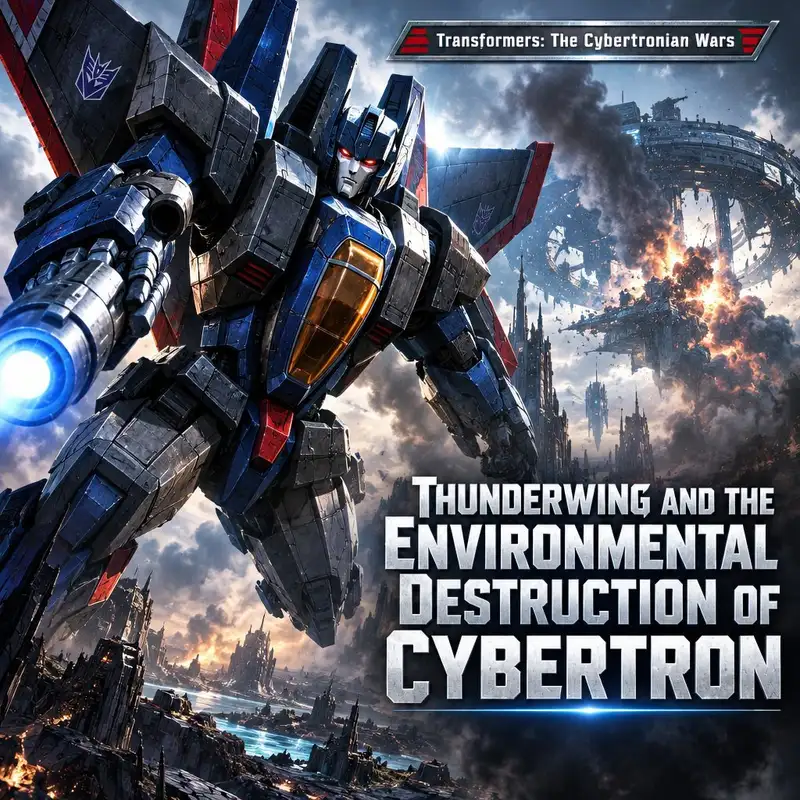
Thunderwing and the Environmental Destruction of Cybertron
Razorclaw’s problem was not whether Thunderwing could be killed. The Decepticon commander had a warship, the Thanatos, and Starblitz torpedoes prepared for a target of extraordinary scale. Megatron had authorized him to end the threat by any means necessary. The problem was that the target stood on Cybertron. Firing would remove Thunderwing, but it might also erase the Decepticons’ homeworld, the Autobots’ homeworld, and the political center of a war that had already scattered both factions across space.
In the I D W comic history that began in two thousand five, Cybertron at this point was no longer a functioning homeland. The Great War had drained resources, damaged the atmosphere, and left much of the planet hazardous or abandoned. Yet an uninhabitable world could still matter. Cybertron held memory, legitimacy, industrial remains, sacred and political symbolism, and the possibility, however remote, of a future return. Razorclaw was being ordered to destroy not just terrain, but the place both factions still regarded as the center of their civilization.
That is the central irony of Thunderwing’s story. He became the immediate reason Cybertron nearly faced deliberate annihilation. But he did not create the deeper crisis alone. Thunderwing had recognized that the planet was failing under the burden of war. He saw a civilization consuming the conditions of its own survival. His diagnosis was substantially correct. His response was disastrous. By attempting to make one Cybertronian body proof against a collapsing world, he became a force that accelerated the destruction he had warned against.
The danger did not begin with Bludgeon’s later attempt to revive him. It began with a war system that treated energy, industry, territory, and survival as military assets first and shared foundations of civilization second. The resulting catastrophe was more than a matter of craters, ruined cities, or dramatic explosions. It was environmental collapse on a planetary scale, caused by prolonged extraction, military consumption, damaged infrastructure, and institutions unable or unwilling to stop fighting long enough to preserve the world on which both sides depended.
Before Thunderwing became a weapon, he was a scientist confronting a conclusion that neither Autobot nor Decepticon leadership wanted to hear. The available record places his warning during the long Cybertronian war, at an earlier point whose exact distance from the later crisis is not firmly established. What matters is the sequence. Thunderwing addressed scientific personnel from both sides and argued that Cybertron’s reserves had been exhausted, its protective atmosphere had been damaged, and its ability to restore itself had been compromised.
This was not a narrow military complaint about one lost refinery or one failed supply route. Thunderwing described a systems failure. A planet that cannot replenish energy, repair environmental damage, or protect its population from hostile conditions cannot sustain ordinary civilian life. It also cannot sustain war indefinitely. Armies may continue to move for a time. Ships may leave. Isolated facilities may remain operational. But a civilization has crossed a dangerous threshold when its homeland can no longer recover from the damage imposed upon it.
Cybertron’s war had created exactly that kind of threshold. The conflict demanded energon, manufacturing capacity, transport, weapons production, repair facilities, and secure lines of communication. Every faction had reasons to seize what remained. Every commander could point to an immediate military necessity. Yet the cumulative effect was larger than any single campaign. Mines and industrial systems did not exist outside the war. Atmospheric damage did not respect faction lines. A damaged planetary environment did not distinguish between an Autobot technician, a Decepticon soldier, or a civilian trying to reach a functioning repair bay.
That is one reason Thunderwing’s warning matters. He was more than predicting hardship for his own faction. He was identifying a shared vulnerability. Cybertronian civil war had become self-defeating at the level of planetary survival. The factions could still argue over legitimacy, command, and ideology, but they were increasingly arguing inside a failing life-support system. The longer the conflict continued, the less likely any battlefield victory would leave a viable world to govern.
The failure was institutional as much as scientific. Scientists could identify the problem. They could measure depletion, observe atmospheric decline, and warn that the planet’s recovery mechanisms had been impaired. But neither side appears to have possessed, or chosen to use, a political structure capable of making planetary survival override military competition. A warning is not a policy. It becomes policy only when leaders accept costs, restrain extraction, redirect industry, and make compromises that armies and political movements may regard as dangerous.
In wartime, that is exceptionally difficult. A faction that reduces production risks defeat. A commander who preserves a resource for the future may lose the means to survive the present. A government that asks soldiers and civilians to accept rationing can be accused of weakness or betrayal. The trouble is that avoiding those choices does not eliminate the cost. It merely transfers the cost into the future, where it returns as a larger and less manageable crisis.
Thunderwing’s diagnosis was right in another important sense. He understood that Cybertron was no longer a secure refuge. It was becoming a hostile environment. But he mistook recognition for solution. Rather than developing a collective answer to a collective catastrophe, he pursued a transformation of the self. His proposed remedy was polydermal grafting, a process that created an external living carapace and linked it to the wearer’s nervous system.
This was not ordinary armor. The graft involved living tissue taken from living subjects and fused into a protective biological-technological shell. In the context of this I D W story, it was an experimental survival technology, not a universal explanation for Cybertronian biology or for similar concepts elsewhere in the franchise. Its purpose appears to have been adaptation. If Cybertron could no longer protect its inhabitants, perhaps a Cybertronian body could be altered to survive conditions that would otherwise destroy it.
There is a grim logic to that idea. When institutions fail, individuals often seek private means of survival. A bunker, an escape ship, a protected enclave, or an enhanced body can appear more achievable than repairing an entire civilization. But individual adaptation is not planetary recovery. A carapace could not restore an atmosphere. It could not replenish exhausted resources. It could not reopen a damaged energy cycle, repair social trust, or demobilize armies. At best, it could allow one subject to endure a world that others could not.
The ethical failure was inseparable from the technical one. A process that uses tissue from living subjects, binds itself to the nervous system, and has not been proven safe demands extraordinary safeguards. Thunderwing instead treated the crisis as though the urgency of the problem justified a leap beyond those safeguards. His urgency was understandable. His method was not. A civilization in collapse creates pressure for desperate experiments, but desperation does not make an untested intervention reliable, humane, or scalable.
Thunderwing tried to make himself proof against a dying world. The process did not preserve the scientist who had warned of that world’s decline. It severely compromised his mind and transformed him into a destructive entity driven largely by damaged instinct rather than meaningful strategic purpose. His body became more resilient and more dangerous. His agency became less certain. The technology intended to preserve a thinking person instead produced a being that could no longer reliably act on the reasoning that had inspired the experiment.
This is where Thunderwing’s story becomes more than a tale of scientific hubris. He was more than injured by his own invention. He became the embodiment of the political failure around him. Cybertron’s leaders had failed to manage a slow ecological catastrophe. Thunderwing’s experiment converted that slow catastrophe into a visible and immediate disaster. The war had already damaged the planet’s capacity to sustain life. Thunderwing’s rampage made the consequences impossible to ignore.
Autobot and Decepticon forces attempted to stop him. Their combined conventional firepower was insufficient. That detail matters because it reveals the mismatch between ordinary military doctrine and the threat Thunderwing had become. Armies are designed around identifiable objectives, command relationships, supply requirements, and enemies who can be deterred, isolated, negotiated with, or destroyed by proportionate force. Thunderwing had become something else: a mobile strategic hazard with no stable political aim and no reliable capacity for restraint.
The initial catastrophe ended with Cybertron itself swallowing Thunderwing. The story presents that outcome as a decisive narrative event, not as an invitation to construct a precise theory of planetary mechanics. What matters is that Thunderwing disappeared into the world he had tried to survive. Cybertron remained devastated. The Great War had already driven it toward environmental death. Thunderwing’s uncontrolled destruction made that ruin worse and gave the planet another wound from which it could not just recover.
It would be inaccurate to say that Thunderwing alone destroyed Cybertron. The war did that over time through exhaustion, damage, and failure of governance. Yet it would be equally inaccurate to treat him as merely another victim. His rampage was an accelerant. He turned a damaged, failing planet into a more dangerous and less recoverable one. In that sense, he was both warning and consequence. He showed what happens when a society treats systemic collapse as a technical problem one exceptional individual can solve alone.
That is why the later energy signal from the planet drew attention. Long after Thunderwing’s first catastrophe, a faint indication from Cybertron suggested the possibility of activity, perhaps even recovery. For a civilization in exile, that possibility could not be ignored. If the world was healing, the implications were enormous. If the signal meant something else, the danger could be equally great. In either case, someone had to investigate.
Jetfire commanded the Autobot science vessel Calabi-Yau on that mission. His crew included Technobots such as Nosecone and Afterburner, personnel with the technical expertise to assess whether Cybertron was becoming viable again. This was reconnaissance, but not the kind conducted by a conventional combat patrol. The Calabi-Yau was sent to answer a scientific and strategic question: was the homeworld beginning to recover, and if so, what could that mean for the wider war?
The mission entered a denied environment. Cybertron’s damaged atmosphere, cosmic radiation, abandoned infrastructure, and scarcity of reliable intelligence made the planet dangerous before any enemy appeared. Ruined worlds create unusual military problems. Maps become less trustworthy. Power networks may be intermittent. Old defenses may still function. Terrain can change around collapsed facilities and unstable industrial zones. A force investigating such a place must assume that the environment itself may be hostile, even before considering sabotage, ambush, or enemy occupation.
The Calabi-Yau carried another vulnerability: hope. The signal suggested that something had changed. That possibility created pressure to interpret activity as recovery. It did not make Jetfire or his crew careless. Their mission was necessary. But it did mean that a weak trace could be mistaken for evidence that Cybertron was returning to life rather than evidence that someone had learned to exploit its ruins. In war, intelligence failures often begin not with stupidity, but with a reasonable expectation that has not been tested against hostile intent.
The ship was attacked by forces able to remain at least partly concealed, then destroyed by missiles launched from Cybertron. The ambush eliminated an important scientific asset and placed the Technobots at the mercy of the attackers. It also revealed a deeper truth. Cybertron’s ruin had not ended the war. It had created a shadowed theater in which actors with access to abandoned facilities, hidden weapons, and old research could operate beyond ordinary scrutiny.
The attack was connected to Bludgeon, leader of a rogue Decepticon cult. That description matters. Bludgeon was more than carrying out a routine order from Megatron’s conventional chain of command. He operated with his own ambitions, followers, and methods. Like many factional leaders in a prolonged civil war, he saw opportunity in the gaps left by dispersed authority. The destruction of Cybertron had not eliminated power politics. It had made power politics more fragmented and more difficult to monitor.
Bludgeon had found Thunderwing’s remains. He did not see them as evidence of a failed experiment and a planetary tragedy. He saw a recoverable strategic asset. That decision required more than simple scavenging. Reanimating Thunderwing depended on an industrial and technical chain: access to the body, a facility capable of conducting grafting work, captive specialists, research knowledge, a powerful energy source, and a means of imposing commands on a being whose mind had already proved unstable.
The captured Technobots were central to this effort. Bludgeon treated technical personnel not as sentient prisoners with expertise and rights, but as raw material for a project. That was a further corruption of Thunderwing’s original work. The grafting process had begun as a desperate attempt to survive environmental collapse. Under Bludgeon, it became coercive militarization. Specialists were captured, knowledge was extracted, and living bodies were incorporated into a program intended to produce control through force.
Bludgeon also relied on Ultra-Energon. In this story, Ultra-Energon is not ordinary energon with a more dramatic label. It is an exceptional and dangerous source of power connected to research associated with Shockwave. Its existence does not establish a renewable fuel supply, a standardized military resource, or a technology either faction could field at scale. It was rare, potent, and poorly suited to casual assumptions. Bludgeon possessed enough to revive and empower Thunderwing. That did not mean he understood every consequence.
The distinction between power and control is crucial. Bludgeon could reactivate Thunderwing’s body. He could provide extraordinary energy. He could install command architecture, including the Axis Cradle, to direct the revived entity. But those achievements were not the same as building a reliable weapon. A weapon obeys orders within expected limits. It distinguishes friend from foe. It can be maintained, recalled, and used without consuming the force that deploys it. Thunderwing had never demonstrated those qualities.
Bludgeon’s plan rested on a familiar authoritarian error. He assumed that a system could be controlled because he had access to its central mechanism. He had the body, the fuel, the laboratory, the technical prisoners, and the command device. Therefore, he believed he possessed Thunderwing. But a damaged mind, an experimental graft, and a volatile energy supply do not become stable simply because they are placed under military hardware. The Axis Cradle gave Bludgeon direction, not mastery.
Thunderwing was sent to Nebulos as part of Bludgeon’s wider effort to exploit the revived entity and use its power in relation to Cybertron’s future. The exact details of that larger ambition matter less than the result. Once unleashed, Thunderwing devastated Nebulos. The planet became the site where a hidden Cybertronian experiment turned into an open interplanetary emergency. What had been buried in a ruined homeworld now threatened a civilian population far from the original war’s center.
The destruction on Nebulos must be described carefully. The record establishes severe devastation, panic, and a crisis beyond the capacity of local forces to contain. It does not provide a precise casualty total or justify claims of complete planetary extinction. But the absence of a number should not diminish the human and Cybertronian significance of the event. Civilian worlds are not testing grounds for unstable weapons. When a weapon cannot distinguish military objective from inhabited terrain, its deployment is already a command failure.
Thunderwing also destroyed most of the Decepticon force sent against him or operating in his path. That outcome was strategically revealing. Faction identity offered no protection. A Decepticon weapon did not become safe around Decepticons merely because Bludgeon had activated it. Thunderwing’s damaged instincts did not preserve friendly units, respect operational boundaries, or recognize the political purpose for which he had been sent. The weapon consumed its own side as readily as anyone else.
Darkwing and Dreadwind withdrew from the catastrophe and reported the crisis upward. Their report transformed Bludgeon’s rogue operation into a problem for Decepticon supreme command. Megatron now faced a threat that could not be dismissed as a local cult action. Thunderwing endangered Decepticon personnel, civilian worlds, strategic mobility, and Cybertron itself. A weapon intended to give one splinter faction leverage had become a danger to every faction with a stake in the war.
Megatron’s response was ruthless but strategically understandable. He authorized Razorclaw to stop Thunderwing by whatever means were required, including the destruction of Cybertron. That authorization did not resolve the political contradiction. It sharpened it. The Decepticons had fought for power over Cybertron, against its existing order and against Autobot resistance. Now their command structure contemplated annihilating the very world whose control had once been central to the struggle.
Razorclaw prepared the Thanatos and its Starblitz torpedoes. The torpedoes represented orbital denial in its most extreme form. They offered a way to remove a target too dangerous for conventional ground forces. But their use would not have been a surgical strike. The narrative establishes an intended planetary destruction, not a precise blast yield or technical blueprint. The operational logic was simple and terrible: if Thunderwing could not be stopped on Cybertron, then Cybertron might have to die with him.
Razorclaw hesitated. That hesitation was not mere sentimentality, nor was it necessarily a rejection of Megatron’s authority. It reflected the fact that homeworlds retain meaning after their material usefulness has been damaged. Cybertron was still the origin point of Decepticon identity. It remained the place whose history gave the war much of its emotional and political force. Destroying it might be militarily rational under extreme conditions, but it would also be an admission that neither faction had preserved the civilization they claimed to lead.
On the Autobot side, Optimus Prime received the distress information and called in the Wreckers. This elite combat unit included Springer, Roadbuster, Topspin, Whirl, Broadside, Sandstorm, Scoop, and Twin Twist. Their role was not to solve Cybertron’s environmental crisis or to negotiate a peace. They were sent because Thunderwing required a force willing and able to conduct a high-risk assault against a target that ordinary units had already failed to contain.
Prime, like Razorclaw, confronted the possibility that Cybertron might have to be destroyed. Springer independently reached the same grim conclusion. This was not evidence that Autobots and Decepticons had reconciled. They had not. Their chains of command remained separate. Their political objectives remained hostile. Their forces did not become one army. What they shared was an immediate understanding that Thunderwing’s continued existence could make every other war aim irrelevant.
Temporary coordination under existential pressure is not peace. It can be useful, even necessary, but it does not settle the causes of conflict. The Autobots and Decepticons could both recognize that a runaway weapon threatened them. They could both contribute forces to the same battlefield. Yet neither side had solved the political, military, and environmental conditions that had produced Thunderwing in the first place. They were cooperating against an emergency, not rebuilding a common society.
Before the orbital strike became inevitable, Jetfire changed the terms of the problem. Bludgeon’s files revealed that Ultra-Energon had made Thunderwing enormously powerful, but not inexhaustible. The more energy Thunderwing spent, the faster the reserve depleted. This was the decisive analytical hinge of the operation. Thunderwing did not need to be overpowered in a single exchange. He needed to be forced into sustained expenditure until the extraordinary resource sustaining him could no longer do so.
That conclusion transformed the battle from a contest of raw force into a problem of logistics and endurance. The Wreckers could not necessarily destroy Thunderwing outright. They could attack, evade, absorb risk, and keep him engaged. But without Jetfire’s analysis, those actions might have amounted only to sacrifice. Once the energy limitation was identified, every successful delay and every attack that drew power from Thunderwing’s reserve served a larger operational purpose.
This is a basic but often overlooked principle of warfare. A powerful system may remain vulnerable if its source of power is finite, its maintenance burden is high, or its performance requires continuous expenditure. The strongest weapon in the immediate fight is not always the force that can sustain itself longest. Bludgeon had treated Ultra-Energon as a path to dominance. Jetfire recognized it as a dependency. The same source that made Thunderwing terrifying also imposed a limit on how long that terror could continue.
Bludgeon’s control system failed before he could turn that power into durable command. The Axis Cradle was destroyed, and Thunderwing lost the external direction imposed upon him. This was not a minor technical setback. It proved that Bludgeon’s authority over Thunderwing had always been brittle. He had not restored a coherent subordinate. He had attached a control apparatus to an unstable entity. Once that apparatus was gone, the supposed weapon reverted to damaged instinct.
Thunderwing returned toward Cybertron through a kind of homing behavior. The final battlefield was therefore shaped not by either high command’s ideal plan, but by the wounded instincts of the being both sides were trying to stop. That is another feature of runaway military technology. Once command breaks down, the weapon’s path may be determined by embedded drives, damaged programming, environmental triggers, or unintended behavior. Leaders are left reacting to consequences rather than directing events.
Cybertron became the final containment zone because it was where Thunderwing went, not because it was a safe place to fight him. In fact, it was among the worst possible places for such a confrontation. The planet was already damaged, politically sacred, environmentally fragile, and filled with the remnants of the civilization that had created the crisis. A final battle there risked further destruction even if the orbital bombardment never came.
The Wreckers engaged Thunderwing on the ground. Decepticon forces under Divebomb also took part. Optimus Prime employed reprogrammed Centurion drones, combat machines that had previously served Bludgeon’s side. Their presence should not be confused with the deployment of ordinary independent soldiers. The drones were tools of combat and control, repurposed because the crisis required every available means of slowing Thunderwing’s advance and increasing his energy expenditure.
The action involved overlapping objectives rather than a unified command. The Autobots wanted Thunderwing neutralized and Cybertron preserved if possible. Razorclaw’s Decepticon forces needed the same immediate result, but remained prepared to destroy the planet if the ground effort failed. Prime and the Wreckers sought a discriminating solution. Razorclaw maintained an annihilation contingency. The difference mattered. One side was trying to make bombardment unnecessary. The other was prepared to carry it out.
Thunderwing’s shift into an enhanced ultra mode showed that the first assault had not resolved the threat. This was a dangerous moment operationally. A force that believes it has found the enemy’s weakness can become careless when the enemy displays an additional reserve of capability. Jetfire’s conclusion had not been disproved, but it had to be tested under pressure. Thunderwing still had energy to spend, still had the ability to inflict damage, and still threatened to push the battle past the point where ground containment was possible.
The value of the Wreckers’ assault was therefore not measured only in visible damage. Their attacks imposed demand on Thunderwing’s energy supply. Their presence fixed him in combat. Their willingness to remain engaged prevented him from moving freely to new targets. This is where tactical action supported operational design. A direct hit mattered because it forced a response. A feint mattered because it drew movement. Survival mattered because every unit that remained in the fight extended the period in which Thunderwing could be made to burn through Ultra-Energon.
Decepticon participation had a similar immediate purpose, but it did not erase distrust. Forces from rival factions can fight beside one another when a threat is sufficiently large, yet they do not suddenly share intelligence, doctrine, or political confidence. Coordination under those conditions is inherently fragile. Each side must consider whether the other is withholding information, preserving assets, or positioning itself for advantage after the crisis. Even so, Thunderwing was dangerous enough that these suspicions had to be managed rather than allowed to end the fight.
Prime’s use of the Centurion drones added another layer of complexity. Reprogrammed enemy machines can provide valuable combat mass, especially when regular personnel are scarce. But they also carry risks. Their original design reflects the enemy’s assumptions. Their loyalty depends on the reliability of the reprogramming. Their use may be tactically efficient while politically uncomfortable. In this case, they were a practical instrument in a battle where the objective was attrition, not ceremony.
The most important intelligence result was Jetfire’s. Raw firepower alone had failed against Thunderwing before. The Wreckers’ courage and combat skill mattered, but their assaults became strategically useful because someone understood what Thunderwing’s power source could and could not sustain. This is why intelligence analysis is often decisive in wars of advanced technology. The question is more than what a weapon can do. It is what keeps it functioning, what it consumes, and what happens when that support fails.
Above the battlefield, the Thanatos remained the final contingency. Razorclaw’s forces withdrew to prepare the Starblitz strike. That withdrawal made clear how narrow the margin had become. If Thunderwing could not be exhausted before the torpedoes were launched, Cybertron might be destroyed despite every effort to preserve it. The ground operation was not taking place in isolation. It was a race against an allied, or at least temporarily aligned, force’s willingness to conclude that the planet had become expendable.
Thunderwing finally exhausted the Ultra-Energon sustaining him and became inert. The immediate tactical threat ended. Razorclaw aborted the Starblitz launch before the bombardment destroyed Cybertron. This was a genuine success, but it must be described at the proper level. Thunderwing had been disabled. A planetary strike had been prevented. A rogue weapon no longer threatened to carry devastation from world to world. Those were major achievements.
The aftermath also pointed away from Cybertron. Jetfire’s examination of Bludgeon’s research connected Ultra-Energon to Earth. Optimus Prime linked that information to an earlier report from Prowl and the Autobot infiltration effort already operating there. The Ark was ordered toward Earth, leading into the next stage of the conflict. This was strategically logical. If the research behind Thunderwing’s revival had connections to another world, it could not be left unexamined.
Thunderwing became the most immediate force accelerating Cybertron’s destruction because he turned a slow systemic collapse into an uncontrolled weapon crisis. Yet the war had prepared the ground long before his experiment failed. His warning remained true even after he lost the ability to act upon it. Cybertron was not saved because Thunderwing fell inert. It was spared immediate annihilation. The world remained a ruined home, because neither faction’s emergency response addressed the war system that had destroyed it.