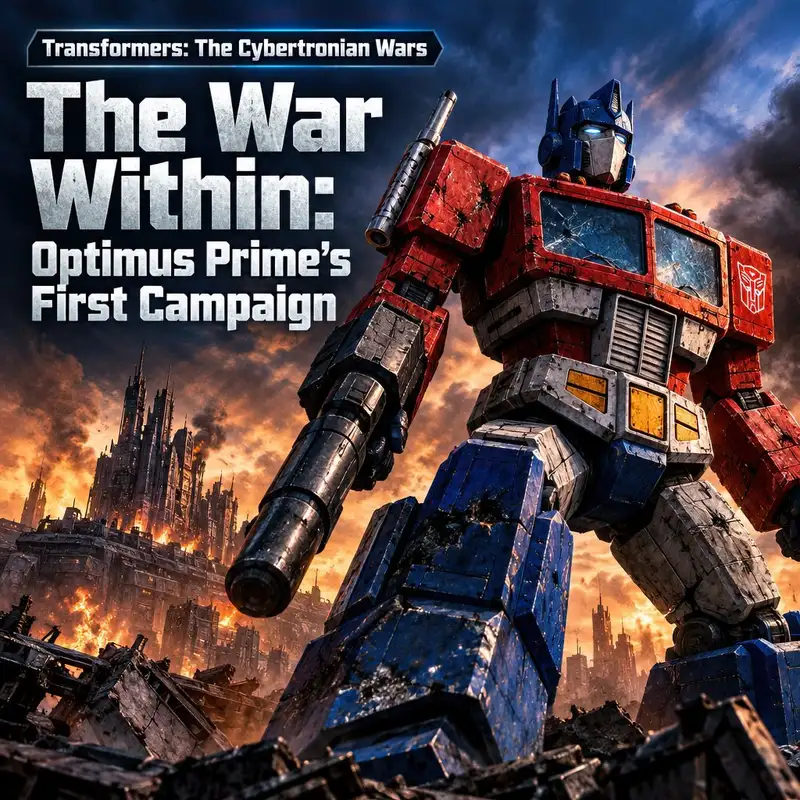
The War Within: Optimus Prime’s First Campaign [Dreamwave]
At the Central Spaceport, the Ark was being readied to leave Cybertron. It was not presented as a triumphal flagship or the beginning of a grand expedition. It was an evacuation vessel, a means to carry Autobots away from a home world that their new leader had judged too dangerous to hold. The order came from Optimus Prime, newly elevated, newly carrying the Matrix of Leadership, and not yet trusted by many of the fighters expected to carry out his decision.
In Dreamwave’s The War Within, this is the first contradiction of Optimus Prime’s command. He does not begin as a celebrated battlefield commander promising to reclaim every city and defeat Megatron in open war. He begins by asking whether the Autobots can survive by leaving. That decision was not cowardice. It was the cold judgment of someone who understood that archives, monuments, institutions, and even a capital city were useless if the people meant to preserve them were destroyed beside them.
The difficulty was that the Autobots did not need only an administrator of survival. They needed a leader in a civil war already being shaped by Megatron’s violence, initiative, and control of the tempo. Cybertron was not facing a distant threat that could be managed through orderly withdrawal. The Decepticons were already attacking its political centers, probing its defenses, and working beneath the surface of the planet itself. An evacuation could preserve lives, but it could also surrender the infrastructure from which any future resistance would have to operate.
Optimus had not sought this responsibility. Before his elevation, he was Optronix, an archivist. The distinction mattered. His authority came from knowledge, memory, and civic continuity rather than from an established military reputation. When Sentinel Prime was killed by Megatron, the Council of Ancients selected Optronix as successor. The Matrix transformed him into Optimus Prime, giving him the title, the symbol, and the burden associated with Autobot leadership.
But a council vote cannot create command confidence. The Matrix could establish legitimacy in the eyes of those who respected ancient authority. It could not prove that the new Prime understood field operations, could judge a defensive line, recognize a deception, or hold together a force under pressure. In wartime, formal authority and practical authority are related, but they are not the same thing. Optimus possessed the first. He had yet to earn the second.
That gap was visible almost immediately. Grimlock, one of the Autobots most inclined toward direct action, gathered senior figures including Jazz and Prowl to consider what should happen if Optimus proved incapable of leading the war. This was not just a matter of personal disrespect. Sentinel Prime’s death had created a succession crisis at the exact moment the Autobots could least afford uncertainty. Their movement had to decide whether loyalty to the office of Prime outweighed doubts about the individual now holding it.
Grimlock represented a pressure common to forces under attack. Frontline leaders often distrust caution when they believe the enemy is exploiting it. From his perspective, the evacuation order risked turning the Autobots into refugees before they had truly tested whether Cybertron could be defended. A commander who began by planning departure could appear to have accepted defeat before the campaign had properly begun.
Prowl and Jazz stood in a different position. Their work was less dramatic but no less important. They helped organize defense, maintain communications, assess threats, and hold together an Autobot structure that was still more fragile coalition than unified wartime machine. The Autobots had a Prime, but they did not yet have the settled command climate of an army whose officers understood their leader’s methods and trusted one another’s judgment.
This made the Ark more than a vehicle. It became the physical expression of a political argument. For Optimus, it offered preservation. For Grimlock, it threatened abandonment. For the Autobots assigned to prepare it, it created immediate practical questions. Who would leave first? Who would remain behind? Which facilities could still function? How much of Cybertronian society could be carried away, and how much would be left to the Decepticons?
The story never provides a reliable manifest, capacity figure, or detailed evacuation plan. It does not need to. The strategic problem is clear enough. An evacuation is never just movement. It is a judgment about what can be saved, who is responsible for those left behind, and whether survival away from home remains politically meaningful. The Ark could move Autobots away from danger. It could not automatically preserve their claim to Cybertron or their ability to shape what came after the war.
While Optimus debated whether the Autobots could survive by leaving Cybertron, Megatron was preparing to use the planet in a far more ambitious way. His campaign was not centered only on capturing Iacon, killing a rival, or winning a succession of conventional battles. Beneath the visible conflict, Decepticon forces were working with Cybertron’s planetary turbines, immense fixed systems buried deep within the world.
The full technical nature of those turbines is not explained in detail. What matters is their potential. Megatron believed that Cybertron’s deeper machinery could be activated and repurposed, transforming the planet into a mobile war-world. In effect, he was not just trying to seize the capital. He was attempting to turn the entire civilization into a strategic weapon, a moving base of power that could carry Decepticon control beyond the limits of a single planet.
That was a very different objective from the one visible on the battlefield. A commander focused only on streets, fortifications, and city centers could miss the real center of gravity. Megatron’s project depended on underground access, engineering control, the right activation mechanism, and protection from interference. It was industrial warfare in the most literal sense. The decisive terrain was not just the surface of Cybertron. It was the machinery that made Cybertron function.
This also explains why Optimus mattered to Megatron in a way that exceeded ordinary enemy leadership. The Matrix of Leadership was not only a symbol of Autobot succession. Megatron saw it as necessary to his larger plan. If he could capture Optimus and take the Matrix, he might gain the means to activate the planetary systems he intended to control. The new Prime was therefore both political target and strategic component.
Megatron interpreted the evacuation order as evidence that Optimus could be maneuvered. There was logic to that assessment. A leader preparing to leave is forced to concentrate forces at embarkation points, establish predictable routes, expose logistics, and make painful choices about what to abandon. The Central Spaceport offered hope, but it also created a focal point. In a war shaped by sabotage and deception, every concentrated evacuation effort becomes vulnerable.
To protect the underground operation, Megatron needed more than defensive guards and engineers. He needed distraction. He needed the Autobots focused on a crisis dramatic enough to pull their new leader away from the wider command problem. The destruction of the Forum of Enlightenment served that purpose.
The Forum was not just another structure damaged in a war. It represented civic memory and public life. Its destruction was an attack on the kind of society the Autobots claimed to defend. The strike also had operational value. It demonstrated Decepticon reach, created outrage, and presented Optimus with a challenge he could not easily ignore without appearing detached from the suffering of Cybertron itself.
The source never provides a formal Decepticon doctrine explaining the attack or an exact accounting of the people affected. It does establish the political meaning. A capital’s civic institutions are not separate from war. They are where authority is performed, history is stored, disputes are resolved, and citizens understand that they belong to a continuing society. Destroying such a place can weaken an enemy even if no military installation is captured.
Optimus read the attack as a deliberate provocation. He understood that Megatron wanted a response. Yet he chose to investigate personally, separating himself from the evacuation effort and from the officers trying to stabilize Autobot command. It was a calculated risk, but one with obvious dangers. A new leader whose authority was already under question was now moving into hostile terrain with limited support and uncertain information.
The decision reveals an early weakness in Optimus’s command. He recognized the political significance of the Forum’s destruction, but he did not yet possess the staff structure or confidence to delegate such an investigation cleanly. He was still learning the difference between being responsible for every crisis and commanding a force capable of responding to crises without him. A leader can be personally brave and still make an operationally dangerous choice by becoming the answer to every emergency.
Below Cybertron’s surface, the war changed character. The broad avenues and defensive positions of Iacon gave way to caverns, industrial passages, bridges, shafts, and machinery older and stranger than the immediate conflict. In that environment, alternate modes and conventional battlefield assumptions had limited value. Movement was constrained. Communications could be interrupted. Recovery of damaged personnel became harder. A separated commander could not rely on easy reinforcement or clear situational awareness.
Soundwave, Ravage, and the Insecticons pursued Optimus through this underworld. Their mission was not just to eliminate him. Capture mattered. Megatron wanted the Matrix, and the Prime carrying it could not be treated as an ordinary battlefield target. The pursuit combined intelligence, tracking, and direct force, using the terrain to isolate Optimus from his own command.
The underground setting also stripped away much of the comfort attached to Optimus’s new office. Above ground, the Matrix marked him as Prime. Below ground, symbols had less immediate value than movement, judgment, and survival. The title did not reveal enemy positions. It did not provide a map of the turbines. It did not ensure that a rescue force could find him. Sacred legitimacy, in other words, was not the same as usable intelligence.
During this descent, Optimus encountered an extraordinary image or voice associated with the Matrix. The experience suggested that Cybertron’s conflict was connected to forces and histories larger than the immediate fight between Autobots and Decepticons. But the story does not fully explain what the vision was, how the Matrix produced it, or whether it represented objective knowledge, warning, memory, or something else.
That uncertainty is important. The Matrix does not hand Optimus a reliable campaign plan. It does not tell him precisely where Megatron is, how to destroy the turbines, or how to save Iacon. What it gives him is a sense that the crisis beneath Cybertron is more consequential than he first believed. It unsettles the assumption that evacuation alone can solve the Autobot problem.
Above ground, Shockwave led the Decepticon assault on Iacon. This was the visible battle, the operation every defender could see. The attack placed pressure on the city’s defenders, tested the Guardian robots, and forced the Autobots to organize a defense around the Decagon. For soldiers in the streets, the fight for Iacon was not a diversion. It was immediate, destructive, and potentially decisive.
Prowl and Jazz had to manage that reality while also recognizing that something was wrong with the pattern of attack. The scale of the Decepticon assault made it dangerous to dismiss. Yet the timing, the absence of Optimus, and the larger strategic context suggested that the city might not be Megatron’s only objective. This is one of the hardest problems in command. A diversion is still a real attack. Ignoring it can lose a city. Committing everything to it can lose the war elsewhere.
The defense of Iacon therefore depended on dispersed competence. Optimus was underground. Prowl and Jazz remained responsible for organizing resistance at the capital. Other Autobots had to continue evacuation work, protect access routes, and respond to developing threats without waiting for their Prime to issue detailed instructions. The campaign began to test whether the Autobots could function as an institution rather than as a collection of individuals united by faith in a title.
Shockwave’s role also deserves attention. He commanded the overt military operation. His task was to force a breakthrough, apply pressure to the defenders, and exploit the confusion created by the broader Decepticon plan. But the assault on Iacon had a purpose beyond the city itself. It kept Autobot attention fixed above ground while Megatron pursued Optimus and the Matrix below.
Megatron made the underlying objective clear enough. The Matrix was essential to activating the planetary engines. The battle for Iacon was therefore connected to a contest over Cybertron’s future function. Would the planet remain a damaged homeland, perhaps abandoned by its defenders? Would it become a Decepticon war machine? Or would the Autobots discover enough of the plan to stop it before the machinery was fully activated?
The first meeting between Optimus and Megatron in this Dreamwave continuity took place beneath Cybertron, not in a public duel before armies or a formal confrontation between established rivals. It was an encounter between two leaders still defining themselves through action. Optimus had inherited authority and was trying to understand what it demanded. Megatron had already built a movement capable of warfare and was attempting to convert strategic ambition into planetary power.
Their conflict was therefore about more than personalities. Megatron treated Cybertron as an asset to be seized, engineered, and directed by force. Optimus had initially treated it as a homeland that might have to be abandoned in order to save its people. Neither position was sentimental. Both were strategic. But Megatron’s plan subordinated the population and the planet to military utility, while Optimus’s evacuation plan risked separating the Autobots from the very civic world they claimed to preserve.
Before their confrontation could produce a clear result, Starscream destroyed the bridge beneath them. Both leaders fell deeper into Cybertron. The immediate effect was physical separation from their forces. The larger effect was a command crisis. Megatron could no longer directly supervise the operation he had designed. Optimus could no longer return quickly to Iacon or the Ark. Subordinates on both sides now had to act with incomplete information and competing priorities.
The fall exposed a weakness in highly personalized command. Megatron’s authority was formidable when he was present. But his absence created opportunity for rivals who did not necessarily share his objectives. Optimus’s absence created a different problem. The Autobots had not yet fully accepted his leadership, but they still had to decide whether to follow his broader purpose, preserve the evacuation, defend Iacon, or attempt to recover him.
Grimlock chose action. Alongside Kup, Ironhide, and Wheeljack, he organized a recovery mission into the damaged interior of Cybertron. This was more than an effort to retrieve the Prime. It was reconnaissance, rescue, and sabotage combined. The team had to navigate dangerous subterranean routes, identify the Decepticon infrastructure at work, and interfere with a project whose full scale they were only beginning to understand.
Grimlock’s role in this operation changed the political meaning of his earlier criticism. He did not suddenly become a disciple of Optimus Prime. The story gives no reason to claim that every doubt disappeared. But he became indispensable to the survival of the new command. A force can question its leader and still fight to recover that leader because institutions are often held together by necessity before they are held together by confidence.
Kup and Ironhide brought field experience to the mission. Wheeljack supplied engineering knowledge essential to understanding and disrupting the turbines. Their work demonstrates why the campaign cannot be understood as only a duel between Optimus and Megatron. The Prime’s survival mattered, but so did the ability of specialists to locate machinery, assess its vulnerability, move through hostile terrain, and act before the enemy completed the larger operation.
This was combined action on a small scale. No detailed order of battle is provided, and there is no need to invent one. What matters is function. Grimlock supplied aggressive field leadership. Wheeljack dealt with the technical problem. Kup and Ironhide supported movement, protection, and recovery. Together, they gave the Autobots a chance to contest an underground operation that could not be defeated by symbolic authority alone.
The recovery team located one of the planetary turbines and began to interfere with the Decepticon effort. That discovery confirmed the scale of Megatron’s design. Cybertron’s future was being contested through fixed infrastructure hidden beneath the battlefield. The Autobots were no longer deciding simply whether to evacuate from a losing war. They were confronting the possibility that their home world could be transformed into an instrument of conquest.
At Kaon, Megatron’s absence produced a different kind of initiative. Starscream assumed control. This was not an orderly succession, and it was not a careful continuation of Megatron’s plan. Starscream understood that the machinery beneath Cybertron offered power. He also understood that the disappearance of Megatron created a chance to use that power for himself.
Scrapper warned him about the turbines. The warning mattered because the machinery was not a simple weapon that could be activated safely by any officer with enough ambition. It was a complex system with destructive potential, operating beneath a populated and contested city. Starscream ignored the caution and activated the machinery beneath Iacon.
This was not just another example of personal rivalry. It was a command and control failure with strategic consequences. Megatron’s regime depended heavily on personal authority, fear, and the rapid exploitation of opportunity. Such a system can move quickly. It can also become unstable when technical expertise, military command, and political succession are not clearly aligned.
Shockwave’s reaction showed that the Decepticons were not a single mind. He was leading an assault on Iacon and attempting to achieve a coherent battlefield result. Starscream’s seizure of initiative threatened to turn the city from an objective into collateral damage. The Decepticons could still inflict immense harm, but the action no longer served a disciplined strategic purpose.
The turbines forced superheated plasma upward through Iacon. The result was devastation on a scale neither side could easily control. The city was not just occupied, captured, or liberated. It was damaged at its foundations. Its defensive system was disrupted, its civic center shattered, and its role as a stable political capital thrown into doubt.
Prowl’s responsibility changed from holding the city to saving what could be saved from it. He evacuated surviving Autobots as the situation collapsed. This was not a glamorous form of command. It was triage. When a defensive position has been penetrated and the infrastructure beneath it becomes lethal, preserving a force may matter more than maintaining a line that no longer serves a military purpose.
Shockwave also ordered a Decepticon withdrawal. That decision makes clear why Iacon’s destruction cannot be called a clean Decepticon victory. The Decepticons had broken through defenses and forced the Autobots from the city. But they did not gain secure, durable control of the capital. The disaster disrupted their own operation, endangered their troops, and prevented them from turning a battlefield success into stable occupation.
Tactically, the attack had inflicted severe damage and compelled an Autobot withdrawal. Operationally, neither faction emerged with reliable control over Iacon. Strategically, Cybertron lost one of its major political and civic centers. The destruction of the city weakened the Autobots, but it also robbed the Decepticons of a valuable prize. A ruined capital is not the same thing as a conquered capital.
The political consequences were deeper still. Iacon represented more than command posts and defensive structures. It was part of the Autobot claim that Cybertron remained a society worth defending. Its destruction damaged public memory, civic continuity, and the possibility of normal governance. The exact civilian toll is not established, but the political injury is unmistakable. A civilization can lose more than territory when its institutions are burned out from beneath it.
This was the moment when Optimus’s initial evacuation strategy had to be reconsidered. Before Iacon’s destruction, leaving Cybertron could be defended as prudent preservation. Afterward, the question became more difficult. If the Autobots withdrew while the Decepticons seized or destroyed the planet’s essential systems, what would remain for those refugees to return to? Could an Autobot people remain politically whole if its cities, memory, infrastructure, and common future were surrendered to an enemy determined to reshape them?
Far below the city, Optimus and Megatron experienced further Matrix-associated visions. They saw images suggesting future forms of conflict, including later and altered modes of war. But these images should not be read as a complete or reliable chronology. The experience functions as warning, not as a fixed prophecy. It tells them that the conflict between their causes may endure and mutate in ways neither fully understands.
For Optimus, the vision reinforced a lesson already emerging from the campaign. War could not be reduced to one city, one battle, or even one successful evacuation. The choices being made beneath Cybertron might shape not only the current balance of power but the political character of whatever survived. For Megatron, the same experience did not produce surrender or reconciliation. It occurred within a struggle for control that both leaders still understood in fundamentally different ways.
The rescue team’s sabotage became decisive. Grimlock’s sword came into Optimus’s hands as he renewed his pursuit of Megatron. Wheeljack used a missile against the planetary turbines, disabling or ruining the system before Starscream’s destructive activation could become the completed transformation Megatron had intended. The story never explains the missile as standard Autobot equipment, nor does it establish the exact technical mechanism of the result. It was a specific intervention in an exceptional crisis.
What can be said with confidence is that Megatron’s immediate objective failed. Cybertron did not become the mobile war-world he had envisioned. The failure was not caused by a single leader acting alone. It came from the accumulated work of defenders in Iacon, the recovery mission underground, Wheeljack’s technical intervention, Grimlock’s field action, and Starscream’s reckless misuse of the same machinery Megatron had hoped to control.
Optimus then defeated Megatron. The victory was real, but it was limited. Megatron was left damaged, apparently with gaps in his memory or understanding, before Soundwave found him. Yet the war was not over. The Decepticon movement had not disappeared. Iacon had not been restored. The Autobots had not won Cybertron. A commander who mistakes a local victory for strategic resolution is likely to be surprised by the next phase of the war.
This limitation is central to Optimus Prime’s first campaign. His most important achievement was not just defeating Megatron in their first confrontation. It was learning what that victory could not repair. It could not undo the Forum’s destruction. It could not restore Iacon as a functioning capital. It could not erase the divisions within Autobot command. It could not make the Ark unnecessary, and it could not guarantee that the Decepticons would not find another way to exploit Cybertron’s weakness.
When the evacuation debate returned, Optimus no longer approached it as the archivist who believed survival could be secured by preserving a population somewhere else. The events beneath Cybertron had changed the meaning of the planet itself. Cybertron was not only territory. It was infrastructure, history, identity, and the political space in which Autobots could remain a people rather than become a scattered remnant.
He rejected the inherited certainty represented by a golden data disc. That gesture did not mean that Optimus dismissed history or tradition. An archivist is unlikely to make that mistake. It meant that he refused to let inherited instructions substitute for judgment. The old models of leadership had not prepared Cybertron for the crisis it faced. Sentinel Prime’s death, Megatron’s campaign, Starscream’s opportunism, and Iacon’s destruction had all demonstrated that legitimacy without adaptation was not enough.
Optimus also did not become Grimlock. He did not conclude that forceful action alone was the answer, or that every strategic problem could be solved by meeting aggression with greater aggression. Grimlock had been right about one thing: a leader who could not fight for Cybertron would not earn the confidence of those asked to defend it. But Grimlock’s battlefield instinct was only one part of what the Autobots required.
Nor did Optimus become Megatron’s opposite merely by refusing conquest. Megatron had seen Cybertron as an instrument to be controlled from above, its ancient systems harnessed to a leader’s military ambition. Optimus came to understand that defending Cybertron required more than retaining possession of the planet. It required preserving the possibility of a civic future on it, even after its capital had been devastated and its institutions had been thrown into crisis.
By the end of the campaign, evacuation is no longer the whole objective. Continued resistance demands something harder: trust among skeptical commanders, intelligent use of specialists, protection of damaged infrastructure, and a political purpose strong enough to justify further sacrifice. The Matrix gives Optimus a title and the Council gives him legal authority, but neither can substitute for the habits of command he has to learn from Grimlock, Prowl, Jazz, Wheeljack, Ironhide, Kup, and the rest of the force. Leadership becomes delegation, criticism, coordination, and the ability to see a battle in Iacon and a turbine beneath the planet as parts of the same war.
Optimus Prime's first campaign does not win Cybertron or end Megatron's rebellion. It changes the meaning of survival. He begins by trying to preserve Autobots from a world he believes cannot be held. He ends by recognizing that survival without a civic center, a homeland, or a political future would leave them alive but strategically diminished. The first test of his command is therefore not whether he can defeat Megatron in one battle. It is whether he can give a battered force a reason to remain connected to the world it may have to save.