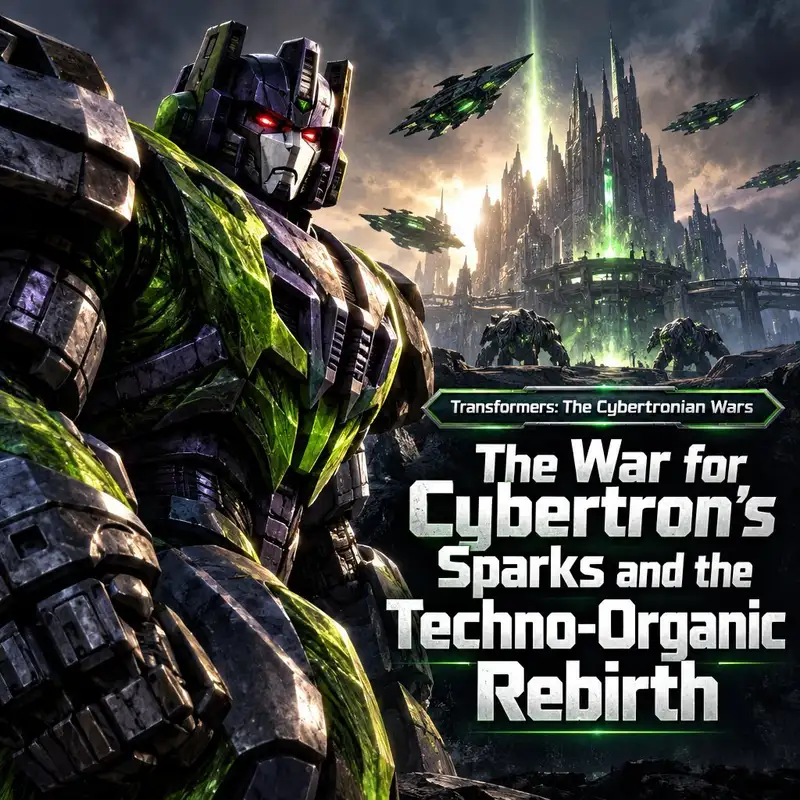
The War for Cybertron’s Sparks and the Techno-Organic Rebirth
Beneath Cybertron’s metal crust, green life begins to spread through a world that had appeared entirely mechanical. It grows in hidden spaces, beyond the reach of the city towers, patrol routes, and surveillance systems above. That growth is quiet, but it is strategically explosive. It proves that Cybertron has not become the sterile machine empire Megatron intends to create.
This is the Cybertron of Beast Machines, the direct screen sequel to Beast Wars. The war begins after Optimus Primal and several fellow Maximals return from prehistoric Earth. They expect home. Instead, they find an occupied planet, an apparently vanished population, and a new order enforced by Vehicon drones.
Megatron already controls Cybertron when the series opens. The record does not show a complete campaign of conquest. It provides no reliable order of battle, a detailed map of fallen cities, or a precise account of how he overcame the planet. What it shows is the aftermath: a regime that has taken control of infrastructure, communications, industry, and the bodies of its citizens.
The returning Maximals are in no condition to challenge that order conventionally. Optimus Primal, Cheetor, Rattrap, and Blackarachnia have no army, no secure base, no established intelligence network, and no dependable line of supply. They return with memories of the Beast Wars, but those memories are of little immediate use on a Cybertron transformed beyond recognition.
Their first problem is not how to retake a city or defeat a general. It is how to understand an empty world. Cybertron’s streets are occupied by Vehicons, yet its ordinary people are nowhere to be found. The absence is so complete that it initially resembles extinction. In time, the Maximals discover something more disturbing. Cybertron’s population has not simply disappeared. It has been stripped of independent embodied life.
That distinction defines the war. The Maximals are not fighting only to replace one ruler with another. They are fighting to restore the possibility that Cybertronians can exist as persons rather than as resources, prisoners, components, or obedient extensions of a centralized command system.
The Oracle gives the returning Maximals their first means of survival, and their first major liability. In the episode called The Reformatting, it changes their bodies into techno-organic forms. These bodies combine mechanical and organic elements. Within Beast Machines, that combination is not a cosmetic redesign. It becomes a new condition of life, one tied to Cybertron’s buried organic potential.
At first, however, it is not a gift that makes them stronger. The Maximals lose the easy command of transformation that had defined their earlier bodies. They cannot reliably shift between beast and robot forms. In a war against mobile drones, air power, armored forces, and centralized surveillance, that failure is an operational crisis.
Transformation had been more than a combat trick. It had allowed reconnaissance, escape, movement through difficult terrain, and rapid changes in fighting posture. Without it, the Maximals lose mobility at precisely the moment they need to avoid direct engagement. Their new bodies may represent a future for Cybertron, but in the immediate present they make a small resistance force easier to track, isolate, and destroy.
The reformatted Maximals must learn to transform again through an internal balance of mechanical and organic life. The series presents that process partly as discipline and partly as spiritual discovery. Yet its military meaning is plain. A resistance that cannot move, hide, adapt, or withdraw is not a resistance for long.
For Optimus Primal, this creates a command problem as well as a personal one. The Oracle provides guidance, visions, and transformation, but it does not hand him a complete operational plan. He must decide what its messages mean, which risks are justified, and how much of the resistance’s future can rest on faith in an ancient and only partly understood authority.
That restraint matters. A commander who treats every vision as a detailed order can become dependent on information he does not control. Optimus has to listen to the Oracle without surrendering judgment to it. His enemy, Megatron, has made a very different decision about Cybertronian nature. He sees organic life not as a possibility to be understood, but as contamination to be removed.
Megatron’s Vehicon state is more than a robot army with a hostile leader. It is an occupation system. The Vehicons patrol, pursue, observe, and enforce. They give Megatron a visible presence across Cybertron, but their importance lies in the institutions behind them. His regime controls the networks through which bodies are manufactured, repaired, armed, directed, and watched.
The regime’s central instrument is the spark. In Beast Machines, a spark is the essential locus of Cybertronian identity and life. It is more than a power cell, and it is not reducible to a memory file. Under extraordinary conditions, a spark can be separated from a body. Megatron turns that terrible possibility into a method of rule.
Spark extraction deprives Cybertronians of embodied agency. A population that cannot inhabit independent bodies cannot organize, vote, flee, work freely, or resist in ordinary ways. The citizens of Cybertron are not reconciled to Megatron’s rule. They are made unable to express opposition through the normal institutions of social life.
That makes spark capture a form of mass detention. It is also a form of political erasure. Megatron does more than imprison opponents behind walls. He seizes the part of them that makes independent existence possible, then places that identity within systems designed to serve his military state.
The policy has an industrial purpose as well. Captured sparks can be used in Vehicon bodies and related systems. Megatron converts personhood into infrastructure. Individual experience, skill, memory, and will are no longer treated as the possessions of a citizen. They become assets to be extracted, redirected, and deployed by the regime.
A silent Cybertron can therefore look unified while being profoundly unstable. Megatron has imposed order, but he has not created legitimacy. He has removed the people’s ability to dissent, then mistakes the absence of visible dissent for consent. That is an error familiar to occupation governments of every kind. Fear can quiet a population. It cannot turn coercion into political loyalty.
The Vehicon Generals make the human, or rather Cybertronian, cost of that system visible. They are more than specialized enemy units. Their altered identities show what happens when a government claims the authority to separate body, spark, memory, and allegiance, then rearrange them for military convenience.
Blackarachnia’s search for Silverbolt is the clearest personal case. Silverbolt had been her partner during the Beast Wars. She believes that the Vehicon General Jetstorm may contain some remnant of him. Her search is not only emotional. It is an intelligence question with strategic consequences. If Megatron can turn captured individuals into loyal commanders, then every missing Cybertronian may become a weapon against those who knew them.
The answer is complicated. Silverbolt’s personality does emerge through Jetstorm, showing that identity has not been cleanly erased. Yet Jetstorm is more than Silverbolt restored. The body, the imposed role, and the regime’s control structure all matter. Recovery does not mean that damage disappears. A person can return while still carrying the consequences of coercion, manipulation, and forced service.
Thrust provides a second, stranger example. Blackarachnia’s investigation reveals that Thrust contains Waspinator rather than Silverbolt. The discovery reinforces a central lesson of the occupation. Under Megatron’s system, body and identity no longer line up in reliable ways. Familiar appearances cannot be trusted, and a military designation may conceal an imprisoned individual.
Tankorr presents an even more dangerous form of partial restoration. He carries Rhinox’s spark within a Tank Drone body. Rhinox’s intelligence, memories, and personality gradually emerge, but they do not return in a clean or stable form. Tankorr remains entangled with Megatron’s systems, resentful of his own condition, and increasingly determined to impose his own vision on Cybertron.
The series does not supply a fully technical doctrine for how spark suppression, memory, and personality recovery work. It does not need to. The uncertainty is part of the horror. Megatron’s technology can rearrange identity well enough to militarize it, but not well enough to guarantee a controllable result. He treats persons as components, then discovers that components with memory and will may not behave as machinery.
The Oracle becomes central to this conflict because it offers a different relationship between knowledge, life, and Cybertron’s future. In The Key, Tankorr identifies the Oracle with the ancient system known as Vector Sigma, drawing on old Autobot data. The connection is strong within the story, but it should not be mistaken for a complete technical specification. The Oracle is not reduced to a simple computer terminal with a clear instruction manual.
More important, the Oracle contains knowledge Megatron cannot fully command. A sparkless Diagnostic Drone gains access to it and returns with the Key to Vector Sigma. The event is both a discovery and an intelligence failure. The Maximals learn more about Cybertron’s buried future, but the Vehicon side also acquires a tool capable of reshaping that future by force.
The Key converts organic matter into techno-matter. Its effect is strategic because it can alter the physical basis of Cybertron’s rebirth. It is not the Matrix, the AllSpark, or a universal artifact from another Transformers history. In Beast Machines, it is a dangerous continuity-specific technology whose demonstrated purpose is transformation on a planetary and ecological scale.
The Key does not appear to have unlimited range, unlimited power, or effortless reproducibility. The series never establishes a standard industrial process that would allow either side to manufacture limitless examples. But even a limited transformational weapon can have immense consequences when the target is the organic potential of an entire world.
For the Maximals, the discovery of organic life beneath Cybertron changes the meaning of liberation. Green material begins to grow below the metal surface. It accelerates life, supports the creation of an orchard, and points toward the presence of an organic core within the planet. The evidence does not provide a complete scientific account of its composition, energy output, or origin. It does establish that Cybertron is not only a world of factories, data systems, and armored cities.
The orchard matters because it makes renewal visible. In a planet ruled by drones, growth itself becomes political. A living system develops according to processes that are not easily centralized, standardized, or reduced to a command signal. It changes, spreads, responds, and creates conditions outside the immediate control of the regime.
Botanica becomes important in this context. Her contribution is more than that of another capable fighter joining an understrength force. She helps the Maximals understand and sustain the organic dimension of Cybertron’s future. That makes her a specialist in survival, restoration, and ecological knowledge, all of which Megatron’s military system has neglected or rejected.
Megatron’s ideal is a perfected machine world. In that vision, Cybertronian life is orderly because it is controlled. Bodies perform assigned functions. Drones obey. Sparks are stored, redirected, or absorbed. Organic life is rejected because it introduces uncertainty, growth, vulnerability, and independent development.
The Maximals defend a more difficult future. A techno-organic Cybertron will be less predictable than Megatron’s machine state. It will contain change that cannot be entirely commanded from a single tower or controlled through a single network. It offers no simple promise of stability. What it offers is the possibility of life that is not owned by the state.
The civilian experience of the war appears mostly through absence. Beast Machines does not provide a detailed account of individual workers, families, neighborhoods, or local resistance cells under Vehicon rule. It would be wrong to invent them. But the emptied cities, missing bodies, captive sparks, and suppressed organic life make the larger loss clear. Cybertron has been deprived of ordinary social existence.
The Key soon becomes a weapon in that larger struggle. Through Tankorr’s maneuvering and the events of The Catalyst, Vehicon forces gain the ability to direct its transforming effect against organic matter. The result is more than a new battlefield device. It is the beginning of an environmental and industrial campaign against the material basis of Cybertron’s rebirth.
Megatron is no longer defending territory in the conventional sense. He is attempting to destroy the conditions under which a different Cybertron could exist. If the organic core can be converted into techno-matter, then the planet’s future may be forced back into the machine-only order he prefers.
This is strategic denial. An army can be defeated and rebuilt. A resistance can hide, recruit, or adapt. But if the underlying environment that supports recovery is destroyed or transformed, the defeated side may lose more than a battle. It may lose the possibility of restoring the society for which it is fighting.
The series shows the Key’s effects, but it leaves important limits unclear. It never establishes that any Vehicon can use it at any range, that the technology can be mass-produced without difficulty, or that every organic system can be converted in the same way. That uncertainty does not weaken the threat. It places the emphasis where it belongs: on control of access, deployment, and intent.
Tankorr’s role also reveals a weakness in Megatron’s command structure. Megatron has taken a brilliant mind and placed it in a form useful to his state. Yet coerced expertise is not the same as loyalty. Tankorr can produce valuable results while pursuing motives Megatron does not fully share or understand.
That is one of the costs of ruling through stolen identity. Megatron gains capability quickly because he does not need to persuade, train, or integrate those he controls. But he loses the trust that makes complex institutions durable. A commander can compel obedience from a drone. He cannot assume the same obedience from a person whose memories are beginning to return.
The second season’s Sparkwar makes that dependency more visible. The conflict expands beyond survival raids and individual recoveries. The Maximals begin confronting the system through which Megatron has converted captured Cybertronians into specialized military power.
Obsidian and Strika represent formidable military experience pressed into Vehicon service. They are not important because the series offers an exact accounting of their forces. It does not. Their importance is that Megatron can redirect exceptional commanders and use their knowledge to reinforce a state already supported by mass drone formations.
Against that structure, the Maximals cannot succeed through frontal battle. They lack the numbers, secure logistics, and industrial support for an open campaign against the whole Vehicon occupation. Their advantages are mobility, local discovery, infiltration, improvisation, and the ability to identify vulnerabilities within Megatron’s highly centralized system.
Spark recovery becomes more than a rescue mission. Each recovered spark weakens Megatron’s monopoly on Cybertronian identity. It restores a possible citizen, a possible witness, a possible commander, and a possible source of independent judgment. In political terms, it reverses the regime’s claim that it alone embodies the planet.
That does not mean every recovered spark immediately becomes a ready soldier for the resistance. Recovery is not the same as repair, and repair is not the same as restoration. Bodies must be found or rebuilt. Memories may be distorted. Trust may have been damaged. A liberated population does not instantly become an organized government.
The Maximals nonetheless understand that the struggle over sparks is the center of the war. Destroying Vehicons can create breathing space. Recovering sparks begins to restore the people for whom Cybertron is supposed to exist. The distinction is the difference between winning engagements and rebuilding a society.
The resistance achieves tactical successes during Sparkwar, but those successes do not eliminate the wider occupation system. Megatron still controls major infrastructure, has access to powerful bodies and weapons, and retains the capacity to regroup. The Maximals can disrupt the machine state. They cannot yet defeat it in open battle.
Megatron responds by pursuing the logical extreme of his own system. In Sparkwar: The Siege, he attempts to absorb the captured sparks and ascend beyond ordinary embodied limits. The goal goes beyond trying to gain power. It is to concentrate Cybertronian identity within himself, turning a planet of persons into the internal property of one ruler.
The attempt fails because the Maximals disrupt it. Megatron’s body is destroyed, but his spark survives in a Diagnostic Drone. This is a demonstrated survival event, not evidence that Cybertronian immortality is routine or easily repeatable. The circumstances are exceptional, and the series does not establish a general method by which any fallen character can return.
The result is deeply ironic. A ruler pursuing machine purity, scale, and absolute command survives in a relatively humble drone body. The episode strips away the spectacle of his larger forms without removing the danger of his will. Megatron does not need a throne room to remain a threat. He needs access to systems, sparks, and opportunities.
Yet the failed ascension exposes the strategic weakness of total centralization. Megatron has built a state around his own command. Its institutions extend his will, but they do not possess much independent resilience. When his central operation is disrupted, the entire system becomes vulnerable to confusion, rivalry, and loss of direction.
A decentralized resistance has its own problems. It can be short of resources, divided by uncertainty, and dependent on personal initiative. But it can also adapt when one leader is isolated or one base is lost. Megatron’s state is more powerful in a direct contest. It is also more brittle because so much depends on the continued dominance of one spark.
The Endgame begins with Megatron recovering from that setback and renewing his effort to seize the remaining sparks. The Maximals attempt to protect what they have recovered and preserve the fragile possibility of Cybertronian restoration. By this stage, the struggle is no longer about whether Megatron can be defeated in a single fight. It is about whether he can complete an irreversible transformation before the resistance can stop him.
For a time, the resistance is overwhelmed. The Maximals’ sparks are extracted, leaving their bodies inert. The immediate operational result is devastating. The resistance loses its leadership, mobility, combat capability, and embodied agency. The very fate it has spent the war fighting now happens to its own central figures.
This is more than a personal defeat for Optimus Primal and his comrades. It demonstrates the scale of Megatron’s power. If the regime can reduce even its most persistent opponents to captive sparks, then it appears able to end organized resistance without needing to win every argument, occupy every hidden route, or persuade a single opponent.
Megatron’s seizure of Optimus Primal’s former Optimal Optimus body intensifies that victory. The body carries symbolic weight because it is associated with a previous organic-mechanical balance. Megatron, the advocate of machine absolutism, occupies a form linked to the possibility that Cybertronian life can be more than the rigid categories he imposes.
The appropriation has strategic value as spectacle. It allows Megatron to display not only physical strength but apparent historical inevitability. He can present himself as the one who has defeated the Maximals, captured their leader, taken their bodies, seized their sparks, and claimed even the symbols of the future they defend.
But possession of a body is not the same as legitimate authority. Megatron can wear the form associated with balance without understanding or accepting what that balance requires. He treats the body as another asset to be captured. In doing so, he repeats the error at the heart of his regime: mistaking control of material things for control of their meaning.
The final campaign drives toward Cybertron’s organic core. Megatron’s objective is now clear. He intends to gather the sparks, activate the Key, and convert the organic core into techno-matter. In military terms, he seeks to eliminate the last physical foundation for a techno-organic future. In political terms, he seeks a final monopoly over life itself.
Optimus Primal’s objective changes accordingly. The defeat of Megatron’s field forces is no longer sufficient. Even the destruction of Megatron’s current body would not solve the problem if the Key is activated and the core transformed. Optimus must prevent an irreversible planetary act.
This distinction separates tactical, operational, and strategic success. Tactically, the Maximals have been beaten and disarmed. Operationally, Megatron controls the approach to the core and holds the decisive equipment. Strategically, however, he is taking an enormous risk. He is concentrating sparks, command authority, symbolic power, and transformational technology in one final operation.
Cheetor’s development matters here because the resistance cannot remain dependent on Optimus Primal alone. A movement built entirely around one leader may inspire loyalty, but it cannot survive repeated crises unless others learn to command, decide, and carry responsibility. Cheetor’s emergence reflects the hard institutional lesson of the war: liberation requires succession, not merely heroism.
The practical problems remain severe. Access to the core matters. So do restored bodies, repair, movement through hostile territory, knowledge of the Key, and the ability to act before Megatron completes his plan. None of these questions are solved by abstract firepower. A resistance can possess courage and still fail if it cannot reach the decisive place at the decisive time.
Megatron’s system is strongest at the very moment it becomes least adaptable. He has concentrated everything he values. That gives him immense immediate power. It also means there is little margin for error. A regime that has eliminated independent centers of judgment cannot easily correct itself when its ruler chooses the wrong objective.
In the final confrontation, Optimus Primal opposes Megatron in the core of Cybertron. The struggle is personal, but it is more than a duel between rival commanders. Their conflict determines what the planet will become. Megatron seeks a world reduced to controlled machinery. Optimus fights for a world in which mechanical and organic life can exist together without one being subordinated to the other.
Both are destroyed in the process that follows. Cybertron is reformatted into a techno-organic world. The result is not a simple rejection of technology. The planet does not become organic by casting aside its mechanical history. It becomes something new, in which machinery and life are no longer arranged according to Megatron’s principle of domination.
The other Maximals are restored. Silverbolt’s identity fully reasserts itself. The conclusion also implies a wider restoration of Cybertron’s population, though the series does not document each spark’s recovery or provide a complete inventory of those returned to embodied life. The implication matters, but so does the limit. Beast Machines ends at the beginning of reconstruction, not after every political and social problem has been solved.
Optimus Primal’s ending requires similar care. His physical death is real and sacrificial. The final vision through the Oracle shows his spark, but it does not establish ordinary resurrection or guarantee that he will return to command. The vision offers continuity of identity and spiritual presence. It does not erase the cost of the decision that saved Cybertron.
Tactically, Megatron and the immediate Vehicon command system are defeated. At campaign scale, the occupation apparatus loses the centralized control structure on which it depended. A drone state built around one ruler cannot easily survive the destruction of that ruler’s final project.
For the wider war, Megatron fails to create a machine-only Cybertron. The organic core is not converted into a dead instrument of state control. Instead, the planet’s transformation prevents the future he sought to impose and opens the possibility of a civilization built on a different understanding of life.
Politically, sparks return to being persons rather than state property. That does not automatically create a constitution, a representative government, or reconciliation between former enemies. But it restores the precondition for all of those things: the existence of independent beings who can remember, choose, disagree, and participate in a shared future.
Institutionally, the Maximals inherit a restored world without a ready-made answer to reconstruction. They have defeated a regime that treated control as unity. They must now avoid rebuilding its habits under a different symbol. The hard work ahead includes bodies, communities, memory, repair, and the question of how a people once reduced to captive sparks can live together again.
For Cybertron’s civilians, the victory is more than survival. It is the return of embodiment, community, and agency. Megatron’s state had treated the population as stored material for a military system. The techno-organic rebirth restores the possibility that Cybertronians can be more than the fuel, processors, soldiers, or symbols required by a ruler’s grand design.
Beast Machines therefore defines the war for Cybertron as a conflict over the meaning of life in a machine civilization. Megatron loses not because technology fails, but because he attempts to turn technology into a system of absolute ownership. His regime cannot survive the return of embodied, independent life, and Cybertron is reborn when machinery and life are no longer arranged beneath a single will that confuses control with unity.