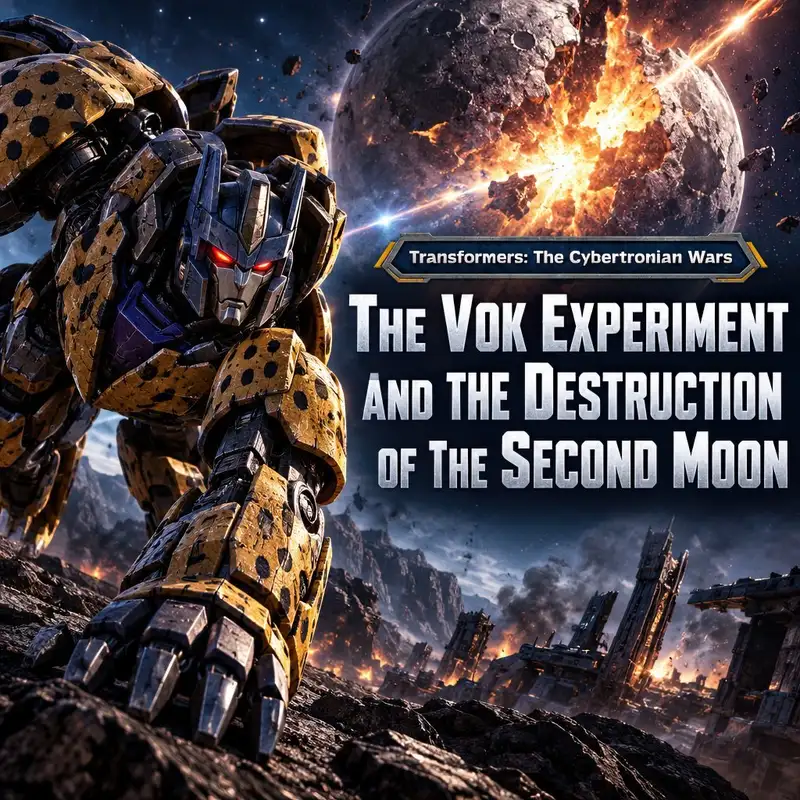
The Vok Experiment and the Destruction of the Second Moon
The smaller moon opens like a machine waking from camouflage. Its surface splits, folds, and rearranges into a weapon aimed at the planet below. What had seemed to be a strange feature of an unfamiliar sky now reveals its purpose. It is not a moon in any natural sense. It is a concealed instrument of planetary destruction.
Megatron understands the danger before anyone has time to debate it. The weapon is not targeting the Maximal base, the Predacon base, or any battlefield. Its beam is directed toward the immense raw energon deposits scattered across the planet. If those deposits ignite, the result will not be a military defeat for one side. It will be the destruction of the entire world.
A conventional commander seeks territory, resources, prisoners, submission, or the defeat of an enemy force. The intelligence behind this weapon appears to seek none of those things. The strike is designed to sterilize the environment itself. Every organic creature, every energon deposit, every Maximal and Predacon, and every piece of evidence connected to the planet’s strange history would be consumed together.
This is the first-season climax of Beast Wars, set on prehistoric Earth. At the time, the world’s later human civilizations do not yet exist, and the original Autobots and Decepticons remain dormant aboard the Ark elsewhere on the planet. The Maximals and Predacons do not know all of that at first. They know only that they have crashed on a primitive world with dangerous energon, unfamiliar ruins, and two moons.
The second moon was always a warning. The combatants simply did not know how to read it.
The crisis begins with a pursuit that was never intended to become a planetary campaign. Megatron, leader of a small Predacon force, steals the Golden Disk and escapes aboard the Darksyde. Optimus Primal and the Maximals pursue in the Axalon, an exploration vessel rather than a purpose-built warship. Both ships pass through transwarp space. Both are damaged. Both crash on the same primitive world.
The survivors arrive with limited personnel, damaged infrastructure, uncertain navigation, and no immediate means of leaving. Their civil war follows them down from space, but the local environment reshapes every decision. The planet contains abundant raw energon. That should have been a strategic advantage. Instead, exposure to it makes prolonged robot mode dangerous.
The solution is a compromise between biology, engineering, and survival. The Maximals and Predacons adopt organic beast modes, using local animal forms to shield themselves from the planet’s energon radiation. Those forms improve concealment and reduce environmental danger, but they also narrow the forces’ freedom of action. A combatant cannot remain in robot mode indefinitely. Every fight, repair effort, patrol, and reconnaissance mission now takes place under an energy constraint.
That constraint matters because it limits investigation. The stranded Cybertronians have enough trouble defending their bases, locating fuel, recovering damaged equipment, and preventing the opposing faction from gaining an advantage. They do not possess a secure scientific expedition, a fleet of survey craft, or a protected research installation. Their understanding of the planet develops through fragments.
One of those fragments is the sky. Two moons should not be there if this is Earth, yet the world contains other clues that it is more than an unknown alien planet. There are familiar prehistoric animals. There are geological features that suggest an ancient Earth environment. There are scattered signs of technology where no technological civilization should exist. The evidence is contradictory until later discoveries make the pattern clearer.
The two moons create doubt, but they do not prove that the Maximals and Predacons have landed somewhere other than Earth. They prove that something has altered, concealed, or supplemented the environment. In military terms, the combatants have entered a theater whose map is incomplete and whose most important infrastructure has been built by an unknown power.
At first, the Maximals and Predacons do not know that power’s name. They call the builders aliens because that is all the evidence supports. There are strange stone formations, unnatural energy patterns, concealed structures, and defensive systems that cannot be explained by the local organic life. The installations are advanced, but their owners remain absent.
That absence is part of the danger. An abandoned weapon can be studied. A functioning system with unseen operators is another matter. The Cybertronians can identify components, trace energy emissions, and speculate about purpose. They cannot establish who built the sites, whether the builders are nearby, what rules govern the defenses, or what threshold will cause the system to react.
Later in Beast Wars, these aliens are identified as the Vok. That name is useful to historians because it distinguishes them from every other alien force in the series. It was not available to the Maximals and Predacons during the first encounters. At the time, they faced an intelligence problem rather than a named enemy. They knew that alien technology existed. They did not know whether it was a laboratory, a surveillance network, a religious site, an abandoned military system, or something more dangerous.
That uncertainty encouraged the most familiar mistake in warfare. If an unknown installation appears vulnerable, somebody will assume it can be taken.
The first major warning comes through Tigatron. Unlike many of the other Maximals, Tigatron has developed a close attachment to the planet’s organic life. He is not indifferent to the larger war, but he sees the wilderness as more than terrain to be exploited. That perspective makes him especially alert to intrusions that do not belong in the natural environment.
He discovers a floating island carrying an alien obelisk and a powerful defensive system. The island is more than a strange landmark. It is a functioning installation, held aloft by technology the Maximals do not understand. Its defenses respond with lethal force when intruders approach. The message is clear enough even before anyone can translate it. The structure is not defenseless salvage.
Blackarachnia sees the same discovery differently. She is a Predacon, but her loyalty is never simple obedience to Megatron. She wants autonomy, leverage, and the freedom to escape the limits imposed by stronger commanders. Alien technology offers all three. If she can seize the installation’s power or understand its systems, she may gain an advantage over the Maximals, over Megatron, and over the entire Beast Wars balance.
Her calculation is not irrational. Stranded forces often seek a technological advantage when manpower and supply are limited. The problem is that Blackarachnia has no reliable intelligence about the island’s purpose. She is attempting to capture a system before she understands its owner, its safeguards, or its relationship to anything beyond the immediate site.
The island’s defenses demonstrate that the alien builders anticipated intrusion. The systems do not behave like passive ruins. They protect the obelisk with a level of force that makes ordinary Maximal-Predacon rivalry seem almost parochial. The combatants have been fighting for survival and eventual victory. The aliens appear prepared to destroy anyone who interferes.
Tigatron ultimately damages the island’s reactor, destroying the installation. Tactically, that prevents Blackarachnia from exploiting the structure and removes an immediate threat. It is a local success. The island is gone, its defenses are silenced, and no one has captured its technology.
But the destruction produces a more important result. A pulse of energy rises from the wreckage and reaches the smaller moon. The scene does not provide a technical manual. It does not establish whether the signal is a warning, an activation command, a system failure, or an automatic response to the reactor’s destruction. What it does establish is connection.
The floating island was not isolated. It was one node in a larger network.
That changes the meaning of every unexplained ruin on the planet. The aliens have not placed random artifacts across prehistoric Earth. They have built a distributed system with fixed installations, defensive measures, and at least one orbital component. The Cybertronians are no longer dealing with a collection of mysteries. They are dealing with infrastructure.
Infrastructure is often more dangerous than a visible army. A visible army can be counted, observed, supplied, and defeated. Hidden infrastructure can wait. It can observe without revealing itself. It can shape the battlefield before anyone knows a battle has begun. And when activated, it can connect events occurring hundreds or thousands of miles apart without needing to move troops through the intervening territory.
The next escalation arrives through a wormhole. An alien energy anomaly emerges and takes shape in Grid Trion, one of the planet’s strange and strategically important regions. It materializes as a vast organic-mechanical dome. The object is too large and too deliberate to be mistaken for a natural feature. It becomes a new fixed node in the theater almost instantly.
The dome does not arrive as a diplomatic mission. No alien delegation requests contact. No explanation is offered in terms the Cybertronians can understand. The structure simply appears, establishes itself, and begins acting on its own priorities.
Airazor is among the first to encounter it closely. The aliens capture and scan her. The process is invasive, but its exact purpose remains unclear. They do not interrogate her in a meaningful conversational sense. They examine her. The distinction is important. A commander questions a prisoner to learn intentions and plans. A scientist examines a specimen to classify it.
Optimus Primal is scanned as well. The resulting communication is garbled, partial, and difficult to interpret. Yet enough comes through to establish the central issue. The alien intelligence refers to a project. The Cybertronians have contaminated it. Something about their presence, or perhaps their conflict, has interfered with work that predates the arrival of the Axalon and Darksyde.
The aliens also refer to a greater danger. That phrase has invited speculation for years because the series does not explain it. It is tempting to fill the silence with other Transformers myths, ancient gods, cosmic threats, or later continuity ideas. The Beast Wars screen record does not support that certainty. The greater danger remains unresolved.
What the Maximals and Predacons know is limited but alarming. They are more than trespassers. They are variables inside an experiment. Their crash, their energon use, their combat, and perhaps their presence on prehistoric Earth have introduced contamination into a controlled environment.
The Vok possess an overwhelming intelligence advantage. They can scan the Cybertronians. They can speak in fragments that reveal their judgment without exposing their full purpose. They can activate machinery placed across the planet and in orbit. The Maximals can observe effects, but they cannot question the system on equal terms.
This is more than a gap in technical sophistication. It is a gap in access. Rhinox can analyze energy readings. Optimus can assess danger. Megatron can recognize military potential. None of them can compel the aliens to explain their project, reveal their chain of command, or state whether the experiment can be preserved without killing everyone on the planet.
The dome soon begins transmitting energy toward the smaller moon. At that point, the earlier pulse from the floating island gains new meaning. The moon is not an incidental anomaly. It is part of the same system. The dome functions as another component, perhaps an activation node, perhaps a control point, perhaps an emergency response mechanism. The exact architecture is not explained, but the operational effect is unmistakable.
The smaller moon absorbs the transmission and transforms.
Its surface opens into a mechanical structure of enormous scale. The weapon does not need to descend into the atmosphere or maneuver against either faction. It occupies a position beyond the reach of ordinary ground forces. Its altitude gives it access to the entire planet, and its design allows it to threaten the world as a system rather than as a battlefield.
Megatron sees the weapon’s purpose with chilling clarity. The beam is aimed at Earth’s raw energon deposits. Those deposits are not confined to a single mine or stored inside one military facility. They are spread across the planet. A strike against them would create a chain reaction on a planetary scale.
The weapon therefore bypasses conventional military resistance. It does not need to defeat the Maximals in combat, overrun the Predacon base, secure supply lines, or occupy strategic terrain. It turns the planet’s own energy resources into the instrument of destruction.
This is why the Vok response cannot be described as an attack on intruders alone. The Maximals and Predacons are part of the contamination problem, but the planned solution is much broader. The weapon is intended to eliminate the environment in which the contamination exists. It would destroy the wildlife Tigatron has tried to protect, the energon deposits both factions depend upon, the dormant Ark and its occupants if the blast reaches them, and the future history of Earth itself.
There is no organized human civilization to evacuate. No government can issue warnings. No industrial society can mobilize shelters or launch a counterstrike. The threatened population is prehistoric life in all its variety, along with the Cybertronian castaways who have made the planet a war zone. The absence of cities does not reduce the moral scale of the act. It makes the Vok’s calculation more severe.
They appear willing to erase an entire biosphere because the experiment has been compromised.
That is the line between containment and termination. Containment would isolate the intruders, remove them, disable their ships, or repair damaged installations. Termination destroys the laboratory, the specimens, and the contaminating agents together. The Vok may have regarded the planet as a controlled environment, but the beings living on it were not treated as participants in a negotiation.
The Vok’s technology is extraordinary, yet it does not solve the Maximals’ immediate problem. The moon weapon is not something they can simply hack, commandeer, or reproduce. No evidence suggests that either faction understands its construction. No evidence suggests that a Vok fleet is waiting nearby, or that the weapon can be manufactured in a Cybertronian factory. It is a unique alien asset, and it must be defeated with the limited means available.
The impending strike creates a temporary alignment of interests between Maximals and Predacons. Neither faction can win the Beast Wars on a dead planet. Megatron may admire the ruthlessness of the weapon, but admiration is not control. He recognizes its efficiency because it resembles the kind of overwhelming force any warlord might wish to possess. He does not possess it.
Optimus Primal faces a command problem more difficult than a straightforward alliance. The Maximals must stop the weapon, but the Predacons remain enemies. They may cooperate where survival requires it, withhold information where advantage allows it, and betray one another the moment the immediate danger passes. There is no unified command, no shared chain of responsibility, and no enforceable agreement beyond the fact that everyone will die if the moon fires.
Primal’s leadership depends on persuasion, technical judgment, and a willingness to assume responsibility for the mission. He listens to Rhinox’s analysis, relies on Rattrap’s improvisation, and accepts assistance from individuals whose motives he cannot fully trust. His authority is not absolute. It must be exercised through a small force under extreme pressure.
Megatron’s command structure works differently. His authority depends heavily on personal dominance, intimidation, and the ability to exploit subordinate ambition. He does not need his followers to share his long-term vision. He needs them to fear the consequences of defiance, compete for his favor, and remain useful.
That system is effective in a short, violent crisis. It is less effective when faced with an external threat that cannot be bullied into submission. Megatron cannot order the moon weapon to stand down. He cannot threaten the Vok into negotiation. He cannot direct a conventional assault against a target far beyond his available reach.
His response is defensive and self-interested. He seals the Predacon base, seeking protection from the anticipated planetary catastrophe. He relies, indirectly, on the possibility that Tarantulas’s private escape project may provide a way out. This is not a plan to save the planet. It is a plan to preserve options.
The distinction matters because Megatron’s later betrayal of Primal is sometimes remembered only as personal malice. It is more than that. It is a command decision made by a leader who understands that the external threat cannot be controlled, but who still wants to emerge from the crisis with fewer enemies and greater freedom of action.
The only plausible vehicle capable of reaching the moon comes from a project that was never intended for collective defense. Tarantulas and Blackarachnia have been modifying a Maximal stasis pod into a small escape craft with transwarp capability. Their work is secret because its purpose is secret. They are preparing an exit from the war and, if necessary, from Megatron.
Tarantulas is a skilled scientist and manipulator, but his project should not be mistaken for a Predacon strategic program. It is not a fleet initiative. It is not evidence that the Predacons can routinely travel through transwarp space. It is one improvised craft, built from a captured or modified stasis pod and dependent on a scarce transwarp cell.
That scarcity defines the mission. The transwarp cell is not ordinary fuel. It is not a standard missile component. It is a specialized piece of technology capable of making the escape craft’s impossible journey feasible. Once it is repurposed as an explosive charge, it cannot also serve as a means of escape.
Blackarachnia’s role is equally revealing. She cooperates with Tarantulas because the project offers autonomy, but she does more than become his loyal partner. Their alliance is transactional. Each seeks leverage over the other. Each expects betrayal. In a less immediate crisis, that distrust might have destroyed the project before it was completed.
Inferno interrupts the work, representing another form of Predacon loyalty. His devotion to Megatron is intense, direct, and destructive to any plan that does not serve the leader’s authority. Yet Blackarachnia later uses Tarantulas’s cyberlink data to complete the escape craft. The project survives because its knowledge can be extracted and repurposed, not because the Predacons suddenly cooperate as a disciplined technical corps.
The stasis pod becomes the only available path to the moon because the crisis has closed off every conventional option. Neither faction has a functioning ship capable of making the journey. No ground weapon can reach the target. No alien control panel is available for sabotage. The Maximals have one improvised platform, one dangerous power source, and very little time.
Meanwhile, Megatron gains his own intelligence advantage. He has watched the schemes of Tarantulas and Blackarachnia. He understands enough about the escape craft to see its value, and more importantly, to see how it can be turned against Primal. Megatron does not need to build the device himself. He needs to exploit the ambitions of those who did.
As the moon weapon charges, conditions at the Maximal base become increasingly desperate. The energy effects of the approaching strike create extreme heat and mounting danger. This is more than an abstract countdown in orbit. The planet is already reacting to the weapon’s activation. The Maximals must decide quickly, with incomplete information and no guarantee that the improvised craft will survive the journey.
Primal takes command of the escape pod. Blackarachnia is ordered to alter its command codes, turning a private Predacon survival vehicle into a Maximal strike platform. Rattrap rigs the transwarp cell as an explosive charge. The plan is brutally simple because complexity is no longer available. The craft must reach the moon, penetrate the weapon, and detonate from within.
Airazor volunteers for the mission. Her willingness reflects the shared understanding that someone may not return. Primal refuses to send her. Instead, he takes the mission himself.
The decision is not a casual display of heroism. It is a command sacrifice shaped by the limits of the situation. Primal cannot offer a safer alternative because none exists. He cannot guarantee extraction. He cannot delegate the mission without asking another member of his small force to accept the same likely fate.
A leader’s presence can also settle uncertainty. The plan depends on a mix of Maximal expertise and Predacon technology. It requires Blackarachnia’s cooperation, Rattrap’s engineering, and the willingness of every remaining Maximal to continue defending the base. By taking the mission himself, Primal makes the responsibility unmistakable. He is not ordering a subordinate into a sacrifice he will not share.
The choice also protects more than the Maximals. If the moon fires, Predacons die as well. So do the planet’s organic inhabitants. The mission is an act of defense, but not a narrow act of factional defense. Primal is trying to save a world whose future he does not fully understand and whose inhabitants cannot ask him for help.
That does not make the operation easy or clean. The escape pod is still a fragile, improvised craft. The transwarp cell is still a scarce and unstable resource. The target is still an alien machine whose interior layout, defenses, and vulnerabilities are largely unknown. The Maximals are not executing a rehearsed special operation. They are sending one commander into a weapon system because the alternative is planetary destruction.
Primal launches toward the artificial moon.
Only after he is committed does Megatron reveal the final element of his plan. He has activated a permanent locking mechanism inside the pod. Primal can enter the alien weapon, but he cannot escape it. The defensive mission has become, as far as Megatron intends, a killing operation.
Megatron has not created the Vok threat. He has not built the moon weapon, issued its termination order, or caused the planet-wide energon chain reaction. Responsibility for the extinction plan belongs to the alien intelligence that activated it. But Megatron sees an opportunity inside the crisis and uses it.
His betrayal follows the logic of his command style. A threat to the whole planet does not erase his rivalry with Primal. If Primal dies destroying the weapon, Megatron may survive the Vok strike while removing the Maximal leader. He can preserve his own position without openly refusing to participate in the planet’s defense.
It is an effective act of treachery at the personal level. It is not strategic mastery at the planetary level. Megatron still depends on Primal’s success. If the pod fails to destroy the weapon, Megatron’s lock changes nothing. He will die with everyone else. He is gambling that his enemy can save him and then be denied the reward of survival.
Primal reaches the interior of the alien weapon. The stasis pod penetrates the structure, carrying the transwarp cell deep enough for the blast to matter. The detonation destroys the artificial moon and prevents the planetary strike. The weapon that had threatened to ignite Earth’s energon reserves is gone.
The immediate mission succeeds. The Vok’s orbital asset is neutralized. Earth survives. The Maximals survive. The Predacons survive. Prehistoric life survives. In the narrowest tactical sense, the operation accomplishes exactly what it had to accomplish.
But the cost appears total. Primal’s body is destroyed with the moon weapon. For the Maximals watching from the planet below, there is no immediate proof of rescue, recovery, or survival. The cliffhanger is real within the experience of the characters. They have watched their commander carry out a mission that seemed designed to kill him.
Later events establish that Primal returns. Historical hindsight allows us to say that his apparent destruction was not permanent. It does not erase the crisis as it was understood at the time. The Maximals had every reason to believe they had lost their leader, and Megatron had every reason to believe his trap had succeeded.
The destruction of the moon also does not destroy the Vok system as a whole. The floating island is gone. The dome has acted. The moon weapon has been eliminated. Yet the builders, their wider infrastructure, their project, and their concern about the greater danger all remain unresolved. Primal has defeated an asset, not identified the command authority behind it.
The blast produces one more consequence. A transwarp, or quantum, wave spreads from the explosion and reaches the surviving Cybertronians. In the aftermath, several Maximals and Predacons are transformed into Transmetals. Their bodies change. Their alternate modes change. Their combat capabilities and physical identities are altered by an event none of them had planned or fully understood.
The series shows the effect clearly, but it does not provide a complete technical account of why the wave affects some individuals and not others. It does not establish a universal scientific formula for Transmetal transformation. The process should not be treated as an ordinary upgrade, a routine battlefield refit, or a known Vok procedure.
What matters is the operational result. The survivors emerge from the crisis with changed bodies and new capabilities. That alters the balance of the Beast Wars. Mobility, durability, weapons, and tactical options are no longer exactly what they were before the moon’s destruction. The conflict has acquired a new technological dimension.
At the same time, the emotional and political consequences remain immediate. The Maximals must cope with the apparent loss of Primal. The Predacons must reassess a battlefield in which Megatron has survived but has not achieved the decisive victory he wanted. Blackarachnia has demonstrated that she can act independently. Tarantulas has lost control of a project meant to secure his escape. Every faction has learned that hidden alien systems can reshape the war without warning.
The destruction of the second moon therefore transforms the Beast Wars because it changes the conditions under which the war is fought. It does not settle the original conflict between Maximals and Predacons. It does not reconcile their political goals. It does not remove Megatron’s ambition, Primal’s responsibility, Blackarachnia’s desire for autonomy, or Tarantulas’s private schemes.
It also does not explain what the Vok were doing on prehistoric Earth. Later contact confirms that the aliens continue to monitor events and that the name Vok belongs to the intelligence behind these interventions. Even then, the original experiment remains only partly visible. The surviving record establishes a project, contamination, extraordinary machinery, and a willingness to destroy the test environment. It does not establish the project’s full purpose.
The Vok experiment became an extinction operation because the Cybertronians were treated as contamination rather than as persons capable of negotiation. The Vok’s response was not to remove the intruders or contain the damage. It was to erase the entire environment in which the interference had occurred.
Primal’s strike prevented that destruction, but it did not defeat the Vok or end the Beast Wars. It destroyed one weapon, preserved Earth’s future history, and created a transwarp event that changed the surviving combatants. The Maximals and Predacons emerged from the crisis alive, altered, and still at war.
The second moon’s destruction proved that survival on prehistoric Earth depended on more than defeating the opposing faction. Both factions had become expendable variables in someone else’s experiment.