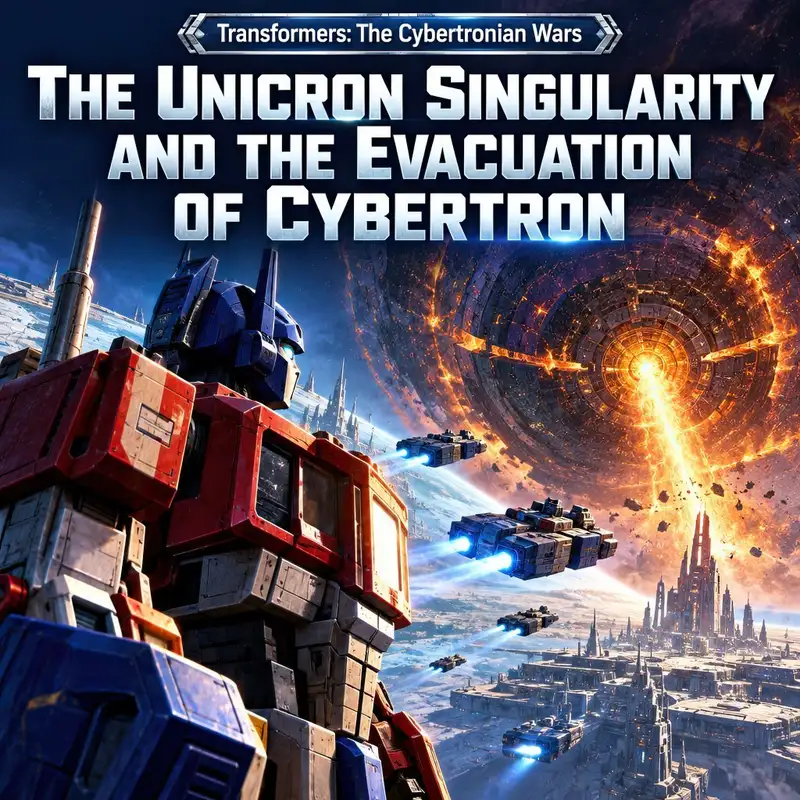
The Unicron Singularity and the Evacuation of Cybertron
Cybertron was being emptied because there was no defensible line left to hold. A vast distortion in space, called the Unicron Singularity, had appeared near the planet and threatened to consume it. The emergency was visible, immediate, and larger than any army. Optimus Prime could deploy Autobots against Decepticons. He could defend an installation, escort a convoy, or contest a bridge. He could not order a counterattack against a rupture that was pulling the home world itself toward destruction.
In the English-language Transformers: Cybertron series, that distinction governs the entire crisis. This is not the evacuation shown in the War for Cybertron games, in Transformers Prime, in the live-action films, or in the later film Transformers One. It is the Cybertron account from nineteen eighty-five and two thousand six, built around a particular cosmic threat and a particular solution. The Singularity does not arrive as an enemy fleet with a command ship to destroy. It turns Cybertron’s survival into a problem of mobility, intelligence, and political cooperation.
The opening decision is therefore not a glorious last stand. It is an organized withdrawal from a planet that can no longer serve as a secure capital, factory base, archive, or refuge. Cybertronian forces and civilians must leave before the world becomes uninhabitable. The immediate objective is not victory. It is preservation. Preserve personnel. Preserve knowledge. Preserve enough institutional continuity that there will still be a civilization to return to if the planet can be saved.
That changes the meaning of the war. A conventional conflict is often organized around control of territory. One side seizes cities, ports, factories, roads, or energy reserves. The other side attempts to deny those gains. But when the territory at the center of the conflict may itself disappear, possession loses much of its meaning. Neither the Autobots nor the Decepticons can build a durable order on a world sliding toward annihilation.
The first operational necessity is departure. Once Cybertron is no longer a secure base, every later decision becomes an expedition from exile. The Autobots are more than defending their world from outside attack. They are trying to keep a dispersed society alive long enough to restore the world that society has lost.
The series connects the Singularity to the destruction of Unicron in the preceding English continuity. Unicron’s defeat did not end cleanly. Instead, Cybertron presents his destruction as having produced a dangerous disturbance in space and time. The anomaly is commonly described as a black hole, and it is portrayed with the visual force of one, but the story does not offer a rigorous astrophysical model. It is better understood as a continuity-specific cosmic rupture than as an ordinary astronomical object governed by a textbook.
Later, Primus offers a broader explanation. Through Jolt, he describes a cosmic balance disturbed by Unicron’s destruction. In that account, the Singularity is more than a random disaster. It reflects the destabilization created by the loss of an opposing force. But Primus is not a neutral civilian scientist filing a technical assessment. He is a unique being whose nature is bound to Cybertron itself, and his explanation belongs partly to the series’ spiritual and mythic language.
The practical result remains clearer than the metaphysics. The Singularity threatens Cybertron, and conventional weapons do not solve the problem. No one identifies a missile, a fleet formation, or an industrial project that can simply destroy it. The available path to survival lies elsewhere, in ancient systems that must be recovered, understood, and assembled under pressure.
This leaves Optimus Prime in an awkward but necessary position. Military leaders are often judged by their ability to hold ground. Here, holding ground would have been a gesture rather than a strategy. The responsible decision is to accept temporary abandonment of the central world. That is not the same as surrender. It is a strategic withdrawal designed to preserve the people, capabilities, and political future of a civilization facing a threat it cannot defeat in place.
What the premise clearly implies is disruption on a vast scale. A civilization organized around Cybertron’s cities, energy systems, repair facilities, archives, and transport networks is forced to scatter. Personnel lose access to familiar workshops and command centers. Units are separated from their normal chains of support. Civilians become dependent on destinations that may not have been prepared to receive them. The ordinary routines that keep a technological society functioning are suddenly uncertain.
Transformation helps individual Cybertronians move through a local environment. It does not eliminate the need for strategic transport. A vehicle mode can carry a soldier across roads or conceal that soldier inside a foreign society. It cannot by itself evacuate a planet across interstellar or dimensional distances. That still requires portals, spacecraft, reliable coordinates, fuel, maintenance, secure arrival points, and some assurance that the destination will not become another trap.
The evacuation also raises questions that the main narrative only partly follows. A home world is more than a military headquarters. It contains labor, memory, institutions, customs, neighborhoods, places of worship, repair centers, and historical records. Leaving it behind means more than moving equipment. It means living with the possibility that the central reference point of an entire civilization may be lost.
The people who leave Cybertron are more than reinforcements for Optimus Prime’s army. They are displaced inhabitants of a threatened world. The series follows its principal heroes closely, as adventure fiction tends to do, but the strategic reality is larger. A society in exile must decide who speaks for it, who receives protection, how resources are distributed, and whether old factional divisions remain meaningful when the planet both factions claimed to want is in danger.
The immediate refuge becomes Earth. Vector Prime, an ancient Cybertronian associated with time and dimensional travel, arrives with information and a means of movement. Landmine is sent through a dimensional portal to Earth, where the Autobots establish a concealed operating base. Earth is not a replacement for Cybertron. It is a forward base, a refuge, and eventually a central node in the effort to save the threatened planet.
This arrangement offers obvious advantages. Earth is outside the immediate reach of the Singularity. Its roads, cities, and machinery provide useful cover for Cybertronians able to adopt local vehicle forms. Its population does not begin with a fully developed understanding of Cybertronian politics, which gives the Autobots room to operate discreetly. The planet also contains people willing to assist them, including Coby, Bud, and Lori.
Those human allies matter because they provide local knowledge rather than because they represent all of humanity. They understand the terrain, social habits, and practical dangers of operating in a human environment. They can help the Autobots navigate a world where a vehicle is expected to have a driver, where unusual military activity attracts attention, and where an unexplained alien machine may be treated as a security threat before it is treated as a refugee.
The Autobots also enter a politically complicated space. They are guests, however informally, on an inhabited world. Their need for refuge does not erase human sovereignty. Their presence brings alien weapons, rival factions, ancient artifacts, and an interplanetary war into the orbit of human institutions. Colonel Franklin and other authorities become relevant because a military organization has responsibilities that are not identical to those of a few helpful civilians.
For the Autobots, Earth is useful precisely because it is not Cybertron. It offers distance from the catastrophe and a place to organize. But that same distance creates dependence. The Autobots must protect a world that did not choose to become central to their survival plan. They must also avoid treating human cooperation as a blank check for unrestricted Cybertronian operations.
The refuge solves one problem and reveals another. Evacuation keeps Cybertronians alive, but it does not stop the Singularity. Survival requires a means of restoring Cybertron before the crisis spreads beyond control. That is where Vector Prime’s knowledge becomes decisive.
Vector Prime does not arrive with a conventional battle plan. He brings a diagnosis. The solution lies in four ancient Cyber Planet Keys and the Omega Lock. Together, these artifacts can restore Primus, whose dormant planetary form is Cybertron. The keys are not ordinary weapons. They are components of an ancient restoration system tied to the planet’s deepest identity and function.
That changes the character of Autobot operations. The task is not to locate one enemy headquarters and seize it. It is to recover several irreplaceable objects scattered across distant worlds, protect them from Decepticon interference, and bring them into a system whose full capabilities are only partly understood. Each key is important on its own, but none is sufficient on its own.
The search is enabled by older Cybertronian infrastructure. Long before the emergency, Cybertron had established links with distant colony worlds through a space-bridge project. Those old connections, weakened by time and disrupted by the current crisis, become the routes through which salvation might be found. The past is no longer background lore. It becomes operational geography.
This is one of the central lessons of the campaign. Civilizations often discover the importance of old infrastructure only when their newer systems fail. A neglected bridge network, an archive of distant colonies, or a forgotten route may become more valuable than a fresh weapons platform. The Autobots need information as much as they need firepower. They need coordinates, local knowledge, and access to communities that developed outside their direct command.
Vector Prime’s knowledge is indispensable, but it is not complete. The fourth destination, Gigantion, is initially lost amid the same spatial disruption threatening Cybertron. This makes the campaign an intelligence problem as well as a mobility problem. The Autobots know that a solution exists, but they do not possess all the information required to execute it immediately.
The Decepticons recognize the same fact. Megatron does not need to destroy Cybertron in order to benefit from the crisis. He can compete for control of the keys, the Omega Lock, and the means of restoring Primus. In a struggle where survival depends on a small number of unique assets, possession becomes political power.
The first major test of this approach comes on Velocitron, the Speed Planet. It would be easy to describe Velocitron as merely the location of the first key. That misses the strategic point. The key is embedded within a society with its own standards, leadership, and traditions. The Autobots arrive with an urgent need, but urgency does not automatically grant authority.
Override, Velocitron’s leader, represents local power that cannot simply be folded into Optimus Prime’s command structure. The Speed Planet places unusual importance on velocity, competition, and performance. Those values shape who is respected, who can claim legitimacy, and how outsiders are judged. For an expeditionary force, that means access must be earned through the rules of the host society.
The Autobots cannot simply announce that Cybertron is in danger and requisition the key as emergency property. Such a demand might be understandable from their own perspective, but it would disregard the fact that Velocitron is not an Autobot base. Its people have their own political identity and their own reasons to distrust outsiders who arrive with a crisis and expect obedience.
The local culture also gives alternate modes a practical meaning. Speed is not decorative. On Velocitron, mobility contributes to credibility. A Cybertronian’s ability to compete, adapt, and operate within the planet’s expectations affects access to influence. The Autobots must use their capabilities in a way that local institutions recognize rather than simply applying military force.
This does not make the process painless. Competition can become a contest for high stakes when the object at issue is part of a planetary survival system. Decepticons can exploit that pressure. They benefit whenever the Autobots appear arrogant, impatient, or unable to respect local sovereignty. Coercion may promise a quicker route to an artifact, but it also risks creating resistance, resentment, and unstable custody.
Velocitron demonstrates that coalition warfare is not just a matter of adding units to a roster. A coalition exists when independent actors decide that cooperation serves their interests, values, or survival. Override’s eventual cooperation matters because it converts a key from a contested local object into part of a broader restoration effort. The Autobots gain more than hardware. They gain a relationship.
Yet success creates a new burden. Once a key is acquired, it must be protected. Every recovered component becomes a target for theft, sabotage, deception, and ambush. The campaign grows stronger with each success, but it also accumulates more responsibilities. Custody is not a ceremonial matter. It is a continuing operational task.
The Jungle Planet presents a different problem. Here, the key is tied to another society and another form of local authority. Scourge rules the planet, and his position cannot be reduced to that of a Decepticon field officer waiting for Megatron’s instructions. He is a local ruler with his own status, followers, and interests.
That distinction complicates the Autobot mission. The Jungle Planet is not an empty archaeological site. It is a political environment where the key is connected to sovereignty and power. The Autobots need cooperation from someone who has reason to regard an outside claim on the artifact as an intrusion. Scourge may recognize the larger danger, but recognition does not automatically produce trust.
The Decepticons are well suited to exploit this kind of division. Their strategy does not depend on defeating every local force in open battle. They can encourage suspicion, bargain with ambitious leaders, and present themselves as the faction more willing to validate local authority in exchange for access. An emergency creates opportunities for those prepared to promise power before they promise stability.
The Jungle Planet therefore shows why artifact recovery is neither a purely military mission nor a purely diplomatic one. Negotiation occurs under the shadow of coercion. Local rulers must decide whether to cooperate, resist, or attempt to use the crisis for their own advantage. The Autobots must decide how far they are willing to go in pursuit of a key without turning potential allies into subjects.
The strategic objective remains clear. The second key must join the first if the restoration system is to become usable. But the route to that objective cannot ignore the people who live around it. A faction that treats every colony as a warehouse of useful relics may win individual expeditions and still lose the political support required for a wider settlement.
The campaign then returns its attention to Earth, where the stakes become more concentrated. Earth contains not only one of the Cyber Planet Keys, but also the Omega Lock. The refuge world is now a strategic center. It is a base for displaced Autobots, an inhabited human planet, a site of ancient Cybertronian infrastructure, and a likely target for every force seeking control of the restoration process.
Evac’s role as guardian matters because it establishes that Earth’s artifacts are more than abandoned equipment. They have their own custodial history. The key and the Omega Lock were preserved across time, and their recovery involves more than locating a hidden device. The Autobots must understand enough of that history to use the objects without assuming that possession alone grants wisdom.
The Omega Lock is particularly important because it is not another weapon to add to a battlefield inventory. It is the mechanism through which the keys can contribute to restoring Primus. Losing it would not merely weaken the Autobots. It would break the only identified route to saving Cybertron. In strategic terms, it is a critical dependency.
That makes Earth difficult to defend. The Autobots cannot simply hide the Omega Lock and hope the crisis passes. The artifact’s existence draws attention. Defending it requires activity, and activity increases the risk of exposure. Decepticon raids threaten both the object itself and the secrecy that has allowed the Autobots to operate on Earth.
Human involvement becomes more complicated as a result. Local authorities are not irrational to be concerned when alien factions battle over artifacts on their planet. From a human security perspective, the Autobots may be allies, but they are also armed extraterrestrials operating around technologies no Earth government fully understands. The need for cooperation is real, and so is the possibility of mistrust.
Earth’s importance also changes the moral character of Autobot strategy. It is no longer enough to think in terms of recovering an object from an uninhabited ruin. The key and Omega Lock are located on a world whose people did not create the Singularity and cannot simply be ordered to accept its consequences. Any defense of the artifacts must account for the risks imposed on civilians.
Even so, holding Earth does not solve the greater problem. A base can be defended temporarily. An artifact can be secured temporarily. Neither outcome seals the Singularity. The Autobots now possess vital parts of the solution, but they still lack the full network required to restore Primus. The final key and the means of reaching it remain uncertain.
Megatron’s response is shaped by the same strategic reality. He and the Decepticons cannot simply ignore the threat to Cybertron. Their ambitions require a world, a population, and a source of power to govern. If the Singularity consumes Cybertron and destabilizes the surrounding universe, there will be little left to conquer.
But shared dependence does not produce shared purpose. Megatron seeks control of the keys and the Omega Lock because the faction that controls the restoration process can claim authority over whatever follows. In a crisis of this magnitude, salvation itself becomes a source of legitimacy. Whoever saves Cybertron can present themselves not merely as a military victor, but as the indispensable leader of a reborn order.
This is a more sophisticated objective than simple destruction, though it remains dangerous. The Decepticons are not trying to preserve Cybertronian life on equal terms. Their strategy is oriented toward dominance through possession. They want the mechanism of survival in their hands, where it can be used to establish political supremacy.
The Decepticons possess several advantages. They are aggressive, mobile, and willing to seize initiative. They can follow the Autobots’ search, exploit every delay, and turn an artifact hunt into a series of contests where speed and force may matter more than broad consent. An emergency rewards actors prepared to move quickly and accept risk.
Their weakness lies in command cohesion. Megatron’s authority is challenged by rival ambitions, particularly when Starscream and other leaders see the crisis as an opportunity to advance themselves. Internal rivalry does not make the Decepticons harmless. It does, however, complicate their ability to sustain a coherent long-term policy. A command structure built around fear and personal ambition can strike hard while still struggling to coordinate a durable political program.
This becomes even clearer after Megatron’s transformation into Galvatron. The change intensifies the connection between personal power and the larger cosmic crisis. Galvatron’s ambitions become more directly tied to controlling the restored order and exploiting the power released by the effort to save Cybertron. The emergency is no longer only a threat to be managed. It becomes an opportunity for domination.
The Autobots face a different challenge. They must move rapidly without behaving as though the crisis has made every independent world their subordinate. They need keys from societies that have their own leaders and histories. They need Earth’s cooperation without treating Earth as an expendable staging area. They need to preserve Cybertronian command without pretending that a scattered refugee population can be managed like a single field army.
The missing fourth key makes all of these difficulties sharper. Gigantion, the Giant Planet, is initially obscured by the spatial disruption. The problem is no longer merely reaching a known destination. It is finding the destination at all. A commander cannot deploy efficiently toward a world that has vanished from the available map.
This is a reminder that information can be as decisive as force. The Autobots have accumulated keys, allies, and knowledge, but none of those assets can substitute for the missing location. The restoration system requires all of its components. A partial solution remains a failed solution when the threat is planetary extinction.
Gigantion also introduces Metroplex, whose scale and significance reflect the world’s unusual character. But giant assets do not automatically solve strategic problems. A figure of immense size may dominate a local battlefield, yet still require coordination, political consent, and access to the wider campaign. Scale can create capability, but it can also create dependence on specialized infrastructure and careful command.
The Autobots cannot simply arrive and assume that Gigantion will serve their needs. As on Velocitron and the Jungle Planet, the relationship has to be built. The crisis has gradually created a network of worlds that matter to one another. Velocitron offers speed and a recovered key. The Jungle Planet brings another local authority into the struggle. Earth serves as refuge and artifact center. Gigantion holds the final missing component and the possibility of completing the restoration plan.
The recovery of the fourth key is the decisive operational turning point. Before Gigantion is found, the Autobots have a plan but not an executable one. After the final key is secured, the restoration system can finally be assembled. The campaign shifts from searching for the means of salvation to defending and activating them.
That does not make the final stage simple. The keys and Omega Lock still need to be brought together. Their purpose must be fulfilled. Galvatron still seeks to control the outcome. And the consequence of failure remains enormous. The Singularity has not become less dangerous merely because the Autobots now understand what must be done.
The final assembly restores Primus. In this continuity, Primus is not an ordinary weapon platform, nor is he an asset that can be manufactured, deployed, or replaced through conventional industry. He is bound to Cybertron’s planetary identity. His awakening represents the activation of a unique cosmic and technological condition that the entire campaign has been organized to recover.
The restoration is therefore not a simple military victory. The Autobots do not win because they field a larger army or destroy every Decepticon force. They win access to the one process the series identifies as capable of sealing the Singularity. The decisive achievement is not the possession of a battlefield. It is the successful integration of a network of ancient systems under conditions of political and military contest.
Galvatron attempts to exploit that moment. His strategy reflects the central political truth of the crisis. If he can control Primus’s restored power and the machinery of survival, he can turn collective rescue into personal rule. The danger is not only that Cybertron might be destroyed. It is that Cybertron might survive under the authority of a faction that sees emergency power as a permanent entitlement.
His immediate bid for control is defeated. Tactically, the Autobots and their allies prevent Galvatron from taking command of the restored power. Operationally, the keys and Omega Lock are successfully brought together. Strategically, the Singularity is sealed, and Cybertron is no longer facing immediate consumption.
Those outcomes should be kept separate. Defeating Galvatron in the final confrontation does not mean every Decepticon abandons the conflict. Sealing the Singularity does not repair every damaged institution. Restoring Primus does not turn ancient infrastructure into a routine technology available to every government. The series presents a crisis resolved, not every political consequence resolved with it.
The political result is especially important. No single faction can credibly claim that it saved Cybertron alone. Optimus Prime’s emergency leadership matters. Vector Prime’s guidance matters. The Autobots’ expeditions matter. But the campaign also depends on cooperation from Velocitron, the Jungle Planet, Earth, Gigantion, and the leaders connected to those worlds.
That shared effort weakens the idea that Cybertron can return unchanged to a system organized around one isolated center of power. The evacuation forced Cybertronians to recognize that their survival depended on worlds beyond Cybertron, and on people who were neither simple subordinates nor disposable auxiliaries. The old map of core world and distant colony no longer adequately describes the political reality.
The crisis also reveals the limits of artifact dependency. The Cyber Planet Keys and Omega Lock save the day because they are unique and because the required conditions are met. But a civilization cannot safely build its future around the assumption that another ancient system will appear whenever disaster strikes. Primus’s intervention is extraordinary. It is not a substitute for institutions, logistics, diplomacy, or reconstruction.
Once the Singularity is sealed, the immediate existential danger recedes. That is not the same as returning to normal. The population that fled Cybertron has experienced displacement. Command networks have been scattered. Relations with human authorities have changed. Colony worlds that once stood at the edge of Cybertronian attention have become essential partners in survival.
The post-crisis effort to build a new space-bridge network is therefore more than a transport project. It is an attempt to create an interplanetary order out of the emergency routes that kept the civilization alive. During the evacuation, mobility was a matter of survival. Afterward, it becomes the foundation for reconnection, trade, diplomacy, and shared security.
A space bridge can shorten distance, but it does not eliminate politics. Someone must maintain it. Someone must control access. Someone must decide whether it carries refugees, commerce, military units, or all three. A network that links worlds can strengthen cooperation, but it can also create new disputes over sovereignty, security, and unequal access.
The gathering of worlds at the end of the crisis suggests the possibility of a broader settlement. Cybertron, Earth, Velocitron, the Jungle Planet, and Gigantion are no longer isolated theaters of separate adventures. They have become part of a common strategic environment. What happens on one world can affect the survival and political future of the others.
That does not mean factional hostility vanishes. It does not mean every displaced Cybertronian returns home without difficulty. It does not mean human concerns about alien technology are automatically settled. Reconstruction requires more than reopening a route or awakening a planetary guardian. It requires rebuilding trust, repairing damaged systems, and deciding what kind of political order should emerge after an emergency that proved the old one was insufficient.
The Singularity crisis matters because it forces a change in strategic thinking. Cybertron survives only when its leaders recognize that the problem cannot be solved by holding ground, defeating an enemy army, or claiming a single artifact. The planet must be temporarily abandoned. Its people and institutions must be preserved in dispersion. Ancient routes must be rediscovered. Independent worlds must be treated as partners rather than scenery.
The evacuation begins as a catastrophe, but it becomes the foundation of a new political geography. Cybertron’s future depends less on restoring its old centrality than on learning to live within a larger network of worlds that now understand how closely their survival is connected.