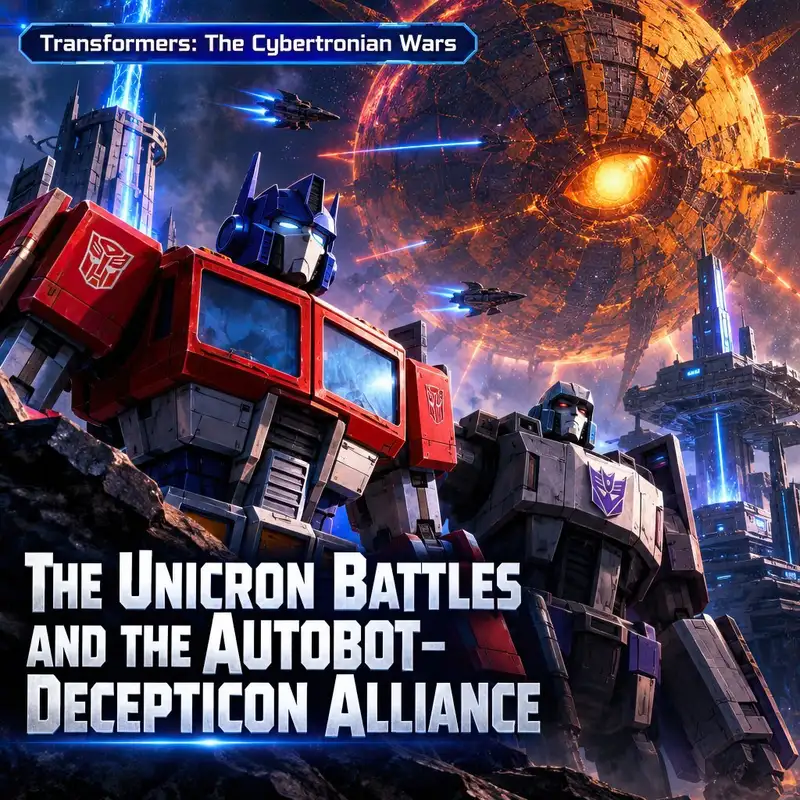
The Unicron Battles and the Autobot–Decepticon Alliance
Starscream’s final attack is not a bid for glory. By this point in the English-language Armada story, argument has failed. Galvatron, the Decepticon commander once known as Megatron, has heard warnings about a greater enemy and treated them as another maneuver in a war full of deception. He has reason, from his own perspective, to distrust Autobot intelligence. His conflict with Optimus Prime has taught him to see every crisis as an opportunity for the other side to gain advantage. So Starscream chooses evidence that cannot be dismissed. He flies directly at Unicron, attacks a foe beyond the reach of ordinary military power, and is destroyed.
The sacrifice matters because Starscream is not speaking as an Autobot convert or a neutral observer. He is a Decepticon whose relationship with Galvatron has been marked by rivalry, frustration, and rebellion. That makes his final act politically costly and therefore credible. He is not asking Galvatron to accept Optimus Prime’s judgment. He is forcing him to confront a threat that does not care who rules Cybertron. Unicron does not offer Decepticon victory, Autobot reform, or a better balance of power. He offers annihilation.
That is the immediate beginning of the Autobot-Decepticon alliance. It does not begin with trust. It does not begin with a treaty, a shared political program, or a sudden discovery that the two armies were never enemies. It begins with the collapse of a dangerous assumption. For most of the war, each side has believed that the other faction is the central strategic problem. Starscream’s death proves that both sides have been operating inside a larger crisis.
The final battles of Armada are often remembered as a struggle against an enormous enemy, and they are that. But their deeper subject is the civil war that prepared the way for Unicron’s return. The Autobots and Decepticons do more than encounter an outside invader. They discover that their competition, fear, and pursuit of military advantage have become part of the enemy’s design. The alliance becomes necessary because neither army can preserve Cybertron alone. It becomes effective only when some of its members recognize that firepower cannot solve a war sustained by hatred.
In Armada, the conflict between Autobots and Decepticons revolves around the Mini-Cons. These smaller Cybertronians are more than equipment. They are sentient beings with their own relationships, fears, loyalties, and capacity for choice. Yet both major armies understand that partnership with a Mini-Con can improve a larger Transformer’s combat ability. That fact turns the Mini-Cons into the most contested strategic resource of the war.
For the Autobots, protecting the Mini-Cons is tied to a broader claim about freedom and self-determination. For the Decepticons, control of Mini-Con power promises military superiority over an enemy that has repeatedly frustrated their ambitions. Those positions are not symmetrical in moral purpose, but they converge in one damaging habit. Both sides often discuss Mini-Cons in the language of military value. They become allies, friends, and persons, but also assets to be found, defended, captured, denied, or linked to weapons.
That pressure shapes the entire war on Earth. The factions are not fighting merely for territory. They are fighting over access to a form of partnership that can alter the balance between individual combatants and larger forces. The Mini-Cons make small encounters strategically significant. A discovery can become a crisis. A capture can become a campaign objective. A personal bond can become a military vulnerability. The war’s political and emotional stakes become tightly bound to technological advantage.
Three Mini-Con-linked weapons become especially important. The Star Saber, the Skyboom Shield, and the Requiem Blaster are exceptional systems formed through the cooperation of Mini-Con teams. One is associated with attack, one with defense, and one with immense destructive potential. Armada does not present these as ordinary weapons that either faction can manufacture in bulk. They are rare, contested, and bound to the Mini-Cons themselves. Their value lies not only in what they can do on a battlefield, but in what control of them appears to promise.
That promise is precisely what makes them vulnerable to manipulation. A weapon that is unique, powerful, and poorly understood can draw commanders into decisions based on fear of what the enemy might gain. The Decepticons seek the advantage such weapons could provide. The Autobots seek to prevent that advantage from falling into Decepticon hands. In the process, both factions become easier to steer. An adversary does not need to command every soldier’s mind if he can shape the incentives under which they act.
The Mini-Con weapons are incorporated into the Decepticons’ Hydra Cannon, an extraordinary system rather than a normal example of Decepticon industry. The Hydra Cannon matters because it turns the competition over Mini-Con power into part of a larger activation sequence. What appears to be a decisive military gain is instead a step toward catastrophe. The Decepticons believe they are acquiring a weapon. In reality, they are helping assemble the conditions under which Unicron can awaken.
This is one of Armada’s most important strategic reversals. The struggle over Mini-Cons seems, at first, to be about which army will gain an edge in the civil war. By the end, it becomes clear that the war’s most valuable assets were connected to a threat neither side understood. The factions had been fighting over power without understanding the system that made that power available. In military history, that is a familiar danger. An army may seize a weapon, a route, a fortress, or a resource and still fail to understand what larger political or technological structure it serves.
Before the final campaign, Megatron adopts the name Galvatron. In this continuity, the change marks a shift in identity and status within the Decepticon cause. It should not be confused with the history of another Megatron in another Transformers story. Armada’s Galvatron remains the same Decepticon commander whose ambition, force of personality, and determination to defeat Optimus have shaped the war. The new name does not dissolve the old rivalry. If anything, it sharpens his desire to prove that the Decepticons can prevail.
Galvatron’s strategic goal remains supremacy. He wants the Decepticons to win the war, not merely survive it. Optimus Prime’s objective is different. He seeks to protect his forces, defend the Mini-Cons’ right to choose their own future, and prevent Cybertron from falling under Decepticon domination. The two commanders are capable military leaders, but their assumptions have become dangerously narrow. Each is still preparing to solve the problem of the other.
When the Autobots return to Cybertron, they enter a theater where the civil war has resumed at full intensity. Galvatron’s forces are already engaged. The conflict is not a clean contest for a single capital, a single command post, or a single decisive weapon. It is a renewed struggle over the future of the planet and the authority to define that future. But the battle has become strategically obsolete before either leader fully recognizes it.
The Mini-Cons warn of a greater danger. Galvatron initially rejects the warning. That decision is not simple stupidity. It emerges from the conditions of the war. He has spent too long measuring threats through the lens of factional advantage. If the Autobots say there is a new enemy, he suspects manipulation. If the Mini-Cons warn him of danger, he sees a possible effort to deny him power. His intelligence problem is more than lack of information. It is an inability to trust information that arrives through enemy channels.
Optimus faces a related problem from the other side. He can recognize the threat, but he cannot compel Galvatron to accept it. The Autobot commander lacks authority over the Decepticons. He can offer evidence, issue warnings, and alter his own operations, but he cannot simply order a rival army into a new mission. The survival of Cybertron therefore depends on changing Galvatron’s judgment, not defeating him in a conventional battle.
At this point, Sideways and Thrust become central. Sideways is not a conventional Decepticon officer pursuing Decepticon victory. He operates inside the war as a deceptive influence, presenting affiliations and loyalties that serve a deeper purpose. His value to Unicron lies in his ability to encourage division, exploit suspicion, and guide powerful actors toward decisions that appear advantageous in the short term. He is more than a spy collecting intelligence. He is an agent shaping the strategic environment.
Thrust plays a different role. He is a Decepticon strategist whose betrayal helps move the Mini-Con weapons toward Unicron’s control. His actions provide an operational mechanism for the awakening sequence. He is important because wars are rarely manipulated by abstract evil alone. Large schemes still require access, movement, timing, and people willing to act on incomplete understanding. Thrust helps make the crisis possible, even if the full meaning of Unicron’s design is not necessarily clear to him at every stage.
The intelligence failure is therefore broad. The Autobots and Decepticons do not understand who truly controls the flow of information. They do not fully understand what the Mini-Con weapons activate. They do not understand the significance of Cybertron’s moon. They do not possess a reliable picture of the system they are operating within. Each side knows enough to fear the other. Neither knows enough to see the larger enemy.
This matters because military organizations often fail not because they possess no intelligence, but because they have intelligence that does not fit their existing assumptions. Galvatron’s command can explain Autobot interference. Optimus can explain Decepticon aggression. Neither explanation is sufficient once Sideways’s deception and Unicron’s preparations come into view. The old framework has become a trap. Every warning sounds like factional propaganda because the war has taught both sides to interpret the world that way.
The revelation comes when Cybertron’s moon is exposed as Unicron. What had appeared to be part of the planetary environment is revealed as a dormant or disguised entity. The Mini-Con weapons, and the chain of events surrounding them, help bring about his transformation. Unicron does not emerge as another army entering the theater. He transforms the theater itself. The object hanging over Cybertron becomes a planet-sized combatant with an agenda outside the civil war.
The operational implications are immediate. Neither Autobots nor Decepticons can treat Unicron as a rival fortress that can be surrounded, starved, or bombarded into submission by familiar means. He is not an occupied city. He is not a conventional fleet. He is not a weapons platform whose capabilities can be estimated from a distance and countered through ordinary force ratios. The crisis overwhelms the scale of the previous conflict.
Cybertron itself is now at risk. The series makes planetary survival the central civilian stake, even though it does not provide a detailed account of evacuation routes, rationing systems, industrial damage, or the experience of ordinary Cybertronian residents. Those omissions matter. They prevent us from pretending that the finale offers a complete social history of the emergency. But the political fact is clear enough. The armies are no longer contesting who will govern Cybertron. They are confronting the possibility that there may be no Cybertron left to govern.
This is the strategic rupture created by Unicron. Territorial victory loses meaning when survival is uncertain. A Decepticon conquest of a destroyed world would be no victory. An Autobot defense that preserved only a scattered remnant would not satisfy the objectives for which Optimus had fought. The political question changes from who should rule to whether anyone will endure.
Starscream’s death forces Galvatron to accept that change. It is not that Galvatron suddenly embraces Autobot principles, accepts Optimus as legitimate, or becomes free of ambition. Rather, he recognizes that the evidence can no longer be fitted into the old story. A rival and former subordinate has died trying to stop Unicron. The threat is real. It is stronger than either army. And it is indifferent to the outcome of the Decepticons’ war against the Autobots.
The alliance that follows is therefore a common-front arrangement. Optimus and Galvatron agree to direct their forces against Unicron. But this is not an integrated military with a shared staff, unified doctrine, permanent rules of command, or carefully negotiated political settlement. The two leaders retain their own authority. Their armies retain their own identities. Their soldiers carry memories of recent battles, losses, and betrayals. The truce creates cooperation under pressure, not reconciliation.
For Optimus, this requires restraint as well as leadership. He cannot treat Decepticons operating against Unicron as acceptable targets simply because they were enemies yesterday. That would destroy the coalition before it could function. He must recognize the difference between the Decepticon cause as a long-term political adversary and individual Decepticon forces now fighting beside Autobots against extinction. This is not sentimental forgiveness. It is operational discipline.
Galvatron must make an equally difficult adjustment. His authority rests heavily on Decepticon confidence that he will lead them to victory over the Autobots. Joining Optimus risks appearing weak, manipulated, or dependent on an enemy. Yet refusing cooperation would leave his own troops exposed to a threat they cannot defeat. His decision is reluctant, but it is rational once Unicron’s reality is accepted. The survival of the Decepticon force becomes more important than the immediate pursuit of supremacy.
The alliance also faces practical problems that the story keeps out of administrative detail. Forces that recently fought one another must identify friend from foe in a rapidly changing battlespace. Commanders must share information without fully trusting the motives behind it. Units must avoid turning every disagreement into a return to civil war. A combined operation depends on more than a declaration from two leaders. It requires personnel at the point of contact to act as though cooperation is real.
There is no reason to imagine that every Autobot and every Decepticon suddenly becomes comfortable with that arrangement. The record does not provide a detailed account of every unit’s reaction, and it would be false to invent one. But the broad challenge is unmistakable. The alliance asks soldiers to reclassify a recent enemy as a temporary partner while the memory of the previous war remains fresh. That is one of the hardest tasks in any emergency coalition.
The first combined assaults against Unicron reveal the limits of unity. The Autobots and Decepticons can bring their forces together, but concentration of firepower does not produce a decisive result. Their attacks demonstrate resistance. They may test defenses, create openings, and establish that the two armies are willing to fight together. But they do not solve the central military problem. The coalition does not yet know how to disable an enemy of Unicron’s nature.
This is more than a matter of needing a larger gun. The key failure is one of reconnaissance and target understanding. A conventional attack works best when commanders know what they are trying to destroy, where its vulnerable systems are located, what effects damage will have, and how the enemy can respond. Against Unicron, the coalition lacks that knowledge. It is fighting an entity whose structure, internal systems, and relationship to the Mini-Cons remain unclear.
The failure of the external assault forces a change in method. If Unicron cannot be defeated from outside, the coalition must learn more about him from within. The mission shifts from bombardment toward penetration, reconnaissance, and internal disruption. This is a far more dangerous form of warfare. The attacking force gives up the relative security of distance and enters a hostile environment whose geography, defenses, and means of control are poorly understood.
Optimus, Galvatron, Hot Shot, Red Alert, the human children, and their Mini-Con allies become central to this internal operation. Their presence does not mean they form a smooth, permanent joint command. Instead, they represent a small group forced to cooperate at close range because the larger armies cannot reach the problem from outside. Their mission requires proximity, improvisation, and trust measured in immediate actions rather than declarations.
Unicron’s interior is not a static fortress with a simple map and an obvious command chamber. It is a shifting, hostile battlespace. Routes change. Teams can become separated. Escape may depend on access points that are unstable or threatened. Rescue is difficult because no ordinary support system can quickly reach personnel lost deep inside the enemy. The operation’s risks are therefore not limited to combat. Navigation, communication, and cohesion become as important as weapons.
For Autobots and Decepticons, this environment strips away some of the habits of their previous war. A commander who distrusts a partner may still need that partner to hold a route, recover a wounded ally, identify a threat, or provide the capability needed to move forward. Factional doctrine offers little help when the terrain itself is alive, unfamiliar, and aligned with the enemy. Cooperation becomes less a matter of political rhetoric and more a condition of survival.
The human children have a specific role in this effort. Rad, Carlos, Alexis, Billy, and Fred are not generals. They do not command Autobot formations or Decepticon units. Their strategic importance comes from their relationships with the Mini-Cons. Throughout Armada, those relationships have demonstrated that the Mini-Cons are more than sources of power. The children can reach them as persons, particularly when military command structures cannot.
That access becomes crucial because Unicron’s strength is connected to the Mini-Cons. An army can destroy an exposed enemy agent. It can breach a defensive perimeter. It can bring weapons to bear. But it cannot compel genuine consent from allies whose agency has been suppressed. The children do not replace the Cybertronian military effort. They address a different problem, one that military force alone cannot solve.
Inside Unicron, Sideways reveals the deeper explanation for the crisis. The revelation comes through an interested antagonist and associated visions, not through an independent archive that can be checked line by line. That source matters. Sideways has every reason to frame events in a way that magnifies Unicron’s power and inevitability. Yet the surrounding events treat his account as the operative truth of Armada’s final conflict.
According to that account, the Mini-Cons were created from Unicron’s own cells. Their connection to him is therefore not merely technological. It is bound to his larger existence. Sideways also explains that Unicron has fed on the hatred between Autobots and Decepticons. The civil war has not been a meaningless illusion. The choices of its participants still matter. But their conflict has been cultivated, encouraged, and exploited by a being that benefits when factional violence becomes self-sustaining.
This does not mean that every Autobot and Decepticon decision was mind control. Armada does not erase Galvatron’s ambition, Optimus’s command choices, Starscream’s resentment, or the responsibility of those who betrayed allies and pursued domination. Unicron’s manipulation operates at the level of conditions and incentives. He exploits rivalry, fear, mistrust, and the desire to possess power. He does not need to manufacture every motive if he can make existing motives destructive.
That is why the revelation is more dangerous than the discovery of a hidden weapon. A weapon can be captured, destroyed, or denied to the enemy. Unicron’s real advantage is that the factions have learned to define themselves through opposition. Autobots understand their mission through resistance to Decepticon aggression. Decepticons understand victory through the defeat and humiliation of the Autobots. Those identities are politically powerful, militarily useful, and vulnerable to exploitation.
The Mini-Cons stand at the center of the answer. The very beings treated by the warring armies as weapons are not passive components in Unicron’s system. They possess agency. They can resist control. They can reject the role assigned to them by their creator or captor. This is the moral and operational turning point of the final battle. Unicron’s power depends on the Mini-Cons functioning as extensions of his will. That dependence becomes a vulnerability when they refuse.
The children help restore and reinforce the Mini-Cons’ independent consciousness. Their contribution is not a sentimental side story detached from the war. It is a strategic intervention. The children have formed bonds with Mini-Cons as individuals, not merely as battlefield enhancements. That recognition allows them to reach a part of the crisis that neither army’s command structure can reach. The Mini-Cons are able to remember themselves as more than weapons.
This matters because the war over Mini-Con power has repeatedly treated their freedom as secondary to their utility. The Autobots have generally defended them more consistently than the Decepticons, but even protective relationships can be strained by military necessity. The final arc insists that the Mini-Cons cannot simply be liberated by one faction and then employed by another without consequence. Their independence must be real if Unicron’s control is to be broken.
Optimus’s destruction of Sideways with the Requiem Blaster is a decisive tactical act. Sideways is a key agent of Unicron’s influence, and removing him disrupts the enemy’s internal control. But it is not the whole victory. Destroying the agent does not by itself resolve the system that gave the agent power. The Mini-Cons must still resist. The coalition must still prevent its own conflict from returning. And Unicron remains a threat larger than any one duel.
For a moment, Unicron appears disabled. The coalition has penetrated his interior, disrupted his control over the Mini-Cons, and removed Sideways. The immediate threat seems to be ending. This should be the moment when the alliance’s success becomes permanent. The common enemy has been stopped. Cybertron has been preserved. The armies that could not defeat Unicron separately have done so together.
Instead, the coalition reveals its deepest weakness. Galvatron challenges Optimus again. The challenge is not just an extra duel added after the real battle. It exposes the fact that the alliance never settled the political question beneath the military emergency. Galvatron still defines victory through supremacy over Optimus. Optimus remains the figure against whom he measures his own authority. The truce has restrained the rivalry. It has not transformed it.
The renewed conflict reactivates Unicron. The meaning is unmistakable. The enemy’s power was never dependent only on his physical body or on the presence of Sideways. It was also bound to the continuation of the hatred that had sustained the war. The moment Optimus and Galvatron return to their familiar struggle, they restore the condition Unicron needs. The coalition had defeated the visible enemy without fully defeating the logic that empowered him.
This is why no external enemy can permanently stabilize a coalition whose leaders still define themselves through mutual destruction. A common threat can compel cooperation. It can suspend a civil war. It can even produce genuine acts of courage across factional lines. But unless the political relationship changes, the coalition remains temporary. Its members will return to old objectives as soon as the immediate danger recedes.
Galvatron’s final decision comes from recognizing that truth. He understands that his hatred of Optimus has ceased to be merely personal or political. It has become a weapon for Unicron. As long as Galvatron continues to pursue the duel, he helps revive the force that threatens both armies and the world they claim to fight for. His choice to sacrifice himself ends the immediate cycle.
The act is both strategic and moral. Strategically, it removes the source of renewed hatred that Unicron is exploiting in that moment. Morally, it represents Galvatron’s rejection of supremacy as the answer to every crisis. He does not win the war in the way he once imagined. He does not defeat Optimus and stand over a conquered Cybertron. Instead, he accepts that continued pursuit of that victory would destroy the Decepticons along with everyone else.
Galvatron’s sacrifice does not erase his record. It does not undo the harm caused by the Decepticon war, settle the grievances that helped sustain the conflict, or transform every Decepticon into an Autobot ally. A final act of self-sacrifice is not a complete political program. But within the immediate crisis, it matters because it breaks the pattern Unicron has relied upon. Galvatron refuses to let his rivalry remain the enemy’s final source of power.
The outcomes of the Unicron Battles must be separated carefully. In the immediate contest, Sideways is destroyed, the Mini-Cons resist Unicron’s control, and Unicron is stopped. In the wider theater, the Autobot and Decepticon forces survive an enemy neither army could defeat alone. The coalition demonstrates that cooperation can produce capabilities unavailable to either faction acting independently.
For the wider war, Cybertron avoids immediate destruction or consumption. The object of the war changes from conquest to survival, and that change saves the planet. Yet strategic survival is not identical to political resolution. Armada’s finale restores peace in its own terms, but it does not present a detailed constitutional settlement. There is no fully described power-sharing arrangement, unified government, demobilization process, justice system, or reconstruction plan.
Institutionally, the limits are clear. Autobots and Decepticons never merge into a single armed force. It does not establish that former Decepticon commanders accept permanent Autobot authority. It does not provide a process for prisoners, reparations, disarmament, or the return of soldiers to civilian life. Those absences do not mean peace is false. They mean its structure remains incomplete.
The civilian outcome is similarly broad rather than detailed. Cybertron survives. Its population is spared the immediate catastrophe represented by Unicron. That is an enormous achievement. But the series gives little evidence about how damaged institutions, disrupted communities, or the social consequences of war are addressed afterward. Survival creates the possibility of rebuilding. It does not accomplish rebuilding by itself.
The Unicron Battles were not won because the Autobots and Decepticons finally gathered enough combined firepower to overpower a larger enemy. Their weapons mattered. Their joint assaults mattered. Their willingness to fight together mattered. But none of those things would have been enough if the Mini-Cons had remained captive within Unicron’s control and if Galvatron had remained captive within his hatred of Optimus.
Starscream forced recognition of the threat when persuasion could no longer break through factional suspicion. The Mini-Cons reclaimed agency after being treated for too long as prizes in a military contest. Optimus held the coalition together long enough for cooperation to become operationally meaningful. And Galvatron ended the immediate cycle by refusing to let his pursuit of supremacy become Unicron’s final weapon.
That is the lasting significance of Armada’s alliance. The Autobots and Decepticons did not solve every cause of their war. They did not create a fully developed peace. They did not prove that centuries of distrust could be repaired by one shared battle. They recognized, however briefly, that their civil war had become the mechanism of their own destruction. The alliance saved Cybertron because some of its participants chose survival over victory, and because that choice made reconciliation possible without pretending it had already been achieved.