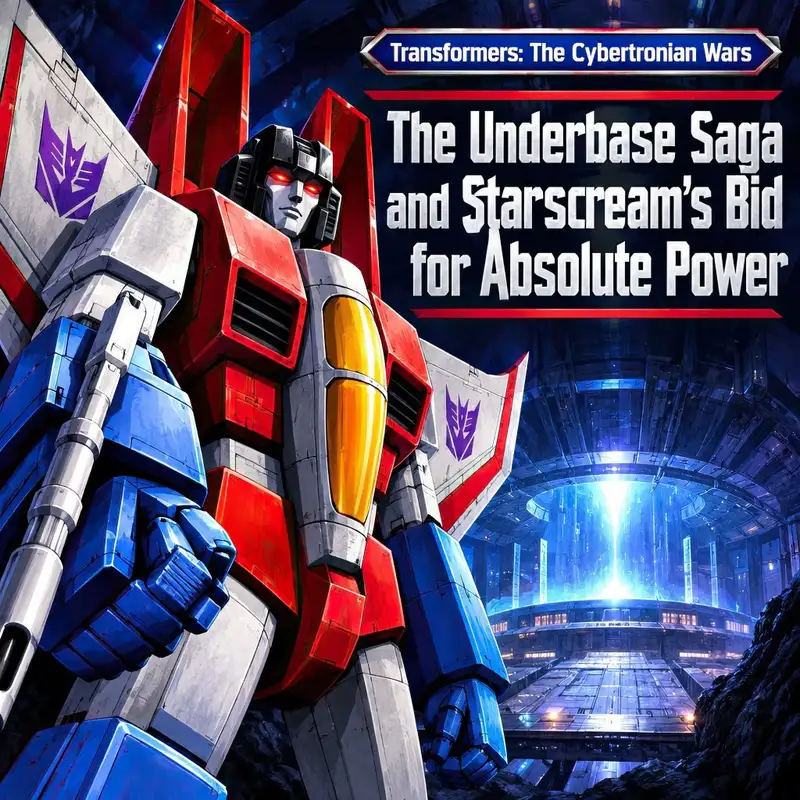
The Underbase Saga and Starscream’s Bid for Absolute Power [Marvel]
On an Arctic ice shelf, Buster Witwicky is left beside a beacon with very little shelter and no useful choice. He is a human hostage in the middle of a Cybertronian war, but he is also the essential piece in Starscream’s operation. If he activates the signal, Autobots may come to rescue him. They may also walk directly into the confrontation Starscream has arranged. If he does nothing, he freezes, and Starscream’s larger plan proceeds without interference.
This is the Marvel comic history of the Transformers, in the Earth phase of its long Autobot-Decepticon war. Here, Starscream’s bid for power is not a simple attempt to replace Megatron in a familiar chain of command. Earth’s Decepticons are already divided. Ratbat controls one force and its resource operations. Scorponok commands another, separate group. Starscream sees that division not as a problem to solve, but as an instrument to use.
The beacon is effective because it creates an urgent, visible crisis. The Autobots cannot ignore Buster’s signal. Ratbat’s forces cannot easily dismiss activity near their rival. Scorponok has reason to suspect a trap, but also reason to respond. Starscream does not need to issue orders to all of them. He needs each force to act according to its own fears, obligations, and incomplete intelligence.
That is the first lesson of the Underbase Saga. Power does not begin with a weapon. It begins with control over information and timing. Starscream understands that a divided command can be more useful than a loyal one, provided its leaders do not know they are being maneuvered. Buster’s danger gives the plan moral pressure as well as tactical pressure. The Autobots cannot treat him as expendable bait, even when they recognize that he may have been placed there for exactly that reason.
Buster eventually activates the beacon. He does so because rescue and resistance have become inseparable. The signal may expose him to further danger, but it is also the only available warning that Starscream is moving pieces on a much larger board. His choice does not give the Autobots control of the operation. It does ensure that Starscream’s deception will draw every major player into the same Arctic theater.
The trap works because Decepticon authority on Earth is shallow and contested. Ratbat has become the practical leader of the Earthbound Decepticons after Shockwave’s removal from that role. His leadership is defined less by grand ideological rhetoric than by efficiency, intelligence collection, and resource exploitation. Ratbat wants Earth used profitably. He wants Decepticon power organized rather than wasted in uncontrolled violence. In a civil war, that sort of administrative discipline can be valuable. It can also create resentment among subordinates who believe they deserve greater authority.
Starscream serves Ratbat in a senior capacity, but he does not accept Ratbat’s authority as a permanent political settlement. He is not content to become the next manager of an Earthbound Decepticon operation. Ratbat commands a base, personnel, intelligence assets, and industrial activity. Starscream wants something more direct and much more dangerous. He wants a form of power that will make Ratbat, Scorponok, the Autobots, and every other possible rival irrelevant.
Scorponok represents the other side of the Decepticon problem. He is not just another officer in Ratbat’s organization. He leads a separate force, accompanied by the Headmasters and by the Nebulan Zarak. His command has its own interests, its own personnel, and its own reasons to distrust Ratbat’s faction. The Decepticons may share symbols and enemies, but they do not share a unified command structure at this moment.
That distinction matters. A faction may look formidable when viewed from outside, especially by human observers trying to distinguish one enormous alien army from another. But internal fragmentation changes what that force can accomplish. Ratbat can protect his own facilities. Scorponok can protect his own command. Neither can easily ensure that the other is acting in the broader Decepticon interest. Starscream’s opportunity exists in the gap between those two claims to authority.
He does not offer a detailed political program for life after his victory. There is no evidence that he has designed a government, arranged supply systems, secured civilian loyalty, or considered how a conquered Earth would actually be administered. His program is simpler and more revealing. Acquire the Underbase. Destroy or neutralize everyone who could challenge him. Let overwhelming personal power settle the question of rule.
The intelligence that makes this ambition possible is discovered at Club Con, Ratbat’s island base. On the surface, the installation presents itself to human visitors as a holiday resort. Beneath that cover, it supports a Decepticon operation involving seabed dredging, concealed infrastructure, and recovered Cybertronian material. It is an example of deceptive infrastructure rather than a model of ordinary Cybertronian base construction. The disguise gives Ratbat’s force a place to work, but it does not make the operation invulnerable.
Blaster and Jessie enter this environment while searching for Buster. Their investigation reveals both the human cost of the Decepticon operation and the intelligence prize at its center. Ratbat’s forces possess records belonging to Grand Slam and Raindance, two Autobot cassette warriors. These records contain information about an ancient and dangerous object called the Underbase.
The Underbase is more than a weapon in the familiar military sense: it is described as a foundation, or concentration, of Cybertronian knowledge joined to extraordinary power. That combination is what makes it so dangerous. A conventional arsenal can be distributed among units, supplied through factories, defended by institutions, and eventually replaced. The Underbase appears to offer knowledge and energy in a form that may transform a single possessor into something far beyond an ordinary commander.
Yet the story establishes no safe method for reproducing its capabilities. There is no indication that Ratbat can build another Underbase, that Scorponok can divide its power among reliable subordinates, or that Starscream can turn it into an industrial system. Possession is not the same as understanding. Understanding is not the same as control. And control of a unique artifact is not the same as the ability to govern after using it.
Ratbat and Starscream use a full-sensory holographic system to examine the recovered records. The information does not just identify the Underbase’s location. It reveals an earlier crisis in the Autobot-Decepticon war, roughly four million years before the Earth events of the saga. The historical record becomes a warning, though Starscream will read it as an invitation.
In that earlier period, the war has already become severe enough that Optimus Prime seeks out High Circuitmaster Boltax. Prime is not pursuing the Underbase for personal glory. He is searching for a way to end a conflict that conventional operations have failed to contain. That motive matters, but it does not make the decision easy. A commander can seek a decisive weapon for defensive reasons and still create a disaster by putting it in one pair of hands.
Megatron is pursuing the Underbase as well. The record presents the two leaders as rivals converging on a strategic object of exceptional value. It does not require imported stories about their relationship from animation, later comics, or other continuities. What matters here is the immediate military logic. Both sides understand that whoever gains the Underbase could gain an advantage beyond the balance of normal armies.
Prime reaches the Underbase first. Then Megatron attacks. At that moment, Prime confronts the central problem of the saga. He can attempt to claim the power for the Autobots. He can allow Megatron to capture it for the Decepticons. Or he can deny it to both sides. His answer is to launch the Underbase into space.
It is a costly decision. Prime gives up a potential war-ending advantage. He also prevents Megatron from obtaining it. More importantly, he refuses the premise that a power this great can be made safe merely by being held by the leader with better intentions. He has no institution capable of supervising the Underbase, no demonstrated means of distributing its capabilities, and no assurance that even an Autobot commander could survive its use without being transformed by it.
This is not passivity. Denial of a decisive capability can be an active strategic choice. Military history is full of commanders who seek control of extraordinary weapons because they fear what an enemy might do with them. The harder question is whether anyone can possess such a weapon without making the political system around it more brittle, more authoritarian, and more dependent on one individual. Prime’s decision recognizes that the Underbase is too dangerous to become a prize in an already destructive civil war.
The Underbase drifts through space for millions of years. Then Soundwave calculates that its trajectory will bring it through Earth’s solar system within roughly a week. Suddenly, an ancient decision becomes an immediate operational deadline. The artifact is no longer an unreachable legend. It is an objective that can be pursued by any force capable of leaving Earth, finding it, and surviving the encounter.
Starscream watches the same record that convinced Prime to deny the Underbase to both factions. He draws the opposite conclusion. To Starscream, Prime’s restraint is not wisdom. It is failure to seize an opportunity. If the Underbase can elevate one Transformer beyond ordinary limits, then the weakness of Ratbat’s command and the rivalry with Scorponok are no longer obstacles. They are temporary inconveniences on the way to absolute power.
Here, Starscream’s operation becomes more than a personal betrayal. He begins to manage perceptions. Ratbat believes the Underbase could become an asset of his Earth command. Scorponok has every reason to fear Ratbat gaining such an advantage. The Autobots see the kidnapping of Buster and the danger posed to Earth. Each group possesses a piece of the truth. None initially sees the whole design.
Starscream’s operational brilliance lies in that compartmentalization. He does not first defeat Ratbat in open battle. He does not first overpower Scorponok. He does not initially challenge the Autobots with superior firepower. He persuades each side, through carefully arranged events, to concentrate on the threat immediately in front of it. While they act, he prepares to leave them behind.
The Underbase’s approach creates pressure that cannot be paused. Every day lost reduces the chance of interception. Starscream needs confusion, but confusion alone is not enough. He needs movement. Ratbat and Scorponok must be drawn into contact. The Autobots must be pulled toward a rescue mission. A ship must become available. And by the time the others recognize his true objective, he must already be on his way.
The Arctic confrontation achieves those aims. Buster, abandoned with the beacon, gives the Autobots a reason to converge on the site. Ratbat’s force and Scorponok’s group are maneuvered toward one another. Starscream has created a situation in which every participant believes it is responding to another commander’s provocation. In reality, they are all helping him clear the route to the Underbase.
This is not a unified Decepticon operation gone wrong. It is the failure of rival Decepticon commands to recognize that their competition has been weaponized against them. Ratbat is concerned with protecting his authority and securing the artifact. Scorponok is concerned with Ratbat’s ambitions and with his own position. Neither side is focused enough on Starscream because neither assumes that a subordinate can turn their rivalry into a strategic escape route.
Buster’s role remains important throughout this maneuver. He is not a military officer and does not suddenly become one because events place him near an alien conflict. But he understands enough to know that the beacon is a warning as well as a plea for help. His decision forces the Autobots to enter the situation and makes it harder for Starscream to conceal the crisis completely. It does not prevent the deception. It gives the resistance to it a chance.
Starscream uses the battle as cover to gain access to Scorponok’s starship. The exact technical details of the theft matter less than its operational effect. He has converted a fight among his enemies and rivals into transport. The Arctic trap was not the final objective. It was a mobility operation. The Underbase is beyond Earth, and Starscream needs a way to reach it before any organized force can stop him.
By the time Ratbat, Scorponok, and the Autobots understand what has happened, the political landscape has changed. Starscream is no longer merely a treacherous subordinate. He is an independent claimant to a power that threatens every established command. That recognition produces one of the saga’s most striking developments: Autobots and Decepticons begin to cooperate against him.
The coalition is not the same as peace. The Autobots have not accepted Decepticon rule. Ratbat has not abandoned his ambitions. Scorponok has not become an Autobot ally in any enduring sense. The participants share only a crisis. They understand that Starscream with the Underbase would threaten all of them, including the Decepticons he once served.
Crisis coalitions are often formed quickly because the alternative is obvious. Their weakness is that they inherit every distrust that existed before the emergency. The Autobots remain wary of both Decepticon commands. Ratbat and Scorponok remain wary of each other. Neither Decepticon leader has reason to assume Optimus Prime will remain indifferent to the Underbase once it is within reach. Cooperation exists, but confidence does not.
The pursuit requires unusual mobility. Club Con transforms into a space-capable platform, and Scorponok’s ship becomes part of the effort to reach the Underbase. This is an improvised response to a unique emergency, not evidence that any concealed island base can routinely launch into space. The story never provides reliable fuel figures, passenger capacity, or technical specifications. It does establish the important fact: access to the Underbase requires specialized transport and rapid adaptation.
The combined force can mobilize. It cannot recover the time Starscream has gained. This is the lasting advantage of his deception. He does not need to defeat the coalition in the Arctic. He only needs to ensure that it begins pursuit after he does. In operations involving a rare objective and a narrow window of access, a small lead can matter more than a larger force.
The coalition reaches the Underbase too late. Starscream has already made contact with it and absorbed a portion of its energy and knowledge. The distinction is essential. He does not acquire the entire Underbase. He does not demonstrate complete understanding of everything it contains. He does not establish a method to reproduce its power. What he obtains is enough to make him catastrophically dangerous, but not enough to make him omniscient or secure.
What follows is a collapse of conventional deterrence. The assembled Autobots and Decepticons can bring weapons, ships, and concentrated firepower against Starscream. Those capabilities had meaning when he was an ordinary combatant. After his partial absorption of Underbase power, they are no longer sufficient. The island base attacks him, but the attack fails to stop him. Starscream uses Scorponok’s ship against the installation, damaging or destroying the platform before escaping.
The scene demonstrates the danger of a unique strategic resource. The Underbase does not improve Starscream’s army. It bypasses the normal relationship between armies. It does not make his logistics stronger, his command structure wiser, or his political position more legitimate. It allows one individual to overwhelm forces that would otherwise constrain him. That is useful for destruction. It is not the same as building durable power.
Starscream has also become a single point of failure. The Underbase’s power is now concentrated inside one body, one mind, and one unstable political project. He has eliminated the checks imposed by Ratbat, Scorponok, and the Autobots, but he has also eliminated every buffer between himself and the consequences of that power. If his body cannot contain it, there is no institution to absorb the failure.
He returns to Earth with the character of the conflict changed completely. What began as a struggle among Decepticon leaders becomes a planetary emergency. Starscream attacks major cities. The war is no longer confined to hidden bases, Arctic ice, alien ships, or the pursuit of an artifact in space. Earth’s population is exposed to the consequences of a Cybertronian command dispute that it did not create and cannot control.
The assembled Autobot and Decepticon forces attempt to stop him. They fail. Starscream’s attacks devastate the battlefield and disable or destroy a large part of the opposition. The immediate event is often remembered as a massacre, and the word conveys the scale of the catastrophe. But the long-term condition of every victim is not identical. Later Marvel stories complicate the fate of some Transformers who appear lost here. The immediate record is clear enough: organized resistance is shattered, and the damage is enormous.
There is no reliable reason to reduce the event to a precise casualty count. The story does not support one. Some Transformers are apparently destroyed. Some are disabled. Some survive the immediate destruction. Some later return through repair, recovery, or the flexible survival rules of a long-running comic universe. None of that erases the fact that Starscream’s assault breaks the forces opposing him at the moment when Earth needs protection most.
An unusual pattern emerges among the survivors. Some Pretenders, Headmasters, Targetmasters, and Powermasters prove more resistant to the immediate effects of Starscream’s attacks, or remain active after others have fallen. The outcome is part of the story. Its exact technical reason is not fully explained. It would be easy to turn that pattern into a universal theory of Cybertronian biology or equipment. The comic does not justify that certainty.
What can be said is that the surviving personnel provide fragments of continued resistance in a situation where conventional force has failed. Their survival does not reverse Starscream’s tactical supremacy. It shows that even an overwhelming attack may leave exceptions, and that the military meaning of a body type or power system can change sharply under extreme conditions. But the Underbase Saga does not establish a general rule that one class of Transformer is always immune to another.
For civilians, those distinctions offer little comfort. A city under attack by a being empowered beyond the ability of both major factions to contain him is not protected by the fact that some specialized warriors remain standing. Starscream’s campaign exposes the weakness of any arrangement in which Earth depends on alien factions to settle their own war away from human population centers. Once their command struggle comes ashore, civilians inherit the risk.
Starscream has achieved tactical dominance. He can defeat opponents who once mattered. He can move through the crisis as though conventional defenses are irrelevant. He has proven that Ratbat and Scorponok were not the highest authorities in the Decepticon world. Yet this success contains the seed of failure. Destroying forces does not create a government. Deactivating rivals does not build a chain of command. Terror can compel immediate obedience, but it never provides a system for repair, supply, administration, or succession.
Meanwhile, the anti-Starscream coalition begins to reveal the political tensions it had only temporarily suppressed. Ratbat and Scorponok both suspect that Optimus Prime may seek to claim the remaining Underbase power. Under the circumstances, the suspicion is understandable. Prime is the Autobot commander. The Underbase is a war-changing asset. A Decepticon leader who assumes that an enemy commander will reject an advantage simply because it is dangerous is taking a considerable risk.
Yet the historical record from Boltax points in another direction. Prime had already launched the Underbase into space rather than allow either himself or Megatron to possess it. That does not by itself prove what he will do in the present crisis. Commanders can change under pressure. Circumstances can alter judgment. But it does establish a pattern of restraint that Ratbat and Scorponok either do not know, do not trust, or cannot afford to trust.
The problem is deeper than one question of personal character. No participant can verify what the others would do if they gained access to the remaining Underbase power. In a coalition built around fear, every effort to secure the artifact can look like preparation for betrayal. The Underbase is not only a military object. It is an engine of suspicion. Whoever moves toward it may be trying to contain it, seize it, destroy it, or deny it to everyone else.
Scorponok acts within that atmosphere of mistrust. He kills Ratbat and takes effective control of the Earthbound Decepticons. The immediate anti-Starscream coalition has not erased the struggle for Decepticon succession. It has merely placed that struggle under the pressure of a larger threat. Ratbat’s death demonstrates how quickly a crisis alliance can coexist with internal purges and command consolidation.
Scorponok’s action improves his position, but it does not solve the central problem. He has gained control over Ratbat’s faction at a moment when Starscream remains beyond the reach of ordinary command. The Decepticons may have fewer leaders now, but they are not more secure. Indeed, the removal of Ratbat confirms Starscream’s larger insight that their political structure was vulnerable. It also confirms Prime’s fear that immense power will attract claimants faster than it produces stability.
Optimus Prime’s final decision must therefore accomplish several things at once. It must stop Starscream. It must protect Earth from further devastation. It must avoid giving the remaining Underbase power to Scorponok or any other Decepticon claimant. And it must avoid transforming Prime himself into the sole holder of the very power he rejected long before.
His answer is not a cleanly prepared doctrine or a device waiting in reserve. It is an improvised countermeasure shaped by the principle he established in the Boltax record. Prime redirects the remaining Underbase energy into Starscream. The goal is not to strengthen Starscream, but to overload him with more power than his body can contain.
The story never provides a scientific accounting of the energy transfer. It never establishes exact yields, internal tolerances, or a reproducible method for using the Underbase against future enemies. The consequence is clear. The additional energy destroys Starscream. The Transformer who tried to turn the Underbase into a personal instrument of absolute rule is defeated by the excess of the very power he sought.
Tactically, the countermeasure works. Starscream is stopped. Operationally, it ends the immediate emergency facing Earth and the battered combined force. Strategically, it prevents the Underbase from becoming Starscream’s permanent weapon of conquest. Prime does not emerge holding an equivalent power for the Autobots. The resolution remains consistent with the earlier choice: dangerous power must be denied, not just transferred to a more acceptable claimant.
That choice carries political risk. Prime acts while Decepticon leaders suspect him of intending the opposite. He cannot prove his motives to everyone in advance. He can only make a decision under pressure and accept that others may interpret it through their own interests. Leadership in such a crisis is more than the ability to destroy the threat: it is the ability to destroy it without creating a new concentration of unchecked authority.
The emergency ends, but the war does not. Scorponok emerges in a stronger position after Ratbat’s death. The Decepticon factions remain Decepticon factions. The Autobots remain their enemies. Earth has been devastated by a conflict that the temporary alliance could contain only after catastrophic damage. The coalition dissolves because it was never a settlement. It was a moment of shared self-preservation.
The Underbase Saga also leaves behind a damaged military landscape. Many combatants have been disabled or apparently destroyed. Command relationships have changed. The Earthbound Decepticons have lost Ratbat and gained Scorponok’s more direct authority. The Autobots have survived a crisis without gaining the power that might have altered the wider war. In institutional terms, the battle ends with no rebuilt political order, only with one immediate threat removed.
The later Marvel comic record complicates the long-term fate of some of the Transformers struck down during Starscream’s rampage. Repair, recovery, and return do not operate with perfect consistency across every later story. That uncertainty should not be used to make the destruction meaningless. A force that suffers mass deactivation, loss of bodies, damaged infrastructure, and the collapse of command still experiences a strategic shock, even when some personnel may eventually be restored.
There is also a real production history behind the survival pattern. The saga appeared during a period when newer Pretender, Headmaster, Targetmaster, and Powermaster characters had greater commercial prominence. That context may help explain why certain groups remain visible after the destruction. But it is not an in-universe explanation. Within the story, the result is simply that a few surviving systems and individuals remain when older formations have been shattered.
Starscream’s campaign is therefore operationally brilliant. He identifies a strategic resource, reads the weakness of divided command, manipulates rival forces into motion, gains transport, and reaches the Underbase before a larger coalition can stop him. Few coups are won by battlefield strength alone. His begins with intelligence, deception, timing, and the ability to make other leaders react to the crisis he has designed.
It is also tactically overwhelming. Once he gains part of the Underbase’s power, ordinary military force proves inadequate. He destroys or disables large numbers of opponents, attacks cities, and reduces the difference between Autobot and Decepticon firepower to near irrelevance. For a brief period, he has achieved what many ambitious commanders imagine they want: no meaningful rival, no effective deterrent, and no battlefield equal.
Starscream's triumph contains its own strategic failure. The Underbase gives him knowledge and destructive power beyond any rival, but it does not give him a body capable of safely containing that power, a functioning state, a supply system, or political legitimacy beyond fear. He can destroy competing commands, but every rival he eliminates also removes another structure through which long-term rule might have been exercised. Absolute force solves the problem of opposition by creating the larger problem of what remains afterward.
That is why the Underbase cannot make Starscream a durable ruler. It is not a constitution, a civil service, a repair network, or a social contract. He wins by deception at the operational level and by overwhelming force in direct combat, yet those victories leave him with no stable order to inherit. The campaign demonstrates the limit of artifact power in political war: a weapon can make one commander temporarily unbeatable, but it cannot build the institutions that would allow his authority to survive once fear is no longer enough.