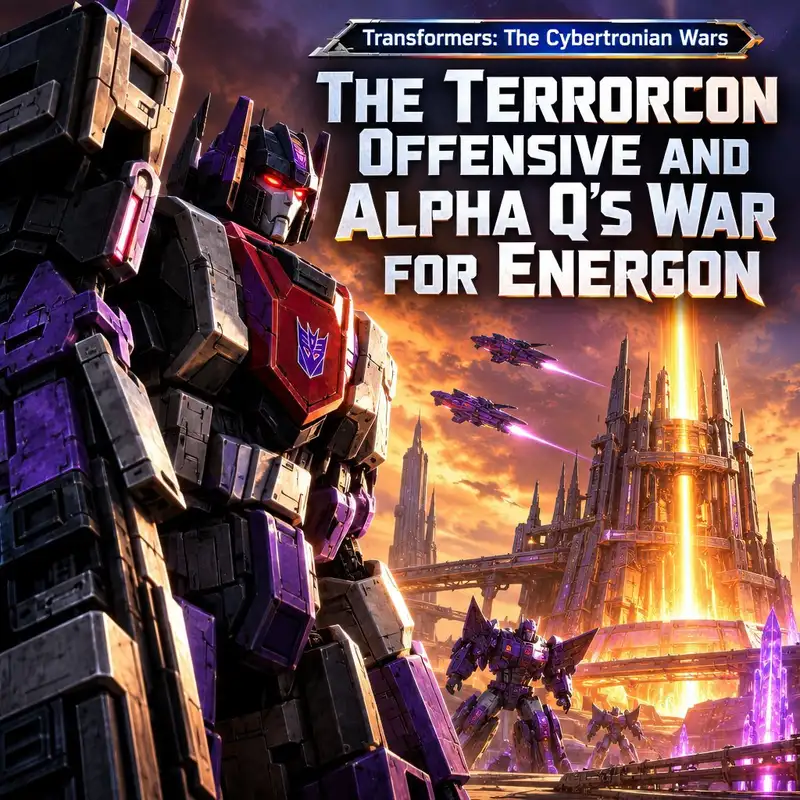
The Terrorcon Offensive and Alpha Q’s War for Energon
An energon-mining settlement is a poor place to fight a war. Its machinery is built to locate deposits, refine a volatile resource, and keep a recovering civilization supplied. Its workers expect shifts, maintenance schedules, and the ordinary frustrations of industrial life. They do not expect massed Terrorcons descending on the site to strip its stores and carry them away. Yet that is the opening military problem in Transformers: Energon. The first battles are not fought for capitals, thrones, or grand declarations of conquest. They are fought over fuel, extraction equipment, and the civilians living beside the mines.
This is the English-language Energon continuity, set roughly a decade after the conflict depicted in Armada. The earlier war had ended with a fragile opening for cooperation. Former enemies had not become friends in any simple sense, but Autobots, surviving Decepticons, and human partners had found a shared practical purpose. Cybertron required restoration. Energon was needed to power that restoration. Across the Solar System, new cities, mines, and processing facilities became part of an effort to rebuild what war had exhausted.
That recovery program gave the Autobots and their human allies something they had lacked for much of the previous conflict: an industrial strategy. They were more than defending isolated bases or responding to Decepticon attacks. They were developing energy sources, building settlements, and connecting infrastructure intended to sustain Cybertron over the long term. It was reconstruction on a planetary scale, although much of the work took place far from Cybertron itself.
The arrangement was useful, but it was never politically secure. Cooperation between Autobots and surviving Decepticons rested on necessity, not reconciliation. Old factional identities remained available to any leader capable of reviving them. The energon program also created a network of fixed targets. A mine cannot easily relocate. A refinery cannot hide in a forest. A city built around an energy field cannot simply transform, drive away, and begin again somewhere safer.
That was the vulnerability Alpha Q exploited. Operating from within the ruined remains of Unicron, he released Terrorcons against energon sites across the Solar System. They attacked places such as Ocean City, Lunar City, and Desert City, striking at the infrastructure of recovery rather than attempting to occupy territory. The Terrorcons were not deployed as a conventional army trying to govern cities after capturing them. Their purpose was extraction. They arrived, seized energon, damaged defenses, and moved the resource into a larger system of collection and transport.
That distinction matters. A territorial campaign requires garrisons, administration, political control, and some plan for dealing with the population left behind. Alpha Q’s opening offensive demanded none of those things. It was a raiding war. Its targets were selected because they contained energon or the equipment required to process it. The victims were left with evacuation, damage control, and the knowledge that the next attack might come at another site before repairs at the first one were complete.
For civilians, the result was no less severe because the attackers had no interest in ruling them. Evacuation could preserve lives, but it could not preserve homes, machinery, mines, archives, or local landmarks. A settlement built around energy extraction was also built around its workers’ social world. When the mine was attacked, the threat extended beyond the energon stockpile. It threatened the possibility that a new community could take root in the aftermath of war.
Alpha Q’s base made the offensive even more unusual. He operated within the damaged body of Unicron, the ancient destroyer whose destruction had ended the Armada-era crisis. Unicron was more than a wreck drifting in space. His remains contained immense surviving systems, residual energy, and the shadow of a capability no ordinary military force could match. Alpha Q turned that wreckage into a sanctuary, a command center, and a means of projecting force against targets scattered across the Solar System.
From the Autobot perspective, this created a difficult intelligence problem. The Terrorcons could strike multiple sites, while the force directing them was concealed inside an object too dangerous to approach casually. Destroying or disabling a conventional raider is one problem. Assessing the interior of Unicron’s remains is another. The Autobots had to defend mines, protect civilians, sustain reconstruction, and determine whether the wreck of their previous enemy was becoming active again.
At first glance, Alpha Q appeared to be gathering energon for the obvious reason. Unicron had been defeated, but perhaps not destroyed beyond recovery. The Terrorcon raids seemed to be the opening phase of an effort to revive him. That conclusion was not wrong, but it was incomplete. Alpha Q did want to use Unicron’s remaining power. The question was what he intended to do with it, and whether the destruction required to obtain the energon could ever be separated from the restoration he claimed to seek.
The Autobots responded with an answer shaped by engineering as much as combat doctrine. They developed energon towers and linked them into a defensive grid. The towers transformed local energy infrastructure into a weapon and a protective system. Energon that might otherwise have remained a vulnerable store of fuel could be channeled into defenses against incoming Terrorcons and other attackers. This gave individual settlements a way to resist raids that might otherwise have overwhelmed them through sheer numbers.
It was an understandable solution. The mines were already there. The energon was already being harvested. The human and Cybertronian personnel operating the sites possessed the technical knowledge needed to build and sustain a network. The Omnicons, whose work was closely tied to energon handling and industrial support, became important to the war effort for reasons more substantial than their presence on the margins of combat scenes. Without people who could process energy, maintain equipment, and restore damaged systems, there would be no defensive grid to defend.
The towers also reflected a broader strength of the Autobot-human coalition. It could organize labor, science, transport, and defense into one system. The Terrorcons could raid. The Autobots and their allies could build. In a long war, that difference matters. A force that can repair a damaged installation, restore power, and move technicians where they are needed may endure losses that would cripple a more purely military organization.
But every defensive network creates a map of its own vulnerabilities. A tower is useful because it is fixed, powerful, and connected to other sites. Those same qualities make it an obvious target. It cannot retreat under pressure. It cannot choose a safer route through difficult terrain. Its value is visible to anyone studying the mining program. The grid improved local defense, but it also concentrated strategic value into nodes that attackers could identify, isolate, sabotage, or destroy.
The danger extended beyond the loss of a single tower. A linked system can turn damage at one point into a wider operational crisis. Loss of a tower could expose a mine, interrupt energy distribution, strand a settlement without adequate protection, or force the defenders to divert resources from another location. The grid did not make the recovery effort invulnerable. It made its priorities clearer, and clarity is useful to an enemy as well as to a commander.
Alpha Q’s campaign intensified when Scorponok emerged as the Terrorcon commander. Scorponok was more than another field officer sent to lead raids. He became Alpha Q’s principal agent in the growing conflict, capable of operating among forces whose objectives were beginning to diverge. His position would become central once Megatron returned, because Scorponok’s loyalty remained tied to Alpha Q even while he moved within Megatron’s expanding Decepticon force.
That divided allegiance was not a minor personal complication. It was a command problem. Alpha Q wanted energon for a purpose that depended on Unicron’s surviving power. Megatron wanted power over Unicron itself. Scorponok could serve as a connection between those plans, but he could not make them compatible. The two leaders might use the same resources, strike the same enemies, and temporarily benefit from the same operations. They were still working toward fundamentally different end states.
Tidal Wave’s capture revealed the scale of the effort. Alpha Q and Scorponok did not rely only on scattered Terrorcon raids. They sought personnel and capabilities that could help move the campaign from resource theft toward the reactivation of larger systems. The energon gathered in the raids became part of the process that restored Megatron. In operational terms, Alpha Q had achieved something remarkable. He had taken a dispersed extraction campaign and used it to recover one of the most dangerous military leaders in the conflict.
Strategically, it was disastrous.
Megatron’s restoration did more than add another powerful figure to Alpha Q’s side. It created the commander most likely to seize control of the entire enterprise. The energon pipeline that Alpha Q had built was not neutral infrastructure. It enabled revival, movement, weapons, and access to Unicron’s remains. Once Megatron returned, those same capabilities could be turned against Alpha Q’s original purpose. A restoration project had armed the man best positioned to convert it into a campaign of conquest.
Megatron did not treat Unicron as a difficult instrument that might be used only under strict limits. He saw the possibility of commanding a strategic weapon. His objective was not the recreation of lost worlds. It was control. A revived Unicron could offer mobility, firepower, intimidation, and the ability to threaten enemies on a scale no conventional Decepticon force could achieve. Whether Unicron could truly be controlled safely was almost beside the point. Megatron’s strategy depended on believing that he could be the one to command the danger.
That belief shattered the fragile post-Armada accommodation. Demolishor’s return to Megatron was one sign of the old factional order reassembling around a familiar leader. Alpha Q also revived Starscream in an attempt to use him against Optimus Prime. Megatron later captured and reprogrammed Starscream, demonstrating the kind of force he intended to build. This was not a coalition of partners negotiating common goals. It was an organization reconstructed through personal authority, coercion, and control over bodies as well as loyalties.
Megatron’s method mattered because it offered speed at the expense of trust. A commander who can restore, capture, and reprogram useful personnel can rapidly gather assets. But such a force is held together by fear, dependence, and the leader’s continued ability to impose his will. It has little room for genuine consent, independent judgment, or peaceful succession. In the short term, this can be militarily effective. In the long term, it leaves the organization vulnerable to internal rebellion, divided loyalties, and sudden collapse when control weakens.
Scorponok embodied those tensions. He could appear within Megatron’s orbit while remaining committed to Alpha Q. That made him valuable as an intermediary and covert operative, but it also meant Megatron could never fully rely on him. The anti-Autobot camp was no longer a single force with one chain of command. It was a contested space in which Alpha Q, Megatron, Scorponok, Terrorcons, restored Decepticons, and coerced subordinates pursued overlapping but incompatible aims.
The result was a three-sided war. The Autobots and human partners fought to protect energon infrastructure and prevent Unicron from becoming active again. Alpha Q fought to gather the energy he believed could restore the worlds Unicron had consumed. Megatron fought to take command of the same power and use it as a weapon. Alliances could form briefly at the tactical level, but they could not resolve the strategic conflict. Every success for one faction created opportunities for the others.
Jungle City showed the human and civilian cost of that contest more clearly than any abstract discussion of infrastructure could. The city and its tower became the focus of a three-sided battle. The defensive system that had been built to protect the settlement instead became a focal point for attack, counterattack, and desperate decisions. When the conflict escalated, the Autobots overloaded the installation rather than allow it to remain useful to their enemies.
That decision may have prevented an immediate enemy gain, but it was not a clean victory. The tower and base were destroyed. Nearby pyramids were lost as well. The evacuation of civilians limited the immediate human cost, yet it could not prevent the destruction of the settlement’s industrial foundation or its surrounding cultural landscape. The battle demonstrated a harsh reality of defensive infrastructure. A facility can be successfully denied to an enemy and still be lost by the people it was built to serve.
At this point, the language of tactical success can become misleading. The Autobots prevented Alpha Q or Megatron from simply taking control of Jungle City’s resources. At the mission level, that mattered. At the local level, however, the city had suffered severe damage. Its capacity to produce, store, and defend energon had been reduced. Its residents had been displaced. Its landmarks were gone. A victory that preserves a wider campaign can still leave a community with little to celebrate.
The destruction also exposed the limits of the grid strategy. Networks are powerful when they function. They can move energy, coordinate defense, and give isolated settlements a connection to a larger coalition. But they also make each node part of a contest that may be decided far away. A mine or city may become a battlefield not because of anything its people have done, but because its tower is useful to a struggle over Cybertron, Unicron, and the future of multiple worlds.
The war’s intelligence dimension became sharper through Kicker. His ability to sense energon made him far more than a young human companion attached to an Autobot operation. In a conflict centered on finding and controlling a scarce strategic resource, Kicker reduced the search problem. He could identify what armies, sensors, and prospecting teams might otherwise need considerable time to locate. That made him an asset in reconnaissance, targeting, and resource planning.
For the Autobots and their human scientific partners, including Dr. Jones, Kicker’s ability supported the recovery program. It helped them find energon needed to sustain Cybertron’s restoration. For Alpha Q and Megatron, it represented a chance to penetrate or redirect that same program. Capturing Kicker would not merely deny the Autobots a friend. It could give an enemy a living guide to the deposits that powered the defensive network and the larger war.
His position created obligations for the Autobots. A human partner with unique knowledge or perception cannot be treated simply as equipment. He requires protection, informed consent, and a degree of autonomy that military planners may find inconvenient. Yet the strategic reality remained. Kicker was a high-value target. The more central his abilities became to energon operations, the more danger followed him. The alliance between humans and Cybertronians was not an abstract partnership. It placed individual people inside the targeting logic of an interstellar resource war.
The truth about Alpha Q complicated that war further. His connection to Planet Q and to worlds consumed by Unicron revealed that his objective was more than destruction for its own sake. He had endured the consequences of Unicron’s appetite. The energon he stole was intended to power a restorative project, using the surviving power within Unicron to recreate what Unicron had destroyed. From that perspective, Alpha Q’s campaign was not a conventional raid for loot or territory. It was an attempt to reverse a catastrophe for which ordinary reconstruction methods appeared inadequate.
That purpose gave Alpha Q’s actions a real strategic logic. If whole worlds had been consumed, then rebuilding a refinery or restoring a damaged city was not enough. He was pursuing a means of restoration on a scale that normal industry could not reach. Unicron’s remains offered access to immense power, and Alpha Q believed that power could be redirected from destruction toward creation. His war was shaped by grief, urgency, and the conviction that there was no other available mechanism capable of restoring what had been lost.
But restorative intent did not make the offensive humane. Alpha Q still authorized raids on mining settlements. Terrorcons still attacked communities whose residents had done nothing to consume Planet Q or destroy other worlds. Energon still had to be taken from infrastructure built for Cybertron’s recovery. Alpha Q’s cause may have been different from Megatron’s, but his methods imposed danger and destruction on those outside his own tragedy.
This is the moral problem at the center of Alpha Q’s war. He was more than another would-be conqueror. He had a restoration objective that deserved to be understood on its own terms. Yet he had also chosen coercion, resource seizure, and military force to pursue it. The fact that his end was compassionate did not erase the damage caused by his means. A civilization rebuilding from war cannot easily accept that its own recovery must be sacrificed to repair losses elsewhere, particularly when the proposed solution involves reactivating the body of Unicron.
Rodimus and his independent Autobot group took Alpha Q’s argument seriously. They believed that reviving Unicron might offer the only chance to restore the worlds that had been destroyed. Their position did not come from indifference to the danger. It came from a different assessment of risk. To Rodimus, destroying Unicron or preventing his revival could mean accepting that those worlds were lost forever. The danger was immense, but so was the potential value of restoration.
Optimus Prime reached the opposite conclusion. He could not treat Unicron as a neutral reconstruction engine waiting for a responsible operator. Megatron’s return had already shown how quickly access to Unicron’s systems could become a struggle for domination. The more Unicron was revived, the more power became available to anyone capable of seizing it. Optimus judged that the risk was existential. If Megatron gained effective command of Unicron, the price of attempting restoration could be the destruction of Cybertron and other worlds still living.
Neither position was frivolous. Rodimus saw an irreplaceable opportunity to repair an atrocity on a planetary scale. Optimus saw a weapon whose very existence made control an illusion. Their disagreement revealed that the Autobots did not possess a single, settled doctrine for dealing with Unicron. They shared a desire to protect lives, but they disagreed over whether protection required using Unicron’s surviving power or denying it to everyone.
That division was strategically important. Military coalitions can survive disagreements about routes, timing, or individual commanders. They struggle when they disagree about the nature of the war itself. Was the goal to defend existing settlements? To restore destroyed worlds? To destroy Unicron permanently? To prevent Megatron from gaining control while preserving the possibility of Alpha Q’s plan? Each answer implied different priorities, different risks, and different uses of energon.
Optimus eventually recognized that local defense was no longer enough. The mines and towers could resist raids, but they could not settle a conflict whose center of gravity lay inside Unicron’s remains. The decision to send the Miranda II marked an operational transition. The Autobots moved from defending a distributed network of settlements toward an expeditionary effort aimed at the source of the threat.
The Miranda II mission carried more than one objective. It had to pursue the Decepticons and confront the growing danger of Unicron. It also had to create the mobility necessary for sabotage, infiltration, and, if required, destruction. That meant moving personnel, equipment, and technical capability into deep space. A force defending a mine can depend on fixed installations and local support. A force operating against Unicron must carry much of its support with it or maintain a secure line back to friendly infrastructure.
Space bridges became essential to that effort, but they did not make the problem disappear. A bridge could transform strategic geography by allowing forces to move between distant points far faster than conventional travel. It could reinforce a threatened site, support an evacuation, or place a strike team near an objective that would otherwise be unreachable. But bridges depended on functioning systems, coordinates, power, security, and maintenance. Damaged infrastructure, uncertain navigation, and hostile interference could turn a route of rapid movement into another point of failure.
The Miranda II therefore represented more than a ship or a convenient means of travel. It was part of the coalition’s attempt to convert industrial recovery capacity into expeditionary power. The same partnership that built mines and towers now had to sustain a deep-space operation. Engineers, technicians, human knowledge, Cybertronian crews, repairs, communication, and transport all became part of the campaign. The war could no longer be understood as a series of attacks on energon deposits. It had become a contest over who could reach, enter, and influence Unicron first.
As Unicron began to reactivate, the stakes widened again. The objective was no longer simply the collection of energon. It was control over a vast and dangerous strategic system. Unicron’s body and head became contested spaces. The Autobots pursued sabotage and disruption. Megatron maneuvered to establish his authority. Alpha Q tried to preserve the restorative possibility that had driven his campaign from the beginning. The conflict moved inside the machinery of destruction itself.
This was also the point at which Megatron’s ambitions became unmistakable. He did not want merely to survive or rebuild a Decepticon force. He wanted Unicron as an instrument of power. A revived Unicron would not simply strengthen Megatron’s army. It could reorder the entire balance of the war. Cybertron, Earth, and other worlds would no longer be defended against raids and conventional attacks alone. They would be threatened by a force capable of consuming or destroying them on a scale beyond ordinary military planning.
The reactivation also destabilized Decepticon forces on Cybertron. Megatron’s return had restored old loyalties, but it had not created a stable political order. His rule depended on continual assertion of dominance, while rival interests and divided allegiances remained active. A faction rebuilt around one leader’s authority can move decisively when that leader is present. It can also fracture when subordinate commanders conclude that the leader’s plans threaten their survival, their autonomy, or the world beneath their feet.
Cybertron’s energon grid became a central target in this expanded war. Shockblast’s action against the grid showed how quickly infrastructure designed for restoration and defense could become a liability when an enemy penetrated or disabled it. The network that protected settlements and supported recovery could not guarantee security if hostile forces could disrupt its operation. Technology did not resolve the political conflict. It gave that conflict additional systems to seize, damage, or turn against their builders.
Megatron’s larger intention was even more severe. He sought to use Cybertron itself as fuel for Unicron. The planet that the energon program had been designed to restore was no longer only the beneficiary of reconstruction. It had become a potential resource to be consumed. This was the final strategic inversion of the campaign. Energon had been harvested to rebuild Cybertron. The same conflict now threatened to feed Cybertron into the very destroyer whose past victims Alpha Q hoped to restore.
Alpha Q’s efforts to direct Earth’s positive energon toward restoration stood in direct opposition to Megatron’s plan. Both depended on energon. Both depended on Unicron’s remaining systems. Both had emerged from the same initial offensive. Yet their purposes could not have been more different. Alpha Q wanted to use power associated with destruction to recreate lost worlds. Megatron wanted to make destruction politically useful to himself.
Optimus Prime’s position remained distinct from both. He did not share Megatron’s desire for domination, and he understood Alpha Q’s motive more clearly once the truth of Planet Q emerged. But Optimus could not accept a strategy that required trusting Unicron’s revived power to remain available for benevolent use. He had seen the evidence of Megatron’s return. He had seen the destruction at the mines and cities. For him, the immediate duty was to prevent a weapon of existential scale from becoming operational under any faction’s control.
Rodimus represented the unresolved moral cost of that decision. If Unicron had the capacity to restore worlds, then destroying or disabling him might foreclose the only path to repair. Optimus’s strategy could save the living while confirming the loss of the dead and displaced. Rodimus’s strategy could offer restoration while risking catastrophe for everyone else. The disagreement did not have an easy answer because both sides were responding to real losses and real dangers.
The irony of the Energon conflict is that every faction depended on systems created by recovery. Mines, towers, energy grids, space bridges, human scientific support, Omnicon labor, Cybertronian engineering, and Unicron’s surviving machinery all became instruments in the war. Reconstruction did not occur outside conflict. It became part of the battlefield. The infrastructure intended to heal a civilization also created routes through which that civilization could be threatened.
That does not mean reconstruction was a mistake. Cybertron still required energon. Civilians still required cities, industry, transport, and protection. The problem was that rebuilding without a durable political settlement left the new infrastructure exposed to actors who understood its importance. The postwar coalition had created productive capacity before it had resolved the rival ambitions, resentments, and factional loyalties that could turn that capacity into a weapon.
Alpha Q’s Terrorcon offensive was therefore not simply a conventional resource raid intended to revive Unicron. It was a desperate restorative war born from the destruction of Planet Q and other worlds consumed by Unicron. Alpha Q sought energon because he believed it could make creation possible again. His objective was larger than theft and different from conquest.
Yet it was not a clean humanitarian enterprise. Alpha Q used Terrorcon attacks, coercive extraction, and the destruction of vulnerable settlements to obtain what he needed. His war was restorative in strategic intent and predatory in method. The civilians living beside energon mines were asked to bear the cost of a restoration project they had not chosen and could not control.
His deepest tragedy went beyond Megatron’s opposition. It was that Alpha Q’s chosen method of saving worlds helped restore the commander most capable of repeating Unicron’s destruction on a planetary scale. The energon gathered for reconstruction became the means of Megatron’s return. The infrastructure built to heal Cybertron became a route toward feeding Cybertron to Unicron. In Energon, the war over fuel reveals a harder truth: a society can build the machinery of recovery, but unless it also builds a peace strong enough to govern that machinery, the tools of restoration may become the weapons of the next catastrophe.