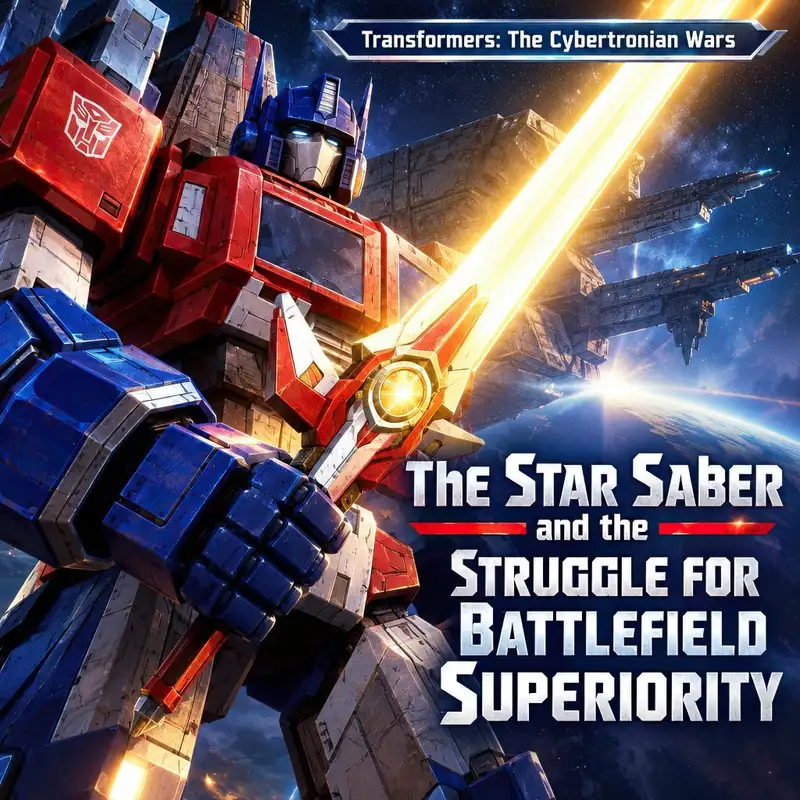
The Star Saber and the Struggle for Battlefield Superiority
When Megatron’s Dark Star Saber struck Optimus Prime’s blade, the result was not a close contest decided by one better move. The original Star Saber shattered. In a few seconds, the Autobots lost the most formidable weapon they had recovered during their relic campaign. Optimus survived, and the wider campaign continued, but the image mattered. A legendary weapon had entered the war, promised an advantage, and then been broken by an enemy who understood exactly what that advantage meant.
That moment captures the central problem of battlefield superiority in Transformers Prime. Possessing a superior weapon is not the same thing as controlling a battle. Controlling a battle is not the same thing as controlling a campaign. And controlling a campaign is not the same thing as deciding the political future of two worlds. The Star Saber gave Optimus Prime real power. It made him more dangerous in direct combat, strengthened the symbolic authority of his office, and later allowed him to destroy a system that could have transformed Earth. But it did not give the Autobots comprehensive military dominance.
This is the Star Saber of Transformers Prime, the ancient Prime relic contested on Earth during the second and third seasons of that series. It is not the Autobot commander called Star Saber in the Japanese Victory series, and it is not the Mini-Con weapon from Armada. In this history, the Star Saber is a unique artifact. Its importance comes not only from what it can do in a duel, but from the much larger struggle over Cybertron’s restoration.
Before the Star Saber appeared, the Autobots were already fighting from a position of constraint. Team Prime was a small expeditionary force operating on Earth. Its members had mobility, courage, specialized skills, and human allies. They also had a concealed base and access to ground bridges, portals that allowed rapid movement between prepared locations. Those advantages mattered. They let a small force appear unexpectedly, recover an artifact, evacuate a damaged teammate, or shift personnel before a Decepticon attack could fully develop.
But a ground bridge was not a substitute for an army. It needed a secure endpoint, a functioning control system, reliable intelligence, and time to use. The Autobots could not be everywhere at once. Every deployment raised questions of base security, recovery, communication, and who would remain behind to protect their human partners. A team that loses one medic, one engineer, or one bridge operator does more than lose another rifle in the line. It loses a capability that may be impossible to replace.
The Decepticons held different advantages. Megatron commanded from the Nemesis, a warship that served as headquarters, transport, detention site, research platform, and symbol of centralized authority. Exact fleet numbers and a complete Decepticon naval doctrine are never given. What the Nemesis clearly provided was operational reach. Megatron could move personnel, house technical projects, hold prisoners, and coordinate operations from a protected mobile base.
He also had access to specialists whose talents complemented one another, even if they did not always cooperate. Soundwave provided surveillance, communications, and quiet enforcement. Knock Out combined medical skill with technical knowledge and a practical interest in staying alive. Dreadwing brought field discipline and heavy combat capability. Starscream supplied ambition, opportunism, and a constant source of instability. Megatron’s command was centralized, but it was not frictionless. The Decepticon leader had more resources than Optimus, yet he also ruled an organization shaped by fear, rivalry, and the need to keep powerful subordinates dependent on him.
That balance helps explain why relics became so important. Neither faction could simply rebuild Cybertron through ordinary industrial means. The planet had suffered catastrophe, depletion, and abandonment. Its future depended on technologies created long before the present war, systems that surviving Cybertronians could find but not necessarily reproduce. Ancient devices became strategic bottlenecks. Whoever controlled one did not automatically control the future, but might gain access to a path that ordinary factories, shipyards, and laboratories could not provide.
The Star Saber emerged from that environment. According to the historical account presented in the series, it was associated with Prima, one of the original Primes, and forged by Solus Prime. That provenance gives the weapon religious, political, and symbolic weight. It belongs to a remembered age when Prime authority was connected to the protection and direction of Cybertronian civilization. The show presents this history through inherited records and exposition, not through a neutral archive that allows every ancient detail to be independently checked. Still, what mattered to the living combatants was clear enough. The Star Saber was treated as a relic of exceptional authority.
Materially, it was a powerful close-combat weapon. In Optimus Prime’s hands, it could project energy and threaten opponents who might otherwise have been able to keep him at range or overwhelm him through heavier armament. A sword may seem an oddly intimate weapon in a conflict of spacecraft, blasters, ground bridges, and ancient planetary machinery. Yet that intimacy was part of its value. The Star Saber turned command encounters into immediate personal danger for Megatron and his senior officers. It changed the calculation of any operation that brought Optimus within striking distance.
Its symbolic value was equally important. Optimus was more than an Autobot field commander. He was a Prime, a leader whose authority carried historical and moral significance. The Star Saber reinforced that status. It connected his command to a larger Cybertronian inheritance, one that Megatron rejected when convenient but clearly understood when it threatened his own legitimacy. In a civil war, symbols matter when they influence obedience, morale, recruitment, and the stories people tell about who has the right to lead.
Still, the Star Saber was not an industrial revolution. Nothing in Transformers Prime establishes that it could cut through any material, draw upon limitless energy, or be manufactured in quantity. It was not an Autobot standard-issue weapon awaiting a larger procurement budget. It was unique, difficult to secure, and dependent on ancient knowledge. That uniqueness made it valuable, but it also made it fragile in a strategic sense. A force that depends on one irreplaceable object has acquired a powerful capability and a dangerous point of failure.
The first contest for the weapon demonstrated that danger before Optimus even held it. In the operation later known through the events of Legacy, the Decepticons detected the presence of an Iacon relic. Megatron did more than dispatch troops toward the location and hope to arrive first. He manipulated the information environment. False coordinates diverted Autobot attention away from the actual objective while the Decepticons pursued the genuine site.
That was not a minor trick. It was an intelligence operation with operational consequences. A larger force may be able to investigate several possible locations at once, establish cordons, maintain reserves, and absorb a wasted deployment. Team Prime could not do that easily. Its personnel were scarce. Its ground bridge network did not make reconnaissance free. Every false lead consumed time and created exposure. An Autobot team sent to the wrong place was more than delayed. It was unavailable to defend the base, assist human allies, recover a relic, or respond to a Decepticon strike somewhere else.
The Autobots did eventually identify the deception and recover the real Star Saber. In narrow mission terms, that was a success. They gained the weapon and denied it to Megatron. But Megatron had already shown that he could shape the battlefield before the first shot was fired. The incident is a useful corrective to the idea that a relic’s owner automatically enjoys the initiative. Initiative belongs to the side that can decide where attention goes, what information is trusted, and how quickly an opponent discovers that it has been misdirected.
The Star Saber also carried another payload. It contained a message from Alpha Trion, a figure whose knowledge connected the relic hunt to Cybertron’s larger crisis. The message revealed the existence of the Omega Keys, four devices connected to the Omega Lock. This changed the meaning of the Star Saber. It was no longer just a weapon recovered from the past. It became a route into a campaign centered on the possible restoration of Cybertron.
The Omega Keys mattered because they could activate the Omega Lock, an ancient system tied to Cyber Matter. Cyber Matter had the capacity to rebuild or transform planetary environments. In the most hopeful interpretation, it offered a means to restore Cybertron from its devastated state. In the most dangerous interpretation, it gave whoever controlled the system the ability to remake another world for Cybertronian purposes. The difference between those interpretations was not technical. It was political and moral. The same system that might save one planet could destroy another.
This made the Omega Lock the true theater-level objective. The Star Saber could help determine who reached it, defended it, or denied its use. But the sword itself could not locate all four Keys. It could not hold every site where a Key might be hidden. It could not secure Earth, govern a restored Cybertron, or persuade divided populations to accept the authority of whoever activated the Lock. The visible weapon mattered because it was connected to the less visible system that would decide the fate of worlds.
Optimus Prime’s position was therefore more difficult than a simple contest for power. He wanted Cybertron restored, but not through the destruction of Earth. Earth was not empty territory or a supply depot available for conversion. It was an inhabited allied world. Its human population had no obligation to surrender its cities, atmosphere, and future to repair the damage done by Cybertronian civil war. For Optimus, restoration without consent would not have been restoration in any defensible political sense. It would have been conquest disguised as reconstruction.
Megatron saw the matter differently. Control of the Omega Lock promised more than material recovery. It promised decisive authority. A leader who restored Cybertron could claim to have solved the central crisis of the war. A leader who could transform Earth into a new Cybertronian world could also eliminate the need to negotiate with humanity or accept the limitations imposed by the planet’s existing population. The Omega Lock was more than infrastructure. It was a mechanism through which military victory could become permanent political control.
Once Megatron understood the connection between the Star Saber and the Omega Keys, he recognized the problem the weapon posed. Optimus with the Star Saber was dangerous in direct combat. Optimus with the message of Alpha Trion was dangerous in a larger sense. He had access to information that could lead the Autobots toward the restoration system. Megatron’s response was not to concede that the weapon made him inferior. It was to develop a countermeasure designed for the specific political and military challenge before him.
That countermeasure began with the Forge of Solus Prime. The Forge was another exceptional relic, associated with creation and construction rather than conventional mass production. Megatron acquired the arm of a deceased Prime and grafted it onto himself so that he could use the Forge. The act had a practical purpose. It gave him access to an artifact whose function was tied to Prime heritage. But it also had symbolic force. Megatron was more than acquiring a tool. He was appropriating the physical remains and historical authority of the order he had spent much of his life opposing.
There is a temptation to describe this as a Decepticon weapons program. That would overstate the evidence. The Dark Star Saber was not the product of a normal factory system. It required a rare combination of assets: the Forge, the grafted arm, Dark Energon, Megatron’s personal direction, and the opportunity to use all of them before the Autobots could interfere. This was an improvised strategic countermeasure, not proof that the Decepticons could equip an army with equivalent blades.
Dark Energon was central to the process, but it should not be treated as a generic power increase. In Transformers Prime, Dark Energon is dangerous, corruptive, and associated with exceptional effects. Megatron used it to create a counterpart to Optimus’s weapon, one tailored to defeat the original Star Saber. The result was the Dark Star Saber. Its achievement was specific and demonstrated. It could meet the Star Saber in battle and shatter it. That does not establish that it was stronger in every imaginable circumstance, or that it represented a permanent technological leap for all Decepticon forces.
Megatron’s action operated at three levels. Tactically, he built a weapon capable of confronting Optimus directly. Technologically, he adapted rare relics and dangerous energy into a focused answer to an enemy advantage. Politically, he challenged the idea that Prime artifacts and Prime authority belonged exclusively to Optimus. If Megatron could wield the Forge and create a dark counterpart to the Star Saber, then the inherited symbols of Cybertronian legitimacy could be contested as well as captured.
Yet Megatron’s solution had weaknesses. It depended on singular objects and singular access. The arm could not be casually replaced. The Forge was not an ordinary industrial facility. Dark Energon was not a routine maintenance supply. And the entire project rested on Megatron’s personal control of the process. Authoritarian systems often look efficient when a leader can focus scarce resources on one dramatic objective. They become brittle when that objective depends on the leader’s continued survival, judgment, and monopoly over irreplaceable assets.
The clash in Alpha; Omega brought these competing forms of power into direct contact. Optimus carried the original Star Saber. Megatron carried the weapon built specifically to oppose it. When the two blades met, Megatron’s Dark Star Saber broke Optimus’s weapon. The immediate tactical result favored the Decepticons. The Autobots had lost their premier close-combat asset. Megatron had proved that ancient Prime relics could be overcome through a combination of intelligence, technical adaptation, and ruthless willingness to exploit forbidden resources.
The Autobot withdrawal was not glorious in the simple sense. They lost a weapon they had only recently acquired, and Optimus had been personally defeated in a contest that carried immense symbolic weight. But survival, recovery, and retention of a critical item are not trivial achievements for a small force. A commander who insists that every setback must become a final stand usually leaves no force behind for the next operation. Smokescreen’s intervention preserved both Optimus and the Autobot claim to continued participation in the larger campaign.
The destruction of the Star Saber also exposed the limits of relic warfare. The Autobots had found an artifact of enormous value, but its possession had not solved their intelligence problem. It had not protected every Omega Key. It had not removed Megatron’s ability to deceive them, deploy specialists, exploit captives, or attack through the Nemesis. The sword made Optimus more formidable. It did not turn Team Prime into a force capable of covering every objective across Earth while simultaneously defending a hidden base and preparing for Cybertron’s recovery.
The Key campaign that followed was fought through dispersed operations rather than one clean battle line. Each Key represented a separate problem of reconnaissance, access, timing, and extraction. The Decepticons could use surveillance, coercion, infiltration, and technical expertise. Soundwave’s value was not that he could somehow know everything. It was that he gave Megatron a patient, disciplined intelligence capability. In a struggle over hidden artifacts, even partial surveillance can be decisive if it reveals where the enemy is moving, whom it is protecting, or what it has learned.
Knock Out’s work also illustrates the importance of specialized personnel. He was more than another Decepticon gunman. His medical and technical skills could support interrogation, repair, experimentation, and analysis of Cybertronian systems. Such expertise had operational value because damaged personnel and unfamiliar relic technology both required more than brute force. A faction can seize an artifact and still fail to exploit it if it lacks the people capable of understanding what it has captured.
Dreadwing brought another kind of capability. He could serve as a reliable field instrument of Megatron’s will, at least for a time. His presence made Decepticon operations more dangerous because he combined combat strength with a degree of discipline not always found among Megatron’s more self-interested subordinates. Starscream, by contrast, represented the opportunity and risk of a command culture built around personal advancement. His ambitions could create openings for the Autobots, but they could also create unpredictable threats. Internal rivalry is not automatically weakness. In some circumstances, it produces initiative. The problem is that initiative may serve the rival’s survival rather than the faction’s strategic purpose.
The Autobots had their own strengths, but those strengths were not reducible to Optimus’s personal weapons. Arcee, Bumblebee, Bulkhead, Ratchet, Wheeljack, Smokescreen, and their human allies contributed through reconnaissance, engineering, direct action, field recovery, technical judgment, and trust built under pressure. Their smaller size sometimes gave them flexibility. They could improvise and make decisions close to the point of action. But flexibility has costs. A dispersed team can react quickly, yet it can also be exhausted, isolated, and forced to choose which emergency it will not answer.
The human partners were part of that operational equation. Earth was not an empty battlefield, and the Autobots’ hidden presence depended on human cooperation. That cooperation brought intelligence, shelter, local knowledge, and emotional stakes. It also created vulnerability. The more Decepticons learned about Autobot movements, relic sites, and human connections, the more dangerous every mission became. Transformation and concealment helped Cybertronians move through Earth’s infrastructure, but disguise did not erase the need for secure communications, careful behavior, and protection of civilians who had become involved in an alien war.
At some point after its destruction, the Star Saber was restored through the Forge of Solus Prime. The series establishes the result. The weapon returned. What it does not provide is a complete industrial explanation for how that restoration worked. There is no basis for imagining an Autobot assembly line producing replacement Star Sabers, nor for assuming that the process could repair any destroyed object or person. The Forge’s role was exceptional. It restored a unique artifact through an exceptional means.
The distinction matters because it preserves the actual strategic character of the weapon. The repaired Star Saber was a return of a singular asset, not the beginning of a new Autobot arms race. The Autobots regained a capability that could matter at critical moments, especially when Optimus confronted a major threat directly. They did not gain numerical equality, comprehensive mobility, or control of Decepticon infrastructure. They gained back a tool whose value depended on placing it at the right point in a wider campaign.
The defining use of that tool came during the crisis at the Omega Lock. By then, Megatron had achieved what the Star Saber alone could never provide: control over the strategic system. He possessed the means to activate the Lock and use Cyber Matter on a planetary scale. His plan was not limited to repairing Cybertron. He intended to terraform Earth into a new Cybertronian world.
This was the moment when the civilian stakes became impossible to ignore. Earth’s population was more than caught between two alien factions. It faced the prospect that its world would be physically remade to serve the needs of another civilization. The scale of the threat does not require an invented calculation of energy yield. The intended effect was clear. The existing human environment, and the society dependent on it, would be treated as expendable material.
For Optimus, the choice was brutal because the Omega Lock represented a genuine hope for Cybertron. Destroying it meant denying Megatron the ability to sacrifice Earth. It also meant denying the Autobots an immediate means of restoring their own homeworld. This was not a choice between loss and no loss. It was a choice about who would bear the loss, and whether a civilization damaged by war had the right to repair itself through the destruction of an inhabited ally.
The repaired Star Saber gave Optimus the capacity to act. He used it to destroy the Omega Lock. In tactical terms, the act disabled the immediate system under Megatron’s control. In strategic terms, it denied the Decepticon leader the ability to turn ancient technology into planetary domination. In political terms, it rejected a restoration project built on the annihilation or transformation of Earth. In civilian terms, it prevented humanity from being reduced to raw material for Cybertronian recovery.
This was the Star Saber’s most consequential employment. It was not a battlefield sweep. It was not a demonstration of personal glory. It was an act of strategic denial. The weapon mattered because it could destroy something that no conventional Autobot formation was positioned to seize and hold. It allowed Optimus to prevent a decisive concentration of power in Megatron’s hands.
But denial is not the same as solution. The destruction of the Omega Lock did not restore Cybertron. It did not erase the damage already done to the planet, rebuild its cities, settle the status of its displaced population, or create a political framework for former enemies to live together. It preserved Earth by postponing Cybertron’s recovery. That was a necessary decision under the circumstances shown, but necessity does not make the cost disappear.
This is one of the hard truths of the Prime war. Ancient technology repeatedly offers shortcuts to decisive force. A relic can restore a weapon. A Key can activate a planetary system. Dark Energon can enable an otherwise impossible countermeasure. Yet these devices do not provide a just settlement. They do not create trust between Autobots, Decepticons, and humans. They do not distribute resources fairly. They do not answer who will govern after the crisis, how former combatants will be treated, or how a ruined world will be rebuilt without repeating the politics that ruined it.
Optimus’s decision at the Omega Lock was therefore both moral and strategic. It established a boundary. Cybertron could not be restored at Earth’s expense. But it also imposed an obligation on the Autobots to seek a future beyond artifact-based solutions. Saving an ally from transformation was essential. It was not enough to answer the longer question of how Cybertronian society would recover from civil war, displacement, and dependence on technologies no one fully controlled.
The Star Saber remained important during the final struggle with Megatron, but even then it did not operate in isolation. By the events of Deadlock, the Decepticon command structure had been badly strained. The Autobots had seized the Nemesis, changing the immediate balance of mobility and command. The ship’s capture did not mean that every Decepticon had surrendered or that the war had been mechanically resolved. It did mean that Megatron no longer possessed uncontested use of his principal command platform.
Bumblebee’s role in the final confrontation further demonstrates the difference between a weapon and the conditions that make a weapon decisive. Bumblebee had been gravely harmed by Megatron and later restored through the power available at the Omega Lock. That restoration was itself an exceptional event, tied to a unique system. It should not be mistaken for proof that Cybertronian death or catastrophic injury could routinely be reversed. In this case, the restoration altered the final battlefield by returning a crucial Autobot combatant to the fight.
Bumblebee retrieved the Star Saber and used it against Megatron. The sword contributed directly to Megatron’s defeat. Yet the outcome rested on a combined set of conditions: the Autobot control of the Nemesis, the weakening of Decepticon cohesion, the restoration of Bumblebee, the actions of the wider team, and the struggle for control of the final battlefield. Remove any one of those factors, and the Star Saber alone may not have been enough.
That does not diminish the weapon. A decisive instrument need not be sufficient by itself. In military history, a bridge can decide an advance without winning the war alone. A codebook can transform an intelligence campaign without replacing soldiers in the field. A single aircraft can strike a critical target only because reconnaissance, maintenance, fuel, planning, and timing made the mission possible. The Star Saber operated in that category. It was a rare capability whose full value appeared when the larger situation had been shaped to make its use possible.
Megatron’s defeat also reveals the limits of his own approach to superiority. He had correctly recognized that Optimus’s relic could threaten him. He had responded with deception, specialized technology, Dark Energon, and an effort to control the Omega Lock. Those were serious and often effective measures. He destroyed the original Star Saber. He secured strategic initiative at key points. He came close to converting control of ancient machinery into permanent rule over both Cybertronian and human futures.
What he could not create was a durable political order. His command depended too heavily on personal domination, coercion, and the control of scarce assets. His subordinates were valuable because they were skilled, but dangerous because the system gave them few reasons to remain loyal beyond fear, ambition, or temporary advantage. His plans could seize opportunities, but they could not resolve the underlying problem of legitimacy. Even victory over Optimus would not have made the destruction of Earth a stable foundation for Cybertronian recovery.
The Autobots, meanwhile, did not win because they possessed a cleaner symbol or a more honorable sword. They survived because they combined limited resources with cooperation, adaptation, local alliances, and a willingness to deny themselves the easy answer when that answer required another world’s destruction. Their position remained precarious. Their technology was often improvised. Their team was small. Their path toward rebuilding Cybertron remained uncertain. But they retained something Megatron repeatedly undermined within his own force: the ability to make political choices that did not treat allies and civilians as expendable components.
The Star Saber gave the Autobots genuine battlefield superiority in a narrow but meaningful sense. It made Optimus exceptionally dangerous in direct conflict. It carried the authority of Prime history. It could destroy an irreplaceable strategic system when no lesser weapon would have sufficed. Later, in Bumblebee’s hands, it helped end Megatron’s immediate rule. Those are not minor effects. They are the difference between a relic that looks impressive and a weapon that changes history.
But the Star Saber never made the Autobots militarily dominant. Megatron neutralized its advantage through intelligence deception, rare relic technology, Dark Energon, and relentless pursuit of the Omega Lock, the system that truly determined the future of Cybertron and Earth. The Autobots regained initiative not by turning the sword into a mass weapon, but by using it to deny Megatron control of that future.
The Star Saber mattered because it gave its holder the power to shape pivotal decisions. It could not replace intelligence, logistics, institutions, coalition trust, or a viable plan for peace.