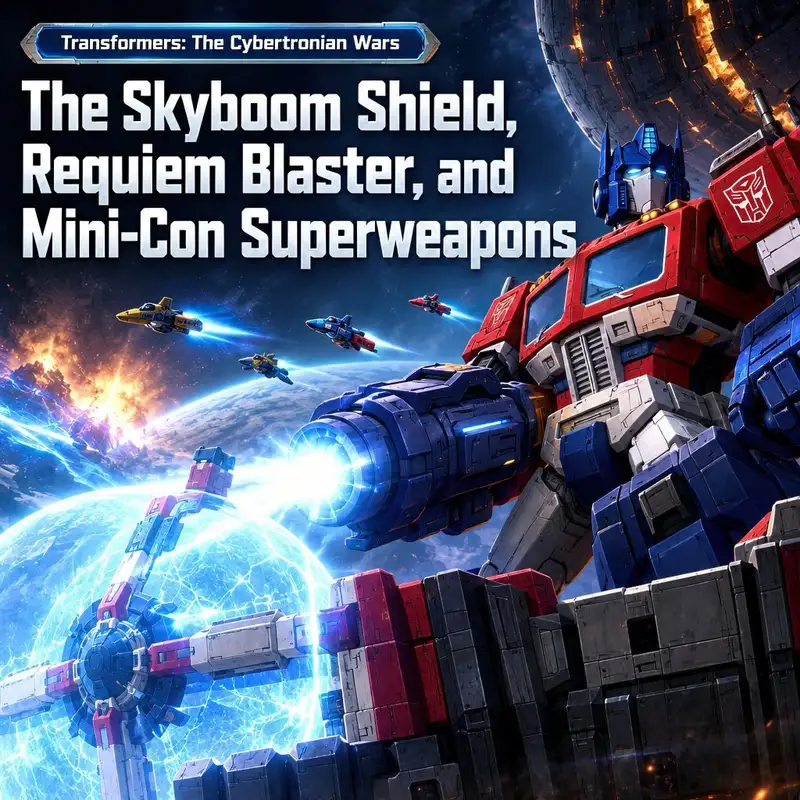
The Skyboom Shield, Requiem Blaster, and Mini-Con Superweapons
The weapon facing Earth was not built in a factory, purchased by a government, or issued to an army. It was assembled from nine captured Mini-Cons, each a small but sentient Cybertronian, and mounted aboard a Decepticon spacegoing platform. Megatron called the combined system the Hydra Cannon. Its immediate target was the Autobot base on Earth. Its practical threat was far wider. A weapon powerful enough to strike that base from orbit left no meaningful margin for error over a populated planet.
In the English-language history of Transformers: Armada, that crisis was the end point of a long contest over three Mini-Con weapons: the Star Saber, the Skyboom Shield, and the Requiem Blaster. Each was formed by a different three-member Mini-Con team. Each could be wielded by larger Cybertronians. Each could shift the outcome of a fight. Yet none gave its holder durable control of the war, because none was truly an object in the ordinary military sense.
The Mini-Cons were people. They could be frightened, loyal, resentful, divided, cooperative, resistant, or captive. Their ability to combine was the basis of every superweapon in this campaign. That meant a faction could not secure these weapons simply by finding the right components. It had to locate them, recover them, transport them, protect them, persuade or coerce them, and prevent the enemy from doing the same. The Hydra Cannon concentrated immense power, but it also concentrated every weakness created by that dependence.
The immediate Autobot problem was brutally simple. Megatron had brought the three weapon systems together before the Autobots could separate them again. The Decepticons had a firing platform, a target, and enough control over the Mini-Cons to activate the weapon. The Autobots faced a combined space assault, interception mission, rescue operation, and planetary-defense emergency. They also faced the possibility that their own presence on Earth had helped turn the planet into a battlefield hostage.
Optimus Prime’s final decision in that crisis was more than a duel with Megatron by other means. He had to judge whether a commander could preserve his own life and command authority while allowing a weapon of uncertain but clearly catastrophic potential to reach Earth. He chose to place himself and the Matrix between the blast and the planet. The act appeared to cost him his life. It did not end his existence permanently, but at that moment neither his soldiers nor Earth’s human population could know that.
To understand why nine Mini-Cons could place a planet in that position, it helps to begin with the political memory surrounding them. Armada presents the Mini-Cons as small Cybertronians whose partnerships can enhance the abilities of larger Autobots and Decepticons. Their size makes them easy to underestimate. Their strategic value makes that mistake dangerous. A single Mini-Con can alter a larger Transformer’s capabilities. A coordinated team of three can become something far more consequential.
The series offers an account of an earlier Cybertronian conflict in which Mini-Cons were exploited as power sources and weapons. According to that history, the Mini-Cons eventually escaped Cybertron and reached Earth in dormant panel form, where they remained for roughly four million years. That timeline is presented through an in-universe historical account, not through an archive beyond all doubt. Still, the political point is clear. The Mini-Cons had reason to fear being found by larger Cybertronians, because larger Cybertronians had used them before.
That past matters because the Armada war did not begin with a neutral contest for abandoned technology. Both major factions were pursuing beings who carried a history of exploitation. The Autobots generally sought partnership with the Mini-Cons, though even partnership could be complicated by military necessity. The Decepticons more often treated Mini-Con power as a resource to be seized and directed. Neither approach could ignore the basic fact that Mini-Cons had preferences of their own.
The dormant panels on Earth created a strategic scramble. They were scattered, portable, and capable of changing the balance between relatively small Autobot and Decepticon forces. Unlike a refinery, a shipyard, or a fortified city, a Mini-Con could move. Unlike a fuel reserve, a Mini-Con could decide not to cooperate. This made each discovery a mixture of reconnaissance, rescue, recruitment, and competition. It also meant that the war’s most valuable assets could appear in places where conventional military planning had little control.
The first great imbalance came from the Air Defense Mini-Con Team and its combined form, the Star Saber. In Armada, the Star Saber is not an artifact inherited from another Transformers history. It is a weapon created when three specific Mini-Cons combine. Once Megatron gained it, the weapon gave him a powerful close-combat advantage and a means of challenging opponents who might otherwise have been able to resist him on more equal terms.
Its importance was not limited to the damage it could inflict. A weapon like the Star Saber changes command behavior. It gives a leader greater confidence in personal combat. It can intimidate subordinates and rivals. It can force an enemy commander to devote resources to avoiding direct confrontation rather than pursuing broader operational goals. It also has symbolic value. Megatron’s possession of the Star Saber advertised that the Decepticons had found a way to convert Mini-Con power into visible battlefield superiority.
In a civil war, such symbolism can matter almost as much as the weapon itself. A faction that appears to possess an unbeatable advantage may attract defectors, frighten neutral parties, and convince its own members that victory is inevitable. Megatron’s authority was already built on strength, command presence, and the ability to keep a diverse Decepticon force moving in the same direction. The Star Saber reinforced that authority. It made his leadership look not only forceful, but increasingly difficult to challenge.
That answer lay with another Mini-Con team. Scavenger identified the Race Mini-Cons as the components of a weapon capable of countering the Star Saber. The team consisted of Dirt Boss, Downshift, and Mirage. Their combined form became the Skyboom Shield. The name suggests protection, and the weapon certainly performs that function. Yet its real strategic significance was more profound. The Skyboom Shield did more than save its wielder from attack. It prevented Megatron from converting the Star Saber into an unanswerable instrument of command.
Recovering the Race Mini-Cons was not a matter of pressing a button in a distant command center. The Decepticons had to identify the correct Mini-Cons, reach them before the Autobots did, physically secure them, and bring the team together. That required intelligence, mobility, and local control. The same small size that made Mini-Cons easy to conceal also made them difficult to track across an unfamiliar planet. Their ability to move independently turned recovery operations into races rather than simple salvage missions.
The Decepticons succeeded in obtaining the necessary components. In the confrontation that followed, Megatron used the completed Skyboom Shield while challenging Optimus Prime and the Star Saber. The result established the shield’s central military fact. It could directly resist the Star Saber. The Decepticon leader who had possessed the war’s most feared close-combat weapon now faced proof that his advantage had a limit.
That mattered because the shield changed the relationship between offense and defense. Before its appearance, the Star Saber encouraged a simple assumption: Megatron could force a decisive engagement and win it. Afterward, that assumption no longer held. A defender equipped with the Skyboom Shield could survive the initial strike, deny the attacker a rapid victory, and create time for allies to intervene. In military terms, the shield imposed caution on an adversary who had been able to act with increasing confidence.
The clash between the Star Saber and the Skyboom Shield produced a massive energy discharge, one that resembled the signal which had first drawn the Transformers toward Earth. No stable technical measure is given for that release. What matters is that the collision demonstrated how these weapons could make themselves impossible to ignore. A contest that had begun over scattered Mini-Cons now advertised its stakes across a far wider theater.
Superweapons tend to have that effect. They do not remain private advantages for long. Their use reveals capabilities, attracts attention, and changes the plans of every force that might be threatened by them. The Star Saber and Skyboom Shield became more than equipment carried by individual leaders. They became strategic signals. They told both sides that Mini-Con teams could produce weapons capable of shifting the war, and that control of those teams would become a central operational objective.
The battle also showed how quickly possession could change. The Autobots gained control of the Skyboom Shield after the confrontation, and the weapon became particularly associated with Smokescreen. That transfer did not erase the Decepticon achievement of finding and assembling the team. It demonstrated instead that portable, unique assets are difficult to defend everywhere. A faction may win the search, complete the assembly, and still lose the weapon in the next engagement if it cannot protect the Mini-Cons who make it possible.
For Smokescreen, the shield was more than a personal enhancement. It gave the Autobots a practical answer to the Star Saber and helped prevent Megatron from dictating every major confrontation. That is the deeper value of a countermeasure. It does not need to destroy the enemy’s weapon. It only needs to make that weapon less decisive. The Skyboom Shield restored uncertainty to a war that Megatron had hoped to simplify through superior force.
The next weapon raised the stakes in a different direction. During a period of mounting pressure from Decepticon operations and the arrival of Tidal Wave, Sideways revealed the existence of a third Mini-Con superweapon. The Requiem Blaster was formed by the Space Mini-Con Team: Astroscope, Payload, and Sky Blast. Where the Star Saber emphasized personal combat and the Skyboom Shield emphasized protection, the Requiem Blaster offered destructive power at a much greater scale.
Sideways’s information was useful, but that does not make Sideways a neutral authority. He was an intelligence manipulator with his own concealed loyalties and a habit of providing just enough truth to redirect other people’s decisions. His descriptions of the Requiem Blaster helped push both factions toward it. Yet any technical explanation he offered had to be treated with caution. Claims that the weapon drew on cosmic phenomena may have reflected weapon lore, propaganda, or knowledge beyond what the others possessed. They do not provide a reliable engineering manual.
Sky Blast was frightened. That fact is not incidental character decoration. It is central to the weapon’s military history. Sky Blast did more than wait to be collected and assembled. He resisted involvement because he understood the danger. The larger Autobots needed him, but their need did not erase his fear or his right to make a choice. The Requiem Blaster could not become available merely because an Autobot commander wanted more firepower.
Rad’s role in this episode was therefore more significant than that of a bystander caught in an alien war. He helped establish trust with Sky Blast. He was willing to accompany a frightened Mini-Con into a situation that larger Cybertronians viewed mainly through the logic of operational necessity. Rad could not command Autobot forces or determine overall strategy. But he could influence whether a crucial participant believed cooperation was possible. In this war, trust became part of the weapons supply chain.
Carlos and Alexis also mattered because the human partners served as intermediaries between groups with very different power, experience, and expectations. The children had local knowledge, mobility, and personal relationships with Mini-Cons. They could move through parts of Earth in ways that attracted less attention than a Cybertronian military operation. More importantly, they could treat the Mini-Cons as friends rather than components. That did not make them formal military officers, but it made them strategically relevant.
The Armada conflict repeatedly shows that small actors can affect large campaigns when they control access to trust. The Autobots possessed experience, weapons, and command structures. The humans possessed a different kind of access. They could speak with Mini-Cons outside the language of orders and battlefield necessity. This did not solve every ethical problem created by the war, but it gave the Autobots an advantage that did not depend solely on coercion.
Once the Space Mini-Con Team was brought together, the Requiem Blaster demonstrated why both sides had pursued it so urgently. Its battlefield effects were severe enough to threaten even powerful Cybertronians. Its exact yield, range, and rate of fire remain unspecified. Its destructive presentation varies with the circumstances of the story. The safer historical conclusion is that it was exceptionally dangerous, not that it can be translated into a precise number of destroyed targets or imaginary units of energy.
That uncertainty did not make the weapon less strategically important. Commanders rarely require laboratory-grade measurements before recognizing that an enemy capability has changed the situation. The Requiem Blaster forced both Autobots and Decepticons to account for the possibility of sudden, overwhelming firepower. It also created a further incentive to seize the Mini-Cons who formed it. Once a weapon becomes valuable enough, its users become targets.
Thrust understood this well. He was more than another Decepticon present in the background of Megatron’s campaigns. He functioned as a strategist, and his operation to capture the Requiem Blaster team showed a clear appreciation of the problem. Direct assault against prepared Autobots could be costly. A better approach was to divide their attention, use distraction, exploit timing, penetrate their base defenses, seize the actual Mini-Con components, and extract them before the defenders could reorganize.
In the operation known as Sacrifice, Starscream served as the diversion while Decepticon forces moved against the Autobot base. The plan worked. The Decepticons captured the Mini-Cons needed to form the Requiem Blaster. From a narrow tactical perspective, it was a successful raid. The attackers reached their objective, overcame resistance, and removed a high-value asset from enemy custody. Such results matter. They demonstrate that even a powerful Autobot base could be penetrated when deception and timing were used effectively.
Smokescreen’s defense of the base also revealed the cost of that success. He resisted the attack and was badly damaged in the effort. The immediate result was more than the loss of a weapon team. It was a blow to Autobot security, a loss of defensive capacity, and a reminder that the Autobots could not assume their alliance with Mini-Cons guaranteed protection. A base is not secure because it possesses a powerful artifact. It is secure only if it can detect, repel, and recover from a determined assault.
The raid exposed a larger operational weakness. The Autobots had concentrated valuable Mini-Con teams in a known location. That concentration made it easier to protect them under normal conditions, but it also created an inviting target for an enemy capable of mounting a coordinated strike. The same problem would later confront the Decepticons. Once a faction gathers rare, irreplaceable assets in one place, it gains temporary control while accepting the risk that one successful raid could unravel the entire arrangement.
Starscream’s role deserves more attention than a simple label of betrayal or loyalty can provide. At this stage of the war, he remained tied to Megatron’s command, yet his relationship with that command was increasingly unstable. His participation in the diversion showed that Megatron could still use him operationally. It did not prove that Starscream accepted Megatron’s political authority without reservation. In a force held together by fear, ambition, and personal rivalry, obedience on one mission does not guarantee reliability in the next.
The distinction matters because the Decepticons’ superweapon program required more than Megatron’s personal strength. It required planners like Thrust, field personnel like Starscream, guards, transport, technicians, and enough coordination to keep the Mini-Cons captive and available. Megatron could dominate a room or win a duel. He could not personally secure every component, operate every facility, and suppress every internal doubt. The more valuable the weapons became, the more his command depended on subordinates whose interests did not always match his own.
The consequences became clearer at the Decepticon moon base. In Rescue, Starscream temporarily aligned himself with the Autobots, giving them access to the Decepticons’ larger project and helping enable an infiltration effort. The shift was important not because it revealed a universal truth about Starscream in every Transformers history, but because it showed the limits of Megatron’s control in this specific war. A subordinate with access to sensitive facilities can become a serious vulnerability when loyalty fractures.
At the moon base, captured Mini-Cons were being compelled to work in support of a Decepticon construction effort. The exact industrial details are less important than the principle. The Decepticons had converted captives into forced labor for a larger military project. That may produce immediate output. It may keep a weapon system functioning long enough for a campaign. But it is not the same as building a stable industrial base or winning the allegiance of the people doing the work.
Coercion creates its own requirements. Captives must be guarded. Facilities must be secured. Communications must be controlled. Escape routes must be watched. Sabotage must be anticipated. Every guard assigned to control unwilling labor is a guard not available for combat elsewhere. Every forced worker is a possible intelligence source, a future saboteur, or a symbol around which resistance can form. The Decepticons possessed military force, but force did not turn the Mini-Cons into willing members of their political order.
The Mini-Cons’ collective resistance and escape made that limitation visible. Their small bodies did not make them politically insignificant. They could deny labor, evade control, communicate with allies, and withdraw the cooperation that larger Cybertronians needed. The weapons campaign had begun with factions chasing Mini-Con power. It increasingly became clear that Mini-Con consent was itself a form of power. A superweapon could be assembled from three Mini-Cons, but it could not be made politically secure if those three Mini-Cons rejected the purpose for which they were being used.
This was the weakness hidden inside the Decepticon advantage. Megatron could capture components. Thrust could design raids. Sideways could offer intelligence. The moon base could hold prisoners. But none of those things created legitimacy. The Decepticons had custody, not partnership. Custody can be enough for a short operation. It is much less reliable for a long war, especially when the captive population understands that its labor is being used to threaten entire worlds.
The movement from separate weapons toward the Hydra Cannon therefore represented more than an escalation in firepower. In Threaten, the Decepticons tested their developing combined system against a comet. The test demonstrated that they were no longer thinking in terms of isolated duels or defensive countermeasures. They were working toward a strategic delivery system. The objective was to combine the Star Saber, Skyboom Shield, and Requiem Blaster into a single weapon capable of projecting force far beyond a battlefield encounter.
The Hydra Cannon should not be understood as merely a larger gun. It required all three Mini-Con weapons. It required Decepticon possession of the relevant Mini-Con teams. It required a space-capable platform to carry and aim the combined system. It required crew, coordination, targeting, and enough protection to keep the Autobots from disrupting the operation before firing. It also required Megatron to believe that the political risks of using such a weapon were acceptable.
Those requirements reveal the difference between tactical firepower and operational architecture. A soldier can carry a weapon into a fight. A strategic weapon must be found, assembled, moved, defended, supplied, and employed at the correct time and place. The Hydra Cannon gave the Decepticons a temporary strategic system. It did not give them a mass-produced arsenal. There is no evidence in Armada that they could replicate the Mini-Con teams, manufacture additional Hydra Cannons, or replace losses through ordinary industrial means.
Its rarity made the weapon powerful and fragile at the same time. An ordinary army can lose rifles, vehicles, or even artillery pieces and replace them if it retains production capacity and supply lines. The Hydra Cannon depended on nine unique individuals. If one Mini-Con escaped, resisted, or was recovered by the Autobots, the system could fail. If the firing platform were disabled, the weapon might become useless. If internal Decepticon loyalty broke down, custody could become contested. Concentrated power can produce dramatic results, but it also creates a very small number of points of failure.
When Megatron turned the Hydra Cannon toward Earth, those failures became the Autobots’ opportunity and Earth’s danger. His stated objective was the Autobot base. Yet a weapon of that scale could not be treated as a precise headquarters strike in any ordinary sense. The base existed on a living, inhabited planet. A missed shot, an uncontrolled discharge, or an escalation beyond the original plan could endanger millions who had no voice in the Cybertronian war.
Earth therefore ceased to be merely the location of the Autobot base or the hiding place of dormant Mini-Cons. It became a hostage. Human civilians did not choose to become participants in Megatron’s campaign, but the weapon made them directly vulnerable to it. The Autobot-human relationship was tested under the most severe conditions. The Autobots had sought allies and refuge on Earth. Now they had to prove that their presence would not simply bring destruction down on the people who had helped them.
At this point, the political consequence of superweapons becomes clearer than the technical one. The Hydra Cannon did not need to destroy Earth to alter the war. By threatening Earth, it forced the Autobots to divert attention from every other objective. It turned military resistance into planetary defense. It placed human lives at the center of Autobot decision-making. And it gave Megatron a coercive tool that went beyond defeating enemy soldiers. He could use the possibility of catastrophe to shape the choices of everyone confronting him.
Yet coercion of that kind has limits. It can compel emergency action, but it rarely creates lasting loyalty. It can make an enemy desperate, but desperation can also produce resistance that would not otherwise have formed. Megatron’s use of the Hydra Cannon did not persuade Earth to accept Decepticon rule. It did not resolve the internal weaknesses of the Decepticon command. It did not eliminate the Mini-Cons’ independent will. It widened the war and sharpened the moral line between gaining advantage and holding legitimate authority.
The Autobot response had several purposes at once. They needed to attack the Decepticon platform. They needed to stop the weapon from firing. They needed to protect or free the Mini-Cons trapped within the system. They needed to preserve their own command structure while facing a crisis that could kill their leader. These missions could not be separated neatly. An attack strong enough to destroy the platform might endanger the Mini-Cons. A rescue attempt might leave the weapon operational. A delay might leave Earth exposed.
That is why Optimus Prime’s intervention carried such weight. When the cannon discharged, he used the Matrix to absorb or redirect the blast and placed himself between the weapon and the planet. The series presents the act as a sacrifice, and it should be understood that way. He accepted personal destruction, or what appeared to be destruction, in order to prevent the weapon from reaching Earth. The immediate recovery of only his Matrix and debris left the Autobots without certainty that their commander would return.
The effect on the Autobots was both emotional and institutional. Losing a commander in combat is never only a matter of grief. It raises questions of succession, command continuity, morale, and strategic purpose. Optimus had been the central figure holding together an alliance of Autobots, Mini-Cons, and human partners under extraordinary pressure. His apparent death created a leadership crisis at precisely the moment when the war was expanding beyond ordinary Earth operations toward the larger threat surrounding Unicron.
Megatron, meanwhile, had failed to translate the Hydra Cannon’s immense potential into victory. Earth survived. The Autobot movement survived. The Mini-Cons remained a contested source of power rather than a permanent Decepticon possession. The operation had demonstrated Decepticon reach and ruthlessness, but it had also exposed the cost of relying on a weapon that required so much coercion, concentration, and protection. A system designed to secure victory had instead deepened the war and created new enemies.
The later Unicron crisis reframed the entire campaign. In Origin, the connection between the Mini-Cons, the three weapons, and Unicron’s interior became clear. The weapons were more than isolated inventions discovered during the Earth campaign. They were tied to a larger design in which Cybertronian conflict could be intensified and exploited. That revelation changes how the audience understands the weapons, but it should not be overstated. It does not prove that Unicron personally scripted every battle, every raid, or every decision made by Megatron, Thrust, or the Autobots.
Cybertronian leaders still made choices. Megatron chose to pursue power through coercion. Thrust chose to develop a raid plan. Starscream chose when to obey and when to break away. Optimus chose to protect Earth at personal cost. The Mini-Cons chose, repeatedly, whether to cooperate, flee, resist, or return. Unicron’s influence helps explain why the weapons mattered within a larger pattern of conflict. It does not remove moral responsibility from the people who used them.
The final reversal is especially revealing. The Requiem Blaster, once sought as a means of gaining dominance over other Cybertronians, was used against Sideways’s shell after the Mini-Cons collectively resisted the system that had tried to manipulate them. The weapon became effective not because a larger commander finally achieved perfect ownership of it, but because Mini-Con agency turned against the force exploiting the war. The smallest participants in the struggle helped determine the fate of the largest weapon systems.
That is the central lesson of Armada’s Mini-Con superweapons. The Star Saber, Skyboom Shield, and Requiem Blaster did not fail because they lacked power. They changed individual battles, constrained commanders, redirected raids, and made Earth vulnerable to planetary coercion. Their limitation was political and institutional. They rested on contested persons, not on stable production, secure supply, or legitimate cooperation.
Megatron could seize Mini-Cons, but he could not make captivity into lasting loyalty. The Autobots could protect Mini-Cons, but they also had to earn their trust rather than assume it. The Skyboom Shield proved that no single weapon remained supreme once an opponent developed a countermeasure. The Requiem Blaster proved that raw firepower depended on the willingness of those who formed it. The Hydra Cannon proved that combining extraordinary capabilities could endanger a planet without securing victory.
In Armada, the decisive limitation of the Mini-Con superweapons was never their firepower. It was the freedom of the Mini-Cons inside them.