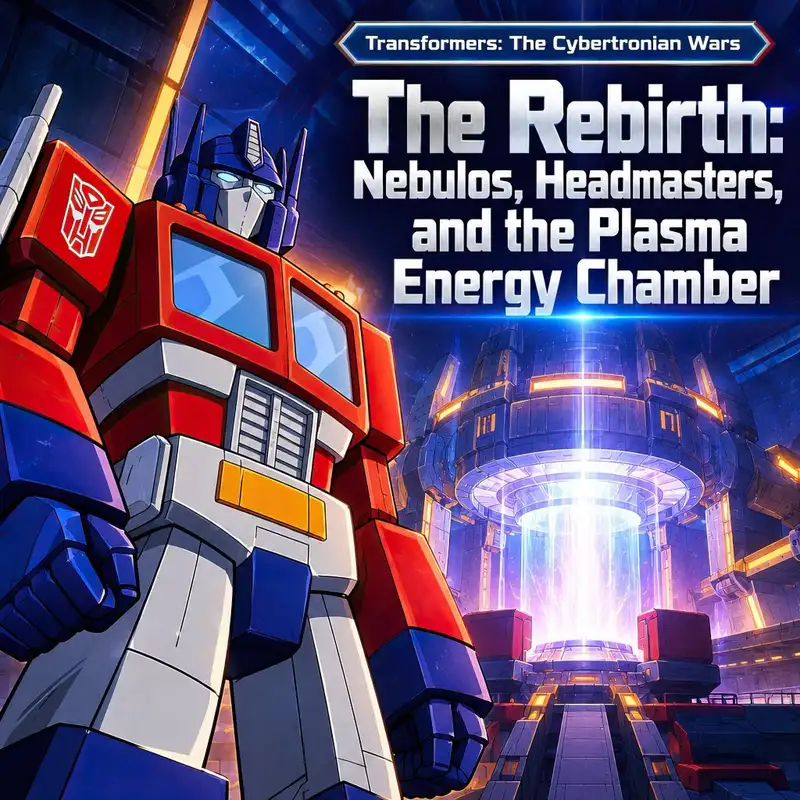
The Rebirth: Nebulos, Headmasters, and the Plasma Energy Chamber [Cartoon]
Several months after the Hate Plague crisis, Autobot City appears to have returned to something like routine. Goldbug and the Technobots are on hand when the Decepticons strike without warning. It looks like a conventional assault, loud enough to draw every available defender into the fight. That is precisely the point. The battle outside is not the operation. It is the distraction that makes the operation possible.
While the defenders are fixed in combat, two Decepticon infiltrators, Pounce and Wingspan, enter the Autobot vaults. Their target is small enough to carry and important enough to endanger worlds: the Key to the Plasma Energy Chamber. The theft demonstrates a basic rule of strategic warfare. The most valuable objective is not always the fortress, the army, or the city under attack. Sometimes it is the one item that opens a system nobody can afford to let an enemy control.
The Plasma Energy Chamber is described as an ancient forge associated with the creation of the original Autobot bodies. In this story, it is a sealed reservoir of immense plasma energy, one connected to Cybertron’s deep past and its physical infrastructure. It is not presented as the AllSpark, and the episodes do not establish that it is identical to Vector Sigma. What matters is simpler and more alarming. Whoever opens the chamber can release power on a planetary scale.
Galvatron’s objective is therefore not a raid for supplies or a bid to defeat a few Autobots in battle. He is seeking leverage over Cybertron itself. The key gives him access to an ancient system whose destructive potential appears to exceed the control of ordinary military weapons. The Decepticons have turned a city assault into cover for an infrastructure operation. By the time the Autobots recognize the real target, the strategic problem has already moved beyond Autobot City.
Optimus Prime understands the danger quickly. The theft cannot be treated as an isolated security failure. The key must be recovered before Galvatron can reach the chamber. The Autobots pursue the Decepticons back to Cybertron, where the conflict becomes a race between forces that possess the key, forces that understand its significance, and forces that hope they can survive whatever opening the chamber will unleash.
At the chamber, Galvatron uses Scourge as the immediate instrument of access. Scourge opens the system and is nearly destroyed by the plasma released in the process. The moment is revealing. Galvatron has gained entry, but entry is not the same as control. The Decepticons can activate an ancient energy source, yet the energy is plainly dangerous even to the force attempting to use it. Strategic escalation often begins with that mistake: treating access to a weapon as proof that one can govern its consequences.
The Autobots recover the key, but the immediate success does not restore the situation. The release of plasma energy strikes their ship and throws it far from Cybertron. In a few moments, a pursuit operation has become an unplanned expedition. The Autobots have been displaced, their transport damaged, their communications and support uncertain, and their mission transformed by geography.
The Decepticons later recover Scourge and resume the pursuit. Galvatron’s larger plan remains active. He intends to exploit the Plasma Energy Chamber in a way that threatens not only Cybertron but Earth’s sun. The story never provides an engineering manual for the chamber or a precise account of every mechanism involved. It does make the strategic effect clear. Galvatron is willing to use Cybertron’s ancient energy infrastructure as a coercive weapon, even if the result places entire worlds at risk.
The damaged Autobot ship comes down on Nebulos, a world neither side expected to become central to the crisis. That matters because Nebulos is not an empty battlefield waiting for visiting Cybertronians to decide its future. It already has a political order, an occupied population, a resistance movement, and a ruling elite that maintains power through machinery and fear.
The Nebulans are humanoid inhabitants of the planet, and their society is ruled by the Hive. The Hive consists of eleven telekinetic rulers whose own bodies have become withered, while their authority rests on control of machines that police and dominate the wider population. Lord Zarak leads them. The arrangement is authoritarian in a very practical sense. The Hive does not need popular legitimacy when it possesses the infrastructure of coercion.
Nebulan resistance fighters initially mistake the Autobots for Hive-controlled machines. Given what they know, that suspicion is sensible. To a population ruled through mechanical enforcers, the arrival of large armed machines is not automatically a promise of liberation. It may simply look like another arm of the occupation. First contact is shaped by experience, and Nebulos has taught its people that machinery can be an instrument of subjugation.
Gort leads the resistance. His fighters understand the Hive’s systems, know the weaknesses of its machines, and possess the local knowledge that an outside expeditionary force lacks. But they do not have the firepower to break the Hive’s control on their own. Their problem is not courage or political will. It is capability. They can identify the vulnerable points in the enemy’s system, but they cannot reliably reach or destroy those points.
The Autobots arrive with the opposite problem. They possess armor, mobility, weapons, and experience against Decepticons, but their ship has crashed. They have no secure base, no familiar supply network, and no dependable repair infrastructure. They do not know the terrain, the political factions, or the technical details of the Hive’s control systems. Their strength is real, but it is poorly matched to the immediate environment.
The crisis becomes more severe when the Decepticons capture several Autobots, including Hot Rod, Kup, Blurr, Crosshairs, Pointblank, and Sureshot. The loss is not just personal. It deprives the remaining Autobots of combat strength, experienced personnel, and options. Meanwhile, Daniel Witwicky is badly injured. The Autobots now face the sort of emergency that advanced technology never entirely removes: damaged personnel, limited medical resources, and an unfamiliar world where even a successful retreat may not be possible.
The situation on Nebulos is therefore not resolved by announcing that the Autobots are stronger than the Hive. They are not operating from a position of simple superiority. They need local intelligence. They need access to the captured Autobots. They need to protect Daniel. They need to understand the Hive’s machinery. And they need to do all of this while the Decepticons remain active and Galvatron’s larger operation continues on Cybertron.
Brainstorm proposes the radical solution that defines the rest of the story. The Nebulans can become direct operators of Cybertronian bodies through specialized exosuits. In the resulting Headmaster arrangement, the Nebulan partner becomes the head component of a Cybertronian body. The process is presented as a practical military and medical response to the situation, not as a fully explained scientific theory. The cartoon never provides a complete account of its biology, its long-term consequences, or every limit on the connection.
What it does establish is an extraordinary redistribution of responsibility. The Autobots agree to a procedure involving the removal of their heads. Nebulan partners accept direct operational roles inside alien bodies built for war. This is not just an upgrade in the usual sense. It changes who perceives the battlefield, who makes immediate decisions, and who bears the physical risk of combat.
Duros becomes Hardhead’s partner. Arcana joins with Brainstorm. Stylor becomes Chromedome’s partner. Gort works with Highbrow. Daniel, whose injuries make the procedure especially urgent, becomes Arcee’s partner. Each pairing is a collaboration between people who previously possessed very different forms of knowledge. The Cybertronians bring bodies designed for mobility, armor, and heavy weaponry. The Nebulans bring local experience, technical understanding, and a direct stake in the liberation of their world.
The arrangement is not the same as a claim that the Nebulans become less important because they are now attached to Cybertronian bodies. The opposite is true. Their importance becomes operationally visible. Before the Headmaster process, the resistance knows where the Hive is vulnerable but cannot exploit that knowledge at sufficient scale. Afterward, Nebulan intelligence can move through hostile territory, survive enemy fire, and direct Cybertronian weapons against targets that matter.
This is combined arms in the broadest sense. The effectiveness does not come from one side possessing every capability. It comes from integrating capabilities that had previously been separated. The Autobots have the means to strike. The Nebulans understand where the strike should fall. Neither side can solve the problem alone.
There is also a political dimension. The Nebulans are no longer passive civilians awaiting rescue by off-world warriors. They become active participants in their own liberation. The distinction matters because military victory imposed from outside can replace one dependency with another. Here, the resistance gains the ability to act on its own intelligence and for its own objectives, even though the technical means are Cybertronian.
The Headmasters prove their value against the Hive’s machines. Guided by Nebulan knowledge, they attack the systems that maintain the occupation and use their new capabilities to rescue the captive Autobots. The tactical result is straightforward. Hive machines that had been difficult for the resistance to defeat are destroyed or disabled. The operational result is larger. The resistance now possesses maneuver, protection, and firepower that can contest the Hive’s control of the planet.
The political result is larger still. The Hive’s claim to authority rests on the idea that its machinery is unavoidable. Its rulers possess the machines, therefore they possess the planet. The Headmasters challenge that claim by demonstrating that control systems can be understood, penetrated, and defeated. A machine empire is still an empire, and its apparent inevitability depends on the belief that nobody can reach the machinery behind the throne.
Nebulos is not fully liberated at this stage. The Hive still exists. Zarak remains powerful. The Decepticons are still present. But the balance has shifted because the resistance now has a way to convert knowledge into force. That shift is more significant than any individual transformation sequence. It changes the relationship between the occupied population, the outside allies, and the regime that had ruled through technological intimidation.
While Nebulos reveals the value of cooperation, Cybertron reveals another and more troubling interpretation of the crisis. Optimus Prime and Ultra Magnus investigate the danger at Vector Sigma. Prime uses the Matrix to establish contact with Alpha Trion, seeking an explanation for the Plasma Energy Chamber, Galvatron’s discovery, and the larger pattern now emerging around Nebulos.
Alpha Trion’s account is the episode’s explanation, but it should be understood as an in-universe revelation rather than an independently verified historical record. He says that Vector Sigma arranged for Galvatron to learn of the Plasma Energy Chamber. The crisis, in this account, was not just a Decepticon scheme discovered by chance. It was part of a larger design intended to bring about a second Golden Age for Cybertron.
That explanation creates as many ethical questions as it answers. If an ancient Cybertronian system allowed, encouraged, or engineered the conditions for Galvatron’s discovery, then the resulting danger was not just the product of enemy action. Cybertron, Earth, and Nebulos were all placed at risk by a plan they did not choose and could not fully understand.
The promised result may be renewal, but the method is catastrophic. Galvatron gains access to destructive energy. Earth’s sun is endangered. Nebulos becomes a battlefield. Civilians remain under the Hive’s domination while outside powers introduce new weapons and new alliances. Even if the predicted Golden Age is genuine, the story leaves room to question whether any ancient authority has the right to gamble with living societies in order to produce a desired future.
Alpha Trion also identifies a condition for that future. A human life must merge with that of an Autobot. This points toward Spike Witwicky. Spike is not introduced here as a ceremonial chosen one standing outside the action. He is already an experienced human ally of the Autobots, familiar with Cybertronian systems and deeply involved in the crisis on Nebulos. The ancient prediction does not replace his judgment. It identifies his participation as necessary within a larger network of decisions.
That distinction matters because prophecy can be politically dangerous. It can encourage leaders to treat ordinary people as pieces in a plan devised elsewhere. The Rebirth avoids making Spike’s role purely passive. He is not carried toward the resolution by fate alone. He contributes technical understanding, accepts risk, works with the Nebulans and Autobots, and takes part in the difficult work of turning a destructive system toward another purpose.
The Decepticons, meanwhile, adapt quickly to the new military technology on Nebulos. Captured by the resistance, they are offered a version of the same solution that created the Autobot Headmasters. Lord Zarak sees opportunity in the arrival of Cybertronian technology. Galvatron sees opportunity in anything that can restore his field forces and advance his larger campaign.
The resulting Decepticon arrangements include the Horrorcons, Apeface and Snapdragon, becoming Headmasters. Other Decepticons accept Nebulan partners who transform into weapon systems, creating the Targetmasters. Cyclonus and Scourge are central to this new Decepticon force. A Targetmaster is not a separate species or a universal category of Cybertronian development. In this story, it is a partnership in which a Nebulan operator becomes a weapon component for a Cybertronian combatant.
The Decepticons have therefore achieved rapid technological adaptation. They can copy the broad military logic of the Headmaster system and extend it into Targetmaster weapons. On the battlefield, that gives them a way to restore strength, improve flexibility, and deny the Autobots a monopoly on the new technology. But technological parity is not the same thing as political cohesion.
Zarak’s interests do not fully align with Galvatron’s. Zarak wants to preserve and expand the Hive’s power over Nebulos. He sees the new technology as a means to turn his regime’s existing infrastructure into a more formidable instrument of domination. Galvatron, by contrast, treats Nebulos as another piece on the board. He has no reason to regard the Hive as an equal ally once its usefulness ends.
The alliance is therefore built on coercion and convenience. Galvatron needs Zarak’s resources and access to Nebulos. Zarak needs Decepticon military power. Neither side has created the kind of trust that exists between the Autobots and the resistance. The Decepticons have matched the machinery, but they have not matched the political relationship that made the Autobot Headmasters effective.
This difference becomes important when the conflict expands from individual bodies to city-scale systems. Brainstorm scans the Decepticon Targetmaster Nightstick, giving the Autobots information about the enemy’s new technological arrangement. Spike uses that knowledge to help develop a countermeasure. Once again, the decisive advantage comes not from raw power but from analysis, adaptation, and the willingness to combine different forms of expertise.
Zarak responds by transforming the Hive’s city into Scorponok. This is more than a larger robot entering the battle: it is infrastructure converted into combat power. The city that had served as the physical center of the Hive’s authority becomes a mobile weapon under Zarak’s command. The transformation expresses the logic of his rule with unusual clarity. If the city cannot remain secure through political control, then it will remain secure through militarization.
Scorponok is a strategic asset because it concentrates mobility, weaponry, and command in an existing center of power. The story never establishes exact dimensions, population capacity, or the ability to manufacture such systems routinely. It does establish that a city can be turned into a weapon when a ruler has the technical means and the willingness to treat civilian infrastructure as an extension of personal authority.
The Autobots answer with Fortress Maximus. Spike and Cerebros become the core of this Autobot city-former. The contrast with Scorponok is not absolute. Fortress Maximus is also a massive military system and also emerges from extraordinary technology. But its command structure reflects cooperation rather than coercion. Spike’s role is not just to activate a machine. He is part of the partnership that allows Cerebros and Fortress Maximus to function against Zarak’s force.
The battle between Scorponok and Fortress Maximus is significant because it shows how rapidly an insurgency and occupation crisis can become a contest of super-heavy assets. Yet the battle does not settle everything. Fortress Maximus checks Scorponok, and the immediate threat to the resistance is reduced. Zarak and the Decepticons withdraw rather than being decisively eliminated. Tactical victory on Nebulos does not end the larger war because Galvatron’s operation on Cybertron remains active.
This is one of the story’s clearest lessons in strategic scale. A city-former can dominate a battlefield and still fail to resolve the political conflict that produced the battle. Scorponok’s retreat does not dismantle the Hive. Fortress Maximus’s success does not repair Cybertron’s energy system. Giant systems can shift the balance, but they do not by themselves create peace, legitimacy, or a durable settlement.
Galvatron now escalates the crisis again. On Cybertron, he activates a massive planetary engine. The engine moves Cybertron back toward Earth and places the planet in position for the Plasma Energy Chamber’s effect to endanger the solar system. The mechanism is extraordinary, apparently unique, and far beyond anything the episodes present as routine military doctrine. This is not an ordinary ship movement or a conventional invasion route. It is a planetary infrastructure system used as a weapon.
The Plasma Energy Chamber’s released energy reaches Earth’s sun and triggers a solar emergency. The scale is deliberately immense, but the story does not require unsupported calculations to make the danger clear. The sun has absorbed excess plasma energy. The resulting catastrophe threatens Earth and the wider solar system. Stopping Galvatron from releasing more energy is necessary, but it is no longer enough. The energy already sent outward must also be dealt with.
Galvatron has achieved immediate destructive effect. He has accessed ancient infrastructure, activated the planetary engine, and created a crisis that no local battlefield victory can solve. Yet he has not achieved a meaningful political end state. He can hold worlds hostage. He can threaten annihilation. He cannot demonstrate a plan for governing what remains after the destruction.
That is the weakness at the center of his strategy. Coercive power can force attention, but it cannot substitute for a viable order. Galvatron’s plan treats Cybertron, Earth, and Nebulos as objects to be manipulated. It does not account for the fact that societies must survive the systems used to dominate them. A weapon capable of destroying the conditions of life is not automatically a weapon capable of producing obedience, much less a stable victory.
The final response depends on Spike, but it does not depend on Spike alone. The Autobots, Nebulan partners, and resistance fighters infiltrate Scorponok. Their immediate objectives are practical. They must rescue Arcee and Daniel, regain access to the systems being used by the enemy, and shut down the Plasma Energy Chamber before the catastrophe becomes irreversible.
The rescue of Daniel and Arcee matters because the Headmaster partnerships are not disposable equipment. Daniel’s connection to Arcee was created under emergency conditions, but it involves a human life and a Cybertronian life operating in direct dependence on one another. The story treats their recovery as part of the mission, not as a secondary concern behind the larger strategic objective.
The infiltration also shows the limits of simply defeating a giant asset from outside. Scorponok can be checked in battle, but the systems inside it still matter. The enemy’s command, prisoners, and technical controls remain embedded within the converted infrastructure. In military terms, neutralizing a platform is not always the same as securing it. The force that controls the internal systems may still determine whether the wider crisis continues.
The Autobots and their allies shut down the Plasma Energy Chamber. That is a tactical success. It stops the immediate source of further plasma release. But the solar problem remains. Earth’s sun has already received excess energy, and shutting the chamber does not cause that energy to vanish. The crisis has passed beyond destruction prevention and entered the harder phase of restoration.
Spike’s importance now becomes clear. He has contributed technical adaptation from the beginning, including work based on the scan of Nightstick. He has become part of the Cerebros and Fortress Maximus system. He is also the human participant identified by Alpha Trion’s account of the second Golden Age. But his decisive role is not mystical in isolation. He helps make possible the cooperative control of systems that neither humans, Nebulans, nor Cybertronians could have managed independently.
Spike and the Nebulans reverse the planetary engine. Instead of continuing to project destructive energy outward, the engine draws the excess solar energy inward toward Vector Sigma. The same broad infrastructure that Galvatron used to threaten the solar system is redirected toward containment and recovery. This is the central reversal of The Rebirth. The answer to a technological crisis is more than a larger weapon: it is a different political use of the technology.
The results unfold at several levels. Tactically, the chamber is shut down. Operationally, the planetary engine is reversed. Strategically, the solar catastrophe is contained before it destroys the system Galvatron sought to hold hostage. Industrally, Cybertron’s energy is restored through Vector Sigma. The planet returns to the golden condition the story calls a second Golden Age.
That outcome should not be reduced to Spike as a lone savior. The resolution requires Nebulan knowledge, Autobot access to Cybertronian systems, Cerebros’s participation, the Headmaster partnerships, the resistance’s struggle against the Hive, and the infrastructure of Cybertron itself. Spike is decisive because he stands at the intersection of those elements. He is the human agent able to cooperate across boundaries that Galvatron’s strategy attempts to erase.
The restoration also changes the meaning of the Headmaster system. Cerebros, exhausted by the conflict, asks Spike to deactivate him permanently. It is a request that recognizes the cost of war and the burden placed on beings turned into strategic assets. Cerebros has helped operate Fortress Maximus in a fight that demanded enormous power, but victory does not make that experience painless or automatically sustainable.
Spike refuses. His response is not that the Headmasters must continue fighting forever because they are useful weapons. Rather, the restored Cybertron changes the purpose of their partnership. A system created in emergency can now be used to protect and rebuild. The distinction is important. Technology born in war does not have to remain permanently organized around war, though changing its purpose requires deliberate political choice.
Optimus Prime assigns the Headmasters and Targetmasters to remain on Nebulos and eliminate the remaining Hive machines. This is a security and reconstruction mission. The Hive’s control systems have not disappeared merely because Scorponok was checked and the solar catastrophe was contained. Nebulos still requires protection from the machinery of its former rulers.
The ending does not provide a complete constitution for Nebulos. It never explains every question of demobilization, justice, political representation, or the fate of every former collaborator. It does show that liberation requires more than a battlefield victory. The remaining Hive machines must be removed because infrastructure built for domination can continue to threaten a society long after its rulers have lost a major battle.
The Decepticons also survive. Galvatron and Zarak remain active, hostile, and distrustful of one another. Their alliance has delivered dramatic tactical capabilities, but it has not created durable unity. They retreat into exile rather than accepting a political settlement. The restored Cybertron is therefore not proof that all Decepticon activity has ended or that the old war has been permanently resolved.
The second Golden Age is best understood as restored capacity, not completed peace. Cybertron has energy again. Its ancient systems have been redirected toward renewal. The immediate solar catastrophe is over. But energy restoration is not the same thing as reconciliation. A planet can regain power without settling every grievance, dismantling every war machine, or establishing a lasting political order.
The Rebirth begins with a stolen key and ends with the reversal of a planetary engine, but its deeper conflict is over who gets to use infrastructure and knowledge. Galvatron turns systems into instruments of coercion. Zarak uses technology to preserve dictatorship. The Nebulan resistance, Spike, and the Autobots combine local knowledge, human initiative, and Cybertronian capability to break those systems open and restore conditions under which a society can function.
That is why Spike becomes decisive without displacing the roles of Optimus, the Autobots, or the Nebulans. Each contributes something the others lack, and the solution only works when those capabilities are joined. The restored Cybertron is not proof that the larger war has disappeared. It is a demonstration that civilization depends on what power is used for. The same kind of infrastructure can hold worlds hostage or make life possible again, and the difference lies in who controls it, why they control it, and whether anyone else is allowed to live under the result.