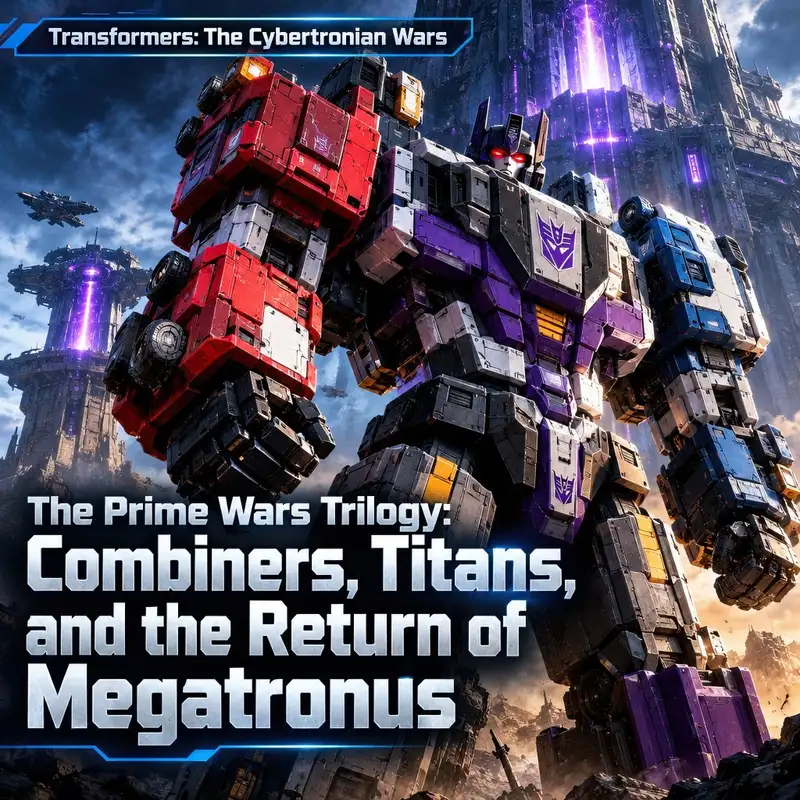
The Prime Wars Trilogy: Combiners, Titans, and the Return of Megatronus
Metroplex and Trypticon do not meet on an empty battlefield. Their struggle unfolds around the places where Cybertronians live, work, travel, and expect government to protect them. Buildings shake. Evacuation becomes urgent. Civic authorities must preserve communications and move civilians while one of their own cities becomes a combatant. The immediate military question is how to stop Trypticon. The deeper political question is harder. Who has the right to command a being that is at once a citizen, a city, and the largest weapon on the planet?
In the animated Prime Wars Trilogy, that question is the endpoint of a wider failure. This is not the history of the Generation One cartoon, the I D W comics, or the Aligned continuity. It is the connected web-series story told through Combiner Wars, Titans Return, and Power of the Primes. Its Cybertron has survived the Great War on Earth and entered a dangerous postwar period. The old factions have not vanished from memory, but the formal Autobot and Decepticon war machines have largely been disbanded. Peace exists. So does distrust.
Roughly four decades after the war, Cybertron is governed by a triumvirate. Starscream holds political authority. Rodimus Prime represents the prestige and burden of Prime leadership. The Mistress of Flame brings the civic and religious-political standing of Caminus, a world and community with its own traditions and interests. On paper, this arrangement offers balance. In practice, it divides authority among personalities, offices, histories, and constituencies that do not always agree on what security requires.
That divided authority matters because the trilogy is not mainly about larger and larger combatants. It is about a society that repeatedly encounters an exceptional source of power before it has agreed on who may control it, how that control can be limited, or what happens when the controller loses legitimacy. First comes the Enigma of Combination and the prospect of Combiner armies. Then come the Titans, whose battles turn infrastructure into a front line. Finally comes Megatronus, who attempts to make every Cybertronian life subordinate to one ancient grievance.
The initial crisis begins on Caminus. Two combined beings, Computron and Menasor, emerge from a space bridge and fight. The appearance of a space bridge is strategically important. It means danger does not need to advance through a conventional frontier. An armed force can arrive suddenly at a politically sensitive location, bypassing the warning time that cities and governments normally need to organize a defense.
Windblade and Maxima intervene in the fighting. Maxima is killed. The loss matters not because the series pauses for a detailed casualty accounting, but because it establishes the cost of treating extraordinary power as an abstract security problem. A battle between Combiners is never merely a dispute among unusually large soldiers. It places everyone nearby at risk. It also demonstrates that a combined body can concentrate enough force to overwhelm ordinary defenders before political leaders have even agreed on a response.
A Combiner, in this story, is more than a Transformer who happens to be larger. Combination joins multiple individuals into a single fighting form. That offers battlefield advantages. It can concentrate armor, mobility, and weapons into one force at a decisive point. Yet the arrangement also creates questions of cohesion, identity, consent, coordination, and command. A government can possess an artifact connected to combination. It cannot automatically manufacture the trust required to make a combined force dependable.
At the center of the crisis is the Enigma of Combination. The Cybertronian Council possesses it, and that possession immediately becomes political. The Enigma is an ancient artifact associated with the ability to create or enable Combiners. It is not presented as an industrial machine that can produce an unlimited army on demand. It does not solve training, loyalty, maintenance, or command. But it does create the possibility that whoever holds it may decide who gains access to a rare and potentially decisive military capability.
That possibility is enough to destabilize the peace. The Council sees the Enigma as a security asset. Given the arrival of hostile Combiners and the fragility of the postwar order, the instinct is understandable. Leaders who believe their opponents may obtain an exceptional weapon often conclude that restraint is merely another name for vulnerability. The trouble is that the same logic operates on every side. Once the Council treats control of the Enigma as necessary to public safety, others have reason to believe their own survival depends on taking it.
The result is an arms race, though not the familiar kind built around factories, fleets, and standardized weapons. This arms race revolves around a singular object, rare bodies, and individuals capable of combining. It is therefore politically volatile. A conventional arms race can be regulated, at least in theory, through production limits, inspections, supply restrictions, and treaties. A struggle over one relic offers fewer safeguards. Possession becomes the central fact. Every negotiation is shadowed by the possibility that one faction will seize the artifact and alter the balance immediately.
Starscream’s position becomes especially difficult. He is a ruler in a society where his name carries the weight of the old war, but he is more than the familiar image of a subordinate Decepticon officer. Here, he must maintain a governing coalition while confronting a crisis that rewards military decisiveness more than civilian legitimacy. Political leaders often discover that emergency authority is easiest to claim when danger is visible and hardest to surrender once danger has passed. Starscream must defend his authority without proving that the government is too weak to protect anyone.
Rodimus Prime and the Mistress of Flame face a different pressure. They have reasons to consider their own Combiner capability. A state that cannot answer a concentrated threat may invite further attack. Caminus has particular cause to fear becoming the ground on which other powers settle their disputes. Yet defensive preparation has a political cost. If the Council creates or controls Combiners in the name of security, it confirms the fear that the Enigma will become the foundation of a new hierarchy of force.
The old leaders of the war return to this argument carrying very different lessons. Optimus Prime resists the temptation to treat lethal retaliation as a complete solution. His caution is not a claim that force is unnecessary. The danger is real, and hostile forces do not become harmless because one side prefers moral language. His concern is that a response built only on destruction may reproduce the conditions that made the crisis possible. It may remove an immediate enemy while leaving the struggle over authority unresolved.
Megatron brings the opposite instinct. His experience makes him useful in a moment when leadership needs someone who understands coercion, threat, and the speed with which a security vacuum can become violence. But military experience can also produce a dangerous confidence that control is achieved once the strongest opponent has been eliminated. Megatron favors more decisive action. The contrast between him and Optimus is not a simple argument between realism and idealism. Both recognize the threat. They disagree over whether survival can be secured by force alone.
The trilogy does not offer either leader an easy vindication. Optimus’s restraint cannot guarantee that adversaries will act responsibly. Megatron’s readiness to impose a solution cannot create the legitimacy that a postwar society needs. The Council’s problem is larger than any individual commander. It has not established a broadly accepted system for deciding how exceptional military power will be controlled. In that vacuum, every act of security looks to someone else like preparation for domination.
Devastator makes the problem visible. Formed by the Constructicons, Devastator seeks the Enigma for himself. His pursuit shows why the Council’s custodianship cannot be treated as neutral. If the Enigma can determine access to combined power, then it is valuable to any actor who wants to escape ordinary political limits. Devastator is not interested in a constitutional settlement. He is interested in possession. That distinction is central. The artifact matters because it can be used, not because it carries public consent.
Victorion provides a different model of Combiner power. Associated with Caminus and the Torchbearers, she is more than another heavy asset added to a roster. Her presence ties combination to community and local identity. That does not make her automatically benign, nor does it make Caminus free of political conflict. It does demonstrate that a combined form cannot be understood only as equipment. The individuals involved retain histories, loyalties, and relationships that cannot be reduced to the intentions of whoever holds an artifact.
This is where the Council’s strategy begins to fail on its own terms. It seeks control over the Enigma because it fears uncontrolled Combiners. Yet the attempt to centralize that control makes the Enigma more politically valuable, more visible, and more worth fighting over. The state does not remove the problem from politics. It moves the problem into the center of politics. Its claim to regulate exceptional force becomes one more source of competition among leaders, former factions, and armed groups.
A Combiner can win a local battle. It can break a defense, protect a vital site, or force an opponent to reconsider a direct attack. But a Combiner cannot by itself build a chain of command that all parties accept. It cannot establish procedures for deployment, rules for civilian protection, or a settlement between communities that fear unequal access to power. The Enigma can enable combination. It cannot produce civic trust. Ancient artifacts are often very poor substitutes for institutions.
The confrontation around Devastator, Victorion, and the Council therefore changes more than the immediate balance of force. It proves that sudden concentration of power is possible. It proves that space bridge mobility can place that power where it can do the most political damage. And it proves that the postwar government does not have a settled answer to the question of who commands the beings created or empowered by the Enigma.
Tactically, the Combiner crisis demonstrates the value of exceptional combined assets. Operationally, it reveals how quickly a space bridge can change the location and tempo of a conflict. Politically, however, the result is far less reassuring. The Council survives, but its authority is weakened. It has not shown that it can prevent armed rivals from contesting the Enigma. Nor has it established a framework that separates legitimate defense from the private accumulation of extraordinary power.
That unresolved problem leads directly into Titans Return. If Combiner warfare tests whether a government can control a small number of exceptional bodies, Titan warfare asks whether government can survive when the bodies in question are also cities and strategic systems. The change in scale is dramatic, but the underlying issue remains the same. Who commands power when the asset is too important, too destructive, and too embedded in civic life to be treated as an ordinary weapon?
Trypticon’s attack brings this question to Cybertron’s population centers. The series does not provide reliable figures for Titan dimensions, evacuation totals, or weapon yield, and it does not need to. The visible effect is clear enough. A battle between Titans threatens buildings, transportation, communications, shelter, and the basic functioning of a city. In an ordinary campaign, commanders may distinguish between defending infrastructure and employing military force. Here, those categories collapse. Metroplex is both infrastructure and force.
Metroplex becomes the principal counterweight to Trypticon. The two Titans are not best understood as oversized infantry units. They are strategic systems. They possess agency, physical presence, and military potential on a scale that forces the entire government to reorganize around them. Their movement changes terrain. Their combat damages the environment that civilians depend on. Their survival has political meaning because the loss of one can mean more than the loss of a weapon. It may mean the loss of a city, an archive, a refuge, or a symbol of collective continuity.
For the Mistress of Flame, Perceptor, Hot Rod, and the wider government, the Titan battle becomes a civil-defense emergency. The task is not just to tell Metroplex where to aim. It is to preserve a functioning society while that aim is being taken. Evacuation routes must remain usable. Communications must survive disruption. Citizens must be moved away from danger even when the scale of that danger makes ordinary planning inadequate. The series gives only fragments of this work, but those fragments matter. They show that a defensive victory can still devastate the community being defended.
This is a familiar problem in military history, though rarely presented with sentient cities. A state may deploy its strongest asset to save a capital or industrial center, only to discover that the deployment itself exposes the population to catastrophic risk. The fact that Metroplex fights for Cybertron does not remove the danger. It intensifies the government’s responsibility. A weapon that protects a city from destruction must also be controlled in a manner that does not destroy the city by accident.
Windblade’s role as Metroplex’s Cityspeaker makes the command problem even clearer. Her connection to Metroplex is more than a rank on an organizational chart. It is a relationship of communication and specialized access. She can serve as a link between a Titan and the political community that must live with the Titan’s actions. That means conventional seniority is not enough. A commander may hold office, possess military experience, or speak for a council, yet still lack the ability to reach the strategic asset that matters most.
This arrangement carries risks. It can create dependence on a single intermediary. It can place enormous pressure on one individual to interpret the needs of both a living city and a frightened government. It can also produce confusion over responsibility. If Metroplex acts, is that decision Metroplex’s, Windblade’s, or the Council’s? The trilogy does not construct a complete constitutional doctrine for such questions. What it does establish is that authority over a Titan cannot be reduced to ownership.
Emissary adds another dimension to the problem. Associated with Fortress Maximus, Emissary is a Titan Master, a much smaller figure whose relationship to a Titan demonstrates that access and interface can matter as much as physical scale. The exact mechanics should not be treated as a universal doctrine for all Titans. The series does not provide one. But the strategic implication is sound. A force that understands the relevant connection, operating system, or partner relationship may influence a vast asset more effectively than a force that merely has more soldiers.
That is an intelligence lesson as much as a military one. The decisive advantage may lie in knowing how an ancient system recognizes command, responds to danger, or accepts communication. Political office does not guarantee technical access. Technical access does not guarantee legitimacy. And legitimacy does not necessarily guarantee that a Titan will obey. The more a society relies on exceptional systems it barely understands, the more vulnerable it becomes to misunderstanding, manipulation, and personal bottlenecks.
The Titan conflict also exposes the limits of postwar reconstruction. Cybertron has rebuilt enough to govern itself, to maintain cities, and to imagine a future beyond the old Autobot-Decepticon war. Yet it remains dependent on ancient facilities, rare artifacts, and specialists with knowledge that is not widely distributed. That is not a stable foundation for public security. A society can survive on inherited infrastructure for a long time. It becomes fragile when a crisis requires that infrastructure to act as a weapon.
Optimus Prime receives warnings through the Matrix of Leadership. The Matrix presents visions involving itself, the Enigma of Combination, and the Requiem Blaster. These visions guide his concern that the Titan crisis is connected to a larger return of ancient powers. But they should not be treated as perfectly transparent prophecy. A vision can warn without providing a complete explanation. It can reveal a danger while leaving the viewer uncertain about the sequence, the mechanism, or the proper response.
Megatron initially regards Optimus’s fears as excessive. That skepticism is understandable in one narrow sense. Leaders who have survived war are often wary of building strategy around signs that cannot be independently verified. Yet the growing pattern makes dismissal increasingly difficult. The Enigma, the Titans, and the Requiem Blaster are not interchangeable artifacts, but each points toward a past whose technologies remain powerful and whose political meaning remains unresolved. Cybertron is discovering that its ancient history is not safely buried.
The strategic danger of such artifacts lies partly in ignorance. A weapon may be decisive, but its activation conditions may be unclear. An ancient system may respond to motives or identities that modern leaders do not understand. A relic may carry religious authority that no elected council can easily match. The result is a gap between possession and control. Cybertronian leaders can find these objects, fight over them, and even use them in part without fully grasping their limits or consequences.
At the end of Titans Return, the crisis escalates abruptly. Optimus Prime dies, and Megatronus emerges as the next revealed threat. The short-form narrative compresses the transition. It is important not to invent unseen campaigns or hidden mechanisms to make the sequence tidier than the released story makes it. What matters is the shift in the strategic picture. Cybertron loses a Matrix-bearing figure who had served as a source of moral and political stability just as the struggle over ancient power becomes existential.
Megatronus is also known as the Fallen, but only within the context of this continuity. He is not the same figure as the Fallen of the live-action films, nor is he the Megatronus of Transformers Prime. Here, he is one of the original Thirteen Primes and the first Decepticon. His claim to authority comes from ancient status, immense power, and command of Prime-era technology. It does not come from modern consent, a functioning government, or responsibility toward the society he threatens.
That distinction is crucial. Ancient legitimacy can be politically potent, especially in a civilization that treats the Primes as foundational figures. But age is not accountability. Megatronus represents a form of authority that bypasses the difficult work of coalition, law, and public trust. He does not need to persuade Cybertron’s institutions that his purpose is just. He intends to compel the world through access to powers no ordinary leader can match.
Power of the Primes begins in the shadow of Optimus’s death. The immediate task is to locate the Requiem Blaster before Megatronus obtains it. The search creates an unlikely coalition. Megatron leads a mixed group that includes Autobots, Decepticons, Combiners, Dinobots, and other allies whose interests do not naturally align. Their common purpose is not reconciliation in the full political sense. It is emergency cooperation against a threat that makes old factional categories insufficient.
The conflict with Grimlock and the Dinobots belongs to this race for the weapon. It demonstrates that even when a civilization faces a common danger, access to strategic assets still creates friction. Groups do not automatically surrender autonomy because someone announces a larger cause. They ask who will hold the weapon, who will define its use, and whether the proposed coalition is a temporary necessity or the beginning of another hierarchy.
Megatron’s role deserves careful treatment. His experience in war makes him an effective figure in a crisis. He understands the value of initiative, the danger of allowing an opponent to secure a decisive artifact, and the necessity of acting before a threat becomes irreversible. But usefulness does not erase his past or create uncomplicated legitimacy. The coalition follows him because the emergency demands capability, not because the old political wounds have disappeared.
This is one of the trilogy’s sharper observations. A former enemy may become indispensable without becoming universally trusted. Postwar societies often need the knowledge of those who helped create the wars they are trying to escape. The question is whether that knowledge can be used within a framework of restraint. Megatron can contribute to survival. He cannot simply inherit moral authority because he now fights a worse enemy.
The coalition also reveals a limit in the old Autobot-Decepticon divide. When Megatronus threatens every Cybertronian spark, faction symbols lose some of their ability to organize political reality. The danger is not directed only at Autobots or Decepticons, citizens of Cybertron or residents of Caminus, soldiers or civilians. It is directed at Cybertronian life itself. Under those conditions, cooperation becomes a practical requirement, even among people who have every reason to distrust one another.
The Requiem Blaster is central to that danger, but it must be kept distinct from the Matrix of Leadership and the Enigma of Combination. The Matrix is associated with leadership and the visions that warn Optimus of the growing crisis. The Enigma is associated with the capacity for combination. The Requiem Blaster is an ancient weapon forged for Megatronus. Their eventual connection is not evidence that every Prime artifact does the same thing. Their importance lies in how Megatronus intends to make three different forms of power reinforce one another.
The trilogy’s flashbacks give the Requiem Blaster a tragic history. Solus Prime forged it for Megatronus as a weapon capable of opposing Unicron. During a confrontation, Megatronus kills Solus with the weapon. The story does not require embellishment beyond that terrible fact. It establishes a relationship marked by creation, conflict, death, and loss. In response, Megatronus is cast out or imprisoned. His exile does not extinguish the grievance that now drives his return.
Megatronus’s objective is not just to conquer Cybertron. Conquest would be terrible enough, but it would at least imply the need to rule a surviving population. His plan is more absolute. By combining the Matrix, the Enigma, and the Requiem Blaster, he seeks to drain the sparks of every Transformer. He intends to use that stolen life force to restore Solus Prime. Every Cybertronian becomes a resource in one being’s attempt to reverse a death.
This is where the trilogy’s political argument reaches its harshest form. Megatronus transforms private grief into species-wide coercion. His loss is real within the story. His response is not healing, justice, or even a coherent program for collective survival. It is extraction on the largest possible scale. The lives of others have value only as energy for restoring what he personally lost. The plan offers no consent, no representation, and no future for those required to pay its cost.
Tactically, the combination of the three artifacts would give Megatronus an unmatched advantage. Strategically, it creates a threat to the continued existence of Cybertronian society. Politically, it is empty except for the will of its author. Megatronus does not present a durable order, a system of law, or a peace that others might inhabit. His authority is pure concentration. Ancient status, unique technology, and personal obsession are gathered into one hand, and that hand treats an entire species as expendable.
The plan also clarifies the danger that has existed since the Enigma first became contested. The issue was never only whether a particular weapon was powerful. The issue was whether extraordinary power could be placed beyond public restraint. At the Combiner stage, the consequence was an arms race. At the Titan stage, the consequence was the militarization of cities and civic infrastructure. Under Megatronus, the consequence is a system in which no citizen has any claim against the person who controls the artifacts.
The final conflict brings together an unstable collection of forces. Volcanicus, Predaking, Victorion, Optimus Primal, Rodimus Cron, Overlord, Megatron, Starscream, Solus Prime, and Megatronus all matter because the struggle is no longer confined to one faction or one chain of command. The appearance of such a coalition should not be mistaken for unified politics. It is evidence of fragmentation as much as unity. Many actors are present because no single institution has sufficient strength or legitimacy to manage the crisis alone.
Rodimus Cron and Overlord further demonstrate the danger of corrupted authority. The title of Prime and the possession of military power do not protect a leader from manipulation or moral collapse. The trilogy repeatedly returns to the same uncomfortable principle. Power is not made safe by attaching it to a revered name. It becomes safer only when there are relationships, institutions, and limits capable of checking its use. Those conditions remain fragile throughout the story.
Solus Prime ultimately sacrifices her spirit to destroy Megatronus. The act ends the immediate existential threat. It also prevents the story from offering an easy restoration. Solus is not just recovered as the object of Megatronus’s desire. Her final choice rejects the logic that countless lives may be consumed to undo one death. The conclusion gives the conflict a moral center without pretending that sacrifice repairs every political failure that preceded it.
Cybertron survives. That survival matters. The threatened destruction of every spark does not occur, and the temporary coalition proves that former enemies and divided communities can act together when they recognize a shared stake in existence. But the series offers only limited evidence about the final condition of the Council, the long-term relationship among its leaders, or the constitutional settlement that follows. A crisis can end before its causes have been fully addressed.
That uncertainty is not a weakness in the historical lesson. It is the lesson. The Prime Wars Trilogy does not present escalation as a simple climb from Combiners to Titans to a larger final villain. Each stage exposes a failure to govern power. The Enigma reveals that possession of a strategic artifact cannot create legitimate control. Titans reveal that weapons powerful enough to defend civilization can also endanger the civilization they defend. Megatronus reveals the final danger of concentrated authority: when ancient prestige, unique technology, and private grief answer to no restraint, every citizen can become fuel for someone else’s purpose.
Cybertron endures because people who distrust one another refuse that logic. Yet the warning remains intact. Peace is not secured when the strongest artifact is captured, the largest Titan is defeated, or the most dangerous leader falls. Peace requires institutions capable of governing extraordinary power before extraordinary power again decides who is allowed to live.