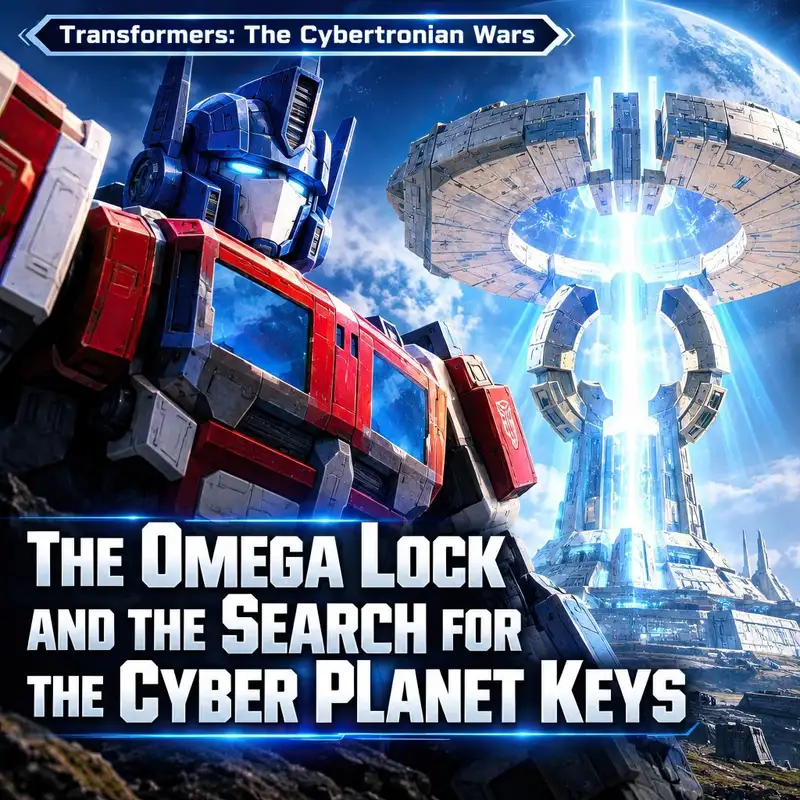
The Omega Lock and the Search for the Cyber Planet Keys
Cybertron’s evacuation began not with the fall of an army, but with the failure of a world to remain a safe place to live. A black hole was expanding toward the planet, threatening not only Cybertron but the surrounding regions of space. The Autobots could still fight. The Decepticons could still raid, pursue, and compete for advantage. None of that changed the immediate strategic fact. A civilization whose homeworld may be consumed has to move its population, preserve its knowledge, and find somewhere from which it can continue to act.
In the English-language Transformers: Cybertron series, Earth became that emergency refuge. It was a place of concealment, temporary basing, and uncertain first contact. It was not a replacement for Cybertron, and it was not a secure rear area. The Autobots arrived carrying the burden of a planetary evacuation while facing an enemy that understood the crisis as opportunity. Megatron did not need to cause the black hole to profit from it. He only needed to ensure that, when the answer was found, he controlled it first.
The proposed answer lay in ancient infrastructure. Vector Prime, an ancient guardian with unusual knowledge of time and space, identified the Omega Lock and the Cyber Planet Keys as the only apparent means of stopping the disaster. The keys were scattered across four worlds. The Lock was the device that could bring their power into a single system. This was not a hunt for four convenient weapons. It was a campaign to recover components of a strategic network whose purpose, limitations, and operating instructions had been partly lost to history.
That distinction mattered from the beginning. An artifact can be powerful without being understood. A map can identify an objective without providing a force capable of reaching it. A key can open a system without telling its holder what will happen afterward. Cybertron’s defenders were depending on legacy technology at the exact moment their society was least able to absorb another failure. The evacuation had scattered their attention. Earth required protection. Decepticon pressure remained constant. And the ancient systems on which survival depended had not been designed for an orderly modern chain of command.
The first serious setback was an intelligence failure. Vector Prime possessed a map that could lead the search toward the lost worlds connected to the Cyber Planet Keys. Megatron deceived him and stole it. The Decepticons gained the initiative before the broader campaign had properly begun. They now had a better starting picture of the operational problem, while the Autobots were forced to reconstruct the search through fragments, ruins, symbols, local accounts, and field expeditions.
It was a classic advantage, but not a complete one. Megatron knew where important assets might be found. He did not automatically command the worlds that held them. He did not possess the consent of their leaders, understand every local custom, or control the machinery needed to activate the larger system. Intelligence is power, but it is not sovereignty. The stolen map gave the Decepticons speed. It did not give them legitimacy, and it did not make ancient infrastructure obedient to whoever arrived with the largest weapon.
For the Autobots, the loss forced a different kind of campaign. They could not simply follow a clean route from objective to objective. They had to investigate. They had to interpret evidence. They had to rely on human allies who understood Earth better than any visitor from Cybertron. They had to negotiate with local authorities on worlds that had developed their own political traditions beyond Cybertron’s immediate reach. In practice, this turned a recovery mission into a coalition war.
Earth was the first intelligence theater. At first glance, it appeared to be an unlikely place for a Cybertronian strategic campaign. It was an inhabited organic world, technologically weaker than Cybertron, politically divided, and full of civilian infrastructure that could not safely absorb open warfare. Yet Earth contained traces of ancient Cybertronian activity. Those traces connected the black-hole crisis to the Omega Lock and to the first steps in understanding what the Autobots had actually been sent to recover.
The Seal of Atlantis became central to that investigation. Atlantis was more than a human legend repurposed for an alien adventure. In this continuity, it was an ancient Cybertronian vessel that had crashed on Earth long before the current conflict. Its ruins carried evidence about the Lock, the keys, and the old network linking distant worlds. Archaeology became logistics. An old wreck became a temporary source of mobility, intelligence, and access. The past was not dead equipment. It was part of the campaign’s supply system.
That made Atlantis valuable to both sides. The Autobots needed what it could reveal and what it might still carry. The Decepticons needed to deny those benefits or seize them for themselves. The struggle over the vessel demonstrated a recurring problem in the key campaign. Ancient systems were never simply discovered in a quiet laboratory. Every clue attracted hostile attention. Every recovered object became something that had to be protected, transported, interpreted, and kept out of enemy hands.
Earth’s human participants were therefore more than witnesses to the conflict. Coby, Bud, Lori, Professor Suzuki, Colonel Franklin, and others provided local knowledge, technical assistance, access to human institutions, and a perspective the Cybertronians lacked. Their involvement also raised difficult questions. The Autobots had come to Earth seeking safety and concealment, but their presence brought danger. Human civilians did not consent to becoming part of a war over alien artifacts. Military investigators did not immediately have reason to trust visitors who could transform into vehicles and disappear into ordinary traffic.
Colonel Franklin and the forces under his authority illustrate that uncertainty. Human military institutions did not become a single, uncomplicated Autobot ally because the black hole was dangerous. They had obligations to public safety, national security, and the protection of civilians who had no idea what was unfolding around them. Cooperation emerged gradually, under pressure. It was practical before it was comfortable. The Autobots needed help. Humans needed information. Neither side could ignore the other once Decepticon operations began threatening populated territory.
The campaign soon moved beyond Earth because the Cyber Planet Keys were tied to worlds with their own institutions and political identities. The first major expedition led to Velocitron, known as Speed Planet. There, the key was associated with the Planet Cup, the prize of the Great Race. To an outsider, this might have seemed absurdly inconvenient. A civilization facing an interstellar disaster had to obtain a strategic artifact by entering a local sporting competition. But that interpretation missed the point.
The Great Race was not a frivolous obstacle placed in the Autobots’ path. It was a legitimate Velocitronian institution. It organized prestige, authority, and public recognition on a world built around speed and racing skill. The Planet Cup mattered because Velocitron’s society had decided it mattered. A foreign military force could have attempted to seize the key by force. It might even have succeeded for a few minutes. But it would have converted a rescue mission into an act of coercion against the very population whose cooperation was needed.
Hot Shot’s role on Velocitron was therefore larger than a race. He had to operate within the local rules of legitimacy. His transformation ability and speed mattered, certainly. On Speed Planet, mobility was a form of military capability. It determined who could pursue, evade, scout, and compete across difficult routes. Yet the decisive result was political. Hot Shot had to demonstrate that the Autobots were willing to meet Velocitron on its own terms rather than treating the planet as a depot from which strategic equipment could be requisitioned.
Override, Velocitron’s leader, initially resisted the demand that her world subordinate its defining institution to an outside emergency. From the Autobot point of view, that reluctance could look reckless. The black hole was real. Time was limited. But Override had responsibilities of her own. She had to decide whether the warning was credible, whether outsiders should dictate policy, and whether surrendering the Planet Cup would weaken the authority structure holding her society together.
Hot Shot’s eventual success changed that calculation. He did not win Velocitron by occupation. He earned standing through conduct the population recognized. The Speed Planet Key became available because the local political order had been engaged rather than brushed aside. Override’s later alignment with the Autobots was more important than the artifact itself. A key could be carried away. A leader who understood the danger and committed her world’s knowledge, mobility, and authority to the wider effort created a durable strategic advantage.
Velocitron taught the Autobots that the keys could not simply be collected. Each one was embedded in a social system. Recovering one meant gaining access to terrain, transport, local expertise, and public trust. The Decepticons could see the physical prize. Optimus Prime was beginning to understand the political structure around it. That difference would become sharper on Jungle Planet, where the issue was not competition within a settled institution but authority contested through force.
Jungle Planet, also called Animatros, was dominated by Scourge and the warriors who followed him. Its political culture placed great weight on strength, personal challenge, and leadership proven in direct conflict. Megatron approached the planet with a familiar imperial assumption. He saw local fighters as assets. If they could be induced, intimidated, or manipulated into serving him, they would become another extension of Decepticon power. Their interests mattered only as long as they were useful.
That was a poor foundation for a coalition. Megatron could gain short-term compliance through fear or promises of status, but he treated local allies as disposable auxiliaries. Once they had delivered military value, he had little reason to respect their independence. Such an approach can produce rapid gains. It can also create brittle command arrangements. A leader who never shares authority must constantly enforce obedience. Every setback becomes a test of personal dominance. Every ally becomes a potential rival.
Optimus faced a different problem. He needed the Jungle Planet Key, but he could not obtain it merely by declaring a universal emergency. He had to demonstrate that the Autobots could deal with the planet’s leadership system without simply replacing Scourge with an Autobot occupation. His partnership with Leobreaker became central to that effort. Leobreaker was not just additional muscle in a difficult fight. He provided local connection and insight, helping translate the wider crisis into terms the planet could recognize.
The confrontation with Scourge had an obvious tactical dimension. A duel could settle immediate questions of strength and leadership. But its larger meaning lay in what happened after Scourge was defeated. Optimus did not execute him. That restraint was not softness, and it was not a refusal to acknowledge the damage Scourge had caused. It was a political decision. Killing a defeated leader might have produced a clean battlefield result while confirming the fear that the Autobots had come to conquer.
By sparing Scourge, Optimus preserved the possibility of realignment. He left space for Jungle Planet’s people to reconsider their relationship with the Decepticons without being forced to choose between submission to Megatron and submission to an alien victor. The Jungle Planet Key was transferred, but so was something more valuable. Authority began to shift. Local warriors could join a common defense without losing the claim that they were acting for their own world.
By this stage, the Autobots had two planetary partners, but their own system remained vulnerable. The Omega Lock was still an object of contest. The Earth Planet Key had not yet been secured. The crisis was also becoming more visible to human institutions, which meant the Autobots had to protect both their mission and the civilians caught near it. Earth was no longer just a hidden base. It had become a front line where secrecy, sovereignty, and survival collided.
The search for Earth’s key unfolded amid Arctic disturbances, ancient installations, military investigation, and mounting Decepticon pressure. These events showed how difficult it was to sustain a covert alliance once the scale of the threat increased. The Autobots could hide in vehicle modes. They could shift bases. They could limit what individual humans knew. None of those measures erased the physical effects of alien activity. Strange energy events, attacks on infrastructure, and armed encounters eventually demanded a response from people responsible for the territory in which they occurred.
For the human side, cooperation with the Autobots did not mean surrendering judgment. Franklin’s forces had to assess a threat they did not fully understand while dealing with Cybertronians who themselves lacked a complete picture. The practical relationship that developed was based on shared necessity. The Autobots needed an Earth partner who could protect civilians, investigate local sites, and help manage exposure. Human authorities needed allies capable of explaining why an ancient alien installation had suddenly become a military objective.
The abandonment of the Autobot base was one of the campaign’s less glamorous but more revealing decisions. Bases are more than places where heroes park between battles. They are communications centers, repair sites, supply points, shelters, and symbols of presence. Losing one disrupts coordination and creates risk for everyone who depended on it. The Autobots withdrew because Decepticon pressure threatened not only the keys but the surrounding human population. It was a logistical decision shaped by civilian protection.
At the same time, Starscream seized the Omega Lock. This was the central command crisis of the campaign’s middle phase. The Decepticons had already gained from Megatron’s theft of the map. Now Starscream demonstrated that the Decepticon side was not a unified machine. He was willing to exploit the broader conflict for his own position. His seizure of the Lock made clear that possession of the artifact could be separated from factional discipline, technical understanding, and responsibility for the consequences.
When the Earth Planet Key was inserted into the Omega Lock, the character of the war changed. The Lock opened a space bridge and exposed the black hole more directly. It also delivered a message directing the combatants to bring the keys and the Lock back to Cybertron. The search was no longer an expedition conducted from a hidden Earth base. It had become an interplanetary movement toward the threatened homeworld and toward a system no one fully understood.
The Omega Lock proved capable of extraordinary effects. It enabled strategic mobility through the space bridge. It revealed a connection between the scattered keys and Cybertron’s survival. It also restored Hot Shot, Red Alert, and Scattershot after they had suffered apparent battlefield destruction. That event established that the Lock possessed exceptional restorative capacity under specific circumstances. It did not establish a routine resurrection system that any force could deploy after every battle. The series presents the restoration as remarkable, not as ordinary field medicine.
That limitation is important because it clarifies what the Lock actually represented. It was more than a source of unlimited power. It was an interface. It connected assets, opened routes, activated systems, and amplified effects that ordinary Cybertronian institutions could not reproduce. But possession, activation, understanding, and legitimate use were four separate things. A commander might hold the Lock without knowing how to operate it. A warrior might activate part of its power without having the authority to direct its consequences. A faction might gain access and still fail to build the coalition needed to use it safely.
Starscream mistook access for sovereignty. After seizing the Omega Lock, he used its power to enlarge himself and declared himself ruler of the universe. The declaration was absurd in one sense, but strategically instructive in another. Starscream had gained a spectacular increase in coercive power. He could dominate a battlefield, intimidate opponents, and present himself as something beyond ordinary command. What he did not gain was a government.
His later absorption of Primus’s power repeated the same error on a greater scale. Starscream kept seeking a decisive source of personal supremacy. Each escalation made him more dangerous. None made him more capable of governing. The campaign repeatedly shows that cosmic power does not solve the command problem. In fact, it can make that problem worse by allowing a single ambitious leader to bypass the relationships, procedures, and alliances that make collective action possible.
The Autobots also had to confront how little they understood. When the Omega Lock was returned to Cybertron and placed into the planet’s systems, the result looked at first like catastrophe. Cybertron appeared to tear itself apart. The evacuation had been undertaken to save the planet, and now the very device meant to preserve it seemed to be destroying it. This was the danger of operating ancient infrastructure without a complete technical or historical record. Even the correct decision can look indistinguishable from disaster while it is happening.
The apparent destruction was transformation. In this continuity, Cybertron was revealed to be the body of Primus, the creator figure connected to the planet and its ancient systems. The Omega Lock had not broken Cybertron apart. It had awakened something embedded within it. That revelation reframed the entire campaign. The Keys and Lock were not isolated relics scattered for adventurers to find. They were parts of a larger system linked to the survival of Cybertron, the threat of the black hole, and the buried history of the world itself.
Primus explained that the destruction of Unicron had produced the spatial rupture behind the black hole. The details belong to this Cybertronian history and should not be treated as a universal account of Unicron or Primus across every Transformers story. What mattered to the commanders present was more immediate. The crisis had a cause. The ancient system had a purpose. And the three keys already recovered were still insufficient. A fourth key was required to complete Primus’s awakening.
That requirement changed the mission again. The Autobots had recovered keys from worlds with recognizable political systems and direct relationships to the emergency. Now they had to find Gigantion, known as Giant Planet, a world isolated by its own defenses and shaped by a very different civilization. The final key lay not in an open vault but within a world whose geography, industry, and cultural memory had to be understood before outsiders could act effectively.
Reaching Gigantion was itself an operation. The campaign relied on ancient ships, including Atlantis, as well as the Ogygia and other Cybertronian vessels. It involved wormhole travel, unstable space-time, and the danger that travelers might become separated from their bodies or lose the coherence needed to act once they arrived. No technical manual is provided for these phenomena, nor is one necessary to understand the operational risk. The operational point is plain. Strategic mobility was powerful, but it was neither safe nor routine.
A space bridge or wormhole can erase distance only after someone has located an endpoint, secured a route, supplied the craft, and accepted the risk of transit. A force that arrives through unstable space may still be disoriented, scattered, or unable to return quickly. That was especially relevant on Gigantion, where an anti-warp field restricted movement and protected the planet from easy access. Isolation was more than geographic. It was strategic policy built into the world’s infrastructure.
Gigantion’s cities and traditions created a setting unlike Velocitron or Jungle Planet. It was a civilization associated with construction, immense urban spaces, and a cultural memory shaped by building. Yet much of that built environment had become abandoned or restricted. Movement through certain areas was more than a matter of choosing the fastest route. Local rules governed access. For visitors under pressure, those rules could seem inconvenient. For Gigantion’s inhabitants, they represented history, safety, and ownership of a world outsiders barely understood.
Metroplex and Quickmix were important because they held local knowledge. Metroplex was formidable in battle, but reducing him to size or firepower would miss his role in the campaign. He represented Gigantion’s authority and its connection to the infrastructure surrounding the Giant Planet Key. Quickmix likewise provided technical understanding rooted in the planet’s construction culture. The Autobots needed both. They could not simply blast their way to the center of the world and expect the result to be stable.
Gigantion’s significance was industrial as much as military. Its abandoned cities, construction systems, and enormous inhabitants suggested a civilization capable of operating at a scale that smaller worlds could not easily match. The key beneath it mattered because it was tied to this system. The world itself mattered because rebuilding interplanetary order would eventually require routes, structures, repair capacity, and people who knew how to create them. The campaign was still focused on survival, but the outline of reconstruction was already visible.
Megatron continued to seek local partners, though his approach remained transactional. Menasor joined him in pursuit of recognition and status, demonstrating that Decepticon recruitment was not identical across every world. Not every follower was motivated by the same grievance, fear, or ambition. But Megatron’s command style gave such alliances limited depth. He could promise power to those who felt overlooked. He could exploit resentment. What he struggled to offer was a political relationship that allowed allies to retain meaningful agency once they had entered his orbit.
The conflict entered its final phase when Megatron drew on dark power associated with Unicron’s armor and emerged as Galvatron. This was an escalation specific to the events of this series, not a general rule that any Megatron can undergo the same transformation under similar conditions. Galvatron’s new power made him vastly more dangerous in the immediate fight. He could overpower opponents, disrupt plans, and threaten the coalition’s access to the final key.
Yet temporary superiority did not settle the campaign. The Giant Planet Key could also produce extraordinary effects, including temporary enlargement and enhanced capability. Such transformations changed the tactical balance, but they did not replace command trust. Optimus, Metroplex, Landmine, and their allies succeeded in checking Galvatron because they could combine local knowledge, leadership, and mutual support. The key’s power mattered. The coalition using it mattered more.
The tactical objective was to stop Galvatron from immediately dominating Gigantion. The strategic objective was larger: preserve access to the fourth key, prevent the collapse of Gigantion’s protective systems into enemy hands, and maintain a coalition capable of responding to the black hole. A battle can be won while a campaign still fails. In this case, the coalition’s ability to hold together under pressure ensured that the fight for Gigantion did not become another example of an artifact changing hands without changing the larger balance.
Once the Giant Planet Key was inserted and Gigantion’s anti-warp field was deactivated, the campaign ceased to be a series of separate expeditions. The worlds were now exposed to one another and to the expanding black hole. Jungle Planet itself was drawn into danger, forcing evacuation and emergency cooperation. This was the point at which the consequences of the earlier alliances became undeniable. Velocitron, Jungle Planet, Gigantion, Earth, and Cybertron could no longer pretend that the crisis belonged somewhere else.
Evacuation is often treated as a passive act, but it is an operational achievement. It requires warning, transport, route security, command discipline, and some assurance that those moved from danger will have somewhere to go. The threat to Jungle Planet showed the civilian meaning of the campaign. The goal was more than to prevent a cosmic phenomenon from reaching a point on a map. It was to preserve populations, cities, histories, and the possibility that distinct worlds could continue to govern themselves after the emergency.
Galvatron’s final ambition was to use the keys and the Omega Lock to destroy or remake the universe under his own authority. It was the culmination of the pattern seen earlier with Megatron and Starscream. Strategic infrastructure was treated as a personal instrument. The keys became trophies of command. The Lock became a throne. The black hole, rather than a shared catastrophe, became an opportunity to establish rule through force.
The flaw in that approach was not that Galvatron lacked power. For a time, he possessed more than anyone else on the field. The flaw was that the system he sought to control depended on relationships he had consistently undermined. The keys had been recovered through local knowledge, political recognition, transport networks, and cooperation between worlds. Their successful use required the very forms of shared authority that Galvatron regarded as weakness. He could seize assets. He could not command the trust necessary to stabilize them.
The final defense therefore belonged to a coalition rather than to the Autobots alone. Optimus Prime provided leadership, but leadership did not mean doing every task himself or absorbing every other authority into his command. Override, Scourge, Metroplex, human allies, Autobot teams, and the inhabitants of the threatened worlds all had roles shaped by their own capabilities and responsibilities. This was not a perfectly unified alliance. It had emerged through suspicion, rivalry, cultural difference, and repeated crisis. That made it more credible, not less.
The keys and the Omega Lock were recovered and restored to Primus. With the system returned to its intended purpose, Primus could act against the black hole. The Ark’s main cannon also became part of the final solution. This was another reminder that salvation depended on more than one miraculous device. Ancient power had to be combined with a functioning vessel, a weapon capable of contributing to the operation, crews able to act under pressure, and an alliance willing to coordinate rather than compete for credit.
The black hole was destroyed, and Cybertron returned to a restored planetary form. That was an enormous strategic success. A civilization that had evacuated under existential threat regained its homeworld. Worlds endangered by the expanding rupture survived. The interplanetary crisis no longer dictated every political choice. But battlefield and cosmic victory did not automatically solve the problems left behind by war, displacement, secrecy, and competing authority.
The peace conference and plans for a new space-bridge network point toward the real work that followed. Restored communications can reconnect worlds, but they also create new arguments over access, security, representation, trade, and military control. A bridge is not only a route for relief and diplomacy. It is also a route for invasion, smuggling, coercion, and political influence. The worlds that had joined the campaign now had to decide how much authority to share and how to prevent another crisis from concentrating too much power in one set of hands.
The search for the Cyber Planet Keys proved that the Omega Lock was never enough by itself. It could open routes, restore damaged warriors under extraordinary conditions, awaken Primus, and help destroy the black hole. It could not decide who had the right, the knowledge, or the capacity to use that power. The Autobots prevailed because they built a coalition across worlds with different customs and interests, while Megatron, Starscream, and Galvatron repeatedly treated shared strategic infrastructure as private authority.