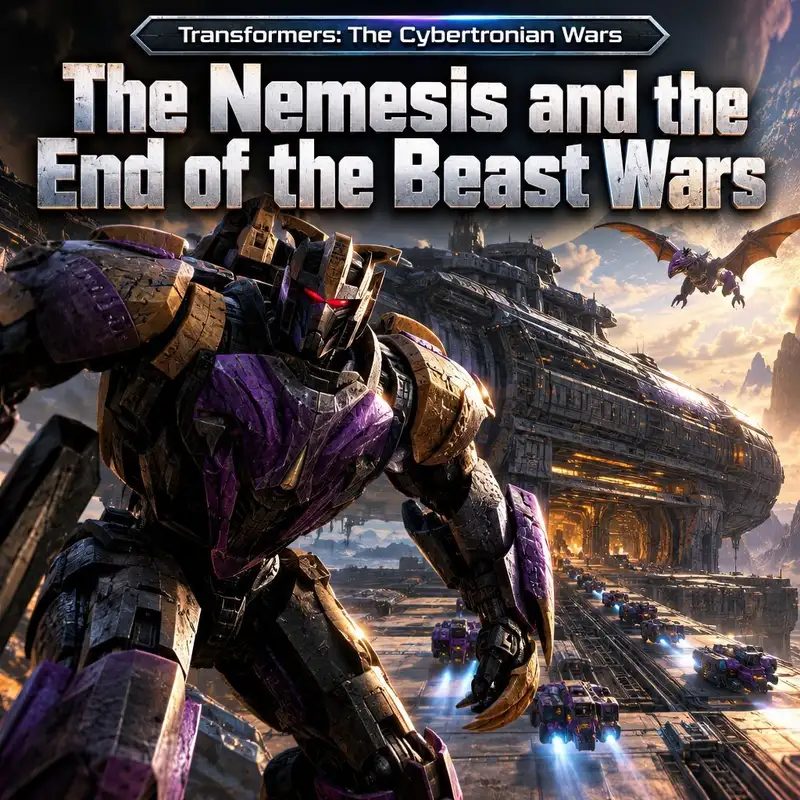
The Nemesis and the End of the Beast Wars
The ocean breaks open beneath a sky that has already seen too much of Cybertron’s past. For the Maximals, the immediate danger had seemed contained. Depth Charge had followed Megatron beneath the surface. Rampage, the Predacons’ most dangerous weapon, was trapped in the same confrontation. Then the water parts, and an ancient Decepticon warship rises from the depths. The Nemesis is not another stranded combatant or hidden base. It is a capital ship from the old war, armed, mobile, and now under Megatron’s control.
In the North American Beast Wars television finale, that emergence changes the shape of the conflict at once. The Maximals are a small field team, built around survival, reconnaissance, repair, and raids on a hostile prehistoric world. They have no fleet, no reserve army, and no practical way to meet an operational warship in a conventional engagement. Megatron, by contrast, now possesses a platform that can strike across the region, menace their base, and reach the one target whose destruction could alter the future.
The crisis extends beyond the Nemesis’s larger weapons. It has mobility, reach, intimidation value, and the ability to impose its timetable on a scattered enemy. A war that had been fought through ambushes, local raids, sabotage, and personal rivalries is suddenly dominated by one ancient vessel. The Maximals cannot win by matching its firepower. They must find a way to make its advantages temporary, limited, and costly.
That is the central problem of the Beast Wars ending. Megatron recovers overwhelming destructive power, but he never turns that power into sustainable strategic control. The Nemesis gives him an opportunity that no Predacon force on prehistoric Earth could otherwise have achieved. Yet the ship also magnifies his failures of judgment. Its energy is finite. Its systems can be damaged. Its command functions can be disrupted. Most importantly, it is controlled by a leader whose campaign is becoming less disciplined the closer he comes to victory.
The Nemesis does not emerge from nowhere, and its importance is not limited to the final battle. Megatron had spent much of the war pursuing a larger objective than defeating Optimus Primal’s Maximals or finding a route back to Cybertron. He wanted to change history. Prehistoric Earth contains the dormant Ark, the ancient Autobot vessel whose occupants include the original Optimus Prime and the original Decepticon Megatron. Both are inactive, preserved at a vulnerable moment in the earlier war.
The Beast Wars Megatron is not the same individual as that original Decepticon leader. He is a later Predacon commander who adopted the name Megatron and inherited a plan connected to the old conflict. The Golden Disk he stole contained information about the Ark and about the possibility of attacking its occupants before they awakened to continue the Great War. That made the Ark more than an archaeological site. It was a historical pressure point, a place where force applied in the past might reshape the future from which the Maximals and Predacons came.
Megatron’s goal, then, was more than survival on Earth. He sought historical revision through a military attack on incapacitated opponents. If the dormant Optimus Prime could be destroyed at the right moment, the future might be rewritten before the Maximals ever returned home. The plan was audacious, but it was also dependent on access. Megatron needed to find the Ark, overcome the Maximals, and apply enough force to alter events without losing control of the consequences.
The Ark therefore matters in several ways at once. It is the object of Megatron’s temporal campaign. It is a shelter and source of knowledge for the Maximals. It is an old warship with systems that may still have some value, even after ages of inactivity. And, in the final crisis, it becomes the place where the Maximals discover the only practical means of striking back. The ship is fixed in place, but its strategic meaning is not fixed. Both sides see it as a weapon, though in very different ways.
By the time Megatron reaches the Nemesis, however, his own force is already coming apart. The Predacon base has been destroyed. Tarantulas, the faction’s most independent scientist and conspirator, is dead. The surviving Predacons remain dangerous, but they are not a coherent conventional army. Inferno and Quickstrike still follow Megatron with varying degrees of enthusiasm. Waspinator has survived repeated disasters and has little reason to trust any grand plan. Rampage remains a weapon of extraordinary violence, but not a subordinate who can be treated as stable.
Dinobot Two is even more complicated. He was created as an engineered duplicate connected to the original Dinobot’s material and conditioned to serve Megatron. He also contains a fragment of Rampage’s unusual spark. That arrangement gives Megatron an enforcer, but it does not create genuine cohesion. It creates dependency. Dinobot Two’s obedience rests on artificial control, incomplete identity, and the pressure of a commander who sees individuals mainly as instruments.
This matters because possession of hidden technology does not solve the ordinary problems of command. A faction may discover a ship, weapon, bridge, or artifact that changes the balance of power overnight. It still needs operators, repair capacity, energy, reliable subordinates, intelligence, and a leader capable of choosing targets rationally. The Nemesis is a dramatic reversal, but it emerges into a Predacon force with weak internal trust and limited capacity to absorb losses.
Tarantulas had prepared the way in secret. Beneath the ruins of his former lair, Dinobot Two discovers concealed access to an underwater rail system. That route leads to the sunken Nemesis. Tarantulas had repaired and modified the old Decepticon vessel, including the installation of a transwarp cell and a Predacon control arrangement. The exact scale of those repairs is not established, and neither is the full condition of the ship. More important, enough had been restored for Megatron to activate it.
The discovery is a reminder that Tarantulas pursued his own agenda even while operating among the Predacons. He had accumulated infrastructure, knowledge, and access that Megatron did not fully control. Once Tarantulas is gone, Megatron inherits the result without inheriting the scientist’s caution or understanding. The Nemesis is therefore both a prize and a warning. It is an ancient platform with modern modifications, recovered by a commander who has little time to learn its limits before using it in battle.
While Megatron takes possession of the ship, Depth Charge pursues Rampage into the same underwater theater. Their confrontation is personal, but it has wider consequences. Depth Charge has hunted Rampage because Rampage destroyed a Maximal colony ship and killed many of those aboard. That history makes the pursuit more than a tactical assignment. It is an attempt to settle an old account, one that has shaped Depth Charge’s conduct throughout the later stages of the war.
Personal vendettas can sometimes align with operational necessity. Rampage is more than a feared enemy fighter. He is one of Megatron’s most dangerous assets, capable of extreme violence and difficult to restrain. Removing him would improve the Maximals’ chances in any final battle. Yet personal motives also narrow judgment. Depth Charge enters the confrontation knowing that the outcome may be fatal for both of them. He is not preserving himself for the campaign to come. He is accepting a mutual destruction that eliminates a threat at the cost of a capable Maximal specialist.
Depth Charge drives a shard of raw energon into Rampage’s spark and detonates it. The blast destroys them both. The episode establishes the result, but it does not provide a complete technical account of Rampage’s unusual spark condition or every consequence of the explosion. What can be said is that both combatants are removed from the war. The Maximals lose a determined hunter and combatant. Megatron loses the Predacon most suited to terror, attrition, and uncontrolled destruction.
The effect on Dinobot Two is equally important, though less fully explained. With Rampage destroyed, the fragment of Rampage’s spark within Dinobot Two no longer appears to bind him in the same way. The clone reacts as though something incomplete has changed. Memories and ethical traits associated with the original Dinobot begin to surface more strongly. The finale does not establish that Dinobot Two literally becomes the original Dinobot restored. It shows a change in his condition and behavior, not a complete answer to the question of identity.
That uncertainty is central to the tragedy of his final decision. Dinobot Two is more than an obedient clone who abruptly changes sides for convenience. Nor can he be treated without qualification as the lost Dinobot returned exactly as before. He is an individual shaped by cloning, enforced loyalty, damaged memory, and an emerging moral awareness. Rampage’s destruction removes one mechanism of control at the same moment Megatron acquires the Nemesis. In operational terms, Megatron gains a warship while losing the stability of his own command structure.
The Nemesis is decisive because it concentrates capabilities the Predacons otherwise lack. It can rise from the ocean and operate above the battlefield. It can project force over distances that would have required scattered ground movement or isolated aerial attacks. It has heavy weapons, a tractor beam, and the ability to threaten the Maximals’ positions from outside the range of ordinary retaliation. Its arrival makes concealment less useful. A hidden base is only useful until a ship can find and destroy it.
The vessel also has psychological value. The Maximals understand what it represents. It is not just Megatron’s new headquarters. It is an artifact from the ancient Decepticon war, a symbol of the military power that once pursued the Ark across space. Its return turns the past into an active combatant. For Megatron, that must have seemed ideal. He had come to the past to alter history, and now he had recovered one of history’s most formidable instruments.
But a capital ship is not an invincible object simply because it is larger than the forces opposing it. The Nemesis has been underwater for ages. It has been repaired and altered, but the episode never establishes that every system is restored to original condition. Its weapons consume energy. Major shots cannot be repeated without consequence. Its command spaces remain vulnerable to intrusion or collision. Its effectiveness depends on what Megatron chooses to do with it, and on whether he can preserve the force needed to sustain its operations.
Megatron’s first employment of the Nemesis reveals the problem. Rather than treating the ship primarily as a precision instrument for securing the Ark, isolating the Maximals, and protecting his remaining subordinates, he uses its power with growing fury. He has gained the ability to shape the battlefield, but he begins to use that ability as an extension of personal rage. This is a familiar failure in revolutionary and civil wars. A leader who confuses punishment with strategy may still destroy targets. He may even terrify opponents. But he can waste the very resources that made victory possible.
The first serious counterstroke comes from Tigerhawk. He is not an ordinary Maximal soldier, and his existence should not be mistaken for a standard fusion process or routine military capability. Tigerhawk is a Vok emissary formed from the combined sparks and bodies of Tigatron and Airazor. His mission is tied to the larger danger of Megatron’s interference with the timeline. He arrives with exceptional power, but he is also a singular figure operating under extraordinary circumstances.
Tigerhawk attacks the Nemesis alone. His assault damages the warship and reduces some of its available offensive capacity. That matters greatly, even though it does not destroy the vessel. In warfare, damage is not meaningful only when it produces an immediate kill. A strike can force a commander to reroute power, abandon a weapon, delay an attack, expose a weakness, or rely on fewer options at a critical moment. Tigerhawk does not win the battle, but he changes the conditions under which the rest of the battle will be fought.
Megatron eventually destroys Tigerhawk with the Nemesis’s fusion cannon. Tactically, that is a victory. He eliminates an enemy powerful enough to threaten his ship and removes the Vok emissary who had come to stop his temporal scheme. Yet it is not a restoration of the Nemesis to full advantage. The vessel has already been damaged, and the attack has shown that the ship can be challenged. Its apparent dominance is real, but it is no longer absolute.
Tigerhawk’s destruction also carries a personal cost that cannot be reduced to a battlefield exchange. Tigatron and Airazor had existed within the fused identity of Tigerhawk. The finale does not establish whether they could have been separated or restored independently. What it does establish is the destruction of the identity that carried both of them. This is one of the ways the final battle narrows the Maximals’ options. They do more than lose hardware. They lose individuals, memories, and relationships that cannot be replaced by repairing a damaged chassis.
Megatron’s next decision is more revealing than the destruction of Tigerhawk. He turns the Nemesis’s weapons on a settlement of proto-humans. The settlement is not the Ark. It is not the Maximal command center. It is not the force standing between Megatron and his historical objective. Its military value is negligible. The attack is punitive, theatrical, and cruel. It demonstrates that Megatron is no longer directing the Nemesis toward the political purpose that justified his campaign, even by his own ruthless standards.
Dinobot Two objects. His protest is framed through honor, but it also has practical force. Destroying a primitive settlement does not bring Megatron closer to the Ark. It does not secure the timeline. It does not protect the Nemesis. It does not create a route home. It spends energy, exposes the ship’s priorities, and risks collateral damage to Megatron’s own side. In a disciplined command structure, such an objection might prompt reassessment. Under Megatron’s personal rule, it becomes a challenge to authority.
Megatron fires anyway. The settlement is destroyed. The episode does not establish reliable casualty numbers, and it gives no basis for a detailed reconstruction of the local population’s losses. But the civilian consequence is unmistakable. A community with little ability to affect the Cybertronian war is struck because it lies within reach of a commander determined to demonstrate power. The attack turns a strategic crisis into an atrocity against people who are not meaningful military participants in the conflict.
The strike also kills Inferno and Quickstrike. They are not destroyed by a Maximal trap or a daring counterattack. They die in Megatron’s own blast. This is a failure at several levels. Tactically, the weapon achieves destruction. Operationally, it wastes force and kills available personnel. Strategically, it does nothing to secure the Ark or rewrite history. Politically, it reveals a command system in which subordinates are expendable even when they remain useful. Morally, it shows that Megatron’s war has become detached from any defensible claim of necessity.
The attack has another consequence. It drains the Nemesis’s energon reserves and delays the ship’s ability to fire its main weapon again. The episode does not provide a measurement of those reserves, and no precise calculation is needed. The important fact is that the ship is not unlimited. Its power has a sustainment problem. A massive weapon can dominate a battlefield in one moment and become unavailable in the next if it consumes too much energy, suffers damage, or is used without regard for the next phase of the operation.
This is the point at which Megatron’s possession of the Nemesis becomes less important than his ability to use it intelligently. He has a ship capable of terrifying the Maximals, yet he spends part of its combat potential on a target that does not matter to his stated objective. He has a shrinking group of followers, yet he accepts the deaths of two more. He has an increasingly uncertain subordinate in Dinobot Two, yet he responds to moral dissent with contempt. The warship remains powerful, but the command behind it is weakening.
The Maximals understand that they cannot answer the Nemesis with direct force. Their problem is not to defeat every weapon aboard the ship. It is to prevent Megatron from using the ship against the Ark before he can complete his temporal sabotage. At Mount St. Hilary, they turn toward the dormant Autobot vessel as both a defensive position and a source of possible solutions. The Ark has been inactive for a vast span of time. It is not a ready reserve fleet. It is a damaged, aging, and uncertain asset.
Optimus Primal’s objectives remain broader than survival. He must preserve the Ark and the occupants whose future is at stake. He must prevent Megatron from changing the timeline. He must protect his own surviving team as far as circumstances allow. And if the crisis can be survived, he must still find a way to return the Maximals to Cybertron. The finale does not permit him to pursue one objective at a time. Every decision is constrained by the fact that failure at the Ark may erase the conditions under which any return home matters.
Rhinox and Blackarachnia attempt to restore enough of the Ark’s systems to create mobility or an escape option. Their work is an example of what the Maximals still possess even after losing fighters and facing a much stronger platform. They have technical expertise, adaptability, and the ability to cooperate across old faction lines. Blackarachnia is a former Predacon, but the crisis has made her part of a functioning Maximal team. That practical trust becomes more valuable than formal rank.
The Ark’s engines respond briefly. That does not establish that the old vessel is fully operational, combat-ready, or capable of sustained space travel. It establishes only that some systems can still be activated. In a war emergency, partial functionality can be enough to create an option. But it can also encourage commanders to rely on a fragile plan. The Maximals are not restoring the Ark to its former role. They are trying to extract one usable capability from an ancient ship before Megatron reaches them.
Their operational logic is sound. They do not need to outgun the Nemesis. They need to exploit its damaged condition, its finite energy, its proximity to a fixed target, and its dependence on a vulnerable command structure. The Maximals are fighting asymmetrically. They are looking for an opening that turns Megatron’s need to approach the Ark into a liability. Yet the first version of their plan nearly collapses before it can be carried out.
The Nemesis reaches Mount St. Hilary and employs its tractor beam against the Ark. The battle is now compressed into a narrow physical space. Megatron has brought his superior platform directly to the historical objective. The Maximals have little room to maneuver, and their hope of moving the Ark depends on systems that have already shown signs of failure. The tractor beam is more than another weapon. It is an instrument of control, allowing Megatron to hold the target in place while preparing to finish the attack.
Optimus Primal boards the Nemesis and confronts Megatron directly. The action is brave and necessary, but it cannot by itself settle the larger campaign. A personal fight may influence command, delay an order, or create an opening. It does not erase the Nemesis’s positional advantage. Megatron remains aboard his own warship, near the Ark, with weapons and systems that the Maximals cannot match. Primal is fighting to prevent immediate disaster, not because a duel offers a complete strategic solution.
Then the Ark’s engines fail. The brief activation has not become escape. The Maximals’ improvised plan, already fragile, appears finished. This is a genuine operational crisis. Their fixed asset cannot move. The Nemesis remains close enough to control the engagement. Megatron still has the initiative. At this stage, superior courage alone cannot save the Maximals, and the technical work of Rhinox and Blackarachnia has not produced the result they needed.
The decisive intelligence does not come from the Ark’s archives, from a Vok intervention, or from a Maximal sensor sweep. It comes from Dinobot Two. His break with Megatron has been developing through a series of pressures. Rampage’s destruction changed the condition that had helped bind him. The attack on the proto-human settlement exposed Megatron’s command as purposeless cruelty. The emerging memories and moral traits associated with the original Dinobot gave him a framework for rejecting an order that he now understood as dishonorable.
Still, Dinobot Two’s choice should be understood as a decision, not as a solved biological mystery. The finale suggests that he is becoming more than Megatron’s manufactured executioner. It provides no final technical verdict on where the original Dinobot ends and Dinobot Two begins. What matters in the battle is that he exercises agency. He recognizes that Megatron’s plan has crossed a line, and he acts against the commander who created and controlled him.
Dinobot Two transmits crucial information to the Maximals. Inside the Ark is an Autobot shuttle. It is a smaller craft, not an equal to the Nemesis and not a hidden superweapon waiting to restore balance. But it is available. In a crisis, availability matters. A modest asset that can be launched now may be more valuable than a greater capability that cannot be activated, crewed, fueled, or brought into position.
His decision exposes the weakness of Megatron’s hierarchy. Coercion can force compliance for a time. It can create fear. It can suppress open disagreement. But it cannot guarantee loyalty when a subordinate concludes that the commander’s orders are strategically irrational and morally intolerable. Megatron had built his remaining force around personal authority. When that authority fails at the critical point, it fails suddenly. There is no deep institutional trust to absorb the shock.
The Maximals, by contrast, are able to act on unexpected information because they retain enough cooperation to adapt. Rhinox can take a technical role. Blackarachnia can assist despite her past. Optimus Primal can hold Megatron’s attention. The others can preserve the immediate defense. Their strength is not that they have become stronger than the Nemesis. Their strength is that they can connect intelligence, engineering, and courage into a new plan before Megatron can recover control.
The shuttle is used as a guided collision weapon. Rhinox pilots it directly into the Nemesis’s control bridge. The strike is not a miracle device, and it does not establish that any small shuttle can defeat any warship. It works because of a specific accumulation of conditions. The Nemesis has already been damaged by Tigerhawk. Its major weapon has been constrained by energy expenditure. It is operating close to the Ark. Its command functions are exposed to a direct intrusion. And Megatron’s own decision-making has stripped away alternatives.
The shuttle passes through the Nemesis and devastates its control area. Megatron is ejected from the warship. Dinobot Two remains aboard as the Nemesis loses control and crashes. His death is both a sacrifice and the final expression of the moral agency he has recovered. He does not survive to receive recognition, explanation, or reconciliation. The series leaves his identity partly unresolved, but it leaves his final act clear. He chooses to prevent Megatron’s victory even at the cost of his own life.
With the immediate battle over, the surviving Maximals still have work to do. Victory does not place them safely at home. The shuttle must be repaired. A transwarp cell must be installed. The survivors must organize themselves for departure. Megatron, though defeated, must be secured as a prisoner. These are not ceremonial details. They are the logistical conditions that turn survival on prehistoric Earth into an actual end to the campaign.
The image of Megatron restrained on the outside of the returning shuttle is striking, but its deeper meaning is institutional. The Maximals are not leaving him behind as a loose threat, nor are they simply destroying him in the aftermath of battle. They are taking custody of the commander whose attempt to change history has failed. What happens politically after their return lies beyond the direct record of this finale, but the act of transporting him establishes that victory includes detention, accountability, and the difficult responsibility of dealing with a defeated enemy leader.
Waspinator remains behind on prehistoric Earth and is accepted by the surviving anthropoids as their leader. The moment is presented with comic energy, but it has real political significance. Waspinator is no longer merely a battered survivor in someone else’s war. He has become part of a local society that must live with the consequences of the conflict around it. The finale does not tell us enough to reconstruct the settlement’s losses, recovery, or future government. It does show that the war leaves behind people whose lives continue after the Cybertronians depart.
That local outcome matters because the Beast Wars had never been only a dispute among visitors from Cybertron. The proto-human settlement is caught in the path of a conflict it did not create. Megatron’s attack destroys its home. The Maximals save the Ark and preserve history, but they cannot undo every consequence of the war. Waspinator’s acceptance suggests survival and adaptation rather than a clean restoration of what existed before. Even a victorious withdrawal leaves civilians and local communities to rebuild around damage they did not choose.
The Maximals’ departure ends the Beast Wars operationally on prehistoric Earth. They have preserved the Ark, defeated the Nemesis, captured Megatron, and restored their route to Cybertron. The next Beast Era screen story begins from the consequences of their return, but those later events are outside the immediate record of this finale. Here, the important point is that the war ends because the surviving Maximals can finally leave the theater with their mission accomplished.
Megatron’s defeat is not the result of the Maximals acquiring superior force. They never do. It comes from the failure to turn force into strategy. The Nemesis gives Megatron reach, firepower, and a direct path to the Ark. But he spends energy on punishment, destroys his own subordinates, ignores the limits of his ship, and relies on obedience that cannot survive a moral crisis. The weapon remains formidable. The command behind it does not.
The Maximals prevail because they recognize the kind of war they are fighting. They do not attempt a grand duel of capital ships that they cannot win. They preserve their technical cooperation, accept help from an unexpected source, and use a vulnerable shuttle against a vulnerable command function at the moment Megatron has exhausted his margin for error. Dinobot Two’s decision and Rhinox’s strike preserve the Ark, the timeline, and the survivors’ path home. The end of the Beast Wars proves that even an ancient warship cannot substitute for disciplined command, reliable allies, or a political purpose worth defending.