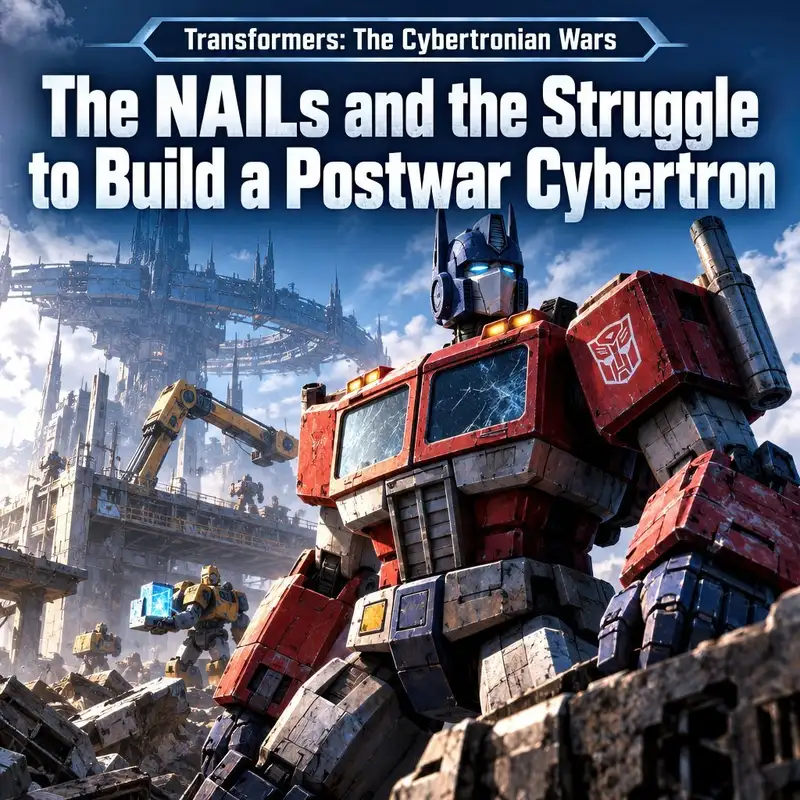
The NAILs and the Struggle to Build a Postwar Cybertron
In restored Iacon, a returning Cybertronian named Zetca is attacked in public by Horri-Bull. Bumblebee intervenes, but he does not have a civilian police force, a settled court system, or much time to negotiate. He has an old wartime control measure: an identification explosive implanted in Horri-Bull. Bumblebee warns him to stop. Horri-Bull refuses. The explosive is activated, and the assault ends.
The immediate result is hard to dispute. Zetca is protected. A violent attacker is stopped. Yet the incident also exposes the condition of the peace Bumblebee has inherited. Cybertron has been restored, but its government still relies on restraints, surveillance, and coercive tools designed for war. The planet has a capital again. It does not yet have a state that all its people recognize as their own.
This is the postwar Cybertron of I D W’s Transformers continuity that began in two thousand five. The Great War between Autobots and Decepticons has devastated the homeworld and scattered its population across space. Then Cybertron is renewed, and the prospect of return becomes real. But physical restoration answers only one question. It creates somewhere to live. It does not decide who has the right to govern.
Optimus Prime understands part of that problem. After the war, he gives up the title of Prime and departs Cybertron. It is an act of humility, but it is also a political vacuum. Optimus had been the symbol of Autobot resistance, military survival, and moral authority. He was not a constitution, a civil service, a judiciary, or a plan for reconciling a population that had spent generations on opposite sides of a civil war.
Into that vacuum comes a vast and politically consequential population: Cybertronians who left during the war rather than serving the Autobots or Decepticons. They return not as an army marching home under a flag, but as people coming back to a damaged homeland whose future has apparently been assigned to the factions that destroyed it.
They become known as NAILs, short for Non-Aligned Indigenous Lifeforms. It is one of those bureaucratic labels that reveals more than it intends. The phrase sounds administrative. It has the cold efficiency of a security file or a census category. But it separates people into those who belong to the established order and those who must be processed, classified, and managed by it.
The name is associated with Prowl, an Autobot strategist whose instincts were formed in clandestine war. Many of the people called NAILs resent the term. That matters because political language is rarely neutral in a society emerging from conflict. A label can identify a population. It can also suggest that population is a problem, an exception, or a security concern before anyone has heard what its members actually want.
The NAILs were not one party. They were not a single ideology, and they were not automatically pacifists. Some wanted autonomy from both old factions. Some wanted safety, housing, repair access, and a predictable civic life. Some supported leaders who promised to resist Autobot influence. Others simply wanted to return home without being compelled to explain why they had survived the war somewhere else.
Their common experience was less a political program than a political injury. They had not chosen the Autobot-Decepticon struggle as their identity. They had left Cybertron during it, often because remaining would have meant serving one side, being targeted by the other, or simply enduring a conflict that had made ordinary life impossible. Now they were expected to accept rule by wartime veterans.
From the Autobot perspective, that expectation could appear practical. The Autobots had fought the Decepticons, endured defeat and exile, and helped bring the war to an end. They possessed commanders, communications, networks of trust, and at least some surviving institutions. In a shattered society, those are not trivial assets. The difficulty was that practical control is not the same thing as consent.
From the NAIL perspective, the situation looked very different. They returned to a world damaged by a war they had not fought, governed by an Autobot administration, while Decepticon prisoners and armed remnants remained a constant danger. Their supposed liberation came with checkpoints, emergency controls, unresolved factional hostility, and public figures who spoke the language of peace while carrying the habits of command.
This was more than a dispute over which emblem flew above Iacon. It was a dispute over citizenship. Were the returnees equal participants in rebuilding Cybertron, or were they guests in a postwar order created by the victorious Autobots? Could neutrality remain a meaningful identity after the war, or would every Cybertronian be forced back into the old binary of Autobot, Decepticon, or suspect?
Bumblebee stood at the center of that crisis. He was not Optimus Prime’s successor in the grand ceremonial sense. He was the leader of a provisional government, an Autobot veteran assigned an immense burden because someone had to hold the system together. His authority rested partly on personal respect, partly on Autobot organization, and partly on the absence of any stronger institution ready to replace it.
His government faced the ordinary requirements of reconstruction, though there was nothing ordinary about the scale of the task. Cybertron needed functioning cities, repair facilities, transport routes, communications, energy distribution, public order, and some way to determine who controlled the planet’s surviving infrastructure. It also needed to manage the return of displaced Cybertronians while containing a defeated enemy that had not truly disappeared.
The comics do not provide a neat inventory of factories, energon reserves, or construction schedules, and they do not need to. The political meaning of scarcity is clear enough. A damaged city with limited repair capacity becomes a contest over priority. A secure transport route becomes a political asset. A functioning communications network is not just infrastructure. It is the means by which a government can issue orders, hear grievances, and claim it still exists.
Bumblebee’s personal decency did not solve this institutional problem. He could listen. He could try to restrain violence. He could appoint figures from outside the Autobot hierarchy. But he had inherited a command structure, not a civilian constitutional system. His government had wartime personnel, wartime detention practices, and wartime intelligence networks. It had little time to build alternatives before the old conflict found new ways to resume.
The Horri-Bull incident shows the dilemma in miniature. Horri-Bull’s assault on Zetca is not excused by political grievance, factional resentment, or the general disorder of the period. A state that cannot protect someone attacked in public has failed at one of its most basic duties. Bumblebee’s intervention therefore has a clear tactical purpose. He stops the attack and demonstrates that violence in Iacon will bring consequences.
At the security level, though, the method is revealing. The identification explosive is not a normal instrument of accountable civilian justice. It is a tool of control. It assumes that certain individuals can be managed through implanted force, that an authorized official can impose immediate punishment, and that the urgency of security outweighs procedure. In war, governments often accept such measures because they fear they have no alternative.
In peace, the same measures acquire a different meaning. They do not disappear merely because hostilities have been declared over. They remain in bodies, databases, prisons, command chains, and habits of thought. A government may use them against someone genuinely dangerous, as Horri-Bull is in that moment. But every use teaches the public what kind of authority the government believes it possesses.
For the NAILs, the problem was more than whether Horri-Bull deserved intervention. The problem was that the new Cybertron still appeared to be ruled through systems designed by the old factions. The state protected Zetca, but it did so with an explosive collar inherited from a militarized order. Civilian safety and due process were both weak because the institutions capable of protecting one had not yet been built without sacrificing the other.
That contradiction gave political opportunity to Metalhawk. He became the most prominent spokesman for the returning non-aligned population during the opening phase of reconstruction. He served within Bumblebee’s provisional arrangement, but he did not accept the premise that Autobot leadership should become permanent merely because the Autobots had emerged on the winning side of the war.
Metalhawk understood the power of return. The NAILs were not a small dissident club that could be ignored after a ceremonial consultation. They were a large part of the population now arriving on Cybertron. Their numbers are not precisely established, but their political weight is unmistakable. They could change the character of the electorate, redefine the center of public opinion, and make an Autobot-Decepticon settlement insufficient.
His message had real force because the evidence was visible everywhere. The returnees could see the ruins. They could see that Decepticons remained imprisoned, armed, angry, or politically organized. They could see Autobots still occupying key security and administrative positions. They could see that the war’s veterans were making decisions about a future in which those who had fled the conflict were expected to live.
Metalhawk’s politics were more than neutral mediation. He was adversarial, ambitious, and willing to sharpen resentment against Autobot authority. He did not speak for every NAIL, because no one could easily speak for such a diverse population. Yet his limitations should not obscure why he mattered. A politician can exploit a grievance and still be responding to something real. The exploitation does not erase the grievance.
The deeper issue was representation. Bumblebee’s government was a coalition assembled in emergency conditions. Metalhawk represented a competing claim: that the civilians and returnees who had not fought for either side should not just be added to an Autobot-led administration. They should help determine the political order itself. That was a far more demanding proposition than giving them a few offices or inviting them to endorse decisions already made.
Cybertron’s postwar politics therefore had three major forces, not two. The Autobots had military victory, administrative experience, and control of much of the surviving apparatus of government. The Decepticons had been defeated, but they retained followers, weapons, prisoners, personal loyalties, organizational habits, and the potential for renewed coercion. The NAILs had demographic weight and a powerful moral objection to inherited factional rule.
Each force possessed something the others lacked. The Autobots had practical authority but an uncertain mandate. The Decepticons had a damaged but persistent political identity, reinforced by the anger of defeat. The NAILs had a claim to civilian legitimacy, but no unified command, no single ideology, and no easy means of converting shared exclusion into a stable governing coalition.
That made Iacon especially important. The city was more than a backdrop for speeches and street fights. It was the place where authority could be seen and tested. Its surviving infrastructure, communications, detention systems, public spaces, and government facilities concentrated political power. Whoever maintained order in Iacon could claim to govern Cybertron. Whoever disrupted it could demonstrate that the government’s control was provisional.
Urban disorder also had consequences beyond the immediate violence. A riot, an assault, a prison breach, or an attack on a public official could reshape public confidence faster than any formal declaration. In a society with no settled monopoly on force, every security failure became evidence for someone’s political argument. Autobots could say that order required firm measures. NAILs could say those measures proved Autobot rule was unfit. Decepticons could say the peace had failed.
The most dangerous weakness lay in the institutions operating behind the public government. Prowl embodied that problem. He was an Autobot security strategist, highly capable, disciplined, and accustomed to thinking in terms of threats, contingencies, and outcomes. During war, those qualities could be indispensable. A resistance movement survives in part because someone is willing to gather intelligence, deceive an enemy, and make decisions that cannot be debated in open session.
But wartime intelligence does not automatically become democratic intelligence when the shooting slows. Its secrecy remains. Its personnel preserve their networks. Its methods continue to look efficient, especially when civilian institutions are weak and enemies are still active. The question is not whether intelligence work has value. Any postwar state facing armed remnants and sabotage needs information. The question is who authorizes its actions and who can hold it accountable.
Prowl’s covert conduct widened the gap between Bumblebee’s formal authority and the power exercised in Cybertron’s name. The specifics of every hidden operation are less important than the political effect of the pattern. An administration that promises transition while its security specialists manipulate events in secret invites suspicion that public institutions are decorative and that the real state still operates through wartime compartments.
For the NAILs, that suspicion was especially corrosive. They had already been labeled as non-aligned and treated as a population requiring management. They had reason to fear that decisions affecting their future might be made by Autobot veterans who believed security required concealment. It became difficult to persuade them that elections would be meaningful if the old intelligence apparatus still reserved the right to shape the field.
This is one of the harsh lessons of reconstruction. Clandestine methods can prevent immediate threats while undermining the trust required for long-term peace. A government may gain a temporary advantage by acting without public scrutiny. It may also teach its citizens that law is a language used after power has already decided the result. Once that belief takes hold, every crisis becomes an argument for competing private forces.
The planned election was meant to break that cycle. It mattered not because Cybertron had suddenly become a mature, settled democracy, but because all the major actors needed some claim beyond battlefield victory. Bumblebee needed a mandate that did not rest solely on Autobot sacrifice. Metalhawk needed a way to turn the returnees’ presence into recognized political power. Even the Decepticons needed a path that did not immediately require another open war.
Starscream recognized that opportunity. In the postwar environment, he saw that political legitimacy could offer something conquest could not: a way to exercise influence while claiming to represent a renewed Cybertron rather than merely a defeated army. He sought a route to power through the emerging electoral process, positioning himself as a leader capable of securing Decepticon interests within a transformed political landscape.
That did not make Starscream a democrat in the modern liberal sense. His calculation was strategic. Procedure could be a weapon as surely as a null ray or a prison break, if it could turn factional strength into accepted authority. A former warlord does not cease to be dangerous because he learns the language of elections. But his willingness to use that language showed that the old binary had become politically inadequate.
Bumblebee sought continuity and order. He hoped an election could give the provisional government a more durable basis. Metalhawk sought to mobilize the anger of the returnees and prevent Autobot dominance from becoming permanent. Starscream sought to convert Decepticon organization into influence and perhaps rule. All three were competing to define what postwar legitimacy would mean.
The NAILs were central to this contest because they could not be treated as a minor bloc. Their political weight meant that neither Autobots nor Decepticons could simply assume the future belonged to them. Metalhawk emerged as a serious rival precisely because the returning population could determine the result. That was the promise of the moment. The people excluded from the old war might now decide the terms of the peace.
It was also the danger. Elections require more than ballots. They require a minimum security environment, some confidence that rivals will accept defeat, institutions that can administer rules, and a public sphere not wholly controlled by military organizations. Cybertron had none of these in reliable form. It was attempting to create civic legitimacy while armed factions, covert actors, and wartime grievances remained active beneath the surface.
The strain broke during the crisis known as the Verge. In Iacon, Decepticons revolt. Megatron is freed. Prowl’s covert operations are exposed. The political transition is overwhelmed by the return of open force. Events that had been contained, hidden, or postponed suddenly become public and immediate. The war is no longer a memory shaping government. Its command structure has begun to reconstitute itself inside the capital.
Tactically, the Decepticons regain initiative in the city. They demonstrate that the provisional administration cannot guarantee control over its own security environment. Operationally, the government loses the ability to separate political competition from armed confrontation. A campaign, an election, and a crisis of public order become inseparable because no institution is strong enough to keep them apart.
The intelligence consequences are equally severe. Prowl’s covert practices, once exposed, become politically toxic. They confirm the fears of those who believed the Autobots were preserving wartime power beneath the language of reconstruction. Even if some actions had been taken to counter real threats, secrecy deprives the government of the ability to explain its conduct credibly when the crisis arrives.
Megatron’s return changes the balance further. He is more than another candidate or public critic. He represents the unresolved core of Decepticon command, charisma, and militarized identity. His release makes it impossible to pretend that the old war has been replaced by ordinary political disagreement. The Decepticon movement has not been demobilized into a lawful opposition. It remains capable of becoming an armed force again.
The election cannot function as a neutral transfer of authority under such conditions. That does not mean elections were foolish. It means they were asked to do work that only deeper reconstruction could have made possible. A vote cannot by itself dissolve private armies, reform intelligence networks, establish courts, or make rival factions accept that they no longer own the state.
Bumblebee’s provisional government falls. Metalhawk is killed. The possibility that the NAILs might develop into an independent political force is damaged not because their grievances vanish, but because the conditions needed to organize those grievances into stable representation are destroyed. The early postwar coalition collapses under pressure from violence, exposure, factional maneuver, and the return of leaders shaped by the old war.
Starscream emerges as ruler of Cybertron. It is tempting to describe this as a political victory, since he had recognized the value of electoral legitimacy and had attempted to pursue it. But that description is incomplete. His rise comes through a mixed process of political calculation, Decepticon organization, public crisis, manipulation, and the breakdown of rival institutions. It is not a clean democratic handover.
Starscream’s government demonstrates an uncomfortable fact about postwar politics. Legitimacy can be pursued, imitated, and weaponized. A leader does not need to reject elections openly in order to exploit the weakness of a political system. If rivals are discredited, security is unstable, information is controlled, and coercive power remains available, procedure can become another instrument through which a strong figure consolidates authority.
That does not mean Bumblebee failed because he was too kind, too weak, or insufficiently ruthless. His failure was institutional. He lacked a clear mandate. He lacked civilian structures capable of restraining wartime security practices. He lacked a credible process for disarming the old conflict and bringing its veterans, prisoners, returnees, and victims into a shared political order. No individual leader could easily improvise all of that under crisis conditions.
Metalhawk’s failure was also institutional, though in a different way. He exposed the weakness of Autobot claims to automatic authority, and he articulated the anger of a population that had been expected to accept a peace designed by others. But the NAILs were too diverse to become a simple bloc. Shared exclusion did not automatically create shared policy, shared leadership, or a durable program for governing Cybertron.
The postwar question then expanded beyond the immediate struggle in Iacon. Cybertron had not endured the war alone. Its collapse, abandonment, and restoration affected colony worlds whose populations had developed their own political interests. They had not necessarily spent the war waiting for Cybertron to recover and resume command over them. Distance, survival, and local experience had created separate identities and separate claims to representation.
Caminus became especially important in this wider political transformation. Its people and institutions were more than an extension of the old Autobot or Decepticon categories. Windblade, associated with Caminus, entered Cybertronian politics as a representative of a world whose relationship with Cybertron had to be negotiated rather than assumed. Her role showed that the future could not be built only around the survivors of the old homeworld’s civil war.
This was more than diplomatic decoration. Colony representation changed the scale of the reconstruction problem. The question was no longer only whether Autobots, Decepticons, and NAILs could share Cybertron. It was whether a political order centered on Cybertron could recognize worlds whose people had their own histories, infrastructure, security concerns, and memories of being ignored during the homeworld’s long collapse.
The Council of Worlds emerged from that need for broader representation. It was an attempt to create a system in which Cybertron did more than reclaim authority over populations that had survived without it. The council represented a move away from the idea that citizenship must follow an old military allegiance or residence on one planet.
It was not a final solution. Councils can distribute seats without distributing power. Representatives can broaden debate while security institutions remain opaque. Former war leaders can adopt new offices without abandoning old habits. The continuing crises of the postwar era, including conflicts involving combiners and Titans, showed that militarized assets and factional distrust remained deeply woven into political life.
The importance of Titans in this period also carried a political lesson. A Titan could be a military asset, a city, a source of infrastructure, and a symbol of collective identity. Control over such beings or systems was never merely a matter of battlefield advantage. It raised questions about command, consent, representation, and whether a rebuilt society was once again concentrating its future in the hands of those who controlled the greatest force.
The NAIL crisis therefore did not end when Starscream took power, or when broader institutions began to include colony representatives. It remained part of the larger transition from civil war to interplanetary governance. The conflict had revealed that Cybertronian society contained more political identities than the old factions could comfortably admit, and that the return of displaced civilians could not be handled as a footnote to military victory.
There is a temptation in postwar stories to treat restoration as resolution. The planet is repaired. The capital is active. Leaders make speeches. Former enemies attend councils. But reconstruction is not the same as repair. A damaged city can receive power before its residents trust the government that allocates it. A prison can be secured before the law governing it is legitimate. A vote can be scheduled before citizens believe it will protect them.
The NAILs made that contradiction impossible to ignore. Their neutrality mattered because it represented a mass population refusing to inherit the political identities that had governed the war. They were not outside Cybertronian society. They were part of its displaced civilian body, returning with the right to ask why the factions that devastated their world believed they alone should determine its future.
Bumblebee’s government treated that challenge with more seriousness than a simple Autobot dictatorship might have done. He included Metalhawk and attempted to move toward political transition. Yet the government’s reflexes remained shaped by military necessity. The Horri-Bull incident, the survival of secretive security practices, and the lack of accountable civilian institutions all showed how difficult it was to build peace using tools designed for war.
Metalhawk’s politics demonstrated the other side of the problem. He could name real exclusion and mobilize genuine resentment. But resentment alone does not create a governing order. A movement defined by opposition to inherited factions still has to answer practical questions about security, representation, dissent, and the use of force. It must explain how a diverse population will make decisions after the common enemy has been identified.
Starscream’s rise provided the darkest answer. He showed that the demand for legitimacy could be appropriated by someone whose political instincts remained rooted in personal power, factional organization, and strategic manipulation. He did not prove that civilian government was impossible. He proved that civilian forms are vulnerable when the institutions beneath them have not been rebuilt.
The struggle over the NAILs was never a side story about returning neutrals complaining after the real heroes had won the war. It was the central test of whether Cybertron had ended a civil war or merely paused it under new management. The Autobots had defeated a military enemy. They had not yet built a political community capable of including those who refused both old banners.
Cybertron could be restored physically while remaining politically unmade. Its hardest reconstruction project was not rebuilding its cities, but building a citizenship broad enough to survive the factions that had destroyed them.