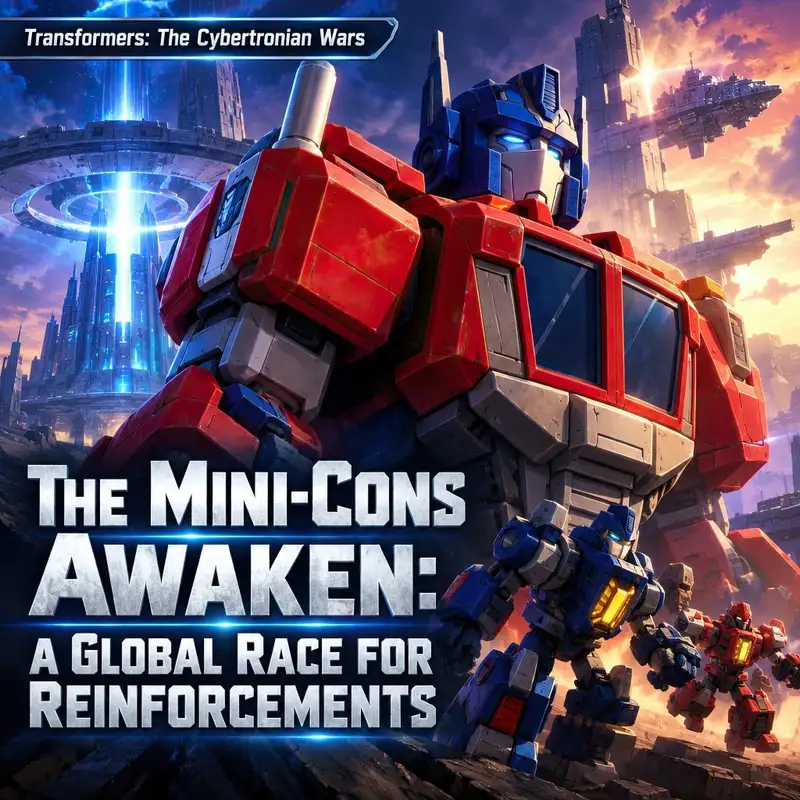
The Mini-Cons Awaken: A Global Race for Reinforcements
Beneath the roads, forests, rail lines, and forgotten ruins of Earth, small Cybertronians lay dormant. They were scattered too widely for any human map to record, and hidden too completely for the planet’s governments to recognize what had landed among them. Then, near Lincoln, Nebraska, three teenagers found the systems connected to that lost arrival. Rad, Carlos, and Alexis did not intend to begin a military crisis. They awakened Mini-Cons, and the activation sent a signal into space.
In the English-language history of Transformers: Armada, that signal did more than announce that alien life existed on Earth. It told two armies that a population they had fought over on Cybertron was alive, scattered, and reachable. Optimus Prime and Megatron did not arrive because Earth had declared a side in their war. They arrived because Earth had become the location of a strategic prize.
Neither commander possessed a complete inventory of what had survived. Neither had a reliable global map of Mini-Con locations. The signal established presence, not control. It created an intelligence problem, a mobility problem, and eventually a political problem. The Mini-Cons were not a mineral deposit or an abandoned weapons cache. They were smaller Cybertronians, capable of forming partnerships with larger Transformers and increasing their military effectiveness.
That distinction matters. Both factions often treated Mini-Cons as reinforcements, power sources, and components of weapons systems. Yet the Mini-Cons were sentient participants in the conflict. The early stages of the campaign do not provide a full account of every Mini-Con’s wishes or political beliefs. Their limited speech and unfamiliar behavior leave much unresolved. But the war that followed was still a contest over living beings whose presence could change the balance between Autobots and Decepticons.
The opening of the Mini-Con crisis did not create the Autobot-Decepticon war. That conflict already existed. Before Earth entered the story, the two sides had competed over access to Mini-Con power on Cybertron. The Mini-Cons had become important because a partnership with one could enhance the abilities of a larger Cybertronian. A soldier who gained a Mini-Con partner did more than acquire a tool. He gained access to a new combat relationship, one that could alter mobility, weapons, sensors, or battlefield effectiveness.
The Mini-Con vessel’s flight from the Cybertronian conflict turned that military competition into a problem of exile and dispersal. The ship eventually crashed on Earth, scattering its passengers across the planet. The English series does not establish a precise crash date, a reliable count of the Mini-Cons involved, or an exact length of dormancy. What matters is the sequence. A population escaped a war, became dormant on another world, and was rediscovered only when human curiosity reactivated the network around them.
That accident shifted the center of gravity of the conflict. Cybertron had been the original political and military arena, but Earth became the decisive search ground. It was not decisive because either faction conquered the planet. Neither did. It became decisive because the Mini-Cons were dispersed there, and because each discovery could alter the balance between individual combatants or reveal a larger Mini-Con capability.
The resulting campaign was not a conventional invasion with a clear front line. It was a series of recovery operations. A Mini-Con might be located in forest terrain, beneath a city, inside an underground transport system, near ancient ruins, underwater, or in remote country where ordinary human access was difficult and Cybertronian movement was conspicuous. Every location imposed its own problems of reconnaissance, transport, concealment, timing, and force protection.
This made Earth’s geography strategically relevant. A road network could assist a vehicle-form Transformer, but it could also restrict movement and expose an unusual machine to human attention. Open desert allowed rapid maneuver but provided little cover. Underground locations favored those who could enter confined spaces, interpret unfamiliar infrastructure, or move without collapsing the route behind them. Water barriers, ruins, rail lines, and urban density were not background scenery. They shaped who could reach a Mini-Con first and who could hold the site afterward.
The first force to arrive at a Mini-Con location gained an immediate advantage, but not necessarily a lasting one. Finding a dormant Mini-Con was only the beginning. The discoverer had to activate it, protect it from enemy interference, establish some form of partnership, and withdraw before the other side could seize or recapture it. A recovered Mini-Con also had to be brought back through a dangerous environment, integrated into a team, and kept secure. This was less like capturing ground and more like conducting repeated raids for mobile, highly valuable personnel.
Both factions developed the basic infrastructure needed to sustain that effort. The Autobots established an Earth base that gave their growing force a place for communication, repair, planning, and protection of their human companions. The Decepticons operated from a lunar base built around the recovered remains of the Mini-Con vessel. That position gave Megatron a fixed staging point above Earth and a secure location from which to direct his forces.
Neither base meant that its owner possessed perfect reach. A lunar installation did not give Megatron instant control of every location on Earth. An Earth base did not give Optimus Prime complete knowledge of where the next Mini-Con would emerge. Both sides still depended on signals, reconnaissance, rapid movement, and the judgment of field commanders. The campaign remained reactive. Each new contact forced a race, and each race created an opportunity for ambush, miscalculation, or escalation.
Rad, Carlos, and Alexis became important because they had been present at the beginning. They were civilians, not diplomats, military officers, or representatives of a unified Earth government. No treaty transformed them into an official Autobot liaison mission. Their importance came from access. They understood local roads, schools, homes, public spaces, and the ordinary habits of the world where the larger Cybertronians now had to operate.
They also developed personal bonds with High Wire, Grindor, and Sureshock, the Mini-Cons awakened near Lincoln. Those relationships gave the Autobots something that sensors and weapons could not provide. The children could observe Mini-Con behavior at close range, communicate through trust rather than command, and move through human environments without causing the alarm that follows a large alien combatant. In a campaign built on incomplete intelligence, those advantages mattered.
The Autobots’ relationship with the children also had political value. Optimus Prime’s force was still an expeditionary military group operating on a planet that had not invited it. Protecting the children and cooperating with them helped establish a practical form of legitimacy at the local level. It did not grant Optimus authority over Earth, and it did not settle the question of what obligations the Autobots owed the Mini-Cons. But it gave the Autobots allies who were invested in people rather than merely in power.
The Decepticons approached the search from a different position. Their central objective was more than to locate Mini-Cons before the Autobots did. Megatron needed to concentrate their power. A few scattered partners could improve individual soldiers, but Megatron’s larger ambition was to convert recovery into superiority. He needed Mini-Cons in Decepticon custody, paired with Decepticon forces, and available for use against Optimus Prime before the Autobots could deny that advantage.
This was the first important asymmetry of the campaign. Optimus could succeed by preventing a Decepticon monopoly. Megatron needed more than occasional victories. He needed enough concentration of power to break the Autobot position. That made the Decepticons more aggressive in their searches and more willing to regard Mini-Con discovery as a direct military contest. It also meant that every Autobot success threatened Megatron’s larger design, even when the immediate encounter appeared minor.
Optimus Prime’s command problem was therefore defensive but not passive. He had to protect the children, preserve the Autobots’ foothold on Earth, recover Mini-Cons when possible, and prevent Megatron from assembling an overwhelming advantage. He also had to build a functioning team from Cybertronians with different temperaments, skills, and priorities. His force was not a settled government with secure territory and established institutions. It was a growing field command under pressure.
Hot Shot represented both the strength and the weakness of that arrangement. He was fast, aggressive, and eager to prove himself. In a sudden race to a newly found Mini-Con, those qualities could be useful. A commander needs personnel willing to move quickly when the other side may arrive at any moment. But Hot Shot’s competitiveness could also complicate discipline. The Mini-Con campaign rewarded initiative, yet uncontrolled initiative could expose the team, escalate a fight, or turn a recovery mission into a personal contest.
Red Alert served a different function. He was more than another combatant placed in the line of battle. His technical and medical skills supported reconnaissance, recovery, assessment, and repair. In a war where damaged Cybertronians could not simply be abandoned without consequence, such work was operationally important. A force that finds a Mini-Con but cannot repair its own personnel, interpret the site, or safely extract a partner has gained less than it appears to have gained.
Smokescreen’s arrival broadened the Autobot force further. His heavy, construction-oriented capabilities made him valuable in a campaign fought across broken terrain, hidden sites, and improvised bases. Construction equipment is not glamorous in a conflict usually remembered for speed and energy weapons, but it is often decisive in practice. Access routes have to be opened. Defensive positions require preparation. Wreckage must be cleared. Damaged infrastructure can either become an obstacle or an opportunity.
Optimus could not solve his problem by collecting Mini-Cons alone. He needed cohesion. He needed field commanders who could work together, specialists who could sustain the force, and enough restraint to prevent every search operation from becoming destructive combat in a human-populated environment. The Autobot advantage was not pure firepower. It was the ability to create a coalition of larger Cybertronians, Mini-Cons, and human civilians who had reasons to trust one another.
Megatron’s command structure had strengths of its own. He possessed a clear military objective, a core group of capable combatants, and a strong personal relationship with Leader-1, his Mini-Con partner. The Decepticon roster included Starscream, Demolishor, and Cyclonus, each contributing different forms of battlefield capability. Heavy force, air mobility, and aggressive pursuit all mattered in a campaign where the next objective might appear anywhere on a planet.
The lunar base also gave Megatron an important operational advantage. It was separate from the Autobots’ human surroundings, difficult for ordinary civilians to reach, and useful for coordinating searches and holding recovered assets. But a secure base is not the same as complete command of a theater. The Decepticons still had to descend to Earth, identify their targets, move through unfamiliar terrain, and contest sites before the Autobots could secure them.
Earth alternate modes improved those operations, but they did not remove their difficulties. A vehicle form could help a Cybertronian travel along local routes or avoid immediate notice. It did not create reliable intelligence. It did not guarantee that a large machine could blend into every environment. It did not solve the problem of reaching a buried Mini-Con before the enemy. A disguise is an advantage in movement and observation. It is not a substitute for planning.
Megatron also faced internal political friction. Starscream was a senior and dangerous subordinate, useful in combat but not simply an extension of Megatron’s will. The Decepticon command structure was centralized around Megatron’s authority, yet it depended on personalities with their own ambitions and judgments. That kind of system can act quickly. It can also become brittle when officers question the leader’s decisions or calculate their own advantage.
The Mini-Con campaign made those tensions more significant. Every recovered partner had military value, and every powerful new weapon could alter prestige within the Decepticon ranks. In a force built around concentrated personal authority, success was never entirely separate from factional politics. A subordinate who gained influence through a new capability might remain loyal, become a rival, or simply make command more difficult. Megatron’s problem was not only to defeat Optimus. It was to keep the Decepticons pointed toward the same strategic objective.
For much of the early campaign, the contest remained a race for individual partners. That changed when the larger Transformers learned that some Mini-Con teams could combine into systems of exceptional military importance. The Star Saber was the clearest escalation. It was formed by three Mini-Cons acting together, and it transformed the meaning of Mini-Con recovery. The prize was no longer limited to a series of individual enhancements. A specific group could create a weapon capable of reshaping direct engagements.
The Star Saber mattered because it concentrated power. An individual Mini-Con partnership could improve one fighter’s performance. A combined weapon altered the tactical relationship between opposing formations and commanders. Possession gave its holder an offensive capability the other side had to plan around. A battle that might otherwise depend on maneuver, teamwork, and ordinary weapons now included a rare system with the potential to dominate a confrontation.
Yet the Star Saber was not an industrial revolution. It could not be treated as a rifle that either army could manufacture in large numbers once someone understood the design. Its value depended on particular Mini-Cons, their continued combination, and the ability of one faction to maintain custody. That made it powerful but fragile. A unique weapon can produce immense pressure, but it can also distort strategy by encouraging both sides to organize too much around one scarce asset.
The political consequence was just as important. The more the Mini-Cons became associated with rare military systems, the harder it became to view them merely as displaced refugees or potential allies. Their strategic value invited control. Their ability to combine made them objects of competition among larger commanders. The early series does not settle every question of Mini-Con consent, but the pattern is clear enough. Their presence became increasingly entangled with the larger factions’ pursuit of coercive power.
When Megatron obtained the Star Saber, Optimus Prime faced a new defensive problem. Denying the Decepticons a monopoly on Mini-Con power had not been enough. Now the Autobots had to find a way to survive and counter an enemy who possessed a concentrated offensive advantage. This was a familiar arms-race pattern. One side acquired a capability that threatened existing plans. The other side had to adapt, seek intelligence, and develop a counterweight before the new weapon could dictate the entire campaign.
Scavenger became important in this phase because he brought specialized knowledge and a more complicated relationship to the Decepticon cause than simple obedience. His role demonstrated that reinforcements do not always arrive as troops. Sometimes they arrive as expertise. In a war involving ancient Mini-Con systems, the side that understands what a discovery means may gain as much from it as the side that physically reaches the site first.
The Skyboom Shield emerged as the principal answer to the Star Saber. Like its counterpart, it depended on a specific three-Mini-Con combination. Its importance lay in its defensive role. If the Star Saber threatened to give Megatron a decisive edge in direct combat, the Skyboom Shield offered the Autobots a way to absorb, resist, or complicate that threat. It did not erase the danger. It changed the calculations around it.
This was not a clean technological solution. The arrival of a shield did not make the Star Saber irrelevant, and the Star Saber’s capture did not make Decepticon victory inevitable. The result was a more complex contest. Tactically, the two systems reshaped particular confrontations. Operationally, they forced both sides to devote attention to custody, deployment, intelligence, and protection. Strategically, neither weapon destroyed the other faction’s ability to continue the war.
The weapons also reinforced the central weakness of the campaign. Both armies were increasingly dependent on Mini-Con participation, possession, or cooperation, but neither had resolved what political place the Mini-Cons should hold after the fighting. The larger factions had found new ways to become stronger. They had not found a way to make the conflict less dependent on the control of a third Cybertronian population.
As the search continued, larger Cybertronian reinforcements began to arrive as well. Blurr’s appearance during the contest over the Mini-Con Incinerator showed that the campaign was broadening beyond the original teams on Earth. Blurr was not a Mini-Con. He was an Autobot reinforcement, bringing his own capabilities and his own personality into an already strained command environment. His claim to Incinerator also showed how personal partnership and factional interest could overlap.
A reinforcement is never merely an additional weapon platform. New personnel bring experience, equipment, information, and sometimes badly needed confidence. They also bring habits formed elsewhere, rivalries, misunderstandings, and demands on the existing chain of command. Blurr’s arrival increased Autobot capability, but it also required integration. Optimus had to ensure that a useful specialist became part of a functioning team rather than another source of friction.
The Decepticons gained Thrust during the same general phase of the campaign. Thrust strengthened Megatron’s side not simply through combat ability but through a more deliberate strategic outlook. He represented the value of operational planning in a war that had often been driven by sudden signals and rapid pursuits. The Decepticons needed more than forceful reactions. They needed methods for anticipating Autobot behavior, concentrating resources, and turning isolated successes into a broader advantage.
Jetfire’s arrival gave the Autobots a corresponding increase in reach and capability. He too was not a Mini-Con. He was a larger Cybertronian reinforcement whose presence altered the balance within the Autobot force. The arrival of figures like Blurr, Thrust, and Jetfire demonstrates that the phrase reinforcements had two meanings during this period. It referred to Mini-Cons who could enhance larger Transformers, and it referred to incoming personnel whose skills could alter the campaign’s command and military structure.
Neither kind of reinforcement automatically produced unity. The Autobots gained specialists and new sources of strength, but Optimus still had to coordinate a diverse field force while protecting civilians and preserving the trust that held the group together. Megatron gained personnel who could sharpen Decepticon operations, but he still faced the problem of loyalty within a command system dominated by his personal authority. More capability did not mean fewer political problems.
The campaign widened again when the Land Military Mini-Con Team made contact with Mini-Cons already active on Earth. This mattered because it suggested that the scattered Mini-Cons were more than isolated objects waiting to be found. They could make contact, move, and influence one another’s circumstances. That does not establish a unified Mini-Con government or a single independent military command. That conclusion has no support in this early part of the story. But it does reveal a broader network of relationships than the larger factions had initially understood.
For the Autobots and Decepticons, that created an intelligence challenge. They were no longer pursuing only dormant signals and fixed locations. They had to respond to movement, emerging contact, and the possibility that Mini-Con activity might develop faster than either command could predict. The search became less like a scavenger hunt and more like a contest over a changing human and Cybertronian landscape.
This increased the burden on logistics. A recovered Mini-Con had to be transported, protected, accommodated, and defended against recapture. Damaged personnel required repair access. Intelligence had to move between field teams and bases. Commanders had to decide which signal deserved immediate response and which might be a diversion. Precise energon allocations, repair capacity, and transport tonnage are never specified. But the repeated need to search, recover, and withdraw makes the basic burden clear.
The children remained important in this wider campaign because Earth was not an empty battlefield. Each new route passed through places where humans lived, traveled, worked, or explored. Forests and ruins may seem remote, but underground rail systems, towns, roads, and public sites were part of civilian life. The full human population remained largely unaware of the war unfolding around it. That ignorance did not make the danger unreal. It meant civilians lacked the information needed to prepare for it.
Rad, Carlos, and Alexis bore an unusual share of that burden. They had no formal authority, no military training, and no ability to compel either faction to leave Earth alone. Yet their friendship with the Autobots and Mini-Cons placed them near the center of repeated confrontations. They became guides, observers, and mediators because the larger conflict had entered their world. The war did not wait for a government declaration or public debate. It arrived through a signal in Nebraska.
That human dimension exposed the difference between tactical success and political control. The Autobots might secure a Mini-Con and protect the children in one encounter. The Decepticons might seize a weapon or force an Autobot withdrawal in another. Neither result gave either faction sovereignty over Earth. Neither established a stable relationship with humanity as a whole. Earth was the campaign’s center of gravity without becoming a unified participant in the war.
The Autobots possessed several real advantages. They had Optimus Prime’s leadership, growing connections with the human trio, a developing Earth base, and a coalition that could benefit from trust as well as strength. Their defensive mission gave them a clearer political case on the ground. They were trying to stop Megatron from monopolizing Mini-Con power, and they were visibly protecting civilians caught in the conflict.
But their limits were equally real. They did not know where every Mini-Con was located. They could not be everywhere at once. They lacked political authority over Earth, and their team contained competing personalities with different ideas about risk and command. Their success depended on cooperation among Autobots, humans, and Mini-Cons, yet cooperation is slower and more demanding than simple obedience. It has to be built and maintained.
The Decepticons also possessed genuine strengths. Megatron had a secure lunar base, a force willing to use aggressive methods, access to Leader-1, and eventually possession of the Star Saber. His troops could exploit speed, air mobility, heavy force, and the pressure created by a direct military threat. In a sudden contest over a newly awakened Mini-Con, the Decepticons could often make the Autobots react on unfavorable terms.
Yet Megatron never achieved the monopoly he required. The Decepticons could capture Mini-Cons, but they could not prevent the Autobots from finding others. They could field exceptional weapons, but they could not transform a unique weapon into permanent control of the theater. They could establish a lunar base, but they could not make Earth’s geography, human population, or Mini-Con network behave as though they were Decepticon territory.
Their internal politics also limited them. A command system based heavily on one leader’s authority can move quickly when the leader’s judgment is sound. It can become vulnerable when subordinates pursue personal influence, question priorities, or withhold their full commitment. Starscream’s importance lay partly in that tension. He was valuable enough to need, dangerous enough to watch, and prominent enough that Megatron could not treat him as interchangeable.
The Mini-Con campaign therefore produced a paradox. It gave both factions more ways to fight. It improved individual warriors, rewarded reconnaissance, encouraged rapid mobility, and introduced rare combined weapons that changed the terms of battle. It also made the war harder to settle. Every discovery created another reason to continue searching. Every weapon created demand for a counterweapon. Every reinforcement altered the command balance without resolving the conflict beneath it.
The campaign’s apparent global reach should not be confused with global control. The Autobots and Decepticons ranged across many kinds of terrain, but neither possessed a complete map of the Mini-Con population or the ability to secure every site permanently. They could move rapidly, but distance still mattered. They could transform, but terrain and local infrastructure still mattered. They possessed advanced technology, but they still depended on bases, communications, repair, intelligence, and personnel able to act under pressure.
This is why the Mini-Cons were more than a convenient source of upgrades. Their awakening exposed the structure of the wider war. Both major factions believed that enough military advantage might finally decide the struggle. But military advantage is not the same as political order. A side can win a duel, capture a weapon, or gain a new partner without establishing legitimacy among the people whose future the war is supposed to determine.
For the Mini-Cons themselves, the situation was especially precarious. Their existence gave them importance, but importance did not automatically give them power over their own fate. The Autobots’ more cooperative relationship with the human children and their Mini-Con companions suggested a different model from Megatron’s pursuit of concentration and control. Still, the Autobots were also fighting to secure Mini-Con capability for their own survival. Protection and military necessity remained intertwined.
That unresolved tension shaped everything that followed. The Mini-Cons had fled a Cybertronian war, only to become central to its continuation on Earth. Their awakening turned a hidden refuge into an active theater. Their partnerships gave individual fighters new strength. Their combined systems created an arms race. Their scattered locations forced both armies into a continuing sequence of searches, recoveries, and confrontations across a world that had not chosen to host them.
The tactical gains were real. The Mini-Cons could improve combat power, and the Star Saber and Skyboom Shield could reshape particular battles. The operational changes were real as well. Both factions expanded their search capacity, brought in larger reinforcements, and adapted their bases and command structures to an Earth-wide recovery effort. But none of those gains produced strategic victory. Neither Optimus nor Megatron could convert possession of Mini-Con power into a final settlement.
The deeper failure was political. The Autobots and Decepticons treated the Mini-Cons as the key to winning a war whose original causes remained unresolved. They competed for partners, weapons, and leverage, while Earth’s civilians inherited the risks of that competition. The Mini-Cons awakened as reinforcements, but their awakening revealed that no amount of additional power could create legitimate order for a civilization still trying to solve its problems through possession, coercion, and war.