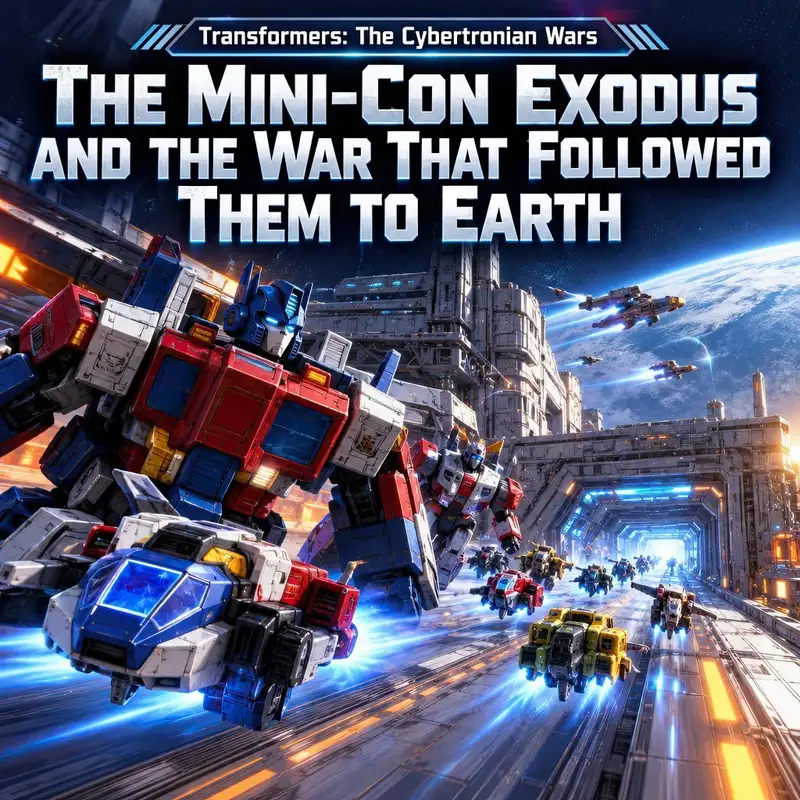
The Mini-Con Exodus and the War That Followed Them to Earth
Rad White, Carlos Lopez, and Alexis Thi Dang enter a cave expecting the usual rewards of adolescent curiosity: a strange find, a story no adult will believe, perhaps a route worth exploring. Instead, they uncover a metal panel buried in the rock. When they activate it, three dormant Mini-Cons awaken. High Wire, Grindor, and Sureshock are not introduced as weapons, military hardware, or prizes in a larger war. They are frightened, displaced beings emerging into an unfamiliar world after an absence measured in millions of years.
The panel also sends a signal across interstellar distance. It reaches Cybertron, where two armed factions have been searching for the Mini-Cons since their disappearance. For the Autobots and Decepticons, the event is not a local mystery. It is intelligence of the highest order. A population that vanished from the battlefield has been found. Its location is Earth. Within hours of that discovery, Earth ceases to be merely the home of three children and becomes a new theater in a Cybertronian war.
That is the central tragedy of the Mini-Con exodus in the English-language Transformers: Armada story. The Mini-Cons escape Cybertron because larger powers have learned to value them for what they can do in war. Their flight removes them from immediate danger, but it does not remove the reason that danger exists. They remain strategically valuable. Once they are rediscovered, the conflict follows them across space.
To understand why one cave panel could draw Optimus Prime and Megatron to Earth, it is necessary to return to the older war on Cybertron. The exact early history is not documented with the precision of a staff archive. Armada gives us broad accounts, memories, and later revelations rather than a complete campaign history. But its essential point is clear. Autobots and Decepticons were already fighting for control of Cybertron when the Mini-Cons became central to the balance of power.
Mini-Cons are smaller Cybertronians, but their importance is more than a matter of size or numbers. They can Powerlinx with larger Transformers. In practice, that means a Mini-Con can connect with a larger partner and alter that partner’s battlefield capability. The result may be improved mobility, a new weapon, better defensive capacity, or another form of amplification. Mini-Con effects vary, and the story never treats every partnership as equally capable. What it does establish is that these links can change the outcome of a fight.
That distinction matters. A Mini-Con is more than an auxiliary soldier. In the right circumstances, one can create a local imbalance between two larger opponents. A force that acquires Mini-Con support may gain an advantage out of proportion to its visible size. On a battlefield where both sides are already closely matched, that sort of advantage becomes politically dangerous. It encourages commanders to think not in terms of coexistence, but possession.
The Decepticons see in Mini-Con power a way to strengthen their offensive position against the Autobots. The Autobots, recognizing the same danger, seek to prevent a Decepticon monopoly. The result is an arms competition built around living participants. The war is no longer only about cities, energon, territory, command, or ideology. It becomes a contest over who can recruit, capture, protect, persuade, or control the Mini-Cons.
Armada’s retrospective account makes clear that the Mini-Cons did more than volunteer to become the deciding factor in a civil war. They attempted to leave. That decision is the foundation of the exodus. It was not an expansion program, a planned colony mission, or an ordinary military redeployment. It was an escape by a population that had become too useful to be left alone.
The series presents a temporary truce between Autobots and Decepticons that allows the Mini-Cons to depart Cybertron aboard an evacuation vessel. The truce is important, but its limits are equally important. It halts immediate fighting around the departure. It does not establish Mini-Con political independence. It does not create a durable settlement between the two larger factions. It does not answer who will control Powerlinx technology if the Mini-Cons return, make contact, or choose sides in the future.
In other words, the truce is a pause in violence, not peace. Both factions have reason to permit the departure because the Mini-Cons’ presence has intensified the war. Yet neither side has built an arrangement capable of surviving the Mini-Cons’ disappearance. The larger conflict remains unresolved. The Mini-Cons are allowed to leave because they are dangerous to fight over, not because Cybertron has accepted that they are entitled to live beyond the reach of military command.
It would be easy to describe the Mini-Cons as slaves and leave the matter there. The screen history does not support a complete legal account of their status on prewar Cybertron, and it does not show that every Mini-Con experienced the conflict in the same way. Some later cooperate closely with larger Transformers. Some form bonds that appear genuine. Some fight. Some resist. The stronger conclusion is more careful. They are a vulnerable population whose military utility repeatedly threatens to outweigh their ability to choose their own future.
Their evacuation was therefore a rational attempt to solve an immediate problem. Distance could separate them from the battlefield. A new destination might give them time to build a society outside Autobot and Decepticon competition. But evacuation across interplanetary distance is never merely a matter of opening a route and hoping for the best. It requires secure transport, navigation, communications, power, recovery plans, and a destination that can receive a displaced population.
The Mini-Con ship does not reach such a destination. During transit, it is damaged while passing through the route that carries it away from Cybertron. Armada does not provide a complete technical reconstruction of the failure, and there is no need to invent one. The operational result is plain. The vessel reaches the Solar System in distress, strikes the Moon, and breaks apart.
Part of the wreckage remains associated with the Moon. Other portions descend toward Earth. Emergency systems scatter the Mini-Cons in storage panels across the planet, where they enter dormancy. The mechanism preserves them from immediate destruction, but it also transforms a collective evacuation into dispersal. Instead of arriving together under their own leadership, the Mini-Cons are separated, buried, and rendered unable to coordinate their own recovery.
This is the paradox of the failed evacuation. It succeeds at the most basic level. The Mini-Cons are no longer on Cybertron’s battlefield. They are beyond the immediate reach of both armies. Yet it fails at the political and logistical level. They do not establish a secure refuge. They do not arrive at a prepared settlement. They do not control their own communications or know where their companions have gone. Their survival now depends on obscurity.
For approximately four million years, obscurity works. Earth is not defended by a Mini-Con state, an Autobot garrison, or a negotiated treaty. It is safe because no one knows where the Mini-Cons are. Their panels remain hidden in caves, ruins, remote terrain, and other places beyond the notice of a young human civilization. The Moon, holding wreckage from the ship, also becomes part of this accidental strategic geography.
Dormancy is not freedom in the full political sense. It is survival through absence. The Mini-Cons escape exploitation by becoming inaccessible. They are preserved, but they are not self-governing. They are hidden, not secure. Still, compared with life as objects of military competition on Cybertron, the silence of Earth protects them for an extraordinary length of time.
Then three children find one panel.
When High Wire, Grindor, and Sureshock awaken, the children respond to them first as individuals. They are strange, energetic, and sometimes difficult to understand, but they are plainly alive. Rad, Carlos, and Alexis do not begin with an order of battle. They do not ask which side can use these beings to gain a military advantage. Their first instinct is curiosity, concern, and friendship.
That civilian perspective is one of Armada’s most important contributions to the Mini-Con story. Rad, Carlos, and Alexis are not leaders of Earth. They are not representatives of a military alliance, intelligence agency, or planetary government. They do not control a fleet or command an army. Their importance is more intimate. They encounter the Mini-Cons before the larger Cybertronians reframe them as strategic assets.
The beacon from the activated panel changes everything. It awakens additional Mini-Con panels scattered across Earth. It also informs Cybertronian command that the lost Mini-Cons survived. The signal is an intelligence disaster from the Mini-Cons’ perspective. Their concealment had endured for millions of years. One accidental activation reveals not merely three survivors, but an entire hidden population and the planet that shelters them.
Optimus Prime and Megatron respond according to the strategic logic already established on Cybertron. Both dispatch forces to Earth. The Autobots seek to prevent the Decepticons from gaining control of Mini-Con power. They also take responsibility for protecting the humans and the Mini-Cons caught in the middle. The Decepticons seek to acquire Mini-Cons because Powerlinx capability offers a means to improve their military position against the Autobots.
Neither expedition is simply a rescue mission. The Autobots may act from more protective motives, and their conduct is sharply different from Decepticon conquest, but they also know that losing the Mini-Cons to Megatron could alter the war. The Decepticons are more direct about treating Mini-Cons as military resources. Yet both commands arrive because the same discovery has transformed Earth into a place of strategic value.
The adoption of Earth vehicle modes gives the incoming Cybertronians mobility and concealment. A truck, sports car, construction vehicle, jet, or other local form can move through human terrain more easily than an openly alien body. But transformation does not make the campaign simple. Earth is large. Its Mini-Con panels are scattered. The factions need search methods, secure bases, communications, repair capability, transport, and enough local knowledge to move without exposing themselves too quickly.
The early Earth war is therefore not one decisive invasion. It is a distributed search-and-denial campaign. A panel discovered by one side might be awakened, protected, hidden, or taken before the other side arrives. A newly active Mini-Con might accept a partnership, resist it, or become the focus of a confrontation between larger Transformers. Every recovery matters because it changes not only immediate strength, but the enemy’s future options.
The terrain matters as well. Caves, deserts, coastal zones, cities, industrial spaces, highways, and orbital approaches all become parts of the campaign. Earth’s civilian population does not receive a unified warning or a coherent political explanation. Most humans remain unaware that a distant war has arrived around them. The people who do understand the danger are usually local participants: the children, their families, and the few Cybertronians directly involved.
That lack of central human control gives the Cybertronian factions room to maneuver, but it also means there is little external authority capable of setting rules. No Earth government establishes a system for Mini-Con asylum. No civilian institution can determine whether a newly awakened Mini-Con is a refugee, a combatant, a prisoner, or an independent person. The practical decisions are made by whoever reaches the panel first.
This is why possession becomes so dangerous. A Mini-Con is not a crate of ammunition that can be counted, shipped, and stored. A Mini-Con has preferences, loyalties, fear, and the capacity to form relationships. Yet the military campaign often treats custody as though it settles the matter. If an Autobot or Decepticon has physical control of a Mini-Con, that commander gains a potential advantage. The Mini-Con’s own consent can become secondary to the urgency of the larger war.
The Decepticons frequently pursue this logic openly. Megatron’s command wants Mini-Con power because it can break Autobot resistance. Individual Decepticons may have different reasons for serving him. Demolishor’s loyalties and doubts are not the same as Starscream’s ambitions, and neither is identical to Megatron’s own hunger for victory. But the command structure as a whole treats Mini-Con acquisition as a central military objective.
The Autobots operate under a different moral claim. Optimus Prime’s forces argue that Mini-Cons must not be allowed to fall under Decepticon control. That claim is not empty. Decepticon possession would likely expose the Mini-Cons, Earth, and the Autobots to greater coercion. But a defensive objective can still create pressure. If Autobot survival depends on a Mini-Con team joining a weapon system, how freely can that team refuse?
Armada repeatedly returns to this question without turning it into a courtroom argument. It uses searches, recoveries, disagreements, and friendships to show that the Mini-Cons are not passive tools. They make choices, often through action rather than extended speech. They flee danger. They form attachments. They cooperate with particular partners. They show reluctance when larger forces expect them to serve a military purpose.
The contest grows more serious because some Mini-Con groups can do more than enhance a single Transformer. Certain teams combine into systems with strategic significance. The Star Saber is an offensive weapon whose existence gives its holder a powerful advantage in direct confrontation. The Skyboom Shield provides protection on a scale that can change the shape of an engagement. The Requiem Blaster creates an even greater danger because it offers long-range destructive leverage.
These are not ordinary weapons in the sense of standard-issue rifles or mass-produced artillery. They depend on specific Mini-Con combinations. Their value lies in rarity, concentration, and the difficulty of denying them to the enemy. That makes the Mini-Cons involved more vulnerable, not less. The more a group can affect the war, the more intensely both factions try to locate, persuade, protect, or seize it.
The Star Saber changes immediate combat calculations. A commander facing it must account for a concentrated offensive capability that ordinary forces may not easily match. The Skyboom Shield changes the defensive equation by making a protected force harder to dislodge or destroy. The Requiem Blaster raises the stakes beyond a single encounter. It suggests that control of Mini-Con partnerships can translate into coercive power over distant targets.
The series wisely does not provide reliable technical figures for range, output, or destructive yield. It does not need to. The operational effect is enough. These systems can alter the tempo of a campaign. They can force the opposing side to redirect forces, revise plans, seek countermeasures, or accept new risks. A rare Mini-Con combination is valuable precisely because it cannot be replaced casually.
That creates a familiar pattern in arms races. A capability acquired for defense encourages the other side to seek an equivalent or superior capability. A weapon intended to deter attack may become an incentive for preemptive action. The Mini-Con teams become focal points for escalation because no faction can safely assume the other will use such power with restraint. The more decisive the weapon appears, the less likely it is that the Mini-Cons attached to it can simply walk away.
The Requiem Blaster storyline makes the moral problem especially clear. The Mini-Cons associated with that weapon do not want to remain trapped between Autobot and Decepticon demands. They attempt to run away. Their flight is not a trivial refusal or an inconvenience to be managed by commanders. It is a political act. They are rejecting the premise that their extraordinary usefulness obliges them to participate in a war.
Rad, Carlos, and Alexis help them because the children understand the situation in personal terms. The Mini-Cons are their friends. Friends are not equipment to be checked out when a crisis begins. The children do not deny that Megatron is dangerous or that the Decepticons would use the weapon badly. What they resist is the idea that danger automatically gives any larger force the right to decide for the Mini-Cons.
The Autobots’ position in this conflict is difficult because the danger is real. If the Decepticons gain the Requiem Blaster, the consequences could be severe. Optimus Prime cannot dismiss the strategic problem. A responsible commander must consider what happens if an enemy acquires a weapon capable of changing the wider balance. The Autobots’ concern is more than institutional self-interest.
But military necessity is not a magic phrase. It identifies a problem. It does not settle the moral answer. The Autobots can genuinely seek to protect the Mini-Cons and still place them under pressure to serve. Their intentions differ from Decepticon domination, and that difference matters. Yet the Mini-Cons’ attempt to flee reveals a contradiction inside the Autobot cause. Protection becomes incomplete when it depends on the protected population providing military power in return.
This is not moral equivalence. Megatron’s pursuit of Mini-Con control is tied to conquest and advantage. The Autobots’ actions are shaped by the need to prevent that conquest. The two sides do not carry the same responsibility. Still, Armada refuses the simpler claim that good intentions erase institutional pressure. A force fighting defensively can still become dependent on the labor, bodies, and choices of those it promises to defend.
The human children serve as a check on that dependency. They are not wiser than every Cybertronian commander in every matter. They lack the burden of directing an army and cannot see every strategic consequence. But their lack of military authority allows them to ask a question that commanders often avoid. What do the Mini-Cons want? It is a basic question, and in a war driven by weapons competition, it can become remarkably difficult to hear.
As the campaign continues, Earth becomes more deeply militarized. The original search for scattered panels expands into broader operations. Both factions establish positions, pursue intelligence, and use increasingly powerful systems. The war’s geography stretches from hidden terrestrial locations to the Moon, Mars, orbital space, and routes beyond Earth. The Mini-Con contest no longer concerns only isolated recoveries. It affects the direction of the whole conflict.
The Hydra Cannon demonstrates how far that escalation can go. Its importance is not an exact calculation of power. No responsible modern-weapons equivalent can be drawn from the story. Its importance lies in what it represents. The struggle over Mini-Con capability now reaches an orbital and planetary scale. A conflict that began with buried panels and local encounters can threaten entire worlds through systems designed to compel, intimidate, or destroy at a distance.
On the battlefield, Powerlinx partnerships change individual fights. A larger Transformer gains a capability that may surprise an opponent or overturn an existing advantage. Across multiple engagements, the scattered panels force both factions into a continuous campaign of search, recovery, protection, and denial. At the level of grand strategy, Earth becomes central because it contains the population and combinations that can shift the war’s balance.
The political level is more troubling. The more the Mini-Cons matter to victory, the harder it becomes for either faction to treat their choices as decisive. A Mini-Con may be called a partner, ally, friend, or asset. The language changes with the speaker. The underlying question remains whether that Mini-Con can refuse a mission when the fate of a battle, a city, or a planet appears to depend on participation.
This is also why the Mini-Con exodus cannot be reduced to a simple tale of a failed escape. The Mini-Cons do not remain helpless after arriving on Earth. They form partnerships. They act in battle. They influence larger Transformers. They make the later struggle against Unicron possible. Their agency grows more visible as the story continues. But agency expressed under conditions of war is not the same as freedom from coercion.
Later developments reveal a deeper connection between the Mini-Cons and Unicron. That knowledge changes the audience’s understanding of their place in the larger Armada story. It also helps explain why Mini-Con power has consequences beyond the immediate Autobot-Decepticon war. Yet it must be handled carefully. The characters involved in the original evacuation did not possess the full later picture. Their decision to leave Cybertron was shaped by the war they knew, not by every cosmic truth revealed afterward.
Retrospective explanation can clarify a history, but it can also distort it. If the Mini-Cons later prove essential in resisting Unicron, it may be tempting to imagine that their earlier militarization was necessary all along. That conclusion does not follow. A population can become indispensable in a later emergency without having consented to exploitation in an earlier war. Necessity discovered after the fact does not erase the choices available before the crisis.
The Mini-Cons’ role in restoring Optimus Prime and aiding the fight against Unicron demonstrates both their significance and their capacity for cooperation. They are not uniformly pacifist. Armada never establishes that they reject all combat, all alliances, or all responsibility for the wider world. Some choose to fight because the threat is real and because their choices matter. That is precisely why they must be treated as persons rather than accessories.
Their participation against Unicron also reveals the limits of a purely military view of power. A commander who sees Mini-Cons only as upgrades will misunderstand what makes them effective. Their strength lies not only in combination systems or amplified weapons. It lies in trust, partnership, initiative, and collective decision. Those qualities cannot be seized as easily as a panel can be captured.
The later war against Unicron does not cleanly resolve the original political problem. A shared existential threat can force cooperation, but cooperation against annihilation is not the same as a just settlement. The Mini-Cons may fight beside Autobots and Decepticons when survival requires it, yet the earlier history still raises hard questions about who controlled their bodies, their labor, and their future when the danger seemed less universal.
The Mini-Con evacuation failed as a peace strategy because it addressed location rather than power. It removed a vulnerable population from Cybertron’s immediate battlefield, but it did not remove the military value that made that population contested. The Mini-Cons reached Earth, survived, and remained hidden for millions of years. Yet they arrived dispersed, dormant, and unable to establish political autonomy before the old war found them again.
Rad’s accidental activation of the first panel did not create the conflict. The conflict already existed on Cybertron. Megatron did not cause the entire Earth war by himself, though his pursuit of Mini-Con power accelerated its violence. Optimus Prime did not come to Earth solely for conquest, but Autobot protection carried its own pressures. The beacon, the preexisting rivalry, the strategic value of Powerlinx, and the decisions of both commands combined to turn refuge into battlefield.
Tactically, the Mini-Cons changed individual engagements. Operationally, their scattered panels created a worldwide campaign of search and denial. Strategically, their presence made Earth a center of the Autobot-Decepticon struggle and eventually exposed it to far larger forms of coercion. Politically, neither major faction initially built an arrangement in which Mini-Con consent mattered more than Mini-Con capability.
The human children understood the issue because they met the Mini-Cons as companions before they met them as instruments of war. Their perspective does not solve every command problem, but it exposes the moral failure at the heart of the conflict. A smaller people cannot be secure merely because powerful allies promise to protect them. Security requires the ability to say yes, to say no, and to shape the terms of one’s own survival.
The war followed the Mini-Cons to Earth because the true battlefield was never Cybertronian territory alone. It was the unresolved question of whether the Mini-Cons would be partners in history, or resources to be commanded by whoever reached them first.