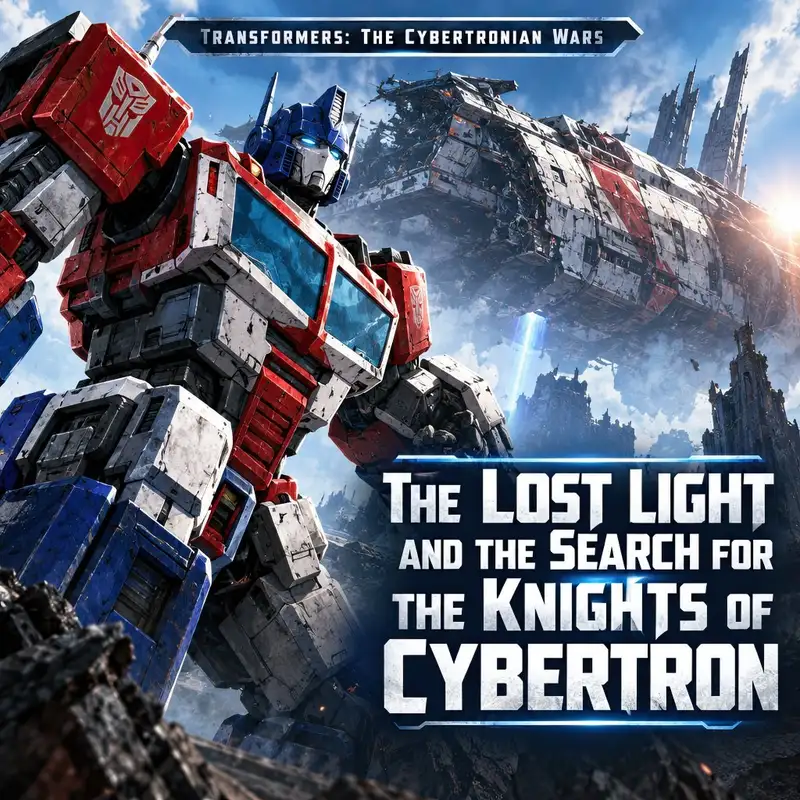
The Lost Light and the Search for the Knights of Cybertron
On Mederi, Team Rodimus found the kind of evidence that can make a historian nervous. Each traveler encountered something intensely personal. A lost companion. A longed-for peace. A vision of arrival after pain. The place seemed to offer what the Knights of Cybertron had promised: Cyberutopia, a destination beyond war, scarcity, faction, and grief. Yet the visions did not agree. There was no shared city, no common government, no population ready to greet them. Each visitor saw a different paradise. That was the first indication that the Lost Light had not reached a surviving civilization. It had reached a system designed to comfort the dying.
This is the story of the Lost Light in I D W’s 2005 Transformers continuity, beginning in the uncertain peace after the Great War. Its mission was straightforward enough to fit on a recruitment poster. Find the Knights of Cybertron, legendary travelers who had supposedly found a better future, and bring that future home. In practice, the expedition was never simply a voyage of exploration. It was a political experiment, a rehabilitation project, a refuge for veterans, and a search for meaning by a society that had survived a civil war without yet learning how to live after it.
The Lost Light did find the Knights’ destination. It found evidence that the Knights had been real, that they had traveled far from Cybertron, and that the map guiding Rodimus had not been invented. But the ship did not recover ancient founders, a functioning colony, or a blueprint for peace. Its real discovery was harsher and more useful. Cybertron’s wounds could not be healed by locating an uncontaminated past. Reconstruction, justice, and community could not be delegated to a legend.
The expedition began after Cybertron had been restored, but restoration did not mean settlement. A planet can regain power, repair cities, and reopen political institutions while remaining divided by memory. The war had created veterans, prisoners, collaborators, exiles, survivors of occupation, former revolutionaries, and former members of a regime built around conquest. It had also left behind institutions that had failed before the fighting began. The old Senate was gone, but its corruption, its inequalities, and its habits of secrecy had not just vanished with it.
Optimus Prime’s departure from formal political leadership created space for new arguments about what came next. Some Cybertronians wanted stable administration, law, and reconstruction. Some wanted punishment for the defeated. Some wanted a return to ordinary life, though ordinary life was difficult to define after a war that had shaped identities for so long. Rodimus offered another answer. He proposed movement. Rather than wait for Cybertron to decide what peace meant, he would take a ship into the unknown and search for a better model.
The Knights of Cybertron were useful precisely because their history was incomplete. They were remembered as explorers and seekers associated with a distant place called Cyberutopia. They were not the Thirteen Primes, and they were not a divine council waiting beyond the stars to resume command. Their appeal was more political than theological. They appeared to belong to a time before the institutions that had broken Cybertron, before the Autobot and Decepticon identities had hardened into opposing military camps, and before war had become the central fact of public life.
That made them ideal figures for a postwar imagination. A society exhausted by conflict often looks backward for founders who seem untouched by the compromises of the present. The founders are presumed wiser because they are distant. Their failures are easier to overlook because the records are incomplete. In the Lost Light’s case, the legend promised more than a location. It promised that somewhere, somehow, Cybertronians had already solved the problem of how to live together.
Rodimus had a map fragment associated with the Matrix of Leadership, and the fragment gave the mission enough material credibility to move beyond folklore. There was a direction to follow, though not a reliable intelligence picture. The ship had no confirmed coordinates for a functioning settlement, no living guide, no diplomatic contact, and no assurance that anyone remained at the end of the route. The mission possessed an objective in the loosest sense. It did not possess the information normally required to plan an expedition around that objective.
More than two hundred Cybertronians joined the voyage. They did not form a conventional naval crew selected for a narrow mission. The Lost Light carried veterans, scientists, medics, archivists, technicians, former Decepticons, damaged survivors, investigators, spiritual seekers, and individuals whose presence on Cybertron had become politically awkward. Some had joined because they believed in Rodimus. Some wanted distance from the rebuilding planet. Some wanted a second chance. Some likely wanted to avoid being left behind when the postwar order began deciding who belonged.
That mixture gave the ship unusual strengths. It had a remarkable concentration of technical knowledge, medical skill, combat experience, and cultural memory. It also carried the problems of postwar Cybertron within its hull. There were old loyalties, hidden crimes, unresolved trauma, and competing ideas of justice. A vessel can have engines, weapons, repair bays, and a navigation system. None of those systems can create trust. The Lost Light could cross interstellar distance. It could not just fly beyond its passengers’ history.
Rodimus was a fitting commander for such a mission because his authority was personal and aspirational. He was not running a settled constitutional government. He was leading an expedition that depended on morale, charisma, and the willingness of diverse people to accept an uncertain future. That style could inspire initiative and loyalty. It could also leave important questions unresolved. What happened when enthusiasm clashed with procedure? Who had the authority to decide which risks were acceptable? What did accountability look like when the mission itself was based on an ancient mystery?
Ultra Magnus represented a different answer. He brought discipline, rules, and an institutional sense of responsibility. On a ship filled with former combatants and political liabilities, that was more than an irritating preference for procedure. It was a form of protection. Clear authority, reliable records, and due process matter most when a community is under strain. The difficulty was that the Lost Light needed both approaches. It needed Rodimus’s capacity to give people a reason to go forward, and Magnus’s insistence that a hopeful mission still required guardrails.
The ship’s daily life made that tension unavoidable. Long-range exploration requires repair capacity, medical care, security, energy management, information control, and maintenance of morale. A wounded crew member still needed treatment. A damaged subsystem still required parts and skilled labor. A security breach still had to be investigated. A dispute between former enemies still had to be managed before it became violence. The Lost Light was less like a simple warship than a small, mobile society operating under military pressure.
Its greatest limitation was not propulsion. It was knowledge. A map can establish that a destination existed. It cannot prove what remains there. It cannot identify hostile territory, predict environmental conditions, certify a medical system, or explain the intentions of those who left it behind. The crew repeatedly had to interpret partial records, abandoned sites, old artifacts, and testimony shaped by fear or loss. Their search for the Knights was therefore an intelligence operation without a reliable archive.
That uncertainty mattered because Cybertron’s own history had become difficult to trust. The prewar system revealed in stories such as Shadowplay was more than flawed in the ordinary bureaucratic sense. It had used repression to preserve itself. The Senate protected hierarchy and privilege. Political policing reached deeply into individual lives. Practices such as Empurata, the forced removal or replacement of a Cybertronian’s face, marked dissenters and criminals in ways that turned punishment into permanent social exclusion. Memory itself could be manipulated through Shadowplay.
These were not abstract scandals from a distant age. They helped explain why the war had become possible. Cybertron had contained real inequality, political exclusion, and systems of control long before Decepticon conquest made the planet a battlefield. Megatron’s movement drew support from those grievances, even though the movement later became a vehicle for atrocity, dictatorship, and war. The point was not that the old system excused what followed. It was that a society which refuses reform can leave revolutionaries, opportunists, and authoritarians room to define change on their own terms.
For the Lost Light’s crew, this history made official narratives suspect. State records had been censored. Personal memories had been altered. Reputations had been manufactured or erased. A clean account of the past was not available simply because the war was over. The Knights of Cybertron became attractive partly because they seemed to offer an escape from that contaminated archive. If Cybertron’s institutions had lied, perhaps the truth survived elsewhere. If the present was compromised, perhaps the past still contained a usable moral authority.
That hope was understandable. It was also dangerous. A civilization cannot rebuild by treating every inherited institution as corrupt and every ancient alternative as pure. The Knights were distant enough to become symbols for almost anything. Rodimus could see them as explorers. Drift could find in the search a spiritual dimension. Veterans could imagine a place where their past no longer defined them. Political idealists could imagine founders who had discovered a better social order. The less anyone knew, the more the legend could carry.
The voyage found clues, but rarely certainty. Its investigations connected the ship to abandoned facilities, missing Cybertronians, damaged records, and older networks of belief and travel. The Circle of Light was one of those important connections. It was not the same thing as the Knights of Cybertron, nor was it a secret government preserving a complete answer. It represented another tradition of searching, spiritual and philosophical as much as geographic. For Drift, whose life had moved from Decepticon violence toward a different understanding of identity, that tradition had personal force.
The Circle of Light mattered because it showed that the search for meaning had not ended with the war. Cybertronians did not divide neatly into soldiers and civilians, believers and skeptics, Autobots and Decepticons. Many were trying to decide what their old identities meant when the conflict that had defined them was over. A former Decepticon could seek peace without being absolved of every past act. A former Autobot could believe in justice while doubting the institutions that claimed to administer it. The Lost Light carried those contradictions with it.
The expedition’s evidence confirmed that the Knights had existed. It did not confirm whether they had survived, what they had found, or whether their destination could sustain a population. This distinction should have shaped every planning assumption. A map is not a settlement plan. A relic is not an alliance. A record of travel is not proof that a route remains safe. The Lost Light had evidence of a journey. It did not have evidence of a viable political future waiting at the journey’s end.
Then the wider crisis known as Dark Cybertron interrupted the search. The Lost Light was pulled back into the survival of Cybertron itself, as Metroplex, the Necrotitan, Shockwave’s schemes, and the destabilization of the planet brought immediate danger. The details of that crisis reach far beyond this expedition, but its strategic lesson is simple. Exploration does not occur outside politics. A ship may leave a damaged home world in search of answers, yet it remains tied to that world’s security, institutions, and unfinished wars.
For a time, the Knights’ quest had to yield to a more urgent reality. If Cybertron collapsed again, there would be no stable society to receive whatever the Lost Light discovered. The expedition’s mission was meaningful only because it assumed a future audience, a population capable of using knowledge, debating it, and building on it. The interruption exposed the limits of Rodimus’s original premise. Finding an ideal destination would not matter if the society seeking it could not survive the present.
When the Lost Light resumed its course, it carried an even more difficult test of postwar peace. Megatron came aboard. By then, this version of Megatron had faced trial and had undergone changes that convinced some people he was no longer the same commander who had led the Decepticons through war and occupation. But change is not acquittal. Personal remorse, philosophical reflection, and altered conduct do not erase the dead, the displaced, or the systems of terror built under one’s command.
Megatron’s arrival turned the ship into a laboratory for the problem Cybertron could not avoid. What should happen to those who had helped create the war? A postwar society needs legal accountability. It also needs some way to deal with people who cannot be imprisoned, exiled, or executed without end. That does not mean every offender deserves trust. It means that justice and political survival are both harder than victory. The Lost Light could not pretend that former enemies would disappear merely because the shooting had stopped.
Rodimus saw value in bringing Megatron aboard, eventually treating him as a co-captain under conditions that remained controversial. Megatron possessed experience, intelligence, and a deep understanding of the political forces that had shaped Cybertron. He could speak to the original failures of the Senate, the seductions of revolution, and the costs of becoming the kind of leader who believes only force can settle history. But giving him authority also imposed a burden on every member of the crew who had suffered under Decepticon rule.
Ultra Magnus’s concerns were therefore institutional, not just personal. A commander must ask whether a decision is legitimate, whether rules apply equally, whether the crew is protected, and whether victims are being asked to bear too much in the name of reconciliation. The Lost Light could not become a serious experiment in peace by declaring its hardest question solved. Megatron’s presence made the question visible every day, in command meetings, private grievances, security risks, and the ordinary discomfort of sharing a ship.
It also made the vessel a target. The Decepticon Justice Division had its own history of coercion and terror, and Megatron’s break with his former role did not make him irrelevant to those who still saw him as a leader, traitor, or symbol. The Lost Light’s mission now carried the war’s central political trauma into deep space. It was searching for a mythic alternative to Cybertronian history while transporting one of the figures most responsible for that history’s catastrophe.
The situation became more complicated still because of quantum duplication. An accident created another Lost Light and another crew. The event did not provide a convenient answer to death. It did not prove that copies were interchangeable, or that loss could be repaired by producing another version of someone. It created a profound problem of identity. If two crews remember the same departure, share the same relationships, and claim the same past, which one owns the mission? The question is not technical alone. It is moral.
For a community already carrying grief, the duplication destabilized ordinary assumptions about continuity. Survivors had to confront the possibility that another version of themselves might live elsewhere, make different choices, or inherit relationships they considered uniquely their own. Casualty accounting became uncertain. So did the meaning of survival. The Lost Light’s search had begun as an effort to find continuity with an idealized past. Now the ship could not even take the continuity of its own present for granted.
That uncertainty created an opening for Getaway. His mutiny was the expedition’s decisive internal failure because it turned fear and grievance into unilateral coercion. Getaway did not invent the crew’s distrust of Megatron. He did not invent the anger of those who believed Rodimus had taken unacceptable risks or treated reconciliation as a personal project. Those concerns were real. But a legitimate concern about command does not justify seizing command through deception, isolating opponents, and arranging their exposure to an enemy.
During the events known as The Dying of the Light, Getaway manipulated the ship’s fractured loyalties, separated Megatron’s supporters and other personnel from the main crew, and used the threat posed by the Decepticon Justice Division as part of his operation. The result was catastrophic. Individuals who should have been protected by the ship’s collective strength became isolated and vulnerable. A disagreement over rehabilitation became a purge. A problem of accountability became an assault on the very possibility of due process.
In the immediate fight, the mutiny exposed personnel to immediate danger. For the operation as a whole, it shattered command continuity and disrupted the mission. For the political settlement, it revealed how fragile the Lost Light’s coalition had always been. A ship cannot claim to be building a postwar future if its leaders and rivals believe justice can be achieved through secret detention, manipulated information, and the removal of inconvenient people before they can answer accusations.
Getaway is not best understood as a simple monster who appeared from nowhere. His actions grew from fear, anger, and a belief that the crew had failed to confront Megatron’s crimes. But fear does not become wisdom merely because it is sincere. His method repeated a pattern that had damaged Cybertron before the war and during it. It treated persons as problems to be processed, rather than members of a community entitled to knowledge, defense, and judgment. In trying to save the expedition from moral compromise, he destroyed much of its legitimacy.
The mutiny also demonstrated an old intelligence lesson. Compartmentalization can protect a mission from external surveillance, but it can also enable internal abuse when too few people understand the plan. The Lost Light had secrets because it operated in dangerous territory. It also had secrets because its crew did not trust one another. Getaway exploited that condition. The enemy did not need to breach every defense. The ship had already created the political gaps through which sabotage could move.
By the time the expedition reached Mederi, its original promise had been transformed. The crew was no longer arriving as confident explorers carrying news of a peaceful Cybertron. It arrived wounded by conflict, divided by the legacy of Megatron, and burdened by the knowledge that a mission dedicated to a better future could reproduce the coercion of the past. That made Mederi’s visions especially potent. The place offered relief precisely when relief was most needed.
Mederi was real. It was not a fake planet or a simple hallucination. It was a genuine destination with a genuine system capable of reaching into the minds of those who entered it. But its purpose was medical, not political. Its telepathic mechanisms had been used to provide comfort to dying patients. They created environments of peace, reunion, fulfillment, or rest tailored to the person experiencing them. The effect could feel completely convincing without constituting evidence that the vision described an external reality.
For Team Rodimus, that distinction became difficult to hold. Cybertronians arriving after war, betrayal, loss, and years of searching were predisposed to interpret consolation as discovery. A vision of Cyberutopia answered too many needs at once. It appeared to confirm the Knights’ story. It offered the dead a place in the emotional lives of the living. It suggested that the expedition’s sacrifices had led somewhere meaningful. It even seemed to promise that a political problem might have a spiritual solution.
But the individual nature of the visions was the warning. A functioning society has shared institutions, shared spaces, disputes, material limits, and people who do not appear only when another person needs them. A utopia that changes completely for each visitor may be emotionally powerful, but it cannot be governed, supplied, defended, or rebuilt. Mederi’s visions were not lies in the crude sense. They gave comfort. Yet comfort and historical truth are not the same thing.
The crew had interpreted an ancient medical environment through the language of its own longing. It saw an afterlife, a lost colony, and the fulfillment of a map because those were the answers it had come seeking. This was not stupidity. It was a predictable intelligence failure. Every expedition carries assumptions about what it hopes to find. When evidence is ambiguous, those assumptions can become a lens that turns a real system into the wrong kind of answer.
The archival evidence on Mederi revealed what had happened to the Knights of Cybertron. They had reached the site while suffering from atrophosia. Their condition had brought them into contact with Mederi’s care system, and the system gave them the same kind of personalized consolation it offered other dying patients. The Knights experienced an idealized Cybertron and interpreted that experience as Cyberutopia. The map they left behind preserved a route toward their final destination. It did not preserve a recoverable civilization.
That discovery was tragic because the legend had not been entirely false. The Knights were not invented. Their journey was real. Their destination was real. Their hope may have been entirely sincere. But later generations had transformed fragments of their final experience into a political myth. The legend survived because it contained enough truth to be believable and enough absence to become useful. It preserved aspiration while losing the circumstances that had produced it.
The Knights had not established a colony capable of receiving new arrivals. They had not left behind a living government, a functioning population, or an industrial system that could help Cybertron reconstruct itself. They had not solved the ordinary problems of survival: how to sustain people, maintain infrastructure, settle disputes, distribute energy, protect the vulnerable, and preserve a society across generations. Their final record was a destination and a dream. It was not a foundation.
This is where the Lost Light’s original objective must be judged carefully. Tactically, the ship succeeded. It reached the end of the trail and established the Knights’ fate. Intellectually, it corrected a false interpretation. Strategically, however, it failed to obtain what Cybertron had hoped the expedition might provide. There was no external authority to settle postwar arguments. No ancient founders returned to arbitrate justice. No perfect city offered a model that could simply be imported to Cybertron.
The failure was not meaningless. In some ways, it was the most valuable result the expedition could have brought home. Myths can sustain a wounded society for a time, but they become dangerous when they replace responsibility. Cybertron had wanted the Knights to solve problems created by its own institutions. It wanted an answer that required no difficult negotiation among survivors, no reckoning with past crimes, no reform of power, and no acceptance that peace must be maintained by imperfect people.
The search did not end quietly at Mederi. The discovery opened into the final crises involving the Crucible, the Grand Architect, the Black Block Consortia, duplicate Cybertrons, and the Functionist Universe. Those events expanded the Lost Light’s intimate voyage into a conflict with consequences far beyond one ship. But the Functionist Universe must not be mistaken for the Knights’ legacy or for Cybertron’s inevitable future. It was a separate alternate reality, shaped by its own history and by a system that elevated function over personhood.
Its importance to this story lies in contrast. The Functionist order offered stability, classification, and control at the cost of individual freedom and dignity. It represented the temptation to treat people as bodies built for assigned roles, to make hierarchy permanent, and to mistake predictability for peace. The Lost Light had begun by searching for a perfect civilization elsewhere. In its final struggle, it confronted a different false answer: a society that claimed order by denying the full personhood of those within it.
The multiversal crisis also reinforced the lesson that technology does not solve political questions on its own. Systems capable of crossing realities, duplicating worlds, or weaponizing planetary structures can alter the scale of a conflict. They do not determine whether those who control them will build a just society. The Functionist alternative was not frightening merely because it was powerful. It was frightening because its power was joined to an ideology that treated coercion as administration and difference as a defect to be corrected.
When the Lost Light was eventually decommissioned, the ending did not offer simple restoration. The crew faced separation, aging, memory, grief, and the recognition that a shared voyage cannot continue forever simply because its passengers have become family. Megatron’s legal fate remained uncertain. The story did not pretend that his transformation into someone different could erase the need for judgment. It also did not pretend that punishment alone could settle every moral debt created by the war.
Quantum technology returned at the end as possibility rather than certainty. Another Lost Light might continue elsewhere. Another version of the crew might receive a future denied to those who had suffered loss in the established timeline. But that possibility does not resurrect the dead for the people who remain. A duplicate is not a universal pardon issued to grief. The crew that returns still carries its own memories, absences, and responsibility for what it has done.
What endured was not Cyberutopia. It was something smaller, more difficult, and more credible. The Lost Light became a community in which people with incompatible histories learned, sometimes badly, how to recognize one another as persons rather than symbols. Former enemies could not be reduced to their former factions, though neither could their actions be forgotten. Veterans could not remain permanently defined by war. Specialists, medics, investigators, and ordinary crew members mattered because peace depends on care, repair, truth, and the unglamorous labor of keeping others alive.
That community was fragile. It could be manipulated. It could fracture. It could make catastrophic mistakes. It could confuse charisma with legitimacy and private certainty with justice. Yet it also developed forms of loyalty that were more durable than the myth that sent it into space. The crew did not become perfect. It became capable, at its best, of facing imperfection without fleeing into a fantasy of pure origins or perfect leaders.
The Lost Light discovered the truth behind the Knights of Cybertron. They were real travelers, and Mederi was their final destination. But the ship found no living founders, no functioning Cyberutopia, and no ancient authority capable of repairing Cybertron’s political wounds. The legend had preserved hope while obscuring failure. What remained was not a recovered golden age, but a hard-won community that learned peace could not be found on an old map. It had to be built, maintained, and defended by people willing to face one another without illusion.