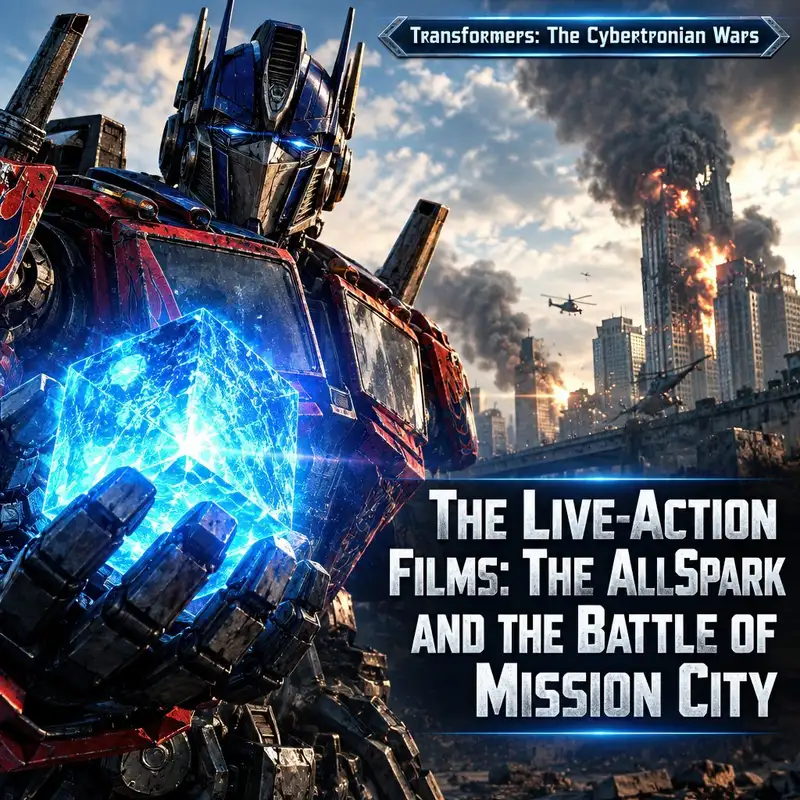
The Live-Action Films: The AllSpark and the Battle of Mission City
Hoover Dam was built to hide a secret, not to survive a war. Beneath its turbines and concrete galleries, Sector Seven had contained two discoveries for generations. One was Megatron, frozen in Arctic ice after reaching Earth long before the modern age. The other was the AllSpark, the cube-shaped artifact he had come to find. When the containment system failed, the dam ceased to be a fortress. It became a confined industrial space holding an awakened Decepticon leader, a strategic object of immense value, and a group of defenders whose communications had just been compromised.
That moment explains the strange logic of the Battle of Mission City. The defenders did not choose an ideal battlefield. They did not select a prepared defensive line, establish secure firing zones, or move civilians out days in advance. They were forced into motion because the place designed to conceal the AllSpark could no longer protect it. The immediate problem was no longer secrecy. It was denial. Megatron could not be allowed to recover the Cube.
In the first live-action Transformers film, the AllSpark is more than a relic or a symbol of Cybertronian history. It is the central strategic resource of the conflict. The film associates it with the origin and life of the Cybertronian race. Its loss helped devastate Cybertron during the ancient war between Autobots and Decepticons. Its recovery is therefore important to both sides, but for sharply different reasons.
Optimus Prime and the Autobots see the AllSpark as something that must be protected from Megatron, even if protecting Earth means destroying it. Megatron sees it as the means to rebuild military power. His plan is not just to return home with a lost national treasure. He intends to use the Cube to transform Earth’s technology into a new Decepticon force. In practical terms, that would turn a developed industrial planet into a source of hostile military capacity.
That possibility gives every smaller fight in the film its strategic meaning. An Autobot and Decepticon clash is not just a duel between powerful individuals. A police car, a fighter aircraft, a radio tower, a city street, or a damaged helicopter matters because it affects access to the AllSpark. The Cube is the object around which intelligence, mobility, air power, evacuation, and command all begin to revolve.
The film does not give a detailed account of the political origins of Cybertron’s war. It does not establish a caste system, a Senate, a revolutionary program, or a long ideological debate between Optimus and Megatron. Those explanations belong to other Transformers continuities, not this one. Here, the available record is simpler and more immediate. Conflict over the AllSpark destroyed Cybertron, and Megatron’s attempt to recover it carried that war to Earth.
The AllSpark should not be confused with the Matrix, Vector Sigma, Primus, or similarly named artifacts from other versions of Transformers. In this film, its demonstrated importance is specific. It is an ancient Cybertronian object capable of giving dangerous new life to Earth machines. That capacity makes it both a cultural inheritance and a weapon of industrial transformation.
Its strategic value also creates a severe custody problem. Possession alone is not enough. Whoever holds the Cube must be able to transport it, secure it, prevent enemy capture, understand at least part of its function, and decide whether its power should ever be used. Sector Seven had achieved concealment. It had not built a durable political or military system capable of managing an open conflict over the artifact.
The human connection to that conflict begins with an accident of history. Megatron reached Earth first, pursuing the AllSpark into the Arctic. He crashed before recovering it, and his frozen body was discovered by Captain Archibald Witwicky. The encounter left Witwicky injured and bewildered, but it also placed the Cube’s coordinates into the record of his experience.
Those coordinates were preserved on Witwicky’s eyeglasses. Generations later, they passed to his descendant, Sam Witwicky. Sam is not recruited as an intelligence asset. He is not a soldier, scientist, or government official. He is an ordinary teenager trying to navigate school, family expectations, and the purchase of his first car. Yet he becomes central to the crisis because the information everyone needs happens to be attached to his family history.
That is an uncomfortable feature of the operation. The most important intelligence key in the campaign is held by a civilian who does not know he possesses it. Sector Seven has spent decades guarding Megatron and the AllSpark, but it has not fully controlled the trail linking the two. Its secrecy protected information from the public, but secrecy also fragmented knowledge among agencies, archives, families, and individuals.
Mikaela Banes becomes part of the same burden of accidental participation. She begins as another civilian drawn into events beyond her experience. Her practical mechanical skill and calmness under pressure make her useful, but she too is not part of a planned military structure. By the time the battle reaches Mission City, the defenders depend on the judgment of people who were never meant to carry the responsibility placed on them.
Bumblebee is the link between those civilians and the Autobot cause. In this continuity, he is an Autobot scout using a yellow car form as concealment and mobility on Earth. His vehicle mode allows him to move through human roads and remain near Sam without immediate public alarm. It does not make him invisible, invulnerable, or independent of support. He is damaged during the fighting, his voice is impaired, and his ability to protect Sam depends on repair, movement, and the support of others.
The Decepticons understand the importance of the human clue quickly enough to make concealment impossible. Frenzy, operating through infiltration and data access, discovers information about the AllSpark and the human institutions guarding it. His actions expose a weakness in the defenders’ arrangements. A secret security organization may be effective at compartmentalizing information, but compartmentalization can become a liability once an enemy gains access to the network.
Frenzy’s intrusion does more than reveal a location. It disrupts communications at the moment communications become essential. The defenders lose the ability to rely on their normal systems, and the release of Megatron turns an intelligence failure into an operational emergency. The Cube is no longer buried beneath a controlled facility. It is now the immediate objective of an awakened Decepticon force.
Before Megatron resumes command, Starscream functions as the senior active Decepticon field leader on Earth. He is more than an aircraft with a dangerous alternate mode. His F-22 Raptor form gives him reach, speed, and access to airspace, but the greater significance is his role in coordinating the assault. The film does not provide a complete Decepticon order of battle, and it does not establish how many Decepticons remain elsewhere. What it does establish is enough. The Decepticons on Earth are organized around recovering the AllSpark.
Their objective is narrower and more dangerous than general destruction. They do not need to conquer every American city or defeat every human military formation. They need the Cube. If Megatron can seize it, he can use Earth’s machinery as the basis for a new army. That plan gives the Decepticons an incentive to strike at communications, transportation, and the people carrying the artifact rather than simply seeking battle for its own sake.
Sector Seven’s original solution had been to hide both Megatron and the AllSpark under Hoover Dam. The location offered physical concealment, restricted access, enormous infrastructure, and the appearance of an ordinary national landmark. The organization designated Megatron as NBE One, an unidentified non-biological extraterrestrial, and studied Cybertronian technology in strict secrecy.
That policy delayed the crisis, but it also left the wider American security system poorly prepared for it. Conventional military personnel knew little or nothing of the threat until the situation was already moving beyond Sector Seven’s control. Civilian officials were forced to make decisions with incomplete information. The Autobots had their own knowledge of Megatron and the AllSpark, but no established place within the American command structure.
This is the central institutional failure of the film. Sector Seven had a containment regime, not a resilient alliance system. It could guard a hidden object and study a captive enemy. It could not easily coordinate a national response once the object became mobile, the enemy awakened, and the secret reached the public battlefield.
The defenders reduce the AllSpark to a portable size, allowing it to be carried rather than remaining as an enormous fixed object beneath the dam. This is a singular event in the film’s crisis, not evidence that the artifact can be routinely resized, shipped, or stored like conventional cargo. Its new form solves one immediate problem. It gives the defenders mobility.
It also creates another problem. A portable strategic artifact can be lost, stolen, dropped, ambushed, or carried into the wrong place. The AllSpark is now physically close to Sam, Bumblebee, and the other members of the improvised defense. Its portability gives them a chance to escape Megatron, but it places an extraordinary burden on individuals operating under fire.
The movement away from Hoover Dam is best understood as an emergency convoy. It includes Autobots, Captain William Lennox and his soldiers, Sector Seven personnel, Secretary John Keller, Sam, Mikaela, and the Cube itself. These are not forces that trained together. They do not share a common doctrine, common communications system, or agreed chain of command.
Optimus Prime commands the Autobots. Lennox exercises practical combat leadership over his soldiers. Keller provides civilian authority at the highest level available in the immediate crisis. Sector Seven has experience with the secret but has lost much of its credibility after its containment has failed. Sam carries the information and eventually the object that everyone else is trying to protect. Authority is divided because the situation is divided.
The convoy also lacks the basic assurances of a conventional withdrawal. There is no secure corridor, no known enemy strength, no reliable communications network, and no guarantee that the Decepticons cannot attack from the ground or air. The group includes civilians who must be protected but who also possess information and abilities that cannot be easily replaced. The cargo is not expendable. The cargo is the reason the enemy is coming.
Bumblebee’s role in that movement is therefore more than escort duty. He provides transport, local mobility, and protection for Sam and Mikaela. His car form allows movement through familiar human infrastructure, but the convoy is still exposed. Roads can be blocked. Aircraft can attack from above. A damaged Autobot may need recovery. A concealed vehicle is no longer concealed once it begins firing weapons in the middle of a national emergency.
Even Cybertronians, for all their self-propelled mobility, require routes, repair, communications, and recovery. The film makes that clear through Bumblebee’s damage and through the vulnerability of the Autobots once they are drawn into open battle. Transformation changes the form of logistics. It does not eliminate logistics.
Mission City becomes the destination because the defenders need to reconnect the battle with American military power. Their communications have been compromised. They need a usable radio system, a way to contact aircraft, and a place where air support can be directed against Decepticon attackers. The city is not selected because urban combat is desirable. It is selected because the defenders have run out of better options.
The choice carries obvious risks. A populated city is crowded with civilians, buildings, vehicles, intersections, power systems, and emergency routes. It limits visibility. It complicates target identification. It gives large transforming combatants countless places to hide, maneuver, or cause accidental destruction. It also means that the AllSpark, the most dangerous object in the conflict, is being brought toward a civilian center.
Yet the alternative is worse. If Megatron recovers the Cube near Hoover Dam, beyond effective support and inside a facility already compromised by Decepticon infiltration, the defenders may lose any chance to stop him. Mission City offers access to radios, military aviation, evacuation capacity, and additional ground forces. It turns a scattered escape into a defensive operation.
That decision illustrates the difference between tactical danger and strategic danger. Bringing the Cube into the city increases immediate risk to civilians. Allowing Megatron to use it could transform Earth into the industrial base of a Decepticon revival. The defenders are forced to accept a dangerous short-term battlefield because they are trying to prevent a much larger and more durable threat.
The resulting operation is the first successful Autobot-human joint action in this film continuity, but it is not a formal alliance in the treaty sense. It is an emergency coalition held together by necessity. The Autobots need human communications, air support, local knowledge, and political authorization. Human forces need the Autobots’ ability to confront Decepticons directly. Both need Sam, because he has become the immediate custodian of the AllSpark.
Maggie Madsen and Glen Whitmann are important to this effort because they help restore the flow of information after the network failure. Their contribution is not glamorous in the conventional battlefield sense, but it is decisive in the way communications often are. A force that cannot speak to aircraft, headquarters, or other friendly units may possess weapons without being able to use them effectively.
The use of older communications equipment at Hoover Dam carries a quiet lesson. Sophisticated networks can be vulnerable when an enemy understands their access points. Older systems are not magically secure, but their separation from the compromised network gives the defenders a path back into contact with military forces. In a crisis, resilience can matter more than elegance.
Keller’s role is equally important. He is not directing every engagement from a command vehicle, and the film does not portray him as a battlefield commander. But civilian authority matters because military action against unidentified alien combatants inside an American city requires political decisions as well as tactical ones. His presence helps connect the chaos at the dam to the broader national response.
Lennox and Sergeant Robert Epps provide the local military leadership that makes the response practical. They understand the immediate terrain, the need to communicate with aircraft, and the necessity of keeping people moving. Their earlier encounter with Decepticon forces has also shown that human weapons can matter when used with accurate information and appropriate ammunition.
The high-heat sabot rounds used against Scorponok demonstrate a tactical vulnerability in at least some Cybertronian armor. They should not be treated as a universal solution to every Transformer in every situation. The film shows an observed effect, not a complete technical manual. Still, the lesson is valuable. Human forces are not irrelevant simply because their opponents are larger, stronger, and technologically unfamiliar.
At Mission City, evacuation becomes inseparable from combat. Helicopters, ground troops, Autobots, and civilian movement must operate in the same space. The defenders need to clear civilians from streets and buildings while preventing Decepticons from reaching Sam and the Cube. They also need to create enough order for aircraft to engage targets without inflicting unacceptable damage on friendly forces or the population they are trying to protect.
This is where the battle becomes more than a collection of individual fights. Air power can strike Decepticon targets that ground forces cannot easily reach. Ground troops can mark threats, relay information, and protect evacuation routes. Autobots can engage Decepticons at close range and absorb attention that would otherwise fall on civilians. Helicopters can move people out of the immediate danger area. None of these capabilities is sufficient alone.
The film depicts marked targets and close air support, but it does not provide a full targeting architecture, a complete set of rules of engagement, or detailed sortie records. That uncertainty matters. Urban close air support is difficult because friendly and enemy forces can be only a short distance apart. The same battle space contains Autobots, Decepticons, soldiers, emergency personnel, civilians, and vehicles that may all be moving rapidly.
The appearance of F-22 Raptors, A-10 Thunderbolt IIs, AC-130 gunships, transport aircraft, and helicopters gives the battle a strong military texture. The production used real American aircraft and personnel, and that support is visible on screen. But cinematic staging should not be mistaken for exact tactical telemetry. The film shows the importance of air-ground coordination, not a reliable record of aircraft numbers, weapon yields, or precise engagement distances.
What matters is the relationship among the forces. Human aviation gives the coalition reach and firepower. Autobots give it the ability to identify and fight Decepticons at close range. Soldiers provide local coordination and protect the human side of the operation. Civilian participants carry intelligence, restore communication, and physically move the object that defines the entire battle.
The civilian danger is real, even if the film does not provide a complete record of losses or reconstruction. Mission City is evacuated under pressure. Buildings and streets are damaged. People flee a conflict they do not understand, involving machines that can resemble aircraft, trucks, police cars, and military vehicles. The film makes the urgency visible, but it does not establish reliable casualty totals or describe the city’s recovery in detail.
That gap should not be filled with invented numbers. What can be said is that the defenders accepted a grave civilian risk because the AllSpark made the alternative still worse. The immediate objective was to get people out, keep the Cube moving, and prevent Megatron from gaining enough time to turn Earth’s technology against Earth.
Several Decepticon losses during the approach and the city battle alter the operational situation without independently deciding the war. Bonecrusher is destroyed by Optimus Prime before the main fight in Mission City. That removes an immediate attacker from the pursuit and demonstrates that the Autobots can still create space for the convoy. It does not end the Decepticon offensive.
Blackout is destroyed during the battle, reducing the threat posed by one of the Decepticons’ most formidable attackers. Brawl is defeated through combined Autobot and human action, illustrating the coalition’s growing ability to concentrate firepower against a dangerous target. These engagements matter because they reduce pressure on the defenders and preserve the possibility of moving Sam and the AllSpark through the city.
Frenzy’s death matters in a different way. He has been central to the Decepticons’ information advantage and communications disruption. Removing him does not restore every damaged system, but it helps prevent further interference and reduces the enemy’s ability to exploit the confusion that made the crisis possible. In a battle shaped by access and coordination, that is no small result.
These are not just trophies from a fight. Each Decepticon removed from the field changes the defenders’ ability to evacuate civilians, maintain communications, and keep the Cube out of enemy hands. Still, the coalition cannot mistake local success for final victory. Megatron remains alive, active, and focused on the AllSpark.
Once Megatron reaches Mission City, the Decepticon plan narrows around him. He is more than another combatant. He is the leader most directly positioned to seize and exploit the artifact. His presence gives the Decepticons a center of gravity. So long as he can reach Sam and the Cube, the earlier defensive successes remain provisional.
Jazz’s death reveals the cost of that reality. As Optimus Prime’s first lieutenant, Jazz is an experienced Autobot combatant, not an incidental bystander. His loss demonstrates that courage and skill do not guarantee survival when the Decepticon leader enters close combat. It also shows that the Autobots are not an inexhaustible force. Every loss reduces their capacity to protect Earth and to sustain their own cause.
The battle between Optimus and Megatron is therefore not just a personal rivalry. It is a struggle over time. Optimus must keep Megatron away from Sam, preserve the chance of denying the Cube to the Decepticons, and protect the remaining Autobots and humans where he can. Megatron needs only a brief opening to recover the object that would transform the strategic balance.
Optimus faces an impossible choice with clarity. He wants to save Earth and preserve the AllSpark if possible, because the Cube is connected to the survival of Cybertronian life. But he understands that the artifact cannot be allowed to become Megatron’s weapon. When Megatron gains the advantage, Optimus offers Sam a final denial option. If necessary, Sam can place the AllSpark into Optimus’s chest, destroying both Prime and Cube.
That offer is not a gesture of despair. It is a command decision shaped by the strategic reality of the battle. Optimus recognizes that preserving the artifact is no longer the highest priority. Preventing Megatron’s use of it is. If the only way to do that is to sacrifice himself, he is willing to accept the cost.
Sam chooses another path. He drives the AllSpark into Megatron’s chest. The decision succeeds because the coalition has created a narrow opportunity through everything that came before it. The evacuation has bought space. The air and ground fight has reduced enemy pressure. Bumblebee, the Autobots, Lennox’s soldiers, Maggie, Glen, Keller, and others have kept the operation from collapsing. Optimus has delayed Megatron long enough for Sam to act.
Sam’s role should not be understood as a random civilian triumph detached from the rest of the battle. He is the person physically holding the decisive object, but he can make that final decision only because others have carried him to that point, protected him, and accepted severe risks to preserve his freedom of action. The battle remains a coalition effort, even though its final act is carried out by one frightened and determined human being.
The result is immediate. Megatron is destroyed, and the AllSpark is destroyed with him. Tactically, the defenders remove the Decepticon leader from the field and eliminate the artifact that he needed. Operationally, they prevent the Cube from becoming a Decepticon force-generation system on Earth. Strategically, they deny the enemy the ability to convert the planet’s machinery into the basis for a new army.
The outcome is not an uncomplicated victory. The AllSpark had been associated with Cybertronian life and with the Autobots’ hope of restoring what was lost. Its destruction prevents Megatron’s plan, but it also means that the Autobots cannot simply use it to rebuild Cybertron. Optimus later retains a fragment, but the film makes clear that the destroyed Cube cannot restore their world.
That cost gives the battle its moral weight. The Autobots do not win by recovering their homeland’s future intact. They win by accepting that the object they hoped to preserve must be denied to Megatron. Earth is saved from immediate militarization, but Cybertron remains damaged, distant, and unresolved.
The aftermath also exposes the political failure of Sector Seven’s long secrecy. The organization had contained Megatron and the AllSpark for generations. Its efforts were not meaningless. Without them, the crisis might have arrived earlier. Yet its structure depended too heavily on concealment, compartmentalization, and the assumption that it could control knowledge indefinitely.
Once the secret became a public military emergency, Sector Seven could not provide the complete response required. It needed the executive branch, regular military forces, civilian experts, and the Autobots themselves. The United States government terminates Sector Seven after the battle. That decision reflects more than embarrassment. It acknowledges that an isolated secret organization had become inadequate to the world it had helped create.
The disposal of dead Decepticon remains in the Laurentian Abyss is also revealing. The government wants the wreckage removed from easy access, presumably to prevent recovery, study, panic, or exploitation. But disposal is not the same as understanding. The battle has shown that Cybertronian technology cannot be treated as ordinary salvage, and that the remains of hostile machines may still carry intelligence, security, and political consequences.
The Autobots remain on Earth after the battle. Their decision is not formalized by a public treaty, a clear legal framework, or a settled agreement over sovereignty and security. They have fought beside American personnel and saved a city, but a battlefield partnership is not the same as a durable political settlement.
Optimus’s final broadcast reaches outward to surviving Autobots in space. It is an appeal, not a verified census. His earlier language about being among the last of their kind expresses loss and uncertainty, not a complete accounting of every Cybertronian who may remain elsewhere. The broader war is not ended merely because Megatron has fallen in Mission City.
Starscream escapes, and that fact alone prevents any claim of total Decepticon defeat. More importantly, the political and military conditions that brought the conflict to Earth have not disappeared. Cybertron is still ruined. The Autobots are still displaced. Human governments now know that alien factions can fight over their world. The AllSpark is gone, but the consequences of its presence remain.
In the immediate fight, Mission City ends with Decepticon attackers defeated, destroyed, or driven away. Operationally, the mixed coalition protects the AllSpark long enough to deny it to Megatron. Strategically, Earth avoids becoming the industrial foundation of a newly created Decepticon army.
Politically, the battle ends one secret containment regime without replacing it with a fully developed human-Cybertronian order. At the civilian level, the city survives immediate catastrophe, but the film leaves much of the human cost and reconstruction record unexamined. That silence does not mean the cost was absent. It means the record is incomplete.
Mission City was decisive because the AllSpark transformed hidden contraband into a contested strategic weapon at the moment secrecy, containment, and centralized control had all failed. The defenders succeeded not because they possessed a superior plan, but because Autobots, soldiers, civilians, and officials built enough trust under fire to evacuate a city, restore communications, employ air power, and deny Megatron the object he needed. The battle saved Earth from immediate militarization, but it did not create peace. It replaced a failed secret with an unresolved coexistence between humanity and Cybertronian survivors.