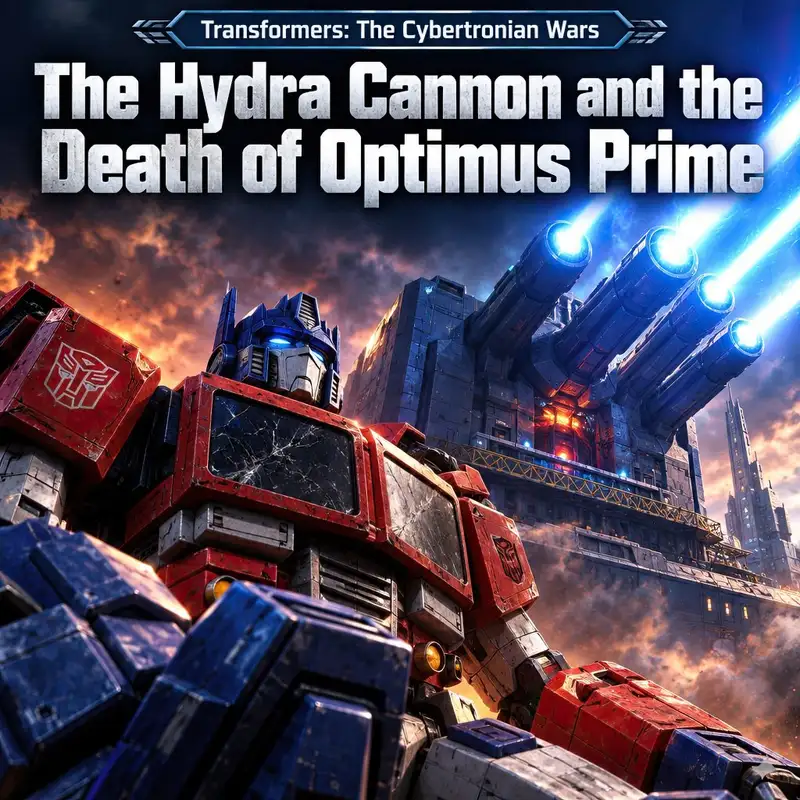
The Hydra Cannon and the Death of Optimus Prime
The test shot was aimed at a comet, not at Earth. That distinction mattered for only a few moments. When the Hydra Cannon fired in Transformers: Armada, the comet vanished in a burst of energy large enough to settle the immediate military question. The Decepticons had not assembled another battlefield weapon or another advantage to be traded back and forth in the contest over Mini-Cons. They had built a mobile strategic threat. Its next target was an Autobot base on an inhabited world.
The destruction of the comet does not provide a neat technical specification. The episode gives no reliable figure for the weapon’s range, yield, recharge cycle, or the exact consequences of a direct planetary strike. It does establish something more important. Megatron’s command had demonstrated that the cannon could concentrate enough force to erase a distant celestial target. The Autobots now had to act on the assumption that their Earth headquarters, and perhaps far more than their headquarters, could be destroyed before any ordinary ground battle began.
This is the point at which the Armada conflict changed scale. Until then, much of the war on Earth had revolved around the search for Mini-Cons, smaller Cybertronian beings whose partnerships and combined systems could amplify the capabilities of larger Transformers. Mini-Cons were sources of military advantage, but they were also people caught between larger factions competing to use their power. The Hydra Cannon turned that competition into a threat directed from space against an entire theater of war.
Orbit gave Megatron an advantage that armor, numbers, or local terrain could not easily provide. A Decepticon force attacking an Autobot base from the ground could be delayed, ambushed, or driven back. A weapon platform positioned beyond immediate ground reach changed the problem. The Autobots could no longer rely on the base’s defenses, the surrounding terrain, or their familiar mobility on Earth. They had to intercept the platform before it completed its firing sequence.
That is the military importance of the Hydra Cannon. Its value was more than raw destructive power. Its value was the ability to bypass conventional resistance. Megatron could threaten the Autobot command center without first securing control of the roads, cities, or skies around it. He could make the survival of Earth depend on a short operational window in space. The weapon did not make him ruler of the planet, but it gave him the ability to force a crisis on terms he had chosen.
The cannon also carried a built-in weakness. It was not an ordinary Decepticon gun mounted on an ordinary ship. It depended on rare Mini-Con systems gathered over the course of the conflict. Those systems had previously appeared as three distinct weapons: the Star Saber, the Skyboom Shield, and the Requiem Blaster. Each had its own purpose, and each was formed through the cooperation of a different Mini-Con team.
The Air Defense Team formed the Star Saber. The Race Team formed the Skyboom Shield. The Space Team formed the Requiem Blaster. In Armada, these were not just convenient accessories that any commander could swap around at will. They represented specialized combinations of Mini-Con power. When brought together, they created the Hydra Cannon, a weapon whose strategic significance came precisely from the rarity of its components and the fact that those components were sentient Cybertronians.
That made the cannon both formidable and fragile. Megatron’s command could concentrate exceptional power in one place, but it also had to protect the Mini-Cons within the system, the machinery that integrated them, the platform that carried it, and the time necessary to bring it into firing condition. The Decepticons had achieved concentration of force. They had also created a high-value target that could not be casually replaced if damaged, captured, or separated from its living components.
The path to that concentration also ran through Decepticon factional politics. Starscream brought the Star Saber and the Skyboom Shield to Megatron, helping make the Hydra Cannon possible. His decision should not be reduced to a familiar story about a subordinate behaving treacherously because that is what a character with Starscream’s name is expected to do. In Armada, his relationship with Megatron was unstable, personal, and political. He wanted influence, recognition, and room to act within a command structure that gave little security to anyone below its leader.
Megatron could use Starscream’s abilities and still distrust him. Starscream could contribute to a Decepticon victory while remaining unsure whether that victory would improve his own position. Such tensions are not a side issue in the history of the Hydra Cannon. A strategic weapon is never merely a machine. It is also the product of who controls its components, who is allowed near it, who receives credit for its construction, and who fears being discarded once the weapon is complete.
The Decepticons had assembled the systems, completed their spaceborne platform, and demonstrated the result. Yet the cannon’s construction did not prove that it could be reproduced at will. The story gives no basis for treating it as a mass-produced artillery system or assuming that Megatron could field a fleet of similar weapons. Its strategic value came from uniqueness. The Decepticons had one extraordinary instrument, and they intended to use it in a way that would make one shot enough.
Megatron’s chosen target was the Autobot base on Earth. On one level, the decision had a direct military logic. The base was a command center, staging area, refuge, and point of coordination for the Autobot effort on the planet. Destroying it could disrupt communications, remove repair and support capacity, scatter personnel, and leave the Autobots without their most secure position in the Earth campaign.
But an orbital strike on an Autobot installation was not a limited action in a vacant battlespace. Earth was not an empty map square. It was a populated world, and the Autobots’ alliance with human children had made the planet more than a temporary hiding place. The weapon’s intended target sat within a larger civilian theater. A blast powerful enough to destroy the base could not be treated as if its consequences would stop neatly at the perimeter fence.
That was the contradiction at the center of Megatron’s plan. He sought a decisive military result by threatening a target that could not be separated from the world around it. The operation promised more than a victory over an enemy command post. It threatened the destruction of a sanctuary, the deaths of civilians, and the collapse of the political relationship that allowed the Autobots to operate on Earth at all.
Megatron’s decision was therefore an escalation toward coercion through annihilatory power. He did not need to defeat every Autobot individually. He needed only to establish that the Decepticons could destroy the place from which the Autobots organized their resistance. The cannon was meant to make defense appear futile, to impose a choice between surrender, flight, or catastrophe.
There is a difference, however, between destroying an opponent’s position and governing what remains afterward. The Hydra Cannon could endanger Earth. It could destroy an Autobot base. It could kill a leader. None of that automatically created a Decepticon administration, a stable occupation, a cooperative human population, or a workable political order. Megatron’s plan was strategically ambitious because it aimed for a decisive outcome. It was politically shallow because it treated destruction as if it were the same thing as control.
The mobility of the platform sharpened the problem for the Autobots. A fixed artillery site can be located, surrounded, sabotaged, or struck over time. A spaceborne firing system can change position, keep its distance from ground defenses, and impose a schedule on the defender. The Autobots had to reach the cannon in the time available, survive the Decepticon screen around it, and stop the firing process before the weapon discharged.
Their intelligence was sufficient to identify the danger. They knew the Hydra Cannon had been assembled. They knew it was moving into position. They knew the target was the Autobot base. What they did not have was time for a clean technical solution. There was no opportunity to isolate the platform, dismantle the component systems at leisure, or build a broad coalition for a long campaign. This was a crisis in the strict military sense. The available choices narrowed quickly, and each carried costs.
The Autobots also faced a moral and operational restriction that Megatron did not accept. The Mini-Cons inside the weapon were not disposable machinery. They were the source of the Hydra Cannon’s power, but they were also sentient beings. A simple order to destroy the weapon at any cost could have meant destroying the Mini-Cons bound into its system. That transformed the mission from an unrestricted strike into a rescue-and-disable operation.
The distinction mattered. It limited what weapons and tactics the Autobots could use. It made a rapid kill shot against the platform less acceptable. It required the attackers to think about separation, extraction, or neutralization rather than simply wreckage. In a battle against a strategic weapon, that is a severe complication. It is also one of the clearest differences between the two factions’ approaches to Mini-Con power.
The Decepticons treated the Mini-Cons as components of a weapon system, sources of force to be captured, controlled, and integrated. The Autobots could not ignore the military value of Mini-Con partnerships, but they recognized the Mini-Cons as allies whose survival mattered in its own right. This did not make the Autobot mission easy or automatically righteous in every decision. It did mean that their command could not treat the Hydra Cannon as an inert target.
Conventional defense on Earth could not solve the problem. Even if the Autobots had been able to organize a strong ground response, the cannon’s platform was beyond the range and geography of that defense. The human children connected to the Autobots, including Rad, Carlos, Alexis, Billy, and Fred, could witness the danger, fear the possible destruction, and later grieve the loss. They did not command the interception, and they did not represent a unified Earth government. Their importance was more immediate. They made clear that the threatened world contained lives not reducible to a military objective.
Before Optimus Prime departed to confront the cannon, he faced another danger. It had no visible blast radius and no mechanical solution. He attempted to transfer the Matrix of Leadership to Hot Shot.
The Matrix in this continuity was tied to Optimus’s leadership and carried great symbolic and practical weight. Offering it to Hot Shot was not a casual gesture. Optimus understood that he might not return from the operation. A commander preparing to enter a battle against a weapon of uncertain but catastrophic power has a responsibility to think beyond the immediate mission. If he dies, who gives orders? Who holds the faction together? Who can turn military survival into political continuity?
Hot Shot refused the Matrix because he did not believe he was ready. That refusal was not cowardice. It was an honest recognition that leadership cannot always be transferred by handing someone an artifact during the final minutes before battle. Possession of the Matrix, military skill, loyalty to the Autobots, and public legitimacy were connected, but they were not identical.
Hot Shot was already an experienced Autobot officer. He was not a helpless recruit, and the later story would show that others looked to him in Optimus’s absence. But experience in combat does not automatically prepare someone to carry a leader’s authority, manage grief across an organization, restrain demands for revenge, and make decisions that affect civilians, Mini-Cons, and an interplanetary war. The moment revealed a succession problem the Autobots had postponed because Optimus remained alive to solve most crises himself.
This is one of the quietest and most important scenes in the story. The Hydra Cannon had forced the Autobots into an immediate military emergency, but Optimus’s offer to Hot Shot showed that the deeper danger was institutional. A faction may be courageous, capable, and united in purpose, yet still depend too heavily on one individual to provide moral direction and command legitimacy. If that individual falls, the surviving organization must discover whether it has leaders or merely followers.
Optimus did not resolve that question before departing. He could identify the risk, but he could not force Hot Shot to feel prepared, and there was no time to build a more durable process. The transfer did not occur. The Matrix remained with Optimus. The Autobot succession problem therefore went into battle with him.
Jetfire joined Optimus for the interception. Their power-linked combination gave them greater combat capability for the assault on the Decepticon platform. In Armada, such combinations mattered because Mini-Con power and Cybertronian cooperation could reshape what individual fighters were able to do. Yet the combined form should not be mistaken for an automatic answer to the Hydra Cannon. It improved their capacity to enter the engagement and contest the Decepticon defenses. It did not grant unlimited time, immunity from fire, or a way to make the Mini-Cons inside the cannon irrelevant.
The operation was a race. Optimus and Jetfire had to force access to the platform, disrupt the weapon, and do so before the charging sequence reached the point of discharge. Megatron’s force did not need to destroy every Autobot attacker. It needed only to delay them. In defensive operations around a strategic weapon, delay can be victory. Every moment spent fighting through a screen, changing position, or protecting the component systems was time the Hydra Cannon had to complete its purpose.
The Decepticon defense included Megatron, Thrust, Demolishor, Cyclonus, Wheeljack, Tidal Wave, and Starscream. The episode does not provide a clean staff chart assigning each of them a formal operational role. What it shows is more useful than an invented order of battle. Megatron had gathered enough force around the cannon to turn the assault into a contested engagement rather than a simple sabotage mission. His defenders created the time and space the weapon required.
Thrust was involved in the deployment and firing process, but the cannon was not the work of one strategist acting alone. Megatron’s authority, Starscream’s contribution to the component systems, the platform’s construction, the presence of the defenders, and the Mini-Cons within the weapon all formed part of the same operation. Strategic systems are often described through the name of the leader who fires them. In practice, they depend on many people, some loyal, some fearful, and some uncertain whether they will survive the success they are helping to create.
The power-linked assault made the Autobot response credible. Optimus and Jetfire could meet the Decepticons in space and apply enough force to threaten the platform. But the defenders had a simpler mission than the attackers. They did not have to preserve a world, rescue Mini-Cons, maintain a base, or prepare for political consequences after the battle. They only had to prevent the shutdown for long enough.
That difference in objectives shaped the fight. The Autobots had to achieve a precise result under several constraints. The Decepticons could accept chaos so long as the Hydra Cannon fired. A force defending a countdown often benefits from disorder. Every distraction becomes useful. Every separate engagement divides the attackers. Every damaged Autobot, every blocked route, and every second lost becomes part of the weapon’s defense.
The episode therefore is more than a story of Optimus and Jetfire failing to hit a target hard enough. Their operation confronted a mobile strategic platform, protected by a substantial Decepticon force, powered through beings they were unwilling to sacrifice, and approaching firing condition faster than they could dismantle it. The tactical problem was difficult because its military and moral dimensions could not be separated.
Eventually, the attackers failed to disable the Hydra Cannon before it fired. That fact must be stated clearly. The Autobot interception did not accomplish its initial mission of shutting down the weapon in time. The Decepticons succeeded in bringing the cannon to discharge. Megatron’s defenders had done what they needed to do.
But tactical failure did not remove the strategic requirement. The shot still could not be allowed to land. Earth and the Autobot base remained in the path of a weapon whose demonstrated power had already forced the Autobots to treat it as a catastrophic threat. Once the cannon fired, the battle changed again. The question was no longer whether Optimus could disable the system. The question was whether anyone could prevent the effect of the shot.
There was no remaining conventional defense visible in that moment. No reserve formation arrived to intercept the blast. No ground weapon could reach it. No carefully prepared evacuation could remove Earth from the line of fire. The available technical solutions had failed or run out of time. The final defensive option was Optimus Prime himself.
His decision was not ceremonial. It was command under conditions of failure. He placed himself in the path of the Hydra Cannon’s discharge and used the Matrix of Leadership in an effort to absorb, counteract, or nullify the blast. The exact mechanism is not fully explained in technical terms. The visual evidence establishes the result, not a portable theory of Matrix physics. The energy of the attack was stopped from destroying Earth and the Autobot base, but it overwhelmed Optimus.
His body disintegrated. When the energy cleared, the Matrix remained, and Sparkplug remained beside it. Sparkplug was Optimus’s Mini-Con partner, not a human observer and not a full-size Autobot. The survival of those remnants did not make the loss less real to those who witnessed it. At that point in the story, Optimus Prime had died in the defense of Earth.
On the battlefield, the sacrifice succeeded. The Hydra Cannon’s shot did not achieve its intended destructive effect. The immediate strike was stopped. Across multiple engagements, the Autobot base survived, along with the Earth position from which the Autobots could continue to organize, shelter allies, and oppose Decepticon operations.
At the level of grand strategy, Optimus denied Megatron the decisive coercive victory the cannon had been built to produce. Megatron had demonstrated that he could threaten Earth from orbit. He had not demonstrated that he could destroy Earth, break the Autobots as an organized force, or force the humans connected to them into submission. The cannon’s first great shot became a moment of terrible loss, but not the end of the campaign.
Politically, however, Optimus’s act created the very leadership vacuum he had tried to address before leaving. The Autobot movement survived physically, but the commander who embodied much of its legitimacy was gone. The Matrix had not passed to Hot Shot. The succession question had not been settled. The Autobots had preserved their base while losing the individual most capable of defining their larger purpose.
At the moral level, Optimus refused the shortcut available to a commander who sees only targets and assets. The Mini-Cons remained part of the problem. Earth’s civilians remained part of the problem. His answer was not to destroy everything around the cannon in the hope that the threat would end. He placed his own body and authority between the weapon and those who could not protect themselves. That is not proof that every earlier Autobot decision was wise, or that sacrifice is always a substitute for planning. It was the choice available when planning had reached its limit.
Megatron achieved a battlefield success of undeniable importance. His weapon fired. His principal enemy died. The emotional effect on the Autobots was immediate and profound. Even Megatron’s own reaction carried weight, because the death was not abstract. Optimus had been his central opponent, the leader around whom the Autobot resistance organized, and a figure whose loss changed the conflict.
Remorse, however, is not absolution. Megatron had assembled the weapon, ordered its deployment, and aimed it at an Earth-based target with catastrophic consequences. Whatever complexity existed in his response to Optimus’s death, it did not erase responsibility for the operation that caused it. A leader can recognize the gravity of a result and still be responsible for choosing the path that made it possible.
The limits of Megatron’s victory were equally important. Earth survived. The Autobot base survived. The Decepticons did not emerge from the attack with durable political authority over the planet. They did not establish an occupation, build a human alliance, or turn fear into a stable settlement. The cannon had delivered destruction and grief, but not control.
This is the weakness of a strategy built around the promise of one decisive terror weapon. It can force an adversary into crisis. It can damage morale, kill leaders, and destroy infrastructure. Yet if the strike fails to achieve its central objective, the attacker may be left with resistance that is more determined, more unified by loss, and less willing to believe that accommodation is possible. Destructive power can compel attention. It cannot, by itself, create legitimacy.
For the Autobots, the immediate danger was not only grief. It was anger. In the aftermath, Hot Shot pressed for retaliation against the Decepticons. That response was understandable. He had just watched Optimus die. He had been offered the Matrix and declined it. He now stood in the space between the leader he admired and the responsibility he had not felt ready to accept.
Revenge can feel like decisiveness, especially in a command crisis. It gives grief a direction. It promises that loss will be answered with action. But retaliation is not the same as strategy. A force that rushes into battle to avenge a fallen commander can surrender initiative, ignore the enemy’s remaining capabilities, and mistake emotional unity for a workable plan. The urge to strike back may strengthen a group for an hour while weakening it for a campaign.
Hot Shot’s reaction therefore reveals both his loyalty and the strain placed on him by Optimus’s absence. He was not permanently replacing Optimus, and he had not suddenly become a fully settled leader because circumstances demanded one. The Autobots had to continue with the officers, friendships, shared mission, and external danger that remained. Their cohesion did not depend on a flawless constitutional mechanism. It depended on people choosing not to let their loss dissolve the cause they still believed in.
The human allies’ grief reinforced that point. For those living through the event, Optimus’s death was not a temporary plot complication awaiting a repair procedure. It was the loss of a friend and protector. The fact that later events would change the situation does not erase what the characters knew at the time. They had no guarantee that the leader who had stopped the Hydra Cannon would ever return.
Optimus did return, but only through an extraordinary event. In Miracle, the Mini-Cons, working with the Matrix, restored him to life. This establishes that the Mini-Cons possessed a collective agency and significance far beyond the Decepticon view of them as useful weapon parts. It also establishes that the Matrix was involved in Optimus’s restoration. It does not establish that the Matrix alone contained a complete backup of him, that any destroyed Cybertronian could be reconstructed through the same process, or that death had become routine and meaningless in Armada.
The restoration should be understood as exceptional, not industrial. There is no indication that either faction can turn it into a standard medical procedure, a reserve-force policy, or a reliable means of recovering every fallen commander. The event depends on circumstances, relationships, and Mini-Con action that cannot simply be assumed elsewhere. It is a miracle within the story’s own terms, not a universal repair manual.
The return also brings the episode back to the Mini-Cons at the center of the Hydra Cannon crisis. The same beings whose combined systems made the weapon possible later become decisive in restoring the life of the commander who stopped it. That contrast matters. Megatron’s strategy recognized Mini-Con power but treated Mini-Cons primarily as instruments. The Autobots’ strategy accepted risk and limitation because it treated them as participants. In the end, Mini-Con agency shaped the outcome more profoundly than Decepticon control did.
Optimus’s return resolved the immediate leadership vacuum, but it did not make the vacuum imaginary. The Autobots had still faced the prospect of continuing without him. Hot Shot had still confronted responsibility before he felt ready. The human allies had still mourned. Megatron had still seen that the Hydra Cannon could kill his enemy even when it failed to destroy Earth. The political and emotional consequences remained part of the war’s history.
The Hydra Cannon was decisive not because it won the war, but because it exposed the war’s deepest vulnerabilities. It concentrated Mini-Con power into a mobile orbital threat that made ordinary battlefield defense inadequate. It showed that a rare combination of living systems, infrastructure, and command decisions could place an entire planet at risk even when the immediate target was an Autobot installation.
Megatron proved that he could assemble immense destructive power. He did not prove that he could convert that power into legitimacy, durable authority, or control over Earth. The cannon’s shot killed Optimus Prime, but it did not erase the Autobot movement or create a political future for the Decepticons. The attack revealed the gap between the ability to destroy and the ability to govern.
Optimus achieved a genuine defensive success. He preserved Earth and the Autobot base when no other solution remained visible. Yet he did so by making himself the final line of defense. That was an act of courage, but it was also evidence of institutional fragility. A movement that needs its commander’s body and Matrix to stop catastrophe has not fully solved the problem of succession, resilience, or distributed responsibility.
Hot Shot’s hesitation before the battle, and his anger afterward, show why succession cannot be improvised at the edge of disaster. Authority must be prepared, accepted, and supported before the leader falls. The Autobots survived Optimus’s death because they retained a shared mission and enough cohesion to continue. They did not survive because the transition had been smooth.
The Mini-Cons provide the final lesson. Treating sentient beings as components can create extraordinary power, but it also produces dependence, coercion, and blindness to the agency of those being used. The Hydra Cannon existed because the Decepticons saw Mini-Con power as something to assemble and fire. Optimus returned because the Mini-Cons acted as allies with a will of their own.
The Hydra Cannon was decisive not because it won the war, but because it exposed the war’s deepest vulnerabilities: Megatron could assemble immense destructive power without gaining legitimacy or control, while Optimus could save Earth only by making himself the final line of defense. His death was therefore a successful defensive operation and a real command rupture, temporarily healed by an extraordinary Mini-Con intervention but never rendered politically or emotionally meaningless.