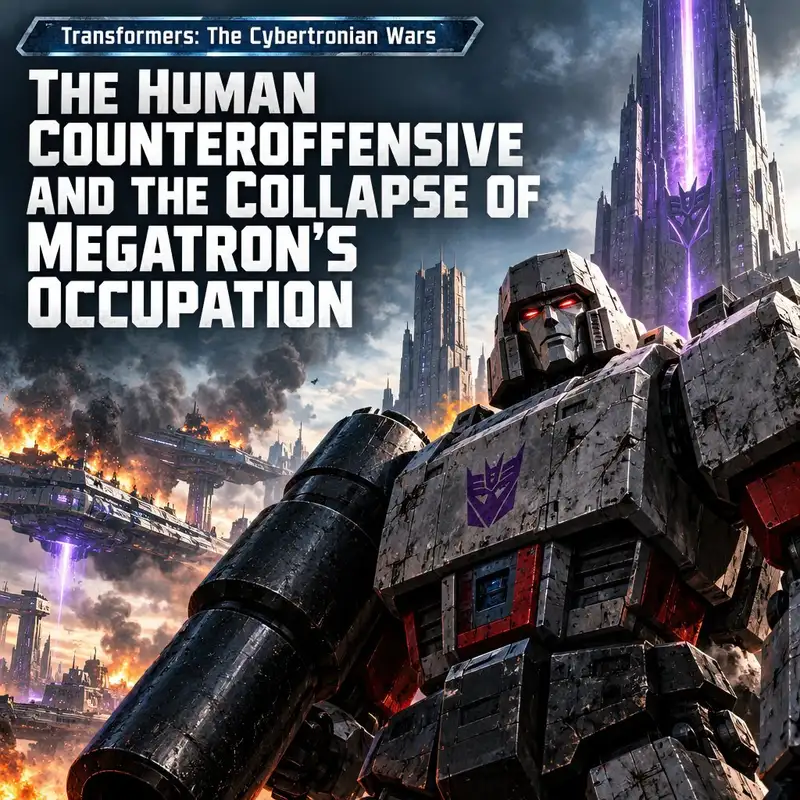
The Human Counteroffensive and the Collapse of Megatron’s Occupation
Chicago was no longer functioning as a city. Its streets had become killing zones, its towers firing positions and observation posts, its transit routes broken by wreckage and guarded by alien machines. Civilians ran, hid, were driven into captivity, or were forced into labor beneath the watch of Decepticon occupiers. The destruction was not incidental to the campaign. It was part of the method. By smashing movement, communications, shelter, and confidence, the invaders turned a population center into a controlled worksite and defensive zone.
In the live-action history of Transformers: Dark of the Moon, Chicago was the clearest center of the Decepticon occupation. The film does not establish that every nation on Earth had been conquered in the same manner, and it would be a mistake to describe the planet as uniformly occupied. But Chicago mattered beyond its symbolism. It was where the occupation’s military force, its human collaborators, and its strategic technology came together. The city was more than being held. It was being used.
The Decepticons and their ally, Sentinel Prime, intended to use Earth as the foundation for Cybertronian reconstruction. That meant resources, infrastructure, and human labor. Their plan was more than to defeat the Autobots, punish humanity, or seize a useful city. It was an extractive project on a planetary scale. Earth’s people would become inputs in the restoration of another world, whether they consented or not.
That made Chicago a strange kind of battlefield. At street level, it looked like an overwhelming military defeat. The defenders had lost air access, freedom of movement, and any obvious safe zone. Their most powerful allies, the Autobots, appeared to have been destroyed. Yet the occupation’s apparent strength concealed a problem. It depended on a small number of assumptions holding at once. The Autobots had to remain gone. Human resistance had to remain fragmented. The Pillar system had to keep functioning. And Megatron and Sentinel Prime had to continue cooperating.
None of those conditions was secure. The counteroffensive that followed did not begin because humans suddenly matched Decepticon weapons. They did not. It began because a group of civilians, soldiers, former soldiers, and surviving Autobots discovered where the occupation was vulnerable. They found that a force capable of terrorizing a city could still be dependent on fixed infrastructure, human access, and an alliance between leaders who no longer trusted one another.
To understand why Chicago fell so quickly, it is necessary to go back only far enough to see the political rupture that made the invasion possible. The decisive event was not the first Decepticon attack on the city. It was the betrayal of the Autobots by Sentinel Prime, a former leader whose authority, knowledge, and technical control gave him a position no ordinary Decepticon commander could duplicate.
Sentinel had been aboard the Ark, the Cybertronian vessel that carried the Pillars away from Cybertron during an earlier phase of the war. The Ark crashed on the Moon, where its existence became entangled with a secret human discovery during the Space Race. The details of that concealment matter to the film’s background, but they are not the center of this campaign. What mattered in the present was that the Ark contained both Sentinel and a strategic system capable of changing the war.
Optimus Prime revived Sentinel believing that the former leader might help the Autobots protect Earth and perhaps restore Cybertron. Instead, Sentinel revealed that he had already made an arrangement with Megatron. He had concluded that Cybertron could not be saved through the Autobots’ war of resistance. In his view, survival required the use of Earth’s resources and its population. He chose restoration through coercion.
That decision was not a battlefield improvisation. Sentinel’s plan rested on a political judgment. He treated Earth not as an inhabited world with rights of its own, nor as an ally whose cooperation might be sought, but as a reserve of labor and material. The survival of Cybertron became the justification for subordinating another civilization. There is a familiar logic in such decisions. A desperate leader begins by saying there is no alternative. Soon enough, the absence of alternatives becomes permission to do anything.
Sentinel’s murder of Ironhide made the break unmistakable. This was no longer a disagreement among Autobots over strategy. Sentinel had abandoned the Autobot cause and joined an operation designed to exploit humanity by force. He retained the prestige of a former Prime and the technical knowledge of the Pillars, but he no longer possessed moral legitimacy among those he had betrayed. That distinction would matter later, when his authority depended less on trust than on control of a machine.
Megatron’s part in the arrangement was equally important, but not identical. Megatron remained the Decepticon leader and the source of much of the occupation’s military power. His forces could occupy streets, destroy defenses, and enforce terror. But Sentinel held the strategic technology and the larger plan. The Decepticons could invade Earth without Sentinel. They could not execute this particular scheme to restore Cybertron without his Pillars and his knowledge.
From the beginning, then, the coalition had a structural weakness. Megatron possessed followers, weapons, and fear. Sentinel possessed the means to transform a conquest into a planetary project. Neither man fully replaced the other. Their partnership was useful because each supplied what the other lacked. It was unstable because neither had a reason to accept permanent subordination.
The Pillars were the central instrument of Sentinel’s design. In practical terms, they formed a space-bridge system, linked devices capable of opening a route across immense distances. The film shows that system moving a concealed Decepticon force from the Moon to Earth and later attempting something far more ambitious: bringing Cybertron into Earth’s vicinity. The exact capacity of the network is not established. We do not know its precise range, power demand, throughput, or the full technical logic of its operation. What we know is enough. It made distance strategically negotiable.
That mattered because conventional military strength depends heavily on geography. A force on the Moon is normally constrained by transport, timing, detection, and the vulnerability of its approach. The Pillars bypassed much of that problem. They allowed the Decepticons to hold forces in concealment and then place them where the defenders were least prepared. Earth could not build a defense around an invasion route it did not know existed.
Strategic mobility, however, is rarely the same thing as strategic invulnerability. The Pillars gave the invaders extraordinary reach, but they also concentrated their grand design around physical devices, identifiable locations, operators, and control arrangements. A system that can move armies and worlds is impressive. A system that depends on a limited set of machines is also a system that can fail catastrophically when those machines are disrupted.
The Decepticons treated the Pillars as more than transportation. They were the foundation of their political economy. The occupation of Chicago supplied a place to defend and administer the operation. The global placement of other Pillars extended the system’s reach. Sentinel’s larger goal required that the machinery remain intact long enough to make Earth subordinate to Cybertron’s restoration. The network was therefore not just a weapon. It was the occupation’s center of gravity.
Destroying individual Decepticons would matter tactically. Disrupting the Pillars would matter strategically. The defenders did not fully understand every technical detail at the outset, but they did not need to. They needed to identify which system made the broader project possible, who controlled it, and how to reach it inside a city held by a stronger enemy.
Before that could happen, the Decepticons first had to convince Earth that resistance was useless. They did so through a combination of coercion, political pressure, and deception. Human authorities were forced to accept the removal of the Autobots from Earth. It was a survival decision made under extreme conditions. The people making it were not given a clean set of options. They faced an enemy that had already demonstrated its ability to inflict mass destruction and had placed humanity in the position of choosing which danger seemed most immediate.
The cost of that decision was devastating. The Autobots were more than foreign guests or powerful weapons. They were Earth’s most capable allies against the Decepticons. Forcing them away removed the one force able to confront Decepticon heavy units on approximately equal terms. It also handed the enemy an intelligence victory. The occupiers gained not only a military advantage, but the belief that Earth had abandoned its strongest defenders.
The departing Autobot ship, the Xantium, was then destroyed by Starscream. To observers on Earth and within the Decepticon command, the result appeared decisive. Optimus Prime and his small force seemed to have been eliminated. That apparent destruction shaped every calculation that followed. Human defenders believed they had lost their principal shield. Sentinel’s operation could proceed without expecting organized Autobot interference. Decepticon troops entered Chicago with the confidence of an army that believed the enemy’s most dangerous formation had ceased to exist.
But the Autobots had survived. Their disappearance was a deception, not a resurrection, repair miracle, or unexplained return from death. They concealed themselves during the destruction of the Xantium and waited for the moment when revealing their survival would matter most. This was not a strategy without risk. It left Chicago exposed during the opening phase of the occupation. It also meant that human defenders had to act before they could be certain their allies would return.
Still, the deception transformed the campaign. The Decepticons had planned around the elimination of the Autobots. Once that assumption proved false, their occupation force faced an enemy it had not properly accounted for. In war, a mistaken estimate of enemy strength can be more dangerous than an ordinary shortage of ammunition. A commander can request more ammunition. It is harder to repair an entire plan built on the belief that a hostile force no longer exists.
The occupation depended on more than alien armor and firepower. It also required human cooperation, whether coerced, purchased, or volunteered. That became clear in the actions of Dylan Gould. Gould was not a Decepticon commander, and he did not control the military operation. His importance lay elsewhere. He served as a human intermediary, someone able to move through human society, exploit private connections, and help translate an alien occupation into practical control.
This is the unglamorous side of conquest. An invading force can destroy buildings with terrifying efficiency, but it still needs access. It needs locations, communications, property, transportation routes, personal leverage, and knowledge of local institutions. A collaborator can provide these more effectively than a foreign occupier, especially when the occupier is large, conspicuous, and not especially suited to blending into human life.
Gould’s role showed that the Decepticons were not relying on force alone. They had built relationships inside human society before the occupation became visible. Whether those relationships grew from fear, self-interest, or ambition, their effect was the same. They gave the invaders a human face, a human point of contact, and a way to manipulate people who might not understand the scale of the threat until it was too late.
Sam Witwicky and Robert Epps entered Chicago because of that human layer of the operation. Their initial purpose was not to command a national liberation army. They were trying to find Carly, who had been drawn into Gould’s orbit and then placed in direct danger. Their mission began as a rescue effort under extraordinary conditions. It became a resistance operation because Carly, Gould, and the Pillar system were all connected.
Epps’s presence also mattered. He was a former NEST soldier, not the commander of the active NEST force. That distinction is important because the defense of Chicago was assembled under emergency conditions, not according to a neat peacetime chain of command. Epps brought military experience, familiarity with Cybertronian conflict, and the ability to gather people who understood what fighting the Decepticons required. But he did not arrive with an intact army or a prepared campaign plan.
Sam’s role was different again. He was neither a conventional military commander nor a Cybertronian combatant. His value lay in access, persistence, and his connection to the human side of the conflict. In an occupation, the people who know where someone is being held, which building can be entered, who can be trusted, or which civilian route remains open may possess information more useful than a great deal of firepower. That does not make them invincible. It makes them relevant.
The small team moving into Chicago was therefore not a substitute for a conventional force. It was a reconnaissance, rescue, and disruption element operating inside a city the enemy believed it controlled. Their purpose was initially narrow. Find Carly. Reach Gould. Survive. Yet narrow missions can become strategically important when they intersect with the enemy’s dependence on human operators and fixed infrastructure.
The urban environment helped create that possibility. Chicago’s buildings, streets, tunnels, service corridors, damaged structures, and civilian spaces were dangerous, but they also complicated Decepticon control. Large Cybertronian combatants could dominate open avenues and demolish fortified positions. They could not always move through every interior space, inspect every passage, or understand every human pattern of movement. A city gives small forces places to hide, routes to improvise, and opportunities to exploit the occupier’s limited visibility.
That did not make the humans masters of the city. The Decepticons retained overwhelming local firepower. They controlled major approaches, threatened civilians, and used destruction to reshape movement. But human scale became an advantage in the limited tasks that mattered most. Infiltration, reconnaissance, sniper fire, communications, demolition, extraction, and target identification could all be performed by personnel who fit inside the infrastructure the invaders were trying to dominate.
The human defenders also understood the city as a lived environment rather than merely a map. They knew that an occupied street is more than terrain. It is a route for civilians, a potential ambush corridor, a line of sight, a trap, or a place where destruction can block a rescue. That knowledge did not overcome Decepticon technology by itself. It helped the defenders find ways to operate around it.
Active NEST personnel under Colonel William Lennox eventually joined the fight, parachuting into the city and bringing a more formal military presence into the improvised defense. The film does not provide a full order of battle, nor does it establish every aircraft, weapon, or command arrangement involved. It does show the essential point. The counteroffensive combined active personnel, former NEST soldiers, civilians caught in the crisis, and Autobots who had survived the enemy’s attempt to remove them.
This was combined arms in the broadest useful sense. Humans did not replace the Autobots. Autobots did not render human participation irrelevant. Each side could do things the other could not do as effectively. Human teams could reach human-scale vulnerabilities and move through the city’s surviving infrastructure. Autobots could provide mobility, protection, and direct combat power against Decepticon forces that would have overwhelmed any ordinary ground team.
The counterattack became possible when the Autobots revealed themselves. Their return was more than an emotional reversal. It changed the operational balance. The Decepticons had built their occupation around the assumption that they could act without serious Autobot interference. Once Optimus Prime, Bumblebee, Ratchet, Sideswipe, Dino, the Wreckers, and other survivors reentered the battle, the occupiers had to contend with opponents capable of engaging their major assets directly.
The Autobots were still a small force. Their survival did not create a mass army overnight. They could not be everywhere in a sprawling, devastated city, and they could not protect every civilian caught in the fighting. But their return gave the defenders the ability to shift from evasion to attack. They could now strike defended nodes, escort human teams through dangerous areas, and challenge the Decepticons at points where human weapons alone would not have been enough.
Optimus Prime’s role was especially important, but it should not be reduced to personal combat. He represented the restoration of Autobot command and the return of a leader whom Sentinel had tried to remove from the political equation. His presence gave the surviving Autobots a focal point for action. It also reminded both humans and Decepticons that Sentinel’s betrayal had not destroyed the cause he had abandoned.
Bumblebee and the other Autobots contributed in the immediate, physical sense that occupation warfare requires. They moved through shattered urban terrain, absorbed and returned fire, broke through obstacles, and protected human allies. Their alternate forms were useful not because they made them invisible in the middle of an invasion, but because they gave them mobility and options. In a city where routes changed by the minute, the ability to shift between vehicle movement and combat posture mattered.
Yet the Autobots could not solve the campaign simply by defeating every hostile machine they encountered. The city contained too many threats, too much destruction, and too much uncertainty. The counteroffensive needed a different kind of focus. It had to identify the system that turned local control of Chicago into a strategic threat to Earth itself.
Before it could reach that system, the defenders had to survive some of the occupation’s heaviest assets. Shockwave and the Driller represented the Decepticons’ ability to impose raw physical destruction on the city. The Driller, in particular, could tear through buildings and structures with a scale of violence that made ordinary movement hazardous. It was not just a weapon in the narrow sense. It was a tool for altering the battlefield.
When an occupier can destroy streets, collapse buildings, and attack from beneath or through urban structures, it can reshape the defender’s choices. Routes disappear. Shelters become traps. Visibility is reduced by debris and smoke. Rescue becomes more difficult because any damaged building may contain both survivors and new hazards. The Driller made Chicago’s physical environment part of the Decepticon defense.
But destructive power did not secure the larger operation. The occupation could create ruins, but it still needed to protect the Pillars, retain human cooperation, and preserve unity at the top of its command. A force can dominate a block and still lose the campaign if the system it was defending collapses somewhere else. This is one of the recurring errors of military power. Destruction is often easier to measure than control, and commanders can mistake the first for the second.
The defenders therefore did not need to clear every street before they could win. They needed to disrupt the enemy’s strategic machinery. That required reaching the Pillar system and the people who enabled it. The battle’s decisive action would not occur because every Decepticon in Chicago had been destroyed. It would occur because the operation to bring Cybertron to Earth could no longer function.
Sam’s pursuit of Carly and Gould brought the human rescue mission into direct contact with that strategic objective. Gould was present at the Pillar installation, serving as part of the human interface around Sentinel’s system. His importance was not that he alone understood every technical aspect of the machinery. The film does not establish that. His importance was that he was embedded in the occupation’s control structure at the point where human access and alien technology met.
Carly’s captivity also mattered politically. The occupation used people not only as labor or collateral damage, but as leverage. A collaborator could threaten an individual and thereby manipulate those connected to her. This is one reason occupation warfare is never purely military. It operates through relationships, fear, and the calculation that someone will comply if the cost of refusal is made personal enough.
Sam’s confrontation with Gould ended at an active Pillar. By forcing Gould into the device, Sam destroyed the control mechanism and triggered the failure of the space-bridge operation. The film presents the result clearly enough even if its technical details remain unexplained. The connection destabilized. Cybertron’s attempted arrival failed. The system that was meant to transform Earth’s fate became the mechanism of the invaders’ defeat.
It is tempting to describe that moment as the defeat of the Decepticons. It was not, at least not by itself. There were still Decepticon forces in Chicago. There were still armed machines, damaged buildings, frightened civilians, and leaders capable of fighting. But strategically, the destruction of the Pillar control system changed everything. The occupation lost its purpose beyond immediate violence.
Without the operational Pillar network, Sentinel could no longer carry out the plan that justified his alliance with Megatron. Cybertron could not be brought into Earth’s vicinity through the active bridge. Earth could not be converted, in that moment, into the industrial base for Sentinel’s reconstruction project. The invaders had lost the mechanism that connected their local occupation to their planetary ambition.
The collapse also stripped Sentinel of much of his leverage over Megatron. Sentinel had brought the grand design, the technology, and the promise of a restored Cybertron. Once the Pillars failed, he remained powerful, dangerous, and politically significant, but his claim to lead the future was badly damaged. A leader who promises a new order and then loses the machinery required to create it is suddenly more vulnerable to every rival who had tolerated him for temporary advantage.
This is where the alliance between Megatron and Sentinel became fatal to itself. Their partnership had never been a stable division of authority. Megatron supplied the Decepticon military apparatus. Sentinel supplied the Pillar system and the restoration plan. In theory, they were allies. In practice, Sentinel increasingly behaved as though Megatron were a useful subordinate rather than an equal partner.
Megatron had accepted an arrangement that left him dependent on a former Autobot leader for the strategic future of Cybertron. That was always a dangerous position for someone whose authority rested on command, intimidation, and personal dominance. As long as the plan appeared to be working, Megatron could tolerate the imbalance. Once the Pillar system failed, the imbalance became harder to ignore. Sentinel’s superiority no longer looked like a path to victory. It looked like an insult attached to a collapsing operation.
Carly recognized that fracture and used it. Her intervention with Megatron was not magical persuasion, nor was it a sudden conversion of Megatron into an ally of Earth. She did not create the rivalry. She pointed to the reality already visible in Sentinel’s conduct. Sentinel intended to rule. Megatron’s role in the restored order would be whatever Sentinel permitted it to be.
Megatron’s attack on Sentinel was therefore an opportunistic attempt to reclaim authority. When Sentinel moved to kill Optimus Prime, Megatron intervened against his own partner. This did not redeem Megatron. He had helped bring the occupation to Chicago. His forces had participated in its violence. His break with Sentinel was driven by power, status, and the refusal to become subordinate, not by remorse for what had been done to Earth.
Still, the attack mattered militarily and politically. It shattered the last remaining unity at the top of the occupation. The Pillar system had failed. The Autobots had returned. Human forces had penetrated the city and disrupted the control structure. Now the two leaders whose cooperation made the campaign possible were fighting one another. An occupation force can survive tactical reverses. It struggles to survive when its strategic system, intelligence estimate, and command coalition all fail at once.
Optimus Prime then killed Megatron and the weakened Sentinel. These deaths ended the immediate command structure that had directed the occupation. They did not prove that every Decepticon force on Earth, on the Moon, or elsewhere had vanished. The later history of this film continuity makes clear that Cybertronian threats and surviving factions did more than disappear with the battle. But the leadership capable of directing this particular project was gone.
The immediate military result was the collapse of the Chicago occupation. The Pillar operation had failed. Major Decepticon combat assets had been defeated or scattered. The Autobots and their human allies had regained control of the city’s contested spaces. Chicago was no longer being used as the operational hub for bringing Cybertron into Earth’s vicinity.
That was liberation, but it was not restoration. A city can be liberated from direct occupation and still remain shattered. The battle left civilians dead, injured, displaced, and bereaved. Buildings, streets, communications, and public spaces had been devastated. The exact number of casualties is not established by the film, and no invented total can convey the human reality better than the images already do. Chicago had survived an existential attack, but survival is not the same as recovery.
The political damage was equally serious. Humanity had been coerced into expelling the Autobots. Then a former Autobot leader had betrayed both the Autobots and Earth. The Decepticons had demonstrated that they could infiltrate human networks and seize a major city with terrifying speed. Even after the immediate threat was defeated, human institutions had reason to fear how little control they possessed over the larger Cybertronian conflict unfolding around them.
That fear would matter in the years that followed. Later events in this film continuity show that the joint relationship between human authorities and the Autobots did not emerge from Chicago stronger and more secure. It deteriorated into suspicion, separation, and persecution. The counteroffensive saved Earth from Sentinel’s immediate project, but it did not build a durable political settlement between humans and Cybertronians.
The deeper explanation lies in the occupation’s brittleness. It looked overwhelming because the Decepticons controlled the skyline, possessed superior heavy weapons, and had already neutralized Earth’s visible defenders. But its strength rested on surprise, on the apparent destruction of the Autobots, on fixed Pillar infrastructure, on human collaboration, and on an alliance between Megatron and Sentinel that had no stable balance of authority.
Once the Autobots returned, the enemy’s intelligence failure became visible. Once human teams reached Gould and the Pillar installation, the occupation’s dependence on human access became visible. Once the bridge collapsed, Sentinel’s strategic project became unrecoverable. And once Megatron understood that Sentinel intended to rule without him, the coalition’s internal contradiction became impossible to contain.
Chicago was therefore not liberated by a single duel, a single weapon, or a sudden equality of force. It was liberated by a coalition that combined complementary strengths and selected the right target. Human defenders supplied access, intelligence, infiltration, rescue, and disruption. The Autobots supplied the mobility and combat power needed to challenge Decepticon heavy units. The final victory came because the defenders attacked the system that made occupation useful, not just the machines that made it frightening.
What remained afterward was a political disaster as well as a military victory. Earth had avoided becoming raw material for another world’s restoration, but Chicago had paid the price of that escape. The counteroffensive destroyed Sentinel’s plan and broke Megatron’s occupation, yet it could not restore the dead, rebuild trust by itself, or erase the fear that the Cybertronian war had brought into human life.