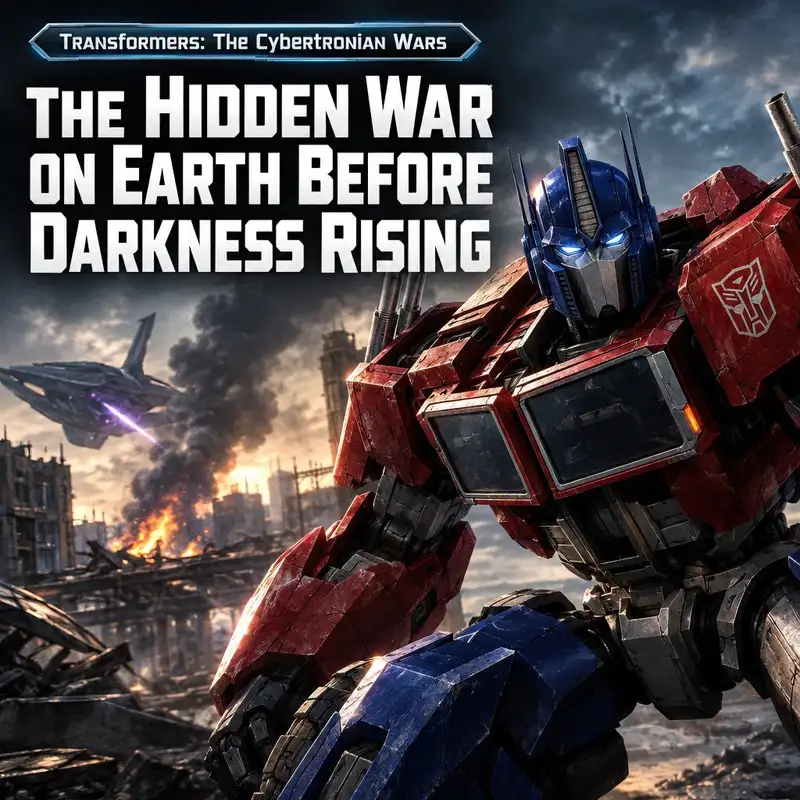
The Hidden War on Earth Before Darkness Rising
Cliffjumper found the first warning in a place that looked as though the war had already passed it by. Near Jasper, Nevada, he came upon an energon site that had been worked and partly exhausted. The discovery did not resemble an invasion. There were no columns of Decepticon armor, no public ultimatum, no city under occupation. There was only evidence of extraction, concealment, and an enemy that had learned how to operate without being seen. When Cliffjumper reported the contact, the Autobots described it as the first Decepticon activity they had known of in three years.
The important words were not “three years.” They were “known of.” On a planet as large as Earth, with a handful of Autobots scattered across distant regions, no confirmed contact did not prove that the enemy had vanished. It proved only that the enemy had avoided detection, chosen other priorities, or left behind a quiet interval that neither side could explain with confidence. Cliffjumper’s patrol turned that uncertainty into a crisis. The energon deposit showed that Earth had value. The Decepticons near it showed that someone had been acting on that value. And the response to his discovery would reveal that the apparent peace had never been a peace at all.
In the Transformers: Prime television history, Earth became important because Cybertron could no longer serve as a secure center for Autobot life or military operations. The wider war had scattered surviving Autobots across space. Optimus Prime’s team on Earth was not an army sent to conquer a new world. It was a small, displaced detachment trying to survive, protect a population that largely did not know it needed protection, and preserve some possibility of restoring their own home. The series does not provide a complete and unambiguous arrival record for every member of the Earth team. What it does establish is more useful than a date on a timeline.
By the opening of Darkness Rising, Optimus, Ratchet, Bumblebee, Bulkhead, Arcee, and Cliffjumper were already operating within an Earth-based security system. Their presence had history behind it. They knew the terrain, maintained cover identities, used a concealed headquarters, and had enough contact with the United States government to communicate through a designated liaison. Earth was therefore neither an accidental refuge nor a fully developed front. It was a forward theater. It offered distance from Cybertronian battlefields, places to hide, access to local infrastructure, and eventually access to energon. But it also imposed severe political limits. An open Autobot-Decepticon war would expose a human civilization that had not consented to join either side.
That condition shaped the Autobot posture from the beginning. Team Prime had mobility, experience, and the ability to transform into local vehicle forms, but it did not possess the personnel needed to patrol an entire planet in any conventional sense. Even a well-organized human military would struggle to monitor every road, mine, refinery, desert basin, industrial district, and air corridor across Earth. A small Cybertronian team had no such prospect. Its task was not permanent territorial control. It was detection, intervention, concealment, and denial. The Autobots had to find Decepticon activity before it reached a scale that endangered civilians or created a permanent enemy foothold.
They had to move quickly enough to exploit what they found. And they had to do so without turning every encounter into public proof that an interstellar civil war had arrived on Earth. That was a difficult mission even before Megatron returned. It became much harder because the enemy did not need to seize a capital city to make progress. The Decepticons could prospect, gather intelligence, test infrastructure, recruit local assets where possible, and wait. For a dispersed force, patience can be a weapon. It can also be a disguise.
The physical center of the Autobot effort was Autobot Outpost Omega One, hidden inside an abandoned missile facility in Nevada. The choice of location made strategic sense. A former military installation provided concealment, hardened underground space, and a plausible reason for unusual security around a remote site. It also gave the Autobots a place where they could repair damaged bodies, coordinate patrols, analyze intelligence, store equipment, and maintain communications away from public view. A hidden base is not just a shelter. It is an institution in miniature. It determines where personnel can recover, where decisions are made, where sensitive information is collected, and where a team can briefly become more than a collection of individual survivors.
At the same time, Outpost Omega One was a vulnerability. A force built around one principal headquarters has limited redundancy. If the base is exposed, the Autobots risk more than losing a garage or command post. They risk losing their medical capacity, technical support, communications, and secure access to the systems that allow a small team to respond across a vast country. Ratchet’s work at the base was therefore not secondary to combat operations. Repair and technical analysis were part of the team’s ability to exist at all. A damaged Autobot who cannot be recovered, stabilized, or repaired is not simply a temporary casualty. In a force this small, that loss changes the available balance of skills, experience, and trust.
The Autobots also possessed ground bridges, systems that allowed rapid movement between points on Earth. That capability mattered enormously, but it had limits. A ground bridge could reduce the time needed to reinforce a threatened location, extract personnel, or shift a team from one patrol zone to another. It changed local mobility. It did not grant control of the planet, and it did not solve the problem of knowing where to go. Intelligence still had to identify the threat. Someone still had to operate the bridge. A destination still had to be reached safely. Most important, a ground bridge was not the same thing as a space bridge. The distinction would become central to the hidden war. One system allowed a small defensive force to move across a planet. The other could connect worlds and alter the strategic geography of the war itself.
The Autobots’ relationship with the United States government added another layer of protection and ambiguity. Special Agent William Fowler served as their liaison. Through him, the Autobots could communicate with at least part of the American security apparatus, seek limited assistance, and manage incidents that might otherwise draw immediate attention. But Fowler was not proof of a public alliance between the Autobots and humanity. The series shows a narrow, classified relationship, not a treaty ratified in open political institutions. The exact knowledge held by civilian officials, military commands, legislators, and the broader public remains unclear. That compartmentalization protected the Autobots from exposure and protected the government from having to explain an alien war it could not control. It also meant that democratic oversight, public preparation, and civilian consent were almost entirely absent. Secrecy bought time. It did not create readiness.
The three-year gap before Darkness Rising must be understood as an intelligence problem, not as a confirmed ceasefire. Team Prime had no known Decepticon contact during that interval. Megatron’s location was uncertain. The enemy seemed absent enough that the Autobots had settled into a pattern of patrols, concealment, and guarded routine. But intelligence services, whether human or Cybertronian, are always tempted to turn a lack of reports into a report of absence. That is especially dangerous when the adversary has every reason to remain quiet. Decepticons could use vehicle modes, remote locations, underground sites, falsified appearances, encrypted communications, and isolated personnel to reduce their signature. They could avoid direct combat because direct combat would invite Autobot response and human attention. They could conduct activity in places that a small Autobot team had no practical means to watch continuously.
This was the central weakness of the Autobot position. They were defending a world too large to observe completely, alongside a human partner whose authority and awareness were limited, against an enemy that had no need to reveal its full strength. The Autobots could respond to a detected threat. They could not guarantee detection. That difference explains why the first reported Decepticon activity in three years came as such a shock. It was not just that an enemy had appeared. It was that an enemy had appeared at a location where it had apparently been working long enough to exploit a strategic resource.
The strongest evidence that Earth had been part of an earlier intelligence contest comes from Arcee and Cliffjumper’s own arrival. Their path to Earth was not a simple flight from a dying world. It began with an investigation into Decepticon activity connected to space-bridge technology. Arcee and Cliffjumper discovered an operation that had implications far beyond a local raid or a hidden supply cache. They were captured before they could fully contain what they had found, and their capture placed Autobot communications at risk.
The critical target was an encrypted message from Optimus Prime, a call directing surviving Autobots toward Earth. Such a transmission carried more than coordinates. It identified a rendezvous point, a potential sanctuary, and a place where scattered survivors might begin to reassemble. In a war of dispersed forces, that information is strategically valuable. A commander trying to reunite survivors must communicate. But every message creates a trail. Encryption can protect information against ordinary interception, yet it cannot always protect it when the messenger is captured and the enemy possesses specialized means of extracting what the messenger knows.
Shockwave used a cortical psychic patch to penetrate the encrypted communication. The process was not a routine intelligence intercept. It required access to prisoners, technical expertise, and a willingness to violate the captured Autobots’ minds in search of strategic information. The result was a compromise of the Autobot call. The Decepticons learned that Earth was not just another distant planet. It was a gathering point. It was where Optimus hoped surviving Autobots could find one another. In effect, an effort to build a refuge created a target.
This episode of the hidden war is important because it shows how Earth became vulnerable before most humans knew Cybertronians existed. The planet’s role was not created by a public declaration or a grand invasion fleet. It was created by information. Optimus needed a location where survivors could converge. The Decepticons needed to know where that location was. Once the message was compromised, Earth entered the enemy’s strategic calculations. The conflict was no longer confined to shattered Cybertronian territory or anonymous reaches of space. It had acquired a potentially decisive external theater.
Arcee and Cliffjumper’s captivity also reveals the human dimension of Cybertronian warfare, even when no humans are present. Both were soldiers, but they were also individuals who had already endured loss and separation. Their value to the Decepticons was not limited to their weapons or bodies. They possessed memories, access, relationships, and knowledge of Autobot plans. Capturing personnel can yield intelligence. It can also spread fear through a force that already lacks numbers and secure territory. When every experienced operative is difficult to replace, the loss of one patrol pair becomes a command problem, an intelligence problem, and a moral injury at the same time.
The Decepticons did not merely learn that Earth existed. They sought the means to bind Earth permanently to the larger war. That was where Shockwave’s work became strategically decisive. During this period, Shockwave remained on Cybertron rather than functioning as an Earth-based field commander. His contribution was scientific and infrastructural. He was working to reconstruct or reverse-engineer space-bridge capability, a project intended to establish a connection between Earth and Cybertron. The concept was simple enough to state and difficult enough to make dangerous. A stable bridge between worlds would not just move a scout or a small raiding party. It could transform the problem of distance.
For the Autobots, Earth’s isolation offered some protection. A hidden team could survive because the Decepticons could not necessarily bring overwhelming force to bear at once. For the Decepticons, a reliable interplanetary route promised to remove that constraint. It could allow the movement of personnel, matériel, knowledge, and potentially whole formations between Earth and Cybertron. The series does not establish the precise capacity of the bridge, the number of troops it could carry, or whether it was the only possible route between the worlds. Those details remain unknown. The strategic implication, however, is clear. A space bridge could convert Earth from a distant refuge into a connected operational base.
Energon was essential to that project. This is why Decepticon extraction on Earth mattered so much. Energon was not just useful fuel for vehicles and weapons. In this operation, it was part of the sustainment chain for a major technical undertaking. A bridge project required more than a scientist with a theory. It required energy, equipment, security, and enough time to build or restore the necessary infrastructure without interference. Earth could provide a resource that Cybertronian forces needed. That made mining sites strategically important even when they looked insignificant from the perspective of an unaware human community.
The hidden war therefore had an industrial dimension. Decepticon prospecting had to locate viable deposits. Extraction had to occur without attracting attention. The energon had to be moved or made available to the broader operation. Security had to protect the site from Autobot reconnaissance. Communications had to link Earth activity to Cybertronian planning. The bridge itself had to function reliably enough to matter. None of these tasks were glamorous, and none could be replaced by personal combat skill. A commander may win a duel and still fail to sustain a theater. A scientist may unlock a strategic capability, but only if labor, resources, transport, and security support the work.
Arcee and Cliffjumper sabotaged the Decepticon bridge and escaped through it to Earth. Their action was a genuine operational success. It denied the Decepticons immediate use of a system that could have changed the balance of the war. It also brought two experienced Autobots to the very world that Optimus had called survivors to reach. But sabotage is rarely the same thing as permanent destruction. The underlying Decepticon objective remained. Earth still had energon. The enemy still possessed knowledge of the Autobot rendezvous. Shockwave still possessed technical expertise. And the larger problem of connecting Earth to Cybertron had not disappeared simply because one installation was damaged.
This is the point at which the hidden Earth theater took its familiar shape. The Autobots had prevented an immediate breakthrough, but they had not removed the reasons that made Earth valuable. Their answer was to establish a defensive presence, build a concealed base, maintain patrols, and react quickly when signs of Decepticon activity emerged. It was a sensible response for a force with limited numbers. It was also a response that accepted uncertainty as a permanent condition. Team Prime could disrupt operations. It could not watch every possible site. It could save a threatened location. It could not make the planet strategically irrelevant.
The Decepticons, meanwhile, had reason to avoid open war. Their effort required time. A public campaign would invite concentrated Autobot resistance, expose extraction sites, and draw human authorities into a conflict that the Decepticons had not yet organized to dominate. Their work was preparatory. It sought resources, access, and opportunity. In that context, silence was not evidence of weakness. It could be evidence of discipline, caution, or incomplete readiness.
The energon site near Jasper demonstrates why covert mining is both useful and risky. A resource deposit is fixed in place. Once the Decepticons identify it, they cannot simply carry the entire operation with them. They need access routes, extraction equipment, storage, guards, and some means of moving the energon onward. Every one of those requirements creates a pattern. Vehicles arrive. Personnel rotate. Energy signatures change. A mine or prospecting operation is easier to hide than an invasion force, but it is harder to hide than an empty desert. It creates a point where the enemy must return, and where a small defensive force may be able to strike.
That made energon sites natural focal points for the Earth campaign. The Autobots could not search the world at random forever. But when they found evidence of Decepticon prospecting, they had something concrete to investigate. The same fixed sites that supported Decepticon logistics could expose Decepticon intent. Cliffjumper’s discovery was dangerous because it showed that the enemy had accepted that risk. The Decepticons were willing to place Vehicons and senior personnel near an extraction operation. They were willing to defend the work. And they were willing to kill a captured Autobot rather than allow him to report freely on what he had found.
For nearby human communities, this hidden resource war created danger without warning. People living around Jasper had no reason to believe that a mineral deposit beneath or near their region had become part of an alien military supply system. They had not agreed to become neighbors to a concealed extraction site. They had no way to assess the risks of Decepticon activity, and no public institution had prepared them for it. The secrecy that kept the wider population calm also denied that population information needed to understand its own vulnerability. This was not yet occupation. The Decepticons were not governing Nevada or openly requisitioning human industry. But covert military activity still affected civilian space. A hidden war can endanger people precisely because they do not know they are living beside it.
The Decepticon organization conducting these operations also faced a problem of command. Megatron had been absent in deep space for three years. His absence did not automatically dissolve Decepticon authority, but it created a vacuum at the top. Starscream attempted to exercise command in his place. He had access to Decepticon personnel, including Vehicons, and he was capable of directing local operations. Yet his authority was provisional. It depended on the continued absence of the leader whose return he had every reason to fear.
A command vacancy is not the same thing as succession. A stable succession requires accepted rules, reliable institutions, or a coalition strong enough to make the transfer of power durable. Starscream had none of those advantages. He could issue orders, but he could not be certain that every Decepticon viewed him as the permanent leader. He could pursue his own ambitions, but he could not safely assume that Megatron was dead, defeated, or incapable of returning. The result was a leadership style marked by urgency and insecurity. Starscream needed results. He needed control of information. And he needed to prevent others from gaining leverage that might weaken his position before he had consolidated it.
That insecurity shaped the handling of Cliffjumper. A captured Autobot was valuable as a source of intelligence, a hostage, and a possible bargaining instrument. But he was also a witness. He had discovered Decepticon activity near Jasper and could confirm that the enemy had returned to Earth. His very survival created risks for Starscream. If the Autobots recovered him, they would gain more than a missing comrade. They would gain direct evidence about Decepticon operations, their command structure, and the state of the Earth theater.
Starscream’s position also helps explain why covert preparation could not remain stable indefinitely. A hidden operation needs patience. It needs disciplined security and a willingness to accept slow progress. A commander worried about a superior’s return may not have the luxury of patience. He may rush an interrogation, conceal information, take risks for immediate advantage, or pursue actions that demonstrate authority rather than actions that build durable capacity. In that sense, Megatron’s absence did not create peace. It created a more fragile and unstable form of Decepticon activity.
Cliffjumper’s final mission exposed that instability. After discovering the energon operation, he encountered Decepticon forces and was captured. Starscream interrogated him, seeking information about Optimus Prime and the Autobots’ Earth presence. Cliffjumper’s death was not merely an isolated act of battlefield violence. It was a tactical loss for Team Prime, an intelligence event, and a political signal. The Decepticons were not just scavenging resources. They were organized enough to capture an Autobot, question him, and eliminate him when he no longer served their immediate purpose.
For the Autobots, the loss changed the situation immediately. A patrol contact became proof that the enemy was active and willing to escalate. Cliffjumper had been part of the Earth team’s reconnaissance network. His disappearance meant that the Autobots lost not only a fighter but also the information he might have carried back. In a larger army, the death of one scout may be absorbed by broader surveillance systems and reserve units. In Team Prime, each member represented a substantial share of the available capability. Cliffjumper’s loss narrowed the team’s margin for error.
His death also challenged the assumptions behind the three-year quiet period. The Autobots could no longer act as though Decepticon activity was a distant possibility. The enemy had demonstrated presence, intent, and reach. It had found energon. It had deployed forces near a human settlement. It had captured one of the Autobots. And it had done all of this before the wider human population understood that Cybertronians were operating on Earth at all.
The personal violence carried into this theater also mattered. Arcee’s history with Tailgate and Airachnid belongs to the earlier Cybertronian war, not to the three-year gap on Earth. Tailgate was captured alongside Arcee, and Airachnid used him as part of an effort to force information from Arcee. His killing was an act of coercion and cruelty, intended not only to remove a captive but to break another prisoner psychologically. That experience remained with Arcee long after the setting changed.
Its relevance to Earth is not that Airachnid’s vendetta was official Decepticon policy. It was not. Airachnid operated with considerable autonomy and pursued violence for personal reasons as well as factional ones. The relevance is that the hidden Earth theater was populated by veterans of a much older civil war. They brought memories of captivity, loss, torture, betrayal, and unresolved personal hatred with them. A covert campaign may appear quiet from the outside. To those serving in it, the war is still present in the decisions they make and the enemies they recognize.
Megatron’s return ended any possibility that the hidden campaign might remain limited. He came back from deep space with Dark Energon and with a plan that reached beyond prospecting or local raids. Dark Energon was not simply a stronger form of fuel. In Megatron’s hands, it became the basis for an experiment in reanimation. He used Cliffjumper’s corpse to test its effects, turning a fallen Autobot into evidence that death itself could be exploited for military purpose.
The act was strategically significant and morally revealing. It showed that Megatron was prepared to treat the bodies of the dead as resources. It also demonstrated a possible means of creating or mobilizing forces that bypassed ordinary recruitment, repair, and loyalty. The immediate experiment was limited and unstable. It should not be mistaken for proof that Megatron possessed an unlimited army or a perfected industrial system for resurrecting Cybertronians. But it revealed the direction of his thinking. The war could be renewed not only by gathering living Decepticons, but by weaponizing the remains of those left behind on Cybertron.
Megatron’s larger plan was to use space-bridge access to bring an army of reanimated Cybertronians from Cybertron to Earth. This was the escalation that transformed the meaning of everything that had come before. Energon mining was no longer just an enemy supply problem. It was part of the material basis for strategic mobility. Bridge research was no longer an isolated scientific program. It was a route for moving the consequences of Cybertron’s ruin directly into Earth’s environment. The Nemesis was no longer simply a distant Decepticon vessel. It became part of an operational system connecting leadership, transport, command, and the prospect of reinforcement.
Team Prime now faced immediate attacks, a hostile force with renewed direction, and a crisis of secrecy. Beyond those encounters, the Decepticons were trying to expand their ability to move forces and coordinate activity across worlds. The larger danger was that Earth could become the staging ground for a renewed phase of the Cybertronian war. The planet’s resources, geography, and civilian infrastructure could become tools in a conflict whose origins lay far beyond human history.
The political consequences were equally important. Jack Darby, Miko Nakadai, and Rafael Esquivel did not begin the Cybertronian war by encountering the Autobots. Their involvement marked the failure of the concealment system that had kept the war compartmentalized. Once human civilians witnessed the conflict directly, the old arrangement became harder to sustain. The Autobots could no longer operate only through hidden bases, vehicle disguises, and a narrow government liaison. They had to account for human allies who possessed courage and local knowledge but who had never chosen to become part of an interstellar war.
That transition exposed the contradiction at the heart of the Earth theater. Secrecy had protected civilians from panic and protected the Autobots from exposure. Yet secrecy had also left civilians unprepared when the conflict intensified. The people most likely to be caught near an energon site, a Decepticon operation, or an Autobot battle had the least information about what was happening around them. The hidden war had postponed public crisis. It had not removed the danger.
The Earth of Darkness Rising was therefore not a peaceful world suddenly attacked by alien forces. It was a world that had already become strategically entangled in a Cybertronian civil war without knowing it. The Autobots had built a covert defensive network because they lacked the strength and political freedom to fight openly. The Decepticons had pursued energon, infrastructure, and intelligence because they needed the means to turn Earth into something more than a distant refuge. The United States connection remained compartmentalized. Most humans remained uninformed. Both sides operated with incomplete knowledge, limited resources, and reasons to delay an open confrontation.
The three-year interval was not an armistice. It was not an empty space in the record. It was a period of uncertainty in which the absence of confirmed contact concealed a contest over information, mobility, and logistics. Arcee and Cliffjumper’s escape delayed an interplanetary breakthrough, but it did not remove Earth from Decepticon plans. Hidden energon extraction supported possibilities that neither the Autobots nor nearby civilians could safely ignore. Starscream’s provisional command kept the enemy active but unstable. Cliffjumper’s death exposed that instability and destroyed the illusion that quiet meant security.
Darkness Rising is not the outbreak of war on Earth. It is the moment when a concealed forward theater becomes too valuable, too violent, and too exposed to remain hidden.