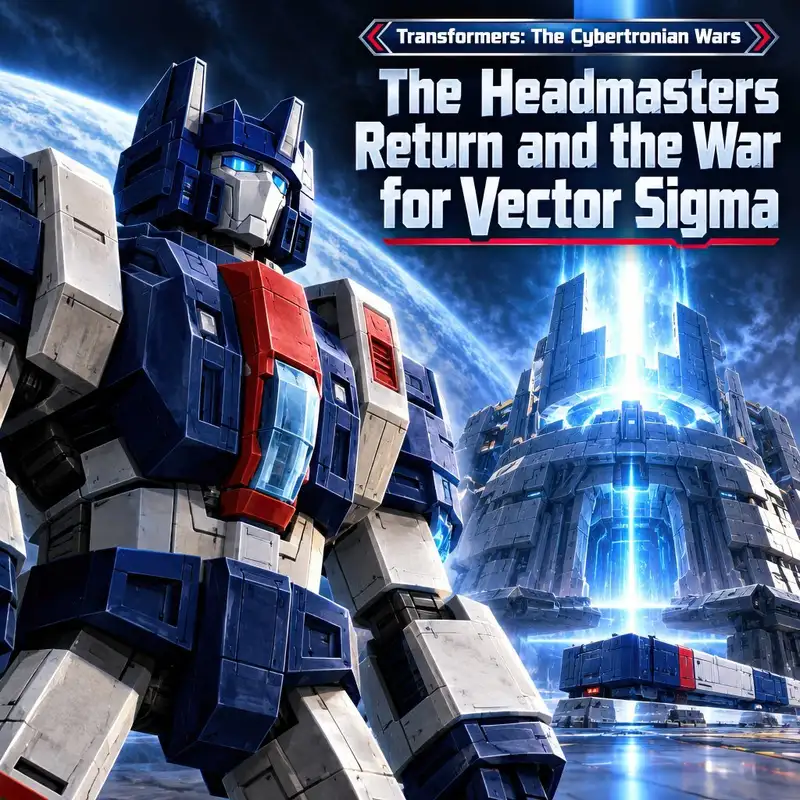
The Headmasters Return and the War for Vector Sigma
Deep beneath Cybertron’s cities, the first emergency was not an invading army. It was a failure at the planet’s core. Vector Sigma, the great computer system tied to Cybertron’s stability and accumulated knowledge, had become unstable. Kup and Spike discovered that the malfunction could destroy Cybertron from within. The planet was already a battlefield, but this was a different kind of danger. No perimeter could contain it. No conventional victory could solve it. The system that helped hold Cybertron together had become the point at which the entire civilization might come apart.
This is the Japanese animated continuation presented in Transformers: The Headmasters, set after the events surrounding Optimus Prime’s return. It follows the earlier animated history through the war with Unicron and the later crisis of the Hate Plague, but it does not follow the American Headmaster story. That distinction matters immediately. The Headmasters arriving here are not partnered with organic beings from another world. They are Cybertronians whose history, bodies, loyalties, and political divisions were shaped far from Cybertron itself.
The timing made the Vector Sigma malfunction especially dangerous. The Matrix of Leadership, which had helped end the Hate Plague, was not on Cybertron. It had been left on Earth to recover its strength. The Autobots therefore faced a strategic problem with three parts. They had to defend a planet under attack. They had to reach the failing system at its core. And they had to recover the one artifact believed capable of helping restore it, from another world entirely. The crisis was more than technical. It was a test of command, mobility, and institutional survival.
Galvatron’s Decepticons understood opportunity when they saw it. Their attacks on Cybertron and Earth came while the Autobots were already divided by the emergency. A force defending cities, hunting for an irreplaceable artifact, and trying to stabilize a planetary system cannot concentrate easily against an enemy offensive. Galvatron did not need to destroy Cybertron immediately. It was enough to exploit confusion, force the Autobots into reactive deployments, and prove that their command structure could be strained at several points at once.
The opening attacks also introduced new Decepticon forces whose value was not limited to raw firepower. Sixshot brought the flexibility of a warrior built for several forms of combat and movement. More important for the immediate fighting, the Decepticon Headmasters Weirdwolf, Skullcruncher, and Mindwipe added a specialized capability to Galvatron’s side. Mindwipe’s hypnotic attacks disrupted Autobot cohesion. The result went beyond individual Autobot defeats. Their ability to organize a defense was temporarily degraded.
That distinction matters in military terms. A commander does not need to destroy every enemy unit to gain the initiative. Disorienting defenders can be enough. A force that cannot trust its own senses, coordinate its movements, or keep its personnel operational may lose control of a critical location without suffering annihilation. Mindwipe’s role showed that the Decepticons were attacking the Autobot system, not simply its front line. At the same time, the instability of Vector Sigma ensured that even a successful local defense could not by itself secure Cybertron.
The Autobot answer arrived from beyond the familiar chain of command. Fortress and four Autobot Headmasters, Chromedome, Hardhead, Brainstorm, and Highbrow, came to Cybertron aboard the ship Maximus. Their arrival helped reverse the immediate battlefield situation, but their greater significance lay in where they had come from. They were not recent recruits transferred from another Autobot garrison. They represented a community that had left Cybertron during the Great War and survived in exile on Planet Master.
Planet Master was more than another colony with a more dramatic name. It was a harsh refuge, a world whose conditions demanded adaptation. The Cybertronians who settled there developed larger bodies known as Transtectors. They operated those bodies by transforming into their heads. The arrangement gave them a practical means of survival and combat under the conditions they faced. It also gave them a distinct military identity. Their equipment, experience, and methods had been shaped by distance from Cybertron and by the necessity of living without the support of its central institutions.
That system should not be mistaken for a universal explanation of Headmasters across Transformers history. In this Japanese continuity, it belongs to the Planet Master community and to the division that later emerged within it. The point is more than how their bodies functioned. The point is what their bodies represented. The Headmasters had become a diaspora with its own technical solutions, its own leaders, and its own memory of the war that had driven them from Cybertron.
Fortress was therefore more than another capable Autobot commander. He brought a ship, trained personnel, and a community that had maintained itself apart from the main Autobot struggle. In a time of crisis, that made him an important source of independent strength. But independent strength can also change political balance. The Autobots gained reinforcements, yet they also gained a second center of experience and authority. Fortress had not inherited his position from Cybertron’s existing leadership. He had earned it through survival, migration, and command on another world.
The Decepticon Headmasters carried the other half of that history. Their eventual leader, Scorponok, had broken with Fortress and the Planet Master community. Weirdwolf, Skullcruncher, and Mindwipe followed that path into alliance with Galvatron’s Decepticons. The split was not a simple sorting of virtuous characters onto one side and villains onto the other. It was a fracture within an exiled population. The same diaspora that gave the Autobots new resilience also supplied the Decepticons with capable specialists and a rival power center.
This gave the conflict a different texture. The Headmasters did not arrive as neutral outsiders who immediately adopted the old war’s familiar lines. Their presence brought an older dispute back into Cybertronian affairs. Fortress and Scorponok each represented communities shaped by separation from the homeworld and by disagreements over leadership. The broader Autobot-Decepticon war absorbed that division, but it did not erase it. In time, that unresolved fracture would prove as dangerous to Cybertron as Galvatron’s open assault.
For the moment, the Autobot priority remained Vector Sigma. Optimus Prime moved toward Cybertron’s depths, where the unstable system threatened the planet. His task was not a conventional battlefield command. He was trying to preserve the infrastructure upon which any defense depended. Meanwhile, Hot Rod and other Autobots were sent toward Earth to recover the Matrix. The plan divided labor according to necessity. Optimus was already on Cybertron and could reach the crisis. Hot Rod’s group could pursue the artifact. Neither task could wait for the other.
It was a sound response to an impossible situation, but it carried obvious risks. The Matrix was decisive only if the Autobots could find it, secure it, and bring it back in time. Possession in the abstract was not enough. An artifact that sits on another planet, separated by enemy activity and uncertain transport, is not a capability available to the commander facing the emergency. The Matrix mattered because it might stabilize Vector Sigma. Yet until it reached Cybertron, it was also a reminder of how dependent the Autobots had become on a resource beyond immediate reach.
The Decepticons recognized the value of the search. Soundwave and his cassette agents discovered that the Autobots were looking for the Matrix on Earth. This shifted the struggle into an intelligence contest. A force seeking a unique object cannot move casually. Its routes, communications, local allies, and recovery plans all become vulnerable. Once the enemy knows what is being sought, it can interfere without necessarily understanding every detail of the object’s function. Denying access can be as useful as seizing the prize.
Blaster stood at the center of that contest for the Autobots. His confrontation with Soundwave was more than a personal duel between familiar rivals. Both functioned as communications and intelligence assets for their respective factions. In a war spread across worlds, the ability to detect enemy movement, coordinate allies, and relay critical information carries military weight. The destruction of both combatants did not erase either faction’s capacity to communicate, but it disrupted institutions that had become identified with information warfare and factional morale.
The asymmetry that followed was important. Soundwave later returned in rebuilt form as Soundblaster, preserving a Decepticon communications function under a new identity. Blaster’s loss remained a serious Autobot absence. The series provides no precise staff chart showing every consequence, and it would be foolish to invent one. Still, the pattern is clear enough. The Decepticons absorbed the loss of their intelligence specialist more effectively than the Autobots did. In a crisis centered on information, access, and timing, that mattered.
The Matrix was eventually recovered, but recovery did not mean that the crisis was over. Hot Rod brought it back toward Cybertron, where Alpha Trion’s spirit intervened in an extraordinary way. The Matrix regained sufficient power to transform Hot Rod into Rodimus Prime. This was not presented as routine repair science or as a simple transfer of rank. It was an exceptional intervention at a moment when the Autobots needed both the Matrix and a leader capable of bearing its authority.
For a brief period, Optimus Prime and Rodimus Prime fought alongside one another. It is tempting to treat that moment as a triumphal restoration of Autobot leadership. In reality, it revealed how fragile that leadership had become. Cybertron had a former commander returned from earlier sacrifice, a newly restored Prime, an external commander in Fortress, and a planetary emergency that could not be solved through ceremony. The Autobots had legitimacy, experience, and courage. What they did not have was time to settle questions of succession under calm conditions.
Optimus’s final action in the first Vector Sigma crisis was directed toward the system itself. He merged with Vector Sigma in order to restore control and stabilize Cybertron. The series presents this as a sacrifice. It should not be reduced to a familiar pattern of destruction and revival, nor should it be assigned a biological mechanism the story does not establish. More important, Optimus gave himself to preserve the planetary institution on which Cybertron depended.
That act bought Cybertron time. It did not solve the political and military conditions that had made Vector Sigma vulnerable. Rodimus now carried the Matrix and the burden of Autobot command. He inherited authority, but authority is not the same thing as settled command confidence. Optimus had been a recognized symbol as well as a military leader. Rodimus assumed leadership amid emergency, loss, and the visible presence of Fortress and the returning Headmasters. The Autobots had survived, but their system of leadership was still adapting to crisis.
The first malfunction also revealed a larger strategic fact. Cybertron had become dangerously dependent on a centralized institution. Vector Sigma was more than a computer in the ordinary sense. In this continuity, it was tied to planetary stability and to knowledge essential to the functioning of Cybertron. That made it a critical asset. It also made it a target. Any enemy that could threaten Vector Sigma could impose pressure far beyond the effect of an ordinary attack on a city, depot, or military base.
The crisis might have taught every faction the value of protecting that infrastructure. Instead, it made Vector Sigma even more tempting. A system that had nearly brought Cybertron down through instability was still valuable because of what it contained and what it could produce. The logic of war is often cruel in this way. The more indispensable an institution becomes, the more attractive it is to those who seek leverage over an enemy. Protection and exploitation begin to compete for the same asset.
When the conflict returned to Vector Sigma several episodes later, the issue was no longer only survival. Soundblaster infiltrated Cybertron and discovered that Vector Sigma was developing a remarkable alloy called Cybertonuron. It was described as far stronger than Cybertonium. That description was enough to transform the system into an industrial objective. Galvatron saw in Cybertonuron the possibility of becoming effectively invincible, or at least of gaining a military advantage so great that ordinary opposition could no longer restrain him.
The series establishes the alloy’s importance, not a complete industrial program. It provides no reliable production rate, reserve estimate, manufacturing plan, or evidence that either faction could equip an army with Cybertonuron. It would be wrong to imagine instant fleets of invulnerable Decepticons. But scarcity can increase strategic value. A unique material under development at Cybertron’s core could alter the balance of power even before it was available in quantity, simply because one leader might secure exclusive access to it.
Vector Sigma now had several roles at once. It remained a system associated with Cybertron’s stability. It was a repository of knowledge and a site of immense technological importance. And it had become the source of a potentially transformative material. That concentration of functions made it difficult to defend. A military command can disperse ordinary workshops, archives, and fuel stores. It cannot easily disperse a singular institution whose importance rests on being central to the planet’s operating system.
Galvatron responded with a planetary offensive. The Predacons struck Cybertron first, putting the defenders under immediate pressure. Meanwhile, Galvatron gathered Decepticon forces on Earth and transferred them through the space bridge. This was not a casual movement between worlds. The space bridge changed the operational geography of the war. It allowed forces dispersed across Earth and Cybertron to concentrate quickly against a decisive objective, reducing warning time and giving Galvatron the ability to choose when the main attack would begin.
Yet the bridge did not make victory automatic. Strategic mobility is useful only when a commander can coordinate the force that arrives, secure a viable endpoint, and hold the objective once it is reached. Galvatron still had to overcome Autobot defenders at Cybertron, manage the ambitions of his own allies, and capture a complex system rather than simply wreck it. The operation depended on speed, pressure, and the assumption that his coalition would remain obedient once the prize came within reach.
The Autobots defended with what they had. Rodimus Prime was present, along with Fortress, the Autobot Headmasters, combiners, and other Autobot forces. The series never establishes a detailed order of battle, and there is no need to manufacture one. What matters is the character of the defense. Cybertron was not protected by one elite team or by a single leader. It was defended by a coalition of returning exiles, conventional forces, specialized units, and the remnants of a command structure still recovering from Optimus’s sacrifice.
Rodimus’s defeat by Galvatron was tactically significant. It demonstrated that Galvatron could overcome the Autobot commander in direct combat during the larger offensive. But tactical success did not give the Decepticons uncontested control of Vector Sigma. The Autobots remained active. Fortress and the Headmasters remained in the field. The Decepticon attack had created a breach in Autobot leadership, not a settled conquest. Galvatron had not yet converted battlefield superiority into control of the planetary system he had come to seize.
That gap between defeating a leader and securing an objective is where Scorponok’s calculation became decisive. Scorponok was allied with Galvatron, but alliance did not mean subordination without limits. He commanded the Decepticon Headmasters and represented a separate power base within the broader Decepticon coalition. His relationship with Galvatron rested on shared immediate interests, not on trust in a common future. The prospect of Cybertonuron made that weakness impossible to ignore.
Scorponok understood what Galvatron’s success would mean for everyone around him. If Galvatron secured an alloy capable of making him still more formidable, then the balance within the Decepticons would change as well. Scorponok could expect less influence, less independence, and perhaps eventual disposal once his usefulness ended. The danger was not imaginary paranoia. Galvatron’s objective was openly personal as well as military. He did not seek Cybertonuron to build a negotiated Decepticon order with independent partners. He sought supremacy.
This was coalition politics at its most destructive. Galvatron had assembled forces capable of threatening Cybertron because the Decepticons could cooperate against the Autobots. But he had not built a post-victory settlement that gave his allies reason to accept his success. His campaign assumed that common hostility toward the Autobots would remain stronger than fear of Galvatron’s dominance. Scorponok concluded otherwise. Once he believed that victory would make him irrelevant or vulnerable, the alliance ceased to be an instrument of conquest and became a threat to his own survival.
Scorponok’s response was not a failed attempt to seize Vector Sigma for himself. It was more radical than that. He recalled Weirdwolf, Skullcruncher, and Mindwipe. He equipped them with bombs and sent them into Vector Sigma’s chamber. Their task was not to capture the alloy, defend the facility, or bargain from a position of strength. Their task was to destroy the system. If Scorponok could not control Cybertonuron, then Galvatron would not control it either. The Autobots would be denied it as well.
This was deliberate infrastructure denial. It converted a campaign for possession into a campaign against the possibility of possession. Such decisions can appear irrational when measured only against the original objective. From Scorponok’s position, however, the calculation was grimly coherent. A world in ruins might be preferable to a Decepticon order in which Galvatron became unchallengeable. The flaw was not that Scorponok misunderstood destruction. The flaw was that he treated the survival of his own factional independence as more important than the survival of Cybertron itself.
The Decepticon Headmasters’ role made the act especially bitter. They had come from the same broad diaspora history as Fortress and the Autobot Headmasters. Planet Master had produced rival communities, rival leadership, and rival military systems. Now the division reached Cybertron’s core. Fortress had returned to help defend a damaged homeland. Scorponok’s followers entered that homeland’s most vital chamber carrying bombs. The conflict was no longer simply between those who had stayed and those who had fled. It was a civil war within a civilization already fragmented by exile.
The Autobots discovered the sabotage, but discovery came too late to guarantee prevention. This is another recurring problem in warfare around critical infrastructure. Defending a system requires more than defeating the enemy outside its walls. It requires security within the facility, reliable intelligence, rapid response, and enough time to distinguish a raid from a decisive act of sabotage. Vector Sigma’s importance made it heavily contested. That same importance created confusion, competing priorities, and opportunities for infiltrators.
When the bombs detonated, Vector Sigma was destroyed. Cybertron was reduced to a ruined shell. The series provides no detailed geological account of the catastrophe, a reliable casualty total, or an exact measure of the blast. Those details are not necessary to understand the result. Cybertron lost the central system that had just been shown as essential to its stability. The world both factions had fought to control was no longer a functioning prize.
Galvatron did not gain Cybertonuron. Scorponok did not gain it. The Autobots did not preserve Vector Sigma. In the narrowest military sense, the sabotage denied the objective to every participant. In the broader strategic sense, it was a disaster for all Cybertronians. Galvatron’s offensive had been designed to secure a resource and increase Decepticon power. Instead, it helped produce the destruction of the industrial and political center that could have sustained any long-term claim to rule.
The consequences were greater than the loss of one computer or one experimental material. Cybertron’s central infrastructure had been broken. The exact scope of damage to repair facilities, manufacturing, archives, energy coordination, and civilian life is not fully mapped on screen. Still, the implications are unavoidable. A planet whose stability depended on Vector Sigma could not lose that system without losing more than a military objective. It lost capacity. It lost continuity. It lost the practical foundation on which a homeworld functions.
The civilian cost is mostly implied rather than closely observed, but it should not be ignored. Cybertron was not an empty battlefield waiting for whichever faction planted its symbol first. It was the homeland of a people already shaped by war, migration, and long separation. Its destruction meant displacement on a civilizational scale. It meant that access to repair, shelter, energy, work, and political community could no longer be assumed. The fall of a central world turns soldiers into refugees as surely as it turns commanders into leaders in exile.
The Autobots withdrew to Athenia and Earth. Their survival depended on dispersal rather than restoration. Rodimus Prime departed with Kup and Blurr to search for a new home for the Transformers. The series shows him leaving the immediate center of Autobot activity, while Fortress assumes greater practical responsibility for those who remained. The exact constitutional language of this shift is not fully explained. What is clear is that command had become more distributed. The Autobot future could no longer depend on one leader, one world, or one central machine.
Fortress’s importance after the catastrophe was therefore larger than his role as a battlefield reinforcement. The Headmasters had returned with a history of exile, adaptation, and self-sufficiency. They had already learned how to survive away from Cybertron’s main institutions because Planet Master had required them to do so. That experience did not make the destruction of Cybertron less traumatic. It did make Fortress and his community uniquely relevant once the homeland could no longer serve as the unquestioned center of Cybertronian life.
There is an irony at the heart of their return. The Headmasters came back to Cybertron just as Cybertron became unusable as the center of their civilization. They arrived not to inherit a secure homeworld, but to defend a society at the moment it lost its foundation. Their distinct bodies and combat abilities mattered in battle, but their deeper value was institutional. They brought a model of continuity outside the old center. They showed that Cybertronian identity could survive displacement, even when Cybertron itself could not immediately sustain it.
That did not make exile easy or politically simple. A dispersed Autobot force faced problems of command, legitimacy, supply, and purpose. Athenia and Earth could offer refuge, but neither was simply Cybertron under another name. The Autobots had to work across different worlds, different populations, and different strategic conditions. A movement formed around defense of Cybertron now had to consider what it meant to defend a people whose homeworld had been wrecked. The war’s geography had changed, and with it the meaning of victory.
For the Decepticons, the destruction exposed the weakness behind Galvatron’s apparent offensive strength. He could gather forces, exploit the space bridge, defeat Rodimus in battle, and threaten the most important system on Cybertron. Yet he could not secure loyalty within his own coalition. His pursuit of overwhelming advantage frightened an ally whose support he still needed. The campaign failed not because Galvatron lacked military power, but because his model of power left no durable place for other ambitious leaders.
Scorponok, in turn, preserved neither his independence nor a viable political future for Cybertron. His decision was rational in the narrow sense that it denied Galvatron the means to dominate him. It was catastrophic in every wider sense. He destroyed the very infrastructure that gave Cybertron strategic and civilizational value. The act protected him from a future in which Galvatron ruled too completely, but it did so by ensuring that neither of them could rule a functioning planet.
The war for Vector Sigma therefore became a lesson in the danger of concentrating survival, industry, knowledge, and political meaning in one vulnerable institution. Vector Sigma mattered because it helped stabilize Cybertron. It mattered because it carried technological importance. It mattered because Cybertonuron made it a potential source of unprecedented military advantage. Those roles made control of the system seem decisive. They also made its destruction devastating beyond the immediate battle.
The Headmasters’ return sharpened that lesson. They were more than new fighters entering an old conflict. Fortress and his followers brought the experience of a people who had already lived beyond Cybertron’s support. Scorponok and his followers brought the unresolved divisions of that same history into Galvatron’s coalition. Their arrival expanded the war’s capabilities, but it also exposed the political fractures that conventional battlefield victories could not resolve.
Cybertron was not destroyed because one side lacked courage or because one commander lost a duel. It was destroyed because a campaign for strategic control became a struggle among leaders who could not imagine a shared outcome. Galvatron sought domination through Cybertonuron. Scorponok feared domination under Galvatron. The Autobots tried to preserve a system that had become too central to replace quickly. When the bombs destroyed Vector Sigma, every faction lost the world it claimed to need.
The war proved that control of a civilization’s core system is not the same thing as possessing a civilization worth ruling.