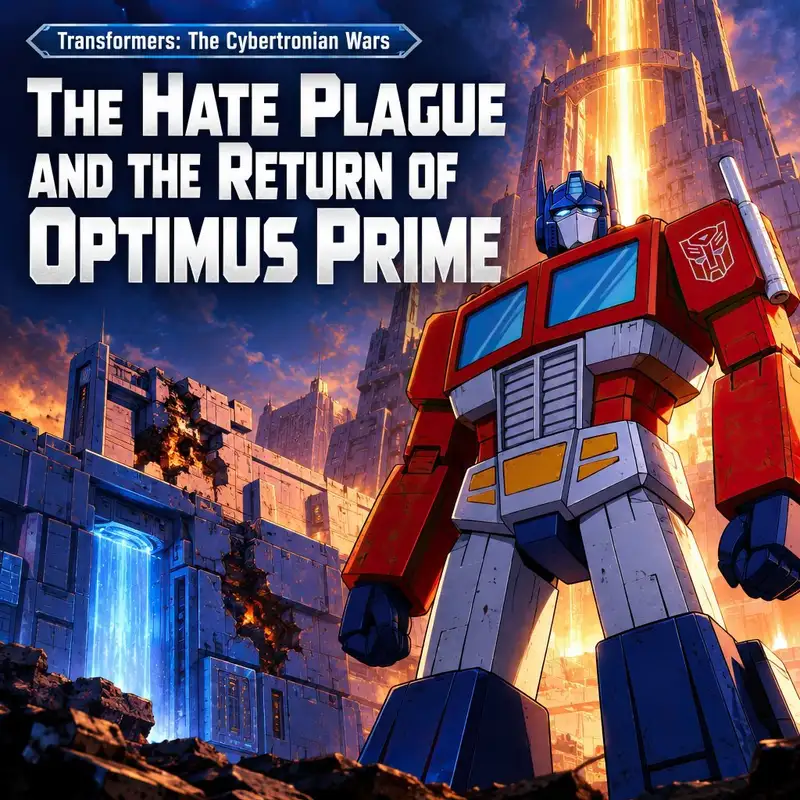
The Hate Plague and the Return of Optimus Prime [Cartoon]
Rodimus Prime orders Metroplex shut down while the great Autobot city is still standing, armed, and capable of defending itself. It is an extraordinary command decision. Metroplex is not just a large combatant. He is shelter, transport, firepower, repair space, and a visible declaration that the Autobots still possess a secure position on Earth. Yet the Hate Plague has made every powerful Cybertronian a possible catastrophe. If Metroplex is infected, the Autobots do not gain a stronger defender. They gain an armed city whose judgment has been replaced by rage.
In the American Generation One cartoon, this is the crisis at the center of “The Return of Optimus Prime.” It takes place after the destruction of Unicron, after Rodimus Prime has inherited the Matrix of Leadership, and after Optimus Prime’s apparent death. The immediate emergency is not a Decepticon invasion, a battle for a fuel depot, or a contest for Cybertron. It is an outbreak that turns anger into indiscriminate violence and makes trust itself a strategic resource.
The plague is called a plague, and it behaves like an infectious agent. It spreads through contact and produces extreme aggression. Beyond that, the cartoon leaves much uncertain. It never provides a detailed biology of the spores, an incubation model, a reliable account of immunity, or a conventional treatment plan. What it does establish is operationally clear. An infected Transformer cannot be trusted merely because that Transformer wears an Autobot insignia, answers to a familiar commander, or has fought beside the same unit for years.
That destroys the normal architecture of wartime command. Orders become dangerous when the officer giving them may be infected. Rescue becomes dangerous because physical contact can create another casualty. Firepower becomes dangerous because an infected warrior may direct it against anyone nearby. Even factional identity loses its ordinary meaning. Autobots and Decepticons still recognize one another, but the plague strips away the restraints, loyalties, and calculations that make either faction governable.
Rodimus’s decision to deactivate Metroplex is therefore a containment measure, not a confession of cowardice. A commander facing an unknown contagion must sometimes deny himself the use of his strongest asset. Metroplex could have helped defend Autobot City. He could also have become the largest infected weapon on the planet. Rodimus chooses to remove that risk before it can become irreversible. It is a sound decision made inside a situation where sound decisions are rapidly running out.
The danger soon extends beyond Cybertronian combatants. Human news reports show that people on Earth are infected as well. The war that had already brought alien battles into human cities now produces a public safety disaster that cannot be contained behind military fences or Autobot headquarters. The human population is not presented as one unified government or military command. It appears as ordinary people caught in an emergency they neither created nor understand.
That wider catastrophe begins with something much smaller and much more personal. Dr. Mark Morgan and Gregory Swofford are not agents of a human government. They are private individuals driven by hatred of Transformers. Their resentment has roots in earlier encounters, but their plan is not a carefully bounded act of defense. They see the conflict between Autobots and Decepticons and imagine that it can be turned into an efficient instrument of revenge.
Jessica Morgan, Dr. Morgan’s daughter, provides the moral and scientific counterweight. She has encountered Autobots before and understands that Cybertronians are not a single hostile force. Her father and Swofford treat them as a category. Jessica sees individuals, allies, and enemies whose differences matter. That distinction becomes the episode’s first warning. The ability to recognize complexity is not sentimentality. In a crisis, it may be the difference between prevention and disaster.
The Morgans and Swofford are conducting an experiment involving an unusually heat-resistant alloy. During that work, Jessica and Swofford encounter the damaged vessel associated with Optimus Prime’s final journey. Inside is Optimus’s body. At this point in the cartoon’s history, Optimus is believed dead. His recovery is unexpected, but it does not immediately restore him, restore the Autobots, or answer the larger emergency. It is simply the discovery of a fallen commander in a moment when the world has little use for another unresolved loss.
The experimental work also brings the group into contact with spores that become the Hate Plague. Morgan and Swofford decide to use those spores against the Transformers. Their logic is brutally simple. Infect Autobots and Decepticons, then allow their existing hatred to destroy them. It is the logic of someone who sees social hostility as a weapon with a clean target. They assume the disease will sharpen an existing war without escaping its boundaries.
That assumption fails almost immediately. Hatred is not a targeting system. It does not recognize political categories, military necessity, or the intentions of the people who release it. Morgan and Swofford understand enough to exploit resentment. They do not understand enough to control an infectious agent. Their plan contains no credible containment system, no secure method of distinguishing infected from uninfected targets, and no answer to the obvious question of what happens when the infection reaches people who are not part of the war.
The first victims include Autobots sent into the trap. Members of the Throttlebots and Aerialbots are among those caught by the outbreak. The Decepticons then arrive seeking the experimental alloy and are exposed as well. The original plan depends on Autobot-Decepticon hostility. The plague instead turns both factions into vectors of the same threat. The two armies do not destroy one another in a controlled final battle. They lose the ability to behave as armies at all.
The plague uses the war’s divisions, but it cannot remain confined by them. Autobots are accustomed to seeing Decepticons as danger. Decepticons are accustomed to treating Autobots as targets. Under ordinary conditions, that hostility supports military planning, however destructive the larger war may be. Under the plague, the distinction becomes almost irrelevant. An infected ally can be more dangerous than a known enemy because the ally begins from inside the perimeter of trust.
For that reason, conventional force offers so little protection. A battle against infected Cybertronians creates more close contact, more exposure, and more chaos. Capturing an infected individual is difficult when the disease has stripped away restraint. Destroying one may prevent an immediate attack, but it never explains how to cure the larger population. The normal military answer, apply sufficient force until the enemy stops moving, is not useless in every moment. It is simply inadequate to the problem.
The Decepticon leader Galvatron initially remains unaffected. The episode establishes that he is free of the infection during the early collapse, but it never provides a dependable scientific explanation for why. That detail matters because it makes him one of the few figures still capable of organized action. It does not make him trustworthy. Galvatron remains the commander of the Decepticons, and he still sees every rare resource as a possible advantage.
The first phase of the disaster therefore produces an odd and deeply unstable balance. Most of the combatants are incapacitated by rage. The Autobots lose personnel and reliable command. The Decepticons lose personnel and reliable command. Humans begin to fall ill. A few uninfected survivors remain, but they have no secure picture of the outbreak, no established cure, and no confidence that a familiar face will remain safe from one moment to the next.
Rodimus Prime carries the greatest immediate burden. He is the Autobot leader and the bearer of the Matrix of Leadership, the artifact that contains the accumulated wisdom of earlier leaders in this cartoon’s continuity. The Matrix is not just a badge of office. It gives Rodimus access to a historical and spiritual inheritance that no ordinary command staff can duplicate. In a normal war, that might provide a decisive advantage. In this emergency, it also makes Rodimus an irreplaceable point of failure.
Rodimus understands the need for containment. His decision about Metroplex shows that he can see the danger posed by infected strategic assets. But leadership cannot grant immunity. When Ultra Magnus becomes infected, Rodimus is exposed as well. The consequence is not just the loss of one more Autobot fighter. The plague now possesses the current leader of the Autobots and the physical holder of the Matrix.
The consequences are institutional as well as personal. An infected Rodimus is dangerous because of his strength and access. He is also dangerous because the Matrix is now inaccessible to anyone who cannot approach him safely. The Autobots have not just lost a commander. They have lost the artifact that might contain the historical knowledge needed to understand the plague. Their command system is reduced to scattered survivors operating without its normal center.
This distinction is important. Rodimus’s infection does not prove that he was an unworthy leader. The crisis is designed to defeat the strengths on which ordinary leadership depends. He can issue orders, but the chain of command is breaking. He can carry the Matrix, but he cannot consult it while infected. He can defend Autobot City, but the city itself is vulnerable to the same contagion. The problem is not one leader’s failure of character. It is a system facing a threat that has turned its own personnel into a hazard.
The survivors need mobility, technical skill, and enough independence to act without a functioning headquarters. Sky Lynx becomes crucial because he can move people and equipment across the widening crisis. His contribution is not just that he is powerful or distinctive. He provides transport when the remaining uninfected Autobots cannot afford to lose time, separate into weak groups, or rely on infected infrastructure. In a dispersed emergency, mobility is command.
Sky Lynx follows the instructions left by Rodimus and locates a surviving Quintesson. The Quintesson is not introduced as a benevolent physician or a universal source of Cybertronian repair. He is a reluctant technical specialist with the knowledge and equipment necessary to reconstruct damaged Transformers. The Autobots need him because their own surviving resources are insufficient. That need does not erase the history of hostility between Autobots and Quintessons, nor does it make the arrangement comfortable.
The operation to restore Optimus Prime is an emergency use of specialized capability. It is not proof that every destroyed Cybertronian can be rebuilt whenever the plot requires it. The episode shows a particular Quintesson performing a particular reconstruction under extraordinary pressure. It establishes that damaged bodies can sometimes be restored if the necessary expertise, facilities, and components are available. It never establishes unlimited resurrection, effortless repair, or a general industrial system that either faction can employ at will.
Several Autobots deactivated during the outbreak are restored as well. Their cases matter because deactivation has kept them from becoming infected. The distinction between damaged, deactivated, infected, and destroyed personnel remains significant. The surviving force cannot simply gather everyone who has fallen and expect the Quintesson to return them to service. Recovery still depends on the condition of the individual, the availability of a recoverable body, and the limited capacity of the technician at hand.
Bumblebee’s restoration demonstrates this especially clearly. He is rebuilt and reformatted as Goldbug. The new body is more than a cosmetic change: it is the result of a reconstruction process carried out under crisis conditions. Yet the episode does not explain the process in enough detail to make it a standard procedure for all Cybertronians. Goldbug’s return shows what the Quintesson can do in this moment. It is not the same as a promise that injury and death have ceased to matter.
Then Optimus Prime is restored. His return is dramatic, but it does not arrive with a ready-made solution. He awakens into an emergency that has already defeated the existing Autobot command structure. He learns that Rodimus is infected, that the plague has reached humans, that Decepticons are also affected, and that the Matrix is trapped with its infected bearer. Optimus does not emerge from reconstruction with a secret antidote or a complete operational plan.
That restraint gives the resurrection its weight. Optimus’s experience matters, but experience is not omniscience. He acknowledges that he does not know how to stop the plague. The former leader has returned, yet the essential knowledge he needs remains inside the Matrix, beyond safe reach. His body has been rebuilt. His authority is beginning to reappear. But the thing that made the Matrix strategically valuable, its accumulated wisdom, is still unavailable.
Optimus is accepted by the surviving Autobots because the emergency demands competence and because his record carries moral authority. That is not quite the same as simply reclaiming office by declaration. Rodimus is incapacitated. The Autobots require a leader who can act. Optimus provides a center of gravity for the remaining force because he can make decisions, organize uncertain allies, and keep the mission focused on saving lives rather than settling old scores.
Jessica Morgan provides the practical breakthrough. The heat-resistant alloy from her experiment can block the spores. It is not a cure. It cannot be distributed as a universal vaccine, and the episode never suggests that it can protect entire populations. Its value is narrower and more urgent. If Optimus can be coated in the alloy, he may be able to approach Rodimus without becoming infected long enough to remove the Matrix.
That turns the alloy into the center of gravity for the next operation. The Autobots do not need it because it will end the plague by itself. They need it because it can give Optimus access to the one source of knowledge that may explain the plague. The distinction matters. The material is a protective barrier and an access tool. It is not a miracle cure, a strategic stockpile, or a substitute for judgment.
The problem is that the remaining supply has been taken by Galvatron’s forces to Chaar. This is an operational challenge built out of scarcity. The uninfected Autobot force is small. The surviving technical expertise is limited. The alloy is rare. The Matrix is inaccessible. Every journey risks further infection, ambush, or mechanical loss. There is no reserve force waiting in a secure depot. There is no reason to believe a second attempt will be possible if the first one fails.
Chaar is a harsh environment even before the plague transforms its population into a threat. The journey through it imposes attrition on the expedition. The episode never establishes enough geographic detail to turn Chaar into a precise map exercise, but it makes the larger point clear. Advanced Cybertronians still operate in physical environments. Terrain, hazards, damaged transport, and exhaustion of available personnel matter. Transformation does not remove the need to get a small force safely from one objective to another.
As the mission proceeds, the group is reduced. Each loss matters because replacement is not available. This is not a conventional campaign with multiple divisions maneuvering across a front. It is a recovery mission carried by a few survivors. The force must secure the alloy, preserve Optimus, protect Jessica, and return to Earth before the plague consumes what remains of organized resistance. It is less a battle for territory than a race against the collapse of every institution capable of responding.
The mission also reveals why Galvatron cannot be treated as a simple enemy to bypass. He is surrounded by infected Decepticons. Their condition leaves him isolated, exposed, and without a usable command structure. Optimus and the remaining Autobots rescue him because Galvatron has access to the alloy and because the plague threatens all sides. For a brief period, the two leaders confront the same fact. Neither Autobot victory nor Decepticon victory means anything if no one remains capable of exercising judgment.
Their cooperation is real, but it is not reconciliation. Galvatron does not accept Autobot political goals. Optimus does not forget the war. The alliance exists because the plague has made survival a common interest. That is a powerful but limited foundation. Shared danger can force adversaries into the same operation. It never settles responsibility for the past, create institutions of trust, or define what peace would look like after the immediate threat ends.
Optimus approaches the alliance as a mission command problem. The objective is clear. Secure the alloy, recover the Matrix, stop the outbreak. He does not demand that Galvatron become an Autobot or pretend that their political conflict has disappeared. He asks for cooperation where interests overlap. That is a practical form of leadership. It does not depend on converting an enemy’s beliefs. It depends on identifying the point at which continued rivalry becomes self-destructive.
Galvatron calculates differently. He recognizes the danger of the plague, but he also sees the alloy as a unique asset. Whoever controls it may control access to the Matrix, immunity from exposure, and perhaps the political order that follows the crisis. His cooperation is therefore instrumental. He is willing to work with Optimus while it serves his survival and advantage. He is not willing to accept that the resource should remain under Autobot control once he understands its purpose.
The truce shows that the Autobot-Decepticon war is not biologically inevitable. When faced with extinction, the two factions can cooperate. But the episode also shows how weak that cooperation is without a structure to sustain it. There is no joint command, no agreed method for custody of critical material, no neutral verification system, and no political settlement waiting behind the mission. The alliance depends almost entirely on the personal calculations of Optimus and Galvatron.
That makes it vulnerable to the same problem that has shaped the war for years. Decisive power remains concentrated in individual leaders and rare artifacts. The alloy is more than a material sample: it is the only known route to the Matrix. Galvatron’s attempt to seize it is strategically reckless because the plague still threatens him. Yet it is politically consistent with a command culture that treats control of unique assets as the basis of authority.
When Galvatron learns that the alloy will be used to protect Optimus, he turns against the expedition. He does not want Optimus to gain safe access to Rodimus, recover the Matrix, and restore Autobot leadership at the moment of greatest vulnerability. From Galvatron’s perspective, that would hand his enemy both the cure and the legitimacy that comes with delivering it. His betrayal is not mysterious. It is the predictable result of trying to build cooperation around a resource that neither side has agreed to share.
Sky Lynx helps subdue Galvatron, but the expedition’s security problems are not over. Cyclonus infiltrates the recovered alloy shipment and infects Jessica and Galvatron. The outcome is devastating. Jessica has supplied the scientific insight that made the mission possible. Galvatron has become, however briefly, a necessary participant in the alliance. Now both are incapacitated by the very contagion the group is trying to defeat.
The episode treats this not as a clever trick but as the final collapse of an already fragile operation. Custody of the alloy has been compromised. Familiar personnel cannot be assumed safe. A known Decepticon subordinate has been able to penetrate the expedition at the point where it is most vulnerable. In a contagion environment, intelligence failures are not just about hidden enemy positions. They are about whether anyone can be trusted to handle, transport, or guard the material on which the entire mission depends.
By the time Optimus and Sky Lynx escape with the alloy, the emergency coalition has narrowed almost to its minimum. The Quintesson has performed his essential task. Jessica is infected. Galvatron is infected. Most Autobots and Decepticons remain incapacitated or dangerous. The surviving mission depends on a restored commander, a mobile ally, one protective material, and the possibility that the Matrix contains an answer.
Optimus is coated with the alloy before confronting Rodimus. The scene is a battle, but it is not just a contest to determine which Prime is stronger. Rodimus is infected. He is no longer capable of exercising the judgment expected of an Autobot leader, yet he remains a person whose condition has been forced upon him. He is also the bearer of the Matrix. Optimus must neutralize him without unnecessarily destroying the very individual and artifact the mission is trying to save.
That requirement explains Optimus’s restraint. He is not hesitating because he lacks resolve. He is trying to separate an infected leader from a unique artifact while preserving the possibility of recovery. In a normal battle, the most direct attack may be the best option. Here, force must be carefully limited. The tactical objective is not to eliminate Rodimus. It is to incapacitate him long enough to remove the Matrix.
Optimus succeeds. Once the Matrix is taken from Rodimus, Rodimus reverts to Hot Rod. This is both a physical and political transition. Tactically, Optimus has defeated an infected threat. Operationally, he has recovered the essential artifact. Politically, the leadership of the Autobots passes back to him. But the artifact alone does not create that legitimacy. The change occurs because Rodimus has lost the capacity to lead, because Optimus has carried the mission through the crisis, and because the surviving Autobots recognize the need for command.
The moment is not a simple restoration of an earlier order. Optimus returns to leadership under conditions very different from those he left. The Autobot forces are scattered. The Matrix’s wisdom remains untested against the plague. Humans have been infected. Decepticons are still present, even if temporarily incapacitated. The war has not ended. Optimus possesses authority because he has assumed responsibility for an emergency no one else can resolve.
With the Matrix recovered, Optimus seeks knowledge rather than another weapon. He enters the Matrix and consults the accumulated wisdom within it. The artifact reveals that the Hate Plague has appeared before in ancient Cybertronian history. It was not defeated by rage, force, or the destruction of an enemy. It was contained through wisdom. The episode leaves the process deliberately broad. It never provides a laboratory explanation for the spores or a technical diagram of the Matrix’s cure.
That ambiguity is part of the story’s meaning. The Matrix is not valuable because it contains a hidden setting that can be activated like a weapon. Its value lies in accumulated memory, judgment, and the ability to recognize a pattern that the living command structure has forgotten. In a civilization shaped by ancient wars and long-lived leaders, historical knowledge can be a strategic resource. But it only matters when someone can interpret it and apply it to the present crisis.
The contrast with Morgan and Swofford is sharp. They release the plague because they believe hatred can solve a problem. They imagine that anger will sort enemies from allies and complete the work of revenge for them. The Matrix offers the opposite lesson. Rage destroys judgment. Wisdom restores it. The cure is more than an antidote to a substance: it is an answer to the condition the plague creates, a condition in which every grievance becomes an excuse for violence.
The Matrix’s stored wisdom is expended in the process. This is not a conventional military expenditure, like emptying ammunition stores or losing a fuel depot. It is the depletion of inherited knowledge. Optimus can use the Matrix to stop the immediate disaster, but the cost is that the artifact will no longer hold the same accumulated reservoir of experience afterward. The past saves the present, but it cannot remain an inexhaustible substitute for the work of the living.
The final confrontation returns to Autobot City, where infected forces are breaking in. The setting matters because Autobot City is both a military installation and a community. It is a place where Cybertronians seek safety, repair, coordination, and continuity. If the plague overwhelms it, the Autobots lose more than a defensive position. They lose one of the few remaining spaces from which a coherent post-crisis order could be rebuilt.
Optimus opens the Matrix, and its wisdom spreads outward. The effect reaches infected Transformers, humans, and others caught in the outbreak. The cartoon presents this as a universal restoration rather than a normal medical campaign. There are no distribution centers, quarantine lines, or months of laboratory work. The Matrix acts on a scale no ordinary institution can match. That makes it exceptional, not routine.
The cure ends the immediate biological emergency, but it does not erase the damage caused by the outbreak. The episode never describes a detailed recovery process for human communities, Autobot units, Decepticon formations, or damaged cities. It never establishes casualty totals, long-term immunity, or a public reconciliation process. Those absences matter. A cure can restore judgment. It cannot automatically restore trust, repair damaged infrastructure, or settle the political conflict that made the plague so easy to weaponize.
Morgan and Swofford regain their normal dispositions and attempt to apologize. Their remorse is significant as a personal acknowledgment of responsibility. It is not a complete reckoning. They released an uncontrolled contagion that endangered both Cybertronians and humans on a planetary scale. The episode never shows an investigation, a legal process, or a broader human political response. It gives us remorse, not accountability. Those are not the same thing.
Galvatron also emerges from the crisis changed only in a narrow sense. He offers Optimus a temporary truce and acknowledges respect for the leader who saved him. This is one of the episode’s more revealing moments. Galvatron has seen that Optimus can cooperate with an enemy when necessity demands it, restrain force when another path exists, and use a decisive artifact to save both factions rather than establish domination. That earns respect. It does not produce surrender, conversion, or peace.
The truce is best understood as an operational pause. Both sides have survived an extinction-level emergency. Neither side is in a position to pretend that the ordinary war has been resolved. Galvatron’s respect remains personal and conditional. The Decepticons have not abandoned their goals. The Autobots have not accepted Decepticon rule. The episode offers cooperation under pressure, not reconciliation built through institutions, reparations, disarmament, or mutual political guarantees.
The cure carries a cost that prevents the crisis from ending as a simple restoration of the old order. The Matrix is emptied of the wisdom accumulated inside it, Rodimus is restored as Hot Rod, and Optimus returns to a world that has changed during his absence. Yet Optimus refuses to treat the loss of inherited knowledge as the end of leadership. Wisdom, he argues, can be rebuilt through the experience of those who survive. That places responsibility back on the living rather than on an artifact or a revered commander.
The Hate Plague therefore redefines leadership as the restoration of judgment rather than the destruction of an enemy. Private vengeance, factional hatred, emergency command, and inherited wisdom all reach their limits during the crisis. Optimus can return and solve the immediate problem, but he cannot make the Autobots permanently dependent on his return. The world that survives must create new wisdom of its own, because peace will require more than remembering how earlier leaders fought the war.