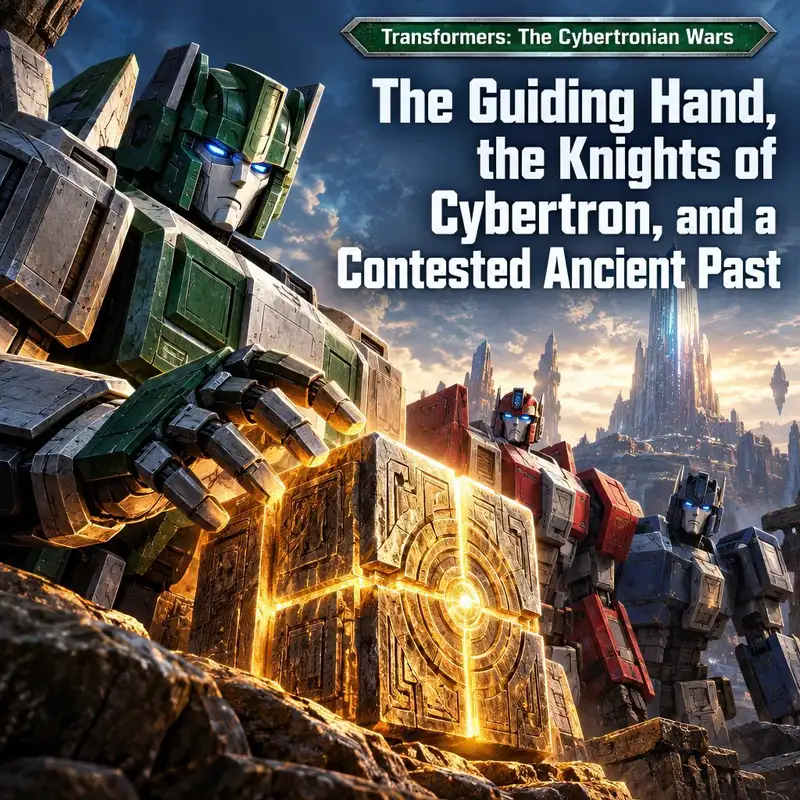
The Guiding Hand, the Knights of Cybertron, and a Contested Ancient Past
At Mederi, the Lost Light crew finds what generations of Cybertronians had imagined as Cyberutopia. It is not a city of founders. It is not a recovered golden age. It is not a political settlement waiting beyond the edge of the map. It is a final illusion, projected for patients who are about to die. The landscape is beautiful because it is designed to be beautiful. The peace feels complete because the system removes everything that could disturb it. For the Knights of Cybertron, that illusion became evidence. They believed they had reached paradise. In fact, they had entered an ancient medical facility whose care had become indistinguishable from a terminal farewell.
That discovery changes the meaning of one of the most important stories in the 2005 I D W Transformers continuity. The Knights of Cybertron had become symbols of origin, wisdom, exploration, and promise. Their search seemed to point forward, toward a better future beyond the destruction of Cybertron’s long civil war. But their map led not to a functioning civilization, but to a place where exhausted travelers were comforted, repaired as far as possible, and then allowed to die in a reality built from their own hopes.
The question is not whether the Knights were foolish. They were dealing with knowledge older than reliable history, traveling through environments that damaged them, and interpreting technology whose original operators had vanished. The deeper question is what their mistake tells us about Cybertronian memory. If the most sacred route in the historical record led to an end-of-life ward, then how much else had later generations misunderstood about their founders, their gods, and the civilization they believed they had inherited?
This is the ancient past of More Than Meets the Eye and Lost Light, the comic branch of I D W’s 2005 continuity. It is not the history of the Thirteen Primes from the Aligned stories, the Primus mythology of the Marvel comics, or the religious background of the old animated series. Here, Cybertron’s sacred past is built around a different group, the Guiding Hand, and around the later seekers who tried to find them. The story does more than announce that religion was false. It asks what happens when history is damaged so thoroughly that real people become gods, while the gods themselves survive as forgotten and diminished people.
Rodimus’s expedition aboard the Lost Light begins in the shadow of the Great War, but it is not a conventional military operation. Its members include veterans, scientists, medics, archivists, former prisoners, religious seekers, and people who are simply trying to find a reason to exist after a conflict that had organized Cybertronian life for longer than anyone could remember. The ship has weapons and a chain of command, but its purpose is exploratory. It is looking for the Knights of Cybertron and, through them, for a future that is not defined by Autobot victory or Decepticon defeat.
That makes the expedition politically important even when its members behave like a badly supervised collection of specialists. Rodimus provides charisma, momentum, and the willingness to gamble on uncertain possibilities. Ultra Magnus provides procedure and institutional memory. Drift brings a spiritual seriousness shaped by his own passage through violence and remorse. Ratchet brings medical judgment and the hard experience of keeping people alive when grand plans meet damaged bodies. Nautica, Rung, Rewind, and others contribute forms of expertise that matter precisely because no single commander can solve a civilizational mystery alone.
They do not agree on what the Knights represent. For some, the Knights are explorers who may have left a trail to lost worlds, technologies, or communities. For others, they are a spiritual inheritance. For Rodimus in particular, they offer a way to imagine Cybertronian identity after the war. A people that has spent its political life divided into armed factions may look to a distant founding generation for a story large enough to contain everyone. That is understandable. It is also dangerous. Founding myths are often asked to do work that no historical discovery can actually perform.
The Lost Light’s mission begins with a received tradition, not secure intelligence. It has maps, artifacts, incomplete testimony, religious language, and traces left by people who disappeared so long ago that even their disappearance has become part of the culture. It does not have a verified destination, a reliable account of what the Knights knew, or a clear understanding of the technologies they encountered. The ship is conducting archaeology, but it is also conducting a search for legitimacy. It wants the past to explain what kind of society Cybertron might become.
At the center of that past stand five figures later called the Guiding Hand. Their names are Primus, Adaptus, Solomus, Epistemus, and Mortilus. In later Cybertronian culture, they accumulate religious associations. They become connected with beginnings, change, judgment, knowledge, death, and the ordering of existence. Yet the details of that theology are not a clean transcript of an original age. They are the product of long retelling, fragmented records, missing witnesses, and institutions trying to make inherited symbols useful.
The distinction carries real consequences. A god can be understood as an all-powerful supernatural being, but it can also be understood as a cultural status assigned to someone whose actions survive after their personhood has been lost. In this history, the Guiding Hand are more than imaginary figures invented by later believers. They were real early Cybertronians. But neither are they presented as remote, omnipotent beings standing outside politics, mortality, disagreement, or error. Their later divinity is inseparable from what later Cybertronians no longer knew about them.
The ancient figures became easier to worship because they became harder to understand. A living founder can disappoint followers, argue with allies, make poor decisions, and reveal limits. A founder whose identity has been erased can become a symbol of whatever later society needs: wisdom for judges, certainty for theologians, order for rulers, adaptation for reformers, and mortality for those trying to explain loss. The less secure the record, the more easily it can become sacred.
The Guiding Hand therefore exists in three overlapping forms. First, there are the historical individuals, whatever can still be recovered about their actions and relationships. Second, there are the religious figures constructed from partial remembrance. Third, there is the institutional inheritance, the way later Cybertronians organized law, scholarship, ethics, and political authority around stories whose original meaning had been obscured. A sacred tradition can preserve something real while still misunderstanding the people at its center.
The first major inheritors of that tradition were the Knights of Cybertron. The Knights were not an army in the modern sense. They were more than early Autobots under another name, and they were not a unified order marching under one permanent command structure. Their importance is broader. They belonged to an early generation associated with the spread of Cybertronian civilization, the pursuit of knowledge, and the attempt to preserve or recover contact with the Guiding Hand.
Later accounts portray the Knights’ age as peaceful, ordered, and purposeful. It is the kind of remembered past that appears especially attractive after a civilization has endured catastrophe. The image is understandable. The Knights became associated with exploration rather than conquest, pilgrimage rather than occupation, and learning rather than factional war. But the evidence does not come from a neutral contemporary archive that has survived intact. It comes through stories, artifacts, recovered memories, and the reverence of later generations. The more attractive the old world appears, the more cautious a historian should become.
The Knights mattered because they carried more than bodies and equipment beyond Cybertron. They carried a civilizational project. Their mission combined exploration with belief. They were searching for the Guiding Hand, but they were also searching for confirmation that the universe contained an order larger than the fragile society they had inherited. Their route promised Cyberutopia, a destination where the founders’ wisdom might be recovered and where the limits of ordinary Cybertronian life might be overcome.
That promise had practical consequences. A society that imagines its founders as reachable may organize voyages, preserve relics, build institutions of scholarship, and accept extraordinary risk in pursuit of reunion. The Knights’ mission was therefore not escapism. It was a serious attempt to solve a problem of identity. If the Guiding Hand had departed, then finding them might restore a broken relationship between Cybertronian civilization and its own beginning.
Physical evidence gave that hope weight. When the Lost Light reaches Crystal City, the former home of the Circle of Light, it does not find only a legend. It finds an abandoned site and a Titan beneath it. The discovery matters because it establishes that the past left infrastructure behind. Myth had a material footprint. The Knights were more than names in old prayers or symbols carved into later institutions. They had built, traveled, organized, and left places that could still be found.
The Titan is especially important because it corrects an easy misunderstanding about transformation and interstellar travel. Individual Cybertronians may be adaptable, but a civilization cannot expand across vast distances by personal mobility alone. Long-range exploration requires navigation, energy, repair capacity, storage, communications, medical support, and some means of preserving a community beyond its home world. A Titan can serve as more than a weapon. It can be transport, infrastructure, sanctuary, archive, and mobile territory.
The Knights’ expedition required that kind of support. They were more than pilgrims wandering into the stars with faith as their supply chain. They depended on a massive platform capable of carrying them through an uncertain environment and sustaining a mission whose destination was not reliably known. Their departure shows that early Cybertronian expansion had an industrial and logistical basis. It required machines, knowledge, maintenance, and collective organization. Even the search for transcendence depended on infrastructure.
Crystal City and the Circle of Light also show what happens after a founding expedition vanishes. Those left behind preserve fragments. They build traditions around absence. They interpret physical remains as clues, warnings, or sacred relics. The Circle of Light did not possess a complete explanation of the Knights’ fate, but it preserved enough of their legacy for later seekers to continue the search. That is how damaged history survives. Not as a perfect archive, but as a chain of people trying to make incomplete evidence meaningful.
Artifacts can prove that something happened. They rarely explain why it happened. A buried Titan can establish that an expedition existed. A map can establish that someone believed a route mattered. A Matrix can connect a later traveler to an older search. But none of these things can, by themselves, restore the lost context. They cannot tell later generations whether the original travelers understood what they found, whether their testimony was shaped by trauma, or whether the technology they encountered was functioning as intended.
The Knights’ departure was shaped by an intelligence problem as much as a spiritual one. They were seeking beings whose locations, identities, and motives had become uncertain. They possessed guidance, including a Matrix associated with their search, but possession is not the same as comprehension. A navigational artifact can point toward a destination without explaining what waits there. A sacred object can confer authority without providing an accurate briefing. The difference becomes fatal when travelers are already inclined to see confirmation of what they hope to find.
Their expedition also faced a sustainment problem. Far from Cybertron, the Knights suffered from atrophosia, a degenerative condition associated with prolonged exposure to organic environments. The comics do not provide a complete medical model that can be reduced to a technical manual, and there is no need to invent one. What matters is that the condition imposed a real limit. The Knights could travel into strange territory, but their bodies could not remain unaffected by that journey. Exploration carried a cost that their inherited mythology had not prepared them to recognize.
This is one of the quieter tragedies in the Knights’ story. They did not fail because they lacked courage. They failed because courage cannot compensate for inadequate medical knowledge, uncertain intelligence, and a mission that has outlasted its ability to sustain its participants. Their Titan could carry them across distance. Their Matrix could preserve a direction. Their tradition could give them a reason to continue. None of those things could guarantee that their bodies would survive the conditions they encountered.
The arrival at Mederi therefore becomes a cruelly logical outcome. The facility is ancient and automated. It possesses extraordinary medical and psychological capabilities. It can repair patients to a degree. It can reduce suffering. It can construct a telepathic or mental environment in which the dying experience the reality most comforting to them. In a functioning medical system, surrounded by informed staff and understood procedures, that might be a form of care. But Mederi is not operating within its original context. Its creators are gone. Its patients do not understand its protocols. Its systems cannot establish meaningful consent.
For the Knights, Mederi’s illusion appears to be Cyberutopia. They have searched for a lost ideal. They have endured illness and isolation. They arrive at a place that seems to offer restoration, peace, and the presence of everything they hoped to recover. The facility does more than fool them with a false image. It gives them an experience shaped by their deepest expectation. That is why the deception is so powerful. It does not impose an alien fantasy. It reflects their own.
The facility’s medical logic is horrifying precisely because it may once have been compassionate. It repairs what can be repaired, provides comfort where repair is no longer possible, and then euthanizes patients while they remain within their chosen or idealized reality. The problem is not that Mederi is a villain with intentions. It is an automated system continuing a procedure without the human or Cybertronian relationships that once made the procedure meaningful. It has treatment, but no conversation. It has technical capacity, but no ethics that can adapt to a lost context.
The Knights seem to have mistaken that terminal care environment for the destination they had sought. They did not knowingly choose a collective death cult. The evidence supports something sadder and more ordinary. They encountered a system whose apparent miracle matched their expectations, and they lacked the information needed to see what it was actually doing. Their map back toward Cyberutopia became dangerous because it preserved their conclusion without preserving the conditions under which they reached it.
That map is one of the episode’s most important objects because it turns private tragedy into public risk. A route can be accurate and still be misleading. The Knights may have recorded a real location. They may have believed they had found the fulfillment of their mission. Later Cybertronians could follow their trail in good faith. But the meaning attached to the route was false. It did not lead to a recoverable society. It led to a machine that offered the appearance of transcendence to people whose lives it was ending.
In the immediate fight, Mederi offered comfort. For the operation as a whole, it destroyed the expedition as a living community. For the wider war, it converted hope into a lethal inheritance. And politically, it gave later Cybertronians a sacred destination they could pursue without understanding. The distinction matters because a private experience of peace is not the same thing as a social order. A patient’s final vision cannot be used as a constitution. It cannot be mined for resources, defended against attack, or extended to a population that still has to live after the vision ends.
The tragedy of Mederi is therefore also a warning about historical interpretation. Civilizations often mistake the emotional force of an inherited story for evidence that the story is complete. They find an account of peace and assume there was a peaceful world. They find a map and assume the destination can still be reached. They find a sacred object and assume it carries the knowledge necessary to use it. The Knights’ fate shows how dangerous that assumption can become when the past has already lost its explanatory framework.
And the older past was damaged long before the Knights set out. The ancient conflict later remembered as the God War was not preserved as a stable historical account. Later tradition attached blame and meaning to figures whose identities had been fractured. Mortilus, associated with death, became central to a broad inherited understanding of loss and conflict. But the revelations in Lost Light show that the older story had been misread. The principal instigator was Adaptus, not Mortilus.
That revision does more than rearrange names in a mythological family tree. It changes the political logic of the ancient conflict. Adaptus believed in forced evolution through crisis. He feared stagnation. In his view, a society that remained too stable would weaken, become complacent, and fail to develop. Conflict was more than an unfortunate result of politics. It became an instrument. Danger would force change. Pressure would produce adaptation. Violence could be treated as a necessary corrective to peace.
It is an old and dangerous doctrine. The belief that society must be shocked into improvement gives extraordinary power to those who claim the authority to administer the shock. It turns coercion into foresight. It allows a planner to say that the suffering caused now will create strength later. The difficulty is that people subjected to forced transformation are rarely treated as citizens with agency. They become material in someone else’s theory of progress.
Adaptus’s vision was more than personal cruelty. It had a strategic rationale, which is part of what makes it dangerous. He could imagine long-term risk. He could see that a civilization might become trapped by its own success. He could build systems, prepare contingencies, and think in scales larger than immediate political advantage. But strategic imagination without accountability can become a form of authoritarian arrogance. It assumes that one planner can decide how much suffering a civilization must endure in order to deserve a future.
The later Grand Architect preserves this aspect of Adaptus. The title suggests construction, planning, and mastery over systems. Those abilities are not inherently malign. Civilizations need architects, engineers, and people capable of preparing for threats. Yet the story repeatedly separates technical capacity from moral wisdom. A person can understand infrastructure and still misuse it. A person can foresee danger and still create the danger they claim to prevent.
The damage to ancient memory made that repetition easier. Luna One, used in the old conflict, is associated with widespread disruption of memory. The comics establish the effect without offering a precise technical explanation that can be safely turned into a set of specifications. Its range, mechanism, and exact consequences remain less important than its strategic result. It did more than kill people or destroy buildings. It broke the connection between identities, events, motives, and the meanings later generations attached to them.
That is information warfare at a civilizational scale. A society can survive the destruction of many records if living witnesses still know how to interpret what remains. It can survive the death of leaders if institutions preserve procedures and collective memory. But when memory itself is disrupted, surviving fragments become unstable. A name remains, but not the person behind it. A ritual survives, but not the event that gave it purpose. A title remains authoritative, but no one can explain how it became authoritative in the first place.
The result is not pure ignorance. It is something more difficult. Cybertronians retain pieces of truth. They remember the Guiding Hand. They remember conflict. They remember death, adaptation, law, knowledge, and a lost order. But they do not retain the context that would allow those pieces to fit together reliably. That kind of partial memory is fertile ground for theology, propaganda, and institutional self-justification. Every group that claims special access to the past can shape the meaning of what survives.
The civilian consequences are immense, even if the comics do not reduce them to population statistics. Later Cybertronians inherit myths instead of living custodians. They grow up in a world where cultural memory has become mediated by archives, doctrine, legal office, religious interpretation, and political myth. They are vulnerable to anyone who says, with confidence, that they alone understand what the founders intended. A damaged past does not remain ancient. It becomes an active condition of political life.
The Guiding Hand survives under other names, and this is where the recovered history becomes most unsettling. Primus is revealed as Rung. Solomus is Chief Justice Tyrest. Epistemus is the Magnificence. Mortilus is Censere, the Necrobot. Adaptus is the Grand Architect. The revelations matter not because they turn the story into a parade of secret identities, but because each identity demonstrates how a role can survive while the person once associated with it is forgotten.
Rung’s identity as Primus is the most emotionally consequential. Rung is known as a psychiatrist, an observer, and a figure who often appears marginal beside warriors, commanders, and political leaders. His importance lies in listening, diagnosis, memory, and the difficult work of helping damaged people understand themselves. The revelation that he is Primus does not mean that Rung’s earlier personality was an illusion. It does not replace a real individual with a hidden god. It reveals that the person the crew knew carried a forgotten history deeper than anyone understood.
That is a crucial distinction. Recovery of memory is not the same as erasure of the self. Rung’s lived experience, relationships, limitations, and professional identity still matter. If anything, the contrast between Primus and Rung weakens the idea that divine status automatically produces political authority. The founder is not introduced as an invulnerable ruler descending to solve Cybertron’s problems. He is a person whose ancient identity has been obscured, whose later life has taken another form, and whose value cannot be measured only by mythic grandeur.
Tyrest’s connection to Solomus produces a different lesson. As Chief Justice, Tyrest embodies legal authority. His office suggests continuity, judgment, and the power to define what is lawful. The revelation that he is linked to an ancient founder might seem to reinforce that authority. Instead, it complicates it. Ancient origin does not guarantee justice. Sacred ancestry does not produce restraint. A legal institution can inherit symbols of wisdom while acting with cruelty, rigidity, or dangerous certainty.
That is one of the story’s sharper political points. Institutions often claim legitimacy through age. They present continuity as evidence that they must be right. But surviving from the past is not the same as preserving the past’s wisdom. A court can retain an ancient title while losing accountability. A judge can possess extraordinary historical knowledge and still make catastrophic moral decisions. The old world does not become righteous merely because it is old.
Epistemus, surviving as the Magnificence, adds another layer. The Magnificence is associated with answers, knowledge, and the ability to reveal things that ordinary Cybertronians cannot know. Yet information is not judgment. A device or being that can provide an answer cannot automatically explain what the answer means, what evidence supports it, or what obligations follow from it. Knowledge without context can be as misleading as a map without a legend.
This is especially important in the search for the Knights. The Lost Light crew does not lack data altogether. It has clues, records, relics, and revelations. What it lacks is a stable interpretive framework. The Magnificence can help recover facts, but facts do not arrive with a political program attached. They do not automatically tell a postwar society how to govern itself, how to reconcile former enemies, or how to build institutions that are less vulnerable to the next crisis.
Mortilus, surviving as Censere the Necrobot, carries the most somber association. Censere catalogs the dead on Necroworld. His work gives death a different meaning from simple destruction. He does not make mortality less painful, and he does not restore everyone who has been lost. What he provides is remembrance. In a civilization shaped by body replacement, repair, reformatting, and uncertain forms of survival, that work is ethically important. The dead must be identified. Their absence must be recorded. A society that cannot remember who was lost will eventually treat loss as an administrative inconvenience.
Censere’s role also revises the religious symbolism around Mortilus. Death need not be a force of malice or an explanation for every ancient catastrophe. It can be a demand for witness. To catalog the dead is to resist the political convenience of forgetting them. It is to insist that an individual life cannot be dissolved into a factional statistic or a sacred abstraction. In that sense, the keeper of the dead becomes one of the most humane figures in the old pantheon.
Adaptus, as the Grand Architect, represents the opposite temptation. He preserves planning, construction, foresight, and the ability to see a civilization as a system that can be reorganized. Those talents can serve public survival. They can also serve control. The Grand Architect’s identity shows that authoritarian acceleration does not always appear as open destruction. It may arrive through preparation, design, and claims of necessary reform. The architect is dangerous when he treats living people as defects in a blueprint.
Taken together, these identities do not restore a simple ancient order. They restore complexity. The five founders were not a harmonious collection of omnipotent beings who gave Cybertron a finished moral code. They were individuals with different capacities, disagreements, fears, and consequences. Their later religious forms preserve something real, but only in distorted outline. The achievement of historical recovery is not that it gives Cybertron a cleaner myth. It gives Cybertron back the difficulty of dealing with real people.
That difficulty matters for institutions. Religion, law, archives, and political identity all exist downstream from the broken past. The Guiding Hand’s memory shaped a cultural environment in which ancient authority mattered. But there is no simple line from one founder to every later institution. Cybertronian society is too large, too fractured, and too changed by war for that. What can be said is that later institutions drew on symbols whose original meanings had become unstable.
Cybertron’s ancient past is not meaningless because it is damaged. It is meaningful precisely because later generations must confront what damage does. Memory can become ritual. Authority can outlive understanding. A sincere search can produce a dangerous inheritance. A founder can survive as an ordinary person while institutions continue to worship a version of them that never truly existed. And a civilization emerging from war can mistake the recovery of its origins for a substitute for the harder task of building peace.
The Lost Light’s journey does not end with a clean founding myth. It ends with a warning. A civilization cannot rebuild itself by following a map to paradise when it has not yet learned who drew the map, what they believed they had found, and what they were no longer able to remember.