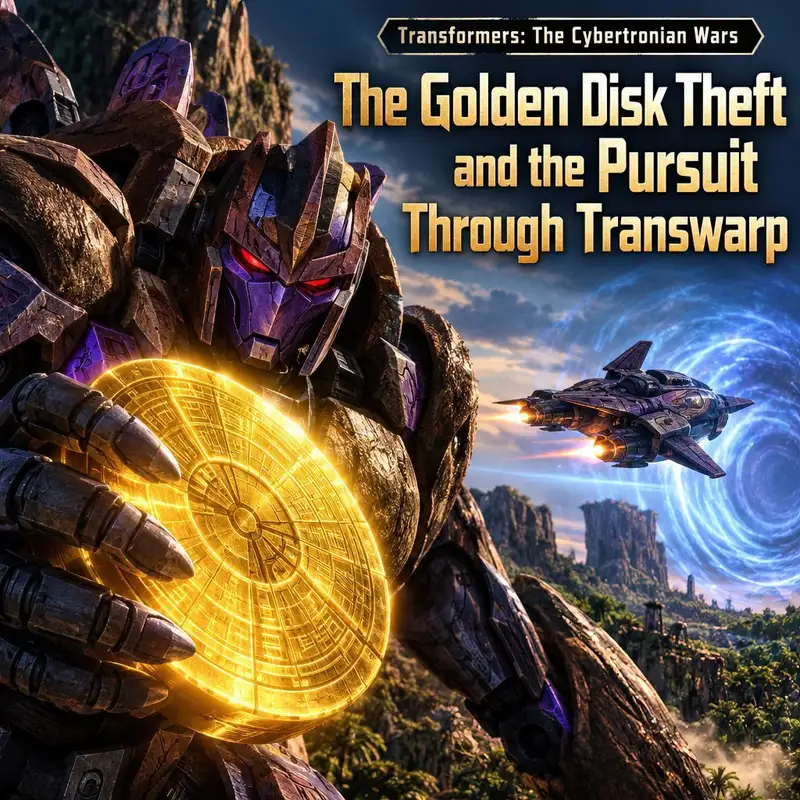
The Golden Disk Theft and the Pursuit Through Transwarp
The Axalon was not sent out to begin a war. It was an exploration vessel, lightly staffed and operating far from the kind of fleet support that would normally accompany a pursuit into unknown space. Yet when a rogue Predacon force stole the Golden Disk and escaped aboard a transwarp-capable ship, Optimus Primal took the Axalon after them. He knew a guarded relic had been taken. He knew the thieves had acquired an extraordinary means of escape. He did not know that the chase was about to cross not only interstellar distance, but time itself.
This is the North American Beast Wars history, set generations after the earlier Autobot-Decepticon war. Its Maximals and Predacons are successor societies, shaped by that older conflict but not identical to the Autobots and Decepticons who fought it. The Megatron at the center of this story is likewise not the original Decepticon leader. He is a later Predacon commander who adopted the name, the symbolism, and eventually the strategic inheritance of a defeated cause.
At first glance, the pursuit appears straightforward. A Predacon raider has stolen a valuable artifact. A Maximal captain gives chase. Both sides are drawn through transwarp and crash on a primitive world rich in energon. That account is true as far as it goes. But it does not explain why Megatron accepted the risk of stealing the disk, acquiring a transwarp vessel, and fleeing the authority of his own era. Nor does it explain why Primal judged the theft dangerous enough to abandon caution and follow.
The later evidence changes the meaning of the opening. The Golden Disk was more than a prize. It was an archive, a map, a coded inheritance, and a weapon aimed at the past. The stolen ship provided movement. The disk provided purpose. Together, they gave Megatron the possibility of reaching a vulnerable moment in history and changing the future from which both he and Primal came.
The Golden Disk was described as a carefully guarded Maximal relic. That alone tells us something important. Institutions do not protect an object so closely simply because it is old. They protect it because it has political, scientific, cultural, or military value. In this case, the disk was known to contain information connected to energon. For a Cybertronian society, that made it more than a curiosity. Energon was essential to activity, repair, transport, industry, and survival. Information about major deposits could become a strategic asset.
Still, energon intelligence by itself does not fully account for the operation that followed. A mineral survey can justify exploration. It can justify competition. It may even justify a raid. It does not necessarily justify a rogue commander gambling his crew, his freedom, and his place in the postwar political order on a transwarp escape. Megatron’s conduct makes more sense when the disk is understood not simply as a record of resources, but as a record with a concealed audience.
Possession of intelligence is not the same as understanding it. Understanding is not the same as being able to act upon it. A commander may capture a map without knowing the terrain. He may decode an enemy message without possessing the transport needed to reach the target. He may find a route through time and space without having the personnel, supplies, or political freedom to exploit it. Megatron’s operation brought all of those elements together in one dangerous gamble.
There is one point of terminology worth making clear. Later in the Beast Wars television series, another golden disk appears, associated with the alien mystery surrounding the Vok. That second disk is not the object Megatron stole at the beginning of the war. The original stolen disk is the one connected to Earth’s Voyager spacecraft and the hidden message from the original Decepticon Megatron. The two objects share a name and a visual resemblance, but they serve very different roles in the story.
The Beast Wars Megatron did not command a conventional Predacon fleet. He led a small, independent crew. The television premiere identifies six Predacons in his force. That was enough for a theft, an escape, and a high-risk expedition. It was not enough to occupy a planet, defeat a prepared military establishment, or sustain an open campaign against a major government. The small size of the force was a weakness in conventional war, but an advantage in covert action. A compact group could move quickly, conceal its intent, and act before larger institutions understood the threat.
This was a form of rogue command. Megatron’s authority rested less on formal office than on personal control, ambition, and the willingness of subordinates to accept risk under his leadership. Such commands can be effective at the beginning of an operation. They can act without committee approval, legal restraint, or public scrutiny. They can also become fragile very quickly. A force built around one commander’s vision must survive internal rivalry, fear, divided loyalties, and the constant question of whether the leader’s gamble still serves the followers.
The supplementary prequel short, The Theft of the Golden Disk, gives the heist more detail than the television series does. It presents a larger web of participants, sabotage, shifting loyalties, and a connection to Cryotek, another Predacon figure. Those details are useful as expanded background, but the television record remains the controlling account of what the pursuit became. The series establishes the theft, the escape, the transwarp chase, and the later revelation of Megatron’s real purpose. It does not require every later embellishment to understand the campaign.
What matters most is that Megatron did more than take the disk and disappear into ordinary space. He obtained the Darksyde, a ship capable of transwarp travel. The Darksyde gave him the means to break free from normal strategic geography. Conventional pursuit depends on distance, fuel, navigation, detection, and the availability of ships. A transwarp system could alter all of those calculations. It could turn a secure relic into the starting point of an operation far beyond the reach of local authorities.
Transwarp, in this setting, is more than fast travel. It is strategic mobility on a different scale. A commander who can cross vast distances can bypass defensive lines, evade pursuit, reach distant worlds, or exploit targets that believe themselves protected by time and isolation. When transwarp also creates temporal displacement, the implications become even more serious. The past is no longer just history. It becomes a potential theater of operations.
But the pursuit through transwarp also shows the limits of that capability. The technology did not produce a clean, controlled arrival at a prepared destination. Both ships were damaged. Both crews were displaced from the support systems of their own era. Neither side emerged with a reliable supply line, a secure base, or a quick route home. Transwarp solved the problem of distance, but it created new problems of damage, isolation, navigation, and survival.
That is why the Golden Disk and the Darksyde must be treated as separate strategic assets. The disk did not create transwarp. It did not power the ship. It did not guarantee a successful passage. The disk contained knowledge. The Darksyde provided mobility. Megatron needed both. Without the ship, the hidden message would have been a secret without reach. Without the disk, transwarp would have carried him away from Cybertron without telling him where history could be broken.
Optimus Primal’s decision to follow was therefore more consequential than it first appeared. He could not know the full plan. At that moment, he had no reason to believe that Megatron intended to attack the original Autobot-Decepticon war. He knew only that a carefully protected relic had been stolen by a rogue Predacon commander who had acquired transwarp capability. That was enough to establish danger, even if the exact nature of the danger remained unknown.
Primal’s position was not ideal. The Axalon was an exploration ship, not a dedicated pursuit cruiser or fleet flagship. Its crew was small. Its mission had not been designed around combat against a fugitive Predacon force. Its commander had to make a decision under uncertainty, with limited information and no assurance that reinforcements could follow. From a narrow risk-management perspective, pursuing through an unfamiliar transwarp opening was hazardous. From a wider strategic perspective, allowing Megatron to vanish with the disk may have been worse.
This is one of the first important command judgments of the Beast Wars. Primal did not chase because he knew every detail of the threat. He chased because he understood that some combinations of capability and intent cannot be safely ignored. A rogue commander, a guarded artifact, and a means of escaping normal space created an unacceptable uncertainty. The Axalon entered the pursuit not because success was guaranteed, but because inaction would have surrendered the initiative.
The result was not a successful arrest operation. It was an accident of history. The Darksyde and the Axalon passed through transwarp and emerged in a distant, primitive environment later identified as prehistoric Earth. Both ships suffered damage. Both crews found themselves far from Cybertron, far from the institutions that had sent or opposed them, and far from any established source of support.
For Megatron, this was both failure and opportunity. He had not escaped cleanly. His ship was damaged, his force was isolated, and the pursuing Maximals were still alive. Yet he had arrived in the era and on the world that mattered to his deeper plan. The crash deprived him of control over the operation’s timing, but it did not remove the strategic value of the destination.
For Primal, the consequences were immediate and severe. The Axalon had been forced from exploration into pursuit, then from pursuit into survival. A damaged ship could not function as a normal base of operations. A small crew could not assume it had the strength to defeat an enemy that retained a local numerical advantage. The Maximals also lost stasis pods during the crash. Those pods contained protoforms, undeveloped Cybertronian bodies that might later become additional personnel. Their loss was not a minor inconvenience. It created a force-generation problem.
A military force becomes stronger not only through victories, but through its ability to recover, reinforce, repair, and replace losses. The scattered stasis pods represented potential Maximal personnel dispersed across an unfamiliar world. Recovering them became essential. Every pod might become an ally. Every pod might be found first by the Predacons. In a conflict fought by small teams, control of even a few additional combatants could alter the local balance.
The Predacons began with more immediate personnel, but numbers did not guarantee cohesion. Megatron’s force contained ambition, resentment, and competing agendas. A small authoritarian command may move quickly, but it often depends on constant pressure from the top. Subordinates may obey because they fear the leader, because they expect personal gain, because they share part of the mission, or because they see no safer alternative. Those motives are not the same thing as durable loyalty.
The Maximals had their own disadvantages, but they possessed a clearer emergency purpose. They had to keep the Axalon functioning, locate their missing stasis pods, understand the planet, and prevent Megatron from exploiting whatever had drawn him there. Their command structure was not free of disagreement, but it had a practical focus. Survival, repair, reconnaissance, and containment became inseparable tasks.
The planet itself complicated everything. At first, prehistoric Earth appeared to offer what both sides needed: energon in extraordinary abundance. In many Transformer stories, access to energon means strength. It means fuel, weapons, mobility, repair, and industrial capacity. Here, the situation was more dangerous. The local energon field was so intense that Cybertronians remaining in ordinary robot mode began to short out after only a short period of exposure.
This transformed the meaning of the environment. Earth was rich in energy, but it was not automatically a usable supply base. The same condition that made the planet strategically interesting also made it hazardous. Neither side could simply arrive, harvest the surrounding resources, and operate as it would on Cybertron. The abundant energon imposed a new survival requirement.
The answer was the adoption of organic beast modes. These forms were not decorative reinventions or simple disguises. They were protective adaptations. The beast modes allowed the Maximals and Predacons to shield themselves from the harmful effects of the planet’s energon radiation and remain active. In military terms, they were environmental equipment as much as alternate forms. They enabled continued operations in a theater that would otherwise have incapacitated both forces.
That did not make the planet easy to fight over. Beast modes improved survivability, but they did not restore the ships, solve the problem of isolation, or erase the need for repair. They did not provide an instant route back to Cybertron. They did not guarantee reliable intelligence about terrain, local life, ancient structures, or the enemy’s plans. They simply allowed both sides to remain in the field.
The lesson is broader than the immediate crisis. Resource abundance is not the same as logistical security. A force can stand on top of an energy source and still be unable to exploit it safely. It may lack the right equipment, processing methods, storage, transport, or protection from environmental effects. Megatron’s apparent search for energon was real enough, but the planet’s energon could not be treated as a simple answer to all of his problems.
The crash also changed the nature of the conflict. Before transwarp, Megatron was conducting a theft and escape. Primal was conducting a pursuit. After the crash, both became stranded expeditionary forces. They had no normal line of communication with home, no immediate reinforcement, and no certainty that rescue was possible. Each side had to improvise a campaign with whatever survived the transit.
This is why the opening of Beast Wars should not be understood as an ordinary planetary invasion. Neither faction arrived with the infrastructure required for conquest. Neither had a prepared civil administration, occupation force, industrial base, or secure supply network. Prehistoric Earth did not become important because it was easy to control. It became important because it contained a point in time that Megatron believed could be exploited.
The full significance of the Golden Disk emerges later, in the events surrounding The Agenda. The disk had originated from Earth’s Voyager program. During the original Autobot-Decepticon conflict, the Decepticon Megatron embedded a secret message within it. That message was not intended for the humans who launched the spacecraft, nor for the Autobots who would later awaken on Earth. It was intended for future Decepticon successors.
The Beast Wars Megatron had decoded the message. That is the crucial revelation. The energon information was useful, but it was not the heart of the operation. The original Megatron had turned the disk into a long-range contingency plan, a message sent forward through time and outward through space. It provided later followers with intelligence about the earlier war and a possible route to intervene in it.
The disk therefore carried more than data. It carried political memory. It offered a defeated faction a way to imagine that defeat was not final. The original Megatron’s message preserved the possibility of revision. If later Decepticon-aligned forces could reach the right place at the right time, they might strike the past before the future Maximal order ever emerged.
This was an inherited strategy, but not a neutral inheritance. The original Megatron was a participant in the earlier war, with every reason to portray the past in terms useful to his own cause. His message was a contingency for future followers, not an impartial archive. It could identify vulnerabilities. It could provide guidance. It could inspire loyalty. But it could not be treated as a complete or objective account of the conflict it sought to reopen.
Even so, the intelligence was powerful because it directed Megatron toward the Ark. On prehistoric Earth, the Ark contained the dormant Autobots and Decepticons from the original war. Those Cybertronians were inactive, vulnerable, and central to the chain of events that would eventually produce the future in which the Maximals and Predacons existed. The Ark was not just a wreck from an old conflict. It was a historical pressure point.
Megatron’s plan went beyond trying to conquer Earth. It was not even primarily to exploit the planet’s energon deposits. His strategic objective was to alter the historical outcome of the earlier war by attacking its dormant participants. If the original Autobots could be destroyed before their awakening, the Autobot victory that shaped the future might never occur. If the original Decepticons could be preserved, revived, or otherwise turned to his advantage, the entire balance of history might change.
That made the conflict existential for both sides, though not all participants understood this at the beginning. Primal’s crew initially knew they were pursuing dangerous thieves on a strange world. They did not yet know that their own future might be at stake. Megatron, by contrast, possessed the decoded message and the strategic context it supplied. He had an intelligence advantage, even if he lacked the resources to exploit it immediately.
This difference in knowledge shaped the campaign. Megatron could choose his searches and maneuvers with a hidden destination in mind. Primal had to infer intent from behavior. The Maximals were more than reacting to battlefield attacks. They were trying to discover why Megatron had risked everything to come to this world. Their task was partly military and partly investigative.
Temporal warfare magnified the stakes. In a conventional campaign, a commander seeks to seize territory, destroy forces, secure resources, or compel a political decision. Megatron sought something more fundamental. He aimed to attack the conditions that made his own society possible. If he succeeded, he might create a future in which Maximal dominance never emerged. He might also erase, transform, or displace the very Predacon world from which he had come.
This was not a contradiction from Megatron’s perspective. He was not trying to preserve the existing Predacon order. He was challenging it. The postwar society that produced him had inherited the symbols of Decepticon history, but it had not restored Decepticon rule. Megatron’s theft was therefore not just a raid against Maximal authority. It was an attempt to reclaim the past on behalf of a more radical, more authoritarian vision of what the future should become.
That political dimension helps explain why the theft became a wider institutional crisis. Megatron was not acting as an authorized representative of a stable Predacon government. He was a rogue commander. His actions risked exposing the postwar order to scandal, diplomatic embarrassment, and a potentially catastrophic temporal disaster. A relic in secure custody had been stolen. A transwarp-capable ship had been used for escape. A radical force had vanished into the past.
Later, Ravage arrives with a mission to capture Megatron. Ravage is significant not simply because he is a formidable operative from an older Decepticon tradition. His arrival demonstrates that the theft had moved beyond the level of an isolated chase. Authorities in the future had recognized that Megatron’s activities required containment. The operation had become an intelligence problem, a law-enforcement problem, and a political problem.
Ravage’s mission also reflects the harsh logic of secrecy. Recovering Megatron was important. Controlling information was important as well. A rogue commander operating under the name of Megatron, using a stolen historical artifact and transwarp technology to interfere with the past, could not be allowed to become a public demonstration of institutional weakness. The wider political consequences would depend on who learned what, who survived to report it, and who controlled the narrative afterward.
Tarantulas adds another layer to that intelligence struggle. The television series establishes him as an operative connected to the Predacon Secret Police, while also revealing that he has ambitions and loyalties beyond Megatron’s immediate command. His presence shows why the Golden Disk mattered as information, not merely as an object. Any faction able to decode, conceal, exploit, or destroy its message could shape the future conflict.
This is a recurring reality of covert operations. The physical artifact may be small. The political value lies in what it reveals. A coded message can be more dangerous than a weapon if it identifies a vulnerability that no weapon could find on its own. The struggle over the disk was therefore a struggle over historical knowledge. Who understood the past? Who could reach it? Who could decide whether it remained unchanged?
The Golden Disk theft changed the war at several levels. Tactically, it produced a chase, a transwarp passage, damaged ships, and two surviving crews forced to adapt to a hostile environment. Neither side gained a clean victory. The Predacons escaped capture, but did not escape pursuit. The Maximals maintained contact, but lost the conditions needed for a controlled arrest.
Operationally, the theft transformed both groups into isolated forces. The Darksyde and Axalon were damaged. Normal resupply and reinforcement became impossible. The Maximals had to recover scattered stasis pods. The Predacons had to maintain cohesion despite rivalry and uncertain prospects. Each side had to learn the terrain, adapt to the energon hazard, and determine whether its damaged ship could ever provide a route out.
Strategically, however, Megatron achieved something vital. He reached the temporal theater required by the original Megatron’s hidden plan. He was no longer merely in possession of historical intelligence. He stood on the world where that intelligence could be used. The difference between knowing that the Ark existed and being able to reach it was the difference between a lost cause’s old message and an active threat to history.
The intelligence consequences were equally important. The disk’s hidden message changed the meaning of every earlier action. It explained why Megatron had stolen the relic, why transwarp mattered, and why prehistoric Earth was worth the risk. It also revealed that the original war had never become entirely past. Its participants, symbols, and unresolved ambitions remained capable of being mobilized by later generations.
Politically, the theft exposed weakness in the order that succeeded the Great War. The Maximals had custody of a relic containing dangerous information. The Predacon establishment, whatever its exact structure, was unable to prevent a rogue commander from taking that relic and using it to launch a temporal operation. The record does not establish the scale of public reaction on Cybertron, and there is no reason to invent a planetwide panic. But it clearly supports the conclusion that the event was an institutional security failure.
The logistical lesson was more restrained, but no less important. Prehistoric Earth held immense energon resources, yet neither force could simply exploit them without consequence. The radiation hazard required beast modes. Damaged ships still needed repair. Small crews still faced exhaustion, loss, and the difficulty of recovering personnel. Technology had carried both factions across time, but it had not freed them from maintenance, environment, or supply.
The civilian dimension is largely outside the surviving record of the theft itself. The television series does not provide a detailed account of Cybertronian civilians witnessing the heist or responding to its aftermath. What can be said is that political legitimacy depends partly on the ability of institutions to guard dangerous knowledge and prevent rogue military actors from rewriting public history. When they fail, the consequences reach beyond the immediate participants.
Primal’s pursuit prevented Megatron from operating in complete secrecy. That was its greatest success. The Maximals became witnesses, opponents, and eventually defenders of the historical order Megatron intended to destroy. Yet the pursuit also brought them to the one place where Megatron’s inherited plan could be attempted. By following the Darksyde through transwarp, Primal turned a covert theft into an open conflict in the past.
That was the paradox at the heart of the campaign. If Primal had not followed, Megatron might have reached prehistoric Earth without organized opposition. By following, Primal accepted enormous risk and became stranded far from home. But he also ensured that Megatron would not be alone with the Ark, the disk’s message, and a chance to remake history.
The Golden Disk mattered because it joined three scarce assets in one operation: inherited intelligence about the past, a transwarp route capable of reaching it, and a rogue commander willing to gamble the future on revision. The pursuit was never just a chase toward an energon world. It was the first defense against an attempt to turn history itself into a battlefield.