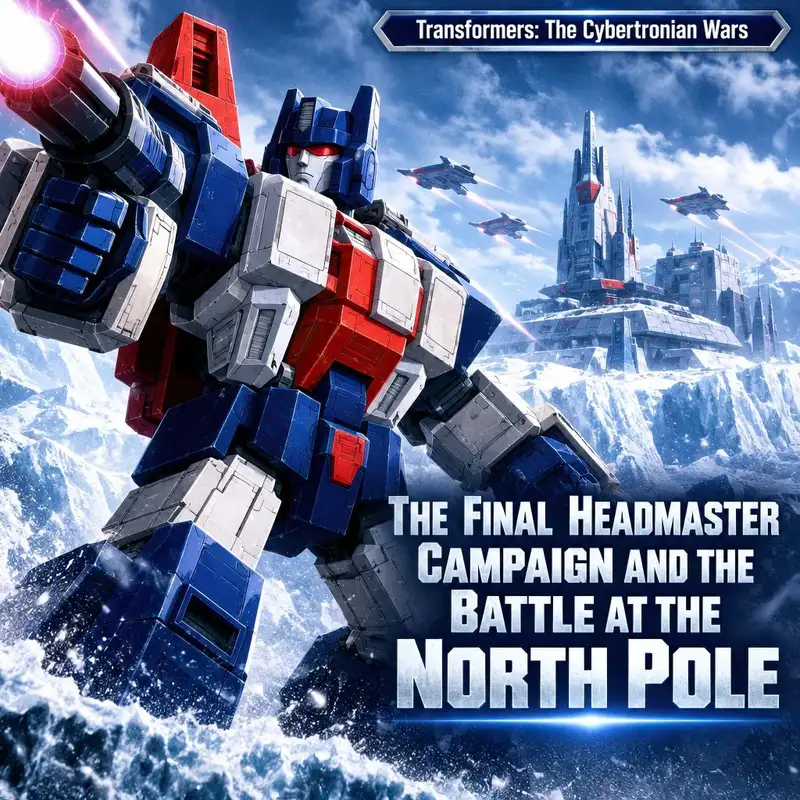
The Final Headmaster Campaign and the Battle at the North Pole
The emergency did not begin at the North Pole. It began with separated reports that looked, at first, like unrelated disasters. Civilian ships came under attack. Strange metal towers rose from the ground in distant cities. An aircraft was forced down in the Andes. Across Earth, Autobots were pulled toward crises that demanded immediate action, while Decepticon forces made certain no local commander could be confident that the next emergency was a diversion rather than the main blow.
In the Japanese animated continuity of Transformers: The Headmasters, this was the closing campaign of Scorponok’s war. It was not the American story called The Rebirth. The Headmasters here were small Cybertronians who operated larger bodies called Transtectors. Their war had already spread far beyond a contest for Cybertron. By its final phase, Earth had become both a refuge and a target, a world whose population, infrastructure, and internal energy could be turned against it.
Scorponok’s objective went beyond trying to defeat Fortress Maximus in battle or occupy a human city. He intended to destroy Earth by converting the planet into part of a weapon system. That ambition changed the character of the campaign. A conventional invasion seeks territory, supply routes, political control, or the destruction of an opposing army. Scorponok’s operation required none of those things in the usual sense. It required concealment, engineering, diversion, and enough time to extract and concentrate destructive energy.
By this stage, Scorponok had become the practical architect of the Decepticon effort. Galvatron remained important to the wider history of the series, but he was not directing this final Earth operation. Scorponok had built an increasingly independent command structure around his own power, his giant MegaZarak form, and the Decepticon forces willing or compelled to serve him. That distinction mattered. A faction can retain old symbols and old loyalties while real authority shifts toward the commander who controls the current campaign.
Before Scorponok could build his planetary weapon, he had to account for the one Autobot asset most likely to break it by force. Fortress Maximus was more than another field commander. In his larger form, Fortress could meet MegaZarak directly and contest the kind of heavy combat power Scorponok intended to use as protection for his operation. Scorponok therefore treated Fortress’s Master Sword as a military problem that required a specialized answer.
He obtained information about the sword through coercion, then arranged the construction of the Zarak Shield on Planet Master. The shield was not presented as a universal defense against every Autobot weapon or every tactical situation. Its purpose was narrower and more dangerous than that. It was built to neutralize Fortress Maximus’s known advantage. Scorponok had identified a decisive enemy system, acquired intelligence about it, and created a countermeasure before committing himself to the larger Earth operation.
This is a familiar pattern in warfare, even if the equipment is less familiar. Commanders do not need to surpass every enemy capability. They need to defeat the capability most likely to disrupt their own plan. The Zarak Shield gave Scorponok a way to challenge Fortress Maximus without assuming that the Master Sword would settle the matter. It changed the expected terms of a future battle, and that was enough to expand Scorponok’s strategic options.
The effect was immediate. Fortress Maximus no longer possessed a straightforward answer to MegaZarak. The Autobots could still fight, and they could still damage or defeat Scorponok’s forces under the right conditions, but their most visible heavy asset had lost the certainty of its preferred weapon. For Scorponok, that was the opening he needed. An Earth-destruction operation could not proceed while Fortress Maximus remained an uncontested deterrent.
The Autobots attempted to regain the initiative in what became known as Operation: Destroy the Decepticons. It was an offensive effort against Scorponok’s base, supported by Autobot forces and allied Master warriors. The purpose was sound enough. If Scorponok could be struck before his new advantage became fully integrated into a larger plan, the Autobots might remove both the commander and the specialized shield that protected him.
The assault did not unfold as a clean preemptive victory. MegaZarak emerged, and the attacking Master warriors found themselves facing a defense organized around Scorponok’s new capability. The Decepticons overwhelmed the initial attack. The Autobots had entered the operation expecting to pressure an enemy base. Instead, they were drawn into a battle against the very heavy system Scorponok had prepared to protect.
Fortress Maximus eventually defeated MegaZarak despite the Zarak Shield. That achievement mattered. It proved that Scorponok’s countermeasure did not make him invulnerable, and it demonstrated that the Autobots still possessed the ability to defeat his largest war body in direct combat. But the tactical result was not the same thing as operational success. Scorponok escaped with the shield. His command structure survived. His future plans survived with it.
That distinction is central to the final campaign. The Autobots could win a battle against MegaZarak and still fail to end the threat. Destroying or disabling an enemy body does not automatically capture the enemy commander, uncover the enemy infrastructure, or prevent the enemy from choosing another battlefield. Scorponok had lost an engagement, but he retained initiative because the Autobots had not destroyed the system that allowed him to plan, conceal, and redeploy.
The failed offensive also revealed a weakness on Scorponok’s side that would become decisive later. His power depended on formidable subordinates, but it did not rest on durable trust. He could command through fear, factional discipline, and the promise of Decepticon victory. Those methods could move forces into battle. They could not guarantee that every capable officer would remain loyal when Scorponok’s own decisions made loyalty incompatible with survival or conscience.
Sixshot became the clearest example. He began the late campaign as one of Scorponok’s most dangerous operatives, a warrior whose combat ability and multiple forms made him useful across very different environments. Yet his position was already becoming unstable. The instability did not begin with a formal political declaration or an Autobot recruitment effort. It began with an encounter on Planet Diamond, where Sixshot protected Daniel Witwicky from hostile creatures.
Daniel had every reason to view Sixshot with fear and anger. Sixshot was associated with the death of Ultra Magnus, and he remained a Decepticon warrior. Yet Daniel responded to the protection he received by treating Sixshot as a person capable of making a choice, rather than as a weapon permanently defined by his faction. That did not erase Sixshot’s past, and it did not turn him into an Autobot. It created something more limited, but militarily important: a personal bond that Scorponok could neither command nor fully understand.
Daniel was not responsible for Sixshot’s entire moral shift. Sixshot had his own judgment, his own experience of Decepticon command, and his own reasons to resent being used. Still, Daniel’s presence mattered because it gave Sixshot a concrete human relationship against which to measure Scorponok’s conduct. Wars often turn abstract categories into habits. Friend, enemy, civilian, target, asset. Personal contact can interrupt that habit, particularly when a commander has built authority on the assumption that subordinates will stop asking who pays the cost.
Scorponok’s command model had little room for that kind of independent judgment. He required obedient strength. Sixshot was valuable precisely because he was powerful, mobile, and difficult for enemies to defeat. But once Sixshot’s personal loyalties began to diverge from Scorponok’s orders, those same qualities made him dangerous to keep close. A coercive command system does more than fear enemy action. It fears the moment when one of its own strongest instruments becomes an independent actor.
That moment came during the duel between Sixshot and Chromedome. Their confrontation on an asteroid carried the weight of their earlier conflicts, but it was more than a personal fight. Chromedome represented the Autobot Headmasters’ field leadership. Sixshot represented the uncertainty within Scorponok’s own force. Each had reason to see the other as an enemy. Yet Scorponok’s intervention showed that he did not value the duel, the mission, or even his own subordinate as much as he valued immediate control.
He detonated explosives on the asteroid, endangering everyone present. The action threatened Autobots, but it also threatened Sixshot. In military terms, Scorponok was willing to destroy a valuable combat asset rather than tolerate uncertainty about that asset’s loyalty. The calculation was ruthless, and it was shortsighted. Commanders can sometimes accept losses in pursuit of an urgent objective. But when they repeatedly treat capable subordinates as expendable, they reduce the willingness of others to take risks on their behalf.
The destruction of the asteroid placed Daniel in immediate danger. Sixshot saved him from falling into lava, an act that made the break with Scorponok impossible to ignore. Sixshot was then presumed dead when the asteroid was destroyed. For the Autobots, the moment appeared to remove a major enemy threat. For Scorponok, it appeared to solve a loyalty problem. In reality, it removed the final basis for Sixshot’s obedience.
The apparent loss of Sixshot also served Scorponok’s larger plan. With attention fixed on scattered battles, lost comrades, and the continuing threat of MegaZarak, he could move toward Earth without revealing the full scale of his operation. His next attack was designed not around one decisive duel, but around a network. It would make every local response appear urgent while concealing the mechanism that connected them.
The Decepticon offensive began with coordinated preparation. Pounce and Wingspan assisted in launching a satellite. At the same time, Death Towers emerged in widely separated regions, including Canberra and Santiago. These structures were not ordinary fortifications. They were elements of a planetary extraction system. Their placement was part of the weapon. They drew power from Earth’s interior, and their geographic arrangement formed a larger pattern that could not be understood from any one tower alone.
The towers were made from crysmagnetal, a material associated in the story with an ancient civilization. When exposed to energy, it could generate electromagnetic radiation. The series provides no complete engineering manual for the material, nor does it establish exact output, throughput, or the number of towers required. What matters is the military effect. The Death Towers allowed Scorponok to transform dispersed locations on Earth into linked nodes of a single destructive machine.
That was the strength of the plan. No single battlefield contained the whole operation. An Autobot commander could arrive at one tower, fight one Decepticon force, and still not know whether the tower was the target, a relay, a distraction, or a trap. Meanwhile, the satellite provided a means of concentrating the energy gathered through the network. Scorponok had created a system in which local crises fed a strategic objective hidden above the atmosphere and beneath the ground.
The plan also depended on distraction. Predaking and Bruticus attacked civilian shipping, creating emergencies far from the Death Towers themselves. Such attacks had military value beyond the damage done to individual vessels. They forced the Autobots to divide their attention. Rescue, evacuation, interception, and defense of sea lanes all demanded personnel who might otherwise have investigated the towers or pursued Scorponok.
The exact number of people endangered by the shipping attacks is not established. It does not need to be. A civilian vessel under attack creates a crisis whether it carries dozens of people or hundreds. It demands a response because the defenders are more than calculating combat efficiency. They are responsible for those who cannot escape an aerial attack or a Decepticon combiner through their own power.
The Autobots answered as a distributed defense force rather than a single army marching behind Fortress Maximus. Protectobots, Throttlebots, Autobot Clones, Targetmasters, Trainbots, and other units responded across separate areas. The story presents them in brief glimpses, but the operational meaning is clear. The defense of Earth required multiple missions at once. Some units fought Decepticon attackers. Others investigated the towers. Others supported human emergency efforts. No commander had the luxury of holding every capable force in reserve for the final battle.
This was combined arms in the broadest sense. It included heavy combat systems, mobile teams, reconnaissance, transport, civilian coordination, and rescue. Transformation made the Autobots adaptable, but it did not eliminate the basic problems of distance and time. A force sent to protect a ship could not simultaneously inspect a tower in another hemisphere. A unit committed to rescuing civilians from a disaster site could not simply be withdrawn because an intelligence report had become more urgent.
The Andes crisis showed why the civilian dimension could not be treated as secondary. Spike Witwicky’s aircraft was forced down. Carly and other people were trapped in a crevasse. The disaster was a consequence of the wider Decepticon operation, even though the immediate task was not a battle against Scorponok. It was a rescue under dangerous conditions, with human lives dependent on cooperation, access, and speed.
Daniel participated in that rescue. His role was not that of a military commander, nor did he possess the authority to direct Autobot forces. What he provided was immediate human involvement in a crisis that threatened his family and other civilians. The Autobots’ relationship with Earth was not sustained only by grand speeches about protection. It was sustained through practical acts: recovering trapped people, supporting overwhelmed responders, and accepting that the human population could not be abandoned while the strategic fight continued elsewhere.
For Scorponok, civilian emergencies were useful because they multiplied demands on the defenders. For the Autobots, responding to those emergencies was not a distraction from the war. It was part of the war. A force that allowed human rescue capacity to collapse might still destroy a satellite later, but it would lose trust, sacrifice lives, and leave Earth more vulnerable to the next attack. Military victory without civil defense would have been a thinner and less durable success.
Even so, rescue and combat did not immediately reveal Scorponok’s true design. The Death Towers still appeared as separate threats until their pattern became visible. Fortress recognized that their locations formed part of a larger planetary arrangement. This was the critical intelligence moment of the campaign. The defenders stopped treating the emergencies as isolated incidents and began to understand that they were looking at a system.
That shift changed the Autobot response. The important question was no longer simply how to destroy an individual tower or defeat an individual Decepticon unit. It was how the towers, the satellite, Scorponok’s location, and the attacks on civilian targets fit together. A dispersed enemy operation can be difficult to defeat because it denies the defender a clear center of gravity. But it also creates dependencies. Every node must function. Every relay must remain protected. Every deception must survive investigation.
Autobot surveillance and field investigation helped establish the outline of the threat. The available evidence in the story supports a broader intelligence effort, rather than a single hero solving the entire problem alone. That is appropriate to the scale of the crisis. A planetary infrastructure attack could not be understood through intuition alone. It required reports from separate battles, examination of unfamiliar material, and the ability to compare events occurring across Earth.
At the same time, Sixshot had survived the asteroid disaster and was conducting an investigation of his own. His actions now placed him outside Scorponok’s command, but not yet securely within Autobot ranks. He confronted the Decepticon Clones and extracted information from them before killing them. He then followed Snapdragon to an Egyptian pyramid and through an underwater route leading to Atlantis.
Sixshot’s investigation is important because it showed how far Scorponok’s authority had weakened. A subordinate who had once been an instrument of Decepticon power was now gathering intelligence independently, following leads without permission, and judging Scorponok’s plan on his own terms. He was no longer functioning as a reliable part of the Decepticon chain of command.
At Atlantis, Sixshot learned the essential purpose of the operation. Scorponok intended to use the Death Towers to draw energy from Earth and direct it through the satellite. This was the final mechanism behind the scattered attacks. The planet’s own power would be harvested and concentrated into a destructive strike. Earth was more than a battlefield. It was the fuel source and intended victim of the weapon.
Scorponok did not respond to Sixshot’s discovery with persuasion, reconciliation, or an effort to restore trust. He attempted to kill him through deception. That decision confirmed what the asteroid attack had already suggested. Scorponok understood loyalty only as obedience. Once Sixshot became unreliable, he was no longer treated as a soldier with independent judgment. He was treated as a security breach to be eliminated.
This was a command failure as much as a moral failure. Scorponok had built an operation requiring secrecy, technical coordination, and disciplined protection of dispersed infrastructure. Yet he discarded one of his most effective field assets at precisely the moment when the campaign needed loyal, capable subordinates. Fear can compel immediate compliance. It cannot reliably produce initiative, resilience, or sacrifice when the system begins to fail.
Once the Death Tower network was understood, the campaign moved toward its final concentration in the Arctic. The decisive battle took place at the North Pole. The polar setting was not just dramatic scenery. It was the point at which Scorponok’s worldwide system had to bring its effects together. The Death Towers could remain dispersed during extraction, but the destructive energy had to be directed through a focal mechanism. Scorponok’s strategy depended on spreading the threat. Its execution required concentration.
That created an opportunity for the Autobots. They had been dispersed by design. Their units had been sent to ships, cities, towers, rescue sites, and Decepticon attacks across the planet. But once they identified the point where the system would deliver its final effect, they could begin gathering available forces. The campaign became a race between Scorponok’s ability to complete the energy transfer and the Autobots’ ability to concentrate enough power at the North Pole to stop it.
Fortress Maximus had to return to Earth aboard Battleship Maximus. This was a reminder that even the Autobots’ most important heavy asset could not simply appear wherever the battle required him. Earlier disruptions to their mobility and infrastructure had consequences. Fortress’s return involved transport, timing, and the availability of a route back to the threatened planet. The story does not establish precise transit times or fuel requirements, but it makes the operational point clear. Strategic assets are only decisive if they can reach the decisive point.
The Autobots assembled the Headmasters and the forces they could bring to the Arctic. They did not arrive as an untouched army prepared for a clean final engagement. They arrived after responding to a worldwide emergency. Some units had fought diversions. Some had helped protect civilians. Some had worked to identify the Death Towers’ purpose. Their strength came not from avoiding those tasks, but from having carried them out without losing the ability to regroup.
Scorponok’s own position was more complicated. He had built the distributed system and retained the initiative for much of the campaign. But his endgame required him to expose MegaZarak near the decisive point. The huge Decepticon body could protect the operation, delay Fortress Maximus, and occupy Autobot attention. It could not complete the planetary attack alone. The satellite and the Death Tower network remained essential. MegaZarak was a shield for the plan, not the plan itself.
The battle between Fortress Maximus and MegaZarak must be understood in that context. It was more than a contest of who possessed the greater body or the stronger weapon. It was a struggle over time. Could MegaZarak hold the Autobots long enough for the satellite to direct the accumulated energy? Could Fortress Maximus remain active long enough to strike the system that made Scorponok’s plan possible? Every exchange mattered because the real target was more than the opponent in front of them.
The Zarak Shield still mattered. Scorponok had not forgotten the lesson of his earlier confrontation with Fortress Maximus. He had developed the shield to counter the Master Sword, and the earlier offensive had shown that direct combat would not be simple. Yet the final battle also demonstrated the limits of a specialized countermeasure. A shield can change a tactical relationship. It cannot guarantee that the wider campaign will unfold according to plan.
The Arctic battle also brought Daniel and Wheelie into danger. Their presence reinforced the fact that civilians and smaller allies remained vulnerable even at the campaign’s military center. Scorponok’s operation had begun by exploiting dispersed civilian emergencies. It ended with civilians still exposed near the decisive battle. The defenders could not focus only on MegaZarak and the satellite. They still had to protect individuals caught in the path of the larger struggle.
Sixshot intervened to save Daniel and Wheelie. That action made his separation from Scorponok operationally undeniable. He was no longer merely a Decepticon who privately doubted his commander. He acted against Scorponok’s immediate interests and protected those Scorponok’s forces endangered. In the context of the battle, that mattered because it removed a powerful potential weapon from the Decepticon side at the moment his intervention could affect events.
The series does not present Sixshot’s action as a formal enlistment in the Autobot ranks. He does not receive a documented place in their command structure, nor does the story resolve every question about his future allegiance. It does establish something more specific. Scorponok could no longer claim Sixshot’s obedience. The Decepticon commander had lost a major asset because he had treated that asset as expendable.
For Chromedome, the intervention gave new meaning to the earlier duel. Their rivalry had been real, and neither combatant’s past disappeared. But the final battle made clear that factional labels did not completely define practical behavior. Chromedome remained an Autobot Headmaster and a field leader. Sixshot remained a figure with an unresolved political position. Yet in the immediate crisis, both acted against Scorponok’s Earth-destruction operation.
Scorponok’s response was to abandon the MegaZarak shell and escape as the final stage of the attack began. This decision was consistent with his wider command style. MegaZarak had been a means to protect the operation. Once the satellite could direct the accumulated energy, Scorponok was willing to leave the shell behind. His priority was survival and the completion of the strike, not a last stand beside the body that carried his name.
The destructive beam then struck Fortress Maximus and the abandoned MegaZarak body. The attack threatened to finish what the Decepticons had spent the entire campaign preparing. The satellite had become the final delivery system, turning the energy extracted through the Death Towers into a concentrated weapon. Fortress Maximus, damaged and under pressure, could not answer the threat through individual strength alone.
The Autobot response was extraordinary. The Headmasters and the wider Autobot force formed a combined configuration that restored power to Fortress Maximus. The event should not be treated as a routine technique available to every Cybertronian force or as a standard military formation transferable across other Transformers histories. In this Japanese continuity and this specific crisis, it was an exceptional act of collective support.
Its importance was more than visual. The combined effort solved the central problem Scorponok had created. He had designed an operation to isolate Fortress Maximus, neutralize his familiar advantage, divide his allies, and strike him after exhausting their response across Earth. The Autobots answered by pooling power behind the one asset capable of reaching the satellite. Scorponok had attempted to make the final battle about one leader standing alone. The Autobots made it a collective effort.
With power restored, Fortress Maximus destroyed the satellite. He then cut MegaZarak in half. The destruction of the shell and the satellite ended the immediate Earth operation. Scorponok’s planetary weapon could no longer complete its purpose. The Death Tower system no longer had a functioning means to direct its accumulated energy into the strike that would destroy Earth.
On the battlefield, the Autobots had broken the satellite and destroyed the MegaZarak shell. Operationally, they had defeated the linked system of towers, diversions, heavy protection, and orbital concentration that Scorponok needed to turn Earth’s own energy against it. At the strategic scale, Scorponok lost Earth as the base for his decisive operation. His attempt to end the campaign through planetary destruction had failed.
The political outcome was equally important. Earth survived not because the Autobots ignored human vulnerability in favor of a final duel, but because they treated the human emergency as part of the campaign. Spike, Carly, Daniel, rescue efforts, threatened ships, and endangered cities all mattered. The Autobots preserved the alliance that allowed them to operate on Earth by acting as defenders of its people, not simply as an alien army fighting an alien enemy above their heads.
The battle did not establish a negotiated peace between Autobots and Decepticons. Scorponok escaped. The destruction of MegaZarak did not prove his permanent death, because he had already abandoned the shell. Nor did the finale resolve the future of every Decepticon force, every Autobot unit, or every divided figure such as Sixshot. The campaign ended Scorponok’s immediate attempt to destroy Earth. It did not erase the wider conflict through a single victory.
What it did reveal was the limit of Scorponok’s strategy. A planetary weapon still required secrecy. It still required infrastructure. It still required disciplined subordinates, secure intelligence, and time. The Death Towers could be concealed, but their pattern could be recognized. The diversions could scatter the defenders, but they could not prevent the Autobots from regrouping once the decisive point was identified. MegaZarak could delay Fortress Maximus, but not replace the satellite that made the plan possible.
Scorponok also discovered that coercive command has a hidden cost. He could order attacks, threaten subordinates, and discard those who became inconvenient. But he could not compel Sixshot to remain loyal once his own actions had made loyalty meaningless. At the North Pole, that loss became practical rather than theoretical. A commander who treats every subordinate as expendable eventually finds that the most capable ones may refuse to be used.
The Battle at the North Pole was not won because Fortress Maximus was simply stronger than MegaZarak. It was won because Scorponok’s attempt to mechanize an entire planet exposed the weaknesses of his command. His network could be found, his diversions could be answered, his strongest subordinate could refuse him, and his final weapon still required a moment of concentration that the Autobots could exploit together. Earth survived because its defenders understood that civilian rescue, alliance, intelligence, and collective force were not separate tasks. They were one campaign.