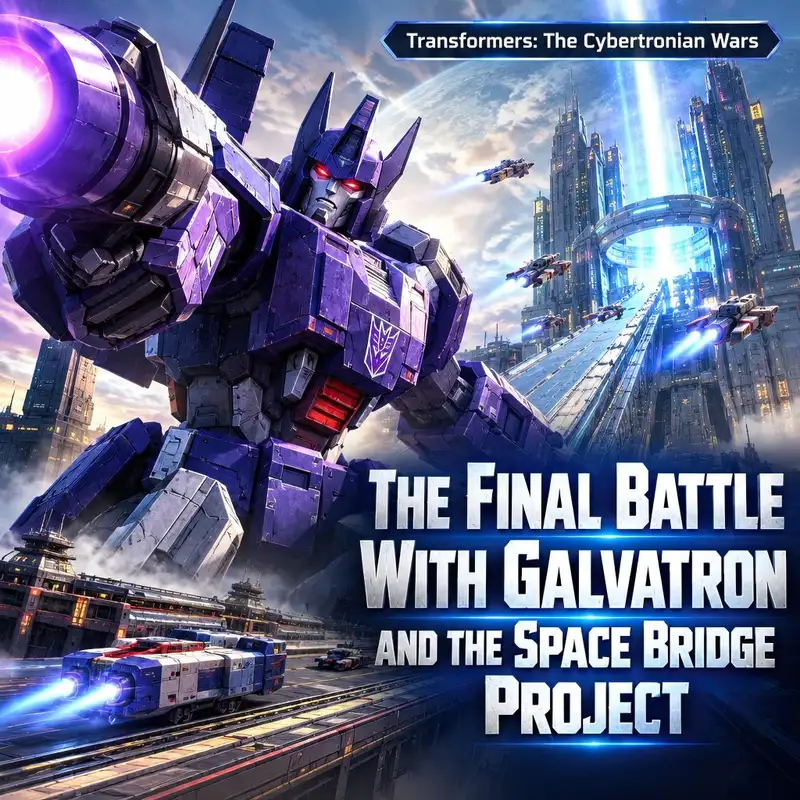
The Final Battle With Galvatron and the Space Bridge Project
Jungle Planet is moving through space when the war appears to be ending. Its people are no longer facing a conventional invasion line or a contest for a city. Their entire world has been displaced by the black-hole crisis. The answer is not a speech, a victory parade, or even the defeat of a Decepticon commander. It is an improvised effort to push a planet back toward safety with engines, ships, ancient machinery, and the cooperation of worlds that only recently had little reason to trust one another.
That is the problem at the heart of the ending of Transformers: Cybertron. In this English-language continuity, Galvatron’s final defeat matters enormously, but it does not complete the work. Removing the leader who turned a universal emergency into a bid for domination does not restore damaged infrastructure. It does not automatically return a displaced world to its proper place. It does not settle who will govern Cybertron, Velocitron, Jungle Planet, Giant Planet, Earth, or the routes between them.
The final episodes are therefore less interested in declaring that peace has arrived than in asking what peace would require after a crisis that crossed planetary boundaries. The immediate military contest has become a broader political and logistical problem. The coalition must protect populations, restore mobility, decide how to handle powerful ancient artifacts, and build institutions that can function when Optimus Prime is not personally present to solve every emergency.
That distinction is important because Galvatron’s campaign has never been only a series of battles against Autobots. He uses the Cyber Planet Keys and the Omega Lock during a cosmic emergency in which the black hole threatens the stability of the inhabited worlds. Earth, Velocitron, and Jungle Planet are drawn into a crisis of movement, proximity, and survival. The danger is not confined to a front line. It affects routes, worlds, governments, and civilians who have no meaningful control over the ancient forces rearranging their strategic environment.
A final battle can remove an enemy from the field. It cannot, by itself, make that environment safe again. That is why the first postwar task is rescue.
The artifacts at the center of this struggle need a little explanation, but only a little. In Transformers: Cybertron, the four Cyber Planet Keys are ancient objects associated with Primus and with a long-ago project that linked worlds across space. The Omega Lock is the mechanism through which their power can activate Primus and related planetary systems. They are not this continuity’s version of the AllSpark, and they are more than keys that open an ordinary space bridge on command.
Their value is strategic because they connect authority to mobility and planetary survival. Whoever controls them can influence systems larger than a normal army can manage. That makes them attractive to a leader like Galvatron, whose command model depends on possessing the decisive instrument, intimidating rivals, and turning every emergency into proof that only he can impose order.
Galvatron’s larger cosmological ambitions are never given a precise scientific explanation. It does establish their political character. He does not seek merely to defeat Optimus Prime, secure a border, or preserve a threatened population. He seeks to use the crisis and the ancient infrastructure around it to remake the universe according to his own will. The Planet Keys are valuable to him because they promise leverage over worlds that would otherwise remain beyond his direct command.
This is a familiar weakness of highly centralized power. It can move quickly when one leader’s decisions are unquestioned. It can concentrate resources, direct fear, and punish hesitation. But its legitimacy becomes concentrated as well. The system is strong only so long as that leader remains able to compel obedience, distribute rewards, and appear invincible.
Galvatron’s final conduct exposes that weakness. His remaining allies are useful while they serve his ambition, but they are not partners in a durable political order. They are instruments, subordinates, or obstacles. Once his plan becomes inseparable from his personal supremacy, the cause has very little life beyond him. A faction held together by fear may fight effectively under pressure. It is rarely well prepared for succession, compromise, or reconstruction.
Optimus Prime faces the opposite problem. He cannot defeat Galvatron simply by becoming a more benevolent version of Galvatron. He cannot seize the Keys, issue commands to every world, and declare that interplanetary order has been restored. The coalition resisting Galvatron is not one army with one chain of command. It is a collection of societies, leaders, crews, local defenders, human allies, and Cybertronian forces with different histories and interests.
The Autobots provide a military core and a recognizable moral center, but they do not own the worlds they are trying to save. Override represents Velocitron. Scourge remains bound to Jungle Planet and its people. Metroplex and Giant Planet bring their own capacity and political standing. Earth has become a participant in the crisis through its human allies, yet those allies do not speak for every government or every civilian population on their planet.
That diversity makes the coalition more difficult to direct. It also makes it more legitimate. The worlds resisting Galvatron are more than receiving orders from Cybertron. They are contributing their own forces, leaders, knowledge, and material support to a common emergency. Their participation changes the political meaning of the final campaign. This is more than an Autobot victory over Decepticons. It is a collective refusal to allow the future of several worlds to be decided by one ruler with access to ancient power.
Such coalitions require more than shared ideals. They require practical means of movement and communication. A leader can promise mutual assistance, but that promise means little if ships cannot reach a threatened world, if refugees cannot be evacuated, or if the only route between allies is controlled by an enemy.
The ancient vessels in the finale matter for exactly that reason. Atlantis, Ogygia, Hyperborea, and Lemuria are more than dramatic relics from a forgotten age. They provide transport, command space, evacuation capacity, and the physical basis for large-scale operations during a spatial crisis. When they combine into the Ark, the result is significant because it gathers scattered capabilities into one operational asset.
The Ark can move personnel and support the broader effort to stabilize the worlds caught in the crisis. It represents inherited infrastructure being placed at the service of a coalition rather than a single ruler. But it is not a magical solution. A ship, even an ancient and extraordinary one, still needs direction, protection, maintenance, energy, and a mission. It can transport capacity. It cannot make political disagreements disappear.
The same is true of Primus and the planetary systems connected to the Cyber Planet Keys. Their power changes what is possible, but it does not eliminate the requirements of planning. A planet must still be protected. A damaged propulsion system must still be repaired. People must still decide who accepts risk, who stays behind, and who has authority to act in an emergency.
Jungle Planet becomes the clearest example of that reality. The world has been displaced and remains in danger after the larger black-hole emergency begins to recede. The coalition attempts to return it to a safe position using rocket propulsion and the combined resources available to the Ark and its allies. The effort is an engineering operation conducted under battlefield conditions.
That matters because it strips away the comforting fiction that cosmic artifacts solve every problem automatically. The Planet Keys may have extraordinary importance, but Jungle Planet cannot simply be wished into place. The coalition must generate thrust, manage the movement of a world, protect the operation, and coordinate among leaders whose first responsibility is to their own populations.
The operation also reveals the difference between a tactical task and a strategic objective. At close range, the engines must work. Across the wider campaign, the coalition must hold together long enough to complete the maneuver and protect the assets involved. In strategic terms, Jungle Planet must be restored to a position where its people can survive without remaining permanently dependent on wartime improvisation.
Politically, the stakes are just as high. A displaced world cannot be told that the war is over if its inhabitants remain exposed to another catastrophe. A declaration of victory means very little to civilians whose home is still moving through dangerous space. The rescue of Jungle Planet is therefore not an epilogue to the conflict. It is proof of whether the coalition’s claimed purpose has any practical meaning.
Galvatron understands this vulnerability. He attacks the propulsion system, damaging the effort to return Jungle Planet to safety. The act is strategically revealing. He does not need to conquer the whole coalition outright if he can disrupt the infrastructure holding it together. By threatening the engines, he turns an emergency recovery operation back into a crisis of command and survival.
His interference produces consequences at several levels. The immediate machinery is damaged. The movement plan is endangered. A world remains exposed. The allied leaders must divert attention and resources from reconstruction back toward combat. And the people of Jungle Planet are forced to depend on a coalition whose promises are being tested in the most literal possible way.
There is a dry lesson here for anyone who believes the conclusion of a war begins when the principal villain falls. The most dangerous phase may begin when damaged systems must work under pressure, when exhausted forces must coordinate without a simple enemy to organize them, and when civilians need transport, repair, and reliable authority more than they need another declaration of triumph.
Galvatron’s survival also makes it impossible to separate the rescue mission from the question of command responsibility. As long as he remains capable of acting, every engineering task must be protected against sabotage. Every ship becomes both a support asset and a potential target. Every political discussion remains vulnerable to coercion by a leader who believes that destroying cooperation is nearly as useful as defeating it.
This is why Optimus Prime accepts the final confrontation with Galvatron. He orders the others to stand aside and takes responsibility for meeting him directly. In a story built around transforming warriors, that decision can look like the expected final duel between rival commanders. But it also carries political and operational weight.
Optimus appears to understand that Galvatron’s authority has become personal in the most dangerous sense. The Decepticon leader’s remaining power rests not on a stable government, a negotiated alliance, or a defensible public purpose. It rests on the belief that he cannot be challenged. A direct confrontation therefore becomes a test of whether that claim can survive.
For Optimus, the duel is also an act of responsibility. He has led the coalition through the black-hole crisis and through the struggle over the Planet Keys. He cannot ask every allied leader to bear the burden of a fight that has become so closely tied to his own command relationship with Galvatron. By taking the challenge himself, he tries to prevent the confrontation from pulling the entire coalition into one leader’s demand for supremacy.
That decision is not without risk. Removing the coalition’s senior commander from broader coordination creates a vulnerability. Optimus cannot simultaneously direct rescue efforts, supervise allies, protect the Ark, and fight Galvatron at full attention. The choice concentrates danger in one individual. If he fails, the coalition loses more than a capable combatant. It loses a central coordinator at the moment coordination matters most.
But Galvatron has engineered the crisis around personal domination. Declining the challenge would not necessarily preserve the coalition from that reality. As long as he remains free to disrupt the rescue operation and exploit the Keys, the larger force cannot fully turn from war to recovery. Optimus chooses to contain the personal contest rather than allow it to spread through the whole alliance.
The importance of the duel, then, is not its spectacle. It is the question of which kind of authority will remain after the crisis. Galvatron seeks to prove that power belongs to the strongest commander with the will to seize it. Optimus seeks to prove that strength can serve obligations larger than the leader who possesses it.
The battle is hard, and it does not proceed as a simple demonstration of Autobot superiority. Galvatron gains the advantage and seriously injures Optimus. For a time, the outcome appears to confirm Galvatron’s belief that force alone settles legitimacy. If the coalition’s leader can be broken in a direct fight, then perhaps every promise of cooperation and reconstruction was only a temporary shelter beneath a weaker commander.
That moment matters because it shows the danger of attaching too much to one figure, even one as trusted as Optimus. The coalition may be broader than a single leader, but the morale, direction, and symbolic purpose of the effort still rest heavily on him. Galvatron understands that a leader can be defeated politically by showing that he cannot protect those who rely on him.
The final intervention comes through Vector Prime. His role must be handled carefully. Vector Prime’s appearance is not evidence that death has become routine or reversible in this continuity. The series presents him as a guardian associated with time, and his earlier sacrifice has already helped make the larger Autobot effort possible. His final presence belongs to the extraordinary logic of this particular crisis.
Vector Prime lends Optimus power through his sword. The gesture is both practical within the story and symbolic in its meaning. Optimus does not prevail by discovering that he alone has always contained unlimited strength. He receives aid from a figure whose sacrifice had already become part of the coalition’s survival. The final victory is connected to continuity of duty, memory, and support across loss.
Optimus then uses the Matrix of Leadership and assumes a golden enhanced form. This Matrix should not be confused with versions from other Transformers histories. Here, it is part of the final resolution of a specific crisis involving Primus, the Planet Keys, and the struggle against Galvatron. Its significance lies in what it allows Optimus to do at that moment, not in a universal list of powers.
With that power, Optimus destroys Galvatron.
The result is decisive at the tactical level. Galvatron can no longer attack the engines, threaten the coalition, or use the emergency as the basis for his personal rule. The most immediate source of violence has been removed. The final commander capable of turning the crisis back toward domination is gone.
Across the operation, the destruction of Galvatron gives the coalition room to return to rescue, stabilization, and movement. Forces that had to prepare for direct interference can focus again on the practical work of securing the worlds affected by the black-hole crisis. Jungle Planet’s survival is no longer hostage to Galvatron’s next attack.
Politically, however, the victory is not a complete settlement. Galvatron’s destruction removes the center of his command system. It does not erase the history that produced his followers, dissolve every Decepticon affiliation, or answer what former enemies will become in a changed interplanetary order. Some survive. Some have already broken from him. Others must now live in a world where the central authority they served no longer exists.
This is one of the more mature implications of the ending. A faction is not a light switch. It cannot be turned off by defeating its leader. Its members have loyalties, fears, habits, local ties, and memories of war. Some may seek a place in the new order. Some may remain dangerous. Some may simply be displaced by a peace they did not expect to survive.
The same is true of the ancient infrastructure. The Cyber Planet Keys and the Omega Lock remain powerful objects after Galvatron is gone. Their danger has not vanished because their previous user has been destroyed. If anything, the war has demonstrated how much leverage they can offer to anyone able to seize them.
The coalition must therefore make a choice. It can treat security as a problem of concealment. It can hide the Keys, lock away the Omega Lock, and reduce the chance that another ambitious commander will use them. Or it can treat the crisis as evidence that isolation itself is part of the danger.
That choice comes before the Space Peace Conference on Cybertron. The conference matters because it marks a transition from emergency command to collective political decision-making. During the crisis, speed and survival had often required commanders to act with incomplete information. In the aftermath, those decisions must become the subject of discussion among the worlds that will live with their consequences.
The participants include Cybertronians from several worlds and human allies who have become part of the shared experience of the conflict. Colonel Franklin is present among those human participants. His role should not be inflated into representation for all of humanity. Earth is not one government, one military, or one voice. But Franklin’s presence shows that the future being discussed is no longer exclusively Cybertronian.
Franklin recommends securing, or effectively hiding, the Cyber Planet Keys and the Omega Lock. It is a cautious proposal, and it deserves to be taken seriously. Galvatron has just demonstrated the danger of allowing unique ancient systems to become instruments of coercion. If access is restricted, the immediate risk of misuse may decline. A weapon nobody can reach is, at least for the moment, a weapon nobody can fire.
His proposal also reflects a sensible postwar instinct. After a catastrophe, survivors often want distance from the tools that made catastrophe possible. They want vaults, restrictions, secrecy, and a return to manageable borders. There is nothing irrational about that response. It recognizes that not every power should remain easily available merely because it can be used.
But concealment does not solve every strategic problem. Hiding the Keys would not restore the routes damaged or disrupted by the crisis. It would not create dependable communication between distant worlds. It would not guarantee aid for a future evacuation. It would not help a threatened colony reach allies before an enemy or disaster isolates it.
More deeply, permanent concealment would leave the worlds in roughly the condition that made Galvatron’s bid for power so dangerous. They would remain separated by distance, vulnerable to disruption, and dependent on rare moments of improvised contact. The ancient infrastructure would be treated as a forbidden inheritance rather than a problem of governance.
Optimus Prime proposes a different course. Instead of merely locking away the systems connected to the Cyber Planet Keys, he proposes building a new Space Bridge project. The proposal is not the activation of a finished device. It is the beginning of a program. Its purpose is to locate and connect distant civilized worlds, continuing the work begun by the ancient Cybertronians through a new and more cooperative political framework.
This is a significant shift in strategic doctrine. Galvatron treated connection as something to seize. The worlds, the Keys, the Omega Lock, and the routes between planets were valuable because they could be placed beneath a single will. Optimus treats connection as something that must be built and shared. Its value lies not in domination but in the ability of separate societies to assist one another.
A functioning network could serve many purposes. It could allow travel between worlds that would otherwise remain isolated. It could carry messages faster and more reliably than ad hoc voyages. It could support trade, reconstruction, scientific exchange, and the movement of technical expertise. In another emergency, it could become an evacuation route or a means of sending aid before a local crisis becomes a planetary disaster.
It could also support collective security. A world that can call for help, receive it, and maintain regular contact with neighbors is harder to isolate. A coalition no longer has to form from scratch each time a threat appears. Familiar routes, shared knowledge, and established relationships can make it more difficult for the next would-be conqueror to play distant worlds against one another.
But the proposal is not free of danger. A network that enables aid can also enable invasion. A route that carries trade can become a chokepoint. A bridge system can be sabotaged, monopolized, or used by a stronger power to impose access conditions on weaker worlds. Any infrastructure that connects societies also creates arguments over who maintains it, who controls it, who can use it, and what happens when security and openness come into conflict.
No finished constitution for the new order is shown. It does not establish an inspection regime, a universal command structure, ownership rules, access law, or a final doctrine for defending the bridges. Those are not minor details. They would determine whether the project became a genuine common system or another instrument of centralized power.
Optimus’s decision is therefore a wager. He does not deny the danger that Franklin identifies. He accepts it and argues, in effect, that fear cannot be the only organizing principle of the postwar universe. Isolation may prevent some immediate abuses, but it can also preserve the fragmentation that makes every world vulnerable when the next emergency arrives.
The proposal is accepted, and that acceptance matters as much as Optimus’s speech. The new project is not presented as his private possession. It requires other leaders to agree that shared infrastructure is worth the risk. It requires worlds with different cultures, capabilities, and recent memories of war to accept a future in which they will be more connected to one another.
The next decisions show that this is more than symbolism. Optimus does not remain on Cybertron as an immovable supreme commander while everyone else builds the network around him. He joins the construction mission. That choice signals that the Space Bridge project will require direct labor, travel, leadership, and the willingness to leave the safety of the restored center.
At the same time, Optimus appoints Jetfire to lead Cybertron in his absence. This is a quiet but important act of institutionalization. A society recovering from crisis cannot depend entirely on one leader’s physical presence. If Cybertronian government only functions when Optimus is on the planet, then the peace remains as fragile as the old emergency command system.
Jetfire’s appointment creates continuity of authority while allowing Optimus to take on the new mission. It also acknowledges that leadership is not the same as personal indispensability. The strongest postwar institution is not one that keeps its most respected figure at the center forever. It is one that can delegate responsibility without losing legitimacy or coherence.
Other leaders make comparable choices. Override transfers leadership of Velocitron to Hot Shot so that she can take part in the broader project. Her decision does not dissolve Velocitron into an Autobot possession. It preserves local authority through succession while allowing a planetary leader to contribute to an interplanetary undertaking.
Scourge remains associated with Jungle Planet. That choice is equally significant. The recovery of Jungle Planet has shown how dangerous it is for a world to be treated as an abstraction in someone else’s strategy. Scourge’s continued connection to his home affirms that participation in the new order does not require abandoning local responsibility.
Leobreaker, Undermine, and Brimstone are among those involved in the wider mission. Metroplex and the inhabitants of Giant Planet also contribute. The ancient ships remain essential. Together, these participants demonstrate that a bridge network cannot be created through one artifact, one commander, or one dramatic act of transformation. It requires vessels, navigational knowledge, engineering, labor, protection, and continued political consent.
That distributed commitment is the real answer to Galvatron’s model of power. Galvatron attempted to gather leverage into his own hands. The Space Bridge project disperses responsibility. It depends on many worlds contributing what they can and retaining a reason to believe the system serves them as well as Cybertron.
There are risks in that arrangement. Shared responsibility can mean unclear responsibility. A coalition can be slow, divided, and vulnerable to disagreement. Delegation can produce rival centers of power. The work of maintaining bridges, ships, and routes is less dramatic than defeating a tyrant, and it is often harder to sustain politically. A crisis can unite people more easily than routine maintenance.
But that is precisely why the ending does not treat construction as an afterthought. The departure from Cybertron is not retirement, and it is not a simple expedition into the unknown. It is reconstruction becoming policy. The coalition is attempting to turn a temporary wartime alliance into a durable way of living in a connected universe.
The closing narrative also requires one small note of caution about how it is viewed. In the English broadcast sequence, the episode called Inferno appears after the effective conclusion of this story. That placement can make the ending look less final than it is. But the material belongs to a broadcast-order complication rather than to the chronological aftermath of Galvatron’s defeat and the Space Bridge initiative.
The final movement belongs with the decisions made after the black-hole crisis, after Jungle Planet’s rescue, and after the Space Peace Conference. Its logic is clear. The end of Galvatron’s rule is necessary, but it is not sufficient. The coalition can only claim victory if it addresses the separation, damaged mobility, and distrust exposed by the crisis.
Jungle Planet remains the best measure of that argument. At the opening of this final phase, an entire world is endangered despite the apparent collapse of the enemy’s plan. Its safety depends on engines, ships, cooperation, and command decisions. The world cannot be saved by a duel alone. The duel matters because it removes the force trying to destroy the rescue effort. But rescue still requires people willing to carry out the work.
The Space Bridge project extends that lesson outward. It recognizes that worlds divided by distance are more easily abandoned, manipulated, or conquered. It recognizes that an emergency network improvised under pressure is not enough. And it recognizes that ancient power remains dangerous when held by a single leader, yet may still be valuable if placed within a system of shared responsibility.
The network is not complete by the end. Not every inhabited world has been found. No universal bridge system has been secured, staffed, or governed on screen. The future remains contingent on cooperation, maintenance, and the willingness of leaders to accept limits on their own control.
That uncertainty is not a weakness in the ending. It is the point. Galvatron offers the false certainty of one will commanding every route and every world. Optimus offers a harder alternative: connection that must be built, protected, shared, and continually negotiated.
The final victory lies not in destroying Galvatron, but in accepting that peace requires institutions strong enough to outlast the leaders who claim to deliver it.