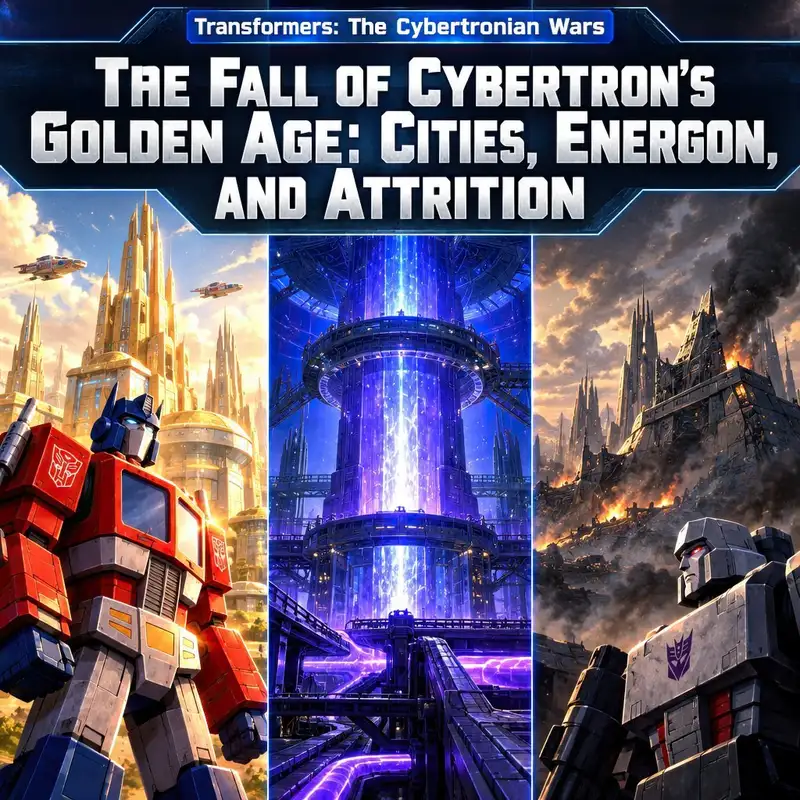
The Fall of Cybertron’s Golden Age: Cities, Energon, and Attrition
Iacon is under attack, but the city is already fighting a second enemy. Beneath its towers and defensive batteries, Cybertron is convulsing. Quakes tear through infrastructure. Electrical storms disrupt a world built on vast networks of power and transport. Energon, the resource that sustains Cybertronian bodies, weapons, repair, and travel, has become scarce enough to drive both sides toward the remaining wells. At the center of the crisis stands the Ark, not yet a symbol of exploration, but an unfinished escape vessel. Decepticon warp cannons threaten its launch before it can carry anyone away.
In the High Moon Studios game history of War for Cybertron and Fall of Cybertron, this is the final condition of the civil war. Cybertron is not merely losing a battle. It is losing the systems that make organized life possible. The surviving Autobots must defend a capital, maintain enough command structure to act, secure fuel for a ship, and find a way off a planet that is failing beneath them. The Decepticons, meanwhile, continue to seek decisive victory over their enemies even as the world they intend to rule becomes harder to inhabit.
That is the meaning of Cybertron’s Golden Age in these games. It is not a fully documented era of constitutional harmony or universal prosperity. The record never gives us enough to make such claims. What the war reveals is the material condition that existed before the collapse: functioning cities, connected energy systems, defended infrastructure, industry, transport, and a society capable of sustaining enormous urban centers. The Golden Age was, at minimum, an age in which Cybertron still worked.
By the opening of Fall of Cybertron, that condition has been destroyed. Iacon remains an Autobot capital, but it is also a damaged command network, a defensive position, a transport hub, and a city trying to assemble the means of its own evacuation. The struggle for Iacon is therefore not a conventional siege in which one army seeks a prestigious landmark. It is a fight over artillery, communications, launch systems, energy access, and the political authority represented by the city itself.
The collapse did not begin in one day. It was the product of attrition. Attrition is often misunderstood as a simple count of battlefield losses. In this war, it meant something broader and more dangerous. It meant damaged systems that could not be fully repaired. It meant defenders forced to choose which installations to save and which to abandon. It meant Energon becoming too scarce for every vehicle, weapon, repair bay, and evacuation plan that depended upon it. It meant a civilization spending its remaining strength merely to remain operational.
Cybertronians in this game continuity can transform, cross immense distances, and deploy weapons far beyond human military technology. None of that makes them independent of supply. A force still requires energy. Damaged personnel still need recovery, parts, facilities, and specialists. Cities still need power, communications, and defensive systems. Ships still need enough fuel and functioning equipment to lift off, navigate, and survive enemy action. Transformation changes mobility. It does not abolish maintenance.
The games do not establish reliable casualty totals, reserve quantities, or population figures, and they do not need to. The effects are clear without arithmetic. Cybertron’s defenders cannot protect every city, every facility, and every remaining source of Energon. Decepticon forces cannot seize every objective without consuming more of the world’s dwindling capacity. Each offensive may win territory while reducing the value of the territory captured. Each defensive success may preserve a position while exhausting the means to hold it.
For that reason, the terminal phase of this war is so bleak. The contest is no longer only over who will govern Cybertron. It is over whether there will be enough Cybertron left to govern. Megatron’s rise and Optimus Prime’s emergency command both unfold inside that narrowing strategic space. Their decisions are different, but neither can escape the larger fact that the war has begun to consume its own foundation.
Megatron’s answer to the problem of strategic deadlock is Dark Energon. In War for Cybertron, he does not seek it as an ordinary fuel source. He seeks it as an exceptional and dangerous advantage, one capable of breaking the existing balance between the Decepticons and the Autobots. His forces seize a Dark Energon production facility and reactivate an Energon Bridge to move the substance where it can serve his campaign. Keeping Decepticon troops moving is only the immediate objective. The larger aim is to transform the war itself.
That distinction matters. Conventional Energon supports the existing military system. It powers forces, facilities, transport, and repair. Dark Energon offers Megatron something more dramatic and more perilous. It promises a route around the limits imposed by ordinary logistics and ordinary military resistance. In political terms, it is the weapon of a leader who no longer intends simply to defeat an opposing army. He intends to seize absolute control over the planet.
There is a certain logic to the decision. Megatron faces an entrenched Autobot order centered on Iacon and supported by institutions that still possess legitimacy, defensive capacity, and access to ancient systems. A direct campaign against that order is costly. It requires attacks on fortified cities, control of infrastructure, and the ability to overcome Autobot defenders who know their own capital. Dark Energon appears to offer a shortcut. It can turn a difficult struggle for political and military dominance into a decisive act against the planet’s deepest systems.
But the strategic weakness is built into the apparent success. A weapon that can alter Cybertron itself is more than a weapon against the Autobots: it is a threat to the world that supports both factions. Megatron’s campaign demonstrates a recurring problem in civil war. A leader may believe that destroying the system is acceptable if the system stands between him and power. Yet once the system is destroyed, victory becomes difficult to distinguish from possession of ruins.
The Decepticons do win major gains. They seize key facilities. They capture territory. They pressure the Autobot command structure. They force the defenders to respond to a threat that cannot be met with ordinary battlefield methods. But military momentum is not the same as strategic sustainability. A campaign can succeed at every immediate objective and still leave its commander with no viable political order to inherit.
The cities of Cybertron make that problem visible. Kaon and Iacon are not just opposing capitals with different faction symbols over their gates. They are command systems. Kaon, the Decepticon center in War for Cybertron, is also associated with detention and coercive power. Its prison infrastructure shows that the conflict is not only fought by armies maneuvering across open ground. It is also fought through control of prisoners, political enemies, information, and fear.
A prison is an institution of war as much as a fortress. It can remove opponents from circulation, intimidate neutral populations, produce intelligence, and signal that a new authority possesses the power to punish. It can also become a burden. Detention requires guards, facilities, transport, records, and political decisions about who is treated as an enemy and who might still be won over. In a civil war, these decisions shape the future as much as battlefield victories do.
Iacon represents a different concentration of power. It is the Autobot capital, but its importance is not ceremonial. It is tied to the defense of the Autobot cause, to communications, to artillery, to transport infrastructure, and to the institutions that recognize Autobot authority. When a capital is threatened, the danger is not just that a leader may lose an office. The danger is that the networks allowing dispersed forces to coordinate may begin to fail.
Cities also preserve continuity. They hold archives, workshops, repair systems, command posts, and the accumulated habits of public life. Even where the games focus on soldiers rather than ordinary civilians, the consequences of urban destruction are apparent. When infrastructure collapses, the effects reach beyond the fighters at the front. Power failures, disrupted transit, damaged facilities, and shrinking access to Energon create a society in which survival becomes increasingly dependent on factional command and military priority.
For the Autobots, Iacon is therefore both a military position and a claim to legitimacy. It is proof that they are not only a scattered resistance but an organized force defending a political center. For Megatron, taking Iacon would do more than weaken enemy defenses. It would demonstrate that Autobot authority could be broken in its own capital. It would give the Decepticons access to systems that had previously remained beyond their reach.
The assault on Iacon becomes one of the war’s great turning points because it connects urban conquest to planetary vulnerability. Zeta Prime, the Autobot leader at this stage of the conflict, is defeated and mortally wounded. His loss is not just a personal tragedy. It creates a command crisis while the enemy is still advancing. A military organization can survive the loss of a commander, but only if it possesses succession, communications, confidence, and enough stability to carry out the transition.
The Decepticons also seize the Omega Key. In immediate military terms, the Key gives them access to Omega Supreme, a colossal Autobot guardian. Omega Supreme is not a standard unit and should not be read as evidence that either faction can routinely manufacture city-scale defenders. He is a singular asset tied to Cybertron’s deeper systems. That uniqueness is precisely why his capture matters. When a side loses a unique guardian, it loses more than firepower. It loses a capability that cannot simply be ordered from another factory.
Megatron’s forces defeat and corrupt Omega Supreme, turning a defender of the old order into an instrument of breach. The operational effect is profound. What had protected access to Cybertron’s central systems becomes the means by which the Decepticons can penetrate them. This is not a normal breakthrough across a defensive line. It is the capture and repurposing of infrastructure so important that it changes the level of the war.
At this point, the conflict moves beyond the struggle for cities. Iacon has been attacked because it opens the path toward something more consequential than its towers or command rooms. Megatron is now positioned to strike at Cybertron’s core. The war has become a contest over the planetary system that permits the cities, armies, and governments of Cybertron to exist at all.
Megatron injects Dark Energon into the core. The act provides him with the kind of penetration his campaign was designed to achieve. He has reached beneath Autobot defenses, beneath Iacon’s authority, and beneath the ordinary geography of the war. Yet the result is not stable conquest. The core is damaged, and its response establishes the scale of the disaster. Cybertron must reboot in order to repair itself.
That reboot comes at an intolerable price for the society now living on the planet. The core explains that Cybertron will become cold, barren, and lifeless for an immense period. The exact duration is not the important point. The key point is that restoration cannot occur on a timetable meaningful to the people fighting the war. The world may recover someday, but it cannot continue to sustain the present civilization.
The core’s nature, the Matrix, and the effects of Dark Energon are specific to this game history, and the games do not provide a complete technical or metaphysical manual. What is clear is the strategic consequence. A fragment of the core’s energy can be entrusted to Optimus, carried forward through the Matrix of Leadership. That does not preserve Cybertron as it is. It preserves the possibility that Cybertron might one day have a future.
This is the moment when restoration gives way to survival. Before the core’s infection, commanders can still imagine that victory might mean regaining control of a functioning planet. Afterward, the central question changes. What can be saved from a civilization whose homeland is no longer capable of supporting it? The answer is no longer territory alone. It is memory, leadership, technical knowledge, personnel, and whatever population can be moved beyond the dying world.
Megatron’s achievement is therefore also his strategic catastrophe. He has broken the old balance. He has breached the systems that protected Iacon. He has forced his enemies into a crisis of evacuation. But he has also destroyed the material basis for ruling Cybertron in any ordinary sense. Control of a collapsing planet is not the same as control of a state. A ruler needs cities that function, energy that flows, industry that produces, and a population that can live under the authority claimed.
The Autobots face a different disaster. They have not chosen the core’s infection, but they must now make decisions within its consequences. Zeta Prime’s death leaves them without their established leader. The Autobot High Council names Optimus the new Prime. In this continuity, Optimus does not begin the war as a settled and unquestioned supreme commander. His authority emerges amid institutional failure, enemy pressure, and a planetary emergency.
That context changes how his command should be understood. Optimus inherits neither a secure capital nor a stable military position. He inherits a damaged cause. He must preserve enough of the Autobot command structure to continue acting while redefining the objective of the war. Defending Iacon still matters, because the city contains vital systems and remains the strongest available center of resistance. But defense can no longer mean holding the homeland indefinitely.
Optimus must manage several problems at once. He must protect surviving forces. He must secure access to energy. He must maintain communications and transportation. He must organize the Ark as a viable means of escape. He must make choices about which facilities can be defended and which must be abandoned. He must also preserve some sense of political purpose among Autobots who are being asked to concede the planet they have fought to protect.
Emergency command can be necessary, but it has limits. A leader can issue orders, prioritize resources, and make sacrifices under pressure. He cannot recreate a functioning society while the systems supporting that society are failing. Optimus’s task is not to rebuild Cybertron in the midst of the collapse. It is to prevent the complete extinction of the political and social community that Cybertron once sustained.
For that reason, the Ark matters so much. It is more than a ship: it is a strategic instrument of continuity. If it launches, it can carry survivors away from a world that can no longer support them. If it fails, the Autobots may retain courage, weapons, and even a few defended positions, but they will remain trapped within a planetary disaster. An evacuation vessel must be fueled, protected, staffed, and given a route. It is a military asset, a logistical system, and a political lifeboat.
There is nothing triumphant about this shift. Evacuation is often portrayed as a clean alternative to defeat. In reality, it is an admission that territorial defense has failed. It means leaving cities, infrastructure, and much of the population’s accumulated world behind. It creates displaced people rather than secure victors. It also transfers the war elsewhere. If the Decepticons survive as an organized enemy, escape does not end the conflict. It only changes its geography.
Fall of Cybertron begins in this final emergency. The game first shows the Ark attempting to reach an escape portal while the Nemesis attacks, then returns six days earlier to the defense of Iacon. That structure is useful because it makes the strategic problem plain. The Ark’s launch is not the result of a single last-minute decision. It is the product of six days in which every surviving installation, energy reserve, and defender must be used to create enough time for departure.
Iacon’s defenses are still formidable enough to matter. Autobots work to hold artillery, communications, and launch infrastructure against the Decepticon offensive. Their objective is not to destroy every Decepticon force on Cybertron. That is no longer realistic. Their objective is to prevent the enemy from disrupting the narrow set of systems required for evacuation. In a collapsing war, commanders stop asking what would be ideal and begin asking what must not fail today.
The awakening of Metroplex gives the defenders a powerful but limited answer. Metroplex is a Titan-scale Autobot concealed within Iacon’s systems. His emergence demonstrates that the city contains resources and defenses from a deeper era, assets built for threats beyond the capabilities of ordinary troops. When he engages the Decepticon warp cannons threatening the Ark, he changes the tactical situation around the capital.
The immediate consequence is significant. The warp cannons cannot continue to menace the launch preparations unchallenged. Decepticon pressure around Iacon is disrupted. The Autobots gain breathing room. But Metroplex does not restore Cybertron’s energy system, reverse the core’s infection, or reopen the possibility of a conventional defense of the planet. He creates time. In this stage of the war, time is perhaps the most valuable commodity available.
That distinction matters because it prevents a common misunderstanding of giant strategic assets. A Titan can dominate a battlefield. It can destroy weapons that ordinary defenders cannot reach or withstand. But size and power do not solve the political and logistical crisis around it. Metroplex cannot turn a failing world into a functioning homeland by force alone. He can hold a line long enough for others to act.
The Autobots still require Energon. The Ark cannot launch on resolve, ancient authority, or battlefield courage. It needs power. That requirement drives the next stage of the campaign away from Iacon and toward the Sea of Rust, where Jazz and Cliffjumper locate a major Energon reserve under Decepticon control.
The Sea of Rust is important because it reveals the final war for what it has become. The Autobots are not seeking a symbolic victory. They are seeking fuel. They need enough energy to keep the Ark viable and to sustain the remaining force long enough to complete the evacuation. The Decepticons, meanwhile, are mining the reserve because control of extraction provides practical military power. A force that controls the remaining supply can decide who moves, who fights, who repairs, and who is left stranded.
The reserve is therefore more than a cache waiting to be seized. It is part of a larger logistical network, however damaged and incomplete that network has become. Energon must be extracted, handled, protected, and moved where it is needed. The games do not establish exact output, storage capacity, or transport arrangements, and no invented numbers are necessary. The strategic point is clear. The last functioning concentrations of energy become objectives because they are the last means by which either faction can continue operating.
This is the cruel arithmetic of attrition. Both sides understand that Cybertron is dying. Both sides still convert its remaining life-supporting resources into military capability. The Decepticons use Energon to maintain their campaign and pursue projects that might produce a decisive advantage. The Autobots need Energon to withdraw. Neither side can simply leave the resource in the ground. Yet every contest for it increases destruction, delay, and risk.
The Sea of Rust also demonstrates that the war is not controlled from a single capital. Even as Iacon remains under threat, important decisions are being made in distant industrial and experimental facilities. The battlefield is distributed across mines, bridges, research sites, ruined regions, and transport routes. A commander who sees only the front line will lose sight of the systems sustaining it.
Shockwave’s operations in the region show how scientific ambition becomes entangled with strategic desperation. His forces are involved in Insecticon experimentation and in a space-bridge project intended to reach Earth. These efforts are not just side projects conducted in a laboratory insulated from the war. They compete for the same shrinking resources, facilities, personnel, time, and security that the broader military campaign requires.
A space bridge, if it can be completed and used reliably, offers a route beyond the dying planet. That makes it strategically important. It could alter mobility, create access to a new world, or provide an escape and invasion route that conventional ships might not offer. But a portal system is not magic simply because it is advanced. It requires infrastructure, power, coordination, and a stable destination. Damage to any part of that system can turn a strategic opportunity into another source of danger.
Shockwave’s Insecticon work carries a similar lesson. Experimental forces and biological manipulation may promise military advantage, but they are not free. They demand secure facilities and sustained support. They create risks of control, reliability, and unintended consequence. In the final phase of Cybertron’s war, even a successful experiment may consume resources that the larger strategic situation cannot spare.
Grimlock and the Dinobots become caught in this environment of experimentation, capture, separation, and escape. Their campaign against Shockwave’s operation damages the space-bridge project, but it also leaves the portal unstable. The outcome is not a neat victory in which the enemy loses a facility and the Autobots gain a safe route. The Decepticon project is disrupted, yet the unstable system remains part of the danger facing everyone involved.
This reflects another problem of total war. Destruction is easier than recovery. A facility can be sabotaged. A bridge can be damaged. An experimental program can be interrupted. But the strategic consequences of disruption may not favor the side that caused it. A damaged portal may still become a route for an enemy. A ruined refinery may deny fuel to both factions. A breached city may no longer serve its original government, but it may also cease to serve anyone well.
The Autobots eventually reach the point where no ordinary repair, mine, or captured installation can guarantee the Ark’s launch. Their solution depends on Metroplex. The Titan transfers his remaining spark energy to the Ark, providing the power required for the ship to depart. The act appears to cost him his life. It is one of the clearest examples of sacrifice in the game’s final campaign, but its meaning is not just emotional.
Metroplex’s energy is not a replacement for an industrial base. It cannot be treated as a repeatable supply method, a routine military doctrine, or evidence that every major asset can simply donate enough power to launch a starship. Metroplex is unique. His sacrifice solves one immediate problem because the Autobots possess one exceptional guardian at one critical moment. It does not solve the underlying collapse that made such a sacrifice necessary.
On the battlefield, the transfer gives the Ark the power to launch. At campaign scale, it allows the Autobots to execute an evacuation that had seemed increasingly impossible. In strategic terms, however, the meaning is harsher. The Autobots are not saving Cybertron. They are abandoning it because it can no longer sustain them. The departure preserves survivors and the prospect of a future, but it concedes the homeland.
The political consequence is equally important. A people who once defended a capital and its institutions now become displaced. Their identity can no longer rest only on control of Iacon, access to familiar infrastructure, or the stability of Cybertronian public life. It must be carried by individuals, ships, memories, symbols, and whatever institutions can survive in exile. That is a far more fragile form of continuity.
The Ark’s launch does not even guarantee safety. The ship is still vulnerable during departure. It must reach the portal. It must retain enough power to travel. Its crew must defend it while the Decepticons attempt to stop the evacuation. A transport becomes most vulnerable when it is committed to movement, carrying what cannot easily be replaced and unable to turn every available system toward battle.
The Nemesis attacks as the Ark approaches the portal. This is fleet combat under conditions of extreme scarcity, not a ceremonial final encounter between rival leaders. The Decepticon ship serves as an offensive platform and a means of bringing boarding forces directly against the evacuation vessel. Soundwave leads the boarding effort. Bruticus breaches the Ark. The ship’s main Energon tank is damaged, threatening the very resource that made launch possible.
Boarding actions are particularly dangerous because they collapse the distinction between ship and battlefield. Defenders cannot simply withdraw from a damaged compartment if that compartment contains vital systems. Attackers do not need to destroy the entire vessel if they can cripple power, navigation, command, or fuel. In the Ark’s case, the Decepticons are not only trying to defeat Autobots in combat. They are trying to prevent the survival of the Autobot remnant.
Bumblebee’s defense of Optimus during the battle shows how close the command problem has become. A shot intended for the Autobot leader is not only a threat to one individual. In this moment, Optimus carries the Matrix and represents the continuity of Autobot command. His loss could fracture an already displaced force at the instant it is attempting to leave its world behind. Bumblebee’s action protects both a commander and the fragile institution gathered around him.
The final confrontation between Optimus and Megatron takes place on the Ark’s hull, with both leaders still fighting for control as the portal draws nearer. It is tempting to see this as the war reduced to its two central figures. In one sense, it is. Their rivalry has shaped the final crisis. Megatron’s campaign has driven the conflict to the core of Cybertron. Optimus has organized the desperate effort to preserve a future beyond it.
The duel between Optimus and Megatron cannot settle a war whose physical foundations are already collapsing. The Ark is damaged, the Nemesis remains in pursuit, the portal is unstable, and Cybertron is failing beneath both fleets. The unstable transit that pulls the two ships away does not deliver victory to either side. Neither faction receives a restored capital, a healthy energy network, or the industrial depth required for normal life. What survives is an armed remnant carrying the conflict away from the world that created it.
Cybertron's Golden Age therefore ends through cumulative attrition rather than one decisive assault. Megatron captures cities and reaches toward the planetary core, but his victories consume the material basis of the rule he wants. Optimus defends Iacon, secures fuel, and launches the Ark, but those successes preserve people and possibility rather than the civilization itself. The final irony is severe: both factions keep fighting for Cybertron until the war has made Cybertron something neither side can actually possess.