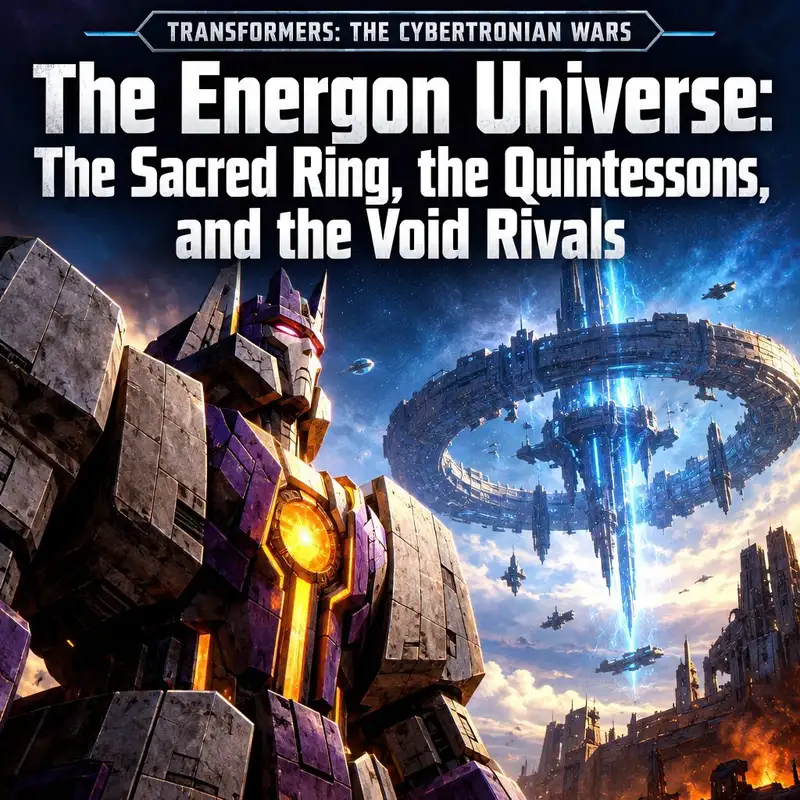
The Energon Universe: The Sacred Ring, the Quintessons, and the Void Rivals
Sharkticon forces swept across the Sacred Ring while Agorrians and Zertonians, who had spent generations preparing to fight one another, faced the harder realization that neither had prepared to defend the world they actually lived on. The invasion did not just add a third army to an old war. It exposed that the Ring was a shared habitat, a shared energy system, and a shared strategic liability. At its center lay a black hole. Around it stood two societies whose political identities had been built on rivalry. Beneath that rivalry, concealed by history, was a prison holding a weapon made to destroy Cybertronians.
This is the Skybound Energon Universe, told through the released Void Rivals comic narrative. Its Quintessons, Cybertronians, Alpha Trion, and ancient wars belong to this continuity alone. Familiar names do not carry their histories in from other Transformers stories. Here, the Sacred Ring is not a distant footnote to Cybertron’s civil war. It is a separate civilization drawn into the wider crisis because its survival has always depended on machinery and knowledge that its own people did not fully possess.
The Quintesson assault made that hidden dependence impossible to ignore. Their forces arrived as an organized external power, supported by warships and by specialized troops that included Sharkticons, Allicons, Bailiffs, Executioners, and Judges. The available record does not provide a clean order of battle, a reliable fleet count, or a map precise enough to reconstruct every axis of advance. It does establish the important point. The Quintessons were able to project force across the Ring while its defenders were still trying to overcome the habits of a much older internal war.
That distinction mattered. Agorria and Zertonia had learned to see security through each other. A border incident, an armed patrol, a political dispute, or a resource shortage could all be interpreted through the assumption that the other society was the permanent enemy. Such assumptions can sustain a conflict for a very long time. They can also make a society slow to recognize a threat that does not fit its inherited categories. By the time the Quintessons made their intentions unmistakable, the defenders had to build coordination under fire.
The Sacred Ring had always been difficult geography. It was a habitat arranged around a black hole, with Agorria and Zertonia existing as linked but rival societies within that extraordinary environment. The comic establishes the Ring’s importance without providing a technical manual for its construction. It would be unwise to invent one. What matters is that its physical structure shaped every political choice made upon it. The Ring was not just territory between two states. It was the infrastructure that allowed either state to exist.
A conventional frontier can sometimes be abandoned. A disputed mining district can be seized, fortified, or negotiated over. The Sacred Ring was different. Its inhabitants depended on the same broad system of energy, movement, and survival. That did not make them politically united. Shared infrastructure often produces arguments over control rather than harmony. Whoever regulates access to power, transport, security, and repair can claim authority. Whoever believes the other side controls those systems can see ordinary dependence as vulnerability.
The long Agorrian-Zertonian conflict therefore had a self-reinforcing quality. Rivalry was not just a matter of military deployments. It informed leadership, family loyalties, elite status, and public memory. Each society developed authority figures and political institutions shaped by the expectation of hostile coexistence. The existence of powerful leaders did not mean either side possessed a unified national purpose. Ministers, military figures, hereditary or elite authorities, and local interests could all agree that the rival was dangerous while disagreeing sharply on how to govern their own people.
For civilians, such a system made security inseparable from legitimacy. If energy access is uncertain, the government that promises protection gains influence. If the neighboring society is portrayed as a threat, military preparedness becomes easier to defend. If the true workings of the Ring are hidden, leaders can present emergency measures as necessities without having to explain the deeper structure of the crisis. A civilization can endure under those conditions. It may even appear stable. But it becomes brittle when events demand trust across the very line that gives its politics meaning.
Darak and Solila provide the clearest view of that brittleness. Darak begins as an Agorrian pilot with ties to Agorria’s political world through his father. Solila is a Zertonian pilot and his rival. Neither begins as a detached observer of the conflict. They are products of it. Their assumptions, reflexes, and suspicions are not personal defects invented for drama. They are the ordinary mental equipment of people raised inside a divided security system.
When their separate missions end in a crash on a remote world, survival requires what their societies had not encouraged: practical cooperation. They need information from one another. They need to assess danger without filtering every fact through factional loyalty. They need to decide when an enemy is still an enemy and when an immediate problem is larger than either of them. That does not erase the war between Agorria and Zertonia. It does show that inherited hostility is a poor substitute for intelligence.
Their partnership begins as an operational necessity before it becomes a political example. They do not first reconcile because their societies discover a common philosophy. They survive because isolation is more dangerous than cooperation. This is an important distinction. Many wartime alliances are built not on trust, but on a shared recognition that separate action has become impossible. The trust, if it develops at all, comes later and remains vulnerable to the pressures that created the old conflict.
Their early experience also reveals that the Sacred Ring is less isolated than its people had assumed. The awakening of Jetfire is one of the first signs that larger powers and older histories intersect with Darak and Solila’s local struggle. Jetfire’s appearance is not evidence that a unified Cybertronian expedition has arrived to solve the Ring’s problems. It is evidence that the Ring has been connected to a broader conflict all along, even if its inhabitants lacked the information to understand that connection.
This is where Void Rivals becomes more than a story about two enemies stranded together. Darak and Solila’s survival partnership becomes an intelligence bridge. Each carries knowledge that the other lacks. Each has access, however imperfect, to a different political culture. Their changing relationship demonstrates that the real obstacle to cooperation is not just personal hatred. It is the institutional cost of admitting that an enemy’s information may be accurate, that a rival’s survival may matter, and that the official story of the war may be incomplete.
The Sacred Ring’s connection to energon raises the stakes further. Energon, in this continuity, is not just a useful fuel seen in battle. It is a strategic resource. It affects military readiness, infrastructure, repair, and the wider position of Cybertronian forces struggling with their own shortage. The Ring’s capacity to produce or provide energon makes it important to outsiders. It also makes it vulnerable. A resource that can sustain a society can attract allies, opportunists, occupiers, and powers who see the local population as an obstacle to be managed.
The comic establishes that the Ring’s energy system has a meaningful relationship to energon. It does not establish an unlimited supply, a simple extraction process, or a solution that can be moved intact to another world. Those are different problems. Discovering an energy source is not the same as refining it safely. Refining it is not the same as transporting it. Transporting it is not the same as defending the infrastructure that produces it. And none of those steps guarantee that a distant civilization can build its future around a source it does not control.
Springer’s arrival makes this strategic interest more explicit. He is searching for Zerta Trion, a legendary Cybertronian figure connected to the Ring’s history and to its energon significance. Later, Hot Rod and Springer become involved with efforts surrounding Agorrian energon infrastructure. Their presence does not prove that the Cybertronians have solved the Ring’s problems or that they can turn it into a secure industrial base. It does show that the Ring’s resource crisis and Cybertron’s broader needs are beginning to overlap.
This overlap changes the political meaning of local decisions. A dispute over energy infrastructure is no longer only an Agorrian matter, or only a Zertonian concern. It can affect the calculations of Cybertronians who need energon, Quintessons who may wish to control it, and other actors who recognize that a hidden energy system can become a source of leverage. The Ring’s inhabitants are not suddenly powerless in this wider contest. But they are no longer the only people with an interest in their future.
The arrival of Wreck-Gar and the Junkions adds another dimension to that change. Their presence broadens the Ring’s social and political landscape. A place that had been understood as a closed conflict between two neighboring peoples is becoming a crossroads. Outside populations bring knowledge, trade, survival skills, competing interests, and new uncertainties. The question is no longer simply whether Agorria can defeat Zertonia, or whether Zertonia can outlast Agorria. The question becomes whether either government has the capacity to manage contact with a widening universe.
That capacity is not created automatically by access to outsiders. A society divided by permanent rivalry may find external contact even more destabilizing. One faction may seek outside support against the other. Another may view foreign assistance as infiltration. A resource deal can become a security crisis. A visitor with useful technical knowledge can be treated as an ally, a spy, a prize, or a threat. The Sacred Ring’s governments lacked a coherent external-security policy because their political order had been designed around an internal enemy.
Wheelie’s encounter with Pythona makes that problem sharper. Pythona is connected to Cobra-La, an outside power with its own interests and history. Her presence does not make Cobra-La a formal ally of Agorria or Zertonia. Nor does it mean that every actor operating around the Ring shares a single plan against the Quintessons. It establishes something more useful and more alarming. The Ring has become relevant to forces far beyond the two societies that once believed they defined its entire political world.
A closed war attracts outsiders when it contains something outsiders need. In the Ring’s case, that something is not only energon. It is also knowledge. The history of Zerta Trion, the nature of the Ring, and the threat contained at its center all have implications beyond local sovereignty. Once those secrets begin to surface, control of information becomes as important as control of territory. The population is forced to learn that its home has been strategically valuable for reasons hidden from it.
The concealed foundation of that history begins with Zerta Trion. In this Energon Universe account, she was once known as Beta. Alongside A-Three, who became Alpha Trion, she took part in a rebellion against Quintesson domination. These identities are specific to this story. They should not be treated as universal biographies for Alpha Trion or any other familiar Cybertronian name. The importance of Beta and A-Three lies not in recognition, but in what their rebellion reveals about the Ring.
Their revolt was more than an ancient act of liberation. It was part of a war against a power capable of creating and employing immense weapons. Zerta’s later role places her at the center of a long-term strategy against that threat. She is both a liberator and an architect of containment. That combination matters because it complicates the image of ancient heroes as simple guardians. A leader may save a people from immediate destruction while binding later generations to a system they did not choose and cannot safely dismantle.
Zerta’s strategy appears to have been shaped by necessity. The danger she confronted could not just be ignored. Yet necessity does not remove the political cost of secrecy. The later inhabitants of the Ring inherited an energy system, a geography, and a conflict they only partly understood. They did not possess the full history of the prison beneath their civilization. They could not meaningfully consent to the risks built into it, because they did not know those risks existed.
This is a recurring problem in states built around extraordinary security measures. A government may conceal a danger in order to prevent panic, preserve operational security, or maintain control. In the short term, secrecy can appear prudent. Over time, it creates a population that cannot judge the policies governing its own survival. When the crisis returns, leaders ask for trust that has not been earned through informed participation. The people are expected to defend a system whose purpose they were never told.
The hidden threat was Goliant. The comic identifies Goliant as a gigantic Quintesson weapon designed to destroy Cybertronians. He is not Unicron, and there is no reason to treat him as a version, equivalent, or multiversal counterpart of that entirely separate figure. Goliant is dangerous enough on his own terms. He represents a deliberate act of Quintesson weapon design, directed against a people the Quintessons had once dominated and still sought to control.
The surviving account describes Zerta luring Goliant away from Cybertron. Distant worlds were then arranged into what became the Sacred Ring around a black hole, trapping Goliant within the resulting structure. The exact engineering is not fully explained. The story gives the strategic effect, not a reproducible construction plan. The Ring became a containment system. Its central black hole was not decorative cosmic scenery. It was part of the mechanism that held a weapon of enormous consequence in confinement.
Containment is often mistaken for resolution. It is not. A prison can prevent an immediate threat from acting, but it requires maintenance, secrecy, political authority, and a plan for failure. The longer it lasts, the more likely later generations are to confuse the prison with the normal world. That is what happened on the Sacred Ring. Its inhabitants lived around a strategic system so old and so fundamental that it had become the background condition of life itself.
Goliant’s essence was also connected to energon production and to the creation or emergence of the Agorrian and Zertonian peoples. The comic establishes that relationship, but its biological and metaphysical mechanisms remain partly unexplained. It would be misleading to reduce it to an industrial formula or a simple account of manufacture. The crucial fact is more unsettling. The life-supporting system of the Ring was entangled with the containment of the weapon beneath it.
That transformed every argument about energon. The resource was not just mined from a neutral deposit. It was tied to an imprisoned threat and to the foundational history of the people depending on it. The Ring’s population was not just living near Goliant. Its society had developed through a system connected to Goliant’s confinement. Energy, identity, and security had never been separate questions. They only appeared separate because the full history had been concealed.
There is a moral burden in that arrangement. Agorrians and Zertonians had fought over power, resources, and political survival without knowing that the system sustaining them had been built around a weapon intended for a different war. Their divisions were real. Their grievances did not become imaginary because ancient Cybertronians had shaped the Ring’s deeper history. But those grievances operated inside a framework designed by others. They were struggling over the management of a prison whose existence they had not been allowed to understand.
The Quintessons could exploit that condition because they understood the strategic value of the Ring more clearly than many of its inhabitants did. They did not need to invent Agorrian-Zertonian distrust. The distrust was already present, reinforced by generations of conflict. An invader with organized forces gains an enormous advantage when defenders must first decide whether they can share intelligence, share infrastructure, and accept each other’s command authority.
This is why unity becomes both a weapon and a risk. Zerta’s plan requires Agorrians and Zertonians to unite in order to free and defeat Goliant while he is weakened. At one level, that makes military sense. Divided forces cannot coordinate defenses effectively. They cannot protect shared infrastructure, move personnel through contested territory, or allocate energon according to the needs of a common campaign. A united defense can combine information, manpower, leadership, and access.
But the plan is not a simple call for peace. It is a strategic gamble. The unity needed to resist the Quintessons may also destabilize the containment system and release the very weapon the Ring was built to imprison. The people of Agorria and Zertonia are therefore asked to overcome an old war at the same moment they are asked to accept a new danger whose scale they could barely assess. Cooperation is not just virtuous. It may be the condition for survival. It may also open the door to catastrophe.
That places extraordinary pressure on command and legitimacy. Leaders must decide whether to trust Zerta’s account of an ancient war, whether to coordinate with former enemies, whether to expose civilians to the risk of Goliant’s release, and whether preserving the current Ring is even possible. None of those decisions comes with a clean answer. A commander who refuses cooperation may doom both societies to Quintesson conquest. A commander who accepts it may appear to surrender sovereignty, betray old loyalties, or gamble with the lives of everyone under their protection.
Unity also does not mean forgiveness. Agorrians and Zertonians cannot erase generations of dead, displaced, or politically excluded people simply because the Quintessons arrive. Soldiers may cooperate in one sector while distrusting one another in another. Political leaders may endorse a common defense while preserving private ambitions. Civilians may support joint resistance while fearing that the end of the war will leave their own community vulnerable. A common enemy can create coordination. It does not automatically create a common state.
The Quintesson War begins openly in issue twenty-five, when the invasion becomes the overriding emergency of the Ring. By the next stages of the conflict, Sharkticon forces are sweeping across the habitat, and Agorrians and Zertonians begin to achieve forms of unity against the invader. This is a real change. It demonstrates that their long rivalry was not inevitable, and that shared danger can force institutions to reconsider who belongs inside the circle of defense.
Yet the Quintessons retain the broader initiative. They arrive with external coordination, specialized forces, and a strategic understanding of the Ring’s importance. The defenders, by contrast, must improvise unity while protecting populations and infrastructure already strained by their own conflict. Local victories may slow an attack or save a community. They do not necessarily restore freedom of movement across the Ring, secure the energy system, or break the invader’s capacity to reinforce and reorganize.
The Quintesson force includes more than disposable mass. Sharkticons provide the visible weight of assault, but the invasion also employs Allicons, Bailiffs, Executioners, Judges, and a higher war authority described in secondary reporting as the War Tribunal. The exact relationships among those offices and units remain only partly defined in the released material. It is enough to say that the invasion reflects hierarchy, specialization, and political purpose. This is not a random raid. It is an attempt to seize control of a strategically valuable system.
The Quintessons’ advantage is not just that they possess more destructive force. It is that they can impose a coherent military problem on societies still deciding who has the right to issue orders. Invading forces can exploit divided communications, incompatible command structures, competing evacuation priorities, and mutual suspicion around supply. A defender who questions every message from a former enemy loses time. In a fast-moving assault, time is a resource as valuable as energon.
The Ring’s defenders adapt where they can. The story depicts Agorrians and Zertonians using energon to amplify their combat capabilities during the war. That should be understood as a limited battlefield adaptation under exceptional pressure. It does not establish a universal doctrine, a safe procedure, or a permanent enhancement available to everyone. Wartime improvisation can produce immediate tactical effects while creating new strain on bodies, supplies, and command judgment. The fact that a desperate measure works once does not mean it can sustain a campaign.
Even so, those adaptations show that cooperation has practical value. Shared access to energon, shared warning, and shared defense can make resistance more effective. Tactical coordination can blunt attacks that would overwhelm isolated units. But the Quintessons’ continuing initiative demonstrates the difference between fighting well in a local engagement and controlling a theater of war. To reverse an invasion, defenders need more than courage. They need secure routes, functioning infrastructure, coherent command, reliable intelligence, and a political order capable of sustaining sacrifice.
Darak and Solila emerge as important figures in this crisis because their authority is practical before it is fully institutional. They have learned, through survival and repeated contact with forces beyond their old conflict, that the Sacred Ring’s war cannot be understood through the old binary. Their partnership gives them credibility with people who have seen the limits of factional certainty. It also leaves them exposed. A leader who asks rivals to cooperate must persuade people who have good reasons, rooted in lived history, to fear betrayal.
Other authority centers remain significant. Minister Dulin becomes an important Agorrian political and resistance figure. On the Zertonian side, Proximus and Zalilak represent additional centers of military and political power. Their presence matters because no society creates unified command simply by announcing it. Authority is dispersed among offices, families, armed groups, and people who control access to information or resources. A common enemy may clarify the need for unity while making every unresolved question of leadership more dangerous.
This is the institutional tragedy of the Ring. Agorrians and Zertonians finally have reasons to coordinate, but their political systems are not built for rapid integration. They must decide who speaks for each population, who commands combined forces, who allocates energon, who controls evacuation, and who bears responsibility if Zerta’s plan fails. These are not administrative details. They determine whether unity is real enough to resist an invasion or merely a slogan repeated while separate chains of command collapse.
Trust in Zerta is particularly difficult. Her knowledge is indispensable, but her history reveals that the Ring itself was built around choices made in an ancient war. She understands Goliant and the Quintesson threat at a level no local leader can easily match. At the same time, the people she asks to act are the people who inherited the consequences of her strategy without knowing its full purpose. Expertise may be necessary. It does not automatically create legitimacy.
The Quintesson War ends its first great phase in devastation. By issue thirty, the Quintessons emerge as the immediate victors. Agorria and Zertonia are badly damaged, and the prior political order has been broken. The record indicates that rulers surrender or flee amid the collapse, but the long-term administrative status of each population remains unsettled. It would be too simple to describe the Ring as permanently annexed or fully conquered in the ordinary sense. Military victory has been achieved. Durable political control is another question.
For civilians, the distinction may offer little immediate comfort. A devastated home is still a devastated home whether the occupying power has completed its bureaucracy or not. The destruction of infrastructure, the loss of secure communities, and the flight of political leaders leave populations politically unmoored. People who once understood themselves through Agorrian or Zertonian identity must now survive in a landscape where those identities have not disappeared, but no longer provide adequate protection.
The aftermath confirms that Darak and Solila no longer possess a secure home base. Subsequent issues establish them on the run. That displacement is more than a change of scenery. It marks the end of the Sacred Ring as a closed system where local authorities, however divided, could assume that the conflict would remain contained within familiar boundaries. The Ring has become part of a wider struggle, and its survivors must operate without the security of the institutions that once defined them.
Displacement also changes the character of leadership. Darak and Solila are no longer simply representatives of rival societies negotiating from protected territory. They become mobile figures carrying information, alliances, and unresolved obligations into a broader conflict. Their experience gives them insight, but not unlimited authority. They cannot speak for every Agorrian or every Zertonian. They cannot repair the Ring by force of personal understanding. Their importance lies in the fact that they have seen the old categories fail.
Zerta’s appeal for Cybertronian assistance points toward the next stage of the crisis. The basis for a new mission is clear enough. The Ring’s fate is connected to Cybertronian survival, Quintesson strategy, and the still unresolved danger of Goliant. What happens beyond that point should not be treated as settled merely because the need for help has been established. A request for assistance is not the same as a guaranteed alliance, and a shared enemy is not the same as a coordinated coalition.
Cobra-La’s interest, the presence of Cybertronians, and the spreading awareness of the Ring’s energon system all ensure that the conflict now reaches beyond its original participants. But the wider Energon Universe is not a single command structure waiting to take control. Different groups possess different goals, different information, and different reasons to fear the Quintessons. The Ring’s crisis creates connections. It does not dissolve competing ambitions.
The Sacred Ring fell because its people were asked to defend a civilization without being told what that civilization actually was. Agorrians and Zertonians did achieve forms of unity their survival required, but too late to prevent devastation, and under conditions where cooperation itself could help unlock Goliant’s release. The Quintesson War turns Void Rivals from a story of rival survivors into a wider Energon Universe crisis: a struggle over whether a society built on concealed containment, exploited energy, and inherited division can survive once the machinery beneath its history begins to move.